Social Psychology: October 2009
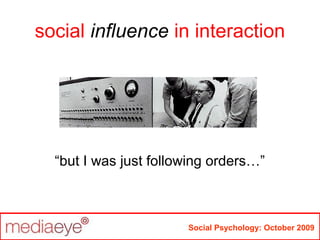
“but I was just following orders…”
social influence in interaction
overview
• what is social psychology?
• why investigate obedience?
• “I was just following orders…”
• how far would you go?
• testing obediece: The Milgram Scenario
• results
• conclusion
• recap
Social Psychology: October 2009
what is social psychology?
“B=f(P,E)”
(K. Lewin, 1951)
Social Psychology: October 2009
The scientific study of how people's thoughts, feelings and
behaviours are influenced by the actual, imagined, or implied
presence of others.
what is social psychology?
• Social psychology is the scientific study of
how people's thoughts feelings and
behaviours are influenced by the actual,
imagined, or implied presence of others
Q.what are 3 social influences that you can
identify?
Social Psychology: October 2009
social influence in interaction
• a major area of Social Psychology is social
influence in interaction
• social influence in interaction investigates and
explores the range and effects of social pressures
on our attitudes, beliefs and behaviour
• obedience and conformity are important areas of
research and investigation
Social Psychology: October 2009
“but I was just following orders…”
• ‘A Report on The Banality of Evil’
• “in certain circumstances, the most ordinary
decent person can become a criminal”
Hannah Arendt, 1963
• contemporary examples
• how far would you go?
Social Psychology: October 2009
Q. are ordinary people willing to obey authority
in violation of their own conscience?
A. The Milgram Scenario (1963,1965 & 1974)
Social Psychology: October 2009
testing obedience
testing obedience
Social Psychology: October 2009
testing obedience
Social Psychology: October 2009
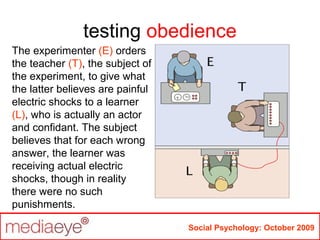
The experimenter (E) orders
the teacher (T), the subject of
the experiment, to give what
the latter believes are painful
electric shocks to a learner
(L), who is actually an actor
and confidant. The subject
believes that for each wrong
answer, the learner was
receiving actual electric
shocks, though in reality
there were no such
punishments.
testing obedience: results
• In Milgram's first set of experiments, 65% (26 of 40) of
experiment participants administered the experiment's
final massive 450-volt shock, though many were very
uncomfortable doing so;
• at some point, every participant paused and questioned
the experiment, some said they would refund the money
they were paid for participating in the experiment.
• Only one participant steadfastly refused to administer
shocks below the 300-volt level.
Social Psychology: October 2009
testing obedience: conclusion
“Ordinary people, simply doing their jobs, and
without any particular hostility on their part, can
become agents in a terrible destructive process…
Social Psychology: October 2009
testing obedience: conclusion
Moreover, even when the destructive effects of
their work become patently clear, and they are
asked to carry out actions incompatible with
fundamental standards of morality, relatively few
people have the resources needed to resist
authority.”
Stanley Milgram, “The Perils of Obedience”, 1974
Social Psychology: October 2009
Social Psycholgy: obedience
Social Psychology: October 2009
“The power of authorities is demonstrated not only in the
extent to which they can command obedience from
followers, but also in the extent to which they can define
reality and alter habitual ways of thinking and acting.”
Phillip Zimbardo, The Lucifer Effect (2007)
social influence in interaction
Social Psychology: October 2009
THANKYOU
“but I was just following orders…”

"but I was just following orders..."

  • 1.
    Social Psychology: October2009 “but I was just following orders…” social influence in interaction
  • 2.
    overview • what issocial psychology? • why investigate obedience? • “I was just following orders…” • how far would you go? • testing obediece: The Milgram Scenario • results • conclusion • recap Social Psychology: October 2009
  • 3.
    what is socialpsychology? “B=f(P,E)” (K. Lewin, 1951) Social Psychology: October 2009 The scientific study of how people's thoughts, feelings and behaviours are influenced by the actual, imagined, or implied presence of others.
  • 4.
    what is socialpsychology? • Social psychology is the scientific study of how people's thoughts feelings and behaviours are influenced by the actual, imagined, or implied presence of others Q.what are 3 social influences that you can identify? Social Psychology: October 2009
  • 5.
    social influence ininteraction • a major area of Social Psychology is social influence in interaction • social influence in interaction investigates and explores the range and effects of social pressures on our attitudes, beliefs and behaviour • obedience and conformity are important areas of research and investigation Social Psychology: October 2009
  • 6.
    “but I wasjust following orders…” • ‘A Report on The Banality of Evil’ • “in certain circumstances, the most ordinary decent person can become a criminal” Hannah Arendt, 1963 • contemporary examples • how far would you go? Social Psychology: October 2009
  • 7.
    Q. are ordinarypeople willing to obey authority in violation of their own conscience? A. The Milgram Scenario (1963,1965 & 1974) Social Psychology: October 2009 testing obedience
  • 8.
  • 9.
    testing obedience Social Psychology:October 2009 The experimenter (E) orders the teacher (T), the subject of the experiment, to give what the latter believes are painful electric shocks to a learner (L), who is actually an actor and confidant. The subject believes that for each wrong answer, the learner was receiving actual electric shocks, though in reality there were no such punishments.
  • 10.
    testing obedience: results •In Milgram's first set of experiments, 65% (26 of 40) of experiment participants administered the experiment's final massive 450-volt shock, though many were very uncomfortable doing so; • at some point, every participant paused and questioned the experiment, some said they would refund the money they were paid for participating in the experiment. • Only one participant steadfastly refused to administer shocks below the 300-volt level. Social Psychology: October 2009
  • 11.
    testing obedience: conclusion “Ordinarypeople, simply doing their jobs, and without any particular hostility on their part, can become agents in a terrible destructive process… Social Psychology: October 2009
  • 12.
    testing obedience: conclusion Moreover,even when the destructive effects of their work become patently clear, and they are asked to carry out actions incompatible with fundamental standards of morality, relatively few people have the resources needed to resist authority.” Stanley Milgram, “The Perils of Obedience”, 1974 Social Psychology: October 2009
  • 13.
    Social Psycholgy: obedience SocialPsychology: October 2009 “The power of authorities is demonstrated not only in the extent to which they can command obedience from followers, but also in the extent to which they can define reality and alter habitual ways of thinking and acting.” Phillip Zimbardo, The Lucifer Effect (2007)
  • 14.
    social influence ininteraction Social Psychology: October 2009 THANKYOU “but I was just following orders…”