Theft
Overview
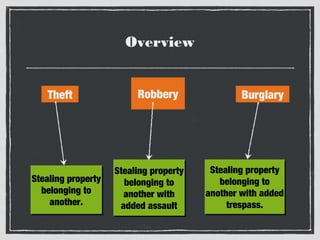
Theft

Stealing property
Stealing property
belonging to
belonging to
another.
another.

Robbery

Stealing property
Stealing property
belonging to
belonging to
another with
another with
added assault
added assault

Burglary

Stealing property
Stealing property
belonging to
belonging to
another with added
another with added
trespass.
trespass.
Overview

We are in a position to understand actus reus and
mens rea.
We are in a position to apportion blame to secondary
parties and attempts.
Now it's time to look at some specific offences.
Session Objectives

By the end of the session, all learners will:
1) Be able to apply the law on theft to a problem
question.
Definition

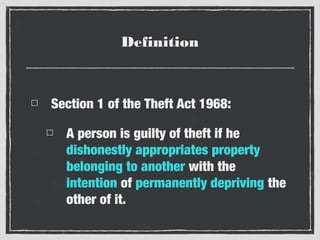
Section 1 of the Theft Act 1968:
A person is guilty of theft if he
dishonestly appropriates property
belonging to another with the
intention of permanently depriving the
other of it.
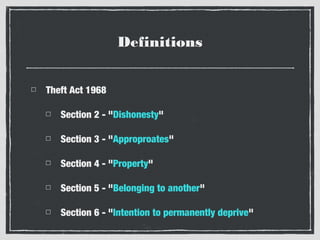
Definitions
Theft Act 1968
Section 2 - "Dishonesty"
Section 3 - "Approproates"
Section 4 - "Property"
Section 5 - "Belonging to another"
Section 6 - "Intention to permanently deprive"
Actus Reus & Mens Rea
Mens
rea

Actus
reus

Dishonestly (s 2)

Appropriation (S 3)
Theft

With intention of
permanently
depriving (s 6)

Property (s 4)
Belonging to
another (s 5)
Appropriation

S 3(1): Any assumption of the rights of the owner.
Includes taking the property innocently, realising that
it belongs to another, and then deciding to deal with it
as the owner.
Appropriation
R v Morris (1983):
D swapped the price labels in a supermarket.
He put the item into a basket and took it to the
checkout
Arrested before he went through the checkout and
convicted of theft.
The House of Lords upheld his conviction.
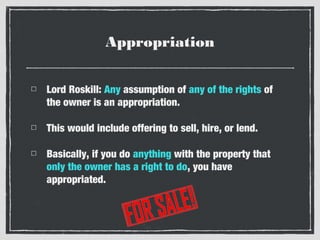
Appropriation
Lord Roskill: Any assumption of any of the rights of
the owner is an appropriation.
This would include offering to sell, hire, or lend.
Basically, if you do anything with the property that
only the owner has a right to do, you have
appropriated.
Appropriation
Pitham v Hehl (1977)
D offered for sale furniture belonging to another
person.
As soon as he offered to sell it, he was guilty of
theft.
Only the owner has the right to offer to sell the
property, so there was an appropriation.
Appropriation

Can there be a theft where V consents to D taking her
property?
Example: I give you a brand new iPad as a gift. Have
you "appropriated" the property?
Appropriation
R v Hinks (2000):
D befriended a vulnerable man of low intelligence.
He withdrew £60,000 for her and gave her his TV
set.
House of Lords upheld her conviction for theft.
There can be an appropriation even if V genuinely
consents.
Appropriation - Summary
D Ormerod:
"Anyone doing anything whatever to property
belonging to another, with or without his consent,
appropriates it..."
Property
Section 4(1):
Money
Real property
Personal property
Things in action
Other intangible property
Real Property
Legal term for land and buildings.
It is an offence to steal turf from someone's garden.
If you are a tennant (renting) you are guilty of theft if
you steal lamp shades etc.
Things in Action
These are rights possessed by a person.
A bank account is a thing in action: The bank doesn't
hold all your notes and coins in a vault with your
name on it.
You have a right to withdraw a certain amount from
your bank.
Belonging to Another

Section 5(1):
Anyone who has possession or control over
property.
Anyone who owns it.
If D steals a handbag, and when he is running away, E
steals it from D, both D AND E are guilty of theft.
Belonging to Another

Is it possible to thieve your own
property?
Belonging to Another
R v Turner (No 2) (1971):
D left his car at a garage for repairs.
Once the repairs were completed, the garage left the
car parked on the road.
D drove his car away.
Court of Appeal: D was guilty of theft. The garage had
control over the car.
Mens Rea - Dishonesty
Section 2(1) says when a person is not dishonest:
a) He believes he has a legal right to deprive the
other of it.
b) He believes that the other would consent if she
knew.
He appropriates it in the belief that the owner
cannot be traced using reasonable steps.
Dishonesty
R v Ghosh (1982)
1) Was he dishonest according to the ordinary
standards of reasonable and honest people?
2) Did the defendant personally realise that what
he was doing was dishonest by those standards?
Robin Hood Question

Robin Hood's job is to steal from the rich and give to
the poor. One day, he is arrested for stealing Alan
Sugar's wallet. He is charged with theft.
In court, he argues that he was not dishonest. He
genuinely believed that giving Alan's money to the
homeless was the honest thing to do.
Is he guilty of theft?
Intention to Permanently
Deprive
Section 6(1):
There must be an intention to treat the thing as
your own and dispose of it regardless of the
owner's rights.
Intention to Permanently
Deprive
DPP v Lavender (1994)
D took a door from a council house and put it on
his girlfriend's council house.
Court said that "disposal" includes "dealing with
the property as if it's your own".
Guilty of theft.
Intention to Permanently
Deprive
R v Lloyd (1985)
D took a film from the cinema so that he could make
an illegal copy.
D returned the film in time for the next screening: he
had only borrowed it.
Borrowing is not theft unless the intention is to return
the thing with all the goodness and virtue taken from
it.
Summary
Dishonesty - Ghosh test: objective and subjective.
Appropriation - doing anything with someone else's
property.
Property - Whether you can touch it or intangible.
Belonging to another - possession, control, or ownership
Intention to permanently deprive - Deal with as if you own
it. Remove all value from it before returning it.

Theft

  • 1.
  • 2.
    Overview Theft Stealing property Stealing property belongingto belonging to another. another. Robbery Stealing property Stealing property belonging to belonging to another with another with added assault added assault Burglary Stealing property Stealing property belonging to belonging to another with added another with added trespass. trespass.
  • 3.
    Overview We are ina position to understand actus reus and mens rea. We are in a position to apportion blame to secondary parties and attempts. Now it's time to look at some specific offences.
  • 4.
    Session Objectives By theend of the session, all learners will: 1) Be able to apply the law on theft to a problem question.
  • 5.
    Definition Section 1 ofthe Theft Act 1968: A person is guilty of theft if he dishonestly appropriates property belonging to another with the intention of permanently depriving the other of it.
  • 6.
    Definitions Theft Act 1968 Section2 - "Dishonesty" Section 3 - "Approproates" Section 4 - "Property" Section 5 - "Belonging to another" Section 6 - "Intention to permanently deprive"
  • 7.
    Actus Reus &Mens Rea Mens rea Actus reus Dishonestly (s 2) Appropriation (S 3) Theft With intention of permanently depriving (s 6) Property (s 4) Belonging to another (s 5)
  • 8.
    Appropriation S 3(1): Anyassumption of the rights of the owner. Includes taking the property innocently, realising that it belongs to another, and then deciding to deal with it as the owner.
  • 9.
    Appropriation R v Morris(1983): D swapped the price labels in a supermarket. He put the item into a basket and took it to the checkout Arrested before he went through the checkout and convicted of theft. The House of Lords upheld his conviction.
  • 10.
    Appropriation Lord Roskill: Anyassumption of any of the rights of the owner is an appropriation. This would include offering to sell, hire, or lend. Basically, if you do anything with the property that only the owner has a right to do, you have appropriated.
  • 11.
    Appropriation Pitham v Hehl(1977) D offered for sale furniture belonging to another person. As soon as he offered to sell it, he was guilty of theft. Only the owner has the right to offer to sell the property, so there was an appropriation.
  • 12.
    Appropriation Can there bea theft where V consents to D taking her property? Example: I give you a brand new iPad as a gift. Have you "appropriated" the property?
  • 13.
    Appropriation R v Hinks(2000): D befriended a vulnerable man of low intelligence. He withdrew £60,000 for her and gave her his TV set. House of Lords upheld her conviction for theft. There can be an appropriation even if V genuinely consents.
  • 14.
    Appropriation - Summary DOrmerod: "Anyone doing anything whatever to property belonging to another, with or without his consent, appropriates it..."
  • 15.
    Property Section 4(1): Money Real property Personalproperty Things in action Other intangible property
  • 16.
    Real Property Legal termfor land and buildings. It is an offence to steal turf from someone's garden. If you are a tennant (renting) you are guilty of theft if you steal lamp shades etc.
  • 17.
    Things in Action Theseare rights possessed by a person. A bank account is a thing in action: The bank doesn't hold all your notes and coins in a vault with your name on it. You have a right to withdraw a certain amount from your bank.
  • 18.
    Belonging to Another Section5(1): Anyone who has possession or control over property. Anyone who owns it. If D steals a handbag, and when he is running away, E steals it from D, both D AND E are guilty of theft.
  • 19.
    Belonging to Another Isit possible to thieve your own property?
  • 20.
    Belonging to Another Rv Turner (No 2) (1971): D left his car at a garage for repairs. Once the repairs were completed, the garage left the car parked on the road. D drove his car away. Court of Appeal: D was guilty of theft. The garage had control over the car.
  • 21.
    Mens Rea -Dishonesty Section 2(1) says when a person is not dishonest: a) He believes he has a legal right to deprive the other of it. b) He believes that the other would consent if she knew. He appropriates it in the belief that the owner cannot be traced using reasonable steps.
  • 22.
    Dishonesty R v Ghosh(1982) 1) Was he dishonest according to the ordinary standards of reasonable and honest people? 2) Did the defendant personally realise that what he was doing was dishonest by those standards?
  • 23.
    Robin Hood Question RobinHood's job is to steal from the rich and give to the poor. One day, he is arrested for stealing Alan Sugar's wallet. He is charged with theft. In court, he argues that he was not dishonest. He genuinely believed that giving Alan's money to the homeless was the honest thing to do. Is he guilty of theft?
  • 24.
    Intention to Permanently Deprive Section6(1): There must be an intention to treat the thing as your own and dispose of it regardless of the owner's rights.
  • 25.
    Intention to Permanently Deprive DPPv Lavender (1994) D took a door from a council house and put it on his girlfriend's council house. Court said that "disposal" includes "dealing with the property as if it's your own". Guilty of theft.
  • 26.
    Intention to Permanently Deprive Rv Lloyd (1985) D took a film from the cinema so that he could make an illegal copy. D returned the film in time for the next screening: he had only borrowed it. Borrowing is not theft unless the intention is to return the thing with all the goodness and virtue taken from it.
  • 27.
    Summary Dishonesty - Ghoshtest: objective and subjective. Appropriation - doing anything with someone else's property. Property - Whether you can touch it or intangible. Belonging to another - possession, control, or ownership Intention to permanently deprive - Deal with as if you own it. Remove all value from it before returning it.