CRIMINAL LAW:
OFFENCES AGAINST
PROPERTY
Lecture 9
Foundation Law 2013/14
Recap-Lecture 8: Offences Against the
Person (2)-Non Fatal Offences:
• Non- fatal offences against the person- what is a non fatal
offence?
• Common Assault
• Battery
• Assault occasioning actual bodily harm (“ABH”)
• Assault occasioning grievous bodily harm (“GBH”)
Common Assault
• R v Ireland (1997): common assault is an offence that is committed when
the D intentionally or recklessly, causes another person to believe that he
will suffer immediate unlawful violence
• Does actual force need to be inflicted on the victim?
• R v Ireland (1997): common assault does not involve the actual
application of force, nor any physical contact with the victim
• Actus reus of common assault: when the D does any act which causes
the victim to believe that unlawful violence is about to be inflicted
• Mens rea of common assault: the intention to cause another to fear the
immediate unlawful violence or recklessness to cause such fear (R v
Venna (1976))
Battery
• Battery is the application, intentionally or recklessly, of unlawful force on
another person
• Actus reus of battery: the actual use of force against the victim
• The force must be unlawful (Collins v Wilcock (1984))
• Mens rea of battery: an intention to apply unlawful physical force or
recklessness as to whether unlawful force has been applied
• Remember……unless the offence is one of strict liability, BOTH the actus
reus and the mens rea needs to be present
Assault Occasioning Actual Bodily
Harm (“ABH”)
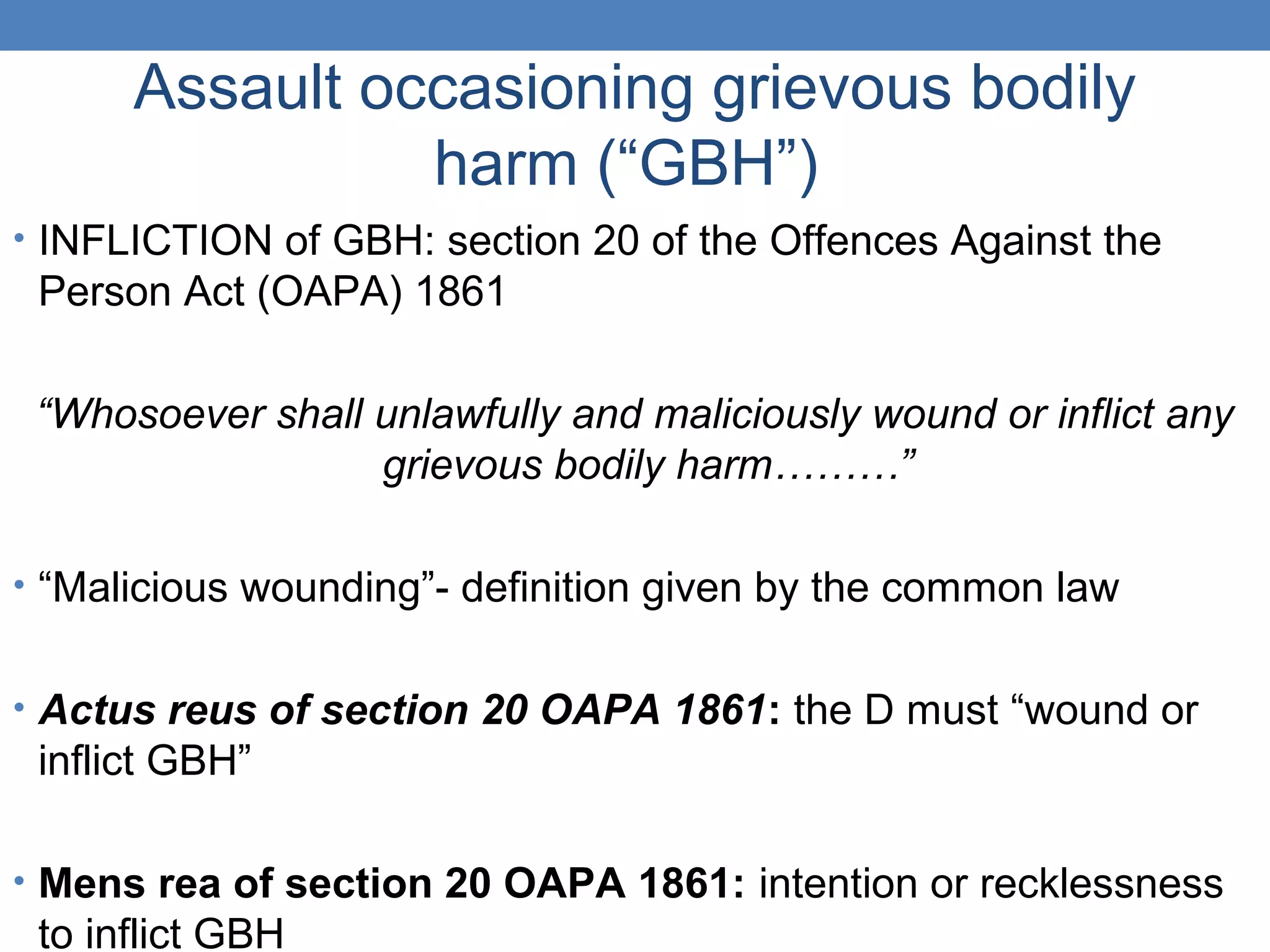
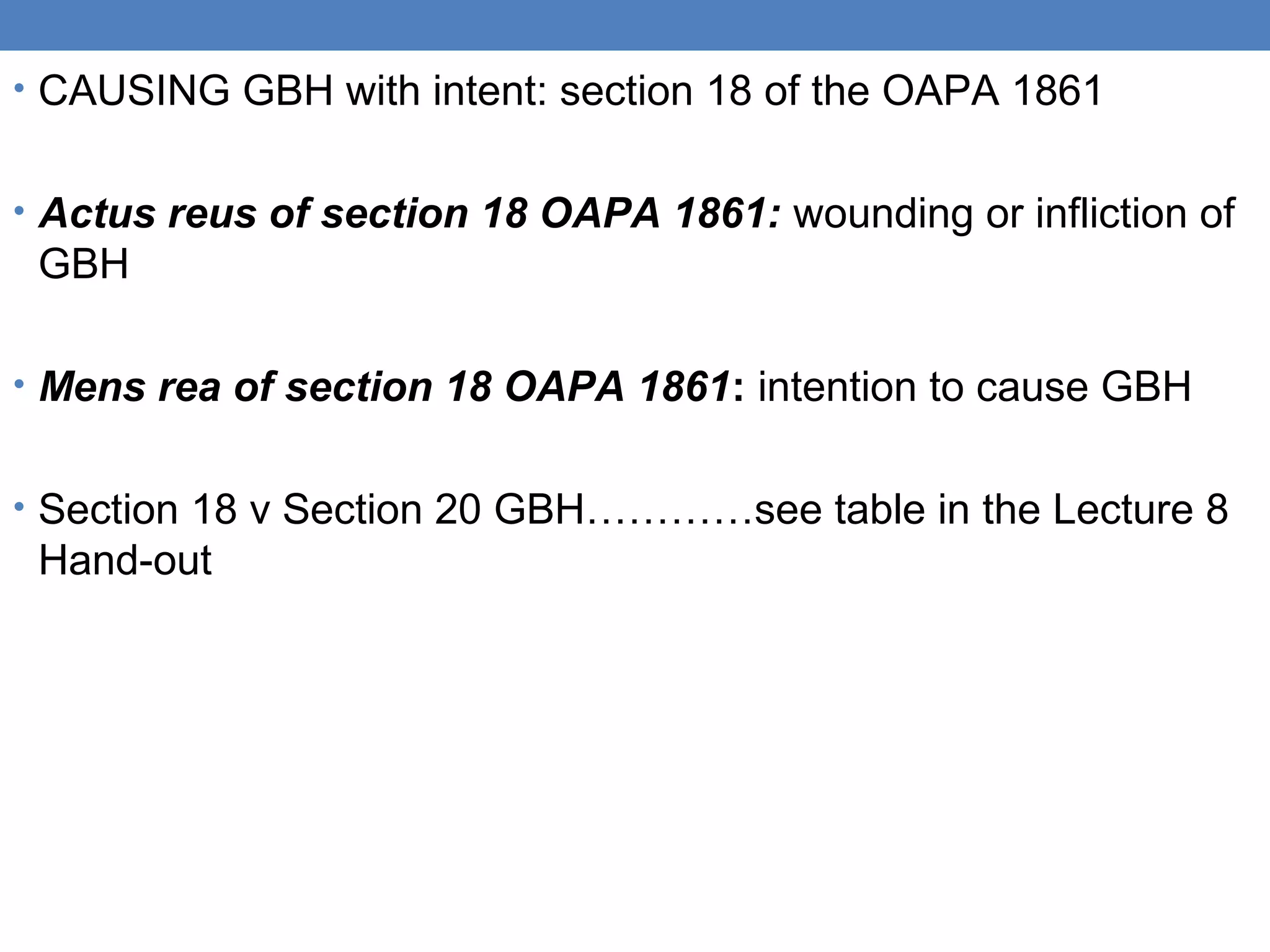
• Assault occasioning actual bodily harm is an assault or battery
which causes actual bodily harm
• To “occasion” means to cause
• Actus reus & mens rea of assault occasioning ABH: is that of
common assault or battery
• AR of common assault: intentionally or recklessly causing the
victim to fear immediate and unlawful violence
• MR of common assault: intention or recklessness to cause fear
of immediate unlawful violence
• AR of battery: application, intentionally or recklessly of unlawful
force
• MR of battery: intention or recklessness to apply unlawful
physical force
Assault occasioning grievous bodily
harm (“GBH”)
• INFLICTION of GBH: section 20 of the Offences Against the
Person Act (OAPA) 1861
“Whosoever shall unlawfully and maliciously wound or inflict any
grievous bodily harm………”
• “Malicious wounding”- definition given by the common law
• Actus reus of section 20 OAPA 1861: the D must “wound or
inflict GBH”
• Mens rea of section 20 OAPA 1861: intention or recklessness
to inflict GBH
• CAUSING GBH with intent: section 18 of the OAPA 1861
• Actus reus of section 18 OAPA 1861: wounding or infliction of
GBH
• Mens rea of section 18 OAPA 1861: intention to cause GBH
• Section 18 v Section 20 GBH…………see table in the Lecture 8
Hand-out
This week………….
• We will be examining offences against PROPERTY
Learning Outcomes:
• Define and distinguish between theft, robbery and
burglary
• Outline the mens rea and actus reus of theft
• Define and distinguish between criminal damage and
arson
• Apply legal principles to given facts and demonstrate
criticality & analysis when answering fact based
questions; and
• Analyse case law and be able to apply case law in a
persuasive manner to hypothetical case studies.
Theft
•Theft is a triable either way offence, which carries a maximum of
7 years’ imprisonment
•Section 1 of the Theft Act 1968 defines theft as follows:
“a person is guilty of theft if he dishonestly appropriates property
belonging to another with the intention of permanently depriving
the other of it”.
•The actus reus of theft is the “appropriation of property
belonging to another” and the mens rea is the “dishonesty” and
“intention to permanently deprive the other”.
Actus Reus of Theft
• The actus reus of theft is the appropriation of property belonging
to another
• Appropriation, loosely translated, means to “take”
• Section 3 of the Theft Act 1968 states that appropriation is “any
assumption of the rights of an owner”
For each of the examples below, identify at what point
appropriation of property has taken place:
Tom goes into his local Tesco’s store and puts a bar of Kit Kat
in his jacket
Ben puts numerous items of grocery into his shopping trolley at
Waitrose
Marc takes Natasha’s iPhone without her knowledge from her
desk and makes numerous phone calls to his girlfriend.
Although the phone is returned to her desk, Natasha receives a
bill for £100 for the calls he made!
Ulfat uses the socket in the LRC to charge his phone
Appropriation of PROPERTY
• The item taken must be property which can be stolen. Electricity
therefore, for the purposes of the definition of theft, is not
considered to be property and there is a separate offence of
dishonestly using electricity
• Oxford v Moss (1979): knowledge is also not considered to be
“property”
Property must BELONG TO ANOTHER
• The property must belong to another
• R v Turner (No 2) (1971): it is possible for the legal owner of the
property to be charged with stealing with his or her own property
if it was in the control of another person who had a legal right to
it
Mens Rea of Theft
• The mens rea of theft is dishonesty and intention to permanently
deprive.
• Dishonesty: this is not defined under the Theft Act 1968 but
section 2 of the Act provides three situations whereby a person’s
act will not be regarded as dishonest. These are:
• If he believes that he has in law the right to deprive the other of the property
• If he believes that the other person would consent to the appropriation if he knew
of the circumstances
• If he believes he cannot discover who the owner is by taking reasonable steps
R v Ghosh (1982): Two stage test for
dishonesty
1. Was what the defendant had done dishonest by the ordinary
standards of reasonable people? (the “reasonable man test”);
and
2. Did the defendant realise that what he was doing was
dishonest by those standards?
 According to the Court of Appeal, if the answer to both those
questions is “yes”, than the defendant has acted dishonestly
Mens Rea of Theft-intention to permanently
deprive
•Theft is only proved if the person appropriating the property not
only was being dishonest but also intended to permanently
deprive the other person of the property
•R v Lloyd (1985): borrowing an item from its owner, is not
considered as theft. However, if the property is kept until it has
little or no value left, then it could be considered as theft
Five elements of Theft
• Dishonest (mens rea)
• Appropriation (actus reus)
• Property (actus reus)
• Belonging to another (actus reus); and
• Intention of permanent deprivation (mens rea)
Remember……….
• Unless the offence is one of strict liability, BOTH the actus reus
and the mens rea of the offence must be established
Case Study:
At the office Christmas party, Vivienne notices that Sara has left
her Tiffany’s wedding ring in the ladies’ restroom. Vivienne takes
the ring and keeps it in her handbag, so that she can give it back
to Sara the following morning.
• Has Vivienne committed the act of theft?
• Would your answer be different if Vivienne decided to keep
the ring?
Robbery
• Section 8 of the Theft Act 1968 defines robbery as:
“A person is guilty of robbery if he steals, and immediately before or at
the time of doing so, and in order to do so, he uses force on any
person or puts or seeks to put any person in fear of being then and
there subjected to force”
• Robbery = theft + force
• It is the element of force (against the person) that distinguishes
robbery from theft (and from burglary). Therefore, the actus reus and
mens rea of theft must be established PLUS the use of force
• Robbery is an indictable offence and can only be tried in the Crown
Court. The offence carries a maximum sentence of life imprisonment
Actus Reus of Robbery
Theft
To be found guilty of robbery, the prosecution must first prove that all
the elements of theft are satisfied: dishonest appropriation of property
belonging to another with an intention to permanently deprive the
other of it
Force
In addition to the requirement of theft, the prosecution must also
prove that the defendant used force:
1. Immediately before or at the time of the theft; and
2. The threat/force was used in order to steal from the victim
R v Hale (1979)
Burglary
• Burglary is an offence under section 9 of the Theft Act 1968
• There are two subsections, section 9 (1) (a) and section 9 (1) (b) which
set out different ways of committing burglary
**See Hand-out**
• The key difference between the two sections is that for an offence
under section 9 (1) (a), the defendant must have the INTENTION of
doing any of the three things outlined above, although he may not
actually do any of them (Walkington (1979))
• Whereas under section 9(1) (b), the defendant must do more than
enter the building as a trespasser; he must steal or inflict grievous
bodily harm or attempt to do one of these
Burglary
• Burglary is a triable either way offence unless it involves the
intention to inflict grievous bodily harm, in which case it will be
tried in the Crown Court.
• If the burglary occurs in a residential building, the defendant can
receive a maximum sentence of 14 years imprisonment.
• If the burglary occurs in a business, the judge can impose a
maximum sentence of 10 years imprisonment.
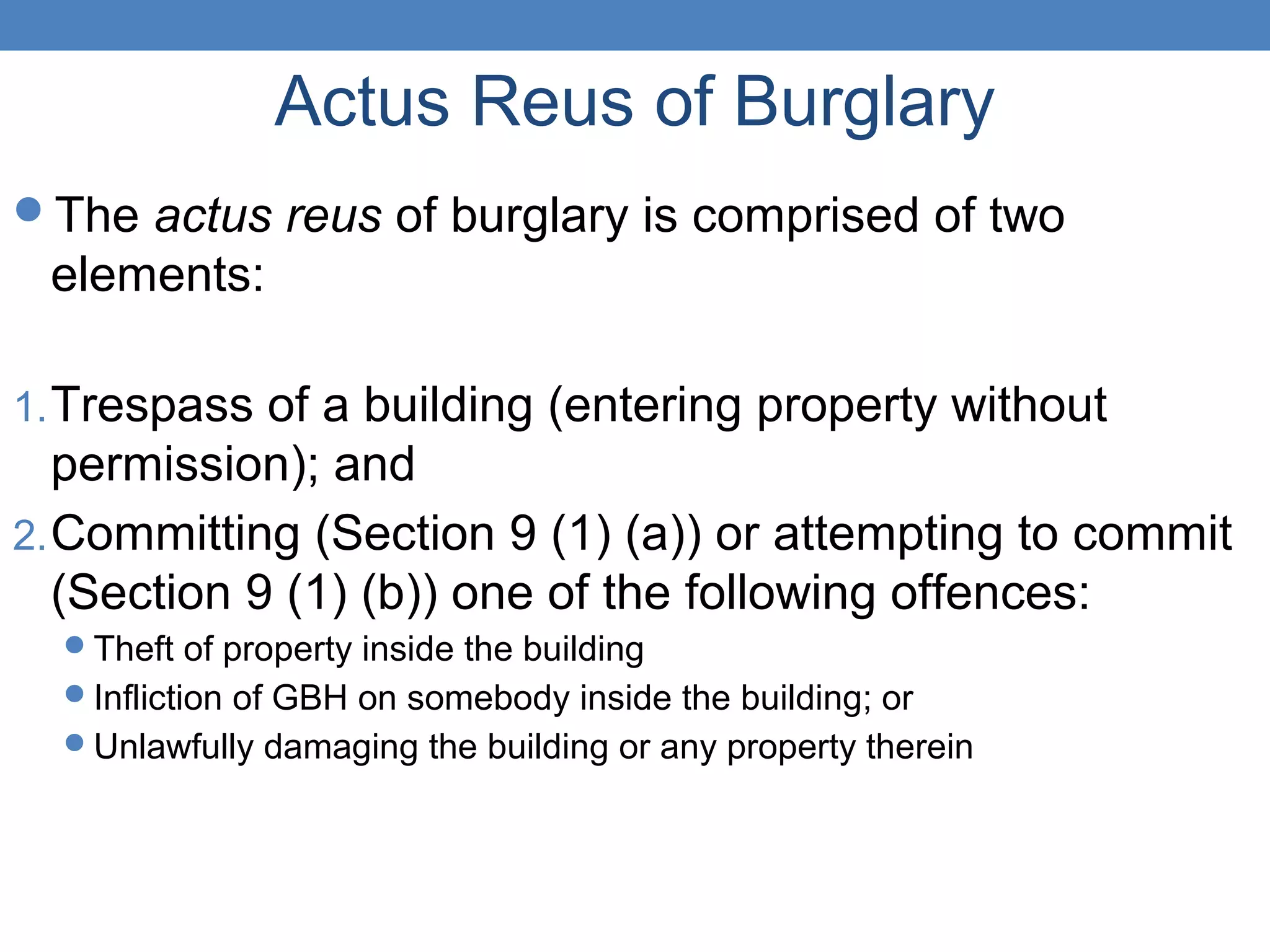
Actus Reus of Burglary
The actus reus of burglary is comprised of two
elements:
1.Trespass of a building (entering property without
permission); and
2.Committing (Section 9 (1) (a)) or attempting to commit
(Section 9 (1) (b)) one of the following offences:
Theft of property inside the building
Infliction of GBH on somebody inside the building; or
Unlawfully damaging the building or any property therein
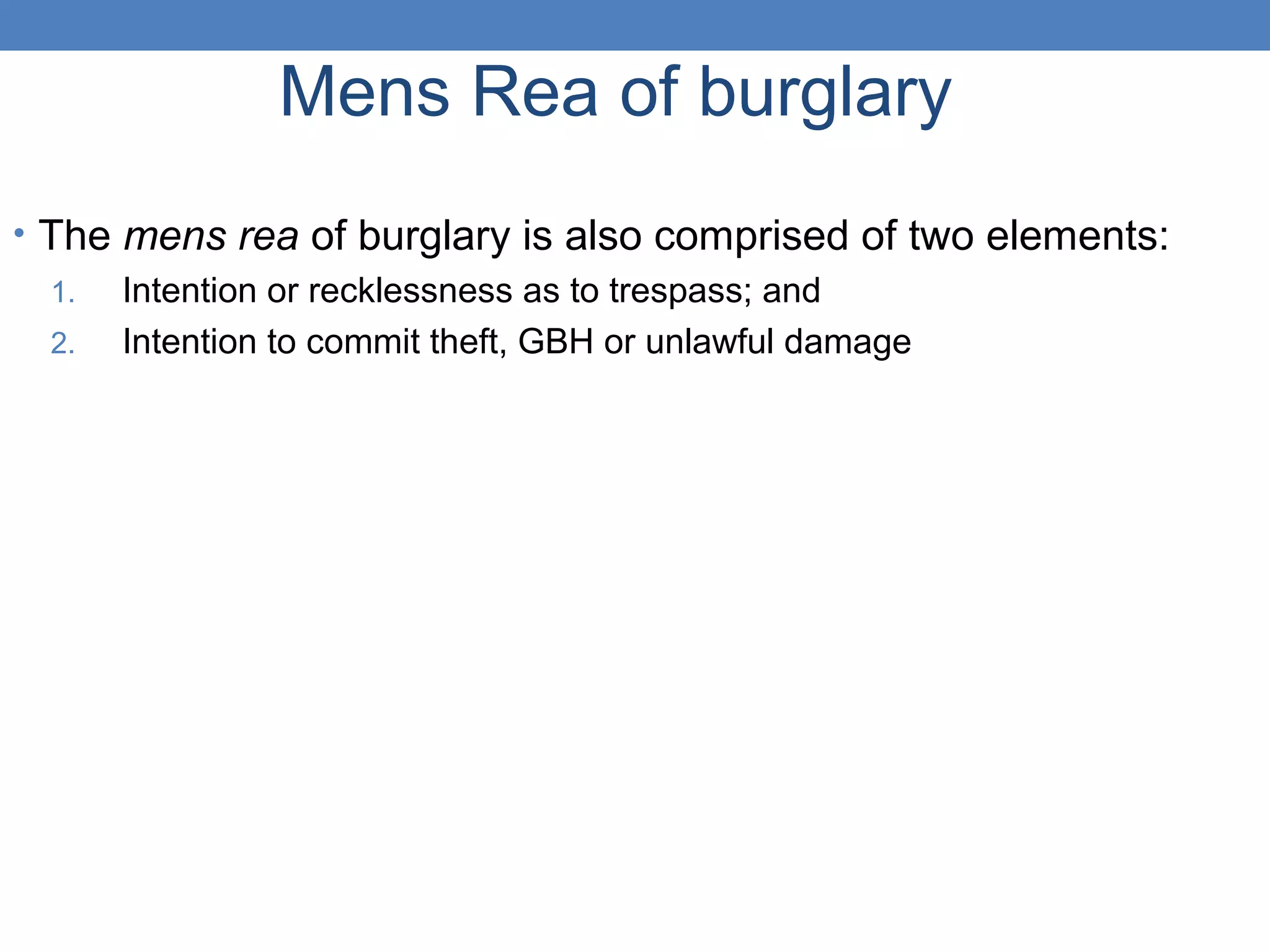
Mens Rea of burglary
• The mens rea of burglary is also comprised of two elements:
1. Intention or recklessness as to trespass; and
2. Intention to commit theft, GBH or unlawful damage
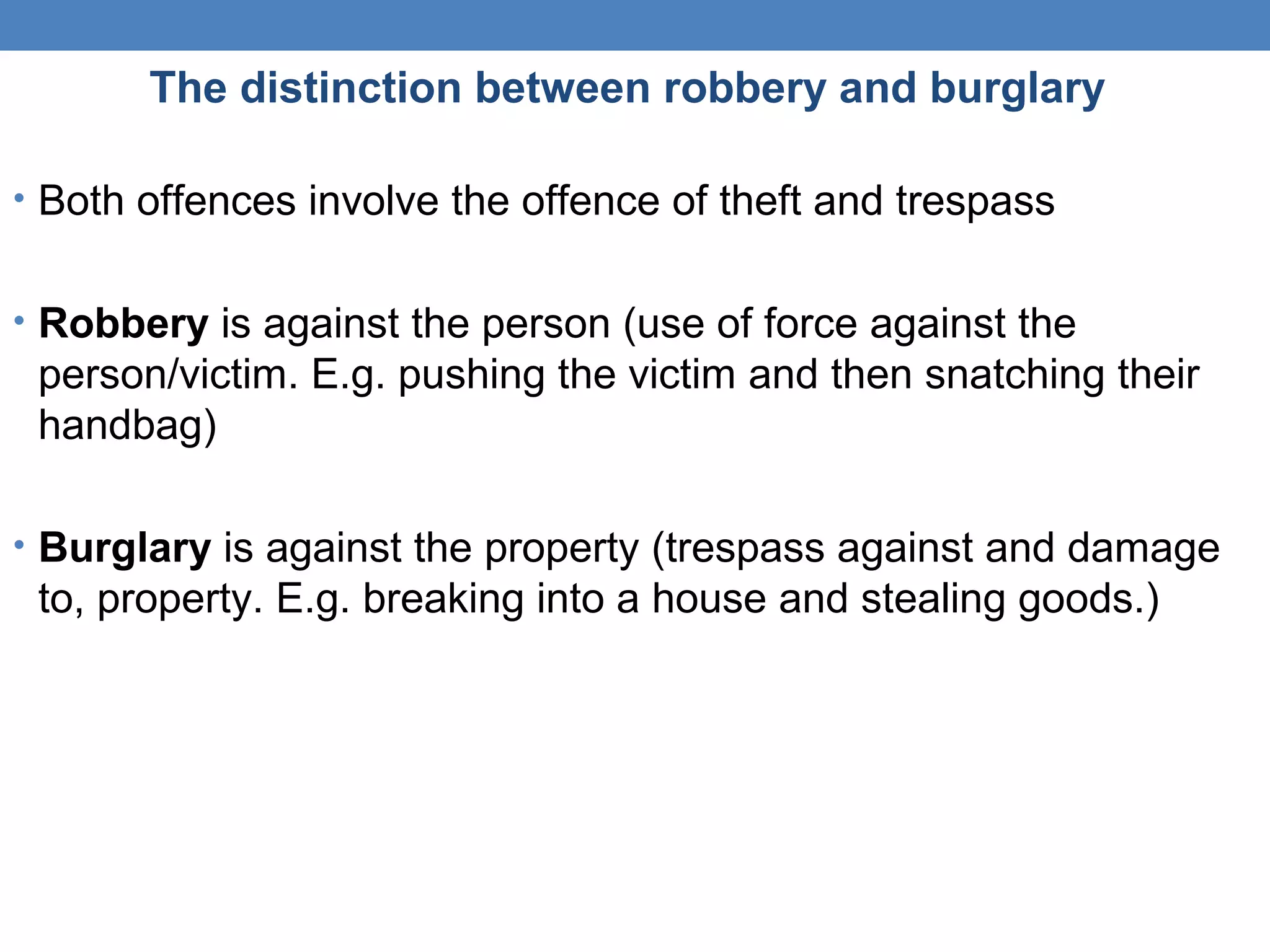
The distinction between robbery and burglary
• Both offences involve the offence of theft and trespass
• Robbery is against the person (use of force against the
person/victim. E.g. pushing the victim and then snatching their
handbag)
• Burglary is against the property (trespass against and damage
to, property. E.g. breaking into a house and stealing goods.)
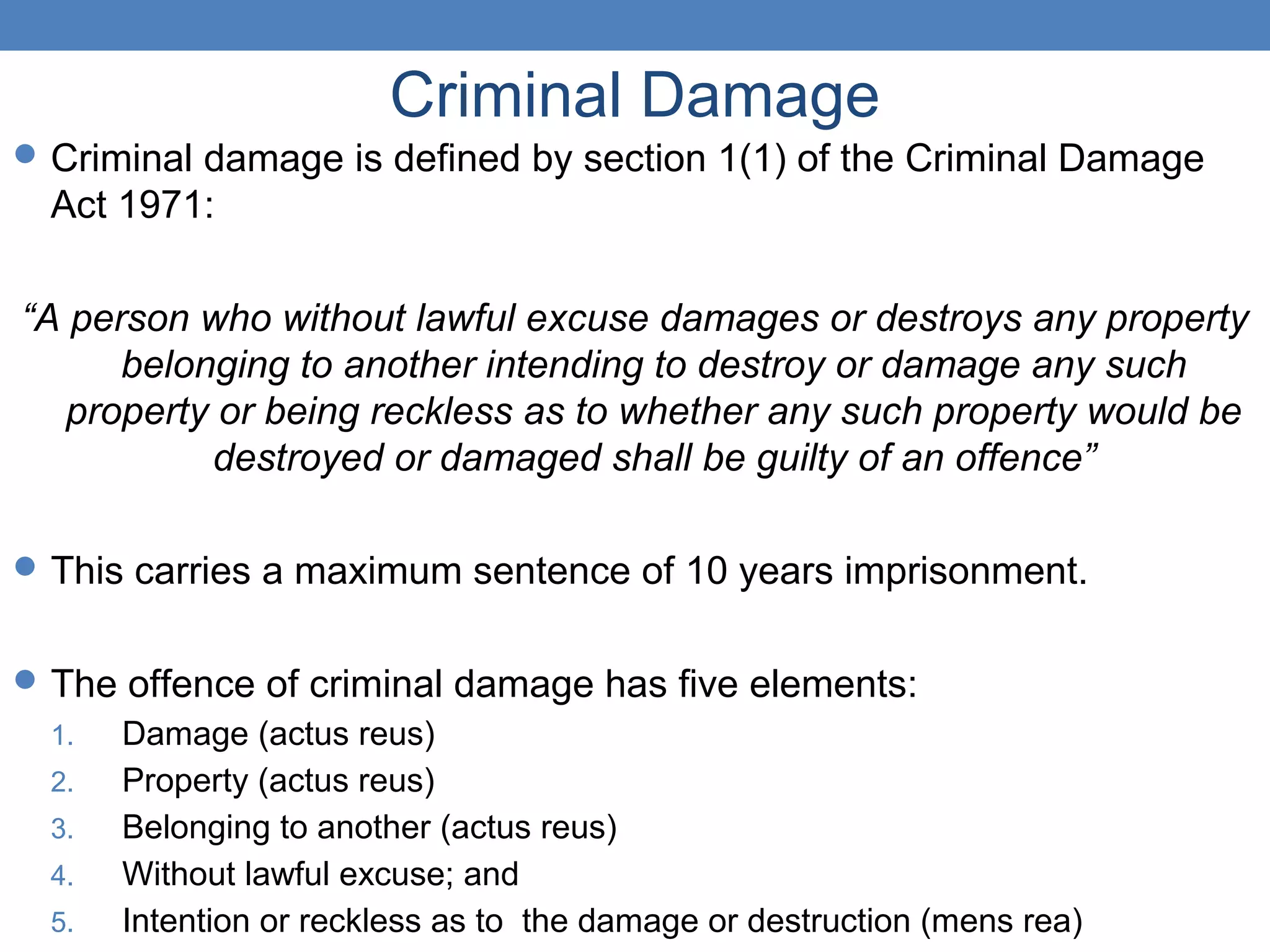
Criminal Damage
Criminal damage is defined by section 1(1) of the Criminal Damage
Act 1971:
“A person who without lawful excuse damages or destroys any property
belonging to another intending to destroy or damage any such
property or being reckless as to whether any such property would be
destroyed or damaged shall be guilty of an offence”
This carries a maximum sentence of 10 years imprisonment.
The offence of criminal damage has five elements:
1. Damage (actus reus)
2. Property (actus reus)
3. Belonging to another (actus reus)
4. Without lawful excuse; and
5. Intention or reckless as to the damage or destruction (mens rea)
Arson
• Section 1(3) of the Criminal Damage Act 1971 states that arson
is:
“Any offence committed....by destroying or damaging property by
fire”
• The difference therefore between arson and criminal damage is
that the damage or destruction must be caused by fire (actus
reus). The mens rea requires the defendant to intend or be
reckless as to damage or destruction by fire
Seminars this week………
• Additional seminars covering Lecture 9- Offences Against
Property
• FHLC: Friday 6th
December 9.30am-11.30am (Room 3.14)
• FHLA & FHLB: Friday 6th
December 4.30pm-6.30pm (Room
2.07)
End of Term (EOT) Exam
• Exam Timetable-will be published this week
• 1.5 hours
• Format of the exam and style of questions similar to the Formative
Test
• Two Sections-Section A & Section B
• Section A- short answer questions (50 marks): there will be 14
Questions- you must answer ALL questions in this section
• Section B- long answer questions (50 marks): two questions (one
essay style and one case study)- you must answer only ONE
question in this section
Law- EOT Exam
• Only the topics studied this term are examinable!
• Revision Tips:
• Practice! Go over the seminar questions and draft answers
under timed conditions/ without notes; Quizzes (available on
Moodle)- including a Revision Quiz
• Term 1 Topics:
The English Legal System
Criminal Law
The English Legal System
• Examination of public and private (civil) law
• The English legal system and the sources of law
• Doctrine of judicial precedent
• The separation of powers; parliament and the law making process; doctrine of
parliamentary supremacy
• Hierarchy of the courts
• The criminal courts- magistrates’ court and the crown court; sentencing powers; aims
of sentencing
• Trial by jury (group presentations)
• The civil courts- the High Court of Justice and the County Courts
• Courts v tribunals
Criminal Law
• Elements of an offence- the actus reus and the mens rea
• Offences Against the Person (1): Fatal Offences- murder &
manslaughter
• Offences Against the Person (2): Non-Fatal Offences- common
assault, battery, assault occasioning ABH/GBH
• Offences Against Property: Theft- robbery & burglary, criminal
damage and arson
Good Luck
Merry Christmas &
Happy New Year!

Lecture 9 offences against property 1

  • 1.
  • 2.
    Recap-Lecture 8: OffencesAgainst the Person (2)-Non Fatal Offences: • Non- fatal offences against the person- what is a non fatal offence? • Common Assault • Battery • Assault occasioning actual bodily harm (“ABH”) • Assault occasioning grievous bodily harm (“GBH”)
  • 3.
    Common Assault • Rv Ireland (1997): common assault is an offence that is committed when the D intentionally or recklessly, causes another person to believe that he will suffer immediate unlawful violence • Does actual force need to be inflicted on the victim? • R v Ireland (1997): common assault does not involve the actual application of force, nor any physical contact with the victim • Actus reus of common assault: when the D does any act which causes the victim to believe that unlawful violence is about to be inflicted • Mens rea of common assault: the intention to cause another to fear the immediate unlawful violence or recklessness to cause such fear (R v Venna (1976))
  • 4.
    Battery • Battery isthe application, intentionally or recklessly, of unlawful force on another person • Actus reus of battery: the actual use of force against the victim • The force must be unlawful (Collins v Wilcock (1984)) • Mens rea of battery: an intention to apply unlawful physical force or recklessness as to whether unlawful force has been applied • Remember……unless the offence is one of strict liability, BOTH the actus reus and the mens rea needs to be present
  • 5.
    Assault Occasioning ActualBodily Harm (“ABH”) • Assault occasioning actual bodily harm is an assault or battery which causes actual bodily harm • To “occasion” means to cause
  • 6.
    • Actus reus& mens rea of assault occasioning ABH: is that of common assault or battery • AR of common assault: intentionally or recklessly causing the victim to fear immediate and unlawful violence • MR of common assault: intention or recklessness to cause fear of immediate unlawful violence • AR of battery: application, intentionally or recklessly of unlawful force • MR of battery: intention or recklessness to apply unlawful physical force
  • 7.
    Assault occasioning grievousbodily harm (“GBH”) • INFLICTION of GBH: section 20 of the Offences Against the Person Act (OAPA) 1861 “Whosoever shall unlawfully and maliciously wound or inflict any grievous bodily harm………” • “Malicious wounding”- definition given by the common law • Actus reus of section 20 OAPA 1861: the D must “wound or inflict GBH” • Mens rea of section 20 OAPA 1861: intention or recklessness to inflict GBH
  • 8.
    • CAUSING GBHwith intent: section 18 of the OAPA 1861 • Actus reus of section 18 OAPA 1861: wounding or infliction of GBH • Mens rea of section 18 OAPA 1861: intention to cause GBH • Section 18 v Section 20 GBH…………see table in the Lecture 8 Hand-out
  • 9.
    This week…………. • Wewill be examining offences against PROPERTY
  • 10.
    Learning Outcomes: • Defineand distinguish between theft, robbery and burglary • Outline the mens rea and actus reus of theft • Define and distinguish between criminal damage and arson • Apply legal principles to given facts and demonstrate criticality & analysis when answering fact based questions; and • Analyse case law and be able to apply case law in a persuasive manner to hypothetical case studies.
  • 11.
    Theft •Theft is atriable either way offence, which carries a maximum of 7 years’ imprisonment •Section 1 of the Theft Act 1968 defines theft as follows: “a person is guilty of theft if he dishonestly appropriates property belonging to another with the intention of permanently depriving the other of it”. •The actus reus of theft is the “appropriation of property belonging to another” and the mens rea is the “dishonesty” and “intention to permanently deprive the other”.
  • 12.
    Actus Reus ofTheft • The actus reus of theft is the appropriation of property belonging to another • Appropriation, loosely translated, means to “take” • Section 3 of the Theft Act 1968 states that appropriation is “any assumption of the rights of an owner”
  • 13.
    For each ofthe examples below, identify at what point appropriation of property has taken place: Tom goes into his local Tesco’s store and puts a bar of Kit Kat in his jacket Ben puts numerous items of grocery into his shopping trolley at Waitrose Marc takes Natasha’s iPhone without her knowledge from her desk and makes numerous phone calls to his girlfriend. Although the phone is returned to her desk, Natasha receives a bill for £100 for the calls he made! Ulfat uses the socket in the LRC to charge his phone
  • 14.
    Appropriation of PROPERTY •The item taken must be property which can be stolen. Electricity therefore, for the purposes of the definition of theft, is not considered to be property and there is a separate offence of dishonestly using electricity • Oxford v Moss (1979): knowledge is also not considered to be “property”
  • 15.
    Property must BELONGTO ANOTHER • The property must belong to another • R v Turner (No 2) (1971): it is possible for the legal owner of the property to be charged with stealing with his or her own property if it was in the control of another person who had a legal right to it
  • 16.
    Mens Rea ofTheft • The mens rea of theft is dishonesty and intention to permanently deprive. • Dishonesty: this is not defined under the Theft Act 1968 but section 2 of the Act provides three situations whereby a person’s act will not be regarded as dishonest. These are: • If he believes that he has in law the right to deprive the other of the property • If he believes that the other person would consent to the appropriation if he knew of the circumstances • If he believes he cannot discover who the owner is by taking reasonable steps
  • 17.
    R v Ghosh(1982): Two stage test for dishonesty 1. Was what the defendant had done dishonest by the ordinary standards of reasonable people? (the “reasonable man test”); and 2. Did the defendant realise that what he was doing was dishonest by those standards?  According to the Court of Appeal, if the answer to both those questions is “yes”, than the defendant has acted dishonestly
  • 18.
    Mens Rea ofTheft-intention to permanently deprive •Theft is only proved if the person appropriating the property not only was being dishonest but also intended to permanently deprive the other person of the property •R v Lloyd (1985): borrowing an item from its owner, is not considered as theft. However, if the property is kept until it has little or no value left, then it could be considered as theft
  • 19.
    Five elements ofTheft • Dishonest (mens rea) • Appropriation (actus reus) • Property (actus reus) • Belonging to another (actus reus); and • Intention of permanent deprivation (mens rea)
  • 20.
    Remember………. • Unless theoffence is one of strict liability, BOTH the actus reus and the mens rea of the offence must be established Case Study: At the office Christmas party, Vivienne notices that Sara has left her Tiffany’s wedding ring in the ladies’ restroom. Vivienne takes the ring and keeps it in her handbag, so that she can give it back to Sara the following morning. • Has Vivienne committed the act of theft? • Would your answer be different if Vivienne decided to keep the ring?
  • 21.
    Robbery • Section 8of the Theft Act 1968 defines robbery as: “A person is guilty of robbery if he steals, and immediately before or at the time of doing so, and in order to do so, he uses force on any person or puts or seeks to put any person in fear of being then and there subjected to force” • Robbery = theft + force • It is the element of force (against the person) that distinguishes robbery from theft (and from burglary). Therefore, the actus reus and mens rea of theft must be established PLUS the use of force • Robbery is an indictable offence and can only be tried in the Crown Court. The offence carries a maximum sentence of life imprisonment
  • 22.
    Actus Reus ofRobbery Theft To be found guilty of robbery, the prosecution must first prove that all the elements of theft are satisfied: dishonest appropriation of property belonging to another with an intention to permanently deprive the other of it Force In addition to the requirement of theft, the prosecution must also prove that the defendant used force: 1. Immediately before or at the time of the theft; and 2. The threat/force was used in order to steal from the victim R v Hale (1979)
  • 23.
    Burglary • Burglary isan offence under section 9 of the Theft Act 1968 • There are two subsections, section 9 (1) (a) and section 9 (1) (b) which set out different ways of committing burglary **See Hand-out** • The key difference between the two sections is that for an offence under section 9 (1) (a), the defendant must have the INTENTION of doing any of the three things outlined above, although he may not actually do any of them (Walkington (1979)) • Whereas under section 9(1) (b), the defendant must do more than enter the building as a trespasser; he must steal or inflict grievous bodily harm or attempt to do one of these
  • 24.
    Burglary • Burglary isa triable either way offence unless it involves the intention to inflict grievous bodily harm, in which case it will be tried in the Crown Court. • If the burglary occurs in a residential building, the defendant can receive a maximum sentence of 14 years imprisonment. • If the burglary occurs in a business, the judge can impose a maximum sentence of 10 years imprisonment.
  • 25.
    Actus Reus ofBurglary The actus reus of burglary is comprised of two elements: 1.Trespass of a building (entering property without permission); and 2.Committing (Section 9 (1) (a)) or attempting to commit (Section 9 (1) (b)) one of the following offences: Theft of property inside the building Infliction of GBH on somebody inside the building; or Unlawfully damaging the building or any property therein
  • 26.
    Mens Rea ofburglary • The mens rea of burglary is also comprised of two elements: 1. Intention or recklessness as to trespass; and 2. Intention to commit theft, GBH or unlawful damage
  • 27.
    The distinction betweenrobbery and burglary • Both offences involve the offence of theft and trespass • Robbery is against the person (use of force against the person/victim. E.g. pushing the victim and then snatching their handbag) • Burglary is against the property (trespass against and damage to, property. E.g. breaking into a house and stealing goods.)
  • 28.
    Criminal Damage Criminal damageis defined by section 1(1) of the Criminal Damage Act 1971: “A person who without lawful excuse damages or destroys any property belonging to another intending to destroy or damage any such property or being reckless as to whether any such property would be destroyed or damaged shall be guilty of an offence” This carries a maximum sentence of 10 years imprisonment. The offence of criminal damage has five elements: 1. Damage (actus reus) 2. Property (actus reus) 3. Belonging to another (actus reus) 4. Without lawful excuse; and 5. Intention or reckless as to the damage or destruction (mens rea)
  • 29.
    Arson • Section 1(3)of the Criminal Damage Act 1971 states that arson is: “Any offence committed....by destroying or damaging property by fire” • The difference therefore between arson and criminal damage is that the damage or destruction must be caused by fire (actus reus). The mens rea requires the defendant to intend or be reckless as to damage or destruction by fire
  • 30.
    Seminars this week……… •Additional seminars covering Lecture 9- Offences Against Property • FHLC: Friday 6th December 9.30am-11.30am (Room 3.14) • FHLA & FHLB: Friday 6th December 4.30pm-6.30pm (Room 2.07)
  • 31.
    End of Term(EOT) Exam • Exam Timetable-will be published this week • 1.5 hours • Format of the exam and style of questions similar to the Formative Test • Two Sections-Section A & Section B • Section A- short answer questions (50 marks): there will be 14 Questions- you must answer ALL questions in this section • Section B- long answer questions (50 marks): two questions (one essay style and one case study)- you must answer only ONE question in this section
  • 32.
    Law- EOT Exam •Only the topics studied this term are examinable! • Revision Tips: • Practice! Go over the seminar questions and draft answers under timed conditions/ without notes; Quizzes (available on Moodle)- including a Revision Quiz • Term 1 Topics: The English Legal System Criminal Law
  • 33.
    The English LegalSystem • Examination of public and private (civil) law • The English legal system and the sources of law • Doctrine of judicial precedent • The separation of powers; parliament and the law making process; doctrine of parliamentary supremacy • Hierarchy of the courts • The criminal courts- magistrates’ court and the crown court; sentencing powers; aims of sentencing • Trial by jury (group presentations) • The civil courts- the High Court of Justice and the County Courts • Courts v tribunals
  • 34.
    Criminal Law • Elementsof an offence- the actus reus and the mens rea • Offences Against the Person (1): Fatal Offences- murder & manslaughter • Offences Against the Person (2): Non-Fatal Offences- common assault, battery, assault occasioning ABH/GBH • Offences Against Property: Theft- robbery & burglary, criminal damage and arson
  • 35.
    Good Luck Merry Christmas& Happy New Year!