The Courts

From Magistrates Court to Supreme Court
Overview

The common law system is based on precedent cases set law for future cases.
Precedents from the higher courts are stronger than
precedents from lower courts.
But how does the court system work?
What is the appeals process?
Objectives
By the end of the session, all learners will:
1) Be able to identify the key features of the courts
system.
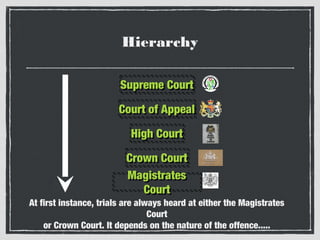
Hierarchy
Supreme Court
Supreme Court
Court of Appeal
Court of Appeal
High Court
High Court
Crown Court
Crown Court
Magistrates
Magistrates
Court
Court

At first instance, trials are always heard at either the Magistrates
Court
or Crown Court. It depends on the nature of the offence.....
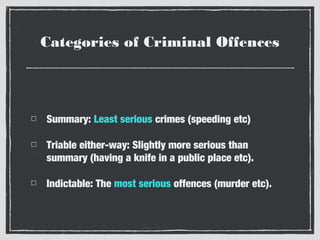
Categories of Criminal Offences

Summary: Least serious crimes (speeding etc)
Triable either-way: Slightly more serious than
summary (having a knife in a public place etc).
Indictable: The most serious offences (murder etc).
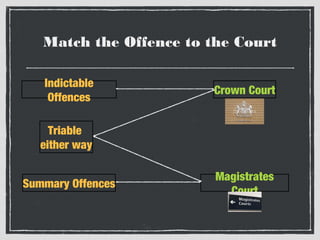
Match the Offence to the Court
Indictable
Offences

Crown Court

Triable
either way
Summary Offences

Magistrates
Court
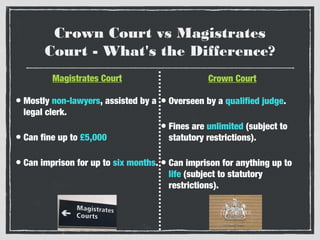
Crown Court vs Magistrates
Court - What's the Difference?
Magistrates Court

Crown Court

• Mostly non-lawyers, assisted by a • Overseen by a qualified judge.
legal clerk.

• Can fine up to £5,000

• Fines are unlimited (subject to
statutory restrictions).

• Can imprison for up to six months. • Can imprison for anything up to
life (subject to statutory
restrictions).
Triable Either Way - Where Will
the Trial be Held?
Plea before venue: If D pleads guilty, he may be
sentenced by the Magistrates. If they think their
powers are insufficient, they will send the case to the
Crown Court for sentencing.
Triable Either Way - Where Will
the Trial be Held?
If D pleads not guilty, a mode of trial procedure takes
place.
Magistrates will consider if the case is suitable to be
heard by them. If not, they will send it to the Crown
Court.
D then gets to choose which court he wants:
Magistrates or Crown.
Triable Either Way - Where Will
the Trial be Held?
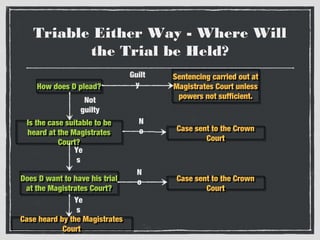
How does D plead?
How does D plead?

Guilt
y

Not
guilty
Is the case suitable to be
heard at the Magistrates
Court?
Court?
Ye
s
Does D want to have his trial
at the Magistrates Court?
Ye
s
Case heard by the Magistrates
Court
Court

N
o

N
o

Sentencing carried out at
Magistrates Court unless
powers not sufficient.

Case sent to the Crown
Court
Court

Case sent to the Crown
Court
Court
Appeals - Magistrates Court
Pleaded guilty: Right to appeal sentence to the Crown Court.
Pleaded not guilty: Right to appeal both conviction and
sentence to Crown Court.
Crown Court can: quash conviction or uphold it; reduce
sentence (but not increase).
21 day time limit.
Appeals - Magistrates Court
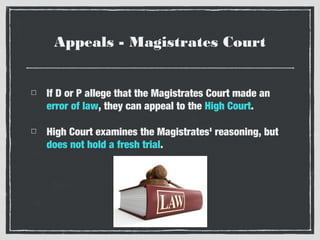
If D or P allege that the Magistrates Court made an
error of law, they can appeal to the High Court.
High Court examines the Magistrates' reasoning, but
does not hold a fresh trial.
Appeals - Magistrates Court

Error of fact: Appealed to the Crown Court and a fresh
trial heard.
Error of law: Appealed to the High Court and the
reasoning examined. No fresh trial.
Overview of the Magistrates
Court

http://www.youtube.com/watch?v=WeNDacwO5NA&list=PL1jG
Crown Court - Procedure
1. Plea and Case Management Hearing: D pleads guilty or
not guilty. If he pleads guilty, he is sentenced; if he
pleads not guilty, a trial is arranged.
2. Criminal Procedure and Investigations Act 1996: D and
P must swap all their evidence and arguments. P must
also disclose any documents that might undermine
their case.
Appeals - Crown Court
Under the Criminal Appeal Act 1995, the Court of Appeal
will give permission to appeal if the conviction is
unsafe.
About 30% of cases are granted permission to appeal.
Must be requested within 28 days.
Appeals to the Supreme Court
P or D may appeal to the Supreme Court.
They must obtain permission, and will only receive it
of the case concerns a point of law of public
importance.
Criminal Cases Review
Commission

Set up under the Criminal Appeal Act 1995
Investigate cases where there might have been a
miscarriage of justice.
http://www.youtube.com/watch?v=eUJHfEb9v88
Youth Court
Offenders aged 10-17 are dealt with by this court: a
branch of the Magistrates Court.
Exceptionally, young offenders can be tried in the
Crown Court for very serious offences.
Trial is held in private.
Members of the press may attend but cannot report
the child's name.
Precedent

Statements of law made by a higher court must be
followed by lower courts.
If a case involving the same bit of law comes before
the Court of Appeal, it must follow the case decided by
the Supreme Court
Precedent
How do we find precedents?
READ CASE LAW: This is why it is a good idea to
mention cases in problem questions - they are
statements of law.
Ratio Decidendi
When a judge decides a case, he gives his reasons in
a law report.
Those reasons and explanations are called ratio
decidendi and they set binding precedents.
The judge might say other things unrelated to the case
(e.g. speculate how the case would have been decided
if the facts were different). This is called obiter dicta
and only sets persuasive precedent.
Do Courts Bind Themselves
Traditionally, all courts bound themselves.
If the Supreme Court says the law is X, it cannot
change the law at a later date. Cannot modernise it.
Ever since the Practice Statement 1966, the Supreme
Court has been able to overrule its previous decisions.
Practice Statement 1966

Knuller v DPP (1973):
Lord Reid: Although we have permission to
overrule older decisions, we should only do so if
there is some very good reason for doing so. It is
important to maintain certainty in the law.
Practice Statement 1966

Pepper v Hart (1993)
House of Lords overruled its previous decision that
Hansard cannot be used to aid statutory
interpretation.

V
Practice Statement 1966
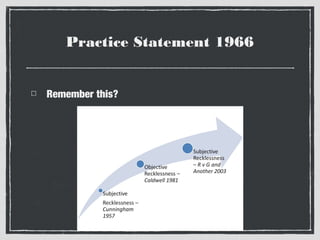
Remember this?
Precedent - Overview

http://www.youtube.com/watch?v=Bu36FGG4dv8

Courts system

  • 1.
    The Courts From MagistratesCourt to Supreme Court
  • 2.
    Overview The common lawsystem is based on precedent cases set law for future cases. Precedents from the higher courts are stronger than precedents from lower courts. But how does the court system work? What is the appeals process?
  • 3.
    Objectives By the endof the session, all learners will: 1) Be able to identify the key features of the courts system.
  • 4.
    Hierarchy Supreme Court Supreme Court Courtof Appeal Court of Appeal High Court High Court Crown Court Crown Court Magistrates Magistrates Court Court At first instance, trials are always heard at either the Magistrates Court or Crown Court. It depends on the nature of the offence.....
  • 5.
    Categories of CriminalOffences Summary: Least serious crimes (speeding etc) Triable either-way: Slightly more serious than summary (having a knife in a public place etc). Indictable: The most serious offences (murder etc).
  • 6.
    Match the Offenceto the Court Indictable Offences Crown Court Triable either way Summary Offences Magistrates Court
  • 7.
    Crown Court vsMagistrates Court - What's the Difference? Magistrates Court Crown Court • Mostly non-lawyers, assisted by a • Overseen by a qualified judge. legal clerk. • Can fine up to £5,000 • Fines are unlimited (subject to statutory restrictions). • Can imprison for up to six months. • Can imprison for anything up to life (subject to statutory restrictions).
  • 8.
    Triable Either Way- Where Will the Trial be Held? Plea before venue: If D pleads guilty, he may be sentenced by the Magistrates. If they think their powers are insufficient, they will send the case to the Crown Court for sentencing.
  • 9.
    Triable Either Way- Where Will the Trial be Held? If D pleads not guilty, a mode of trial procedure takes place. Magistrates will consider if the case is suitable to be heard by them. If not, they will send it to the Crown Court. D then gets to choose which court he wants: Magistrates or Crown.
  • 10.
    Triable Either Way- Where Will the Trial be Held? How does D plead? How does D plead? Guilt y Not guilty Is the case suitable to be Is the case suitable to be heard at the Magistrates heard at the Magistrates Court? Court? Ye s Does D want to have his trial Does D want to have his trial at the Magistrates Court? at the Magistrates Court? Ye s Case heard by the Magistrates Case heard by the Magistrates Court Court N o N o Sentencing carried out at Sentencing carried out at Magistrates Court unless Magistrates Court unless powers not sufficient. powers not sufficient. Case sent to the Crown Case sent to the Crown Court Court Case sent to the Crown Case sent to the Crown Court Court
  • 11.
    Appeals - MagistratesCourt Pleaded guilty: Right to appeal sentence to the Crown Court. Pleaded not guilty: Right to appeal both conviction and sentence to Crown Court. Crown Court can: quash conviction or uphold it; reduce sentence (but not increase). 21 day time limit.
  • 12.
    Appeals - MagistratesCourt If D or P allege that the Magistrates Court made an error of law, they can appeal to the High Court. High Court examines the Magistrates' reasoning, but does not hold a fresh trial.
  • 13.
    Appeals - MagistratesCourt Error of fact: Appealed to the Crown Court and a fresh trial heard. Error of law: Appealed to the High Court and the reasoning examined. No fresh trial.
  • 14.
    Overview of theMagistrates Court http://www.youtube.com/watch?v=WeNDacwO5NA&list=PL1jG
  • 15.
    Crown Court -Procedure 1. Plea and Case Management Hearing: D pleads guilty or not guilty. If he pleads guilty, he is sentenced; if he pleads not guilty, a trial is arranged. 2. Criminal Procedure and Investigations Act 1996: D and P must swap all their evidence and arguments. P must also disclose any documents that might undermine their case.
  • 16.
    Appeals - CrownCourt Under the Criminal Appeal Act 1995, the Court of Appeal will give permission to appeal if the conviction is unsafe. About 30% of cases are granted permission to appeal. Must be requested within 28 days.
  • 17.
    Appeals to theSupreme Court P or D may appeal to the Supreme Court. They must obtain permission, and will only receive it of the case concerns a point of law of public importance.
  • 18.
    Criminal Cases Review Commission Setup under the Criminal Appeal Act 1995 Investigate cases where there might have been a miscarriage of justice. http://www.youtube.com/watch?v=eUJHfEb9v88
  • 19.
    Youth Court Offenders aged10-17 are dealt with by this court: a branch of the Magistrates Court. Exceptionally, young offenders can be tried in the Crown Court for very serious offences. Trial is held in private. Members of the press may attend but cannot report the child's name.
  • 20.
    Precedent Statements of lawmade by a higher court must be followed by lower courts. If a case involving the same bit of law comes before the Court of Appeal, it must follow the case decided by the Supreme Court
  • 21.
    Precedent How do wefind precedents? READ CASE LAW: This is why it is a good idea to mention cases in problem questions - they are statements of law.
  • 22.
    Ratio Decidendi When ajudge decides a case, he gives his reasons in a law report. Those reasons and explanations are called ratio decidendi and they set binding precedents. The judge might say other things unrelated to the case (e.g. speculate how the case would have been decided if the facts were different). This is called obiter dicta and only sets persuasive precedent.
  • 23.
    Do Courts BindThemselves Traditionally, all courts bound themselves. If the Supreme Court says the law is X, it cannot change the law at a later date. Cannot modernise it. Ever since the Practice Statement 1966, the Supreme Court has been able to overrule its previous decisions.
  • 24.
    Practice Statement 1966 Knullerv DPP (1973): Lord Reid: Although we have permission to overrule older decisions, we should only do so if there is some very good reason for doing so. It is important to maintain certainty in the law.
  • 25.
    Practice Statement 1966 Pepperv Hart (1993) House of Lords overruled its previous decision that Hansard cannot be used to aid statutory interpretation. V
  • 26.
  • 27.