LEVELS OF WRITTEN EXPRESSION
WRITTEN COMMUNICATION II
Remembe
r !
Compositions nearly always have three main parts:
introduction, body, and conclusion.
The first paragraph is often an introduction —a
paragraph that introduces the topic, says something
interesting about it, and states the thesis.
Following the introduction are several paragraphs
called the body. These paragraphs give readers
specific information about the topic, supporting and
developing the thesis.
The conclusion, which is often one paragraph, gives
readers a final, interesting point to think about.
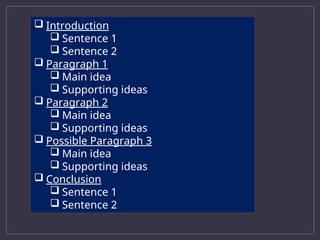
 Introduction
 Sentence 1
 Sentence 2
 Paragraph 1
 Main idea
 Supporting ideas
 Paragraph 2
 Main idea
 Supporting ideas
 Possible Paragraph 3
 Main idea
 Supporting ideas
 Conclusion
 Sentence 1
 Sentence 2
LEVELS
OF
WRITTEN
EXPRESSION
Adaptation
Adaptation is the adapting of a literary source (e.g.
a novel, short story, poem) to another genre or
medium, such as a film, stage play, or video game.
It can also involve adapting the same literary work in the
same genre or medium just for different purposes, e.g. to
work with a smaller cast, in a smaller venue (or on the road),
or for a different demographic group (such as adapting a
story for children).
Structure
The following is a general structure to follow for
many kinds of writing. Adapt it to specialized
assignments as appropriate.
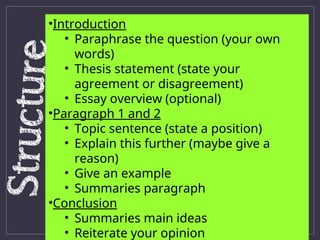
•Introduction
• Paraphrase the question (your own
words)
• Thesis statement (state your
agreement or disagreement)
• Essay overview (optional)
•Paragraph 1 and 2
• Topic sentence (state a position)
• Explain this further (maybe give a
reason)
• Give an example
• Summaries paragraph
•Conclusion
• Summaries main ideas
• Reiterate your opinion
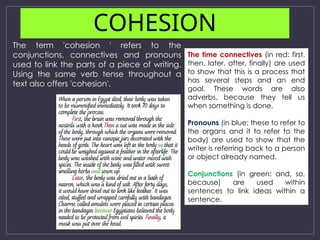
COHESION
The time connectives (in red: first,
then, later, after, finally) are used
to show that this is a process that
has several steps and an end
goal. These words are also
adverbs, because they tell us
when something is done.
Pronouns (in blue: these to refer to
the organs and it to refer to the
body) are used to show that the
writer is referring back to a person
or object already named.
Conjunctions (in green: and, so,
because) are used within
sentences to link ideas within a
sentence.
The term 'cohesion ' refers to the
conjunctions, connectives and pronouns
used to link the parts of a piece of writing.
Using the same verb tense throughout a
text also offers 'cohesion'.
Regulations
The ability to self-regulate plays a big role in writing.
When people set goals about how many words the
term paper must be, then check the word count as
they write, that’s self-regulation. If they get to the end
of a sentence, realize it makes no sense and decide to
rewrite it, that’s self-regulation.
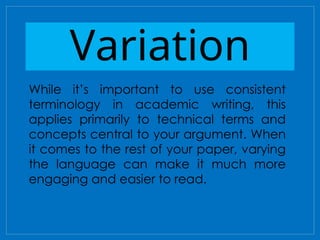
Variation
While it’s important to use consistent
terminology in academic writing, this
applies primarily to technical terms and
concepts central to your argument. When
it comes to the rest of your paper, varying
the language can make it much more
engaging and easier to read.
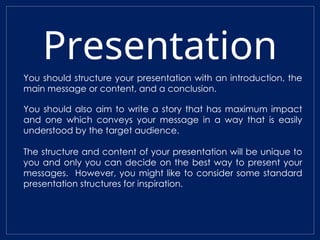
Presentation
You should structure your presentation with an introduction, the
main message or content, and a conclusion.
You should also aim to write a story that has maximum impact
and one which conveys your message in a way that is easily
understood by the target audience.
The structure and content of your presentation will be unique to
you and only you can decide on the best way to present your
messages. However, you might like to consider some standard
presentation structures for inspiration.
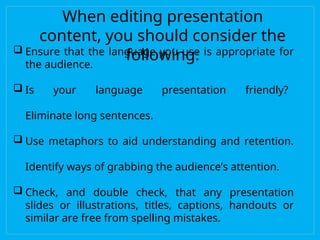
When editing presentation
content, you should consider the
following:
 Ensure that the language you use is appropriate for
the audience.
 Is your language presentation friendly?
Eliminate long sentences.
 Use metaphors to aid understanding and retention.
Identify ways of grabbing the audience’s attention.
 Check, and double check, that any presentation
slides or illustrations, titles, captions, handouts or
similar are free from spelling mistakes.
Thanks!

written com 2 .pptttttttttttttttttttttttttttttttt

  • 1.
    LEVELS OF WRITTENEXPRESSION WRITTEN COMMUNICATION II
  • 2.
  • 3.
    Compositions nearly alwayshave three main parts: introduction, body, and conclusion. The first paragraph is often an introduction —a paragraph that introduces the topic, says something interesting about it, and states the thesis. Following the introduction are several paragraphs called the body. These paragraphs give readers specific information about the topic, supporting and developing the thesis. The conclusion, which is often one paragraph, gives readers a final, interesting point to think about.
  • 4.
     Introduction  Sentence1  Sentence 2  Paragraph 1  Main idea  Supporting ideas  Paragraph 2  Main idea  Supporting ideas  Possible Paragraph 3  Main idea  Supporting ideas  Conclusion  Sentence 1  Sentence 2
  • 5.
  • 6.
    Adaptation Adaptation is theadapting of a literary source (e.g. a novel, short story, poem) to another genre or medium, such as a film, stage play, or video game. It can also involve adapting the same literary work in the same genre or medium just for different purposes, e.g. to work with a smaller cast, in a smaller venue (or on the road), or for a different demographic group (such as adapting a story for children).
  • 7.
    Structure The following isa general structure to follow for many kinds of writing. Adapt it to specialized assignments as appropriate.
  • 8.
    •Introduction • Paraphrase thequestion (your own words) • Thesis statement (state your agreement or disagreement) • Essay overview (optional) •Paragraph 1 and 2 • Topic sentence (state a position) • Explain this further (maybe give a reason) • Give an example • Summaries paragraph •Conclusion • Summaries main ideas • Reiterate your opinion
  • 9.
    COHESION The time connectives(in red: first, then, later, after, finally) are used to show that this is a process that has several steps and an end goal. These words are also adverbs, because they tell us when something is done. Pronouns (in blue: these to refer to the organs and it to refer to the body) are used to show that the writer is referring back to a person or object already named. Conjunctions (in green: and, so, because) are used within sentences to link ideas within a sentence. The term 'cohesion ' refers to the conjunctions, connectives and pronouns used to link the parts of a piece of writing. Using the same verb tense throughout a text also offers 'cohesion'.
  • 10.
    Regulations The ability toself-regulate plays a big role in writing. When people set goals about how many words the term paper must be, then check the word count as they write, that’s self-regulation. If they get to the end of a sentence, realize it makes no sense and decide to rewrite it, that’s self-regulation.
  • 11.
    Variation While it’s importantto use consistent terminology in academic writing, this applies primarily to technical terms and concepts central to your argument. When it comes to the rest of your paper, varying the language can make it much more engaging and easier to read.
  • 12.
    Presentation You should structureyour presentation with an introduction, the main message or content, and a conclusion. You should also aim to write a story that has maximum impact and one which conveys your message in a way that is easily understood by the target audience. The structure and content of your presentation will be unique to you and only you can decide on the best way to present your messages. However, you might like to consider some standard presentation structures for inspiration.
  • 13.
    When editing presentation content,you should consider the following:  Ensure that the language you use is appropriate for the audience.  Is your language presentation friendly? Eliminate long sentences.  Use metaphors to aid understanding and retention. Identify ways of grabbing the audience’s attention.  Check, and double check, that any presentation slides or illustrations, titles, captions, handouts or similar are free from spelling mistakes.
  • 14.