Structuralism
Word Picture
Weeping Woman
Structuralism
Reja Fatima
Roll No.3655
Weeping
Woman
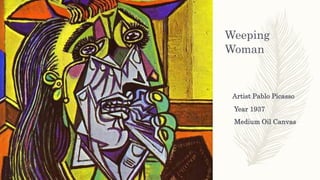
Artist Pablo Picasso
Year 1937
Medium Oil Canvas
Weeping
Woman
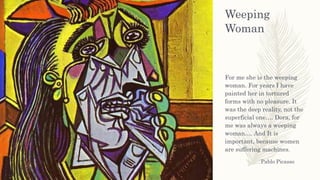
For me she is the weeping
woman. For years I have
painted her in tortured
forms with no pleasure. It
was the deep reality, not the
superficial one…. Dora, for
me was always a weeping
woman…. And It is
important, because women
are suffering machines.
Pablo Picasso
Conceptual
Framework
1936 Spanish civil war.
Picasso was obsessed with
exploring the woman’s face
and emotions conveyed
through her expressions.
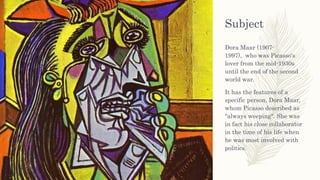
Subject
Dora Maar (1907-
1997), who was Picasso's
lover from the mid-1930s
until the end of the second
world war.
It has the features of a
specific person, Dora Maar,
whom Picasso described as
"always weeping". She was
in fact his close collaborator
in the time of his life when
he was most involved with
politics.
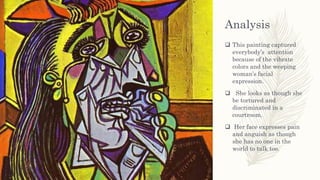
Analysis
 This painting captured
everybody’s attention
because of the vibrate
colors and the weeping
woman’s facial
expression.
 She looks as though she
be tortured and
discriminated in a
courtroom.
 Her face expresses pain
and anguish as though
she has no one in the
world to talk too.
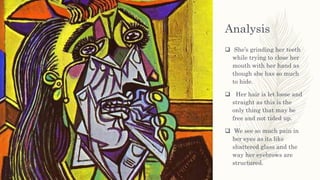
Analysis
 She’s grinding her teeth
while trying to close her
mouth with her hand as
though she has so much
to hide.
 Her hair is let loose and
straight as this is the
only thing that may be
free and not tided up.
 We see so much pain in
her eyes as its like
shattered glass and the
way her eyebrows are
structured.
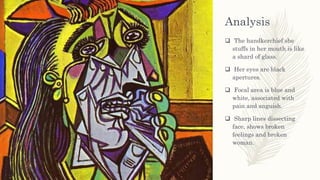
Analysis
 The handkerchief she
stuffs in her mouth is like
a shard of glass.
 Her eyes are black
apertures.
 Focal area is blue and
white, associated with
pain and anguish.
 Sharp lines dissecting
face, shows broken
feelings and broken
woman.
Analysis
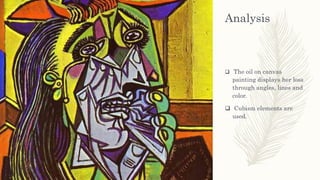
 The oil on canvas
painting displays her loss
through angles, lines and
color.
 Cubism elements are
used.
Cultural
Framework
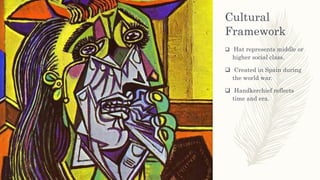
 Hat represents middle or
higher social class.
 Created in Spain during
the world war.
 Handkerchief reflects
time and era.

The weeping women

  • 1.
  • 2.
  • 3.
  • 4.
    Weeping Woman For me sheis the weeping woman. For years I have painted her in tortured forms with no pleasure. It was the deep reality, not the superficial one…. Dora, for me was always a weeping woman…. And It is important, because women are suffering machines. Pablo Picasso
  • 5.
    Conceptual Framework 1936 Spanish civilwar. Picasso was obsessed with exploring the woman’s face and emotions conveyed through her expressions.
  • 6.
    Subject Dora Maar (1907- 1997),who was Picasso's lover from the mid-1930s until the end of the second world war. It has the features of a specific person, Dora Maar, whom Picasso described as "always weeping". She was in fact his close collaborator in the time of his life when he was most involved with politics.
  • 7.
    Analysis  This paintingcaptured everybody’s attention because of the vibrate colors and the weeping woman’s facial expression.  She looks as though she be tortured and discriminated in a courtroom.  Her face expresses pain and anguish as though she has no one in the world to talk too.
  • 8.
    Analysis  She’s grindingher teeth while trying to close her mouth with her hand as though she has so much to hide.  Her hair is let loose and straight as this is the only thing that may be free and not tided up.  We see so much pain in her eyes as its like shattered glass and the way her eyebrows are structured.
  • 9.
    Analysis  The handkerchiefshe stuffs in her mouth is like a shard of glass.  Her eyes are black apertures.  Focal area is blue and white, associated with pain and anguish.  Sharp lines dissecting face, shows broken feelings and broken woman.
  • 10.
    Analysis  The oilon canvas painting displays her loss through angles, lines and color.  Cubism elements are used.
  • 11.
    Cultural Framework  Hat representsmiddle or higher social class.  Created in Spain during the world war.  Handkerchief reflects time and era.