The Virtual Manager Presented by Salvatore Gigante - Leadership and Effectiveness in Virtual Workplace
Today’s Objectives Identify the challenges to managing  from a distance Assess self in key skill areas used to manage from a distance Identify key distance leadership and management skills Develop strategies to allow team to be more effective in a virtual environment
What are the challenges of  managing from a distance? How do these challenges differ from managing a team locally?
Challenges become magnified when managing from a distance
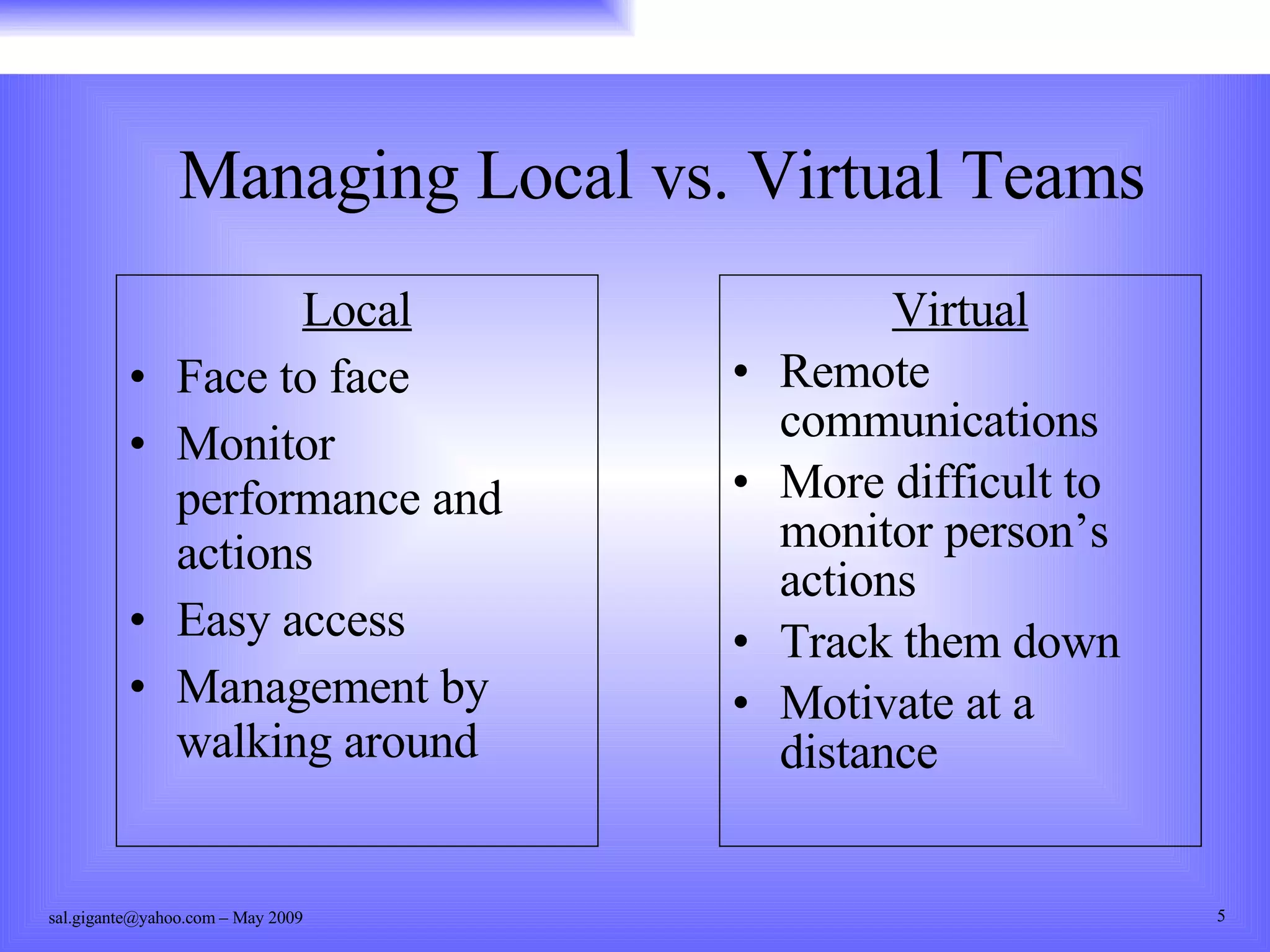
Managing Local vs. Virtual Teams Local Face to face Monitor performance and actions Easy access Management by walking around Virtual Remote communications More difficult to monitor person’s actions Track them down Motivate at a distance
Effective Leadership and Management Skills Providing Strategic Direction Communication (staying connected) Building Relationships Setting Objective Goals Coaching Motivating Providing Development Opportunities Providing Feedback and Support Managing by results, not activity
Are your Employees Being Productive?  Is Trust an Issue for You?
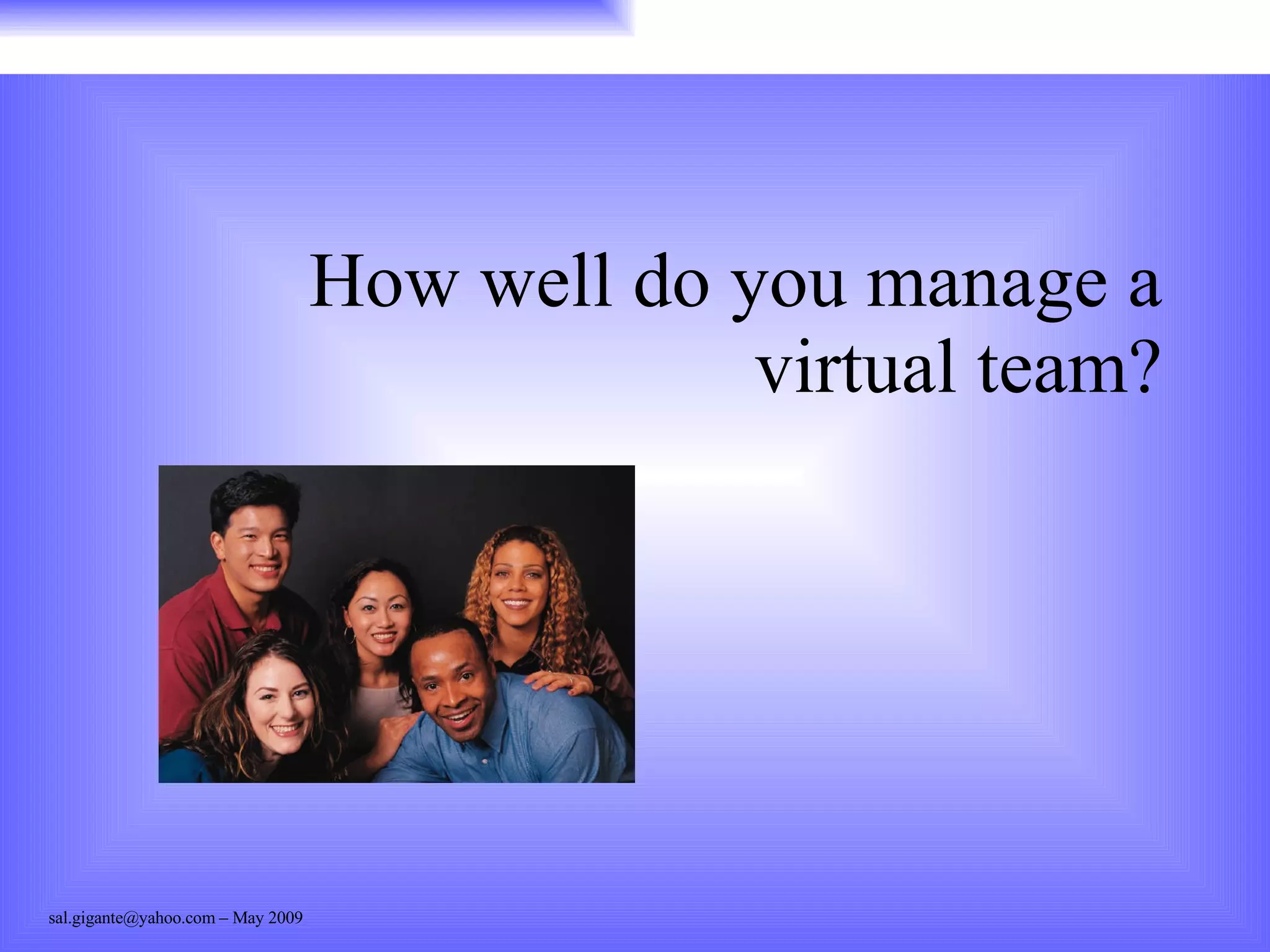
How well do you manage a virtual team?
How would you describe your current management style? Very direct with a "telling" style A coaching style A controlling style A wait and see style, allowing employees to "figure it out"
Do you have written measurable goals  for each employee? Do you  meet regularly with each employee in person to discuss what and how they are doing?
Do you do a formal orientation for new employees to the team? Do you formally work to build team cohesiveness?
How do you approach a performance issue with a remote employee? Allow the employee some time to work out the issue before addressing Address immediately by letting the employee know what is expected of them Discuss the situation with the employee as soon as you can meet in-person Address the situation as soon as you are aware of it through two-way discussion
Tools for Virtual Teams Telephone Scheduled Team Conference Calls (Weekly) E-mails IM – Instant Messaging Live Meeting Virtual Learning software Videoconference Face to Face Visits One on One Telephone Conference
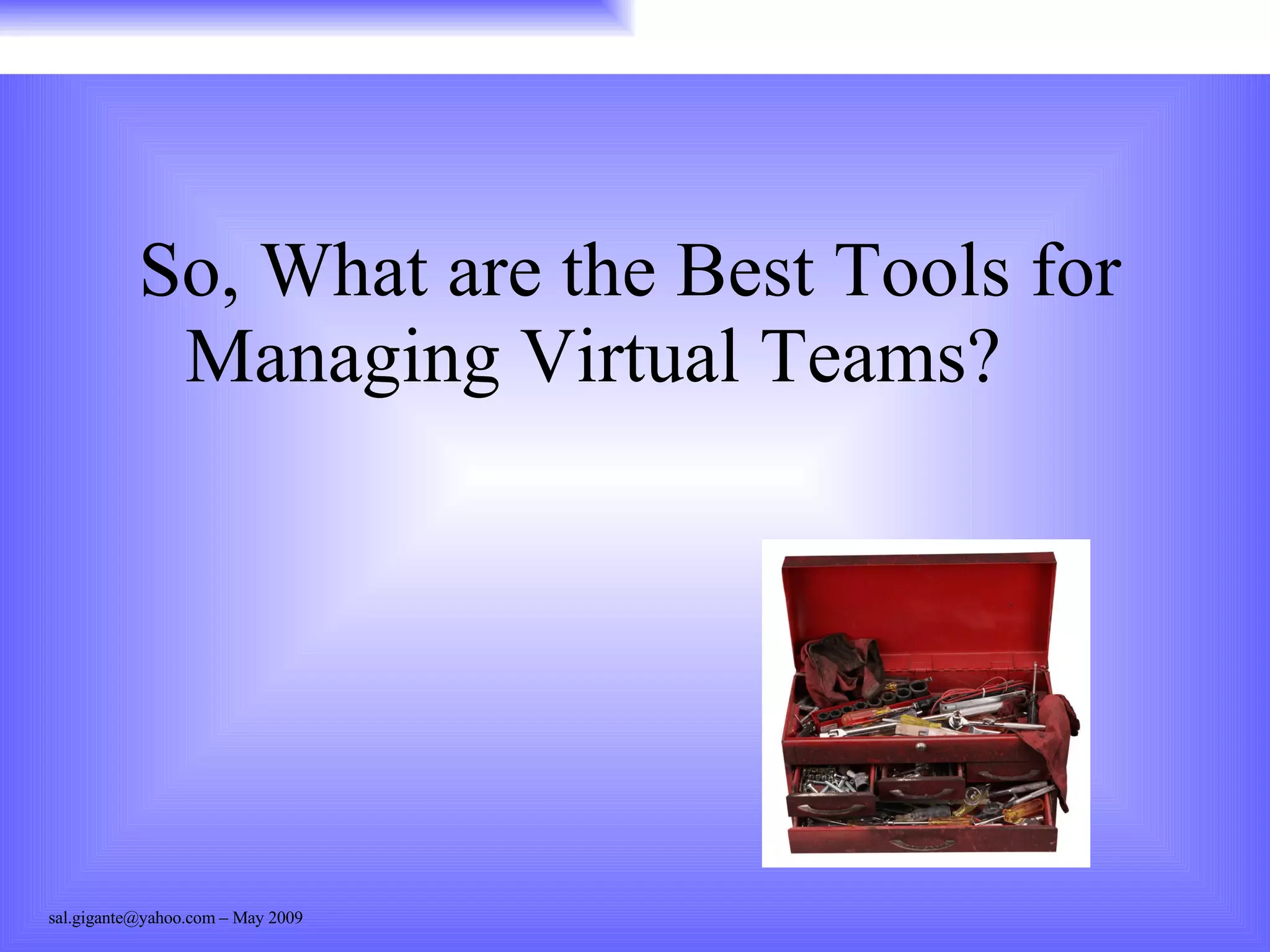
So, What are the Best Tools for Managing Virtual Teams?
What Questions or Situations do you Have? Do you have a situation you would like to share? Do you have any questions?
Action Planning What are you currently doing well? What can you do better? Specifically, what do you need to do to improve your virtual leadership skills? By when will you make these improvements?
Virtual Team Leadership Tips  Take pictures of the team and post them on a site that is available to the entire team. Don’t always handout project to the people who offices near you, be sure to distribute evenly amongst the team. Never deliver bad new or negative feedback by e-mail. Watch your tone in your e-mail. Be sensitive to the time zone of your virtual team. If you virtual team is in another country, be sure to accommodate them by having calls on their time zone
A Final Thought…. Here are the 4 critical dimensions of Communication Build Trust –  The core of communication is developing trust. Share Knowledge –  Knowledge is power.  Equip your team with as much knowledge as you can. Provide Feedback –  People need to know where they stand. Walk the Talk  – We have to walk our talk personally and professionally.
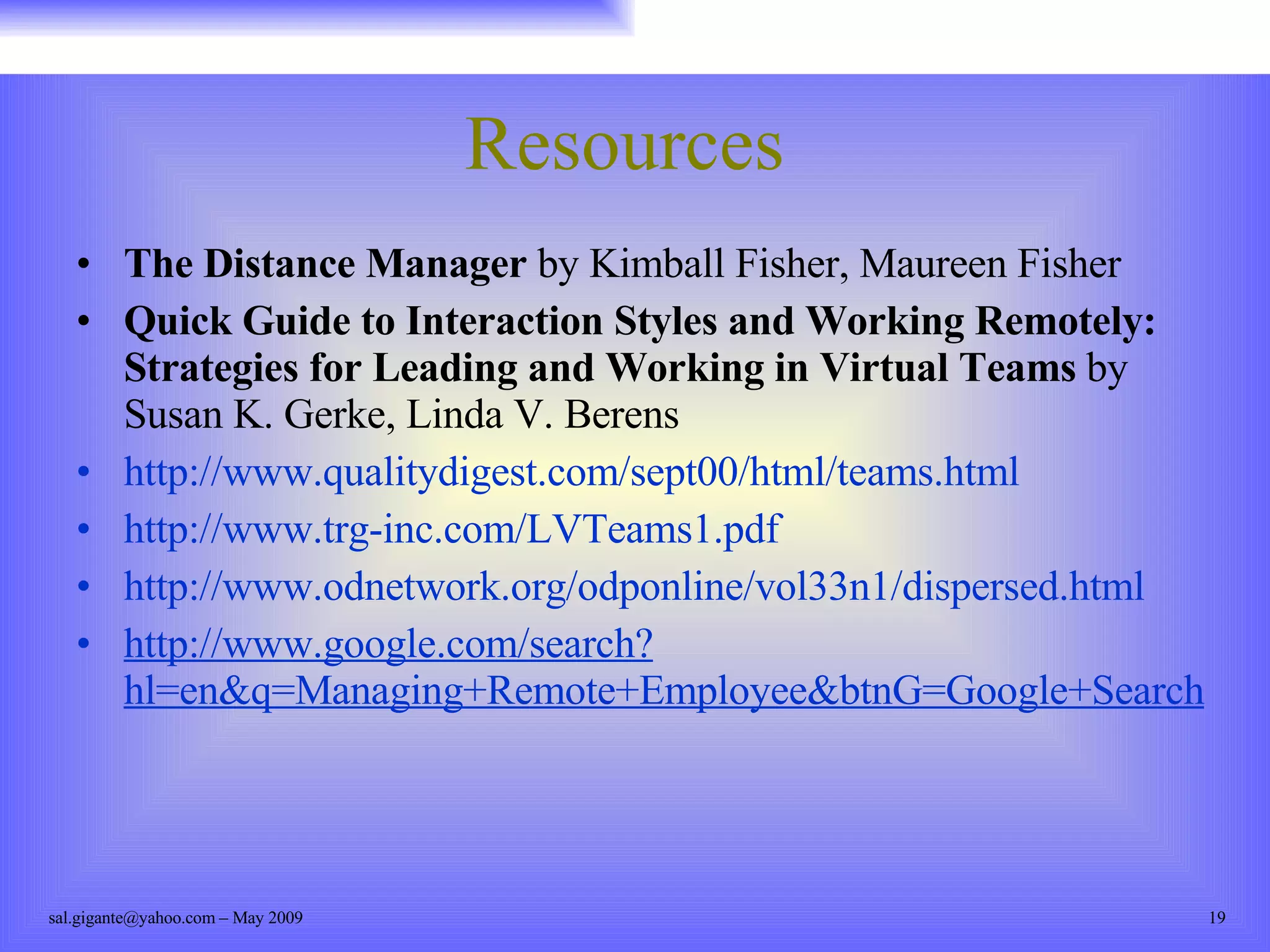
Resources The Distance Manager  by Kimball Fisher, Maureen Fisher Quick Guide to Interaction Styles and Working Remotely: Strategies for Leading and Working in Virtual Teams  by Susan K. Gerke, Linda V. Berens http://www.qualitydigest.com/sept00/html/teams.html http://www.trg-inc.com/LVTeams1.pdf http://www.odnetwork.org/odponline/vol33n1/dispersed.html http://www.google.com/search?hl=en&q=Managing+Remote+Employee&btnG=Google+Search

The Virtual Manager May 2009

  • 1.
    The Virtual ManagerPresented by Salvatore Gigante - Leadership and Effectiveness in Virtual Workplace
  • 2.
    Today’s Objectives Identifythe challenges to managing from a distance Assess self in key skill areas used to manage from a distance Identify key distance leadership and management skills Develop strategies to allow team to be more effective in a virtual environment
  • 3.
    What are thechallenges of managing from a distance? How do these challenges differ from managing a team locally?
  • 4.
    Challenges become magnifiedwhen managing from a distance
  • 5.
    Managing Local vs.Virtual Teams Local Face to face Monitor performance and actions Easy access Management by walking around Virtual Remote communications More difficult to monitor person’s actions Track them down Motivate at a distance
  • 6.
    Effective Leadership andManagement Skills Providing Strategic Direction Communication (staying connected) Building Relationships Setting Objective Goals Coaching Motivating Providing Development Opportunities Providing Feedback and Support Managing by results, not activity
  • 7.
    Are your EmployeesBeing Productive? Is Trust an Issue for You?
  • 8.
    How well doyou manage a virtual team?
  • 9.
    How would youdescribe your current management style? Very direct with a "telling" style A coaching style A controlling style A wait and see style, allowing employees to "figure it out"
  • 10.
    Do you havewritten measurable goals for each employee? Do you meet regularly with each employee in person to discuss what and how they are doing?
  • 11.
    Do you doa formal orientation for new employees to the team? Do you formally work to build team cohesiveness?
  • 12.
    How do youapproach a performance issue with a remote employee? Allow the employee some time to work out the issue before addressing Address immediately by letting the employee know what is expected of them Discuss the situation with the employee as soon as you can meet in-person Address the situation as soon as you are aware of it through two-way discussion
  • 13.
    Tools for VirtualTeams Telephone Scheduled Team Conference Calls (Weekly) E-mails IM – Instant Messaging Live Meeting Virtual Learning software Videoconference Face to Face Visits One on One Telephone Conference
  • 14.
    So, What arethe Best Tools for Managing Virtual Teams?
  • 15.
    What Questions orSituations do you Have? Do you have a situation you would like to share? Do you have any questions?
  • 16.
    Action Planning Whatare you currently doing well? What can you do better? Specifically, what do you need to do to improve your virtual leadership skills? By when will you make these improvements?
  • 17.
    Virtual Team LeadershipTips Take pictures of the team and post them on a site that is available to the entire team. Don’t always handout project to the people who offices near you, be sure to distribute evenly amongst the team. Never deliver bad new or negative feedback by e-mail. Watch your tone in your e-mail. Be sensitive to the time zone of your virtual team. If you virtual team is in another country, be sure to accommodate them by having calls on their time zone
  • 18.
    A Final Thought….Here are the 4 critical dimensions of Communication Build Trust – The core of communication is developing trust. Share Knowledge – Knowledge is power. Equip your team with as much knowledge as you can. Provide Feedback – People need to know where they stand. Walk the Talk – We have to walk our talk personally and professionally.
  • 19.
    Resources The DistanceManager by Kimball Fisher, Maureen Fisher Quick Guide to Interaction Styles and Working Remotely: Strategies for Leading and Working in Virtual Teams by Susan K. Gerke, Linda V. Berens http://www.qualitydigest.com/sept00/html/teams.html http://www.trg-inc.com/LVTeams1.pdf http://www.odnetwork.org/odponline/vol33n1/dispersed.html http://www.google.com/search?hl=en&q=Managing+Remote+Employee&btnG=Google+Search

Editor's Notes

  • #2 Welcome participants to the session Leading from a Distance. Introduce yourself and any background you might have with leading or working with virtual teams.