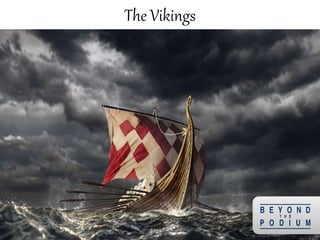
The Vikings
2
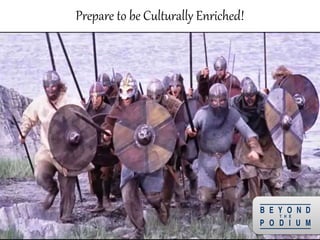
Prepare to be Culturally Enriched!
3
Vikings Demographics
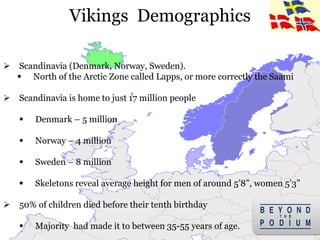
 Scandinavia (Denmark, Norway, Sweden).
 North of the Arctic Zone called Lapps, or more correctly the Saami
 Scandinavia is home to just 17 million people
 Denmark – 5 million
 Norway – 4 million
 Sweden – 8 million
 Skeletons reveal average height for men of around 5’8”, women 5’3”
 50% of children died before their tenth birthday
 Majority had made it to between 35-55 years of age. 4
5
Sailed North Atlantic, reaching south to North Africa and east to Russia,
Constantinople and the Middle East – A nasty, unpleasant, brutish lot!
 Viking comes from the Old Norse word "vik" (bay or creek) which
formed the root of “Vikingr”, Pirate or Sea Warrior!
 “Berserkers” (berserkr) was a Viking who wore bear or wolf skins and
howled in battle like wild animals!
 Good to die in battle - best chance of going to Valhalla
(didn’t want to die of old age)
Vikings
Viking Age (800 to 1066 AD)
6
 Practiced gift exchange with allies, and traded for profit with
foreigners, taking by force what they could not buy.
 Norsemen saw little difference between trading and plunder
 Exploited their superiority in warfare and sailing technology
 Culture clash between the Pagan Norsemen and predominantly Christian
European Traders
 Bottom line – like all explores sought wealth and fame!
https://www.facebook.com/TribesPeople/videos/1671348653124505/
Vikings
Viking Age (800 to 1066 AD)
7
 Population explosion: Exceeded agricultural potential of homeland?
 Youth Bulge: Eldest son customarily inherited family's entire estate
 Selective procreation: Motive for emigration was to acquire wives
 Staleness of old trade routes: A need to seek out new profitable ones
 Fall of Roman Empire (5th C) / expansion of Islam (7th C), opportunities
were reduced in Europe by redirecting resources along the Silk road
 Mediterranean trade lowest in history when Vikings began expansion
 Founded new trade routes in Arabic and Frankish lands
took control of Frisians trade markets
Expansion/Migration
Vikings
8
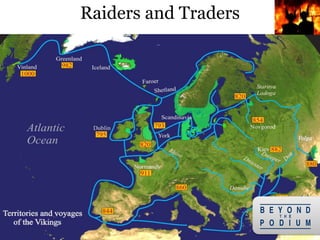
 First noticed during the 8th century when “Vikings”
travelled by sea from all of Scandinavia
 Swedes went east:
 Opened up Russia
 Danes went southwest:
 Conquered England and raided the French coast
 Norse travelled northwest:
 Conquered Ireland and settled Iceland, Greenland and Newfoundland
Raiders and Traders
9
Vikings From the North East
Raiders
10
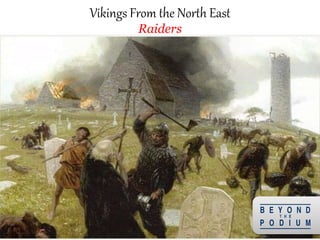
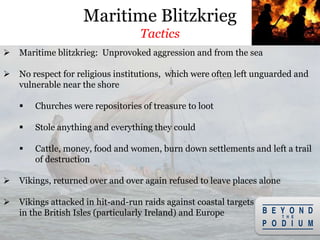
 Maritime blitzkrieg: Unprovoked aggression and from the sea
 No respect for religious institutions, which were often left unguarded and
vulnerable near the shore
 Churches were repositories of treasure to loot
 Stole anything and everything they could
 Cattle, money, food and women, burn down settlements and left a trail
of destruction
 Vikings, returned over and over again refused to leave places alone
 Vikings attacked in hit-and-run raids against coastal targets
in the British Isles (particularly Ireland) and Europe
Maritime Blitzkrieg
Tactics
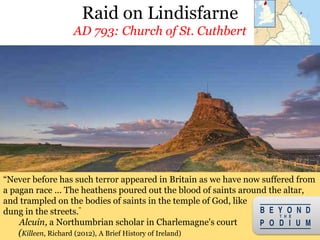
Raid on Lindisfarne
AD 793: Church of St. Cuthbert
12
Attack on Lindisfarne in Northumberland marked beginning of the Viking Age
“Never before has such terror appeared in Britain as we have now suffered from
a pagan race ... The heathens poured out the blood of saints around the altar,
and trampled on the bodies of saints in the temple of God, like
dung in the streets.”
Alcuin, a Northumbrian scholar in Charlemagne's court
(Killeen, Richard (2012), A Brief History of Ireland)
Vikings Raiders
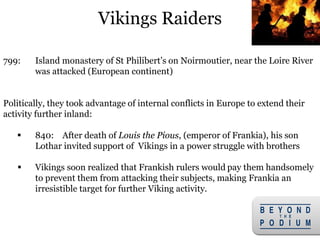
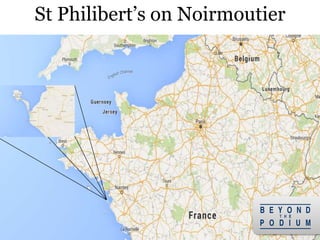
799: Island monastery of St Philibert’s on Noirmoutier, near the Loire River
was attacked (European continent)
Politically, they took advantage of internal conflicts in Europe to extend their
activity further inland:
 840: After death of Louis the Pious, (emperor of Frankia), his son
Lothar invited support of Vikings in a power struggle with brothers
 Vikings soon realized that Frankish rulers would pay them handsomely
to prevent them from attacking their subjects, making Frankia an
irresistible target for further Viking activity.
13
St Philibert’s on Noirmoutier
14
15
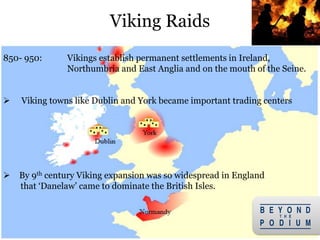
850- 950: Vikings establish permanent settlements in Ireland,
Northumbria and East Anglia and on the mouth of the Seine.
 Viking towns like Dublin and York became important trading centers
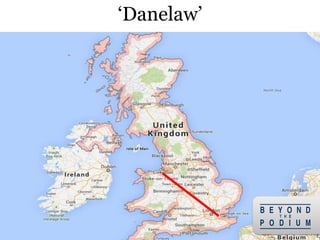
 By 9th century Viking expansion was so widespread in England
that ‘Danelaw’ came to dominate the British Isles.
Viking Raids
16
‘Danelaw’
17
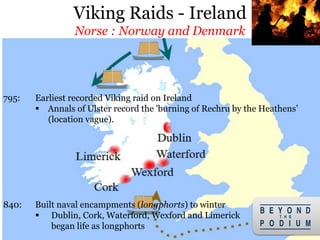
795: Earliest recorded Viking raid on Ireland
 Annals of Ulster record the 'burning of Rechru by the Heathens’
(location vague).
840: Built naval encampments (longphorts) to winter
 Dublin, Cork, Waterford, Wexford and Limerick
began life as longphorts
Viking Raids - Ireland
Norse : Norway and Denmark
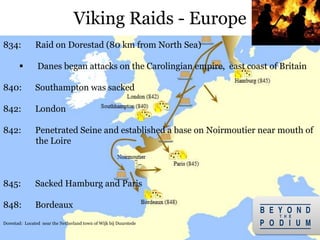
Viking Raids - Europe
18
834: Raid on Dorestad (80 km from North Sea)
 Danes began attacks on the Carolingian empire, east coast of Britain
840: Southampton was sacked
842: London
842: Penetrated Seine and established a base on Noirmoutier near mouth of
the Loire
845: Sacked Hamburg and Paris
848: Bordeaux
Dorestad: Located near the Netherland town of Wijk bij Duurstede
19
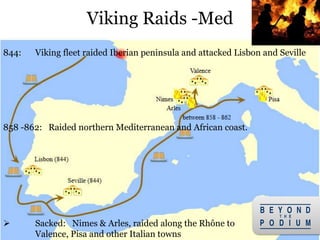
844: Viking fleet raided Iberian peninsula and attacked Lisbon and Seville
858 -862: Raided northern Mediterranean and African coast.
 Sacked: Nimes & Arles, raided along the Rhône to
Valence, Pisa and other Italian towns
Viking Raids -Med
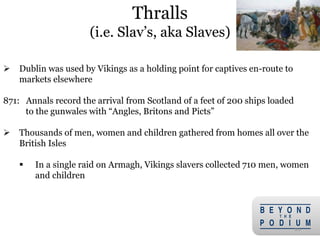
Thralls
(i.e. Slav’s, aka Slaves)
 Dublin was used by Vikings as a holding point for captives en-route to
markets elsewhere
871: Annals record the arrival from Scotland of a feet of 200 ships loaded
to the gunwales with “Angles, Britons and Picts”
 Thousands of men, women and children gathered from homes all over the
British Isles
 In a single raid on Armagh, Vikings slavers collected 710 men, women
and children
20
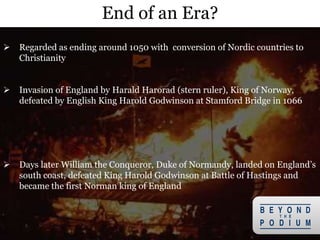
End of an Era?
 Regarded as ending around 1050 with conversion of Nordic countries to
Christianity
 Invasion of England by Harald Harorad (stern ruler), King of Norway,
defeated by English King Harold Godwinson at Stamford Bridge in 1066
 Days later William the Conqueror, Duke of Normandy, landed on England’s
south coast, defeated King Harold Godwinson at Battle of Hastings and
became the first Norman king of England
21
 Dublin founded in 841 - Dubh Lin (Black pool)
 Vikings referred to Africans as Blamadr (Bluemen) because Norsemen
had no distinction between the color Blue and Black
 Around 911: Charles the Simple, King of France ceded the town of Rouen,
with a vast area of surrounding territory to a Viking Leader named Rollo
 This was the land of the Northmen – Nor manni- that we know today
as Normandy
 William the Conqueror was a descendent of those Vikings
22
Useless Male Trivia
(U.M.T)
U.M.T
Old Norse Words used Today
anger angr (=“trouble, affliction")
awe agi (=“terror")
die deyja (="pass away")
egg egg (="egg")
guest gestr (="guest")
gun Gunnhildr (= “female name, elements name,
gunn and hildr, mean "war and/or battle”)
lad ladd (="young man")
Ransack rannsaka (="to search the house")
saga saga (="story, tale")
skill skil (="distinction")
skull skulle (="head")
Slaughter slahtr (="butchering")
Thursday Þorsdagr (="Thor's day")
troll troll (="giant, friend, demon”)
ugly uggligr (="Dreadfull, repulsive")
yule jól (="A feast upon winter solstice,
later appropriated by Christianity.") 23
24
991-1018: Kings of England paid Viking invaders 2.8 million Troy oz in
silver coins as tribute
 Today more Anglo-Saxon silver coins are in Denmark than England
 Brunette Vikings would use soap with high Lye content to bleach their hair
 No horned helmets – image dates back to the 1800s, when Swedish
Artists included the headgear in their portrayals of the raiders
 Wagner staged his “Der Ring des Nibelungen” in the 1870s, costume
designer Carl Emil Doepler created horned helmets for
Viking characters
U.M.T
25
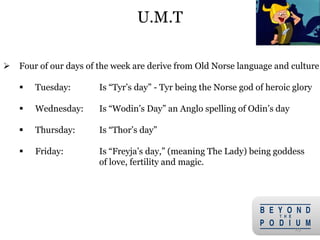
 Four of our days of the week are derive from Old Norse language and culture
 Tuesday: Is “Tyr’s day” - Tyr being the Norse god of heroic glory
 Wednesday: Is “Wodin’s Day” an Anglo spelling of Odin’s day
 Thursday: Is “Thor’s day”
 Friday: Is “Freyja’s day,” (meaning The Lady) being goddess
of love, fertility and magic.
U.M.T
26
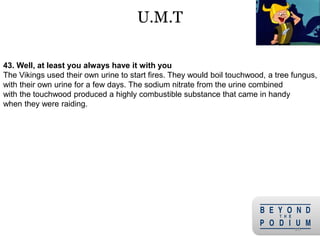
43. Well, at least you always have it with you
The Vikings used their own urine to start fires. They would boil touchwood, a tree fungus,
with their own urine for a few days. The sodium nitrate from the urine combined
with the touchwood produced a highly combustible substance that came in handy
when they were raiding.
U.M.T
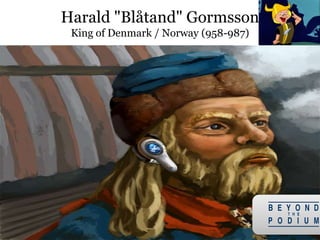
 Nickname: blátǫnn - Old Norse, or Blåtand – Danish means Bluetooth
 Usual explanation: Bad tooth that appeared "blue" (means dark)
 Wore blue -being most expensive, thus underlying his royalty
 Famous for uniting disparate tribes and converting Danes to Christianity
 Found a way to make communicate between groups that previously
refused to connect with one another
Harald "Blåtand" Gormsson
King of Denmark / Norway (958-987)
27
 Runic initials for Harald: “H” (Hagall) and “B” (Bjarkan)
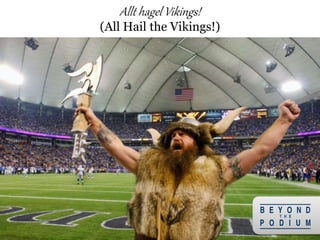
Allt hagel Vikings!
(All Hail the Vikings!)
28
29
Remember!
it takes a Viking to
Raze a Village
The End
30

Vikings raiders

  • 2.
  • 3.
    Prepare to beCulturally Enriched! 3
  • 4.
    Vikings Demographics  Scandinavia(Denmark, Norway, Sweden).  North of the Arctic Zone called Lapps, or more correctly the Saami  Scandinavia is home to just 17 million people  Denmark – 5 million  Norway – 4 million  Sweden – 8 million  Skeletons reveal average height for men of around 5’8”, women 5’3”  50% of children died before their tenth birthday  Majority had made it to between 35-55 years of age. 4
  • 5.
    5 Sailed North Atlantic,reaching south to North Africa and east to Russia, Constantinople and the Middle East – A nasty, unpleasant, brutish lot!  Viking comes from the Old Norse word "vik" (bay or creek) which formed the root of “Vikingr”, Pirate or Sea Warrior!  “Berserkers” (berserkr) was a Viking who wore bear or wolf skins and howled in battle like wild animals!  Good to die in battle - best chance of going to Valhalla (didn’t want to die of old age) Vikings Viking Age (800 to 1066 AD)
  • 6.
    6  Practiced giftexchange with allies, and traded for profit with foreigners, taking by force what they could not buy.  Norsemen saw little difference between trading and plunder  Exploited their superiority in warfare and sailing technology  Culture clash between the Pagan Norsemen and predominantly Christian European Traders  Bottom line – like all explores sought wealth and fame! https://www.facebook.com/TribesPeople/videos/1671348653124505/ Vikings Viking Age (800 to 1066 AD)
  • 7.
    7  Population explosion:Exceeded agricultural potential of homeland?  Youth Bulge: Eldest son customarily inherited family's entire estate  Selective procreation: Motive for emigration was to acquire wives  Staleness of old trade routes: A need to seek out new profitable ones  Fall of Roman Empire (5th C) / expansion of Islam (7th C), opportunities were reduced in Europe by redirecting resources along the Silk road  Mediterranean trade lowest in history when Vikings began expansion  Founded new trade routes in Arabic and Frankish lands took control of Frisians trade markets Expansion/Migration
  • 8.
    Vikings 8  First noticedduring the 8th century when “Vikings” travelled by sea from all of Scandinavia  Swedes went east:  Opened up Russia  Danes went southwest:  Conquered England and raided the French coast  Norse travelled northwest:  Conquered Ireland and settled Iceland, Greenland and Newfoundland
  • 9.
  • 10.
    Vikings From theNorth East Raiders 10
  • 11.
     Maritime blitzkrieg:Unprovoked aggression and from the sea  No respect for religious institutions, which were often left unguarded and vulnerable near the shore  Churches were repositories of treasure to loot  Stole anything and everything they could  Cattle, money, food and women, burn down settlements and left a trail of destruction  Vikings, returned over and over again refused to leave places alone  Vikings attacked in hit-and-run raids against coastal targets in the British Isles (particularly Ireland) and Europe Maritime Blitzkrieg Tactics
  • 12.
    Raid on Lindisfarne AD793: Church of St. Cuthbert 12 Attack on Lindisfarne in Northumberland marked beginning of the Viking Age “Never before has such terror appeared in Britain as we have now suffered from a pagan race ... The heathens poured out the blood of saints around the altar, and trampled on the bodies of saints in the temple of God, like dung in the streets.” Alcuin, a Northumbrian scholar in Charlemagne's court (Killeen, Richard (2012), A Brief History of Ireland)
  • 13.
    Vikings Raiders 799: Islandmonastery of St Philibert’s on Noirmoutier, near the Loire River was attacked (European continent) Politically, they took advantage of internal conflicts in Europe to extend their activity further inland:  840: After death of Louis the Pious, (emperor of Frankia), his son Lothar invited support of Vikings in a power struggle with brothers  Vikings soon realized that Frankish rulers would pay them handsomely to prevent them from attacking their subjects, making Frankia an irresistible target for further Viking activity. 13
  • 14.
    St Philibert’s onNoirmoutier 14
  • 15.
    15 850- 950: Vikingsestablish permanent settlements in Ireland, Northumbria and East Anglia and on the mouth of the Seine.  Viking towns like Dublin and York became important trading centers  By 9th century Viking expansion was so widespread in England that ‘Danelaw’ came to dominate the British Isles. Viking Raids
  • 16.
  • 17.
    17 795: Earliest recordedViking raid on Ireland  Annals of Ulster record the 'burning of Rechru by the Heathens’ (location vague). 840: Built naval encampments (longphorts) to winter  Dublin, Cork, Waterford, Wexford and Limerick began life as longphorts Viking Raids - Ireland Norse : Norway and Denmark
  • 18.
    Viking Raids -Europe 18 834: Raid on Dorestad (80 km from North Sea)  Danes began attacks on the Carolingian empire, east coast of Britain 840: Southampton was sacked 842: London 842: Penetrated Seine and established a base on Noirmoutier near mouth of the Loire 845: Sacked Hamburg and Paris 848: Bordeaux Dorestad: Located near the Netherland town of Wijk bij Duurstede
  • 19.
    19 844: Viking fleetraided Iberian peninsula and attacked Lisbon and Seville 858 -862: Raided northern Mediterranean and African coast.  Sacked: Nimes & Arles, raided along the Rhône to Valence, Pisa and other Italian towns Viking Raids -Med
  • 20.
    Thralls (i.e. Slav’s, akaSlaves)  Dublin was used by Vikings as a holding point for captives en-route to markets elsewhere 871: Annals record the arrival from Scotland of a feet of 200 ships loaded to the gunwales with “Angles, Britons and Picts”  Thousands of men, women and children gathered from homes all over the British Isles  In a single raid on Armagh, Vikings slavers collected 710 men, women and children 20
  • 21.
    End of anEra?  Regarded as ending around 1050 with conversion of Nordic countries to Christianity  Invasion of England by Harald Harorad (stern ruler), King of Norway, defeated by English King Harold Godwinson at Stamford Bridge in 1066  Days later William the Conqueror, Duke of Normandy, landed on England’s south coast, defeated King Harold Godwinson at Battle of Hastings and became the first Norman king of England 21
  • 22.
     Dublin foundedin 841 - Dubh Lin (Black pool)  Vikings referred to Africans as Blamadr (Bluemen) because Norsemen had no distinction between the color Blue and Black  Around 911: Charles the Simple, King of France ceded the town of Rouen, with a vast area of surrounding territory to a Viking Leader named Rollo  This was the land of the Northmen – Nor manni- that we know today as Normandy  William the Conqueror was a descendent of those Vikings 22 Useless Male Trivia (U.M.T)
  • 23.
    U.M.T Old Norse Wordsused Today anger angr (=“trouble, affliction") awe agi (=“terror") die deyja (="pass away") egg egg (="egg") guest gestr (="guest") gun Gunnhildr (= “female name, elements name, gunn and hildr, mean "war and/or battle”) lad ladd (="young man") Ransack rannsaka (="to search the house") saga saga (="story, tale") skill skil (="distinction") skull skulle (="head") Slaughter slahtr (="butchering") Thursday Þorsdagr (="Thor's day") troll troll (="giant, friend, demon”) ugly uggligr (="Dreadfull, repulsive") yule jól (="A feast upon winter solstice, later appropriated by Christianity.") 23
  • 24.
    24 991-1018: Kings ofEngland paid Viking invaders 2.8 million Troy oz in silver coins as tribute  Today more Anglo-Saxon silver coins are in Denmark than England  Brunette Vikings would use soap with high Lye content to bleach their hair  No horned helmets – image dates back to the 1800s, when Swedish Artists included the headgear in their portrayals of the raiders  Wagner staged his “Der Ring des Nibelungen” in the 1870s, costume designer Carl Emil Doepler created horned helmets for Viking characters U.M.T
  • 25.
    25  Four ofour days of the week are derive from Old Norse language and culture  Tuesday: Is “Tyr’s day” - Tyr being the Norse god of heroic glory  Wednesday: Is “Wodin’s Day” an Anglo spelling of Odin’s day  Thursday: Is “Thor’s day”  Friday: Is “Freyja’s day,” (meaning The Lady) being goddess of love, fertility and magic. U.M.T
  • 26.
    26 43. Well, atleast you always have it with you The Vikings used their own urine to start fires. They would boil touchwood, a tree fungus, with their own urine for a few days. The sodium nitrate from the urine combined with the touchwood produced a highly combustible substance that came in handy when they were raiding. U.M.T
  • 27.
     Nickname: blátǫnn- Old Norse, or Blåtand – Danish means Bluetooth  Usual explanation: Bad tooth that appeared "blue" (means dark)  Wore blue -being most expensive, thus underlying his royalty  Famous for uniting disparate tribes and converting Danes to Christianity  Found a way to make communicate between groups that previously refused to connect with one another Harald "Blåtand" Gormsson King of Denmark / Norway (958-987) 27  Runic initials for Harald: “H” (Hagall) and “B” (Bjarkan)
  • 28.
    Allt hagel Vikings! (AllHail the Vikings!) 28
  • 29.
    29 Remember! it takes aViking to Raze a Village
  • 30.