The Value—and Limits—of
Distributive Justice in
Information Privacy
Digital Sociology Mini-conference
Eastern Sociological Society
March 19, 2016
JEFFREY ALAN JOHNSON
INTERIM DIRECTOR
INSTITUTIONAL EFFECTIVENESS & PLANNING
UTAH VALLEY UNIVERSITY
Justice and
Information
Privacy
@the_other_jeff
“The findings and the
theories that emerged
have often relied on
overlapping constructs
nestled within loosely
bounded nomological
networks. This has
resulted in a
suboptimal cumulative
contribution to
knowledge.”
(Smith, Dinev, & Xu
2011)
Justice and
Information
Privacy
@the_other_jeff
“The findings and the
theories that emerged
have often relied on
overlapping constructs
nestled within loosely
bounded nomological
networks. This has
resulted in a
suboptimal cumulative
contribution to
knowledge.”
(Smith, Dinev, & Xu
2011)
Privacy, however,
is a concept in
disarray. Nobody
can articulate
what it means.
(Solove 2008)
Justice and
Information
Privacy
@the_other_jeff
The question behind this paper is
whether we can bring coherence by
viewing information privacy as a
question of justice. David Schlosberg,
for example, made important strides in
environmental justice by taking the
underlying theory of justice seriously.
The underlying theory of justice is even
more implicit in information privacy, and
thus stands to gain even more from
analysis.
Privacy as
an
Instrument
of Justice
@the_other_jeff
“That social norm is
just something that
has evolved over
time.”
“Privacy as we knew it
in the past is no longer
feasible.”
“I trade my privacy for
the convenience.”
Title IV or ADEA: Case
law protections on
information collection.
ADA or GINA:
Statutory protections
but with exceptions for
legitimate uses.
Privacy as
an
Instrument
of Justice
@the_other_jeff
Privacy can be dead—it can be traded for
convenience, abandoned because it is impractical,
evolve out of existence—because it is not justice in
itself; rather it simply contributes to the pursuit of
justice in other areas. If information privacy is no
longer feasible or has evolved out of existence, then
one simply looks elsewhere for such protections—a
belief that one’s own virtue upholds a system of
perfect meritocracy, perhaps? But this does not
undermine the value of privacy; e.g., the privacy of
GitHub contributors clearly supports more equitable
outcomes. We want to study this but we need more
that just instrumental theories.
Most privacy theories
protect privacy by
controlling the flow
of information to
other parties, i.e.,
by distributing it.
Information
Privacy as a
Distributive
Question
@the_other_jeff
“Access to individually
identifiable personal
information”
“The ability of the
individual to protect
information about
himself “
Information
Privacy as a
Distributive
Question
@the_other_jeff
If the purpose of privacy is to distribute
information, then justice in information
privacy must be to distribute it well.
From the perspective of most theories
of information privacy, then, privacy is a
question of distributive justice. Hence if
we can build a coherent theory of
distributive justice in information then
that would protect privacy.
Process-
Oriented
Distributive
Justice
@the_other_jeff
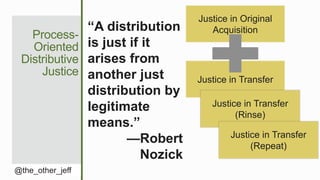
“A distribution
is just if it
arises from
another just
distribution by
legitimate
means.”
—Robert
Nozick
Justice in Original
Acquisition
Justice in Transfer
Justice in Transfer
(Rinse)
Justice in Transfer
(Repeat)
Consent in
Process-
Distributive
Privacy
@the_other_jeff
Justice in
transfer
requires a
more
robust
principle of
consent
than “caveat
emptor.”
Privacy Policies and
Terms of Service
Agreements
Consent in
Process-
Distributive
Privacy
@the_other_jeff
The Apple iTunes Terms of Service (2015)
agreement, for example, runs nearly 21,000 words,
suggesting a reading time of between 98 and 136
minutes without accounting for the difficulty of the
text. It has a Flesch-Kincaid Grade Level score of
16—a college graduate—and a Flesch Reading
Ease score of 31.4, putting it above the reading
comprehension level of the more than 70% of
Americans without a bachelor’s degree.
Consent in
Process-
Distributive
Privacy
@the_other_jeff
Justice in
transfer
requires a
more
robust
principle of
consent
than “caveat
emptor.”
Privacy Policies and
Terms of Service
Agreements
FERPA
HIPAA Privacy Rule
Consent in
Process-
Distributive
Privacy
@the_other_jeff
Process-
distributive
privacy
requires a
principle of
justice in
original
acquisition.
Educational Data
Creation and
Collection
Pattern-
Oriented
Distributive
Justice
@the_other_jeff
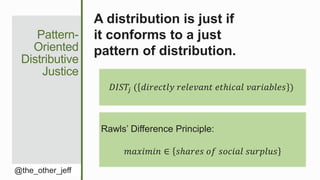
A distribution is just if
it conforms to a just
pattern of distribution.
𝐷𝐼𝑆𝑇𝑗 ( 𝑑𝑖𝑟𝑒𝑐𝑡𝑙𝑦 𝑟𝑒𝑙𝑒𝑣𝑎𝑛𝑡 𝑒𝑡ℎ𝑖𝑐𝑎𝑙 𝑣𝑎𝑟𝑖𝑎𝑏𝑙𝑒𝑠 )
Rawls’ Difference Principle:
𝑚𝑎𝑥𝑖𝑚𝑖𝑛 ∈ 𝑠ℎ𝑎𝑟𝑒𝑠 𝑜𝑓 𝑠𝑜𝑐𝑖𝑎𝑙 𝑠𝑢𝑟𝑝𝑙𝑢𝑠
Pattern-
Oriented
Distributive
Justice
@the_other_jeff
While process is important to some pattern
theories of distributive justice, in those theories
the process is usually instrumental to either
reach or justify a particular pattern of
distribution. Rawls’ original position and veil of
ignorance are well-known procedural solutions
to the problem of how to ensure that
individuals choosing principles of justice will do
so without regard for their own interests. But
Rawls is clear that the original position is
intended to justify a set of distributive
principles.
Distributing
Rights to
Information
Privacy
@the_other_jeff
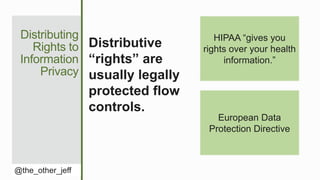
Distributive
“rights” are
usually legally
protected flow
controls.
HIPAA “gives you
rights over your health
information.”
European Data
Protection Directive
Distributing
Rights to
Information
Privacy
@the_other_jeff
In order for information privacy rights to
work distributively, you already need a
theory of information privacy to
operationalize and delineate, e.g., how
to interpret Riley v. California beyond
the search incident to arrest rule?
Distributing
Rights vs.
Distributing
Information
@the_other_jeff
Process and
Pattern suggest
different
solutions to
privacy vs.
open data
challenge.
Just transfer of a
universal & inalienable
right is trivial.
Distributive justice for
a non-scarce good
that must be restricted
is a novel problem.
Beyond
Distributive
Privacy
@the_other_jeff
Distributive
justice misses
the structural
conditions of
distribution
Target operates (in) a
political economy of
information marked by
inequality.
Information is itself
constituted by
translation regimes.
Beyond
Distributive
Privacy
@the_other_jeff
Clearly, the exchange of information between consumers
and suppliers is not equitable, as large corporations do not in
the same transaction generally reveal to customers detailed
information regarding their internal structure or operations. . .
. [I]t is this very inequality in the relationship between
consumers and suppliers of goods and services in the
marketplace that compels individuals to provide personal
information. The ability of the producer or supplier to set the
terms of the contract that the consumer can only accept or
decline defines the transaction as inherently inequitable. . . .
The consumer is ultimately a “contract taker, rather than a
contract maker,” and thus provides the information in the
belief that it represents a reasonable transaction cost. . . .
[I]ndividuals are not necessarily aware of the degree of
inequalities in their relationship with suppliers because
marketers and advertisers have effectively concealed the
consumerist Panopticon. (Campbell and Carlson 2002, 591–
592)
Beyond
Distributive
Privacy
@the_other_jeff
Non-material goods are relations
that shape action, not things.
Greene, 2010:
A person enjoys political obscurity when she can
go about her day as she so chooses without
others perceiving or otherwise determining the
nature of her political views. The politically
obscure person is able to control and manage
the extent of disassociation from the political
views she holds (or once held) or political
actions taken in the present and in the past.
Beyond
Distributive
Privacy
@the_other_jeff
When Greene translates this concept into a right
that can be distributed, the language of action,
and in fact the actors involved, disappear.
Rather than controlling and managing, the
person simply “exist[s]”; the others actively trying
to know and influence her political views become
a passive, impersonal occurrence that happens
to a person. A right that is possessed gives no
consideration to what one might do with such a
right; it is merely passed out and its recipients
wished the best of luck.
Political obscurity therefore describes a broader right
than anonymity: it is the fundamental right to exist
without one's political preferences being
continuously recorded and, consistent with the right
articulated in Reporters Committee, a right against
state-facilitated cataloguing of one's political
preferences.
Beyond
Distributive
Privacy
@the_other_jeff
Non-material goods are relations
that shape action, not things.
Greene, 2010:
Structural
Privacy and
Gamergate
@the_other_jeff
The problem
in Gamergate
is not unequal
privacy but
silencing and
power.
Anita Sarkeesian is
everything wrong with the
feminist woman, and she is
going to die screaming like
the craven little whore that
she is if you let her come to
USU. I will write my
manifesto in her spilled
blood, and you will all bear
witness to what feminist lies
and poison have done to the
men of America.
Structural
Privacy and
Gamergate
@the_other_jeff
The threats directed toward Quinn, Wu, and Sarkeesian
were not just insults meant to hurt their feelings.
Gamergate depends critically on the structure of gender
relations. It began when Quinn’s ex-boyfriend, in a
lengthy diatribe, accused her of being sexually
unfaithful, it peaked when someone still unidentified
threatened to massacre “the craven little whore” who
has poisoned the men of America. Doxing them was a
threat intended to silence them and maintain a system
of structural power that favors men, one that was, due
to the legally enshrined hyper-masculine culture of Utah
that treats carrying a gun as the sine qua non of
manhood, successful in at least Sarkeesian’s case.
These three women’s information privacy was violated
not simply in that personal information was distributed
improperly but because information about them was
used as a tool of domination and oppression.
Toward
Structural
Information
Justice
@the_other_jeff
What if the real (and much more difficult to
document) harm befell those who did not—or
would not—sign the petition? What if the harm in
releasing petition names is not to activists being
mooned or shouted at as they advocate publicly
for their cause? What if the real privacy victim is
a mother of two, passing a petition circulator
entering the grocery store, fearful that signing a
petition—even for a cause in which she very
much believes—might create a lifelong indelible
association with that cause on her Internet
record? (Greene 2010)
Further
Information
@the_other_jeff
Jeffrey Alan Johnson
Interim Director,
Institutional Effectiveness & Planning
Utah Valley University
jeffrey.johnson@uvu.edu
@the_other_jeff
Full paper available at
http://ssrn.com/abstract=2747177

The Value-and Limits-of Distributive Justice in Information Privacy

  • 1.
    The Value—and Limits—of DistributiveJustice in Information Privacy Digital Sociology Mini-conference Eastern Sociological Society March 19, 2016 JEFFREY ALAN JOHNSON INTERIM DIRECTOR INSTITUTIONAL EFFECTIVENESS & PLANNING UTAH VALLEY UNIVERSITY
  • 2.
    Justice and Information Privacy @the_other_jeff “The findingsand the theories that emerged have often relied on overlapping constructs nestled within loosely bounded nomological networks. This has resulted in a suboptimal cumulative contribution to knowledge.” (Smith, Dinev, & Xu 2011)
  • 3.
    Justice and Information Privacy @the_other_jeff “The findingsand the theories that emerged have often relied on overlapping constructs nestled within loosely bounded nomological networks. This has resulted in a suboptimal cumulative contribution to knowledge.” (Smith, Dinev, & Xu 2011) Privacy, however, is a concept in disarray. Nobody can articulate what it means. (Solove 2008)
  • 4.
    Justice and Information Privacy @the_other_jeff The questionbehind this paper is whether we can bring coherence by viewing information privacy as a question of justice. David Schlosberg, for example, made important strides in environmental justice by taking the underlying theory of justice seriously. The underlying theory of justice is even more implicit in information privacy, and thus stands to gain even more from analysis.
  • 5.
    Privacy as an Instrument of Justice @the_other_jeff “Thatsocial norm is just something that has evolved over time.” “Privacy as we knew it in the past is no longer feasible.” “I trade my privacy for the convenience.” Title IV or ADEA: Case law protections on information collection. ADA or GINA: Statutory protections but with exceptions for legitimate uses.
  • 6.
    Privacy as an Instrument of Justice @the_other_jeff Privacycan be dead—it can be traded for convenience, abandoned because it is impractical, evolve out of existence—because it is not justice in itself; rather it simply contributes to the pursuit of justice in other areas. If information privacy is no longer feasible or has evolved out of existence, then one simply looks elsewhere for such protections—a belief that one’s own virtue upholds a system of perfect meritocracy, perhaps? But this does not undermine the value of privacy; e.g., the privacy of GitHub contributors clearly supports more equitable outcomes. We want to study this but we need more that just instrumental theories.
  • 7.
    Most privacy theories protectprivacy by controlling the flow of information to other parties, i.e., by distributing it. Information Privacy as a Distributive Question @the_other_jeff “Access to individually identifiable personal information” “The ability of the individual to protect information about himself “
  • 8.
    Information Privacy as a Distributive Question @the_other_jeff Ifthe purpose of privacy is to distribute information, then justice in information privacy must be to distribute it well. From the perspective of most theories of information privacy, then, privacy is a question of distributive justice. Hence if we can build a coherent theory of distributive justice in information then that would protect privacy.
  • 9.
    Process- Oriented Distributive Justice @the_other_jeff “A distribution is justif it arises from another just distribution by legitimate means.” —Robert Nozick Justice in Original Acquisition Justice in Transfer Justice in Transfer (Rinse) Justice in Transfer (Repeat)
  • 10.
    Consent in Process- Distributive Privacy @the_other_jeff Justice in transfer requiresa more robust principle of consent than “caveat emptor.” Privacy Policies and Terms of Service Agreements
  • 11.
    Consent in Process- Distributive Privacy @the_other_jeff The AppleiTunes Terms of Service (2015) agreement, for example, runs nearly 21,000 words, suggesting a reading time of between 98 and 136 minutes without accounting for the difficulty of the text. It has a Flesch-Kincaid Grade Level score of 16—a college graduate—and a Flesch Reading Ease score of 31.4, putting it above the reading comprehension level of the more than 70% of Americans without a bachelor’s degree.
  • 12.
    Consent in Process- Distributive Privacy @the_other_jeff Justice in transfer requiresa more robust principle of consent than “caveat emptor.” Privacy Policies and Terms of Service Agreements FERPA HIPAA Privacy Rule
  • 13.
    Consent in Process- Distributive Privacy @the_other_jeff Process- distributive privacy requires a principleof justice in original acquisition. Educational Data Creation and Collection
  • 14.
    Pattern- Oriented Distributive Justice @the_other_jeff A distribution isjust if it conforms to a just pattern of distribution. 𝐷𝐼𝑆𝑇𝑗 ( 𝑑𝑖𝑟𝑒𝑐𝑡𝑙𝑦 𝑟𝑒𝑙𝑒𝑣𝑎𝑛𝑡 𝑒𝑡ℎ𝑖𝑐𝑎𝑙 𝑣𝑎𝑟𝑖𝑎𝑏𝑙𝑒𝑠 ) Rawls’ Difference Principle: 𝑚𝑎𝑥𝑖𝑚𝑖𝑛 ∈ 𝑠ℎ𝑎𝑟𝑒𝑠 𝑜𝑓 𝑠𝑜𝑐𝑖𝑎𝑙 𝑠𝑢𝑟𝑝𝑙𝑢𝑠
  • 15.
    Pattern- Oriented Distributive Justice @the_other_jeff While process isimportant to some pattern theories of distributive justice, in those theories the process is usually instrumental to either reach or justify a particular pattern of distribution. Rawls’ original position and veil of ignorance are well-known procedural solutions to the problem of how to ensure that individuals choosing principles of justice will do so without regard for their own interests. But Rawls is clear that the original position is intended to justify a set of distributive principles.
  • 16.
    Distributing Rights to Information Privacy @the_other_jeff Distributive “rights” are usuallylegally protected flow controls. HIPAA “gives you rights over your health information.” European Data Protection Directive
  • 17.
    Distributing Rights to Information Privacy @the_other_jeff In orderfor information privacy rights to work distributively, you already need a theory of information privacy to operationalize and delineate, e.g., how to interpret Riley v. California beyond the search incident to arrest rule?
  • 18.
    Distributing Rights vs. Distributing Information @the_other_jeff Process and Patternsuggest different solutions to privacy vs. open data challenge. Just transfer of a universal & inalienable right is trivial. Distributive justice for a non-scarce good that must be restricted is a novel problem.
  • 19.
    Beyond Distributive Privacy @the_other_jeff Distributive justice misses the structural conditionsof distribution Target operates (in) a political economy of information marked by inequality. Information is itself constituted by translation regimes.
  • 20.
    Beyond Distributive Privacy @the_other_jeff Clearly, the exchangeof information between consumers and suppliers is not equitable, as large corporations do not in the same transaction generally reveal to customers detailed information regarding their internal structure or operations. . . . [I]t is this very inequality in the relationship between consumers and suppliers of goods and services in the marketplace that compels individuals to provide personal information. The ability of the producer or supplier to set the terms of the contract that the consumer can only accept or decline defines the transaction as inherently inequitable. . . . The consumer is ultimately a “contract taker, rather than a contract maker,” and thus provides the information in the belief that it represents a reasonable transaction cost. . . . [I]ndividuals are not necessarily aware of the degree of inequalities in their relationship with suppliers because marketers and advertisers have effectively concealed the consumerist Panopticon. (Campbell and Carlson 2002, 591– 592)
  • 21.
    Beyond Distributive Privacy @the_other_jeff Non-material goods arerelations that shape action, not things. Greene, 2010: A person enjoys political obscurity when she can go about her day as she so chooses without others perceiving or otherwise determining the nature of her political views. The politically obscure person is able to control and manage the extent of disassociation from the political views she holds (or once held) or political actions taken in the present and in the past.
  • 22.
    Beyond Distributive Privacy @the_other_jeff When Greene translatesthis concept into a right that can be distributed, the language of action, and in fact the actors involved, disappear. Rather than controlling and managing, the person simply “exist[s]”; the others actively trying to know and influence her political views become a passive, impersonal occurrence that happens to a person. A right that is possessed gives no consideration to what one might do with such a right; it is merely passed out and its recipients wished the best of luck.
  • 23.
    Political obscurity thereforedescribes a broader right than anonymity: it is the fundamental right to exist without one's political preferences being continuously recorded and, consistent with the right articulated in Reporters Committee, a right against state-facilitated cataloguing of one's political preferences. Beyond Distributive Privacy @the_other_jeff Non-material goods are relations that shape action, not things. Greene, 2010:
  • 24.
    Structural Privacy and Gamergate @the_other_jeff The problem inGamergate is not unequal privacy but silencing and power. Anita Sarkeesian is everything wrong with the feminist woman, and she is going to die screaming like the craven little whore that she is if you let her come to USU. I will write my manifesto in her spilled blood, and you will all bear witness to what feminist lies and poison have done to the men of America.
  • 25.
    Structural Privacy and Gamergate @the_other_jeff The threatsdirected toward Quinn, Wu, and Sarkeesian were not just insults meant to hurt their feelings. Gamergate depends critically on the structure of gender relations. It began when Quinn’s ex-boyfriend, in a lengthy diatribe, accused her of being sexually unfaithful, it peaked when someone still unidentified threatened to massacre “the craven little whore” who has poisoned the men of America. Doxing them was a threat intended to silence them and maintain a system of structural power that favors men, one that was, due to the legally enshrined hyper-masculine culture of Utah that treats carrying a gun as the sine qua non of manhood, successful in at least Sarkeesian’s case. These three women’s information privacy was violated not simply in that personal information was distributed improperly but because information about them was used as a tool of domination and oppression.
  • 26.
    Toward Structural Information Justice @the_other_jeff What if thereal (and much more difficult to document) harm befell those who did not—or would not—sign the petition? What if the harm in releasing petition names is not to activists being mooned or shouted at as they advocate publicly for their cause? What if the real privacy victim is a mother of two, passing a petition circulator entering the grocery store, fearful that signing a petition—even for a cause in which she very much believes—might create a lifelong indelible association with that cause on her Internet record? (Greene 2010)
  • 27.
    Further Information @the_other_jeff Jeffrey Alan Johnson InterimDirector, Institutional Effectiveness & Planning Utah Valley University jeffrey.johnson@uvu.edu @the_other_jeff Full paper available at http://ssrn.com/abstract=2747177

Editor's Notes

  • #16 While process is important to some pattern theories of distributive justice, in those theories the process is usually instrumental to either reach or justify a particular pattern of distribution. Rawls’ original position and veil of ignorance are well-known procedural solutions to the problem of how to ensure that individuals choosing principles of justice will do so without regard for their own interests. But Rawls is clear that the original position is intended to justify a set of distributive principles.
  • #23 When Greene translates this concept into a right that can be distributed, the language of action, and in fact the actors involved, disappear. Rather than controlling and managing, the person simply “exist[s]”; the others actively trying to know and influence her political views become a passive, impersonal occurrence that happens to a person. A right that is possessed gives no consideration to what one might do with such a right; it is merely passed out and its recipients wished the best of luck.
  • #24 When Greene translates this concept into a right that can be distributed, the language of action, and in fact the actors involved, disappear. Rather than controlling and managing, the person simply “exist[s]”; the others actively trying to know and influence her political views become a passive, impersonal occurrence that happens to a person. A right that is possessed gives no consideration to what one might do with such a right; it is merely passed out and its recipients wished the best of luck.
  • #28 She points, for example, to the publication of signers of a Maryland petition to bring an anti-same sex marriage measure to the ballot by an LGBT newspaper that resulted in one university terminating its chief diversity officer, who had signed the petition, as an example of how a lack of political obscurity undermines the capacity to act politically.