The Usability Perception Scale (UPscale): 
A Measure for Evaluating Feedback Displays 
Beth Karlin 
Transformational Media Lab 
bkarlin@uci.edu 
Rebecca Ford 
Center for Sustainability 
rebecca.ford@otago.ac.nz
Underlying Assumptions 
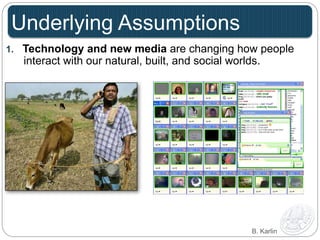
1. Technology and new media are changing how people 
interact with our natural, built, and social worlds. 
B. Karlin
Underlying Assumptions 
1. Technology and new media are changing how people 
interact with our natural, built, and social worlds. 
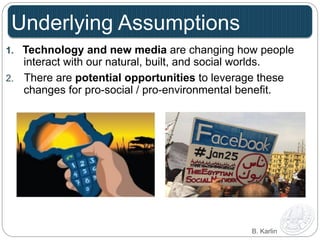
2. There are potential opportunities to leverage these 
changes for pro-social / pro-environmental benefit. 
B. Karlin
Underlying Assumptions 
1. Technology and new media are changing how people 
interact with our natural, built, and social worlds. 
2. There are potential opportunities to leverage these 
changes for pro-social / pro-environmental benefit 
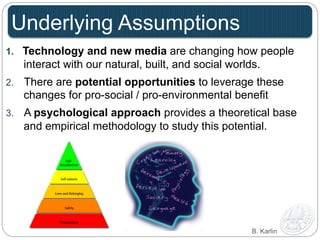
3. A psychological approach provides a theoretical base 
and empirical methodology to study this potential. 
B. Karlin
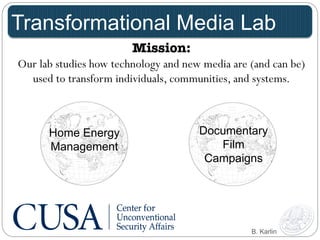
Transformational Media Lab 
Mission: 
Our lab studies how technology and new media are (and can be) 
used to transform individuals, communities, and systems. 
Documentary 
Film 
Campaigns 
Home Energy 
Management 
B. Karlin
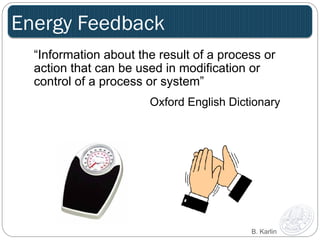
Energy Feedback 
“Information about the result of a process or 
action that can be used in modification or 
control of a process or system” 
Oxford English Dictionary 
B. Karlin
Energy Feedback 
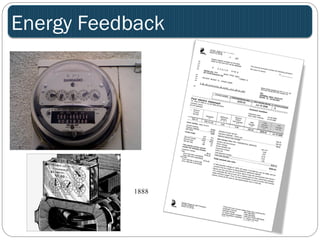
1888
Energy Feedback 
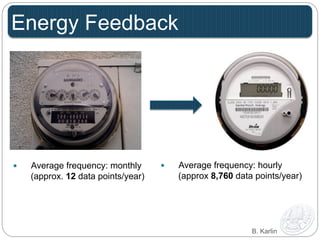
— Average frequency: monthly 
(approx. 12 data points/year) 
— Average frequency: hourly 
(approx 8,760 data points/year) 
B. Karlin
Small changes, big impacts 
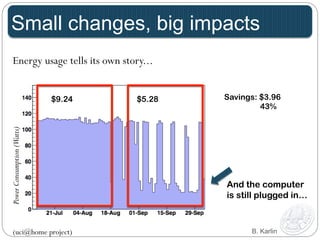
Energy usage tells its own story... 
Power Consumption (Watts) 
$9.24 $5.28 Savings: $3.96 
43% 
And the computer 
is still plugged in… 
B. Karlin 
(uci@home project)
Appliance Disaggregation 
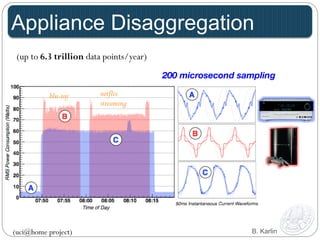
(up to 6.3 trillion data points/year) 
blu-ray netflix 
streaming 
200 microsecond sampling 
(uci@home project) B. Karlin
Savings Add Up 
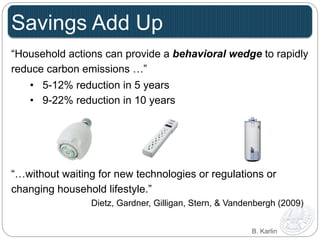
“Household actions can provide a behavioral wedge to rapidly 
reduce carbon emissions …” 
• 5-12% reduction in 5 years 
• 9-22% reduction in 10 years 
“…without waiting for new technologies or regulations or 
changing household lifestyle.” 
Dietz, Gardner, Gilligan, Stern, & Vandenbergh (2009) 
B. Karlin
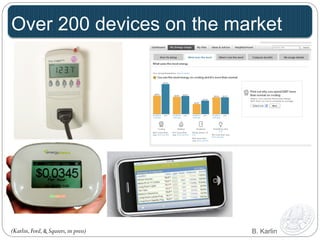
Over 200 devices on the market 
(Karlin, Ford, & Squiers, in press) B. Karlin
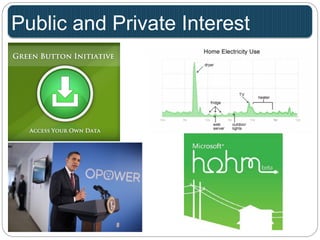
Public and Private Interest 
What are we 
missing?
Feedback is effective… 
— 100+ studies conducted since 1976 
— Reviews found average 10% savings 
— Mean r-effect size = .1174 (p < .001) 
• Significant variability in effects 
(from negative effects to over 20% savings) 
Darby, 2006; Ehrhardt-Martinez et al., 2010; 
Fischer, 2008; Karlin & Zinger, under review B. Karlin
Feedback i✗s c an be effective… 
— 100+ studies conducted since 1976 
— Reviews found average 10% savings 
— Mean r-effect size = .1174 (p < .001) 
• Significant variability in effects 
(from negative effects to over 20% savings) 
Da rby, 2006; Ehrhardt-Martinez et al., 2010; 
Fischer, 2008; Karlin & Zinger, in preparation 
B. Karlin
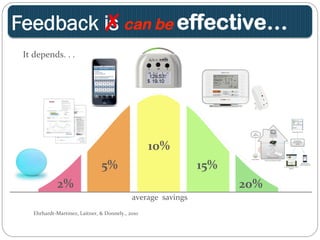
Feedback i✗s c an be effective… 
It 
depends. 
. 
. 
Ehrhardt-­‐Martinez, 
Laitner, 
& 
Donnely., 
2010 
10% 
5% 
15% 
2% 
20% 
average 
savings
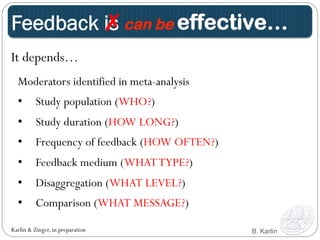
✗ can be effective… 
Feedback is 
It depends… 
Moderators identified in meta-analysis 
• Study population (WHO?) 
• Study duration (HOW LONG?) 
• Frequency of feedback (HOW OFTEN?) 
• Feedback medium (WHAT TYPE?) 
• Disaggregation (WHAT LEVEL?) 
• Comparison (WHAT MESSAGE?) 
Karlin & Zinger, in preparation B. Karlin
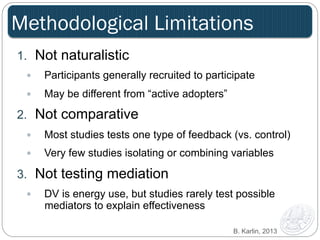
Methodological Limitations 
1. Not naturalistic 
— Participants generally recruited to participate 
— May be different from “active adopters” 
2. Not comparative 
— Most studies tests one type of feedback (vs. control) 
— Very few studies isolating or combining variables 
3. Not testing mediation 
— DV is energy use, but studies rarely test possible 
mediators to explain effectiveness 
B. Karlin, 2013
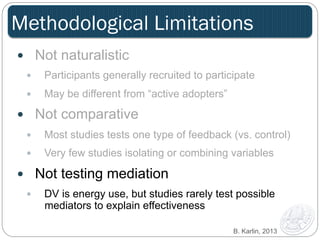
Methodological Limitations 
— Not naturalistic 
— Participants generally recruited to participate 
— May be different from “active adopters” 
— Not comparative 
— Most studies tests one type of feedback (vs. control) 
— Very few studies isolating or combining variables 
— Not testing mediation 
— DV is energy use, but studies rarely test possible 
mediators to explain effectiveness 
B. Karlin, 2013
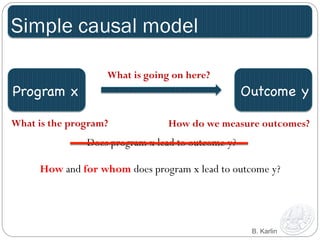
Simple causal model 
What is going on here? 
Program x 
Outcome y 
Does program x lead to outcome y? 
B. Karlin 
What is the program? 
How do we measure outcomes? 
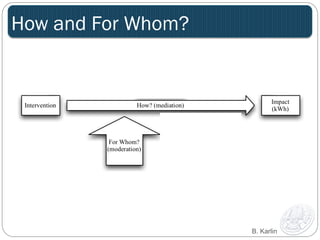
How and for whom does program x lead to outcome y?
How and For Whom? 
B. Karlin
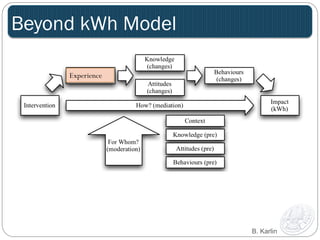
Beyond kWh Model 
B. Karlin 
Experience
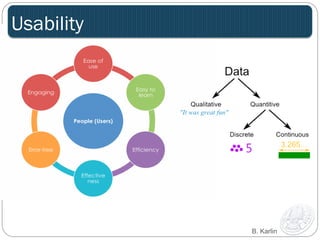
Usability 
B. Karlin
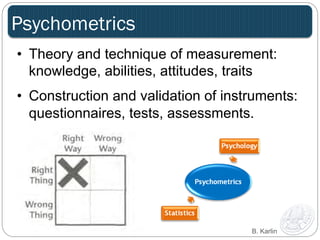
Psychometrics 
• Theory and technique of measurement: 
knowledge, abilities, attitudes, traits 
• Construction and validation of instruments: 
questionnaires, tests, assessments. 
B. Karlin
Psychometrics 
B. Karlin 
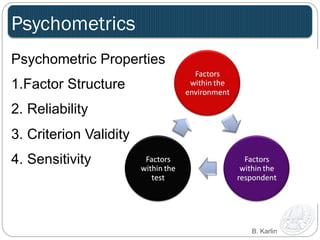
Psychometric Properties 
1. Factor Structure 
2. Reliability 
3. Criterion Validity 
4. Sensitivity
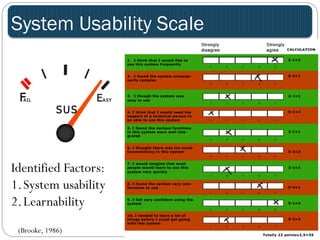
System Usability Scale 
Identified Factors: 
1. System usability 
2. Learnability 
(Brooke, 1986) B. Karlin
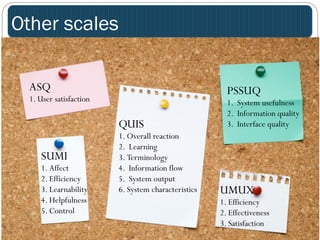
Other scales 
ASQ 
1. User satisfaction 
SUMI 
1. Affect 
2. Efficiency 
3. Learnability 
4. Helpfulness 
5. Control 
PSSUQ 
1. System usefulness 
2. Information quality 
QUIS 3. Interface quality 
1. Overall reaction 
2. Learning 
3. Terminology 
4. Information flow 
5. System output 
6. System characteristics UMUX 
1. Efficiency 
2. Effectiveness 
3. Satisfaction
Identified Limitations 
1. Designed primarily to evaluate products or 
systems rather than info-visualizations 
2. Assessed with metrics primarily associated 
w/ease of use (e.g., learnability) & efficiency. 
Less focus on continued engagement. 
B. Karlin
Identified Needs 
1. Address the unique needs of eco-feedback 
displays (as opposed to systems or products) 
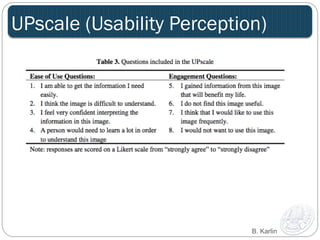
2. Incorporate validated sub-scales for ease of 
use and engagement 
B. Karlin
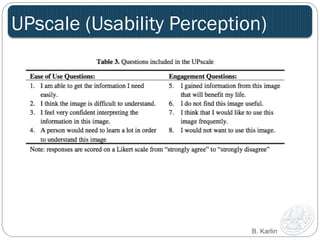
UPscale (Usability Perception) 
B. Karlin
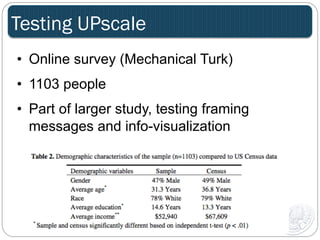
Testing UPscale 
B. Karlin 
• Online survey (Mechanical Turk) 
• 1103 people 
• Part of larger study, testing framing 
messages and info-visualization
Results 
B. Karlin 
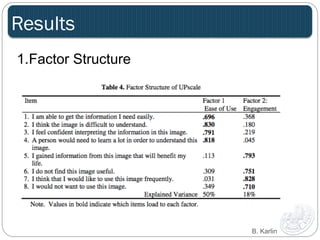
1. Factor Structure 
2. Reliability 
3. Criterion Validity 
4. Sensitivity
Results 
B. Karlin 
1. Factor Structure 
2. Reliability 
3. Criterion Validity 
4. Sensitivity
Results 
B. Karlin 
1. Factor Structure 
2. Reliability 
3. Criterion Validity 
4. Sensitivity 
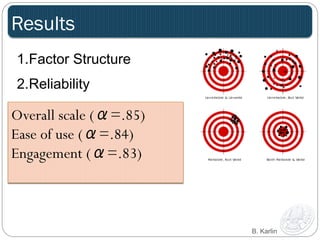
Overall scale (α=.85) 
Ease of use (α=.84) 
Engagement (α=.83)
Results 
B. Karlin 
1. Factor Structure 
2. Reliability 
3. Criterion Validity 
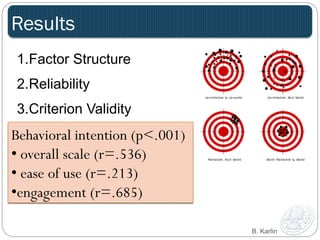
B4e.h Saveinosriatli vinittye ntion (p<.001) 
• overall scale (r=.536) 
• ease of use (r=.213) 
• engagement (r=.685)
Results 
B. Karlin 
1. Factor Structure 
2. Reliability 
3. Criterion Validity 
4. Sensitivity 
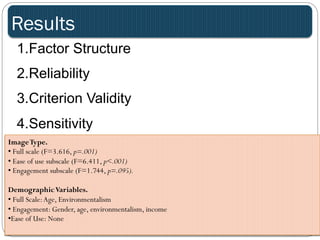
Image Type. 
• Full scale (F=3.616, p=.001) 
• Ease of use subscale (F=6.411, p<.001) 
• Engagement subscale (F=1.744, p=.095). 
Demographic Variables. 
• Full Scale: Age, Environmentalism 
• Engagement: Gender, age, environmentalism, income 
• Ease of Use: None
UPscale (Usability Perception) 
B. Karlin
Closing Thoughts 
“If you do not know how to ask the right question, 
you know nothing.” 
– Edward Deming 
Thank You! 
Beth Karlin 
Transformational Media Lab 
bkarlin@uci.edu 
Rebecca Ford 
Center for Sustainability 
rebecca.ford@otago.ac.nz
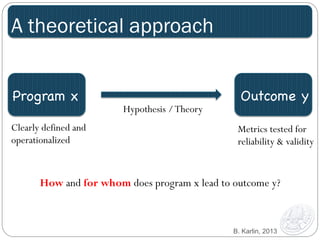
A theoretical approach 
Program x 
Outcome y 
Hypothesis / Theory 
Clearly defined and 
operationalized 
Metrics tested for 
reliability & validity 
How and for whom does program x lead to outcome y? 
B. Karlin, 2013

The Usability Perception Scale (UPscale): A Measure for Evaluating Feedback Displays

  • 1.
    The Usability PerceptionScale (UPscale): A Measure for Evaluating Feedback Displays Beth Karlin Transformational Media Lab bkarlin@uci.edu Rebecca Ford Center for Sustainability rebecca.ford@otago.ac.nz
  • 2.
    Underlying Assumptions 1.Technology and new media are changing how people interact with our natural, built, and social worlds. B. Karlin
  • 3.
    Underlying Assumptions 1.Technology and new media are changing how people interact with our natural, built, and social worlds. 2. There are potential opportunities to leverage these changes for pro-social / pro-environmental benefit. B. Karlin
  • 4.
    Underlying Assumptions 1.Technology and new media are changing how people interact with our natural, built, and social worlds. 2. There are potential opportunities to leverage these changes for pro-social / pro-environmental benefit 3. A psychological approach provides a theoretical base and empirical methodology to study this potential. B. Karlin
  • 5.
    Transformational Media Lab Mission: Our lab studies how technology and new media are (and can be) used to transform individuals, communities, and systems. Documentary Film Campaigns Home Energy Management B. Karlin
  • 6.
    Energy Feedback “Informationabout the result of a process or action that can be used in modification or control of a process or system” Oxford English Dictionary B. Karlin
  • 7.
  • 8.
    Energy Feedback —Average frequency: monthly (approx. 12 data points/year) — Average frequency: hourly (approx 8,760 data points/year) B. Karlin
  • 9.
    Small changes, bigimpacts Energy usage tells its own story... Power Consumption (Watts) $9.24 $5.28 Savings: $3.96 43% And the computer is still plugged in… B. Karlin (uci@home project)
  • 10.
    Appliance Disaggregation (upto 6.3 trillion data points/year) blu-ray netflix streaming 200 microsecond sampling (uci@home project) B. Karlin
  • 11.
    Savings Add Up “Household actions can provide a behavioral wedge to rapidly reduce carbon emissions …” • 5-12% reduction in 5 years • 9-22% reduction in 10 years “…without waiting for new technologies or regulations or changing household lifestyle.” Dietz, Gardner, Gilligan, Stern, & Vandenbergh (2009) B. Karlin
  • 12.
    Over 200 deviceson the market (Karlin, Ford, & Squiers, in press) B. Karlin
  • 13.
    Public and PrivateInterest What are we missing?
  • 14.
    Feedback is effective… — 100+ studies conducted since 1976 — Reviews found average 10% savings — Mean r-effect size = .1174 (p < .001) • Significant variability in effects (from negative effects to over 20% savings) Darby, 2006; Ehrhardt-Martinez et al., 2010; Fischer, 2008; Karlin & Zinger, under review B. Karlin
  • 15.
    Feedback i✗s can be effective… — 100+ studies conducted since 1976 — Reviews found average 10% savings — Mean r-effect size = .1174 (p < .001) • Significant variability in effects (from negative effects to over 20% savings) Da rby, 2006; Ehrhardt-Martinez et al., 2010; Fischer, 2008; Karlin & Zinger, in preparation B. Karlin
  • 16.
    Feedback i✗s can be effective… It depends. . . Ehrhardt-­‐Martinez, Laitner, & Donnely., 2010 10% 5% 15% 2% 20% average savings
  • 17.
    ✗ can beeffective… Feedback is It depends… Moderators identified in meta-analysis • Study population (WHO?) • Study duration (HOW LONG?) • Frequency of feedback (HOW OFTEN?) • Feedback medium (WHAT TYPE?) • Disaggregation (WHAT LEVEL?) • Comparison (WHAT MESSAGE?) Karlin & Zinger, in preparation B. Karlin
  • 18.
    Methodological Limitations 1.Not naturalistic — Participants generally recruited to participate — May be different from “active adopters” 2. Not comparative — Most studies tests one type of feedback (vs. control) — Very few studies isolating or combining variables 3. Not testing mediation — DV is energy use, but studies rarely test possible mediators to explain effectiveness B. Karlin, 2013
  • 19.
    Methodological Limitations —Not naturalistic — Participants generally recruited to participate — May be different from “active adopters” — Not comparative — Most studies tests one type of feedback (vs. control) — Very few studies isolating or combining variables — Not testing mediation — DV is energy use, but studies rarely test possible mediators to explain effectiveness B. Karlin, 2013
  • 20.
    Simple causal model What is going on here? Program x Outcome y Does program x lead to outcome y? B. Karlin What is the program? How do we measure outcomes? How and for whom does program x lead to outcome y?
  • 21.
    How and ForWhom? B. Karlin
  • 22.
    Beyond kWh Model B. Karlin Experience
  • 23.
  • 24.
    Psychometrics • Theoryand technique of measurement: knowledge, abilities, attitudes, traits • Construction and validation of instruments: questionnaires, tests, assessments. B. Karlin
  • 25.
    Psychometrics B. Karlin Psychometric Properties 1. Factor Structure 2. Reliability 3. Criterion Validity 4. Sensitivity
  • 26.
    System Usability Scale Identified Factors: 1. System usability 2. Learnability (Brooke, 1986) B. Karlin
  • 27.
    Other scales ASQ 1. User satisfaction SUMI 1. Affect 2. Efficiency 3. Learnability 4. Helpfulness 5. Control PSSUQ 1. System usefulness 2. Information quality QUIS 3. Interface quality 1. Overall reaction 2. Learning 3. Terminology 4. Information flow 5. System output 6. System characteristics UMUX 1. Efficiency 2. Effectiveness 3. Satisfaction
  • 28.
    Identified Limitations 1.Designed primarily to evaluate products or systems rather than info-visualizations 2. Assessed with metrics primarily associated w/ease of use (e.g., learnability) & efficiency. Less focus on continued engagement. B. Karlin
  • 29.
    Identified Needs 1.Address the unique needs of eco-feedback displays (as opposed to systems or products) 2. Incorporate validated sub-scales for ease of use and engagement B. Karlin
  • 30.
  • 31.
    Testing UPscale B.Karlin • Online survey (Mechanical Turk) • 1103 people • Part of larger study, testing framing messages and info-visualization
  • 32.
    Results B. Karlin 1. Factor Structure 2. Reliability 3. Criterion Validity 4. Sensitivity
  • 33.
    Results B. Karlin 1. Factor Structure 2. Reliability 3. Criterion Validity 4. Sensitivity
  • 34.
    Results B. Karlin 1. Factor Structure 2. Reliability 3. Criterion Validity 4. Sensitivity Overall scale (α=.85) Ease of use (α=.84) Engagement (α=.83)
  • 35.
    Results B. Karlin 1. Factor Structure 2. Reliability 3. Criterion Validity B4e.h Saveinosriatli vinittye ntion (p<.001) • overall scale (r=.536) • ease of use (r=.213) • engagement (r=.685)
  • 36.
    Results B. Karlin 1. Factor Structure 2. Reliability 3. Criterion Validity 4. Sensitivity Image Type. • Full scale (F=3.616, p=.001) • Ease of use subscale (F=6.411, p<.001) • Engagement subscale (F=1.744, p=.095). Demographic Variables. • Full Scale: Age, Environmentalism • Engagement: Gender, age, environmentalism, income • Ease of Use: None
  • 37.
  • 38.
    Closing Thoughts “Ifyou do not know how to ask the right question, you know nothing.” – Edward Deming Thank You! Beth Karlin Transformational Media Lab bkarlin@uci.edu Rebecca Ford Center for Sustainability rebecca.ford@otago.ac.nz
  • 39.
    A theoretical approach Program x Outcome y Hypothesis / Theory Clearly defined and operationalized Metrics tested for reliability & validity How and for whom does program x lead to outcome y? B. Karlin, 2013