THE TIMES ARE A CHANGING
WHY AREN’T OUR ORGANISATIONS?

  A new form of
  organisation is
  emerging - one
  that is better
  suited to the new
  technology and
  uncertainty of the
  times.

  This organisation
  no longer has
  “machine” as its
  dominant form of
  design.


Leaders have indirect roles


Have organisations moved with the times?
Dr Norman Chorn | Centre for Strategy Development |   norman.chorn@centstrat.com | www.centstrat.com | www.normanchorn.com


The history of
technology
It is said that the history of humankindʼs                  In essence, Moody and Nogrady argue that
cultural traditions is the history of technology.           each wave of technology has been
This is, perhaps, a bit too far removed from                accompanied by a different model of
our discussion on organisations. But what if                organisation. The “machine” model has
we consider how the various waves of                        dominated much of the previous waves, but
technology have influenced the shape of                      there is a shift away from the “machine” model
organisations?                                              indicated
                                                            by the present use of information and
Klondratiefʼs work¹, as referenced by Moody                 communication technology.
and Nogrady in their book, The Sixth Wave²,
demonstrates how successive waves of                        Instead, we note that most organisations still
technology have directly impacted on the                    use the “machine” model in their design and
emerging shape of organisations. Technology                 the way they are managed. Why is this? Is it
has influenced both the nature of work and the               simply a reluctance to change? Or were there
dynamics of markets - and this impacted on                  real benefits that derived from the traditional
the resultant shape of organisations operating              machine model?
in those conditions.
                                                            This paper suggests that a move to another
                                                            model may well be imminent.
Waves of technology


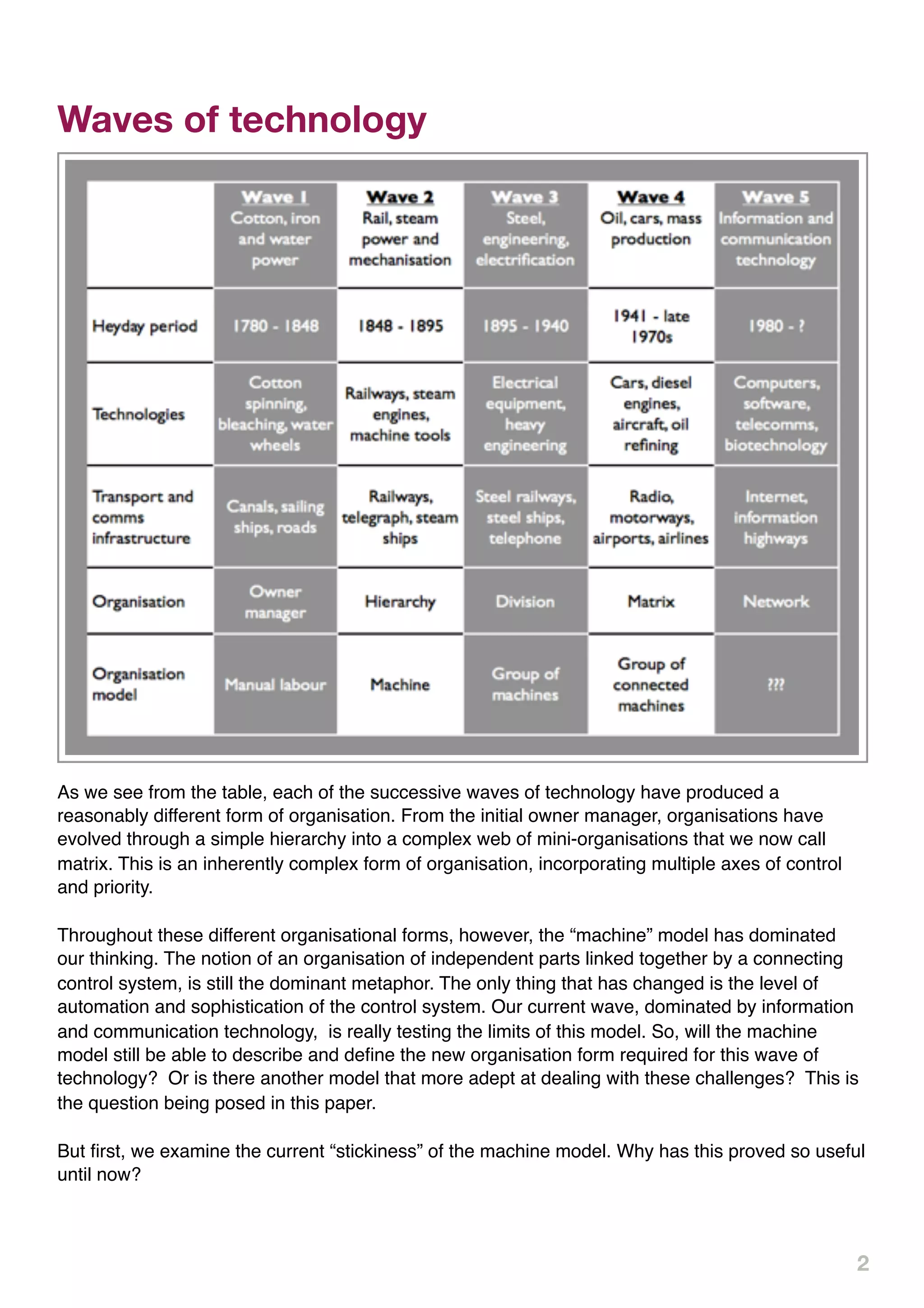
As we see from the table, each of the successive waves of technology have produced a
reasonably different form of organisation. From the initial owner manager, organisations have
evolved through a simple hierarchy into a complex web of mini-organisations that we now call
matrix. This is an inherently complex form of organisation, incorporating multiple axes of control
and priority.

Throughout these different organisational forms, however, the “machine” model has dominated
our thinking. The notion of an organisation of independent parts linked together by a connecting
control system, is still the dominant metaphor. The only thing that has changed is the level of
automation and sophistication of the control system. Our current wave, dominated by information
and communication technology, is really testing the limits of this model. So, will the machine
model still be able to describe and define the new organisation form required for this wave of
technology? Or is there another model that more adept at dealing with these challenges? This is
the question being posed in this paper.

But first, we examine the current “stickiness” of the machine model. Why has this proved so useful
until now?


                                                                                                     2
Benefits of the machine model of
organisation
As we might expect, the machine model of organisation has produced significant benefits for
organisations - and many of these have enabled the advances we have experienced through
the period of the industrial revolution.

The key benefits have included:

   ✓   standardisation - and the resultant benefits of improved efficiency
   ✓   specialisation - resulting in the reduced complexity of tasks
   ✓   goal alignment - enabling leaders to set clear objectives
   ✓   hierarchy - enabling authority to flow from the top of the organisation
   ✓   planning and control - allowing leaders to make forecasts about the future
   ✓   extrinsic rewards - enabling leaders to secure the compliance of people.

The major downside, however, is that these advances have mostly come at the expense of
adaptability. Sadly, the “machine” organisation is proving incompatible with both the
demands of a rapidly changing environment and the possibilities afforded by the new
prevailing technology.

History has shown us any model or species that is incompatible with its environment,
eventually fails and becomes extinct.

So, if the current “machine model” is no longer viable for dealing with prevailing conditions
and technological possibilities, what is? Are there any other models that we might consider as
a basis for designing and building more appropriate organisations?


“Life” as a model for organisation?
In terms of survival and the ability to thrive in difficult conditions, it is hard to go past the
example of life. Despite the ravages of floods, fire, drought, earthquakes and famine, life
continues to flourish and multiply on our planet. Why is this? What are its unique features?
What can we learn about lifeʼs ability to adapt to prevailing conditions that we might apply to
the creation of our organisations?

If we examine biology - the study of life and living organisms - we can identify a number of key
principles that inform our discussion about organisationsʼ ability to adapt to prevailing
conditions and technology.

I have identified five of these principles - and there are many others - and outlined their
implications for the design and creation of modern organisations. Organisations that are better
suited to the current technology and the needs of an uncertain and continuously changing
environment.


                                                                                                   3
WHAT CAN LIFE
TEACH US ABOUT
ORGANISATIONS?


 1. The goal of   The purpose of an organisation is best defined in terms of its
 life is          contribution, or value-add, to its customers. The purpose of an
 reproduction     organisation is NOT to make a profit. Rather, the profitability (or
 and adding       otherwise) of an organisation is an indication of how well it is meeting its
 value to the     purpose of adding value to customers. It is a measure of performance,
 eco-system       not the reason for the performance.

                  This places customer needs at the centre of the organisationʼs design
                  and business model. While functions, business processes and products
                  are important activities within the organisation, they should not be the
                  prime determinant of how the organisation is designed.

                  Since the business definition of an organisation (ie what is the business
                  of this organisation?) is the starting point of any strategy or planning
                  process, the implication is that the organisation should be defined in
                  terms of the outcomes it produces for customers, rather than the
                  products or services it produces. Eg: “our business is solving customersʼ
                  travel problems” rather than “we book airtravel and accommodation for
                  customers”.


 2. Life          Any living organisation - one that remains relevant to the changing
 continuously     environment - will continually be changing form and function in order to
 changes and
                  meet customersʼ needs. There are two key implications of this principle.
 adapts to the
 surrounding
 environment      Firstly, organisations should begin by defining the customer groups that
                  they serve according to the needs and behaviours of these customers.
                  This means using psychographic criteria rather than the traditional
                  demographic segmentation criteria. Eg: we will group our customers by
                  whether they require a customer intimate relationship with a vendor or
                  whether they prefer to deal with a vendor in an armʼs-length manner.


                                                                                                 4
Secondly, organisations will develop specific value-propositions for each
                   of these customer segments. Eg: the “intimate relationship” segment will
                   receive a value proposition that augments the core product with a related
                   service package, while the “armʼs-length” segment will be provided the
                   core product only - usually through a different channel.

3. Species co-     As with life, organisations are usually engaged in a battle for survival
exist by seeking   within a resource constrained environment. In order to survive and thrive,
niches within      organisations need to identify a niche (market segment) within their
their              industry that they plan to serve.
environment,
and then           In order to develop a competitive advantage in this segment of the
differentiating
                   market, they will need to develop a form of positioning that appeals in a
themselves to
                   unique way to the customers in this segment. Positioning refers to the
uniquely suit
                   value proposition and the distinctive capabilities the organisation brings to
that niche. But
this               this segment.
differentiation
always comes at    The important implication is that this positioning comes at a cost to the
a cost             organisation. This cost is usually in the form of set of trade-offs that are
                   made (ie: the competitive advantage is achieved by a focus in a particular
                   space that precludes a simultaneous focus in another).

                   So, the strategy decision to do something is also a decision NOT to do
                   something else. Strategy is about deciding what you will not do as much
                   as it is about what you WILL do.

4. The process     The manner in which organisations adapt to constantly changing
of adaptation is   conditions is much the same as life adapts to a changing environment.
driven by
natural            Adaptation is enabled by natural selection - the process whereby one set
selection.         of attributes proves more effective at coping with prevailing conditions
Natural            than another. Essentially, this is achieved by having a broad diversity of
selection is
                   opinions and capabilities - and then experimenting with these competing
enabled by bio-
                   ideas and views.
diversity,
ongoing
experimentation    Organisations that successfully adapt to changing customer needs do so
and built-in       by ongoing experimentation as well as an element of redundancy. This
redundancy         means that we might attempt several pathways to solving a new
                   customer need before one eventually succeeds. We may even develop
                   several alternative solutions that compete with each other until the
                   optimum is found. In the same way as robust systems have several
                   pathways to a goal, the living organisation has redundant capabilities to
                   address the changing needs in its markets.

                   Importantly, this is achieved by the harnessing of diversity as well as
                   ongoing experimentation.


                                                                                                   5
5. Life does not   Clearly, organisations will not survive for an extended periods in
survive in         extremely hostile environments. In most cases, they seek more
extreme            inhabitable surrounds - ie markets that offer greater opportunity.
conditions -       However, unlike other forms of life, organisations do not always
and does not       respond proactively by seeking other markets when they perceive
give rise to       conditions to be deteriorating. Instead, they often pursue excessive
extreme
                   cost cutting and destroy the very fabric of the organisation - a type of
conditions
                   “anorexia industrialosa”.

                   In addition to making life unbearable for their people (they then leave
                   the organisation), this response only prolongs the agony and often
                   results in a painful demise.

                   The living organisation will be constantly attuned to the changing
                   conditions in the market and recognise the point at which it is no longer
                   capable of supporting viable life. Because of diversity and ongoing
                   experimentation (see 4 above), new opportunities are uncovered before
                   the current market is exhausted, and the ongoing cycle of life can
                   continue.


What does this mean for organisations?
As the uncertainty and volatility in our markets intensify, we may be witnessing the end of
the “machine” era - an era in which we attempted to design and lead our organisations as
if they were machines in which we worked. In order to reap the benefits of adaptation to
the new conditions, we could be looking to the model of “life” with which to create our
organisations.

A model of “life” would guide us in:

1. Defining the overall purpose of the organisation in terms of meeting the needs of
   chosen customer groups

2. Designing and building the organisation around the specific needs and behaviours of
   the key customer groups

3. Positioning the organisation in a unique way by making some specific choices and
   trade-offs so as to achieve competitive advantage in a particular part of the market

4. Accommodating diversity, experimentation and redundancy in the way we lead the
   organisation

5. Proactively seeking out new market opportunities before the current market niche is
   “exhausted” and our unique positioning is eroded.


                                                                                               6
Creating a
 Living
 Organisation


 Leaders
 should ask
 five questions
 of their
 organisations


Questions for leaders
Based on this analysis, I would urge leaders to ask the following questions of their own
organisations:

1. Have you defined a higher purpose for your organisation - one that centres on
   adding value to your customers?

2. Have you designed your organisation around the specific needs of your key
   customer groups? Do you have specific value propositions for each of these
   customer groups and segments?

3. Is your organisation positioned in a way that produces competitive advantage in
   your key markets? Have you made the necessary trade-offs to make this
   positioning sustainable?

4. Do you have the requisite diversity of opinion, capability and personnel in your
   leadership team and management? Do you encourage experimentation and allow
   for planned redundancy?

5. Are you actively exploring new market opportunities while pursuing business as
   usual? Are you attuned to signs of market “exhaustion”?


 !"#$%&'("&)*(+,'-"#.,/"0,'%&)'
 $1&+"#2&3'2&'+/1'4252&3'6#3%&2,%7"&'8'
 -2+/'0%#7(*9%#'#1:1#1&(1'+"'("$091;'%&)'
 (/%991&32&3'0#"<91$,'="*'$%='<1'
                        !"#$%&'("&)*(+,'-"#.,/"0,'%&)'$1&+"#2&3'2&'+/1'
 ,11.2&3'+"'%))#1,,>'?"&+%(+'/2$'"&'
                        4252&3'6#3%&2,%7"&'8'-2+/'0%#7(*9%#'#1:1#1&(1'+"'
 &"#$%&>(/"#&@(1&+,+#%+>("$
                        ("$091;'%&)'(/%991&32&3'0#"<91$,'="*'$%='<1'
                        ,11.2&3'+"'%))#1,,>'?"&+%(+'/2$'"&'
                        &"#$%&>(/"#&@(1&+,+#%+>("$


                                                                                           7

The times are a changing why aren't organisations

  • 1.
    THE TIMES AREA CHANGING WHY AREN’T OUR ORGANISATIONS? A new form of organisation is emerging - one that is better suited to the new technology and uncertainty of the times. This organisation no longer has “machine” as its dominant form of design. Leaders have indirect roles Have organisations moved with the times? Dr Norman Chorn | Centre for Strategy Development | norman.chorn@centstrat.com | www.centstrat.com | www.normanchorn.com The history of technology It is said that the history of humankindʼs In essence, Moody and Nogrady argue that cultural traditions is the history of technology. each wave of technology has been This is, perhaps, a bit too far removed from accompanied by a different model of our discussion on organisations. But what if organisation. The “machine” model has we consider how the various waves of dominated much of the previous waves, but technology have influenced the shape of there is a shift away from the “machine” model organisations? indicated by the present use of information and Klondratiefʼs work¹, as referenced by Moody communication technology. and Nogrady in their book, The Sixth Wave², demonstrates how successive waves of Instead, we note that most organisations still technology have directly impacted on the use the “machine” model in their design and emerging shape of organisations. Technology the way they are managed. Why is this? Is it has influenced both the nature of work and the simply a reluctance to change? Or were there dynamics of markets - and this impacted on real benefits that derived from the traditional the resultant shape of organisations operating machine model? in those conditions. This paper suggests that a move to another model may well be imminent.
  • 2.
    Waves of technology Aswe see from the table, each of the successive waves of technology have produced a reasonably different form of organisation. From the initial owner manager, organisations have evolved through a simple hierarchy into a complex web of mini-organisations that we now call matrix. This is an inherently complex form of organisation, incorporating multiple axes of control and priority. Throughout these different organisational forms, however, the “machine” model has dominated our thinking. The notion of an organisation of independent parts linked together by a connecting control system, is still the dominant metaphor. The only thing that has changed is the level of automation and sophistication of the control system. Our current wave, dominated by information and communication technology, is really testing the limits of this model. So, will the machine model still be able to describe and define the new organisation form required for this wave of technology? Or is there another model that more adept at dealing with these challenges? This is the question being posed in this paper. But first, we examine the current “stickiness” of the machine model. Why has this proved so useful until now? 2
  • 3.
    Benefits of themachine model of organisation As we might expect, the machine model of organisation has produced significant benefits for organisations - and many of these have enabled the advances we have experienced through the period of the industrial revolution. The key benefits have included: ✓ standardisation - and the resultant benefits of improved efficiency ✓ specialisation - resulting in the reduced complexity of tasks ✓ goal alignment - enabling leaders to set clear objectives ✓ hierarchy - enabling authority to flow from the top of the organisation ✓ planning and control - allowing leaders to make forecasts about the future ✓ extrinsic rewards - enabling leaders to secure the compliance of people. The major downside, however, is that these advances have mostly come at the expense of adaptability. Sadly, the “machine” organisation is proving incompatible with both the demands of a rapidly changing environment and the possibilities afforded by the new prevailing technology. History has shown us any model or species that is incompatible with its environment, eventually fails and becomes extinct. So, if the current “machine model” is no longer viable for dealing with prevailing conditions and technological possibilities, what is? Are there any other models that we might consider as a basis for designing and building more appropriate organisations? “Life” as a model for organisation? In terms of survival and the ability to thrive in difficult conditions, it is hard to go past the example of life. Despite the ravages of floods, fire, drought, earthquakes and famine, life continues to flourish and multiply on our planet. Why is this? What are its unique features? What can we learn about lifeʼs ability to adapt to prevailing conditions that we might apply to the creation of our organisations? If we examine biology - the study of life and living organisms - we can identify a number of key principles that inform our discussion about organisationsʼ ability to adapt to prevailing conditions and technology. I have identified five of these principles - and there are many others - and outlined their implications for the design and creation of modern organisations. Organisations that are better suited to the current technology and the needs of an uncertain and continuously changing environment. 3
  • 4.
    WHAT CAN LIFE TEACHUS ABOUT ORGANISATIONS? 1. The goal of The purpose of an organisation is best defined in terms of its life is contribution, or value-add, to its customers. The purpose of an reproduction organisation is NOT to make a profit. Rather, the profitability (or and adding otherwise) of an organisation is an indication of how well it is meeting its value to the purpose of adding value to customers. It is a measure of performance, eco-system not the reason for the performance. This places customer needs at the centre of the organisationʼs design and business model. While functions, business processes and products are important activities within the organisation, they should not be the prime determinant of how the organisation is designed. Since the business definition of an organisation (ie what is the business of this organisation?) is the starting point of any strategy or planning process, the implication is that the organisation should be defined in terms of the outcomes it produces for customers, rather than the products or services it produces. Eg: “our business is solving customersʼ travel problems” rather than “we book airtravel and accommodation for customers”. 2. Life Any living organisation - one that remains relevant to the changing continuously environment - will continually be changing form and function in order to changes and meet customersʼ needs. There are two key implications of this principle. adapts to the surrounding environment Firstly, organisations should begin by defining the customer groups that they serve according to the needs and behaviours of these customers. This means using psychographic criteria rather than the traditional demographic segmentation criteria. Eg: we will group our customers by whether they require a customer intimate relationship with a vendor or whether they prefer to deal with a vendor in an armʼs-length manner. 4
  • 5.
    Secondly, organisations willdevelop specific value-propositions for each of these customer segments. Eg: the “intimate relationship” segment will receive a value proposition that augments the core product with a related service package, while the “armʼs-length” segment will be provided the core product only - usually through a different channel. 3. Species co- As with life, organisations are usually engaged in a battle for survival exist by seeking within a resource constrained environment. In order to survive and thrive, niches within organisations need to identify a niche (market segment) within their their industry that they plan to serve. environment, and then In order to develop a competitive advantage in this segment of the differentiating market, they will need to develop a form of positioning that appeals in a themselves to unique way to the customers in this segment. Positioning refers to the uniquely suit value proposition and the distinctive capabilities the organisation brings to that niche. But this this segment. differentiation always comes at The important implication is that this positioning comes at a cost to the a cost organisation. This cost is usually in the form of set of trade-offs that are made (ie: the competitive advantage is achieved by a focus in a particular space that precludes a simultaneous focus in another). So, the strategy decision to do something is also a decision NOT to do something else. Strategy is about deciding what you will not do as much as it is about what you WILL do. 4. The process The manner in which organisations adapt to constantly changing of adaptation is conditions is much the same as life adapts to a changing environment. driven by natural Adaptation is enabled by natural selection - the process whereby one set selection. of attributes proves more effective at coping with prevailing conditions Natural than another. Essentially, this is achieved by having a broad diversity of selection is opinions and capabilities - and then experimenting with these competing enabled by bio- ideas and views. diversity, ongoing experimentation Organisations that successfully adapt to changing customer needs do so and built-in by ongoing experimentation as well as an element of redundancy. This redundancy means that we might attempt several pathways to solving a new customer need before one eventually succeeds. We may even develop several alternative solutions that compete with each other until the optimum is found. In the same way as robust systems have several pathways to a goal, the living organisation has redundant capabilities to address the changing needs in its markets. Importantly, this is achieved by the harnessing of diversity as well as ongoing experimentation. 5
  • 6.
    5. Life doesnot Clearly, organisations will not survive for an extended periods in survive in extremely hostile environments. In most cases, they seek more extreme inhabitable surrounds - ie markets that offer greater opportunity. conditions - However, unlike other forms of life, organisations do not always and does not respond proactively by seeking other markets when they perceive give rise to conditions to be deteriorating. Instead, they often pursue excessive extreme cost cutting and destroy the very fabric of the organisation - a type of conditions “anorexia industrialosa”. In addition to making life unbearable for their people (they then leave the organisation), this response only prolongs the agony and often results in a painful demise. The living organisation will be constantly attuned to the changing conditions in the market and recognise the point at which it is no longer capable of supporting viable life. Because of diversity and ongoing experimentation (see 4 above), new opportunities are uncovered before the current market is exhausted, and the ongoing cycle of life can continue. What does this mean for organisations? As the uncertainty and volatility in our markets intensify, we may be witnessing the end of the “machine” era - an era in which we attempted to design and lead our organisations as if they were machines in which we worked. In order to reap the benefits of adaptation to the new conditions, we could be looking to the model of “life” with which to create our organisations. A model of “life” would guide us in: 1. Defining the overall purpose of the organisation in terms of meeting the needs of chosen customer groups 2. Designing and building the organisation around the specific needs and behaviours of the key customer groups 3. Positioning the organisation in a unique way by making some specific choices and trade-offs so as to achieve competitive advantage in a particular part of the market 4. Accommodating diversity, experimentation and redundancy in the way we lead the organisation 5. Proactively seeking out new market opportunities before the current market niche is “exhausted” and our unique positioning is eroded. 6
  • 7.
    Creating a Living Organisation Leaders should ask five questions of their organisations Questions for leaders Based on this analysis, I would urge leaders to ask the following questions of their own organisations: 1. Have you defined a higher purpose for your organisation - one that centres on adding value to your customers? 2. Have you designed your organisation around the specific needs of your key customer groups? Do you have specific value propositions for each of these customer groups and segments? 3. Is your organisation positioned in a way that produces competitive advantage in your key markets? Have you made the necessary trade-offs to make this positioning sustainable? 4. Do you have the requisite diversity of opinion, capability and personnel in your leadership team and management? Do you encourage experimentation and allow for planned redundancy? 5. Are you actively exploring new market opportunities while pursuing business as usual? Are you attuned to signs of market “exhaustion”? !"#$%&'("&)*(+,'-"#.,/"0,'%&)' $1&+"#2&3'2&'+/1'4252&3'6#3%&2,%7"&'8' -2+/'0%#7(*9%#'#1:1#1&(1'+"'("$091;'%&)' (/%991&32&3'0#"<91$,'="*'$%='<1' !"#$%&'("&)*(+,'-"#.,/"0,'%&)'$1&+"#2&3'2&'+/1' ,11.2&3'+"'%))#1,,>'?"&+%(+'/2$'"&' 4252&3'6#3%&2,%7"&'8'-2+/'0%#7(*9%#'#1:1#1&(1'+"' &"#$%&>(/"#&@(1&+,+#%+>("$ ("$091;'%&)'(/%991&32&3'0#"<91$,'="*'$%='<1' ,11.2&3'+"'%))#1,,>'?"&+%(+'/2$'"&' &"#$%&>(/"#&@(1&+,+#%+>("$ 7