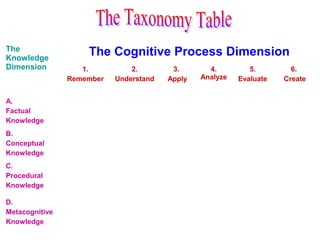
The
Knowledge
Dimension
The Cognitive Process Dimension
1.
Remember
2.
Understand
3.
Apply
4.
Analyze
5.
Evaluate
6.
Create
A.
Factual
Knowledge
B.
Conceptual
Knowledge
C.
Procedural
Knowledge
D.
Metacognitive
Knowledge
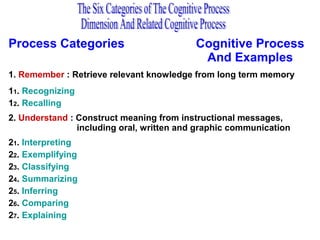
Process Categories Cognitive Process
And Examples
1. Remember : Retrieve relevant knowledge from long term memory
11. Recognizing
12. Recalling
2. Understand : Construct meaning from instructional messages,
including oral, written and graphic communication
21. Interpreting
22. Exemplifying
23. Classifying
24. Summarizing
25. Inferring
26. Comparing
27. Explaining
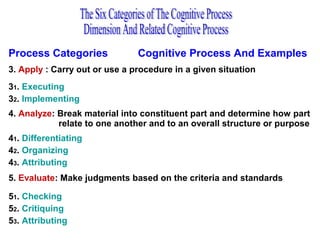
Process Categories Cognitive Process And Examples
3. Apply : Carry out or use a procedure in a given situation
31. Executing
32. Implementing
4. Analyze: Break material into constituent part and determine how part
relate to one another and to an overall structure or purpose
41. Differentiating
42. Organizing
43. Attributing
5. Evaluate: Make judgments based on the criteria and standards
51. Checking
52. Critiquing
53. Attributing
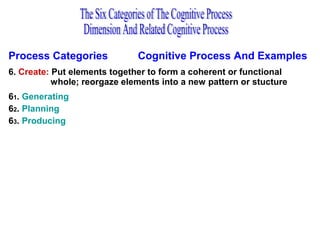
Process Categories Cognitive Process And Examples
6. Create: Put elements together to form a coherent or functional
whole; reorgaze elements into a new pattern or stucture
61. Generating
62. Planning
63. Producing
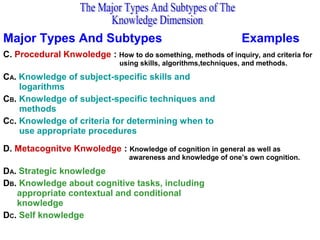
Major Types And Subtypes Examples
A. Factual Knwoledge : The basic elements students must know to be
acquainted with a discipline or solve problems in
it.
AA. Knowledge of Termimology
AB. Knowledge of specific details and
elements
B. Conceptual Knwoledge : The interrelationships among the basic
elements within a larger structure the enable
them to function together.
BA. Knowledge of Classifications and
categories
BB. Knowledge of principles and
generaralizations
BC. Knowledge of theories, models and
structures
Major Types And Subtypes Examples
C. Procedural Knwoledge : How to do something, methods of inquiry, and criteria for
using skills, algorithms,techniques, and methods.
CA. Knowledge of subject-specific skills and
logarithms
CB. Knowledge of subject-specific techniques and
methods
CC. Knowledge of criteria for determining when to
use appropriate procedures
D. Metacognitve Knwoledge : Knowledge of cognition in general as well as
awareness and knowledge of one’s own cognition.
DA. Strategic knowledge
DB. Knowledge about cognitive tasks, including
appropriate contextual and conditional
knowledge
DC. Self knowledge
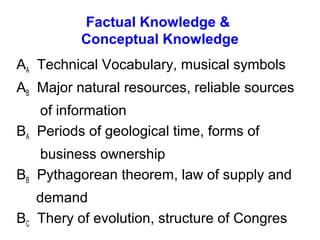
Factual Knowledge &
Conceptual Knowledge
AA Technical Vocabulary, musical symbols
AB Major natural resources, reliable sources
of information
BA Periods of geological time, forms of
business ownership
BB Pythagorean theorem, law of supply and
demand
BC Thery of evolution, structure of Congres
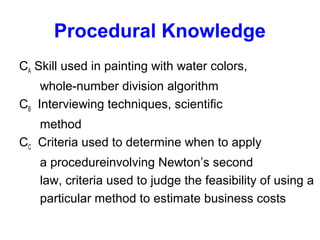
Procedural Knowledge
CA Skill used in painting with water colors,
whole-number division algorithm
CB Interviewing techniques, scientific
method
CC Criteria used to determine when to apply
a procedureinvolving Newton’s second
law, criteria used to judge the feasibility of using a
particular method to estimate business costs
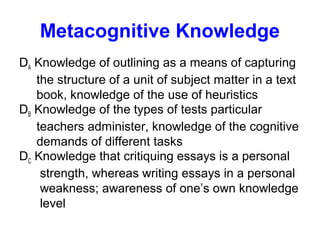
Metacognitive Knowledge
DA Knowledge of outlining as a means of capturing
the structure of a unit of subject matter in a text
book, knowledge of the use of heuristics
DB Knowledge of the types of tests particular
teachers administer, knowledge of the cognitive
demands of different tasks
DC Knowledge that critiquing essays is a personal
strength, whereas writing essays in a personal
weakness; awareness of one’s own knowledge
level
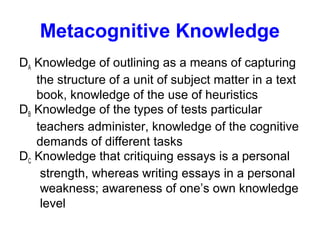
Metacognitive Knowledge
DA Knowledge of outlining as a means of capturing
the structure of a unit of subject matter in a text
book, knowledge of the use of heuristics
DB Knowledge of the types of tests particular
teachers administer, knowledge of the cognitive
demands of different tasks
DC Knowledge that critiquing essays is a personal
strength, whereas writing essays in a personal
weakness; awareness of one’s own knowledge
level

the taxonomy table

  • 1.
    The Knowledge Dimension The Cognitive ProcessDimension 1. Remember 2. Understand 3. Apply 4. Analyze 5. Evaluate 6. Create A. Factual Knowledge B. Conceptual Knowledge C. Procedural Knowledge D. Metacognitive Knowledge
  • 2.
    Process Categories CognitiveProcess And Examples 1. Remember : Retrieve relevant knowledge from long term memory 11. Recognizing 12. Recalling 2. Understand : Construct meaning from instructional messages, including oral, written and graphic communication 21. Interpreting 22. Exemplifying 23. Classifying 24. Summarizing 25. Inferring 26. Comparing 27. Explaining
  • 3.
    Process Categories CognitiveProcess And Examples 3. Apply : Carry out or use a procedure in a given situation 31. Executing 32. Implementing 4. Analyze: Break material into constituent part and determine how part relate to one another and to an overall structure or purpose 41. Differentiating 42. Organizing 43. Attributing 5. Evaluate: Make judgments based on the criteria and standards 51. Checking 52. Critiquing 53. Attributing
  • 4.
    Process Categories CognitiveProcess And Examples 6. Create: Put elements together to form a coherent or functional whole; reorgaze elements into a new pattern or stucture 61. Generating 62. Planning 63. Producing
  • 5.
    Major Types AndSubtypes Examples A. Factual Knwoledge : The basic elements students must know to be acquainted with a discipline or solve problems in it. AA. Knowledge of Termimology AB. Knowledge of specific details and elements B. Conceptual Knwoledge : The interrelationships among the basic elements within a larger structure the enable them to function together. BA. Knowledge of Classifications and categories BB. Knowledge of principles and generaralizations BC. Knowledge of theories, models and structures
  • 6.
    Major Types AndSubtypes Examples C. Procedural Knwoledge : How to do something, methods of inquiry, and criteria for using skills, algorithms,techniques, and methods. CA. Knowledge of subject-specific skills and logarithms CB. Knowledge of subject-specific techniques and methods CC. Knowledge of criteria for determining when to use appropriate procedures D. Metacognitve Knwoledge : Knowledge of cognition in general as well as awareness and knowledge of one’s own cognition. DA. Strategic knowledge DB. Knowledge about cognitive tasks, including appropriate contextual and conditional knowledge DC. Self knowledge
  • 7.
    Factual Knowledge & ConceptualKnowledge AA Technical Vocabulary, musical symbols AB Major natural resources, reliable sources of information BA Periods of geological time, forms of business ownership BB Pythagorean theorem, law of supply and demand BC Thery of evolution, structure of Congres
  • 8.
    Procedural Knowledge CA Skillused in painting with water colors, whole-number division algorithm CB Interviewing techniques, scientific method CC Criteria used to determine when to apply a procedureinvolving Newton’s second law, criteria used to judge the feasibility of using a particular method to estimate business costs
  • 9.
    Metacognitive Knowledge DA Knowledgeof outlining as a means of capturing the structure of a unit of subject matter in a text book, knowledge of the use of heuristics DB Knowledge of the types of tests particular teachers administer, knowledge of the cognitive demands of different tasks DC Knowledge that critiquing essays is a personal strength, whereas writing essays in a personal weakness; awareness of one’s own knowledge level
  • 10.
    Metacognitive Knowledge DA Knowledgeof outlining as a means of capturing the structure of a unit of subject matter in a text book, knowledge of the use of heuristics DB Knowledge of the types of tests particular teachers administer, knowledge of the cognitive demands of different tasks DC Knowledge that critiquing essays is a personal strength, whereas writing essays in a personal weakness; awareness of one’s own knowledge level