Cognitive & Metacognitive
Factors of Learning
DR. JUNREY P. PETERE, LPT., FRIEDR
LECTURER
Objectives
1. Identify the cognitive and metacognitive factors of
learning
2. Describe the cognitive processes of experts and expert
system
3. Understand the role of prior knowledge in the learning
process
4. Discuss the role of the teacher in facilitating learning
What is Metacognition
 This refers to higher order thinking which involves active control over the cognitive
process engage in learning
 Activities such as planning how to approach a given learning task, monitoring
comprehension, and evaluating progress toward the completion of a task.
 Includes monitoring progress as one learn and making changes and adapting
strategies if one perceived he/she is not doing well
 It is thinking about thinking, knowing “what we know” and what we don’t know
 An appreciation of what one already knows, together with a correct apprehension
of the learning task and what knowledge and skills it requires, knowing strategic
knowledge to a particular situation, and to do so efficiently and reliably (Taylor,
1999)
 This refers to learners understanding and control of their cognitive processes
Two main component of
Metacognition
Student’s knowledge of learning strategies to use in
particular learning situation
and
Cognitive monitoring which includes students’ ability to
select, use, and monitor learning strategies that
complement their learning styles and the specific
situation
Learning Settings
 Traditional Settings
- instruction and learning process are typically the responsibility of the teachers
- the teacher is the information source
 Learner-centered classroom
- the learner play a big role in the construction of knowledge
- the teacher plays the role of a facilitator and resource provider
- the teacher recommends and points the way to useful resources
- the teacher asks thought-provoking questions and provides opportunities for
students to construct and be accountable for their own learning
Psychological Principles - Learner &
Learning Principles (American Psychological Ass., 2005)
1. Nature of the Learning Process – The learning of complex subject matter is most
effective when it is an intentional process of constructing meaning from
information and experience.
2. Goals of the Learning Process – The successful learner, over time and with
support and instructional guidance, can create meaningful, coherent representation
of knowledge.
3. Construction of knowledge – The successful learner can link new information
with existing knowledge in meaningful ways.
4. Strategic thinking – The successful learner can create and use a repertoire of
thinking and reasoning strategies to achieve complex learning goals
5. Thinking about thinking – Higher strategies for selecting and monitoring mental
operations facilitate creative and critical thinking
6. Context of learning – learning is influenced by environmental factors, culture,
technology, and instructional practices.
Metacognitive Strategies
 It is one of the most powerful predictors of learning
 Thinking about thinking; knowing what we know & what we don’t know
 It regulates cognitive activity, but at the same time it needs cognitive activity as a
vehicle, e.g. checking the outcome of mathematical procedure requires the
cognitive activity of recalculation.
 METACOGNITIVE ACTIVITIES
* planning how to approach a given learning task
* monitoring comprehension
* evaluating progress toward the completion of task
Basic Metacognitive Strategies
 Connecting new information to former knowledge
 Selecting thinking strategies deliberately
 Planning, monitoring, and evaluating thinking processes
 A Thinking Person
* in-charge of her behavior
* determines when it is necessary to use metacognitive strategies
* learns how to learn
* self-reflective
* self-knowledge
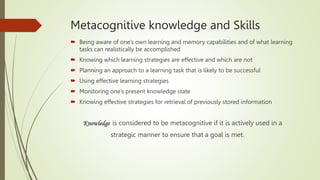
Metacognitive knowledge and Skills
 Being aware of one’s own learning and memory capabilities and of what learning
tasks can realistically be accomplished
 Knowing which learning strategies are effective and which are not
 Planning an approach to a learning task that is likely to be successful
 Using effective learning strategies
 Monitoring one’s present knowledge state
 Knowing effective strategies for retrieval of previously stored information
Knowledge is considered to be metacognitive if it is actively used in a
strategic manner to ensure that a goal is met.
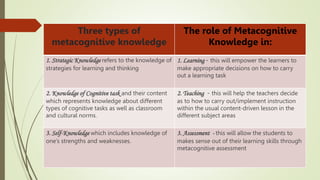
Three types of
metacognitive knowledge
The role of Metacognitive
Knowledge in:
1. Strategic Knowledge refers to the knowledge of
strategies for learning and thinking
1. Learning - this will empower the learners to
make appropriate decisions on how to carry
out a learning task
2. Knowledge of Cognitive task and their content
which represents knowledge about different
types of cognitive tasks as well as classroom
and cultural norms.
2. Teaching - this will help the teachers decide
as to how to carry out/implement instruction
within the usual content-driven lesson in the
different subject areas
3. Self-Knowledge which includes knowledge of
one’s strengths and weaknesses.
3. Assessment - this will allow the students to
makes sense out of their learning skills through
metacognitive assessment
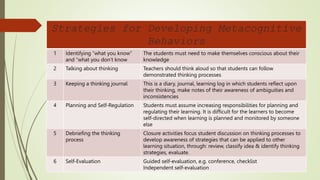
Strategies for Developing Metacognitive
Behaviors
1 Identifying “what you know”
and “what you don’t know
The students must need to make themselves conscious about their
knowledge
2 Talking about thinking Teachers should think aloud so that students can follow
demonstrated thinking processes
3 Keeping a thinking journal This is a diary, journal, learning log in which students reflect upon
their thinking, make notes of their awareness of ambiguities and
inconsistencies
4 Planning and Self-Regulation Students must assume increasing responsibilities for planning and
regulating their learning. It is difficult for the learners to become
self-directed when learning is planned and monitored by someone
else
5 Debriefing the thinking
process
Closure activities focus student discussion on thinking processes to
develop awareness of strategies that can be applied to other
learning situation, through: review, classify idea & identify thinking
strategies, evaluate.
6 Self-Evaluation Guided self-evaluation, e.g. conference, checklist
Independent self-evaluation
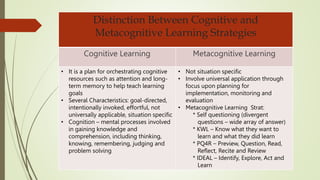
Distinction Between Cognitive and
Metacognitive Learning Strategies
Cognitive Learning Metacognitive Learning
• It is a plan for orchestrating cognitive
resources such as attention and long-
term memory to help teach learning
goals
• Several Characteristics: goal-directed,
intentionally invoked, effortful, not
universally applicable, situation specific
• Cognition – mental processes involved
in gaining knowledge and
comprehension, including thinking,
knowing, remembering, judging and
problem solving
• Not situation specific
• Involve universal application through
focus upon planning for
implementation, monitoring and
evaluation
• Metacognitive Learning Strat:
* Self questioning (divergent
questions – wide array of answer)
* KWL – Know what they want to
learn and what they did learn
* PQ4R – Preview, Question, Read,
Reflect, Recite and Review
* IDEAL – Identify, Explore, Act and
Learn
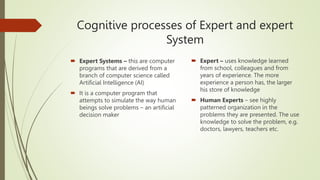
Cognitive processes of Expert and expert
System
 Expert Systems – this are computer
programs that are derived from a
branch of computer science called
Artificial Intelligence (AI)
 It is a computer program that
attempts to simulate the way human
beings solve problems – an artificial
decision maker
 Expert – uses knowledge learned
from school, colleagues and from
years of experience. The more
experience a person has, the larger
his store of knowledge
 Human Experts – see highly
patterned organization in the
problems they are presented. The use
knowledge to solve the problem, e.g.
doctors, lawyers, teachers etc.
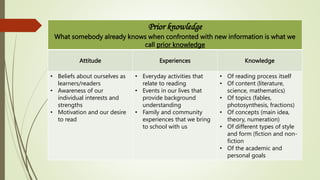
Prior knowledge
What somebody already knows when confronted with new information is what we
call prior knowledge
Attitude Experiences Knowledge
• Beliefs about ourselves as
learners/readers
• Awareness of our
individual interests and
strengths
• Motivation and our desire
to read
• Everyday activities that
relate to reading
• Events in our lives that
provide background
understanding
• Family and community
experiences that we bring
to school with us
• Of reading process itself
• Of content (literature,
science, mathematics)
• Of topics (fables,
photosynthesis, fractions)
• Of concepts (main idea,
theory, numeration)
• Of different types of style
and form (fiction and non-
fiction
• Of the academic and
personal goals
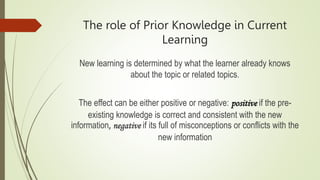
The role of Prior Knowledge in Current
Learning
New learning is determined by what the learner already knows
about the topic or related topics.
The effect can be either positive or negative: positive if the pre-
existing knowledge is correct and consistent with the new
information, negative if its full of misconceptions or conflicts with the
new information
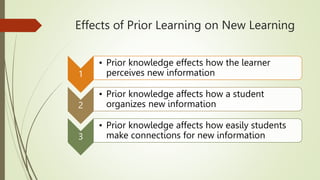
Effects of Prior Learning on New Learning
1
• Prior knowledge effects how the learner
perceives new information
2
• Prior knowledge affects how a student
organizes new information
3
• Prior knowledge affects how easily students
make connections for new information
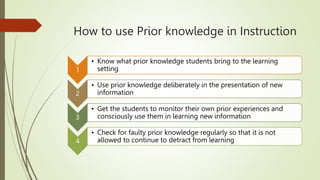
How to use Prior knowledge in Instruction
1
• Know what prior knowledge students bring to the learning
setting
2
• Use prior knowledge deliberately in the presentation of new
information
3
• Get the students to monitor their own prior experiences and
consciously use them in learning new information
4
• Check for faulty prior knowledge regularly so that it is not
allowed to continue to detract from learning
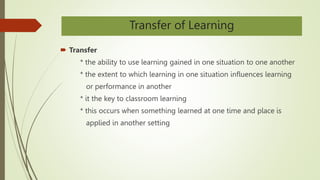
Transfer of Learning
 Transfer
* the ability to use learning gained in one situation to one another
* the extent to which learning in one situation influences learning
or performance in another
* it the key to classroom learning
* this occurs when something learned at one time and place is
applied in another setting
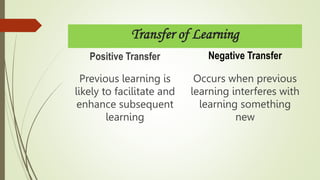
Transfer of Learning
Positive Transfer
Previous learning is
likely to facilitate and
enhance subsequent
learning
Negative Transfer
Occurs when previous
learning interferes with
learning something
new
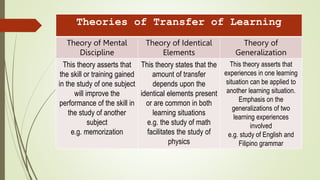
Theories of Transfer of Learning
Theory of Mental
Discipline
Theory of Identical
Elements
Theory of
Generalization
This theory asserts that
the skill or training gained
in the study of one subject
will improve the
performance of the skill in
the study of another
subject
e.g. memorization
This theory states that the
amount of transfer
depends upon the
identical elements present
or are common in both
learning situations
e.g. the study of math
facilitates the study of
physics
This theory asserts that
experiences in one learning
situation can be applied to
another learning situation.
Emphasis on the
generalizations of two
learning experiences
involved
e.g. study of English and
Filipino grammar
Conditions Influencing What and How much
learning will be transferred
 Task similarity exercises a strong influence on transfer.
* red (stop) change to orange, wouldn’t bother much because orange is almost similar
to red, and would relatively easy to transfer the stopping habit.
* red (stop) change to green, would surely bother the drivers as this would require
them to make new and opposite response (this is an instance of negative transfer)
 The degree of original learning is an important element in transfer . More practice on and
greater familiarity with the original material produces more positive transfer
 Personal variables such as: intelligence, motivation, and past experiences, are important
but difficult to control, influence transfer
Biological Basis of Learning
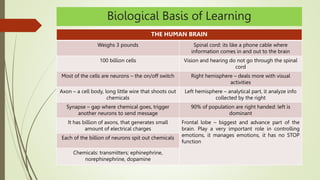
THE HUMAN BRAIN
Weighs 3 pounds Spinal cord: its like a phone cable where
information comes in and out to the brain
100 billion cells Vision and hearing do not go through the spinal
cord
Most of the cells are neurons – the on/off switch Right hemisphere – deals more with visual
activities
Axon – a cell body, long little wire that shoots out
chemicals
Left hemisphere – analytical part, it analyze info
collected by the right
Synapse – gap where chemical goes, trigger
another neurons to send message
90% of population are right handed: left is
dominant
It has billion of axons, that generates small
amount of electrical charges
Frontal lobe – biggest and advance part of the
brain. Play a very important role in controlling
emotions, it manages emotions, it has no STOP
function
Each of the billion of neurons spit out chemicals
Chemicals: transmitters; ephinephrine,
norephinephrine, dopamine
Reflection
Try to recall how one of your teachers in high school
facilitated transfer of learning among students. Write
a paragraph about this experience
Thank You!!!

3-Cognitive-Metacognitive-Factors-of-Learning.pptx

  • 1.
    Cognitive & Metacognitive Factorsof Learning DR. JUNREY P. PETERE, LPT., FRIEDR LECTURER
  • 2.
    Objectives 1. Identify thecognitive and metacognitive factors of learning 2. Describe the cognitive processes of experts and expert system 3. Understand the role of prior knowledge in the learning process 4. Discuss the role of the teacher in facilitating learning
  • 3.
    What is Metacognition This refers to higher order thinking which involves active control over the cognitive process engage in learning  Activities such as planning how to approach a given learning task, monitoring comprehension, and evaluating progress toward the completion of a task.  Includes monitoring progress as one learn and making changes and adapting strategies if one perceived he/she is not doing well  It is thinking about thinking, knowing “what we know” and what we don’t know  An appreciation of what one already knows, together with a correct apprehension of the learning task and what knowledge and skills it requires, knowing strategic knowledge to a particular situation, and to do so efficiently and reliably (Taylor, 1999)  This refers to learners understanding and control of their cognitive processes
  • 4.
    Two main componentof Metacognition Student’s knowledge of learning strategies to use in particular learning situation and Cognitive monitoring which includes students’ ability to select, use, and monitor learning strategies that complement their learning styles and the specific situation
  • 5.
    Learning Settings  TraditionalSettings - instruction and learning process are typically the responsibility of the teachers - the teacher is the information source  Learner-centered classroom - the learner play a big role in the construction of knowledge - the teacher plays the role of a facilitator and resource provider - the teacher recommends and points the way to useful resources - the teacher asks thought-provoking questions and provides opportunities for students to construct and be accountable for their own learning
  • 6.
    Psychological Principles -Learner & Learning Principles (American Psychological Ass., 2005) 1. Nature of the Learning Process – The learning of complex subject matter is most effective when it is an intentional process of constructing meaning from information and experience. 2. Goals of the Learning Process – The successful learner, over time and with support and instructional guidance, can create meaningful, coherent representation of knowledge. 3. Construction of knowledge – The successful learner can link new information with existing knowledge in meaningful ways. 4. Strategic thinking – The successful learner can create and use a repertoire of thinking and reasoning strategies to achieve complex learning goals 5. Thinking about thinking – Higher strategies for selecting and monitoring mental operations facilitate creative and critical thinking 6. Context of learning – learning is influenced by environmental factors, culture, technology, and instructional practices.
  • 7.
    Metacognitive Strategies  Itis one of the most powerful predictors of learning  Thinking about thinking; knowing what we know & what we don’t know  It regulates cognitive activity, but at the same time it needs cognitive activity as a vehicle, e.g. checking the outcome of mathematical procedure requires the cognitive activity of recalculation.  METACOGNITIVE ACTIVITIES * planning how to approach a given learning task * monitoring comprehension * evaluating progress toward the completion of task
  • 8.
    Basic Metacognitive Strategies Connecting new information to former knowledge  Selecting thinking strategies deliberately  Planning, monitoring, and evaluating thinking processes  A Thinking Person * in-charge of her behavior * determines when it is necessary to use metacognitive strategies * learns how to learn * self-reflective * self-knowledge
  • 9.
    Metacognitive knowledge andSkills  Being aware of one’s own learning and memory capabilities and of what learning tasks can realistically be accomplished  Knowing which learning strategies are effective and which are not  Planning an approach to a learning task that is likely to be successful  Using effective learning strategies  Monitoring one’s present knowledge state  Knowing effective strategies for retrieval of previously stored information Knowledge is considered to be metacognitive if it is actively used in a strategic manner to ensure that a goal is met.
  • 10.
    Three types of metacognitiveknowledge The role of Metacognitive Knowledge in: 1. Strategic Knowledge refers to the knowledge of strategies for learning and thinking 1. Learning - this will empower the learners to make appropriate decisions on how to carry out a learning task 2. Knowledge of Cognitive task and their content which represents knowledge about different types of cognitive tasks as well as classroom and cultural norms. 2. Teaching - this will help the teachers decide as to how to carry out/implement instruction within the usual content-driven lesson in the different subject areas 3. Self-Knowledge which includes knowledge of one’s strengths and weaknesses. 3. Assessment - this will allow the students to makes sense out of their learning skills through metacognitive assessment
  • 11.
    Strategies for DevelopingMetacognitive Behaviors 1 Identifying “what you know” and “what you don’t know The students must need to make themselves conscious about their knowledge 2 Talking about thinking Teachers should think aloud so that students can follow demonstrated thinking processes 3 Keeping a thinking journal This is a diary, journal, learning log in which students reflect upon their thinking, make notes of their awareness of ambiguities and inconsistencies 4 Planning and Self-Regulation Students must assume increasing responsibilities for planning and regulating their learning. It is difficult for the learners to become self-directed when learning is planned and monitored by someone else 5 Debriefing the thinking process Closure activities focus student discussion on thinking processes to develop awareness of strategies that can be applied to other learning situation, through: review, classify idea & identify thinking strategies, evaluate. 6 Self-Evaluation Guided self-evaluation, e.g. conference, checklist Independent self-evaluation
  • 12.
    Distinction Between Cognitiveand Metacognitive Learning Strategies Cognitive Learning Metacognitive Learning • It is a plan for orchestrating cognitive resources such as attention and long- term memory to help teach learning goals • Several Characteristics: goal-directed, intentionally invoked, effortful, not universally applicable, situation specific • Cognition – mental processes involved in gaining knowledge and comprehension, including thinking, knowing, remembering, judging and problem solving • Not situation specific • Involve universal application through focus upon planning for implementation, monitoring and evaluation • Metacognitive Learning Strat: * Self questioning (divergent questions – wide array of answer) * KWL – Know what they want to learn and what they did learn * PQ4R – Preview, Question, Read, Reflect, Recite and Review * IDEAL – Identify, Explore, Act and Learn
  • 13.
    Cognitive processes ofExpert and expert System  Expert Systems – this are computer programs that are derived from a branch of computer science called Artificial Intelligence (AI)  It is a computer program that attempts to simulate the way human beings solve problems – an artificial decision maker  Expert – uses knowledge learned from school, colleagues and from years of experience. The more experience a person has, the larger his store of knowledge  Human Experts – see highly patterned organization in the problems they are presented. The use knowledge to solve the problem, e.g. doctors, lawyers, teachers etc.
  • 14.
    Prior knowledge What somebodyalready knows when confronted with new information is what we call prior knowledge Attitude Experiences Knowledge • Beliefs about ourselves as learners/readers • Awareness of our individual interests and strengths • Motivation and our desire to read • Everyday activities that relate to reading • Events in our lives that provide background understanding • Family and community experiences that we bring to school with us • Of reading process itself • Of content (literature, science, mathematics) • Of topics (fables, photosynthesis, fractions) • Of concepts (main idea, theory, numeration) • Of different types of style and form (fiction and non- fiction • Of the academic and personal goals
  • 15.
    The role ofPrior Knowledge in Current Learning New learning is determined by what the learner already knows about the topic or related topics. The effect can be either positive or negative: positive if the pre- existing knowledge is correct and consistent with the new information, negative if its full of misconceptions or conflicts with the new information
  • 16.
    Effects of PriorLearning on New Learning 1 • Prior knowledge effects how the learner perceives new information 2 • Prior knowledge affects how a student organizes new information 3 • Prior knowledge affects how easily students make connections for new information
  • 17.
    How to usePrior knowledge in Instruction 1 • Know what prior knowledge students bring to the learning setting 2 • Use prior knowledge deliberately in the presentation of new information 3 • Get the students to monitor their own prior experiences and consciously use them in learning new information 4 • Check for faulty prior knowledge regularly so that it is not allowed to continue to detract from learning
  • 18.
    Transfer of Learning Transfer * the ability to use learning gained in one situation to one another * the extent to which learning in one situation influences learning or performance in another * it the key to classroom learning * this occurs when something learned at one time and place is applied in another setting
  • 19.
    Transfer of Learning PositiveTransfer Previous learning is likely to facilitate and enhance subsequent learning Negative Transfer Occurs when previous learning interferes with learning something new
  • 20.
    Theories of Transferof Learning Theory of Mental Discipline Theory of Identical Elements Theory of Generalization This theory asserts that the skill or training gained in the study of one subject will improve the performance of the skill in the study of another subject e.g. memorization This theory states that the amount of transfer depends upon the identical elements present or are common in both learning situations e.g. the study of math facilitates the study of physics This theory asserts that experiences in one learning situation can be applied to another learning situation. Emphasis on the generalizations of two learning experiences involved e.g. study of English and Filipino grammar
  • 21.
    Conditions Influencing Whatand How much learning will be transferred  Task similarity exercises a strong influence on transfer. * red (stop) change to orange, wouldn’t bother much because orange is almost similar to red, and would relatively easy to transfer the stopping habit. * red (stop) change to green, would surely bother the drivers as this would require them to make new and opposite response (this is an instance of negative transfer)  The degree of original learning is an important element in transfer . More practice on and greater familiarity with the original material produces more positive transfer  Personal variables such as: intelligence, motivation, and past experiences, are important but difficult to control, influence transfer
  • 22.
    Biological Basis ofLearning THE HUMAN BRAIN Weighs 3 pounds Spinal cord: its like a phone cable where information comes in and out to the brain 100 billion cells Vision and hearing do not go through the spinal cord Most of the cells are neurons – the on/off switch Right hemisphere – deals more with visual activities Axon – a cell body, long little wire that shoots out chemicals Left hemisphere – analytical part, it analyze info collected by the right Synapse – gap where chemical goes, trigger another neurons to send message 90% of population are right handed: left is dominant It has billion of axons, that generates small amount of electrical charges Frontal lobe – biggest and advance part of the brain. Play a very important role in controlling emotions, it manages emotions, it has no STOP function Each of the billion of neurons spit out chemicals Chemicals: transmitters; ephinephrine, norephinephrine, dopamine
  • 23.
    Reflection Try to recallhow one of your teachers in high school facilitated transfer of learning among students. Write a paragraph about this experience
  • 24.