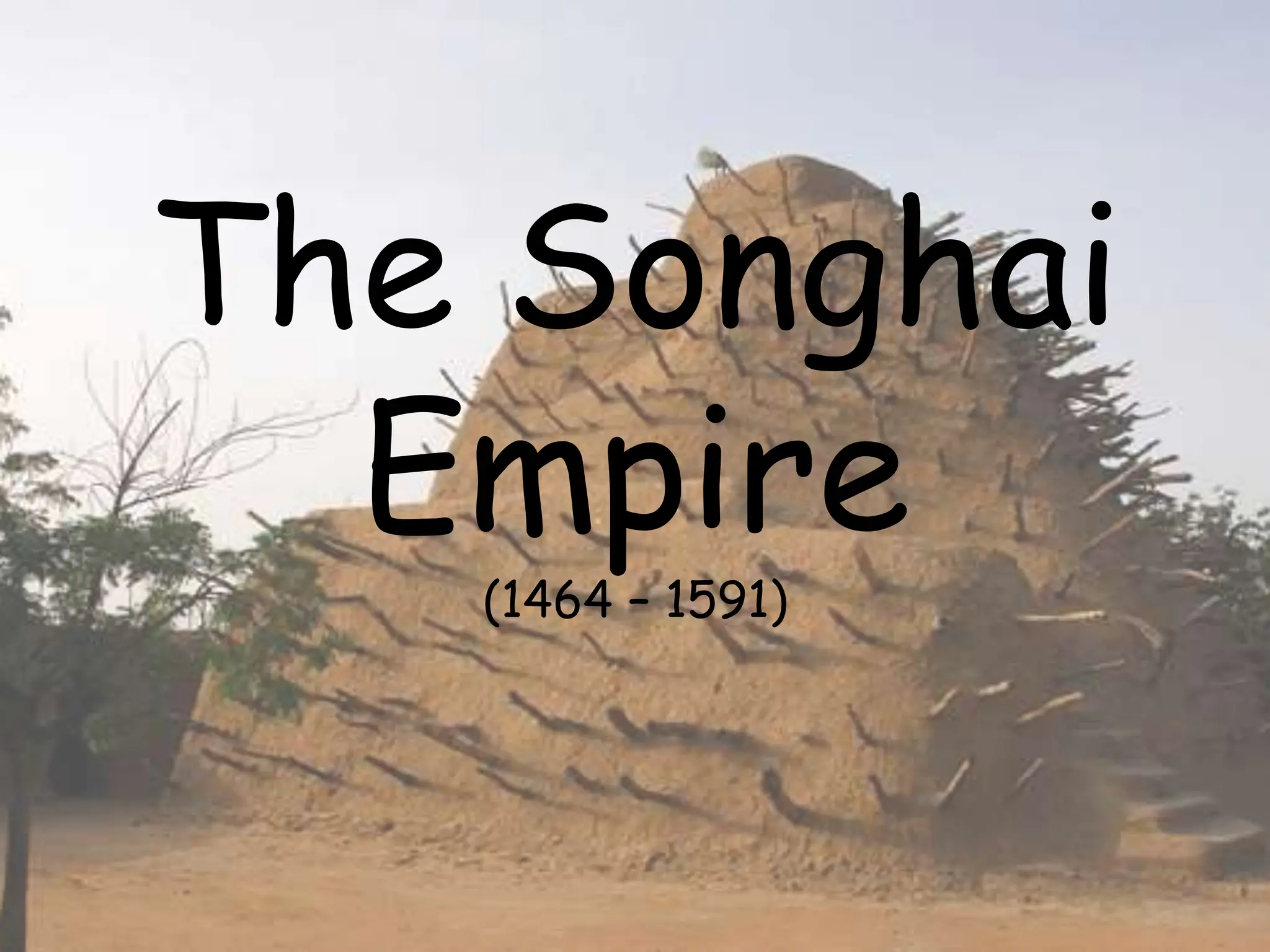
The Songhai
Empire
(1464 – 1591)
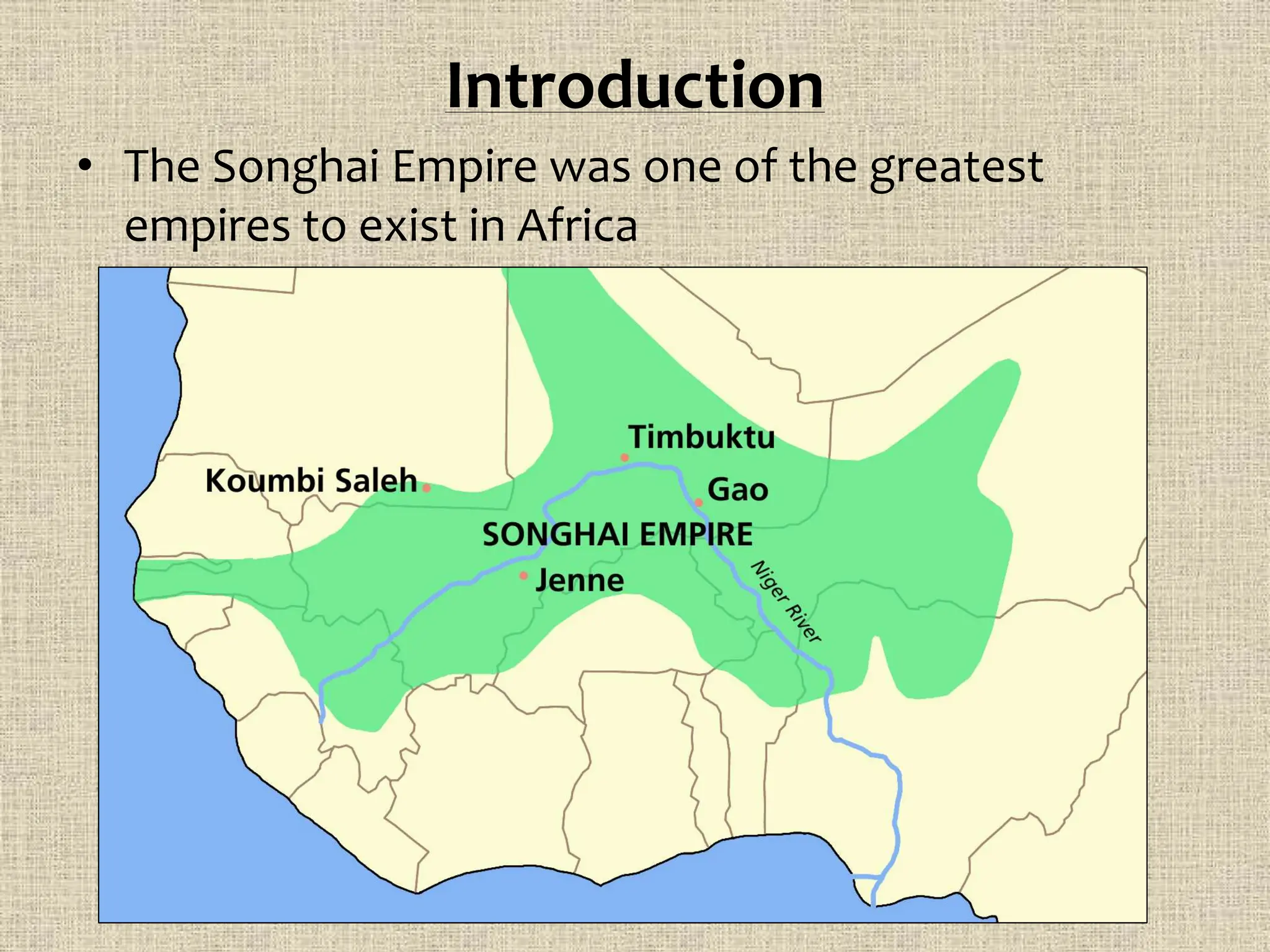
Introduction
• The Songhai Empire was one of the greatest
empires to exist in Africa
Trade
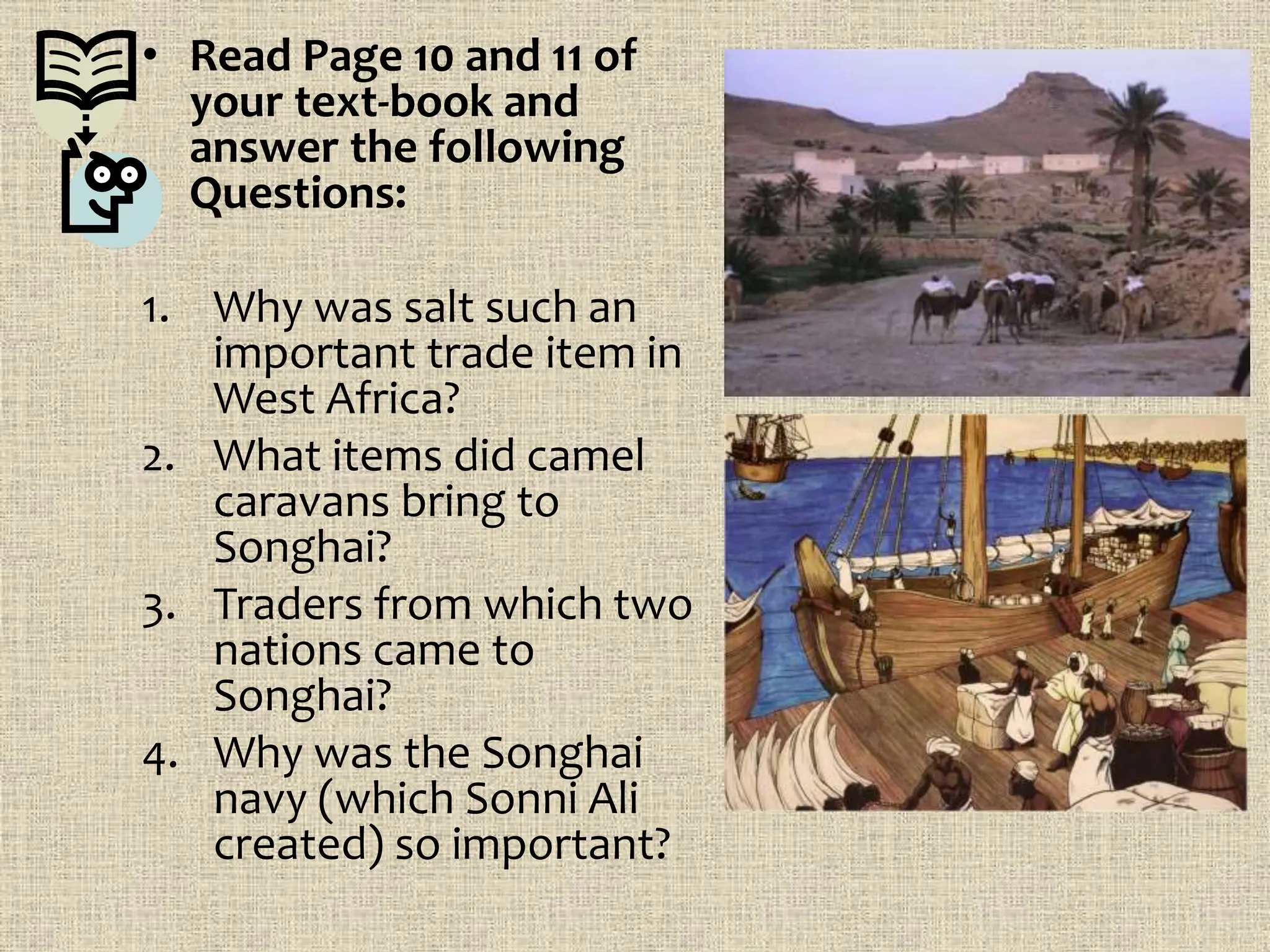
• Trade was one of
the foundations
of the Songhai
Empire.
• Its capital,
Timbuktu was at
the end of the
camel caravan
route linking
North Africa, Sub-
Saharan Africa
and Arabia.
• Merchants from
various nations
gathered here to
buy and sell
goods.
Sonni Ali and the Rise of the Soghai
Empire
• The Songhai kingdom was
originally a small state, but under
Sonni Ali (who ruled from 1462 –
1492), it conquered several other
West African states.
• He took control of the trading
towns of Jenne in 1473 and
Timbuktu in 1488) which allowed
him to control various trade
routes.
• Two of the most important items
traded were gold and salt
• Read Page 10 and 11 of
your text-book and
answer the following
Questions:
1. Why was salt such an
important trade item in
West Africa?
2. What items did camel
caravans bring to
Songhai?
3. Traders from which two
nations came to
Songhai?
4. Why was the Songhai
navy (which Sonni Ali
created) so important?
The Songhai Army
• Sonni Ali had a very well organized army.
• He had over 30,000 infantry (foot soldiers), 1,000
cavalry (soldiers on horseback) and a navy of over
400 boats.
• Only nobles could become cavalry because horses
were so expensive.
• The infantry were farmers and slaves who were
armed with spears, shields, and bows and arrows.
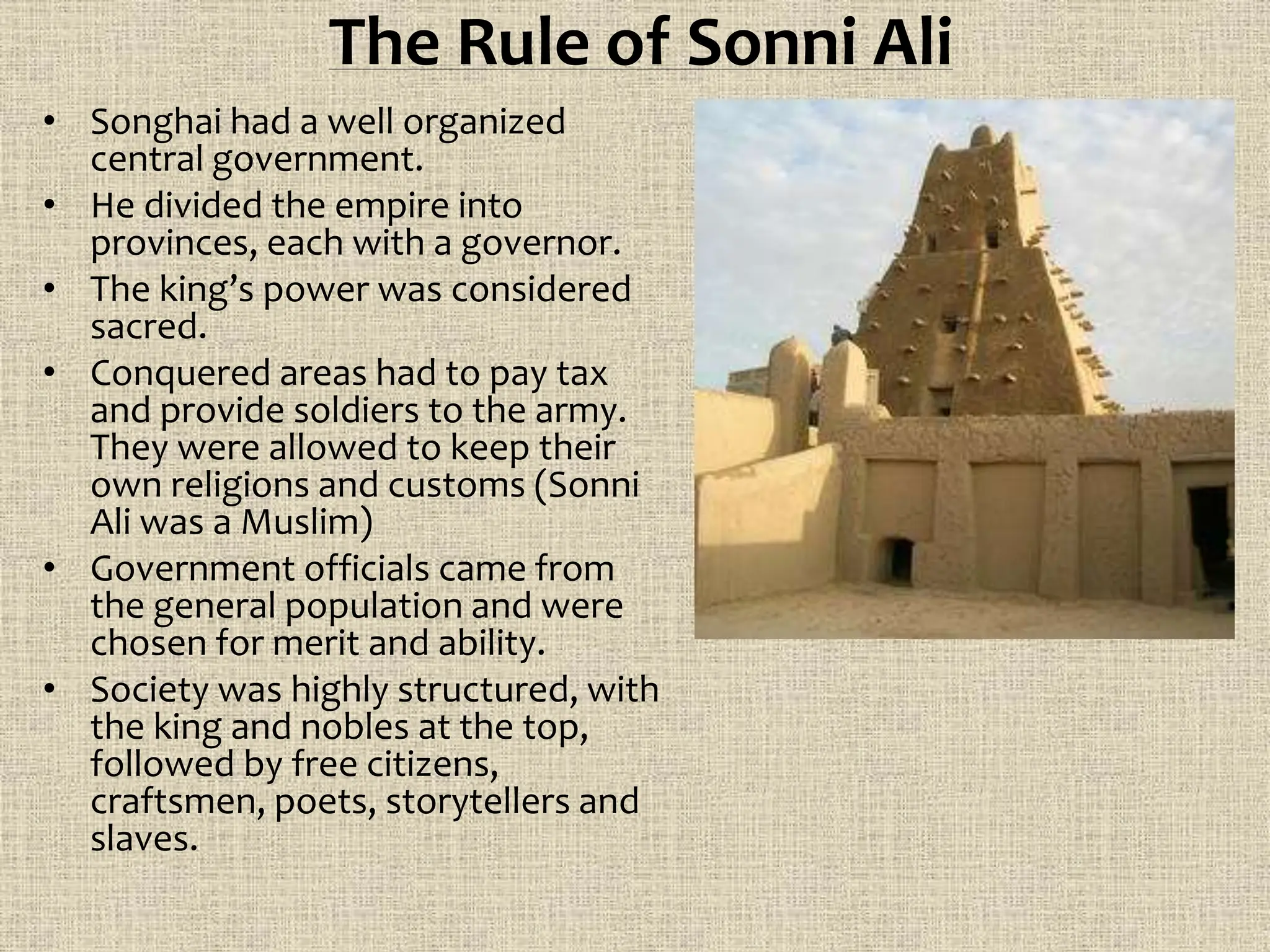
The Rule of Sonni Ali
• Songhai had a well organized
central government.
• He divided the empire into
provinces, each with a governor.
• The king’s power was considered
sacred.
• Conquered areas had to pay tax
and provide soldiers to the army.
They were allowed to keep their
own religions and customs (Sonni
Ali was a Muslim)
• Government officials came from
the general population and were
chosen for merit and ability.
• Society was highly structured, with
the king and nobles at the top,
followed by free citizens,
craftsmen, poets, storytellers and
slaves.
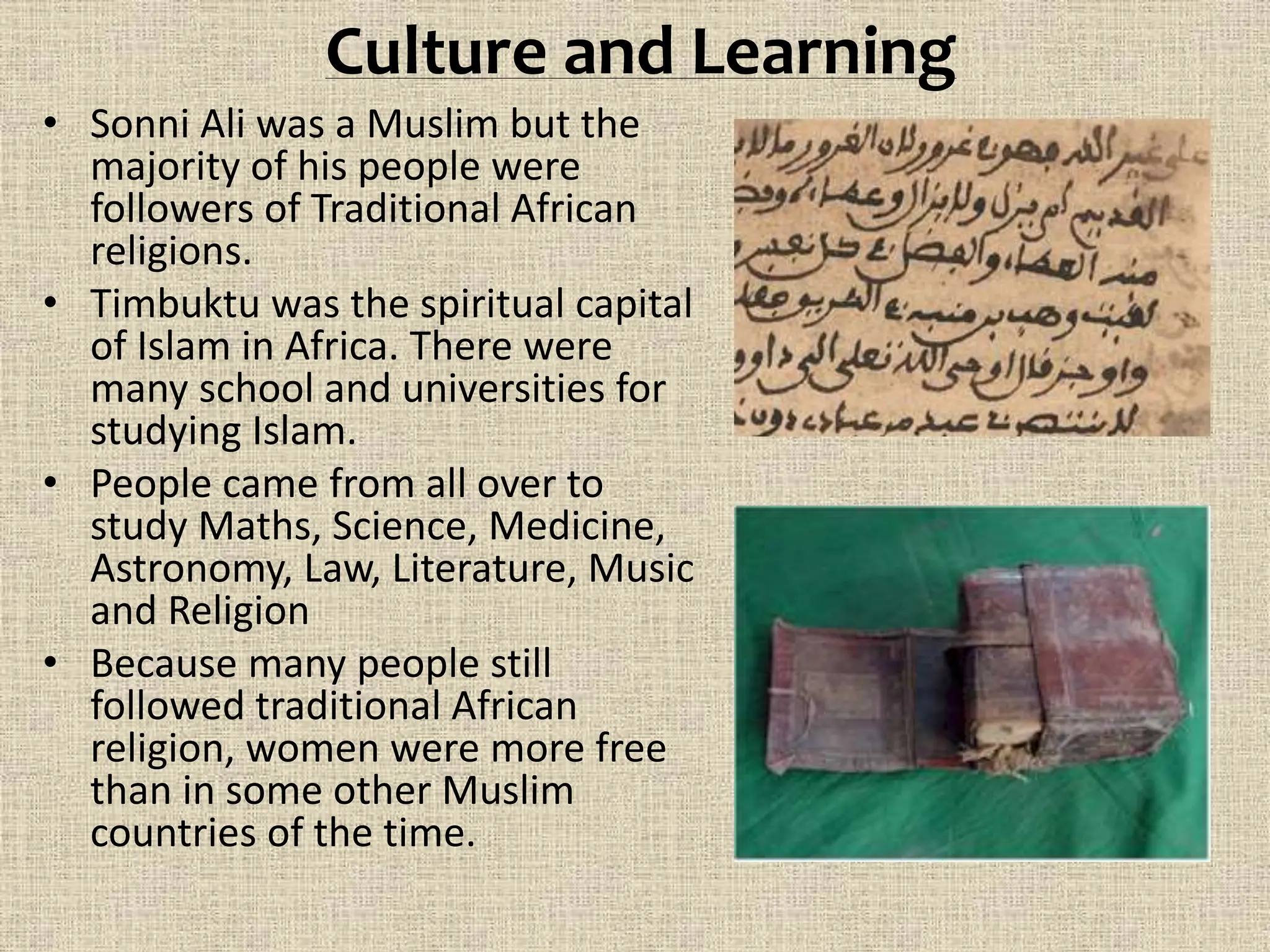
Culture and Learning
• Sonni Ali was a Muslim but the
majority of his people were
followers of Traditional African
religions.
• Timbuktu was the spiritual capital
of Islam in Africa. There were
many school and universities for
studying Islam.
• People came from all over to
study Maths, Science, Medicine,
Astronomy, Law, Literature, Music
and Religion
• Because many people still
followed traditional African
religion, women were more free
than in some other Muslim
countries of the time.
The Timbuktu Manuscripts
• Most of the learning of
Timbuktu was recorded
in a series of ancient
letters, books and other
written material.
• Most was written in
Arabic or in the Songhai
language using Arabic
writing.
Ignoring African History...
• From what you know of the Songhai Empire, is this
accurate?
• Why do you think Europeans in Africa have ignored
or downplayed things like the Songhai Empire?
Perhaps in the future there will be some African
history to teach. But at the present [1964] there is
none, or very little: there is only the history of
Europe in Africa. The rest is largely darkness.
-Hugh Trevor-Roper (historian)
The Fall of the Songhai Empire
• Sonni Ali died in 1492 and was replaced by one of
his general, Aski Mohammed who banned African
religion and made Islam the official religion. The
empire remained stable and wealthy for many
years.
• Morocco attacked Songhai in 1591 to gain control
of the gold trade and defeated the Songhai army.
They took control of Timbuktu.
• The Empire split up and never recovered.
Turn to Task 1.2 in your text book
(page 13)
• Read “Source A”
describing the
origins of praise-
singing in Songhai
and answer
questions (a) and
(b) in your
workbook
Task 1.2: Answers
(a) (i) Women cared deeply for their husbands. Can
also show that it was a male-dominated society
and that women were submissive.
(ii) Drums are part of traditional music
(iii) There were wars.
(iv) Goats were kept and kalabashes were grown
as a crop
(a) This is a primary source, so it would be
reasonably reliable. Some aspects of the song
may have changed as it was passed on from
generation to generation
Fill in the sections relating to the Songhai Empire:
Ming Songhai Mughal Europe
Origins
Travel & Trade
Government
System
Women
Technological
Advances
Culture
Decline
Table (Songhai): Answers
Origins
• Founded by Sonni Ali
• In area of old Mali Empire
Travel and Trade
• Controlled trans-Saharan trade and Niger river.
• Main trade goods: salt and gold
• Jenne and Timbuktu: main trade cities
Government System
• Ruled by the king. Rule was sacred
• Divided into provinces ruled by governors
• Officials were ordinary people.
Technological Advances
• Advances in maths, science, medicine.
Women
• Generally subservient to men, although had more
freedom than women in some other Muslim
countries.
Culture
• Religion: Islam and traditional African religion.
• Traditional religion tolerated under Sonni Ali.
Decline
• Attack by Moroccan army: defeated and lost
Timbuktu
• Civil wars and empire broken up. Ruled by less
competent leaders
Timbuktu in the News...
Mail and Guardian (28 January 2013)
French and Malian troops have sealed off Timbuktu after fleeing rebels
torched buildings including a South African-funded prized manuscript
library
Timbuktu's mayor, Ousmane Halle, reported that fleeing Islamist fighters
had torched a South African-funded library in the city containing
thousands of priceless manuscripts.
"The rebels set fire to the newly-constructed Ahmed Baba Institute built by
the South Africans ... this happened four days ago," Halle Ousmane told
Reuters by telephone from Bamako.
With its cultural treasures, Timbuktu had previously been a destination for
adventurous tourists and international scholars.
The world was shocked by its capture on April 1 by Tuareg desert fighters
whose separatist rebellion was later hijacked by Islamist radicals who
imposed severe sharia law.
Provoking international outrage, the Islamist militants who follow a more
conservative Salafist branch of Islam destroyed dozens of ancient shrines
in Timbuktu sacred to moderate Sufi Moslems, condemning them as
idolatrous and un-Islamic. They also applied amputations for thieves and
stoning of adulterers under sharia, while forcing women to go veiled.
Sky News (28 Jan 2013)
"Some of the documents date back to the 13th century," she
said. "The town dates back to the 11th century and this
was all the documentation they'd built up over centuries of
life in Timbuktu - all either burnt by the Jihadists or they
have disappeared."
The city's mayor, Ousmane Halle, said: "They torched all the
important ancient manuscripts. The ancient books of
geography and science. It is the history of Timbuktu, of its
people. It's truly alarming that this has happened."
During their rule, the militants systematically destroyed
UNESCO World Heritage sites in Timbuktu, long a hub of
Islamic learning.
A spokesman for the al Qaeda-linked militants has said the
tombs of Sufi saints were destroyed because they
contravened Islam, encouraging Muslims to venerate saints
instead of God.
1. What do you think a separatist rebellion is?
2. What do we mean when we say something
like a rebellion was hijacked?
3. Why do you think SA paid for the library to
be built?
4. What do you think will happen to the
manuscripts that were not destroyed but
have disappeared?
5. The burnings were internationally
condemned. Why do you think this is
considered such a terrible disaster?
The Songhai Empire.pptx

The Songhai Empire.pptx

  • 1.
  • 2.
    Introduction • The SonghaiEmpire was one of the greatest empires to exist in Africa
  • 3.
    Trade • Trade wasone of the foundations of the Songhai Empire. • Its capital, Timbuktu was at the end of the camel caravan route linking North Africa, Sub- Saharan Africa and Arabia. • Merchants from various nations gathered here to buy and sell goods.
  • 4.
    Sonni Ali andthe Rise of the Soghai Empire • The Songhai kingdom was originally a small state, but under Sonni Ali (who ruled from 1462 – 1492), it conquered several other West African states. • He took control of the trading towns of Jenne in 1473 and Timbuktu in 1488) which allowed him to control various trade routes. • Two of the most important items traded were gold and salt
  • 5.
    • Read Page10 and 11 of your text-book and answer the following Questions: 1. Why was salt such an important trade item in West Africa? 2. What items did camel caravans bring to Songhai? 3. Traders from which two nations came to Songhai? 4. Why was the Songhai navy (which Sonni Ali created) so important?
  • 6.
    The Songhai Army •Sonni Ali had a very well organized army. • He had over 30,000 infantry (foot soldiers), 1,000 cavalry (soldiers on horseback) and a navy of over 400 boats. • Only nobles could become cavalry because horses were so expensive. • The infantry were farmers and slaves who were armed with spears, shields, and bows and arrows.
  • 7.
    The Rule ofSonni Ali • Songhai had a well organized central government. • He divided the empire into provinces, each with a governor. • The king’s power was considered sacred. • Conquered areas had to pay tax and provide soldiers to the army. They were allowed to keep their own religions and customs (Sonni Ali was a Muslim) • Government officials came from the general population and were chosen for merit and ability. • Society was highly structured, with the king and nobles at the top, followed by free citizens, craftsmen, poets, storytellers and slaves.
  • 8.
    Culture and Learning •Sonni Ali was a Muslim but the majority of his people were followers of Traditional African religions. • Timbuktu was the spiritual capital of Islam in Africa. There were many school and universities for studying Islam. • People came from all over to study Maths, Science, Medicine, Astronomy, Law, Literature, Music and Religion • Because many people still followed traditional African religion, women were more free than in some other Muslim countries of the time.
  • 9.
    The Timbuktu Manuscripts •Most of the learning of Timbuktu was recorded in a series of ancient letters, books and other written material. • Most was written in Arabic or in the Songhai language using Arabic writing.
  • 10.
    Ignoring African History... •From what you know of the Songhai Empire, is this accurate? • Why do you think Europeans in Africa have ignored or downplayed things like the Songhai Empire? Perhaps in the future there will be some African history to teach. But at the present [1964] there is none, or very little: there is only the history of Europe in Africa. The rest is largely darkness. -Hugh Trevor-Roper (historian)
  • 11.
    The Fall ofthe Songhai Empire • Sonni Ali died in 1492 and was replaced by one of his general, Aski Mohammed who banned African religion and made Islam the official religion. The empire remained stable and wealthy for many years. • Morocco attacked Songhai in 1591 to gain control of the gold trade and defeated the Songhai army. They took control of Timbuktu. • The Empire split up and never recovered.
  • 12.
    Turn to Task1.2 in your text book (page 13) • Read “Source A” describing the origins of praise- singing in Songhai and answer questions (a) and (b) in your workbook
  • 13.
    Task 1.2: Answers (a)(i) Women cared deeply for their husbands. Can also show that it was a male-dominated society and that women were submissive. (ii) Drums are part of traditional music (iii) There were wars. (iv) Goats were kept and kalabashes were grown as a crop (a) This is a primary source, so it would be reasonably reliable. Some aspects of the song may have changed as it was passed on from generation to generation
  • 14.
    Fill in thesections relating to the Songhai Empire: Ming Songhai Mughal Europe Origins Travel & Trade Government System Women Technological Advances Culture Decline
  • 15.
    Table (Songhai): Answers Origins •Founded by Sonni Ali • In area of old Mali Empire Travel and Trade • Controlled trans-Saharan trade and Niger river. • Main trade goods: salt and gold • Jenne and Timbuktu: main trade cities Government System • Ruled by the king. Rule was sacred • Divided into provinces ruled by governors • Officials were ordinary people.
  • 16.
    Technological Advances • Advancesin maths, science, medicine. Women • Generally subservient to men, although had more freedom than women in some other Muslim countries. Culture • Religion: Islam and traditional African religion. • Traditional religion tolerated under Sonni Ali. Decline • Attack by Moroccan army: defeated and lost Timbuktu • Civil wars and empire broken up. Ruled by less competent leaders
  • 17.
  • 18.
    Mail and Guardian(28 January 2013) French and Malian troops have sealed off Timbuktu after fleeing rebels torched buildings including a South African-funded prized manuscript library Timbuktu's mayor, Ousmane Halle, reported that fleeing Islamist fighters had torched a South African-funded library in the city containing thousands of priceless manuscripts. "The rebels set fire to the newly-constructed Ahmed Baba Institute built by the South Africans ... this happened four days ago," Halle Ousmane told Reuters by telephone from Bamako. With its cultural treasures, Timbuktu had previously been a destination for adventurous tourists and international scholars. The world was shocked by its capture on April 1 by Tuareg desert fighters whose separatist rebellion was later hijacked by Islamist radicals who imposed severe sharia law. Provoking international outrage, the Islamist militants who follow a more conservative Salafist branch of Islam destroyed dozens of ancient shrines in Timbuktu sacred to moderate Sufi Moslems, condemning them as idolatrous and un-Islamic. They also applied amputations for thieves and stoning of adulterers under sharia, while forcing women to go veiled.
  • 19.
    Sky News (28Jan 2013) "Some of the documents date back to the 13th century," she said. "The town dates back to the 11th century and this was all the documentation they'd built up over centuries of life in Timbuktu - all either burnt by the Jihadists or they have disappeared." The city's mayor, Ousmane Halle, said: "They torched all the important ancient manuscripts. The ancient books of geography and science. It is the history of Timbuktu, of its people. It's truly alarming that this has happened." During their rule, the militants systematically destroyed UNESCO World Heritage sites in Timbuktu, long a hub of Islamic learning. A spokesman for the al Qaeda-linked militants has said the tombs of Sufi saints were destroyed because they contravened Islam, encouraging Muslims to venerate saints instead of God.
  • 20.
    1. What doyou think a separatist rebellion is? 2. What do we mean when we say something like a rebellion was hijacked? 3. Why do you think SA paid for the library to be built? 4. What do you think will happen to the manuscripts that were not destroyed but have disappeared? 5. The burnings were internationally condemned. Why do you think this is considered such a terrible disaster?