Society for the Conservation of Philippine Wetlands. Inc.
Environment
…“immediate surroundings of an individual”
…”is a complex system that deals with a
network of living and non-living entities”
Includes:
• Physical Components (air, water, land,
energy)
• Biological Components (plants, animals)
• Socio-Economic Components (people,
communities, institutions, values)
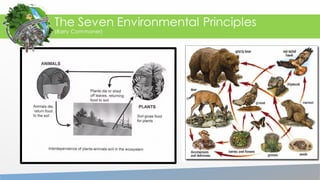
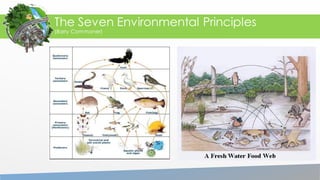
I. Everything is connected to everything else.
Ecosystem
• is the basic functional unit of nature
• is the interaction of the community (living components) and
the non-living environment
The Seven Environmental Principles
(Barry Commoner)
The Seven Environmental Principles
(Barry Commoner)
The Seven Environmental Principles
(Barry Commoner)
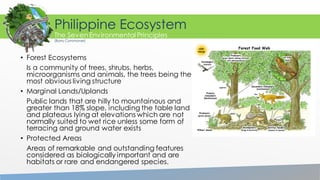
• Forest Ecosystems
Is a community of trees, shrubs, herbs,
microorganisms and animals, the trees being the
most obvious living structure
• Marginal Lands/Uplands
Public lands that are hilly to mountainous and
greater than 18% slope, including the table land
and plateaus lying at elevations which are not
normally suited to wet rice unless some form of
terracing and ground water exists
• Protected Areas
Areas of remarkable and outstanding features
considered as biologically important and are
habitats or rare and endangered species.
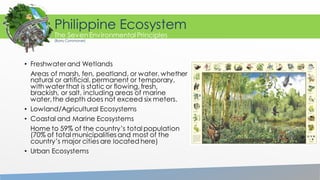
Philippine Ecosystem
The Seven Environmental Principles
(Barry Commoner)
• Freshwaterand Wetlands
Areas of marsh, fen, peatland, or water, whether
natural or artificial, permanent or temporary,
with waterthat is static or flowing, fresh,
brackish, or salt, including areas of marine
water,the depth does not exceed six meters.
• Lowland/Agricultural Ecosystems
• Coastal and Marine Ecosystems
Home to 59% of the country’s total population
(70% of total municipalities and most of the
country’s major cities are located here)
• Urban Ecosystems
Philippine Ecosystem
The Seven Environmental Principles
(Barry Commoner)
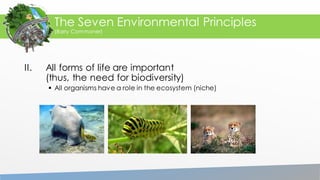
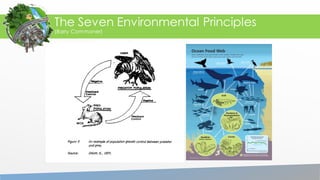
II. All forms of life are important
(thus, the need for biodiversity)
 All organisms have a role in the ecosystem (niche)
The Seven Environmental Principles
(Barry Commoner)
The Seven Environmental Principles
(Barry Commoner)
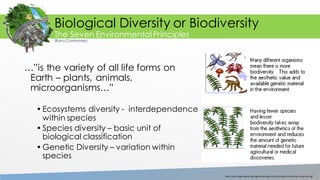
…”is the variety of all life forms on
Earth – plants, animals,
microorganisms…”
•Ecosystems diversity - interdependence
within species
•Species diversity – basic unit of
biological classification
•Genetic Diversity – variation within
species
Biological Diversity or Biodiversity
The Seven Environmental Principles
(Barry Commoner)
http://www.regentsprep.org/regents/biology/units/ecology/biodiversitycomparison.gif
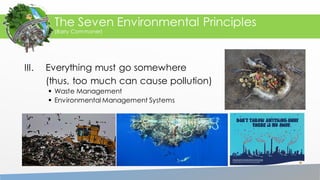
III. Everything must go somewhere
(thus, too much can cause pollution)
 Waste Management
 Environmental Management Systems
The Seven Environmental Principles
(Barry Commoner)
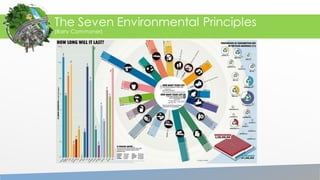
IV. Ours is a finite earth
(thus, the need for conservation)
 Trends in Paradigm
The Seven Environmental Principles
(Barry Commoner)
Preservation
(no touch)
Conservation
(Wise Use)
Sustainable
Development
The Seven Environmental Principles
(Barry Commoner)
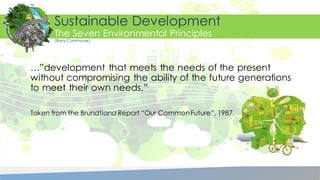
…”development that meets the needs of the present
without compromising the ability of the future generations
to meet their own needs.”
Taken from the Brundtland Report “Our CommonFuture”, 1987.
Sustainable Development
The Seven Environmental Principles
(Barry Commoner)
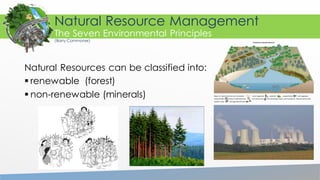
Natural Resources can be classified into:
 renewable (forest)
 non-renewable (minerals)
Natural Resource Management
The Seven Environmental Principles
(Barry Commoner)
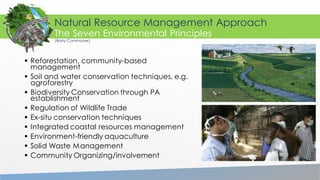
 Reforestation, community-based
management
 Soil and water conservation techniques, e.g.
agroforestry
 Biodiversity Conservation through PA
establishment
 Regulation of Wildlife Trade
 Ex-situ conservation techniques
 Integrated coastal resources management
 Environment-friendly aquaculture
 Solid Waste Management
 Community Organizing/involvement
Natural Resource Management Approach
The Seven Environmental Principles
(Barry Commoner)
V. Nature knows best
(thus, the need for
ecological technology)
“Nature must be obeyed first
before it can be
commanded”
 Humans should first understand
nature and follow its laws
 Humans should not go against
natural processes if we want a
sustained yield of natural resources
The Seven Environmental Principles
(Barry Commoner)
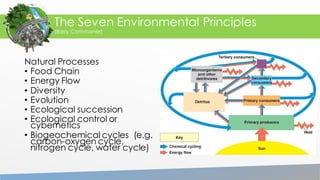
Natural Processes
• Food Chain
• Energy Flow
• Diversity
• Evolution
• Ecological succession
• Ecological control or
cybernetics
• Biogeochemical cycles (e.g.
carbon-oxygen cycle,
nitrogen cycle, water cycle)
The Seven Environmental Principles
(Barry Commoner)
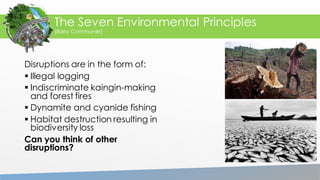
Disruptions are in the form of:
 Illegal logging
 Indiscriminate kaingin-making
and forest fires
 Dynamite and cyanide fishing
 Habitat destruction resulting in
biodiversity loss
Can you think of other
disruptions?
The Seven Environmental Principles
(Barry Commoner)
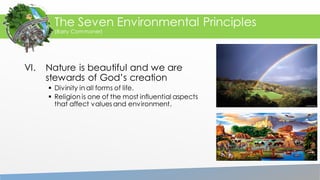
VI. Nature is beautiful and we are
stewards of God’s creation
 Divinity in all forms of life.
 Religion is one of the most influential aspects
that affect values and environment.
The Seven Environmental Principles
(Barry Commoner)
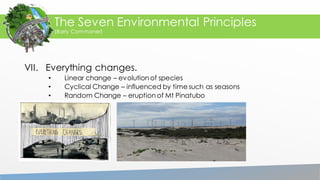
VII. Everything changes.
• Linear change – evolution of species
• Cyclical Change – influenced by time such as seasons
• Random Change – eruption of Mt Pinatubo
The Seven Environmental Principles
(Barry Commoner)
1. Everything is Connected to Everything Else
 Ecosystem
2. All forms of life are important
 Roles and niches, biodiversity
3. Everything Must Go Somewhere
 There is no ‘away’
4. Ours is a finite Earth
 No touch, wise use, sustainable development
5. Nature knows best
 Nature must be obeyed first before it can be commanded
6. Nature is Beautiful and We are Stewards of God’s Creation
 Religion is one of the most influential aspects that affect values and
environment
7. Everything Changes
 Linear, cyclical, random
22
SUMMARY
The Seven Environmental Principles
(Barry Commoner)
Workshop
 Connect ideas from the game with any of the
abovementioned principles
 Discuss relevance in everyday life.
The Seven Environmental Principles
(Barry Commoner)

The-Seven(7)-Environmental-Principles-.pdf

  • 1.
    Society for theConservation of Philippine Wetlands. Inc.
  • 2.
    Environment …“immediate surroundings ofan individual” …”is a complex system that deals with a network of living and non-living entities” Includes: • Physical Components (air, water, land, energy) • Biological Components (plants, animals) • Socio-Economic Components (people, communities, institutions, values)
  • 3.
    I. Everything isconnected to everything else. Ecosystem • is the basic functional unit of nature • is the interaction of the community (living components) and the non-living environment The Seven Environmental Principles (Barry Commoner)
  • 4.
    The Seven EnvironmentalPrinciples (Barry Commoner)
  • 5.
    The Seven EnvironmentalPrinciples (Barry Commoner)
  • 6.
    • Forest Ecosystems Isa community of trees, shrubs, herbs, microorganisms and animals, the trees being the most obvious living structure • Marginal Lands/Uplands Public lands that are hilly to mountainous and greater than 18% slope, including the table land and plateaus lying at elevations which are not normally suited to wet rice unless some form of terracing and ground water exists • Protected Areas Areas of remarkable and outstanding features considered as biologically important and are habitats or rare and endangered species. Philippine Ecosystem The Seven Environmental Principles (Barry Commoner)
  • 7.
    • Freshwaterand Wetlands Areasof marsh, fen, peatland, or water, whether natural or artificial, permanent or temporary, with waterthat is static or flowing, fresh, brackish, or salt, including areas of marine water,the depth does not exceed six meters. • Lowland/Agricultural Ecosystems • Coastal and Marine Ecosystems Home to 59% of the country’s total population (70% of total municipalities and most of the country’s major cities are located here) • Urban Ecosystems Philippine Ecosystem The Seven Environmental Principles (Barry Commoner)
  • 8.
    II. All formsof life are important (thus, the need for biodiversity)  All organisms have a role in the ecosystem (niche) The Seven Environmental Principles (Barry Commoner)
  • 9.
    The Seven EnvironmentalPrinciples (Barry Commoner)
  • 10.
    …”is the varietyof all life forms on Earth – plants, animals, microorganisms…” •Ecosystems diversity - interdependence within species •Species diversity – basic unit of biological classification •Genetic Diversity – variation within species Biological Diversity or Biodiversity The Seven Environmental Principles (Barry Commoner) http://www.regentsprep.org/regents/biology/units/ecology/biodiversitycomparison.gif
  • 11.
    III. Everything mustgo somewhere (thus, too much can cause pollution)  Waste Management  Environmental Management Systems The Seven Environmental Principles (Barry Commoner)
  • 12.
    IV. Ours isa finite earth (thus, the need for conservation)  Trends in Paradigm The Seven Environmental Principles (Barry Commoner) Preservation (no touch) Conservation (Wise Use) Sustainable Development
  • 13.
    The Seven EnvironmentalPrinciples (Barry Commoner)
  • 14.
    …”development that meetsthe needs of the present without compromising the ability of the future generations to meet their own needs.” Taken from the Brundtland Report “Our CommonFuture”, 1987. Sustainable Development The Seven Environmental Principles (Barry Commoner)
  • 15.
    Natural Resources canbe classified into:  renewable (forest)  non-renewable (minerals) Natural Resource Management The Seven Environmental Principles (Barry Commoner)
  • 16.
     Reforestation, community-based management Soil and water conservation techniques, e.g. agroforestry  Biodiversity Conservation through PA establishment  Regulation of Wildlife Trade  Ex-situ conservation techniques  Integrated coastal resources management  Environment-friendly aquaculture  Solid Waste Management  Community Organizing/involvement Natural Resource Management Approach The Seven Environmental Principles (Barry Commoner)
  • 17.
    V. Nature knowsbest (thus, the need for ecological technology) “Nature must be obeyed first before it can be commanded”  Humans should first understand nature and follow its laws  Humans should not go against natural processes if we want a sustained yield of natural resources The Seven Environmental Principles (Barry Commoner)
  • 18.
    Natural Processes • FoodChain • Energy Flow • Diversity • Evolution • Ecological succession • Ecological control or cybernetics • Biogeochemical cycles (e.g. carbon-oxygen cycle, nitrogen cycle, water cycle) The Seven Environmental Principles (Barry Commoner)
  • 19.
    Disruptions are inthe form of:  Illegal logging  Indiscriminate kaingin-making and forest fires  Dynamite and cyanide fishing  Habitat destruction resulting in biodiversity loss Can you think of other disruptions? The Seven Environmental Principles (Barry Commoner)
  • 20.
    VI. Nature isbeautiful and we are stewards of God’s creation  Divinity in all forms of life.  Religion is one of the most influential aspects that affect values and environment. The Seven Environmental Principles (Barry Commoner)
  • 21.
    VII. Everything changes. •Linear change – evolution of species • Cyclical Change – influenced by time such as seasons • Random Change – eruption of Mt Pinatubo The Seven Environmental Principles (Barry Commoner)
  • 22.
    1. Everything isConnected to Everything Else  Ecosystem 2. All forms of life are important  Roles and niches, biodiversity 3. Everything Must Go Somewhere  There is no ‘away’ 4. Ours is a finite Earth  No touch, wise use, sustainable development 5. Nature knows best  Nature must be obeyed first before it can be commanded 6. Nature is Beautiful and We are Stewards of God’s Creation  Religion is one of the most influential aspects that affect values and environment 7. Everything Changes  Linear, cyclical, random 22 SUMMARY The Seven Environmental Principles (Barry Commoner)
  • 23.
    Workshop  Connect ideasfrom the game with any of the abovementioned principles  Discuss relevance in everyday life. The Seven Environmental Principles (Barry Commoner)