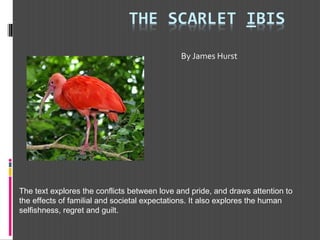
By James Hurst
The text explores the conflicts between love and pride, and draws attention to
the effects of familial and societal expectations. It also explores the human
selfishness, regret and guilt.
Reminder: This Term
We will complete all the online lessons
We will read all the text
We will discuss ALL the assignments
* All you have to do – is show up for class
OR watch the recording and you will have
NO extra assigned work
Essential QuestionsEssential Questions
What can short stories teach about self-
discovery?
How do life experiences influence an individual?
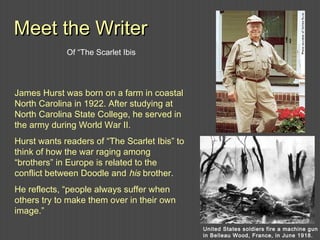
James Hurst was born on a farm in coastal
North Carolina in 1922. After studying at
North Carolina State College, he served in
the army during World War II.
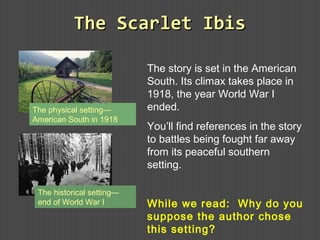
Hurst wants readers of “The Scarlet Ibis” to
think of how the war raging among
“brothers” in Europe is related to the
conflict between Doodle and his brother.
He reflects, “people always suffer when
others try to make them over in their own
image.”
Meet the WriterMeet the Writer
United States soldiers fire a machine gun
in Belleau Wood, France, in June 1918.
Of “The Scarlet Ibis
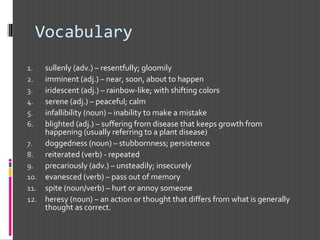
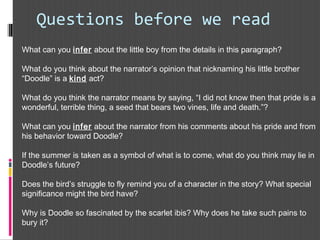
The story is set in the American
South. Its climax takes place in
1918, the year World War I
ended.
You’ll find references in the story
to battles being fought far away
from its peaceful southern
setting.
While we read: Why do you
suppose the author chose
this setting?
The Scarlet IbisThe Scarlet Ibis
The physical setting—
American South in 1918
The historical setting—
end of World War I
Vocabulary
1. sullenly (adv.) – resentfully; gloomily
2. imminent (adj.) – near, soon, about to happen
3. iridescent (adj.) – rainbow-like; with shifting colors
4. serene (adj.) – peaceful; calm
5. infallibility (noun) – inability to make a mistake
6. blighted (adj.) – suffering from disease that keeps growth from
happening (usually referring to a plant disease)
7. doggedness (noun) – stubbornness; persistence
8. reiterated (verb) - repeated
9. precariously (adv.) – unsteadily; insecurely
10. evanesced (verb) – pass out of memory
11. spite (noun/verb) – hurt or annoy someone
12. heresy (noun) – an action or thought that differs from what is generally
thought as correct.
Questions before we read
What can you infer about the little boy from the details in this paragraph?
 
What do you think about the narrator’s opinion that nicknaming his little brother
“Doodle” is a kind act?
What do you think the narrator means by saying, “I did not know then that pride is a
wonderful, terrible thing, a seed that bears two vines, life and death.”?
 
What can you infer about the narrator from his comments about his pride and from
his behavior toward Doodle?
 
If the summer is taken as a symbol of what is to come, what do you think may lie in
Doodle’s future?
 
Does the bird’s struggle to fly remind you of a character in the story? What special
significance might the bird have?  
 
Why is Doodle so fascinated by the scarlet ibis? Why does he take such pains to
bury it?  
Let’s Begin Reading the StoryLet’s Begin Reading the Story
If you did not attend live CC, then locate theIf you did not attend live CC, then locate the
text below this lesson or in DocSharingtext below this lesson or in DocSharing
Once you have finished reading the story,
complete the rest of the lesson
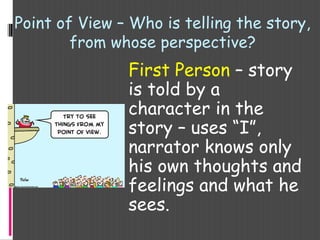
Point of View – Who is telling the story,
from whose perspective?
First Person – story
is told by a
character in the
story – uses “I”,
narrator knows only
his own thoughts and
feelings and what he
sees.
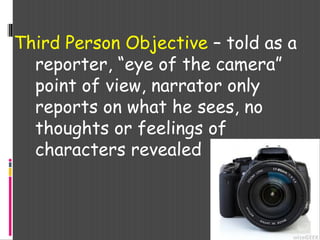
Third Person Objective – told as a
reporter, “eye of the camera”
point of view, narrator only
reports on what he sees, no
thoughts or feelings of
characters revealed
Third Person Omniscient – “God-
like” narrator – knows the
thoughts and feelings of all
characters and sees all that
happens.
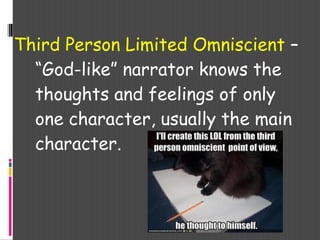
Third Person Limited Omniscient –
“God-like” narrator knows the
thoughts and feelings of only
one character, usually the main
character.
Point of View
 How is the story told?
 How old is the narrator before the
flashback?
“But sometimes (like right now), as I
sit in the cool, green-draped parlor,
the grindstone begins to turn, and
time with all its changes is ground
away– and I remember Doodle.”
Narrator BackgroundNarrator Background
Hurst refers to a number of trees and flowers by the local
names that he learned as a boy.
The “bleeding tree” is a type of pine from which white
sap runs like blood when the bark is cut.
“Graveyard flowers” are sweet smelling gardenias,
which, because they bloom year after year, are often planted in
cemeteries.
The frayed twigs of the “toothbrush tree” were once
used by people to clean their teeth after eating.
Characterization – Methods used by the
author to let the reader get to know the characters.
Direct Method of Characterization – the
author directly tells the reader something
about the character (He is kind.)
1. Character’s name
2. Character’s appearance (how he/she looks,
clothes worn, etc.)
3. What the character says
4. What the character thinks and feels
5. What the character does
6. What other people think of the character
7. How animals react to the character (animal
growls)
Indirect Method of Characterization –
the reader draws a conclusion about the
character based on
Types of Characters
1. Protagonist – the main character
who is trying to achieve a goal
2. Antagonist – the character who
antagonizes, who causes problems in
the story; the antagonist may be an
obstacle rather than a person at
times
1. Flat Character – character with only one trait, one-sided,
no depth
2. Round Character – a complex character, many-sided,
realistic, more traits are given or observed in this type of
character
3. Static character – does not change during the story (in
personality, maturity, beliefs, etc.)
4. Dynamic character – changes, usually for the better, due
to events in the story
5. Foil – This character serves as a contrast for another
character, often the characteristics of the “foils” appear
exaggerated because of the stark contrast. (Tybalt and
Benvolio in Romeo and Juliet)
6. Stereo Types – athlete, bully, lawyer, bikers, etc.
More Characters…
Characterize the narrator
 Characterization- much of what we learn
about the narrator is based on his words,
thoughts, or actions regarding his brother
 Is this direct or indirect characterization?
 Is the narrator dynamic or static?
Characterize Doodle
Doodle was just about the craziest brother a boy every had. Of course, he
wasn’t crazy crazy like old Miss Leedie, who was in love with President Wilson and
wrote him a letter every day, but was a nice crazy, like someone you meet in your
dreams. He was born when I was six and was, from the outset, a disappointment. He
seemed all head, with a tiny body which was red and shriveled like an old man’s.
Everybody thought he was going to die-everybody except Aunt Nicey, who had
delivered him. She said he would live because he was born in a caul, and cauls were
made from Jesus’ nightgown. Daddy had Mr. Heath, the carpenter, build a little
mahogany coffin for him. But he didn’t die, and when he was three months old,
Mama and Daddy decided they might as well name him. They named him William
Armstrong, which is like tying a big tail on a small kite. Such a name sounds good
only on a tombstone. 
I thought myself pretty smart at many things, like holding my breath,
running, jumping, or climbing the vines in Old Woman Swamp, and I wanted more
than anything else someone to race to Horsehead Landing, someone to box with,
and someone to perch with in the top fork of the great pine behind the barn, where
across the fields and swamps you could see the sea. I wanted a brother. But Mama,
crying, told me that even if William Armstrong lived, he would never do these things
with me. He might not, she sobbed, even be “all there.” He might, as long as he lived,
lie on the rubber sheet in the center of the bed in the front bedroom where the white
Marquette curtains billowed out in the afternoon sea breeze, rustling like palmetto
fronds.
What can you infer about the
little boy from the previous
passage?
INFER: conclude from facts and reasoning rather than from
obvious information.
Theme:
 Themes are rarely stated directly in literature. (In “The
Scarlet Ibis” they are!) Most often, a reader has to infer the
theme of a work after considerable thought.
 The theme is the statement the writer wants to make about
that subject.
 For example, if the subject is “growing up,” the theme might
be :
 For most young people, growing up is a process that
involves the pain of achieving self-knowledge.
The central idea – what is the main idea of
the piece?
Key Lines that Develop the
Theme of Pride
 “There is within me (and with sadness I have
watched it in others) a knot of cruelty borne by
the stream of love, much as our blood
sometimes bears the seed of our
destruction…”
 “All of us must have something to be proud of”
 “Pride is a wonderful, terrible thing, a seed
that bears two vines, life and death.”
How is pride “wonderful and
terrible”?
 Wonderful because he teaches Doodle to
walk
 Terrible because he does it for selfish reasons
 How does this quote function in the story??
Literary Devices
Foreshadowing: hints of clues of
events that have yet to occur
 “summer was dead, but autumn was not yet born”
 Summer of 1918 was blighted- plant growth replaced by
death and decay
 “…last graveyard flowers were blooming”
 such times make him “remember Doodle”
 Doodle’s real name only looks good on a tombstone
 arrival of the bird, its death, and Doodle burying it
 Fall of Ibis- Doodle’s fall
 Doodle’s response to the Ibis
 “Dead birds is bad luck…Specially red dead birds!”
Imagery
 Essentially, imagery is any series of words that
create a picture, or sensory experience in your
head.
 The use of figurative language (similes,
metaphors, and personification) helps create
imagery in writing. Let’s look at some examples.
Examples
 “…with a tiny body which was red and shriveled like
an old man’s”
 “…curtains billowed out in the afternoon sea breeze,
rustling like palmetto fronds”
 “Even death did not mar its grace, for it lay on the
earth like a broken vase of red flowers.”
 “The [rain] drops stung my face like nettles”
What death imagery do you
recall?
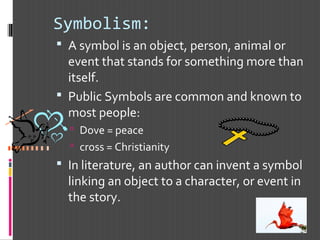
Symbolism:
 A symbol is an object, person, animal or
event that stands for something more than
itself.
 Public Symbols are common and known to
most people:
 Dove = peace
 cross = Christianity
 In literature, an author can invent a symbol
linking an object to a character, or event in
the story.
Why Symbolism?
 All figurative language and stylistic devices
are used to help convey the theme of the
story. If you cannot figure out what a symbol
stands for, think about the controlling ideas
of the story, and your theme will lead you to
understand the symbol.
Why does the author choose the scarlet
ibis as the symbol as opposed to another
bird?
Watch the CC if you need help
With what is red usually associated?
Watch the CC if you need help
Why choose a red bird and develop red
imagery?
Watch the CC if you need help
Symbol – The Scarlet Ibis
Additional Important Terms
Tone – the author’s attitude
toward the story and readers
Tells us what the author thinks
about his or her main character
Mood – the feeling the reader
gets from the reading
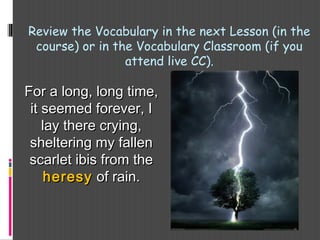
For a long, long time,For a long, long time,
it seemed forever, Iit seemed forever, I
lay there crying,lay there crying,
sheltering my fallensheltering my fallen
scarlet ibis from thescarlet ibis from the
heresyheresy of rain.of rain.
Review the Vocabulary in the next Lesson (in the
course) or in the Vocabulary Classroom (if you
attend live CC).

The scarlet ibis introductioninlms

  • 1.
    By James Hurst Thetext explores the conflicts between love and pride, and draws attention to the effects of familial and societal expectations. It also explores the human selfishness, regret and guilt.
  • 2.
    Reminder: This Term Wewill complete all the online lessons We will read all the text We will discuss ALL the assignments * All you have to do – is show up for class OR watch the recording and you will have NO extra assigned work
  • 3.
    Essential QuestionsEssential Questions Whatcan short stories teach about self- discovery? How do life experiences influence an individual?
  • 4.
    James Hurst wasborn on a farm in coastal North Carolina in 1922. After studying at North Carolina State College, he served in the army during World War II. Hurst wants readers of “The Scarlet Ibis” to think of how the war raging among “brothers” in Europe is related to the conflict between Doodle and his brother. He reflects, “people always suffer when others try to make them over in their own image.” Meet the WriterMeet the Writer United States soldiers fire a machine gun in Belleau Wood, France, in June 1918. Of “The Scarlet Ibis
  • 5.
    The story isset in the American South. Its climax takes place in 1918, the year World War I ended. You’ll find references in the story to battles being fought far away from its peaceful southern setting. While we read: Why do you suppose the author chose this setting? The Scarlet IbisThe Scarlet Ibis The physical setting— American South in 1918 The historical setting— end of World War I
  • 6.
    Vocabulary 1. sullenly (adv.)– resentfully; gloomily 2. imminent (adj.) – near, soon, about to happen 3. iridescent (adj.) – rainbow-like; with shifting colors 4. serene (adj.) – peaceful; calm 5. infallibility (noun) – inability to make a mistake 6. blighted (adj.) – suffering from disease that keeps growth from happening (usually referring to a plant disease) 7. doggedness (noun) – stubbornness; persistence 8. reiterated (verb) - repeated 9. precariously (adv.) – unsteadily; insecurely 10. evanesced (verb) – pass out of memory 11. spite (noun/verb) – hurt or annoy someone 12. heresy (noun) – an action or thought that differs from what is generally thought as correct.
  • 7.
    Questions before weread What can you infer about the little boy from the details in this paragraph?   What do you think about the narrator’s opinion that nicknaming his little brother “Doodle” is a kind act? What do you think the narrator means by saying, “I did not know then that pride is a wonderful, terrible thing, a seed that bears two vines, life and death.”?   What can you infer about the narrator from his comments about his pride and from his behavior toward Doodle?   If the summer is taken as a symbol of what is to come, what do you think may lie in Doodle’s future?   Does the bird’s struggle to fly remind you of a character in the story? What special significance might the bird have?     Why is Doodle so fascinated by the scarlet ibis? Why does he take such pains to bury it?  
  • 8.
    Let’s Begin Readingthe StoryLet’s Begin Reading the Story If you did not attend live CC, then locate theIf you did not attend live CC, then locate the text below this lesson or in DocSharingtext below this lesson or in DocSharing Once you have finished reading the story, complete the rest of the lesson
  • 9.
    Point of View– Who is telling the story, from whose perspective? First Person – story is told by a character in the story – uses “I”, narrator knows only his own thoughts and feelings and what he sees.
  • 10.
    Third Person Objective– told as a reporter, “eye of the camera” point of view, narrator only reports on what he sees, no thoughts or feelings of characters revealed
  • 11.
    Third Person Omniscient– “God- like” narrator – knows the thoughts and feelings of all characters and sees all that happens.
  • 12.
    Third Person LimitedOmniscient – “God-like” narrator knows the thoughts and feelings of only one character, usually the main character.
  • 13.
    Point of View How is the story told?  How old is the narrator before the flashback? “But sometimes (like right now), as I sit in the cool, green-draped parlor, the grindstone begins to turn, and time with all its changes is ground away– and I remember Doodle.”
  • 14.
    Narrator BackgroundNarrator Background Hurstrefers to a number of trees and flowers by the local names that he learned as a boy. The “bleeding tree” is a type of pine from which white sap runs like blood when the bark is cut. “Graveyard flowers” are sweet smelling gardenias, which, because they bloom year after year, are often planted in cemeteries. The frayed twigs of the “toothbrush tree” were once used by people to clean their teeth after eating.
  • 15.
    Characterization – Methodsused by the author to let the reader get to know the characters. Direct Method of Characterization – the author directly tells the reader something about the character (He is kind.)
  • 16.
    1. Character’s name 2.Character’s appearance (how he/she looks, clothes worn, etc.) 3. What the character says 4. What the character thinks and feels 5. What the character does 6. What other people think of the character 7. How animals react to the character (animal growls) Indirect Method of Characterization – the reader draws a conclusion about the character based on
  • 17.
    Types of Characters 1.Protagonist – the main character who is trying to achieve a goal 2. Antagonist – the character who antagonizes, who causes problems in the story; the antagonist may be an obstacle rather than a person at times
  • 18.
    1. Flat Character– character with only one trait, one-sided, no depth 2. Round Character – a complex character, many-sided, realistic, more traits are given or observed in this type of character 3. Static character – does not change during the story (in personality, maturity, beliefs, etc.) 4. Dynamic character – changes, usually for the better, due to events in the story 5. Foil – This character serves as a contrast for another character, often the characteristics of the “foils” appear exaggerated because of the stark contrast. (Tybalt and Benvolio in Romeo and Juliet) 6. Stereo Types – athlete, bully, lawyer, bikers, etc. More Characters…
  • 19.
    Characterize the narrator Characterization- much of what we learn about the narrator is based on his words, thoughts, or actions regarding his brother  Is this direct or indirect characterization?  Is the narrator dynamic or static?
  • 20.
    Characterize Doodle Doodle wasjust about the craziest brother a boy every had. Of course, he wasn’t crazy crazy like old Miss Leedie, who was in love with President Wilson and wrote him a letter every day, but was a nice crazy, like someone you meet in your dreams. He was born when I was six and was, from the outset, a disappointment. He seemed all head, with a tiny body which was red and shriveled like an old man’s. Everybody thought he was going to die-everybody except Aunt Nicey, who had delivered him. She said he would live because he was born in a caul, and cauls were made from Jesus’ nightgown. Daddy had Mr. Heath, the carpenter, build a little mahogany coffin for him. But he didn’t die, and when he was three months old, Mama and Daddy decided they might as well name him. They named him William Armstrong, which is like tying a big tail on a small kite. Such a name sounds good only on a tombstone.  I thought myself pretty smart at many things, like holding my breath, running, jumping, or climbing the vines in Old Woman Swamp, and I wanted more than anything else someone to race to Horsehead Landing, someone to box with, and someone to perch with in the top fork of the great pine behind the barn, where across the fields and swamps you could see the sea. I wanted a brother. But Mama, crying, told me that even if William Armstrong lived, he would never do these things with me. He might not, she sobbed, even be “all there.” He might, as long as he lived, lie on the rubber sheet in the center of the bed in the front bedroom where the white Marquette curtains billowed out in the afternoon sea breeze, rustling like palmetto fronds.
  • 21.
    What can youinfer about the little boy from the previous passage? INFER: conclude from facts and reasoning rather than from obvious information.
  • 22.
    Theme:  Themes arerarely stated directly in literature. (In “The Scarlet Ibis” they are!) Most often, a reader has to infer the theme of a work after considerable thought.  The theme is the statement the writer wants to make about that subject.  For example, if the subject is “growing up,” the theme might be :  For most young people, growing up is a process that involves the pain of achieving self-knowledge. The central idea – what is the main idea of the piece?
  • 23.
    Key Lines thatDevelop the Theme of Pride  “There is within me (and with sadness I have watched it in others) a knot of cruelty borne by the stream of love, much as our blood sometimes bears the seed of our destruction…”  “All of us must have something to be proud of”  “Pride is a wonderful, terrible thing, a seed that bears two vines, life and death.”
  • 24.
    How is pride“wonderful and terrible”?  Wonderful because he teaches Doodle to walk  Terrible because he does it for selfish reasons  How does this quote function in the story??
  • 25.
  • 26.
    Foreshadowing: hints ofclues of events that have yet to occur  “summer was dead, but autumn was not yet born”  Summer of 1918 was blighted- plant growth replaced by death and decay  “…last graveyard flowers were blooming”  such times make him “remember Doodle”  Doodle’s real name only looks good on a tombstone  arrival of the bird, its death, and Doodle burying it  Fall of Ibis- Doodle’s fall  Doodle’s response to the Ibis  “Dead birds is bad luck…Specially red dead birds!”
  • 27.
    Imagery  Essentially, imageryis any series of words that create a picture, or sensory experience in your head.  The use of figurative language (similes, metaphors, and personification) helps create imagery in writing. Let’s look at some examples.
  • 28.
    Examples  “…with atiny body which was red and shriveled like an old man’s”  “…curtains billowed out in the afternoon sea breeze, rustling like palmetto fronds”  “Even death did not mar its grace, for it lay on the earth like a broken vase of red flowers.”  “The [rain] drops stung my face like nettles”
  • 29.
    What death imagerydo you recall?
  • 30.
    Symbolism:  A symbolis an object, person, animal or event that stands for something more than itself.  Public Symbols are common and known to most people:  Dove = peace  cross = Christianity  In literature, an author can invent a symbol linking an object to a character, or event in the story.
  • 31.
    Why Symbolism?  Allfigurative language and stylistic devices are used to help convey the theme of the story. If you cannot figure out what a symbol stands for, think about the controlling ideas of the story, and your theme will lead you to understand the symbol.
  • 32.
    Why does theauthor choose the scarlet ibis as the symbol as opposed to another bird? Watch the CC if you need help With what is red usually associated? Watch the CC if you need help Why choose a red bird and develop red imagery? Watch the CC if you need help Symbol – The Scarlet Ibis
  • 33.
    Additional Important Terms Tone– the author’s attitude toward the story and readers Tells us what the author thinks about his or her main character Mood – the feeling the reader gets from the reading
  • 34.
    For a long,long time,For a long, long time, it seemed forever, Iit seemed forever, I lay there crying,lay there crying, sheltering my fallensheltering my fallen scarlet ibis from thescarlet ibis from the heresyheresy of rain.of rain. Review the Vocabulary in the next Lesson (in the course) or in the Vocabulary Classroom (if you attend live CC).