International Journal of Trend in Scientific Research and Development (IJTSRD)
Volume 6 Issue 5, July-August 2022 Available Online: www.ijtsrd.com e-ISSN: 2456 – 6470
@ IJTSRD | Unique Paper ID – IJTSRD50687 | Volume – 6 | Issue – 5 | July-August 2022 Page 1600
The Role of Electronic Dictionary in Learning Process
V. Selvakumar1
, Dr. A. Munian2
1
Project Assistant - MKU-RUSA Project, 2
Principal Investigator - MKU-RUSA Project,
1,2
Madurai Kamaraj University, Madurai, Tamil Nadu, India
ABSTRACT
Dictionary is the treasure house of any language. Language learning
by acquiring language skills is assuming more important in learning.
If one could acquire listening skills, one could achieve other skills
such as listening, speaking, reading and writing. Listening skill can
be developed by using technical gadgets. In this new scenario using
technical gadgets such as e-library, language laboratory and e-
dictionary to acquire knowledge in language felt easy. But learners
are still frustrating in learning a language. If learners are attracted by
teaching methodology, they will acquire the knowledge in language
easily. Learners must be motivated to use technological gadgets to
learn language and can be given opportunity to develop their
vocabulary by using electronic dictionary. The Modernity in
language learning depends on introducing electronic medium for the
learners to get accuracy, aptness and to save their time. This paper
emphasizes on using electronic dictionary to learn a language.
KEYWORDS: Dictionary, Language skills, Technology, Language
learning, Online education
How to cite this paper: V. Selvakumar |
Dr. A. Munian "The Role of Electronic
Dictionary in Learning Process"
Published in
International Journal
of Trend in
Scientific Research
and Development
(ijtsrd), ISSN: 2456-
6470, Volume-6 |
Issue-5, August
2022, pp.1600-1604, URL:
www.ijtsrd.com/papers/ijtsrd50687.pdf
Copyright © 2022 by author (s) and
International Journal of Trend in
Scientific Research and Development
Journal. This is an
Open Access article
distributed under the
terms of the Creative Commons
Attribution License (CC BY 4.0)
(http://creativecommons.org/licenses/by/4.0)
1. INTRODUCTION
Technology – Enhanced learning has taken huge
leaps in the present context. Online educational
resources are drawing popularity day by day. Among
the online educational resources e-dictionary is an
important tool in the learning process. Language
learning is mainly for proficiency and fluency in
communication in the speaking and graphic form.
Therefore, depending on compiling the manual
dictionaries could not satisfy the present need of the
language learners and researchers. In this
technological scenario learners should be motivated
to learn the language easily by using electronic
dictionary in the class room because it provides an
easy and accessible way of learning words. It is a
powerful learning aid that promotes the better
understanding and stimulates a desire to learn the
language independently.
The word dictionary is taken from Latin word
‘dictionarius’. It is drived from the word ‘diction’
which means ‘style’. Lexicography deals with the
practice of compiling dictionaries. To acquire
language skills, learners use electronic dictionary in
learning process. Learners could be motivated
themselves by improving vocabulary by referring to
the different dictionaries which come under the
reference materials. Learning process has to be done
in an interesting way. Learners could be attracted by
the teaching methodology using technological
gadgets in the classroom. The role of dictionary is to
express the semantics and to expose the etymology of
a word. Dictionary functions to accumulate word
power, the modelling of using an apt word in the apt
place and the usage of the word in different occasions
and periods. No manual compilation could be vast
and vivid as the expectation of the learners, moreover,
using manual dictionary which is full of time
consuming and laborious. But giving semantics,
syntactic and etymological form of lexis byelectronic
dictionary can be much more beneficial and very
quick access to learners. Therefore, introducing e-
dictionaries are welcoming factor in the language
learning especially in English. Learning English is
found to be deteriorating in stranded with reference to
vocabulary and structure among the students seeking
higher education. The Dictionary words are arranged
in the alphabetical method with phonetic symbols,
synonyms, order of words or phrases with meaning
and information. Dictionary gives not only meaning
IJTSRD50687
International Journal of Trend in Scientific Research and Development @ www.ijtsrd.com eISSN: 2456-6470
@ IJTSRD | Unique Paper ID – IJTSRD50687 | Volume – 6 | Issue – 5 | July-August 2022 Page 1601
for each word but also tells how the words in a
sentence and phrases are used both in the archaic and
modern times.
1.1. Types of Dictionaries
In general dictionaries are categorized into following
1. Traditional or printed dictionary
2. Electronic dictionary / e- dictionary
3. Daniel jones phonetic dictionary
4. Mobile dictionary
5. Online dictionary
6. Thesaurus and
7. Encyclopaedia
Of these dictionaries, the present paper lays emphasis
on electronic dictionary.
1.1.1. Electronic Dictionary
Electronic dictionary is a dictionary of digital form
which can be used to access any number of words or
lexemes. It can also be said as the dictionary in the
digital form. At present, there are different types of
dictionaries which can be downloaded in the
smartphones or tablets as apps. It is a user easy and
friendly to learners to learn more words within the
short time. It is better and faster for class-based
activities. The electronic dictionary is more useful in
the classroom teaching than paper dictionary, even
though it may create a great distraction in the
classroom teaching. We have more than one-million
words in e-dictionary with different meaning. It is
easy to update with new word. While we teach the
grammar elements in English such as verbs, Idiomatic
phrase, sentence structure, etc, it is easy to interact
with the learners and easy to search a word for
meaning.
1.2. Overview of Literature
There are some works carried out by the scholars
pertaining to Electronic dictionary
Aust, R. et al. (1993), view that An electronic
dictionary is “an electronic aid that offers immediate
access to reference information with a clear and direct
return path to the target information”
Hulstijn et al. (1996) confirmed that learners checking
dictionaries are to find the meaning of words which
have reading and listening leading to learning
vocabulary. They highlighted the vocabulary learning
strategies which illustrates that language learners can
find out new vocabulary on their own by using
dictionaries
Stirling (2003) Kobayashi (2006) as cited in Rezaei
and Davoudi (2016) have compared with the bulk of
paper dictionaries and slow retrieve, the increasing
popularity of electronic dictionaries can be credited to
better readability and their ease of use, which makes
the consultation process less time-consuming.
Neubach and Cohen (1988) cited in Kobayashi (2006)
reported that consulting a dictionary improves the
retention of learning the terminology. They are of the
opinion that there is a growing interest in the role of
electronic dictionaries for learning foreign languages.
According to Dashtestani (2013), there has been an
increase in student’s use of electronic dictionaries for
EFL purposes.
According to Dashtestani (2013), while conducting
comparison survey to compare between EFL Iranian
student’s and teacher’s perspectives on the role of e-
dictionaries, came out with the findings that faculty
and students held moderately positive attitudes
toward the role of electronic dictionaries for learning
EFL.
Rezaei and Davoudi (2016) opine that electronic
dictionary have advanced rapidly in the last three
decades. Electronic dictionaries are made available in
CD-ROM, small hand - held calculator-type reference
works and online (Nesi, 2009). Moreover, CD-ROM
and hand-held devices used by researchers show
interest in online dictionaries due to the rapid advance
of the Internet, Smartphones and Ipads (Rezaei and
Davoudi, 2016). Electronic Dictionaries used more
broadly by language learners are becoming a new
technological tool of vocabulary learning among
second language learners.
From those works reviewed, it is understand that
Electronic dictionary offers immediate access to
obtain information and it consumes less processing
time for the learners or users. In EFL classroom, the
use of electronic dictionary is more helpful to the
learners. Thus Electronic dictionaries used by
language learners as new technological tool of
vocabulary learning are more growing in the
academic area.
1.3. Classification of Electronic Dictionary
The development of new technology and the Internet
have progressively the dictionary concept. Electronic
dictionaries can be classified into various types
according to different norms. An Electronic
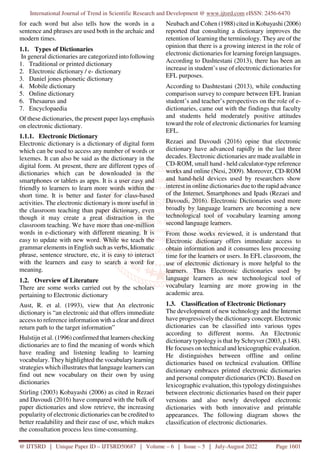
dictionary typology is that by Schryver (2003, p.148).
He focuses on technical and lexicographic evaluation.
He distinguishes between offline and online
dictionaries based on technical evaluation. Offline
dictionary embraces printed electronic dictionaries
and personal computer dictionaries (PCD). Based on
lexicographic evaluation, this typology distinguishes
between electronic dictionaries based on their paper
versions and also newly developed electronic
dictionaries with both innovative and printable
appearances. The following diagram shows the
classification of electronic dictionaries.
International Journal of Trend in Scientific Research and Development @ www.ijtsrd.com eISSN: 2456-6470
@ IJTSRD | Unique Paper ID – IJTSRD50687 | Volume – 6 | Issue – 5 | July-August 2022 Page 1602
1.4. Speed of an Electronic Dictionary
Electronic Dictionary provides users with a stronger search function in the digital form. Speed is seen as one of
the main advantages of using electronic dictionaries in particular those online and CD ROMs. Wescher and Pitts
(2000, p.1) are of the view that electronic dictionary is speed of the unknown words (searching words), students
are looked up by the users and the students can find quickly the words faster with a electronic dictionary than
with a paper dictionary. Speed is often perceived as an advantage of Electronic Dictionaries but it has been
recommended that speedy reading must therefore be observed as a deliberate activity.
1.5. Use of Electronic Dictionary
It helps to develop learners’ knowledge in language learning and enhances the learners to develop receptive
skills. Individual attention can be given by the teachers while using electronic dictionary in the class. It helps to
learn more Indian languages apart from their mother tongue and many volumes get compressed into one
electronic dictionary. Learners educational qualification level can be raised. It is a boon for language learners
and also brings out the hidden talents of the slow learners. One can easily update some of the brands by using
internet and software. E-dictionary provides storage and retrieval become quick and easy, active learning
opportunity, tension free environment and gives feedback immediately.
As far as the learning situation is concerned, E-Dictionary is used in the following domain. They are:
1. The electronic dictionary extends educational opportunity to develop new ways of learning and increases the
array of learning opportunity.
2. It inspires the students in finding, evaluating and sharing information.
3. It provides proper motivation and instil interest towards the self-learning.
4. The leaners can learn at anytime, anywhere without other external help.
5. This enables the leaners to learn more depending of their aptitude, attitude and also ability.
6. It encourages cooperative attitude among users because a view of the screen is more easily shared than a
view of the page.
7. Providing users with authentic recorded voice facilities for better pronouncing.
International Journal of Trend in Scientific Research and Development @ www.ijtsrd.com eISSN: 2456-6470
@ IJTSRD | Unique Paper ID – IJTSRD50687 | Volume – 6 | Issue – 5 | July-August 2022 Page 1603
1.6. Suggestion for using electronic dictionary in
the classroom teaching and learning process
Language should be taught with proper phonetic
sound. An electronic gadget such as language
laboratory and e-dictionary, etc, help the learners to
learn the language properly. Opportunities should be
provided for using technological gadgets to the
learners to learn the language effectively and
properly. Language class must be provided with
digital board, electronic dictionary, language
laboratory and internet facility, etc. More exposure
should be given to the learners to use technological
gadgets in learning language.
1.7. Conclusion
Electronic dictionaries may not replace the traditional
paper dictionaries but they can surely supplement the
paper dictionaries. Electronic gadgets are valuable in
teaching and learning process. Using e-dictionary is
considered as a skill and dictionaries are considered
as pillar of language learning. The present situation,
the language learners need not carry any dictionaries
along with them and where ever they go. The E-
dictionary revitalise and helps to overcome from the
formal learning to informal learning. The ordinary
library functions in certain period of time, but the E-
dictionary helps a lot 24x7 and whenever we need to
refer the study materials. Even in the Covid19
pandemic situation. This could help the language
learners in different levels of vocabulary learning and
also used both in class and outside of the class. So,
preparing and learning the E-dictionaries can surely
be an unconventional and fashionable trend in
language leaning. The E-dictionaries will help a lot
for the language learners and particularly for the
school going students.
Acknlowledgement
We the authors of this article acknowledge Madurai
Kamaraj University - RUSA for providing Computer
and Printer so as to execute research in the project
area.
References
[1] David Nunan, Lindsey Miller, New Ways in
teaching listening, Virginia, USA 1993.
[2] Jack C. Richards and Richard Schmidt,
Longman Dictionary of Language Teaching
and Applied Linguistics, Pearson Educated ltd,
2010.
[3] Merriam-Webster Dictionary Merriam-
Webster, Inc.
[4] https://www.oxfordlearnersdictionaries.com/
definition/english/relax?q=relax
[5] Shalini Aggarwal, Essential Communication
Skills, New Delhi, Ane Books Pvt. Ltd.,
2009.
[6] Patsy Lightbown and Nina Spada, How
Languages are learned, Oxford University
press 4th
edition 2013.
[7] Ann Malamah – Thomas, Classroom
Interaction, Oxford University press 1987.
[8] Ruth Gairns and Stuart Redman, Working
with Words: A guide to Teaching and
Learning Vocabulary, Cambridge University
press 1986.
[9] Learner’s Dictionary Mobile search
Marriam – Webster Learner’s Dictionary.
com
[10] Lois Bloom, Language Development from
Two to Three, Cambridge University press,
1991.
[11] De Shryver, Gilles- Maurice and David Joff,
On How Electronic Dictionaries are really
used, In Geoffery Willams and Sandra
International Journal of Trend in Scientific Research and Development @ www.ijtsrd.com eISSN: 2456-6470
@ IJTSRD | Unique Paper ID – IJTSRD50687 | Volume – 6 | Issue – 5 | July-August 2022 Page 1604
vessier (eds.), Lorient; ERUALEX, pp. 187-
196, 2002.
[12] Weschler, R., & Pitts, C, An experiment
using electronic dictionaries with EFL
students, The Internet TESL Journal, 6(8),
2000.
[13] Dashtestani, R, EFL teachers’ and students’
perspectives on the use of electronic
dictionaries for learning English, CALL-EJ,
14(2), 51-65, 2013.
[14] Davoudi, M. R. The Influence of Electronic
Dictionaries on Vocabulary Knowledge
Extension, Journal of Education and Learning;
Vol. 5, No. 3, 139-148, 2016.
[15] Rezaei, M., & Davoudi, M, The Influence of
Electronic Dictionaries on Vocabulary
Knowledge Extension, Journal of Education and
Learning, Vol. 5, No. 3, 139-148, 2016.
[16] Nesi, H, Dictionaries in electronic form. In A.
Cowie (Ed.), The Oxford History of English
Lexicography (pp. 458-478), Oxford University
Press, 2009 -January.
[17] Stirling, J, The Portable Electronic Dictionary:
Faithful Friend or Faceless Foe? Retrieved
from English Language Garden:
http://www.elgweb.net/ped article.html 2003.
[18] Knight, S, Dictionary Use While Reading: The
Effects on Comprehension and Vocabulary
Acquisition For Students Of Different Verbal
Abilities, The Modern Language Journal, Vol.
78, No. 3, 285-299, 1994.
[19] Hulstijn, JH, M Hollander and T Greidanus,
Incidental Vocabulary Learning by Advanced
Foreign Language Students: The Influence of
Marginal Glosses, Dictionary Use and the
Reoccurrence of Unknown Words, The Modern
Language Journal, 80, 1996.
[20] Aust, R., Kelley, M. J., & Roby, W. The use of
hyper-reference and conventional dictionaries,
Educational Technology Research and
Development, 41(4), 63-73, 1993.

The Role of Electronic Dictionary in Learning Process

  • 1.
    International Journal ofTrend in Scientific Research and Development (IJTSRD) Volume 6 Issue 5, July-August 2022 Available Online: www.ijtsrd.com e-ISSN: 2456 – 6470 @ IJTSRD | Unique Paper ID – IJTSRD50687 | Volume – 6 | Issue – 5 | July-August 2022 Page 1600 The Role of Electronic Dictionary in Learning Process V. Selvakumar1 , Dr. A. Munian2 1 Project Assistant - MKU-RUSA Project, 2 Principal Investigator - MKU-RUSA Project, 1,2 Madurai Kamaraj University, Madurai, Tamil Nadu, India ABSTRACT Dictionary is the treasure house of any language. Language learning by acquiring language skills is assuming more important in learning. If one could acquire listening skills, one could achieve other skills such as listening, speaking, reading and writing. Listening skill can be developed by using technical gadgets. In this new scenario using technical gadgets such as e-library, language laboratory and e- dictionary to acquire knowledge in language felt easy. But learners are still frustrating in learning a language. If learners are attracted by teaching methodology, they will acquire the knowledge in language easily. Learners must be motivated to use technological gadgets to learn language and can be given opportunity to develop their vocabulary by using electronic dictionary. The Modernity in language learning depends on introducing electronic medium for the learners to get accuracy, aptness and to save their time. This paper emphasizes on using electronic dictionary to learn a language. KEYWORDS: Dictionary, Language skills, Technology, Language learning, Online education How to cite this paper: V. Selvakumar | Dr. A. Munian "The Role of Electronic Dictionary in Learning Process" Published in International Journal of Trend in Scientific Research and Development (ijtsrd), ISSN: 2456- 6470, Volume-6 | Issue-5, August 2022, pp.1600-1604, URL: www.ijtsrd.com/papers/ijtsrd50687.pdf Copyright © 2022 by author (s) and International Journal of Trend in Scientific Research and Development Journal. This is an Open Access article distributed under the terms of the Creative Commons Attribution License (CC BY 4.0) (http://creativecommons.org/licenses/by/4.0) 1. INTRODUCTION Technology – Enhanced learning has taken huge leaps in the present context. Online educational resources are drawing popularity day by day. Among the online educational resources e-dictionary is an important tool in the learning process. Language learning is mainly for proficiency and fluency in communication in the speaking and graphic form. Therefore, depending on compiling the manual dictionaries could not satisfy the present need of the language learners and researchers. In this technological scenario learners should be motivated to learn the language easily by using electronic dictionary in the class room because it provides an easy and accessible way of learning words. It is a powerful learning aid that promotes the better understanding and stimulates a desire to learn the language independently. The word dictionary is taken from Latin word ‘dictionarius’. It is drived from the word ‘diction’ which means ‘style’. Lexicography deals with the practice of compiling dictionaries. To acquire language skills, learners use electronic dictionary in learning process. Learners could be motivated themselves by improving vocabulary by referring to the different dictionaries which come under the reference materials. Learning process has to be done in an interesting way. Learners could be attracted by the teaching methodology using technological gadgets in the classroom. The role of dictionary is to express the semantics and to expose the etymology of a word. Dictionary functions to accumulate word power, the modelling of using an apt word in the apt place and the usage of the word in different occasions and periods. No manual compilation could be vast and vivid as the expectation of the learners, moreover, using manual dictionary which is full of time consuming and laborious. But giving semantics, syntactic and etymological form of lexis byelectronic dictionary can be much more beneficial and very quick access to learners. Therefore, introducing e- dictionaries are welcoming factor in the language learning especially in English. Learning English is found to be deteriorating in stranded with reference to vocabulary and structure among the students seeking higher education. The Dictionary words are arranged in the alphabetical method with phonetic symbols, synonyms, order of words or phrases with meaning and information. Dictionary gives not only meaning IJTSRD50687
  • 2.
    International Journal ofTrend in Scientific Research and Development @ www.ijtsrd.com eISSN: 2456-6470 @ IJTSRD | Unique Paper ID – IJTSRD50687 | Volume – 6 | Issue – 5 | July-August 2022 Page 1601 for each word but also tells how the words in a sentence and phrases are used both in the archaic and modern times. 1.1. Types of Dictionaries In general dictionaries are categorized into following 1. Traditional or printed dictionary 2. Electronic dictionary / e- dictionary 3. Daniel jones phonetic dictionary 4. Mobile dictionary 5. Online dictionary 6. Thesaurus and 7. Encyclopaedia Of these dictionaries, the present paper lays emphasis on electronic dictionary. 1.1.1. Electronic Dictionary Electronic dictionary is a dictionary of digital form which can be used to access any number of words or lexemes. It can also be said as the dictionary in the digital form. At present, there are different types of dictionaries which can be downloaded in the smartphones or tablets as apps. It is a user easy and friendly to learners to learn more words within the short time. It is better and faster for class-based activities. The electronic dictionary is more useful in the classroom teaching than paper dictionary, even though it may create a great distraction in the classroom teaching. We have more than one-million words in e-dictionary with different meaning. It is easy to update with new word. While we teach the grammar elements in English such as verbs, Idiomatic phrase, sentence structure, etc, it is easy to interact with the learners and easy to search a word for meaning. 1.2. Overview of Literature There are some works carried out by the scholars pertaining to Electronic dictionary Aust, R. et al. (1993), view that An electronic dictionary is “an electronic aid that offers immediate access to reference information with a clear and direct return path to the target information” Hulstijn et al. (1996) confirmed that learners checking dictionaries are to find the meaning of words which have reading and listening leading to learning vocabulary. They highlighted the vocabulary learning strategies which illustrates that language learners can find out new vocabulary on their own by using dictionaries Stirling (2003) Kobayashi (2006) as cited in Rezaei and Davoudi (2016) have compared with the bulk of paper dictionaries and slow retrieve, the increasing popularity of electronic dictionaries can be credited to better readability and their ease of use, which makes the consultation process less time-consuming. Neubach and Cohen (1988) cited in Kobayashi (2006) reported that consulting a dictionary improves the retention of learning the terminology. They are of the opinion that there is a growing interest in the role of electronic dictionaries for learning foreign languages. According to Dashtestani (2013), there has been an increase in student’s use of electronic dictionaries for EFL purposes. According to Dashtestani (2013), while conducting comparison survey to compare between EFL Iranian student’s and teacher’s perspectives on the role of e- dictionaries, came out with the findings that faculty and students held moderately positive attitudes toward the role of electronic dictionaries for learning EFL. Rezaei and Davoudi (2016) opine that electronic dictionary have advanced rapidly in the last three decades. Electronic dictionaries are made available in CD-ROM, small hand - held calculator-type reference works and online (Nesi, 2009). Moreover, CD-ROM and hand-held devices used by researchers show interest in online dictionaries due to the rapid advance of the Internet, Smartphones and Ipads (Rezaei and Davoudi, 2016). Electronic Dictionaries used more broadly by language learners are becoming a new technological tool of vocabulary learning among second language learners. From those works reviewed, it is understand that Electronic dictionary offers immediate access to obtain information and it consumes less processing time for the learners or users. In EFL classroom, the use of electronic dictionary is more helpful to the learners. Thus Electronic dictionaries used by language learners as new technological tool of vocabulary learning are more growing in the academic area. 1.3. Classification of Electronic Dictionary The development of new technology and the Internet have progressively the dictionary concept. Electronic dictionaries can be classified into various types according to different norms. An Electronic dictionary typology is that by Schryver (2003, p.148). He focuses on technical and lexicographic evaluation. He distinguishes between offline and online dictionaries based on technical evaluation. Offline dictionary embraces printed electronic dictionaries and personal computer dictionaries (PCD). Based on lexicographic evaluation, this typology distinguishes between electronic dictionaries based on their paper versions and also newly developed electronic dictionaries with both innovative and printable appearances. The following diagram shows the classification of electronic dictionaries.
  • 3.
    International Journal ofTrend in Scientific Research and Development @ www.ijtsrd.com eISSN: 2456-6470 @ IJTSRD | Unique Paper ID – IJTSRD50687 | Volume – 6 | Issue – 5 | July-August 2022 Page 1602 1.4. Speed of an Electronic Dictionary Electronic Dictionary provides users with a stronger search function in the digital form. Speed is seen as one of the main advantages of using electronic dictionaries in particular those online and CD ROMs. Wescher and Pitts (2000, p.1) are of the view that electronic dictionary is speed of the unknown words (searching words), students are looked up by the users and the students can find quickly the words faster with a electronic dictionary than with a paper dictionary. Speed is often perceived as an advantage of Electronic Dictionaries but it has been recommended that speedy reading must therefore be observed as a deliberate activity. 1.5. Use of Electronic Dictionary It helps to develop learners’ knowledge in language learning and enhances the learners to develop receptive skills. Individual attention can be given by the teachers while using electronic dictionary in the class. It helps to learn more Indian languages apart from their mother tongue and many volumes get compressed into one electronic dictionary. Learners educational qualification level can be raised. It is a boon for language learners and also brings out the hidden talents of the slow learners. One can easily update some of the brands by using internet and software. E-dictionary provides storage and retrieval become quick and easy, active learning opportunity, tension free environment and gives feedback immediately. As far as the learning situation is concerned, E-Dictionary is used in the following domain. They are: 1. The electronic dictionary extends educational opportunity to develop new ways of learning and increases the array of learning opportunity. 2. It inspires the students in finding, evaluating and sharing information. 3. It provides proper motivation and instil interest towards the self-learning. 4. The leaners can learn at anytime, anywhere without other external help. 5. This enables the leaners to learn more depending of their aptitude, attitude and also ability. 6. It encourages cooperative attitude among users because a view of the screen is more easily shared than a view of the page. 7. Providing users with authentic recorded voice facilities for better pronouncing.
  • 4.
    International Journal ofTrend in Scientific Research and Development @ www.ijtsrd.com eISSN: 2456-6470 @ IJTSRD | Unique Paper ID – IJTSRD50687 | Volume – 6 | Issue – 5 | July-August 2022 Page 1603 1.6. Suggestion for using electronic dictionary in the classroom teaching and learning process Language should be taught with proper phonetic sound. An electronic gadget such as language laboratory and e-dictionary, etc, help the learners to learn the language properly. Opportunities should be provided for using technological gadgets to the learners to learn the language effectively and properly. Language class must be provided with digital board, electronic dictionary, language laboratory and internet facility, etc. More exposure should be given to the learners to use technological gadgets in learning language. 1.7. Conclusion Electronic dictionaries may not replace the traditional paper dictionaries but they can surely supplement the paper dictionaries. Electronic gadgets are valuable in teaching and learning process. Using e-dictionary is considered as a skill and dictionaries are considered as pillar of language learning. The present situation, the language learners need not carry any dictionaries along with them and where ever they go. The E- dictionary revitalise and helps to overcome from the formal learning to informal learning. The ordinary library functions in certain period of time, but the E- dictionary helps a lot 24x7 and whenever we need to refer the study materials. Even in the Covid19 pandemic situation. This could help the language learners in different levels of vocabulary learning and also used both in class and outside of the class. So, preparing and learning the E-dictionaries can surely be an unconventional and fashionable trend in language leaning. The E-dictionaries will help a lot for the language learners and particularly for the school going students. Acknlowledgement We the authors of this article acknowledge Madurai Kamaraj University - RUSA for providing Computer and Printer so as to execute research in the project area. References [1] David Nunan, Lindsey Miller, New Ways in teaching listening, Virginia, USA 1993. [2] Jack C. Richards and Richard Schmidt, Longman Dictionary of Language Teaching and Applied Linguistics, Pearson Educated ltd, 2010. [3] Merriam-Webster Dictionary Merriam- Webster, Inc. [4] https://www.oxfordlearnersdictionaries.com/ definition/english/relax?q=relax [5] Shalini Aggarwal, Essential Communication Skills, New Delhi, Ane Books Pvt. Ltd., 2009. [6] Patsy Lightbown and Nina Spada, How Languages are learned, Oxford University press 4th edition 2013. [7] Ann Malamah – Thomas, Classroom Interaction, Oxford University press 1987. [8] Ruth Gairns and Stuart Redman, Working with Words: A guide to Teaching and Learning Vocabulary, Cambridge University press 1986. [9] Learner’s Dictionary Mobile search Marriam – Webster Learner’s Dictionary. com [10] Lois Bloom, Language Development from Two to Three, Cambridge University press, 1991. [11] De Shryver, Gilles- Maurice and David Joff, On How Electronic Dictionaries are really used, In Geoffery Willams and Sandra
  • 5.
    International Journal ofTrend in Scientific Research and Development @ www.ijtsrd.com eISSN: 2456-6470 @ IJTSRD | Unique Paper ID – IJTSRD50687 | Volume – 6 | Issue – 5 | July-August 2022 Page 1604 vessier (eds.), Lorient; ERUALEX, pp. 187- 196, 2002. [12] Weschler, R., & Pitts, C, An experiment using electronic dictionaries with EFL students, The Internet TESL Journal, 6(8), 2000. [13] Dashtestani, R, EFL teachers’ and students’ perspectives on the use of electronic dictionaries for learning English, CALL-EJ, 14(2), 51-65, 2013. [14] Davoudi, M. R. The Influence of Electronic Dictionaries on Vocabulary Knowledge Extension, Journal of Education and Learning; Vol. 5, No. 3, 139-148, 2016. [15] Rezaei, M., & Davoudi, M, The Influence of Electronic Dictionaries on Vocabulary Knowledge Extension, Journal of Education and Learning, Vol. 5, No. 3, 139-148, 2016. [16] Nesi, H, Dictionaries in electronic form. In A. Cowie (Ed.), The Oxford History of English Lexicography (pp. 458-478), Oxford University Press, 2009 -January. [17] Stirling, J, The Portable Electronic Dictionary: Faithful Friend or Faceless Foe? Retrieved from English Language Garden: http://www.elgweb.net/ped article.html 2003. [18] Knight, S, Dictionary Use While Reading: The Effects on Comprehension and Vocabulary Acquisition For Students Of Different Verbal Abilities, The Modern Language Journal, Vol. 78, No. 3, 285-299, 1994. [19] Hulstijn, JH, M Hollander and T Greidanus, Incidental Vocabulary Learning by Advanced Foreign Language Students: The Influence of Marginal Glosses, Dictionary Use and the Reoccurrence of Unknown Words, The Modern Language Journal, 80, 1996. [20] Aust, R., Kelley, M. J., & Roby, W. The use of hyper-reference and conventional dictionaries, Educational Technology Research and Development, 41(4), 63-73, 1993.