Tania and Marthathe dictionary
DICTIONARY Is the single most important resource students have for learning English.It will give students greater control over their own learning.We are not born knowing how to use dictionaries well, thus students need to gain the knowledge and skills to get what they can from the dictionary effectively. Makes things explicitGenerates a great deal of thinking about meaning and language.  Dictionaries can provide useful support not simply when teachers are in doubt about something but when they want students to confirm their own suppositions about something in english.
Dictionaries are not only a tool for private or individual learning problemsbecome a springboard to all sorts of other communicative and interactive activities.Source of interaction,Develop their confidence as dictionary users and as language learners. Serve as a focus for communication and classroom interaction. Help students explore personal preferences and learning styles and may also lead students to new modes of study
Why teachers do not teach us how to use it?Many teachers understand the need to teach dictionary skills, but nevertheless do not teach their students how to use a dictionary. These are some of the reasons for this.Many teachers assume that the students already will know how to use an English-English dictionary effectively because they believe they can already use a dictionary well in spanish or other language. Some teachers are afraid that students will resist an English-English dictionary, and stay dependent on the bilingual dictionary and feel that their efforts will be wasted. Convincing a student to learn to use an English-English dictionary takes a lot of time and commitment on the part of the teacher and the student. Dictionary work is not part of the syllabus and work is not considered interesting. Teachers do not have a clear understanding of what is in the dictionary or how to introduce an English-English dictionary.
What kinds of dictionaries are there?Bilingual dictionariesProduction dictionariesMonolingual (English-English) dictionariesLearner DictionariesPicture DictionariesMultimedia dictionaries
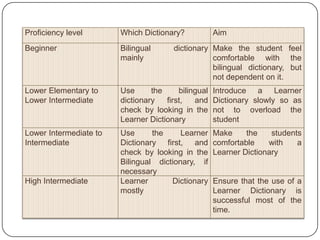
Bilingual and Learner Dictionaries should not been seen as competitors, but as complementary to each other.Many teachers and students believe bilingual are bad for language? But why?Bilingual dictionaries reinforce the notion that there are eparallel worlds in the two languages, when in reality many concepts in spanish  do not exist in english and cannot be translated, and vice versa.Bilingual dictionaries emphasize the notion that translation is the best way to learn words.They often have more than one translation in each headword and the student does not know which is the correct one to use. However, in order to learn the language well, the student has to work within the language, not from outside it.
MOVING TO LEARNERS DICTIONARYThe students will be practicing English as they use their dictionaries. Mental effort is needed to use learner dictionariesinformation will be retained and have a lasting effect. Building their passive vocabulary. Many words cannot be translated easily.
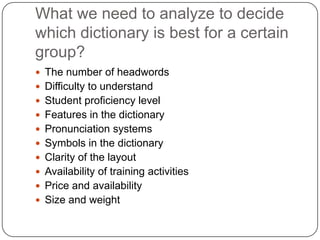
What we need to analyze to decide which dictionary is best for a certain group?The number of headwordsDifficulty to understandStudent proficiency levelFeatures in the dictionaryPronunciation systemsSymbols in the dictionaryClarity of the layoutAvailability of training activitiesPrice and availabilitySize and weight
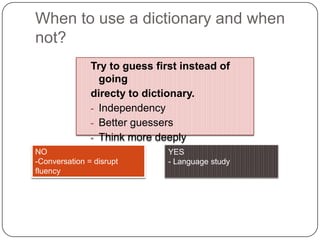
Whento use a dictionary and whennot?Try toguessfirstinstead of goingdirectytodictionary.Independency
Betterguessers
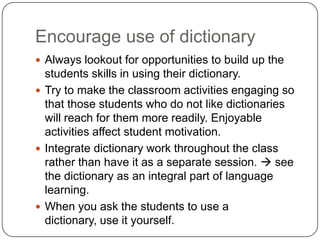
Think more deeplyNOConversation = disruptfluencyYESLanguagestudyEncourage use of dictionaryAlways lookout for opportunities to build up the students skills in using their dictionary. Try to make the classroom activities engaging so that those students who do not like dictionaries will reach for them more readily. Enjoyable activities affect student motivation. Integrate dictionary work throughout the class rather than have it as a separate session.  see the dictionary as an integral part of language learning. When you ask the students to use a dictionary, use it yourself. 

Dictionary

  • 1.
  • 2.
    DICTIONARY Is thesingle most important resource students have for learning English.It will give students greater control over their own learning.We are not born knowing how to use dictionaries well, thus students need to gain the knowledge and skills to get what they can from the dictionary effectively. Makes things explicitGenerates a great deal of thinking about meaning and language. Dictionaries can provide useful support not simply when teachers are in doubt about something but when they want students to confirm their own suppositions about something in english.
  • 3.
    Dictionaries are notonly a tool for private or individual learning problemsbecome a springboard to all sorts of other communicative and interactive activities.Source of interaction,Develop their confidence as dictionary users and as language learners. Serve as a focus for communication and classroom interaction. Help students explore personal preferences and learning styles and may also lead students to new modes of study
  • 4.
    Why teachers donot teach us how to use it?Many teachers understand the need to teach dictionary skills, but nevertheless do not teach their students how to use a dictionary. These are some of the reasons for this.Many teachers assume that the students already will know how to use an English-English dictionary effectively because they believe they can already use a dictionary well in spanish or other language. Some teachers are afraid that students will resist an English-English dictionary, and stay dependent on the bilingual dictionary and feel that their efforts will be wasted. Convincing a student to learn to use an English-English dictionary takes a lot of time and commitment on the part of the teacher and the student. Dictionary work is not part of the syllabus and work is not considered interesting. Teachers do not have a clear understanding of what is in the dictionary or how to introduce an English-English dictionary.
  • 5.
    What kinds ofdictionaries are there?Bilingual dictionariesProduction dictionariesMonolingual (English-English) dictionariesLearner DictionariesPicture DictionariesMultimedia dictionaries
  • 6.
    Bilingual and LearnerDictionaries should not been seen as competitors, but as complementary to each other.Many teachers and students believe bilingual are bad for language? But why?Bilingual dictionaries reinforce the notion that there are eparallel worlds in the two languages, when in reality many concepts in spanish do not exist in english and cannot be translated, and vice versa.Bilingual dictionaries emphasize the notion that translation is the best way to learn words.They often have more than one translation in each headword and the student does not know which is the correct one to use. However, in order to learn the language well, the student has to work within the language, not from outside it.
  • 7.
    MOVING TO LEARNERSDICTIONARYThe students will be practicing English as they use their dictionaries. Mental effort is needed to use learner dictionariesinformation will be retained and have a lasting effect. Building their passive vocabulary. Many words cannot be translated easily.
  • 8.
    What we needto analyze to decide which dictionary is best for a certain group?The number of headwordsDifficulty to understandStudent proficiency levelFeatures in the dictionaryPronunciation systemsSymbols in the dictionaryClarity of the layoutAvailability of training activitiesPrice and availabilitySize and weight
  • 9.
    Whento use adictionary and whennot?Try toguessfirstinstead of goingdirectytodictionary.Independency
  • 10.
  • 11.
    Think more deeplyNOConversation= disruptfluencyYESLanguagestudyEncourage use of dictionaryAlways lookout for opportunities to build up the students skills in using their dictionary. Try to make the classroom activities engaging so that those students who do not like dictionaries will reach for them more readily. Enjoyable activities affect student motivation. Integrate dictionary work throughout the class rather than have it as a separate session.  see the dictionary as an integral part of language learning. When you ask the students to use a dictionary, use it yourself.