The Rise of Sales Development
@PersistIQ
@PersistIQ
“The sales development team is the
most important sales process
innovation in the last 10 years.”
-David Cummings
(Click to Tweet)
1. The 4 Critical Factors………………………………………………….4
2. Number of Touchpoints………………………………………………..
12
3. Channel Diversity………………………………………………………. 16
4. Time Between Touches………………………………………………..
22
5. Content of Touchpoints…………………………………………………
30
6. Re-emphasize Business Value………………………………………...37
1. The Rise of Sales Development………………………………….
2. The Rise of the SDR…………………………………………...…..
3. Modern Outbound Sales...……………………………………..….
4. Building a Great Sales Development Team ………………...…..
5. Onboarding and Training …….……………………………………
6. Further Reading……………...……………………………………..
@PersistIQ
Table of Contents
@PersistIQ
The Rise of Sales Development
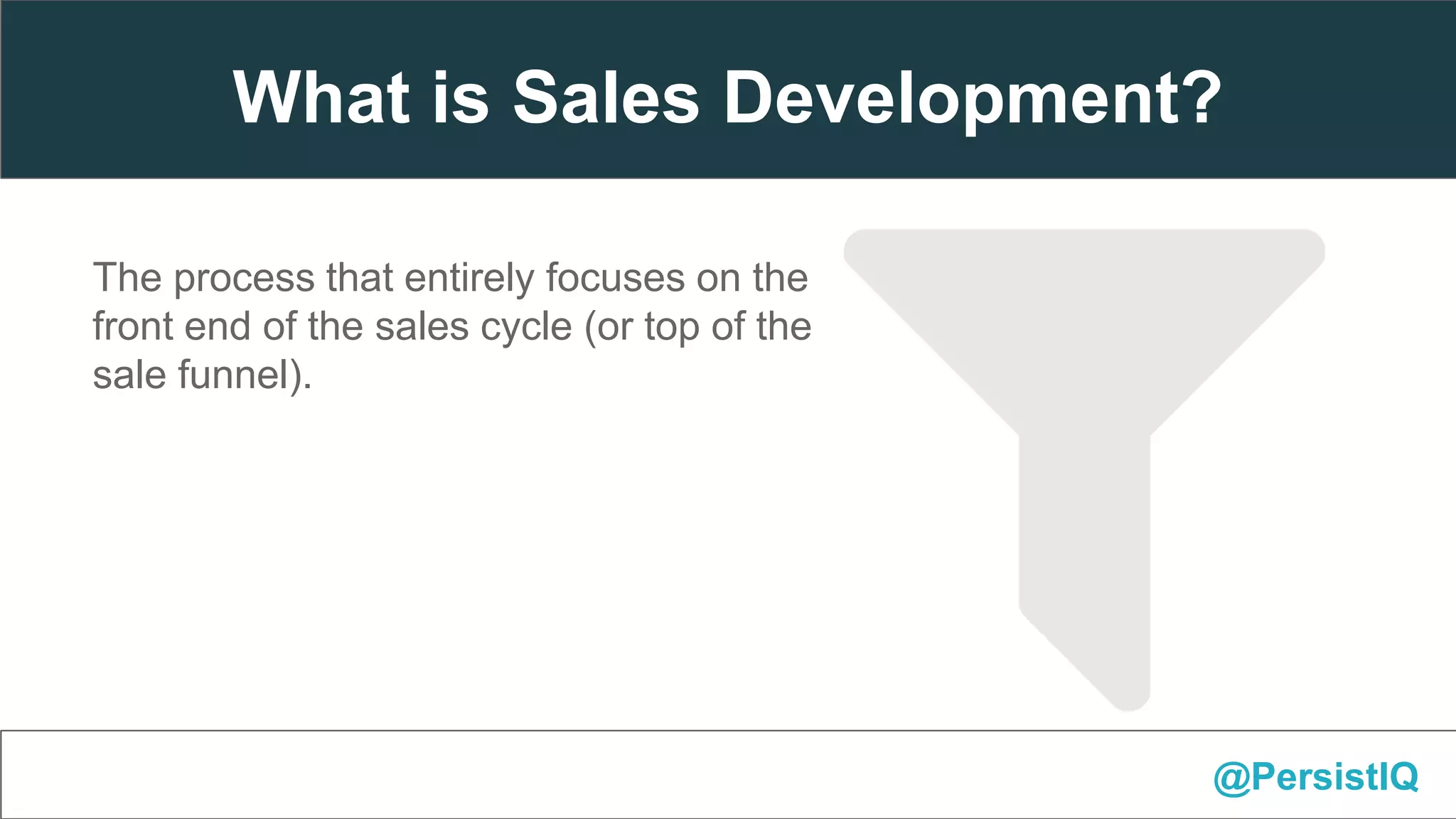
The process that entirely focuses on the
front end of the sales cycle (or top of the
sale funnel).
@PersistIQ
What is Sales Development?
@PersistIQ
In the 1980s were lead by trend-setters such as Oracle, which
was one of the fastest growing companies during that era.
Other companies, like Salesforce (started by a former Oracle
executive) quickly followed suit and put an emphasis on using
technology to sell.
Sales Development Pioneers
@PersistIQ
Technology is transforming sales and a new way
for prospecting and qualifying leads is emerging.
It’s perfect marriage of technology, process and
people and it’s known as “modern sales
development.”
A New Paradigm for Prospecting
@PersistIQ
(Click to Tweet)
“New sales technology means new
roles, new rules & new resources.”
-PersistIQ
@PersistIQ
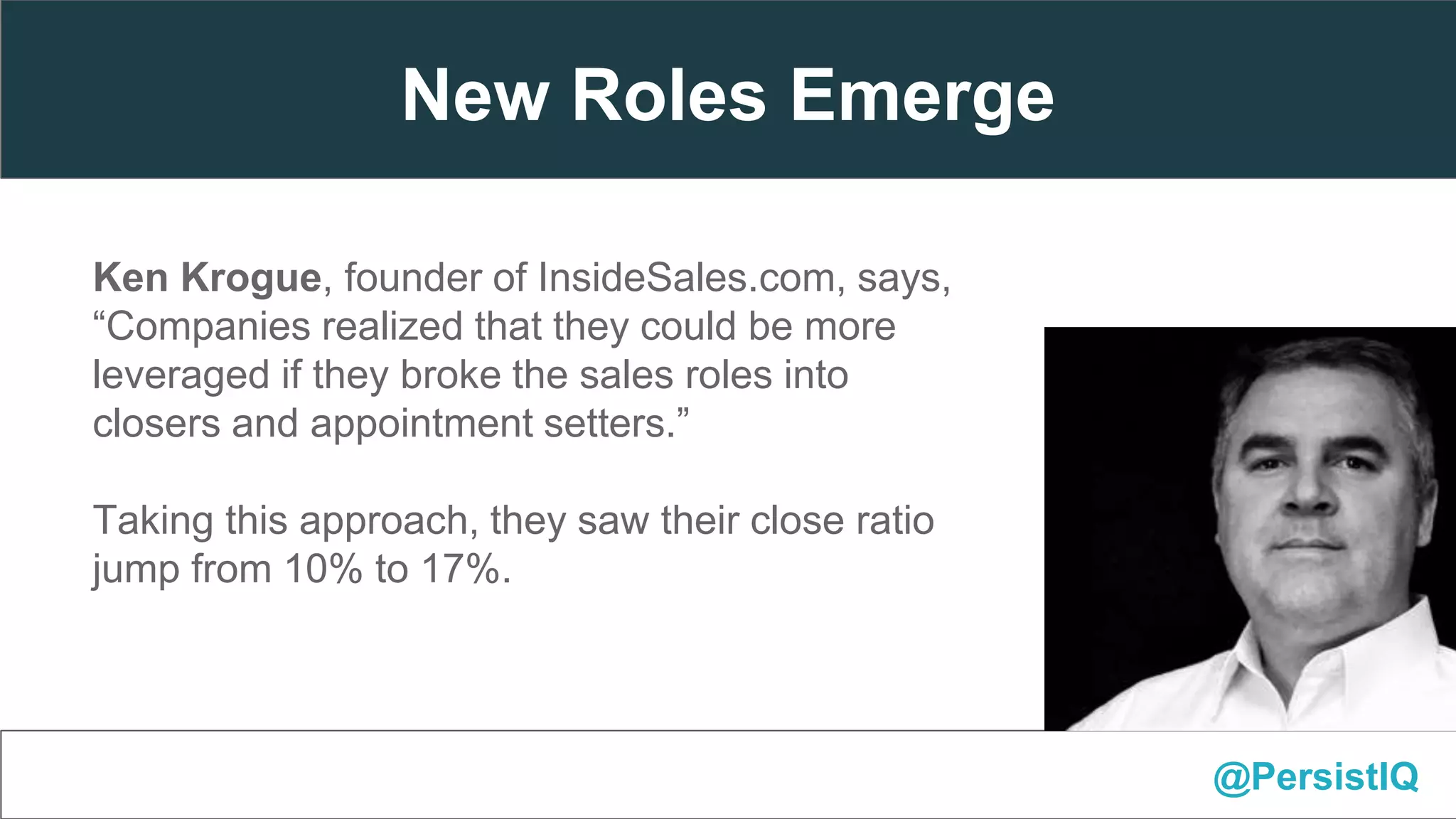
Ken Krogue, founder of InsideSales.com, says,
“Companies realized that they could be more
leveraged if they broke the sales roles into
closers and appointment setters.”
Taking this approach, they saw their close ratio
jump from 10% to 17%.
New Roles Emerge
The “appointment setters” are the SDRs and
BDRs who are responsible for prospecting,
initiating contact, and qualifying leads.
The “closers” are the AEs who are responsible
for giving demos or consultations and
negotiating contracts.
@PersistIQ
Role Specialization
@PersistIQ
(Click to Tweet)
“Companies realized they could be more
effective if they broke the sales roles into
closers & appointment setters.”
-Ken Krogue,
InsideSales.com
@PersistIQ
The Rise of the SDR
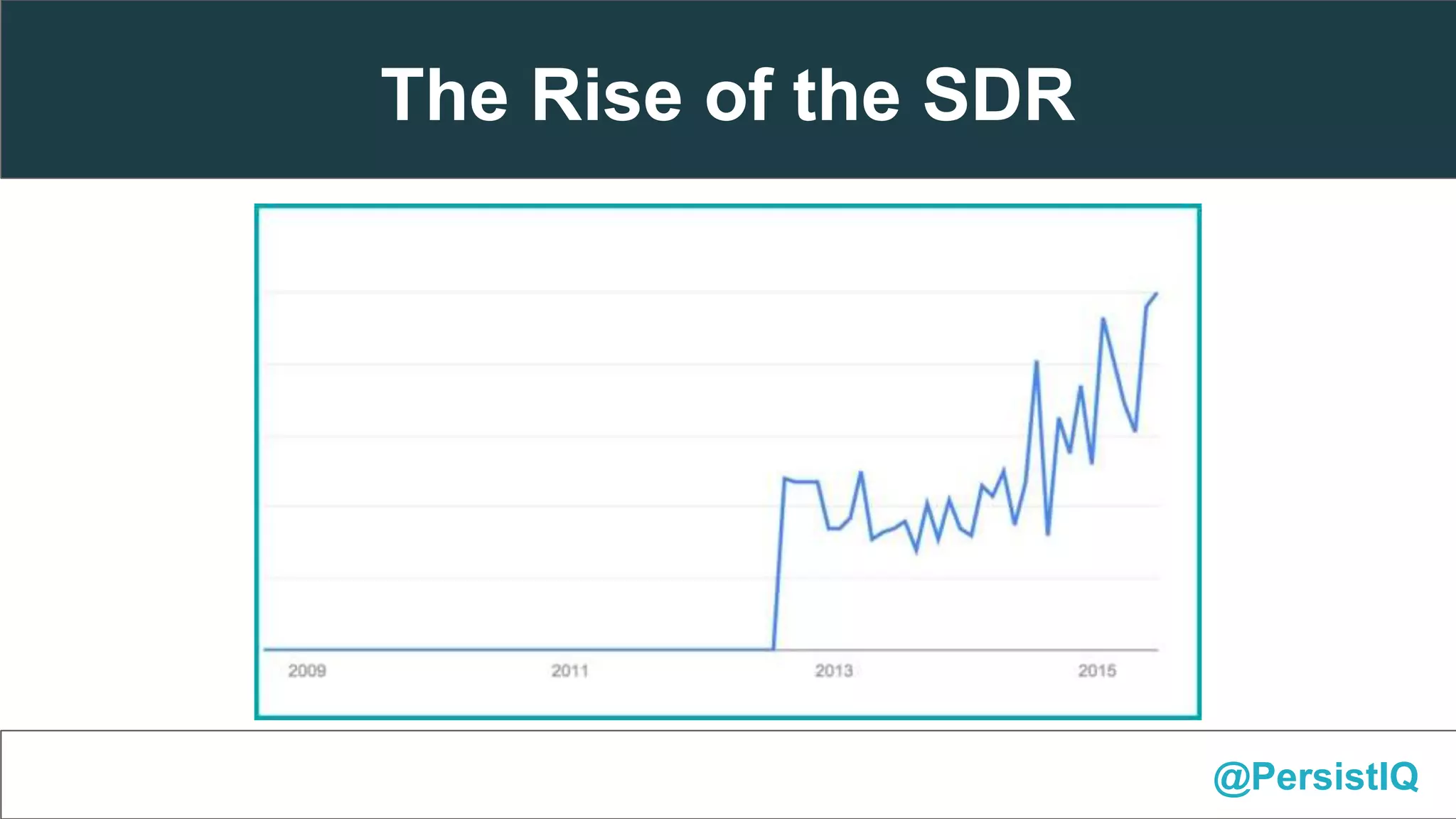
Google Trends shows that the term “sales
development representative” broke into the
scene no more than 2.5 years ago.
@PersistIQ
The Sales Development Rep
@PersistIQ
The Rise of the SDR
Simply put, generate pipeline.
How?
Outbound sales.
@PersistIQ
The SDR’s Role
@PersistIQ
Modern Outbound Sales
Outbound Sales is anything that involves the
sales rep reaching out to a prospect.
This could be done through manually searching
for prospects to calling and emailing prospects to
interacting with them on social media.
@PersistIQ
What is Outbound?
@PersistIQ
(Click to Tweet)
The use of prospecting tools & setting
meetings has become a skill in and of
itself; thus the role of the SDR was born.
-PersistIQ
If you’re starting your first outbound campaign, we wrote an entire
blog post on this, called The Quick Start Guide to Outbound Sales,
which you can read here.
@PersistIQ
A Guide to Outbound
Though not all are mutually exclusive, prospecting tools live at the
very top of a company’s sales funnel, and include tools like the
following:
● PersistIQ Chrome Extension
● LinkedIn Sales Navigator
● Rapportive
@PersistIQ
The Tools & Technology
Another option is to buy lists prospects from a list
broker. This gives you the advantage of time and
quantity, but it often comes with price.
@PersistIQ
Buying Lists
@PersistIQ
Build a Great Sales Development
Team
@PersistIQ
(Click to Tweet)
“World-class sales hiring is the
biggest driver of sales success”
-Mark Roberge
CRO at Hubspot
Great-functioning teams attract more great talent, making it
easier to hire in the future.
Start by identifying defining your company and team culture.
Don’t skip this step. Max Levchin said his biggest mistake at
Slide was failing to define the company’s culture.
@PersistIQ
Hiring
An SDR will probably spend a lot of time on the
phone and writing emails, so look for people with
good phone and writing skills and a track
record of success in roles that required those
skills.
@PersistIQ
The Hard Skills
The ability to listen well is critical.
Ask candidates to explain back a complicated point
about your product that you walked them through.
Or ask candidates to review a case study before the
interview, then and have them explain it to you live.
@PersistIQ
The Soft Skills
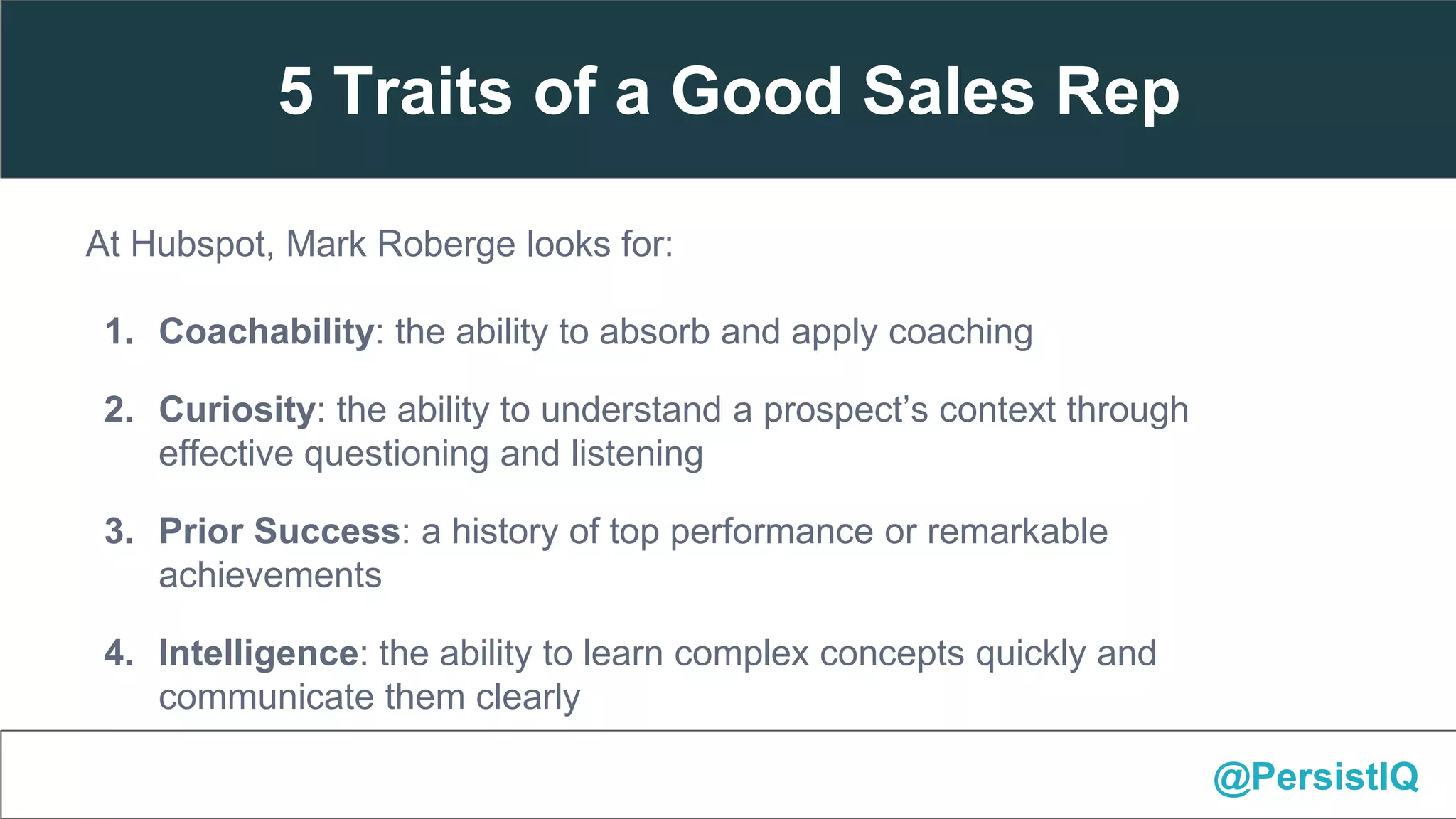
At Hubspot, Mark Roberge looks for:
1. Coachability: the ability to absorb and apply coaching
2. Curiosity: the ability to understand a prospect’s context through
effective questioning and listening
3. Prior Success: a history of top performance or remarkable
achievements
4. Intelligence: the ability to learn complex concepts quickly and
communicate them clearly
5. Work Ethic: proactively pursuing the company mission with a high@PersistIQ
5 Traits of a Good Sales Rep
We recently interviewed Jordan Wan, CEO of
CloserIQ, and he offered his 5 Tips for Hiring the
Right Sales Reps Without Getting “Sold”
@PersistIQ
5 Tips for Hiring
@PersistIQ
Advice from Ken Krogue of InsideSales
Encourage employee referrals
Profile candidates on LinkedIn
Hire recent college graduates who are energetic and competitive
Hire people who have recently finish professional accelerator programs
@PersistIQ
Onboarding & Training
Spend the 1st week on company culture and
processes, basic product training and getting
comfortable with the sales process.
By the end of the first week, reps should be
able to take calls.
@PersistIQ
Onboarding - Week 1
The 2nd week should be heavy on role playing and taking calls
every single day. Also consider peppering message and buyer
personas.
Reps should be comfortable with taking calls on their own at
the end of the second week.
@PersistIQ
Onboarding - Week 2
Week 3 should consist of more specific process training,
such as CRM and outbound platform.
Reps should be able to launch an entire outbound
campaign on their own.
@PersistIQ
Onboarding - Week 3
Week 4 should consist of more lead generation training as well as
specific and more narrow topics, like call mapping and objection
handling.
By the end of the 1st month, reps should fully ramped.
@PersistIQ
Onboarding - Week 4
@PersistIQ
(Click to Tweet)
“Nine out of 10 sales training initiatives
have no lasting impact beyond 120 days”
-RAIN Group
Training doesn’t stop after onboarding.
Exams and certifications add predictability to sales trainings.
Establish this culture early on during your onboarding, and do not
deviate from the plan.
@PersistIQ
Ongoing Training
● How to Build the Perfect Sales Stack
● 4 Critical Factors For Sales Follow-Up Success
● 5 Steps to Personalizing Your Sales Emails at Scale
@PersistIQ@clearbit
Further Reading
@PersistIQ
PersistIQ
Want to see how PersistIQ can
help you be more effective with
outbound sales?
Let us show you!
PersistIQ.com/demo
#MeasuringSalesMetrics@clearbit @PersistIQ

The Rise of Sales Development

  • 1.
    The Rise ofSales Development @PersistIQ
  • 2.
    @PersistIQ “The sales developmentteam is the most important sales process innovation in the last 10 years.” -David Cummings (Click to Tweet)
  • 3.
    1. The 4Critical Factors………………………………………………….4 2. Number of Touchpoints……………………………………………….. 12 3. Channel Diversity………………………………………………………. 16 4. Time Between Touches……………………………………………….. 22 5. Content of Touchpoints………………………………………………… 30 6. Re-emphasize Business Value………………………………………...37 1. The Rise of Sales Development…………………………………. 2. The Rise of the SDR…………………………………………...….. 3. Modern Outbound Sales...……………………………………..…. 4. Building a Great Sales Development Team ………………...….. 5. Onboarding and Training …….…………………………………… 6. Further Reading……………...…………………………………….. @PersistIQ Table of Contents
  • 4.
    @PersistIQ The Rise ofSales Development
  • 5.
    The process thatentirely focuses on the front end of the sales cycle (or top of the sale funnel). @PersistIQ What is Sales Development?
  • 6.
    @PersistIQ In the 1980swere lead by trend-setters such as Oracle, which was one of the fastest growing companies during that era. Other companies, like Salesforce (started by a former Oracle executive) quickly followed suit and put an emphasis on using technology to sell. Sales Development Pioneers
  • 7.
    @PersistIQ Technology is transformingsales and a new way for prospecting and qualifying leads is emerging. It’s perfect marriage of technology, process and people and it’s known as “modern sales development.” A New Paradigm for Prospecting
  • 8.
    @PersistIQ (Click to Tweet) “Newsales technology means new roles, new rules & new resources.” -PersistIQ
  • 9.
    @PersistIQ Ken Krogue, founderof InsideSales.com, says, “Companies realized that they could be more leveraged if they broke the sales roles into closers and appointment setters.” Taking this approach, they saw their close ratio jump from 10% to 17%. New Roles Emerge
  • 10.
    The “appointment setters”are the SDRs and BDRs who are responsible for prospecting, initiating contact, and qualifying leads. The “closers” are the AEs who are responsible for giving demos or consultations and negotiating contracts. @PersistIQ Role Specialization
  • 11.
    @PersistIQ (Click to Tweet) “Companiesrealized they could be more effective if they broke the sales roles into closers & appointment setters.” -Ken Krogue, InsideSales.com
  • 12.
  • 13.
    Google Trends showsthat the term “sales development representative” broke into the scene no more than 2.5 years ago. @PersistIQ The Sales Development Rep
  • 14.
  • 15.
    Simply put, generatepipeline. How? Outbound sales. @PersistIQ The SDR’s Role
  • 16.
  • 17.
    Outbound Sales isanything that involves the sales rep reaching out to a prospect. This could be done through manually searching for prospects to calling and emailing prospects to interacting with them on social media. @PersistIQ What is Outbound?
  • 18.
    @PersistIQ (Click to Tweet) Theuse of prospecting tools & setting meetings has become a skill in and of itself; thus the role of the SDR was born. -PersistIQ
  • 19.
    If you’re startingyour first outbound campaign, we wrote an entire blog post on this, called The Quick Start Guide to Outbound Sales, which you can read here. @PersistIQ A Guide to Outbound
  • 20.
    Though not allare mutually exclusive, prospecting tools live at the very top of a company’s sales funnel, and include tools like the following: ● PersistIQ Chrome Extension ● LinkedIn Sales Navigator ● Rapportive @PersistIQ The Tools & Technology
  • 21.
    Another option isto buy lists prospects from a list broker. This gives you the advantage of time and quantity, but it often comes with price. @PersistIQ Buying Lists
  • 22.
    @PersistIQ Build a GreatSales Development Team
  • 23.
    @PersistIQ (Click to Tweet) “World-classsales hiring is the biggest driver of sales success” -Mark Roberge CRO at Hubspot
  • 24.
    Great-functioning teams attractmore great talent, making it easier to hire in the future. Start by identifying defining your company and team culture. Don’t skip this step. Max Levchin said his biggest mistake at Slide was failing to define the company’s culture. @PersistIQ Hiring
  • 25.
    An SDR willprobably spend a lot of time on the phone and writing emails, so look for people with good phone and writing skills and a track record of success in roles that required those skills. @PersistIQ The Hard Skills
  • 26.
    The ability tolisten well is critical. Ask candidates to explain back a complicated point about your product that you walked them through. Or ask candidates to review a case study before the interview, then and have them explain it to you live. @PersistIQ The Soft Skills
  • 27.
    At Hubspot, MarkRoberge looks for: 1. Coachability: the ability to absorb and apply coaching 2. Curiosity: the ability to understand a prospect’s context through effective questioning and listening 3. Prior Success: a history of top performance or remarkable achievements 4. Intelligence: the ability to learn complex concepts quickly and communicate them clearly 5. Work Ethic: proactively pursuing the company mission with a high@PersistIQ 5 Traits of a Good Sales Rep
  • 28.
    We recently interviewedJordan Wan, CEO of CloserIQ, and he offered his 5 Tips for Hiring the Right Sales Reps Without Getting “Sold” @PersistIQ 5 Tips for Hiring
  • 29.
    @PersistIQ Advice from KenKrogue of InsideSales Encourage employee referrals Profile candidates on LinkedIn Hire recent college graduates who are energetic and competitive Hire people who have recently finish professional accelerator programs
  • 30.
  • 31.
    Spend the 1stweek on company culture and processes, basic product training and getting comfortable with the sales process. By the end of the first week, reps should be able to take calls. @PersistIQ Onboarding - Week 1
  • 32.
    The 2nd weekshould be heavy on role playing and taking calls every single day. Also consider peppering message and buyer personas. Reps should be comfortable with taking calls on their own at the end of the second week. @PersistIQ Onboarding - Week 2
  • 33.
    Week 3 shouldconsist of more specific process training, such as CRM and outbound platform. Reps should be able to launch an entire outbound campaign on their own. @PersistIQ Onboarding - Week 3
  • 34.
    Week 4 shouldconsist of more lead generation training as well as specific and more narrow topics, like call mapping and objection handling. By the end of the 1st month, reps should fully ramped. @PersistIQ Onboarding - Week 4
  • 35.
    @PersistIQ (Click to Tweet) “Nineout of 10 sales training initiatives have no lasting impact beyond 120 days” -RAIN Group
  • 36.
    Training doesn’t stopafter onboarding. Exams and certifications add predictability to sales trainings. Establish this culture early on during your onboarding, and do not deviate from the plan. @PersistIQ Ongoing Training
  • 37.
    ● How toBuild the Perfect Sales Stack ● 4 Critical Factors For Sales Follow-Up Success ● 5 Steps to Personalizing Your Sales Emails at Scale @PersistIQ@clearbit Further Reading
  • 38.
    @PersistIQ PersistIQ Want to seehow PersistIQ can help you be more effective with outbound sales? Let us show you! PersistIQ.com/demo #MeasuringSalesMetrics@clearbit @PersistIQ

Editor's Notes

  • #5 Obvious - but you improve what you measure Cost - too much data, tracking it, making sense of it, confusion among the team S
  • #6 Obvious - but you improve what you measure Cost - too much data, tracking it, making sense of it, confusion among the team S
  • #7 Obvious - but you improve what you measure Cost - too much data, tracking it, making sense of it, confusion among the team S
  • #8 Obvious - but you improve what you measure Cost - too much data, tracking it, making sense of it, confusion among the team S
  • #10 Obvious - but you improve what you measure Cost - too much data, tracking it, making sense of it, confusion among the team S
  • #11 Obvious - but you improve what you measure Cost - too much data, tracking it, making sense of it, confusion among the team S
  • #13 Obvious - but you improve what you measure Cost - too much data, tracking it, making sense of it, confusion among the team S
  • #14 Obvious - but you improve what you measure Cost - too much data, tracking it, making sense of it, confusion among the team S
  • #15 Obvious - but you improve what you measure Cost - too much data, tracking it, making sense of it, confusion among the team S
  • #16 Obvious - but you improve what you measure Cost - too much data, tracking it, making sense of it, confusion among the team S
  • #17 Obvious - but you improve what you measure Cost - too much data, tracking it, making sense of it, confusion among the team S
  • #18 Obvious - but you improve what you measure Cost - too much data, tracking it, making sense of it, confusion among the team S
  • #20 Obvious - but you improve what you measure Cost - too much data, tracking it, making sense of it, confusion among the team S
  • #21 Obvious - but you improve what you measure Cost - too much data, tracking it, making sense of it, confusion among the team S
  • #22 Obvious - but you improve what you measure Cost - too much data, tracking it, making sense of it, confusion among the team S
  • #23 Obvious - but you improve what you measure Cost - too much data, tracking it, making sense of it, confusion among the team S
  • #25 Obvious - but you improve what you measure Cost - too much data, tracking it, making sense of it, confusion among the team S
  • #26 Obvious - but you improve what you measure Cost - too much data, tracking it, making sense of it, confusion among the team S
  • #27 Obvious - but you improve what you measure Cost - too much data, tracking it, making sense of it, confusion among the team S
  • #28 Obvious - but you improve what you measure Cost - too much data, tracking it, making sense of it, confusion among the team S
  • #29 Obvious - but you improve what you measure Cost - too much data, tracking it, making sense of it, confusion among the team S
  • #30 Obvious - but you improve what you measure Cost - too much data, tracking it, making sense of it, confusion among the team S
  • #31 Obvious - but you improve what you measure Cost - too much data, tracking it, making sense of it, confusion among the team S
  • #32 Obvious - but you improve what you measure Cost - too much data, tracking it, making sense of it, confusion among the team S
  • #33 Obvious - but you improve what you measure Cost - too much data, tracking it, making sense of it, confusion among the team S
  • #34 Obvious - but you improve what you measure Cost - too much data, tracking it, making sense of it, confusion among the team S
  • #35 Obvious - but you improve what you measure Cost - too much data, tracking it, making sense of it, confusion among the team S
  • #37 Obvious - but you improve what you measure Cost - too much data, tracking it, making sense of it, confusion among the team S
  • #38 Obvious - but you improve what you measure Cost - too much data, tracking it, making sense of it, confusion among the team S