The Real Estate
    Sector
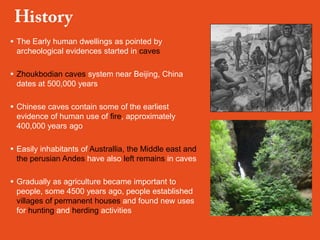
 The Early human dwellings as pointed by
  archeological evidences started in caves

 Zhoukbodian caves system near Beijing, China
  dates at 500,000 years

 Chinese caves contain some of the earliest
  evidence of human use of fire, approximately
  400,000 years ago

 Easily inhabitants of Australlia, the Middle east and
  the perusian Andes have also left remains in caves

 Gradually as agriculture became important to
  people, some 4500 years ago, people established
  villages of permanent houses and found new uses
  for hunting and herding activities
Key Features
   The term ‘Real Estate’ is defined as land, including the air above it and the ground below
    it, and any buildings or structures on it. It is also referred to as realty

   Real estate involves the purchase, sale, and development of land, residential and non-
    residential buildings

   The activities of the real estate sector encompass the housing and construction sectors
    also

   The real estate sector is a major employment driver, being the second largest employer
    next only to agriculture

   About 250 ancillary industries such as cement, brick, steel, timber, building materials etc.
    are dependent on the real estate industry

   India Still has a shortfall of 2.47 crores as on 2007


Source: http://planningcommission.nic.in/
Impact of Real Estate Industry on
 some other key industries
 Retail(Malls)
 Hospitality (Resorts, hotels, lodges, spa, inns)
 Entertainment Industries(Multiplexes, Theatres, Recreation
  centers )
 Economic Services( Hospitals, school)
 Information technology(IT) Enabled companies( call centers)
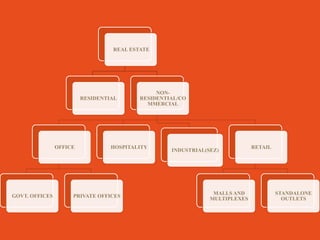
REAL ESTATE


                                               NON-
                         RESIDENTIAL      RESIDENTIAL/CO
                                            MMERCIAL


                OFFICE            HOSPITALITY                                RETAIL
                                                   INDUSTRIAL(SEZ)


                                                                MALLS AND             STANDALONE
GOVT. OFFICES        PRIVATE OFFICES
                                                               MULTIPLEXES              OUTLETS
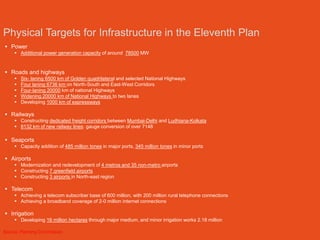
Physical Targets for Infrastructure in the Eleventh Plan
 Power
      Additional power generation capacity of around 78500 MW


 Roads and highways
        Six- laning 6500 km of Golden quadrilateral and selected National Highways
        Four laning 6736 km on North-South and East-West Corridors
        Four-laning 20000 km of national Highways
        Widening 20000 km of National Highways to two lanes
        Developing 1000 km of expressways

 Railways
      Constructing dedicated freight corridors between Mumbai-Delhi and Ludhiana-Kolkata
      8132 km of new railway lines: gauge conversion of over 7148

 Seaports
      Capacity addition of 485 million tones in major ports, 345 million tones in minor ports

 Airports
      Modernization and redevelopment of 4 metros and 35 non-metro airports
      Constructing 7 greenfield airports
      Constructing 3 airports in North-east region

 Telecom
      Achieving a telecom subscriber base of 600 million, with 200 million rural telephone connections
      Achieving a broadband coverage of 2-0 million internet connections

 Irrigation
      Developing 16 million hectares through major medium, and minor irrigation works 2.18 million

Source: Planning Commission
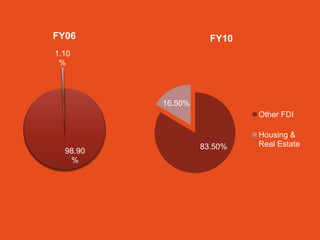
FY06                 FY10
1.10
 %


          16.50%
                            Other FDI

                            Housing &
                   83.50%   Real Estate
  98.90
   %
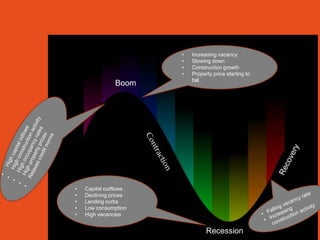
•   Increasing vacancy
                       •   Slowing down
                       •   Construction growth
                       •   Property price starting to
                           fall
               Boom


•   Capital outflows
•   Declining prices
•   Lending curbs
•   Low consumption
•   High vacancies


                                 Recession
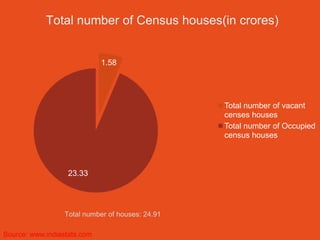
Total number of Census houses(in crores)


                             1.58


                                                 Total number of vacant
                                                 censes houses
                                                 Total number of Occupied
                                                 census houses


                   23.33


                 Total number of houses: 24.91

Source: www.indiastats.com
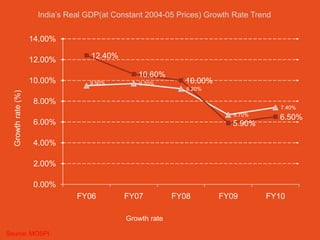
India’s Real GDP(at Constant 2004-05 Prices) Growth Rate Trend


                    14.00%

                    12.00%         12.40%

                                               10.60%
                    10.00%        9.50%        9.70%        10.00%
                                                             9.20%
  Growth rate (%)


                    8.00%
                                                                                      7.40%
                                                                         6.70%
                                                                                      6.50%
                    6.00%                                               5.90%

                    4.00%

                    2.00%

                    0.00%
                               FY06         FY07          FY08       FY09        FY10

                                            Growth rate

Source: MOSPI
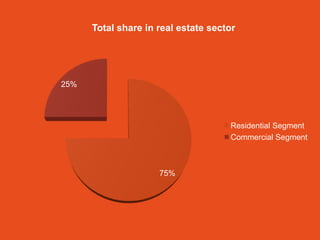
Total share in real estate sector


25%


                                     Residential Segment
                                     Commercial Segment


                     75%
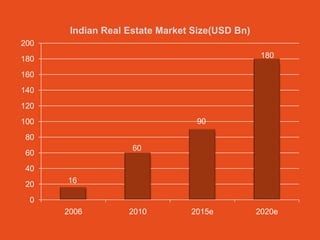
Indian Real Estate Market Size(USD Bn)
200
180                                              180

160
140
120
100                              90
 80
                    60
 60
 40
 20   16

  0
      2006         2010         2015e           2020e
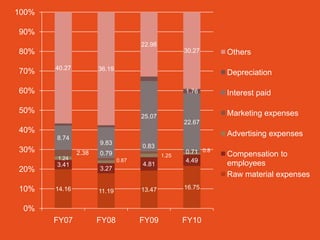
100%

90%
                                     22.98
80%                                                 30.27      Others
       40.27          36.19
70%                                                            Depreciation

60%                                                 1.76       Interest paid

50%                                                            Marketing expenses
                                     25.07
                                                    22.67
40%                                                            Advertising expenses
       8.74
                      9.83
                                     0.83
30%            2.38                                 0.71 0.8
       1.24
                      0.79                   1.25              Compensation to
                              0.87                  4.49
       3.41                          4.81                      employees
20%                   3.27
                                                               Raw material expenses
10%    14.16                         13.47          16.75
                      11.19

 0%
       FY07           FY08           FY09           FY10
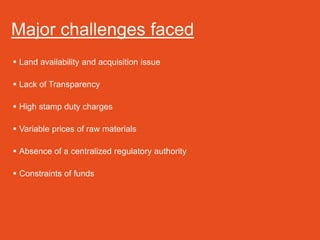
Major challenges faced
 Land availability and acquisition issue

 Lack of Transparency

 High stamp duty charges

 Variable prices of raw materials

 Absence of a centralized regulatory authority

 Constraints of funds
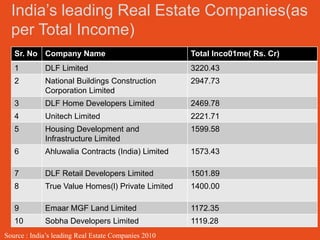
India’s leading Real Estate Companies(as
  per Total Income)
   Sr. No Company Name                                Total Inco01me( Rs. Cr)
   1         DLF Limited                              3220.43
   2         National Buildings Construction          2947.73
             Corporation Limited
   3         DLF Home Developers Limited              2469.78
   4         Unitech Limited                          2221.71
   5         Housing Development and                  1599.58
             Infrastructure Limited
   6         Ahluwalia Contracts (India) Limited      1573.43

   7         DLF Retail Developers Limited            1501.89
   8         True Value Homes(l) Private Limited      1400.00

   9         Emaar MGF Land Limited                   1172.35
   10        Sobha Developers Limited                 1119.28
Source : India’s leading Real Estate Companies 2010
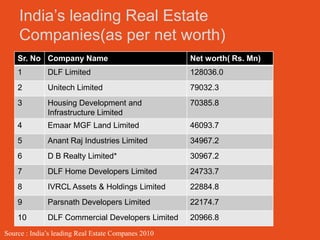
India’s leading Real Estate
    Companies(as per net worth)
    Sr. No Company Name                              Net worth( Rs. Mn)
    1         DLF Limited                            128036.0
    2         Unitech Limited                        79032.3
    3         Housing Development and                70385.8
              Infrastructure Limited
    4         Emaar MGF Land Limited                 46093.7
    5         Anant Raj Industries Limited           34967.2
    6         D B Realty Limited*                    30967.2
    7         DLF Home Developers Limited            24733.7
    8         IVRCL Assets & Holdings Limited        22884.8
    9         Parsnath Developers Limited            22174.7
    10        DLF Commercial Developers Limited      20966.8
Source : India’s leading Real Estate Companes 2010
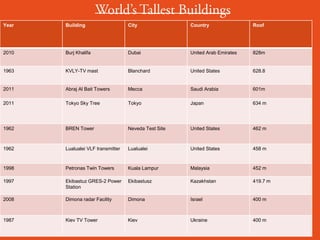
Year   Building                    City               Country                Roof


2010   Burj Khalifa                Dubai              United Arab Emirates   828m


1963   KVLY-TV mast                Blanchard          United States          628.8


2011   Abraj Al Bait Towers        Mecca              Saudi Arabia           601m

2011   Tokyo Sky Tree              Tokyo              Japan                  634 m


1962   BREN Tower                  Neveda Test Site   United States          462 m


1962   Lualualei VLF transmitter   Lualualei          United States          458 m


1998   Petronas Twin Towers        Kuala Lampur       Malaysia               452 m

1997   Ekibastuz GRES-2 Power      Ekibastusz         Kazakhstan             419.7 m
       Station

2008   Dimona radar Facility       Dimona             Israel                 400 m


1987   Kiev TV Tower               Kiev               Ukraine                400 m
Breakthroughs
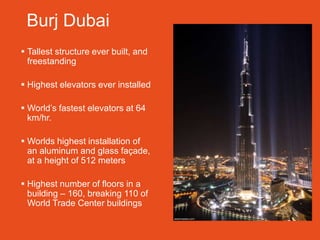
Burj Dubai
 Tallest structure ever built, and
  freestanding

 Highest elevators ever installed

 World’s fastest elevators at 64
  km/hr.

 Worlds highest installation of
  an aluminum and glass façade,
  at a height of 512 meters

 Highest number of floors in a
  building – 160, breaking 110 of
  World Trade Center buildings
Stakeholders
   Constructing companies
   Developers
   Engineers
   Technicians
   Design consultants
   Landlords
   Foremen
   Clerical staff
   Skilled workers
   Unskilled workers
   Banks
   Insurance companies
   Tenants
   Suppliers of material( Electrical, Material, etc.)
   Buyers
   Government
   Licensing/ Registration offices( e.g. BMC)
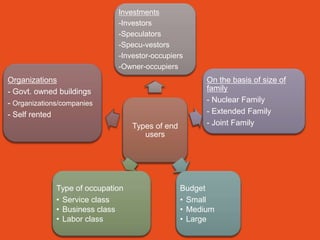
Investments
                              -Investors
                              -Speculators
                              -Specu-vestors
                              -Investor-occupiers
                              -Owner-occupiers
Organizations                                           On the basis of size of
- Govt. owned buildings                                 family
- Organizations/companies                               - Nuclear Family
- Self rented                                           - Extended Family
                                   Types of end         - Joint Family
                                      users


              Type of occupation                  Budget
              • Service class                     • Small
              • Business class                    • Medium
              • Labor class                       • Large
Value Parameters(Residential)
   Price                                     Slum in the area
   Location                                  Quality of Amenities
                                               Upcoming projects, infrastructural
   Connectivity                               developments
   Neighbourhood                             Developing/ Ready to possess buildings
   Access to facilities like hospitals,      Permissions by necessary Govt. bodies
    schools, gardens, markets etc.            Investment/ Lease / Self occupancy
   Future growth prospects                   Parking Space
   Brand name
   Reputation of the builder                    Financial Aspects
   Lifestyle                                   Cash/ Cheque component
   Quality of construction                     Home Loan Interest rates
                                                Property and other tax
   Legality of construction
                                                Terms of Payment
   Speed of Construction
                                                Monthly outflow or maintenance cost
   Space ( S/B area vs. Carpet Area)           Down payment
   Environmental friendliness                  Fixed/Floating
   Earthquake Resistance                       Slab duration/
   Security Parameters like distance           Difficulty in getting Loan
    from the police station, fire station.      Affordability
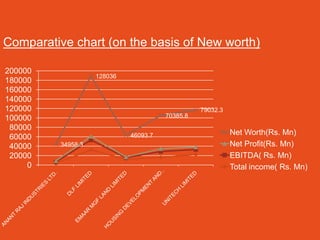
Comparative chart (on the basis of New worth)

200000
                    128036
180000
160000
140000
120000                                           79032.3
100000                                 70385.8
 80000
                             46093.7                       Net Worth(Rs. Mn)
 60000
 40000    34958.3                                          Net Profit(Rs. Mn)
 20000                                                     EBITDA( Rs. Mn)
     0                                                     Total income( Rs. Mn)
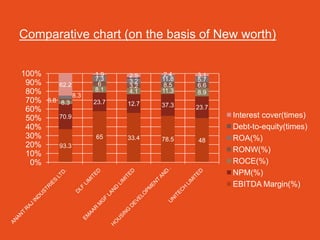
Comparative chart (on the basis of New worth)


100%                   1.9    2.5    2.4    3.1
                       7.3    3.2    11.8   5.7
 90%      62.2          6     3.2    8.5    6.6
 80%                   8.1    4.1    11.3   8.9
                 8.3
 70%   6.8 8.3         23.7   12.7   37.3   23.7
 60%
 50%      70.9                                     Interest cover(times)
 40%                                               Debt-to-equity(times)
 30%                   65     33.4   78.5          ROA(%)
                                            48
 20%      93.3
 10%                                               RONW(%)
  0%                                               ROCE(%)
                                                   NPM(%)
                                                   EBITDA Margin(%)
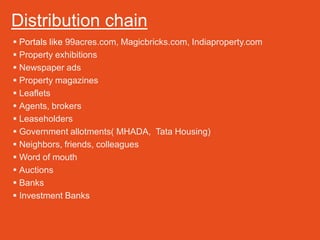
Distribution chain
 Portals like 99acres.com, Magicbricks.com, Indiaproperty.com
 Property exhibitions
 Newspaper ads
 Property magazines
 Leaflets
 Agents, brokers
 Leaseholders
 Government allotments( MHADA, Tata Housing)
 Neighbors, friends, colleagues
 Word of mouth
 Auctions
 Banks
 Investment Banks
Backend
supply chain
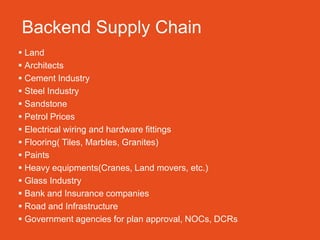
Backend Supply Chain
 Land
 Architects
 Cement Industry
 Steel Industry
 Sandstone
 Petrol Prices
 Electrical wiring and hardware fittings
 Flooring( Tiles, Marbles, Granites)
 Paints
 Heavy equipments(Cranes, Land movers, etc.)
 Glass Industry
 Bank and Insurance companies
 Road and Infrastructure
 Government agencies for plan approval, NOCs, DCRs
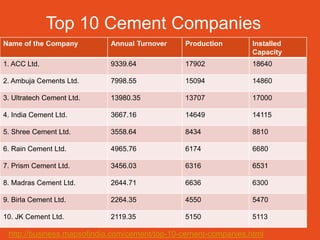
Top 10 Cement Companies
Name of the Company        Annual Turnover     Production        Installed
                                                                 Capacity
1. ACC Ltd.                9339.64             17902             18640

2. Ambuja Cements Ltd.     7998.55             15094             14860

3. Ultratech Cement Ltd.   13980.35            13707             17000

4. India Cement Ltd.       3667.16             14649             14115

5. Shree Cement Ltd.       3558.64             8434              8810

6. Rain Cement Ltd.        4965.76             6174              6680

7. Prism Cement Ltd.       3456.03             6316              6531

8. Madras Cement Ltd.      2644.71             6636              6300

9. Birla Cement Ltd.       2264.35             4550              5470

10. JK Cement Ltd.         2119.35             5150              5113

 http://business.mapsofindia.com/cement/top-10-cement-companies.html
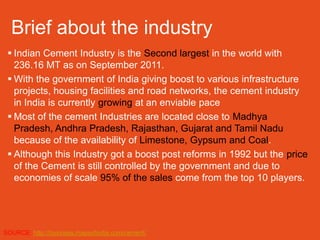
Brief about the industry
  Indian Cement Industry is the Second largest in the world with
   236.16 MT as on September 2011.
  With the government of India giving boost to various infrastructure
   projects, housing facilities and road networks, the cement industry
   in India is currently growing at an enviable pace
  Most of the cement Industries are located close to Madhya
   Pradesh, Andhra Pradesh, Rajasthan, Gujarat and Tamil Nadu
   because of the availability of Limestone, Gypsum and Coal.
  Although this Industry got a boost post reforms in 1992 but the price
   of the Cement is still controlled by the government and due to
   economies of scale 95% of the sales come from the top 10 players.


SOURCE: http://business.mapsofindia.com/cement/
Indian Steel Industry
     India is the 8th largest producer of steel with a production
      capacity of 35MT.

     There has been a significant growth in the production and
      consumption of steel in the domestic market.

     The consumption of steel in the Country is a significant
      indicator of the development in the country owing to the
      use of steel in the infrastructure, housing and Industry


SOURCE: www.cci.gov.in/images/media/.../Indicussteel_20090420151842.pdf
Top 5 Steel companies in India
(on the basis of production)

 Tata Steel
 Steel Authority of India Ltd.
 Bhushan Power and Steel
 Jindal Steel and Power Limited.
 Essar Steel
Petrol/Diesel
 A Price of Crude oil has a huge impact in the Realty market
  because of the rise in price of other raw materials.

 Highly regulated market with top leaders being IOCL, HPCL
  and BPCL
Glass Industry

     The topmost glass manufacturers in India are Asahi India
      Glass, NSG Group, Saint-Gobain, Guardian Industries and
      Hindustan National Glass.

     A strong demand and growth of infrastructure, liquor & other
      beverages, boom in building and construction will see the
      glass industry at its best in the coming years.

     The industry is estimated at 5500 crores by the end of FY
      11-12


Source: www.niir.org/.../glass...glass...glass...glass...glass...glass-glass...glass...
Paint Industry
         Indian Paint Industry is valued at Rs. 11000 Crores by FY
          2009-10.

         The Ratio of the organized and unorganized sector is 65:35
          with the unorganized sector’s involvement being more in the
          distemper coating

         Top leaders are Asian Paints, Nerolac, Berger, Jenson and
          Nicholson, Dulux.


Source: http://www.managementparadise.com/forums/publish-upload-project-download-reference-project/72869-paint-industry-analysis.html
Basis of questionnaire
 Current trend

 Expected trend

 Profit margins

 Overall market growth overview
Runwal Symphony, Vakola,
Santacruz(east)
 Project
   16 floors
   2 wings
   2, 3 bhk
• Total area- 10000 sq. ft.
• Construction cost- Rs. 2500 per sq. ft.
• Land cost – Rs. 2500 per sq. ft.
• Other expenses- Rs. 600 per sq. ft.
• Considering 30% area sold while booking or bhoomi poojan.
• Interest = around 10-12%
• Therefore total cost= 10000 * 5600= 5.6 cr
• Total sales cost = 9800* 11000= 10.78 cr(avg out)
• Booking sales= 4200(30%) * 8000= 3.36 cr[Construction cost
  averages out]
• Total sales revenue= 10.78 + 3.36= 14.14 cr
• Total profit % = 152% profit
Laws Governing Real Estate Market In India

      Indian Transfer of Property Act
      Indian Registration Act, 1908
      Indian Urban Land (Ceiling And Regulation) Act, 1976
      Rent Control Acts
      The Town & Country Planning Acts


http://www.indialawoffices.com/pdf/realestate.pdf
No specific tax incentives for real estate sector, however the
    following incentives will boost the real estate.

     Excise duty rates on bulk cement and packaged cement
      brought on par; bulk cement to attract excise duty of Rs.400
      per Metric Tone or 14 per cent ad valorem, whichever is higher

     Cement clinkers excise duty at Rs.450 per Metric Tone.

     General CENVAT rate on all goods reduced from 16 per cent
      to 14 per cent to give a stimulus to the manufacturing sector.

     Reduction in the excise duty from 16 per cent to 14 per cent.

     Reduction in customs duty from 5 per cent to nil on steel and
      aluminum melting scraps
http://www.indialawoffices.com/pdf/realestate.pdf
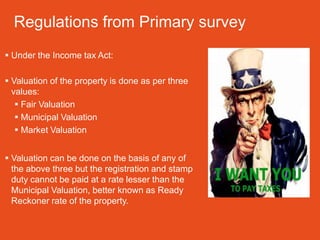
Regulations from Primary survey
 Under the Income tax Act:

 Valuation of the property is done as per three
  values:
    Fair Valuation
    Municipal Valuation
    Market Valuation


 Valuation can be done on the basis of any of
  the above three but the registration and stamp
  duty cannot be paid at a rate lesser than the
  Municipal Valuation, better known as Ready
  Reckoner rate of the property.
 (CLIS) Change of land Use

 NOC – At least in 2 stages

 Plan verification

 Registration

 NOC post completion

 As per new rule an additional Service tax of 2.5% will be levied on
  the registration value
Stamp Duty Rates
 Non-residential Properties – Flat 5%

 Residential Flats in a housing society and buildings covered under Article
  25(d) of schedule I of Bombay Stamp Act 1958 attracts concessional rates
  depending upon the market rates depending upon its market value as
  follows:
    Below 100000 - Nil
    100000- 250000 - 0.5% of the value
    250000- 500000 – 1250 + 3% above 500000
    Above 500000 – 8750 + 5% of the value above 500000
Registration
 Post January 2010 the
  registration fees of a property
  in Maharashtra has gone up to
  1% of the ready reckoner rate.

 Earlier this rate was Flat Rs.
  30000.
TRENDS
 A large number of projects that have come up in the
  past decade have placed a lot of importance on
  additional amenities like swimming pool, gymnasium, etc
  thereby increasing the maintenance cost for thee
  projects.

 A lot of developers are now considering moving to the
  construction of 1BHK and BK apartments in prime
  locations because of growing demands for this particular
  format by the lower-middle and middle income groups
 Some of the builders that I visited have now gone on to make
  apartment sizes much larger than the ones prevalent for that particular
  segment. E.g. A normal 3 BHK should be between 1500-1700 sq. ft.
  RNA Builders are now coming up with areas like 2400 and 2800 sq. ft.
  These flats are brought over by a lot of investors

 Builders too are looking forward to developing compact houses with
  reduced space. For e.g. 3 BHK usually having 1500 to 1800 sq. ft are
  reducing their floor size to 1000 and 1200 sq. ft. catering majorly to the
  people with limited budget and higher requirement

 Concept of satellite cities like Amby valley and Lavasa too is
  experiencing a boom. Urban crowd are slowly moving from cities like
  Delhi to Gurgaon and Noida. This trend can also be seen in Mumbai in
  the past decade.
NEED
GAPS
Medical Travelers
 India has over 5 lakh patients travelling every year for
  medical purpose

 People from abroad travel to India for
    Orthopedic surgeries like hip/knee replacement
    Birmingham hip resurfacing
    Cardiac surgeries like cardiac bypass
    Valve replacement
    Pediatric heart surgeries for congenital heart disease
Prevalent Long term illnesses
 Cancer – GIT(Gastro Intestinal Track)
 Cancer – Hepatocellular Carcinoma
 Bone Marrow Transplant( Leukemia, Hodgkin's)
 Brain Cancer
 Pancreatic Cancer
 Terminal Stage of HIV( Full Blown AIDS)
 IVS( In vitro fertilization)
Top Hospitals In Mumbai
 Tata Memorial
 Jaslok Hospital
 Hinduja Hospital
 Amla Cancer Hospital
 KEM
 Fortis
 Bombay Hospital
 Leelawati
 Breach Candy
 Wockhard
 Asian Heart Institute
Proposal for Medical Tourism
 Setting up of medical service apartments

 These service apartments should be within the boundaries of the city
  because of our capacity to charge more

 Other business facilities like internet service, fax should be made to
  encourage them to stay with us

 Tie-Ups with the above mentioned hotels for this purpose should be a
  good idea

 Tie-Ups with people who are involved in medical tourism
 Recommend to construct and set up apartments in the vicinity of the
  city dedicated specially to cancer patients or long-term residential
  patients termed as ‘Medical Service Apartments’

 24 Hour Ambulance service in case of any Mishap

 Modern Pathology Laboratory to be set up for time to time examination

 Tie-Ups with Hospitals for the marketing of these Apartments
SATELLITE CITIES
 Development of satellite cities unlike Amby valley and
  Lavasa catering to the need of the lower-middle and middle
  age group.

 Basic Requirement of this particular segment being
  affordable houses with basic amenities and safety.
SEGMENTATION
   MATRIX

The real estate sector presentation

  • 1.
  • 2.
     The Earlyhuman dwellings as pointed by archeological evidences started in caves  Zhoukbodian caves system near Beijing, China dates at 500,000 years  Chinese caves contain some of the earliest evidence of human use of fire, approximately 400,000 years ago  Easily inhabitants of Australlia, the Middle east and the perusian Andes have also left remains in caves  Gradually as agriculture became important to people, some 4500 years ago, people established villages of permanent houses and found new uses for hunting and herding activities
  • 3.
    Key Features  The term ‘Real Estate’ is defined as land, including the air above it and the ground below it, and any buildings or structures on it. It is also referred to as realty  Real estate involves the purchase, sale, and development of land, residential and non- residential buildings  The activities of the real estate sector encompass the housing and construction sectors also  The real estate sector is a major employment driver, being the second largest employer next only to agriculture  About 250 ancillary industries such as cement, brick, steel, timber, building materials etc. are dependent on the real estate industry  India Still has a shortfall of 2.47 crores as on 2007 Source: http://planningcommission.nic.in/
  • 4.
    Impact of RealEstate Industry on some other key industries  Retail(Malls)  Hospitality (Resorts, hotels, lodges, spa, inns)  Entertainment Industries(Multiplexes, Theatres, Recreation centers )  Economic Services( Hospitals, school)  Information technology(IT) Enabled companies( call centers)
  • 5.
    REAL ESTATE NON- RESIDENTIAL RESIDENTIAL/CO MMERCIAL OFFICE HOSPITALITY RETAIL INDUSTRIAL(SEZ) MALLS AND STANDALONE GOVT. OFFICES PRIVATE OFFICES MULTIPLEXES OUTLETS
  • 6.
    Physical Targets forInfrastructure in the Eleventh Plan  Power  Additional power generation capacity of around 78500 MW  Roads and highways  Six- laning 6500 km of Golden quadrilateral and selected National Highways  Four laning 6736 km on North-South and East-West Corridors  Four-laning 20000 km of national Highways  Widening 20000 km of National Highways to two lanes  Developing 1000 km of expressways  Railways  Constructing dedicated freight corridors between Mumbai-Delhi and Ludhiana-Kolkata  8132 km of new railway lines: gauge conversion of over 7148  Seaports  Capacity addition of 485 million tones in major ports, 345 million tones in minor ports  Airports  Modernization and redevelopment of 4 metros and 35 non-metro airports  Constructing 7 greenfield airports  Constructing 3 airports in North-east region  Telecom  Achieving a telecom subscriber base of 600 million, with 200 million rural telephone connections  Achieving a broadband coverage of 2-0 million internet connections  Irrigation  Developing 16 million hectares through major medium, and minor irrigation works 2.18 million Source: Planning Commission
  • 7.
    FY06 FY10 1.10 % 16.50% Other FDI Housing & 83.50% Real Estate 98.90 %
  • 8.
    Increasing vacancy • Slowing down • Construction growth • Property price starting to fall Boom • Capital outflows • Declining prices • Lending curbs • Low consumption • High vacancies Recession
  • 9.
    Total number ofCensus houses(in crores) 1.58 Total number of vacant censes houses Total number of Occupied census houses 23.33 Total number of houses: 24.91 Source: www.indiastats.com
  • 10.
    India’s Real GDP(atConstant 2004-05 Prices) Growth Rate Trend 14.00% 12.00% 12.40% 10.60% 10.00% 9.50% 9.70% 10.00% 9.20% Growth rate (%) 8.00% 7.40% 6.70% 6.50% 6.00% 5.90% 4.00% 2.00% 0.00% FY06 FY07 FY08 FY09 FY10 Growth rate Source: MOSPI
  • 11.
    Total share inreal estate sector 25% Residential Segment Commercial Segment 75%
  • 12.
    Indian Real EstateMarket Size(USD Bn) 200 180 180 160 140 120 100 90 80 60 60 40 20 16 0 2006 2010 2015e 2020e
  • 13.
    100% 90% 22.98 80% 30.27 Others 40.27 36.19 70% Depreciation 60% 1.76 Interest paid 50% Marketing expenses 25.07 22.67 40% Advertising expenses 8.74 9.83 0.83 30% 2.38 0.71 0.8 1.24 0.79 1.25 Compensation to 0.87 4.49 3.41 4.81 employees 20% 3.27 Raw material expenses 10% 14.16 13.47 16.75 11.19 0% FY07 FY08 FY09 FY10
  • 14.
    Major challenges faced Land availability and acquisition issue  Lack of Transparency  High stamp duty charges  Variable prices of raw materials  Absence of a centralized regulatory authority  Constraints of funds
  • 15.
    India’s leading RealEstate Companies(as per Total Income) Sr. No Company Name Total Inco01me( Rs. Cr) 1 DLF Limited 3220.43 2 National Buildings Construction 2947.73 Corporation Limited 3 DLF Home Developers Limited 2469.78 4 Unitech Limited 2221.71 5 Housing Development and 1599.58 Infrastructure Limited 6 Ahluwalia Contracts (India) Limited 1573.43 7 DLF Retail Developers Limited 1501.89 8 True Value Homes(l) Private Limited 1400.00 9 Emaar MGF Land Limited 1172.35 10 Sobha Developers Limited 1119.28 Source : India’s leading Real Estate Companies 2010
  • 16.
    India’s leading RealEstate Companies(as per net worth) Sr. No Company Name Net worth( Rs. Mn) 1 DLF Limited 128036.0 2 Unitech Limited 79032.3 3 Housing Development and 70385.8 Infrastructure Limited 4 Emaar MGF Land Limited 46093.7 5 Anant Raj Industries Limited 34967.2 6 D B Realty Limited* 30967.2 7 DLF Home Developers Limited 24733.7 8 IVRCL Assets & Holdings Limited 22884.8 9 Parsnath Developers Limited 22174.7 10 DLF Commercial Developers Limited 20966.8 Source : India’s leading Real Estate Companes 2010
  • 17.
    Year Building City Country Roof 2010 Burj Khalifa Dubai United Arab Emirates 828m 1963 KVLY-TV mast Blanchard United States 628.8 2011 Abraj Al Bait Towers Mecca Saudi Arabia 601m 2011 Tokyo Sky Tree Tokyo Japan 634 m 1962 BREN Tower Neveda Test Site United States 462 m 1962 Lualualei VLF transmitter Lualualei United States 458 m 1998 Petronas Twin Towers Kuala Lampur Malaysia 452 m 1997 Ekibastuz GRES-2 Power Ekibastusz Kazakhstan 419.7 m Station 2008 Dimona radar Facility Dimona Israel 400 m 1987 Kiev TV Tower Kiev Ukraine 400 m
  • 18.
  • 19.
    Burj Dubai  Talleststructure ever built, and freestanding  Highest elevators ever installed  World’s fastest elevators at 64 km/hr.  Worlds highest installation of an aluminum and glass façade, at a height of 512 meters  Highest number of floors in a building – 160, breaking 110 of World Trade Center buildings
  • 20.
    Stakeholders  Constructing companies  Developers  Engineers  Technicians  Design consultants  Landlords  Foremen  Clerical staff  Skilled workers  Unskilled workers  Banks  Insurance companies  Tenants  Suppliers of material( Electrical, Material, etc.)  Buyers  Government  Licensing/ Registration offices( e.g. BMC)
  • 21.
    Investments -Investors -Speculators -Specu-vestors -Investor-occupiers -Owner-occupiers Organizations On the basis of size of - Govt. owned buildings family - Organizations/companies - Nuclear Family - Self rented - Extended Family Types of end - Joint Family users Type of occupation Budget • Service class • Small • Business class • Medium • Labor class • Large
  • 22.
    Value Parameters(Residential)  Price  Slum in the area  Location  Quality of Amenities Upcoming projects, infrastructural  Connectivity developments  Neighbourhood  Developing/ Ready to possess buildings  Access to facilities like hospitals,  Permissions by necessary Govt. bodies schools, gardens, markets etc.  Investment/ Lease / Self occupancy  Future growth prospects  Parking Space  Brand name  Reputation of the builder Financial Aspects  Lifestyle  Cash/ Cheque component  Quality of construction  Home Loan Interest rates  Property and other tax  Legality of construction  Terms of Payment  Speed of Construction  Monthly outflow or maintenance cost  Space ( S/B area vs. Carpet Area)  Down payment  Environmental friendliness  Fixed/Floating  Earthquake Resistance  Slab duration/  Security Parameters like distance  Difficulty in getting Loan from the police station, fire station.  Affordability
  • 23.
    Comparative chart (onthe basis of New worth) 200000 128036 180000 160000 140000 120000 79032.3 100000 70385.8 80000 46093.7 Net Worth(Rs. Mn) 60000 40000 34958.3 Net Profit(Rs. Mn) 20000 EBITDA( Rs. Mn) 0 Total income( Rs. Mn)
  • 24.
    Comparative chart (onthe basis of New worth) 100% 1.9 2.5 2.4 3.1 7.3 3.2 11.8 5.7 90% 62.2 6 3.2 8.5 6.6 80% 8.1 4.1 11.3 8.9 8.3 70% 6.8 8.3 23.7 12.7 37.3 23.7 60% 50% 70.9 Interest cover(times) 40% Debt-to-equity(times) 30% 65 33.4 78.5 ROA(%) 48 20% 93.3 10% RONW(%) 0% ROCE(%) NPM(%) EBITDA Margin(%)
  • 25.
    Distribution chain  Portalslike 99acres.com, Magicbricks.com, Indiaproperty.com  Property exhibitions  Newspaper ads  Property magazines  Leaflets  Agents, brokers  Leaseholders  Government allotments( MHADA, Tata Housing)  Neighbors, friends, colleagues  Word of mouth  Auctions  Banks  Investment Banks
  • 26.
  • 27.
    Backend Supply Chain Land  Architects  Cement Industry  Steel Industry  Sandstone  Petrol Prices  Electrical wiring and hardware fittings  Flooring( Tiles, Marbles, Granites)  Paints  Heavy equipments(Cranes, Land movers, etc.)  Glass Industry  Bank and Insurance companies  Road and Infrastructure  Government agencies for plan approval, NOCs, DCRs
  • 28.
    Top 10 CementCompanies Name of the Company Annual Turnover Production Installed Capacity 1. ACC Ltd. 9339.64 17902 18640 2. Ambuja Cements Ltd. 7998.55 15094 14860 3. Ultratech Cement Ltd. 13980.35 13707 17000 4. India Cement Ltd. 3667.16 14649 14115 5. Shree Cement Ltd. 3558.64 8434 8810 6. Rain Cement Ltd. 4965.76 6174 6680 7. Prism Cement Ltd. 3456.03 6316 6531 8. Madras Cement Ltd. 2644.71 6636 6300 9. Birla Cement Ltd. 2264.35 4550 5470 10. JK Cement Ltd. 2119.35 5150 5113 http://business.mapsofindia.com/cement/top-10-cement-companies.html
  • 29.
    Brief about theindustry  Indian Cement Industry is the Second largest in the world with 236.16 MT as on September 2011.  With the government of India giving boost to various infrastructure projects, housing facilities and road networks, the cement industry in India is currently growing at an enviable pace  Most of the cement Industries are located close to Madhya Pradesh, Andhra Pradesh, Rajasthan, Gujarat and Tamil Nadu because of the availability of Limestone, Gypsum and Coal.  Although this Industry got a boost post reforms in 1992 but the price of the Cement is still controlled by the government and due to economies of scale 95% of the sales come from the top 10 players. SOURCE: http://business.mapsofindia.com/cement/
  • 30.
    Indian Steel Industry  India is the 8th largest producer of steel with a production capacity of 35MT.  There has been a significant growth in the production and consumption of steel in the domestic market.  The consumption of steel in the Country is a significant indicator of the development in the country owing to the use of steel in the infrastructure, housing and Industry SOURCE: www.cci.gov.in/images/media/.../Indicussteel_20090420151842.pdf
  • 31.
    Top 5 Steelcompanies in India (on the basis of production)  Tata Steel  Steel Authority of India Ltd.  Bhushan Power and Steel  Jindal Steel and Power Limited.  Essar Steel
  • 32.
    Petrol/Diesel  A Priceof Crude oil has a huge impact in the Realty market because of the rise in price of other raw materials.  Highly regulated market with top leaders being IOCL, HPCL and BPCL
  • 33.
    Glass Industry  The topmost glass manufacturers in India are Asahi India Glass, NSG Group, Saint-Gobain, Guardian Industries and Hindustan National Glass.  A strong demand and growth of infrastructure, liquor & other beverages, boom in building and construction will see the glass industry at its best in the coming years.  The industry is estimated at 5500 crores by the end of FY 11-12 Source: www.niir.org/.../glass...glass...glass...glass...glass...glass-glass...glass...
  • 34.
    Paint Industry  Indian Paint Industry is valued at Rs. 11000 Crores by FY 2009-10.  The Ratio of the organized and unorganized sector is 65:35 with the unorganized sector’s involvement being more in the distemper coating  Top leaders are Asian Paints, Nerolac, Berger, Jenson and Nicholson, Dulux. Source: http://www.managementparadise.com/forums/publish-upload-project-download-reference-project/72869-paint-industry-analysis.html
  • 35.
    Basis of questionnaire Current trend  Expected trend  Profit margins  Overall market growth overview
  • 36.
    Runwal Symphony, Vakola, Santacruz(east) Project  16 floors  2 wings  2, 3 bhk
  • 37.
    • Total area-10000 sq. ft. • Construction cost- Rs. 2500 per sq. ft. • Land cost – Rs. 2500 per sq. ft. • Other expenses- Rs. 600 per sq. ft. • Considering 30% area sold while booking or bhoomi poojan. • Interest = around 10-12% • Therefore total cost= 10000 * 5600= 5.6 cr • Total sales cost = 9800* 11000= 10.78 cr(avg out) • Booking sales= 4200(30%) * 8000= 3.36 cr[Construction cost averages out] • Total sales revenue= 10.78 + 3.36= 14.14 cr • Total profit % = 152% profit
  • 38.
    Laws Governing RealEstate Market In India  Indian Transfer of Property Act  Indian Registration Act, 1908  Indian Urban Land (Ceiling And Regulation) Act, 1976  Rent Control Acts  The Town & Country Planning Acts http://www.indialawoffices.com/pdf/realestate.pdf
  • 39.
    No specific taxincentives for real estate sector, however the following incentives will boost the real estate.  Excise duty rates on bulk cement and packaged cement brought on par; bulk cement to attract excise duty of Rs.400 per Metric Tone or 14 per cent ad valorem, whichever is higher  Cement clinkers excise duty at Rs.450 per Metric Tone.  General CENVAT rate on all goods reduced from 16 per cent to 14 per cent to give a stimulus to the manufacturing sector.  Reduction in the excise duty from 16 per cent to 14 per cent.  Reduction in customs duty from 5 per cent to nil on steel and aluminum melting scraps http://www.indialawoffices.com/pdf/realestate.pdf
  • 40.
    Regulations from Primarysurvey  Under the Income tax Act:  Valuation of the property is done as per three values:  Fair Valuation  Municipal Valuation  Market Valuation  Valuation can be done on the basis of any of the above three but the registration and stamp duty cannot be paid at a rate lesser than the Municipal Valuation, better known as Ready Reckoner rate of the property.
  • 41.
     (CLIS) Changeof land Use  NOC – At least in 2 stages  Plan verification  Registration  NOC post completion  As per new rule an additional Service tax of 2.5% will be levied on the registration value
  • 42.
    Stamp Duty Rates Non-residential Properties – Flat 5%  Residential Flats in a housing society and buildings covered under Article 25(d) of schedule I of Bombay Stamp Act 1958 attracts concessional rates depending upon the market rates depending upon its market value as follows:  Below 100000 - Nil  100000- 250000 - 0.5% of the value  250000- 500000 – 1250 + 3% above 500000  Above 500000 – 8750 + 5% of the value above 500000
  • 43.
    Registration  Post January2010 the registration fees of a property in Maharashtra has gone up to 1% of the ready reckoner rate.  Earlier this rate was Flat Rs. 30000.
  • 44.
  • 45.
     A largenumber of projects that have come up in the past decade have placed a lot of importance on additional amenities like swimming pool, gymnasium, etc thereby increasing the maintenance cost for thee projects.  A lot of developers are now considering moving to the construction of 1BHK and BK apartments in prime locations because of growing demands for this particular format by the lower-middle and middle income groups
  • 46.
     Some ofthe builders that I visited have now gone on to make apartment sizes much larger than the ones prevalent for that particular segment. E.g. A normal 3 BHK should be between 1500-1700 sq. ft. RNA Builders are now coming up with areas like 2400 and 2800 sq. ft. These flats are brought over by a lot of investors  Builders too are looking forward to developing compact houses with reduced space. For e.g. 3 BHK usually having 1500 to 1800 sq. ft are reducing their floor size to 1000 and 1200 sq. ft. catering majorly to the people with limited budget and higher requirement  Concept of satellite cities like Amby valley and Lavasa too is experiencing a boom. Urban crowd are slowly moving from cities like Delhi to Gurgaon and Noida. This trend can also be seen in Mumbai in the past decade.
  • 47.
  • 48.
    Medical Travelers  Indiahas over 5 lakh patients travelling every year for medical purpose  People from abroad travel to India for  Orthopedic surgeries like hip/knee replacement  Birmingham hip resurfacing  Cardiac surgeries like cardiac bypass  Valve replacement  Pediatric heart surgeries for congenital heart disease
  • 49.
    Prevalent Long termillnesses  Cancer – GIT(Gastro Intestinal Track)  Cancer – Hepatocellular Carcinoma  Bone Marrow Transplant( Leukemia, Hodgkin's)  Brain Cancer  Pancreatic Cancer  Terminal Stage of HIV( Full Blown AIDS)  IVS( In vitro fertilization)
  • 50.
    Top Hospitals InMumbai  Tata Memorial  Jaslok Hospital  Hinduja Hospital  Amla Cancer Hospital  KEM  Fortis  Bombay Hospital  Leelawati  Breach Candy  Wockhard  Asian Heart Institute
  • 51.
    Proposal for MedicalTourism  Setting up of medical service apartments  These service apartments should be within the boundaries of the city because of our capacity to charge more  Other business facilities like internet service, fax should be made to encourage them to stay with us  Tie-Ups with the above mentioned hotels for this purpose should be a good idea  Tie-Ups with people who are involved in medical tourism
  • 52.
     Recommend toconstruct and set up apartments in the vicinity of the city dedicated specially to cancer patients or long-term residential patients termed as ‘Medical Service Apartments’  24 Hour Ambulance service in case of any Mishap  Modern Pathology Laboratory to be set up for time to time examination  Tie-Ups with Hospitals for the marketing of these Apartments
  • 53.
    SATELLITE CITIES  Developmentof satellite cities unlike Amby valley and Lavasa catering to the need of the lower-middle and middle age group.  Basic Requirement of this particular segment being affordable houses with basic amenities and safety.
  • 54.