REAL ESTATE SECTOR OVERVIEW
The real estate sector in India assumed greater
prominence with the liberalization of the
economy
The Indian real estate sector has traditionally
been dominated by a number of small regional
players with relatively low levels of expertise
and/or financial resources.
it has traditionally tapped high net-worth
individuals and other informal sources of
financing, which has led to low levels of
transparency.
8/7/2013 1
M. Chandra Sekhar Reddy, Executive
Assistant, CREDAI AP
Real Estate Sector Overview
This scenario underwent a change.
As of today, the real estate industry’s dynamics reflect
consumers’ expectations of higher quality with India’s
increasing integration with the global economy.
Residential real estate industry has witnessed
stupendous growth in the past few years owing to the
following reasons:
Continuous growth in population
Migration towards urban areas
Ample job opportunities in service sectors
Growing income levels
Rise in nuclear families
Easy availability of finance8/7/2013 2
M. Chandra Sekhar Reddy, Executive
Assistant, CREDAI AP
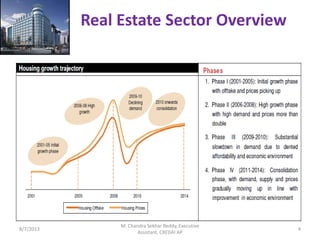
• The huge gap in Demand and Supply of
houses leading to a steep rise in residential
capital values especially in urban areas.
• Broadly, residential real estate industry can be
divided into four growth phases, as can be
seen in the chart below
Real Estate Sector Overview
8/7/2013 3
M. Chandra Sekhar Reddy, Executive
Assistant, CREDAI AP
Real Estate Sector Overview
8/7/2013 4
M. Chandra Sekhar Reddy, Executive
Assistant, CREDAI AP
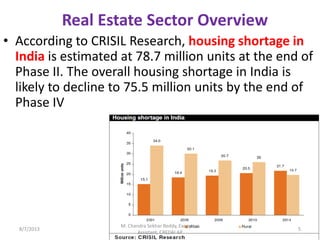
• According to CRISIL Research, housing shortage in
India is estimated at 78.7 million units at the end of
Phase II. The overall housing shortage in India is
likely to decline to 75.5 million units by the end of
Phase IV
Real Estate Sector Overview
8/7/2013 5
M. Chandra Sekhar Reddy, Executive
Assistant, CREDAI AP
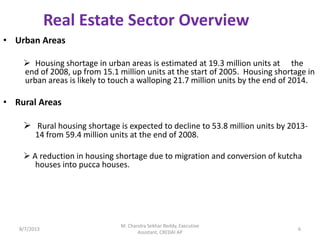
• Urban Areas
 Housing shortage in urban areas is estimated at 19.3 million units at the
end of 2008, up from 15.1 million units at the start of 2005. Housing shortage in
urban areas is likely to touch a walloping 21.7 million units by the end of 2014.
• Rural Areas
 Rural housing shortage is expected to decline to 53.8 million units by 2013-
14 from 59.4 million units at the end of 2008.
 A reduction in housing shortage due to migration and conversion of kutcha
houses into pucca houses.
Real Estate Sector Overview
8/7/2013 6
M. Chandra Sekhar Reddy, Executive
Assistant, CREDAI AP
• Despite strong fundamentals backing the residential real estate, it is
highly influenced by economic cycles.
• Between 2008- 09 the real estate market in India too witnessed an
astounding fall in demand and capital values
• However, the sector experienced a pickup in demand during the
second half of 2009 across major cities mainly attributed to
improvement in economy
• Demand for houses mounted as the global economy improved
bringing back financial confidence to the home buyers along with
low interest rates. End-users, who had put their purchasing plans
on hold due to the fall in affordability levels and job-related
uncertainties, started booking houses.
Real Estate Sector Overview
Recent Industry Trends
8/7/2013 7
M. Chandra Sekhar Reddy, Executive
Assistant, CREDAI AP
• In 2010- 11 total revenue was US$ 66.8 billion. By 2020, the
sector is expected to earn a revenue of US$ 180 billion.
• the demand is expected to grow at a compound annual growth
rate (CAGR) of 19 per cent between 2010 and 2014.
• India Ranked 20th in the list with investment volume of US $3.4
billion on 2012.
• In a couple of years this sector will attract US $ 4-5 billion from
FDIs
• From April 2000- Feb 2012 Construction development sector has
attracted FDI worth US $ 22,007.67 millions
• India needs to invest US$ 1.2 trillion over the next 20 years to
modernize its infrastructure
Real Estate Sector Overview
Market Size/ Growth Prospects
8/7/2013 8
M. Chandra Sekhar Reddy, Executive
Assistant, CREDAI AP
• FDI up to 100 per cent is allowed under the automatic route in
townships, housing, built-up infrastructure and construction
development projects
• Also planning to introduce a single-window system for
clearance of all real estate projects across the country. Which
bring down the average approval time from the current 196
days to 45-60 days
• Under the JNNURM programmes the Government has
sanctioned projects worth Rs 41,723 crores (US$ 7.51 billion)
for building of 1,569,000 houses/dwelling units for
economically weaker/lower income group
Government
Real Estate Sector Overview8/7/2013 9
M. Chandra Sekhar Reddy, Executive
Assistant, CREDAI AP
• Some of the initiatives taken in the union budget
2013-14 include:
• For homes and flats with a carpet area of 2,000 square
feet or more or of a value of Rs 1 crore (US$ 180,213)
or more, which are high-end constructions, where the
component of services is greater, rate of abatement
reduced from 75 to 70 percent
• Rs 6,000 crore (US$ 1.08 billion) were given to Rural
Housing Fund
• National Housing Bank plans to set up Urban Housing
Fund. Rs 2,000 crore (US$ 360.47 million) will be
provided to the fund in the current financial year
Real Estate Sector Overview
8/7/2013 10
M. Chandra Sekhar Reddy, Executive
Assistant, CREDAI AP
• The real estate industry in India is yet in a promising
stage.
• It the second largest employer after agriculture and
expected growth rate would be 30 per cent over the next
decade.
• The real estate market could start to perform better as
the easing of FDI norms will begin to show results during
the second half of the year
• the Finance Ministry's motivation through softening of
interest rates and lending more to the real estate sector
will have a positive impact on both developers and
consumers.
Real Estate Sector Overview
Road Ahead
8/7/2013 11
M. Chandra Sekhar Reddy, Executive
Assistant, CREDAI AP
12
Thank You
8/7/2013
M. Chandra Sekhar Reddy, Executive
Assistant, CREDAI AP

Real estate sector overview

  • 1.
    REAL ESTATE SECTOROVERVIEW The real estate sector in India assumed greater prominence with the liberalization of the economy The Indian real estate sector has traditionally been dominated by a number of small regional players with relatively low levels of expertise and/or financial resources. it has traditionally tapped high net-worth individuals and other informal sources of financing, which has led to low levels of transparency. 8/7/2013 1 M. Chandra Sekhar Reddy, Executive Assistant, CREDAI AP
  • 2.
    Real Estate SectorOverview This scenario underwent a change. As of today, the real estate industry’s dynamics reflect consumers’ expectations of higher quality with India’s increasing integration with the global economy. Residential real estate industry has witnessed stupendous growth in the past few years owing to the following reasons: Continuous growth in population Migration towards urban areas Ample job opportunities in service sectors Growing income levels Rise in nuclear families Easy availability of finance8/7/2013 2 M. Chandra Sekhar Reddy, Executive Assistant, CREDAI AP
  • 3.
    • The hugegap in Demand and Supply of houses leading to a steep rise in residential capital values especially in urban areas. • Broadly, residential real estate industry can be divided into four growth phases, as can be seen in the chart below Real Estate Sector Overview 8/7/2013 3 M. Chandra Sekhar Reddy, Executive Assistant, CREDAI AP
  • 4.
    Real Estate SectorOverview 8/7/2013 4 M. Chandra Sekhar Reddy, Executive Assistant, CREDAI AP
  • 5.
    • According toCRISIL Research, housing shortage in India is estimated at 78.7 million units at the end of Phase II. The overall housing shortage in India is likely to decline to 75.5 million units by the end of Phase IV Real Estate Sector Overview 8/7/2013 5 M. Chandra Sekhar Reddy, Executive Assistant, CREDAI AP
  • 6.
    • Urban Areas Housing shortage in urban areas is estimated at 19.3 million units at the end of 2008, up from 15.1 million units at the start of 2005. Housing shortage in urban areas is likely to touch a walloping 21.7 million units by the end of 2014. • Rural Areas  Rural housing shortage is expected to decline to 53.8 million units by 2013- 14 from 59.4 million units at the end of 2008.  A reduction in housing shortage due to migration and conversion of kutcha houses into pucca houses. Real Estate Sector Overview 8/7/2013 6 M. Chandra Sekhar Reddy, Executive Assistant, CREDAI AP
  • 7.
    • Despite strongfundamentals backing the residential real estate, it is highly influenced by economic cycles. • Between 2008- 09 the real estate market in India too witnessed an astounding fall in demand and capital values • However, the sector experienced a pickup in demand during the second half of 2009 across major cities mainly attributed to improvement in economy • Demand for houses mounted as the global economy improved bringing back financial confidence to the home buyers along with low interest rates. End-users, who had put their purchasing plans on hold due to the fall in affordability levels and job-related uncertainties, started booking houses. Real Estate Sector Overview Recent Industry Trends 8/7/2013 7 M. Chandra Sekhar Reddy, Executive Assistant, CREDAI AP
  • 8.
    • In 2010-11 total revenue was US$ 66.8 billion. By 2020, the sector is expected to earn a revenue of US$ 180 billion. • the demand is expected to grow at a compound annual growth rate (CAGR) of 19 per cent between 2010 and 2014. • India Ranked 20th in the list with investment volume of US $3.4 billion on 2012. • In a couple of years this sector will attract US $ 4-5 billion from FDIs • From April 2000- Feb 2012 Construction development sector has attracted FDI worth US $ 22,007.67 millions • India needs to invest US$ 1.2 trillion over the next 20 years to modernize its infrastructure Real Estate Sector Overview Market Size/ Growth Prospects 8/7/2013 8 M. Chandra Sekhar Reddy, Executive Assistant, CREDAI AP
  • 9.
    • FDI upto 100 per cent is allowed under the automatic route in townships, housing, built-up infrastructure and construction development projects • Also planning to introduce a single-window system for clearance of all real estate projects across the country. Which bring down the average approval time from the current 196 days to 45-60 days • Under the JNNURM programmes the Government has sanctioned projects worth Rs 41,723 crores (US$ 7.51 billion) for building of 1,569,000 houses/dwelling units for economically weaker/lower income group Government Real Estate Sector Overview8/7/2013 9 M. Chandra Sekhar Reddy, Executive Assistant, CREDAI AP
  • 10.
    • Some ofthe initiatives taken in the union budget 2013-14 include: • For homes and flats with a carpet area of 2,000 square feet or more or of a value of Rs 1 crore (US$ 180,213) or more, which are high-end constructions, where the component of services is greater, rate of abatement reduced from 75 to 70 percent • Rs 6,000 crore (US$ 1.08 billion) were given to Rural Housing Fund • National Housing Bank plans to set up Urban Housing Fund. Rs 2,000 crore (US$ 360.47 million) will be provided to the fund in the current financial year Real Estate Sector Overview 8/7/2013 10 M. Chandra Sekhar Reddy, Executive Assistant, CREDAI AP
  • 11.
    • The realestate industry in India is yet in a promising stage. • It the second largest employer after agriculture and expected growth rate would be 30 per cent over the next decade. • The real estate market could start to perform better as the easing of FDI norms will begin to show results during the second half of the year • the Finance Ministry's motivation through softening of interest rates and lending more to the real estate sector will have a positive impact on both developers and consumers. Real Estate Sector Overview Road Ahead 8/7/2013 11 M. Chandra Sekhar Reddy, Executive Assistant, CREDAI AP
  • 12.
    12 Thank You 8/7/2013 M. ChandraSekhar Reddy, Executive Assistant, CREDAI AP