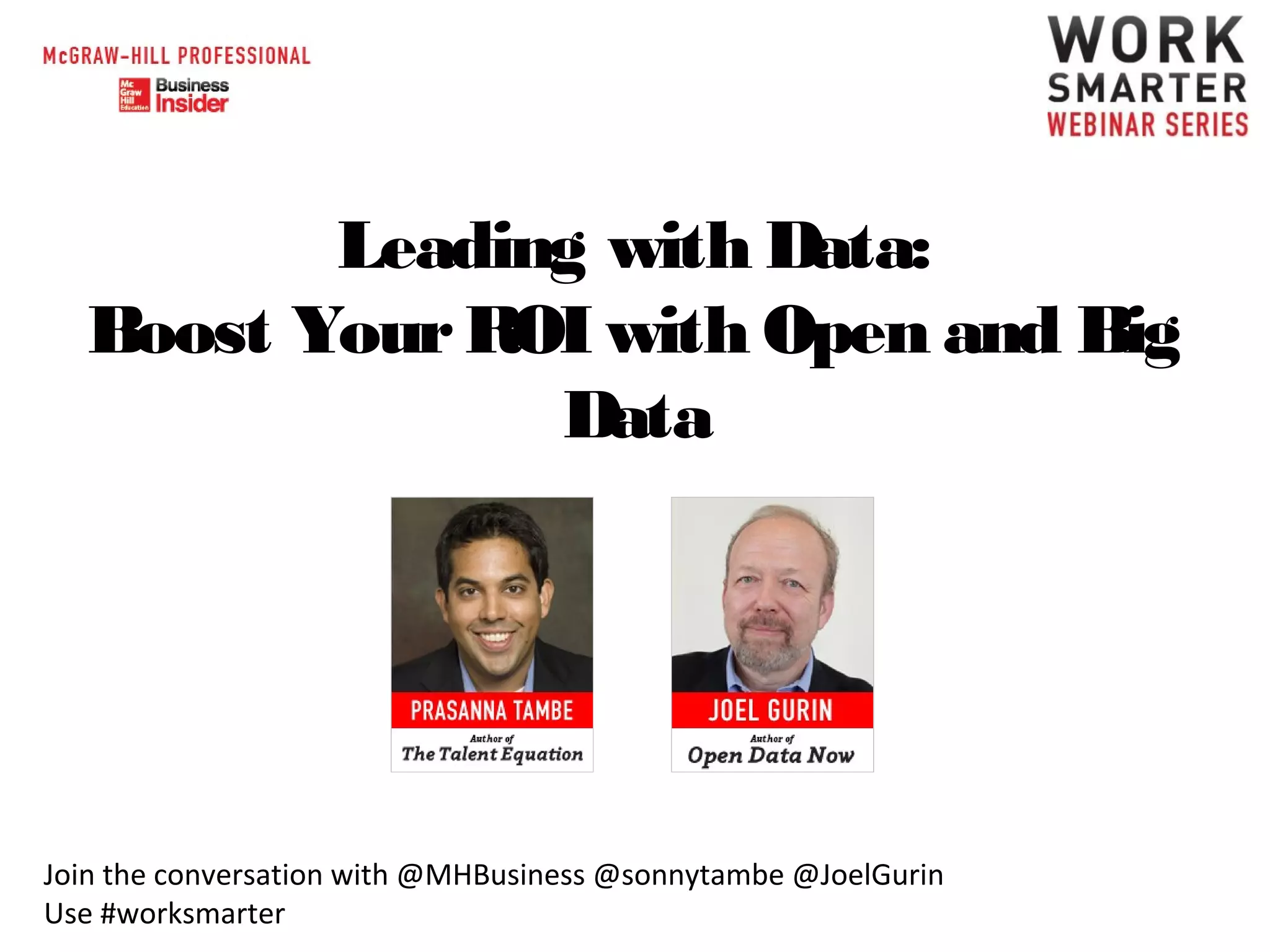
Leading with Data:
Boost Your ROI with Open and Big
Data

Join the conversation with @MHBusiness @sonnytambe @JoelGurin
Use #worksmarter
2
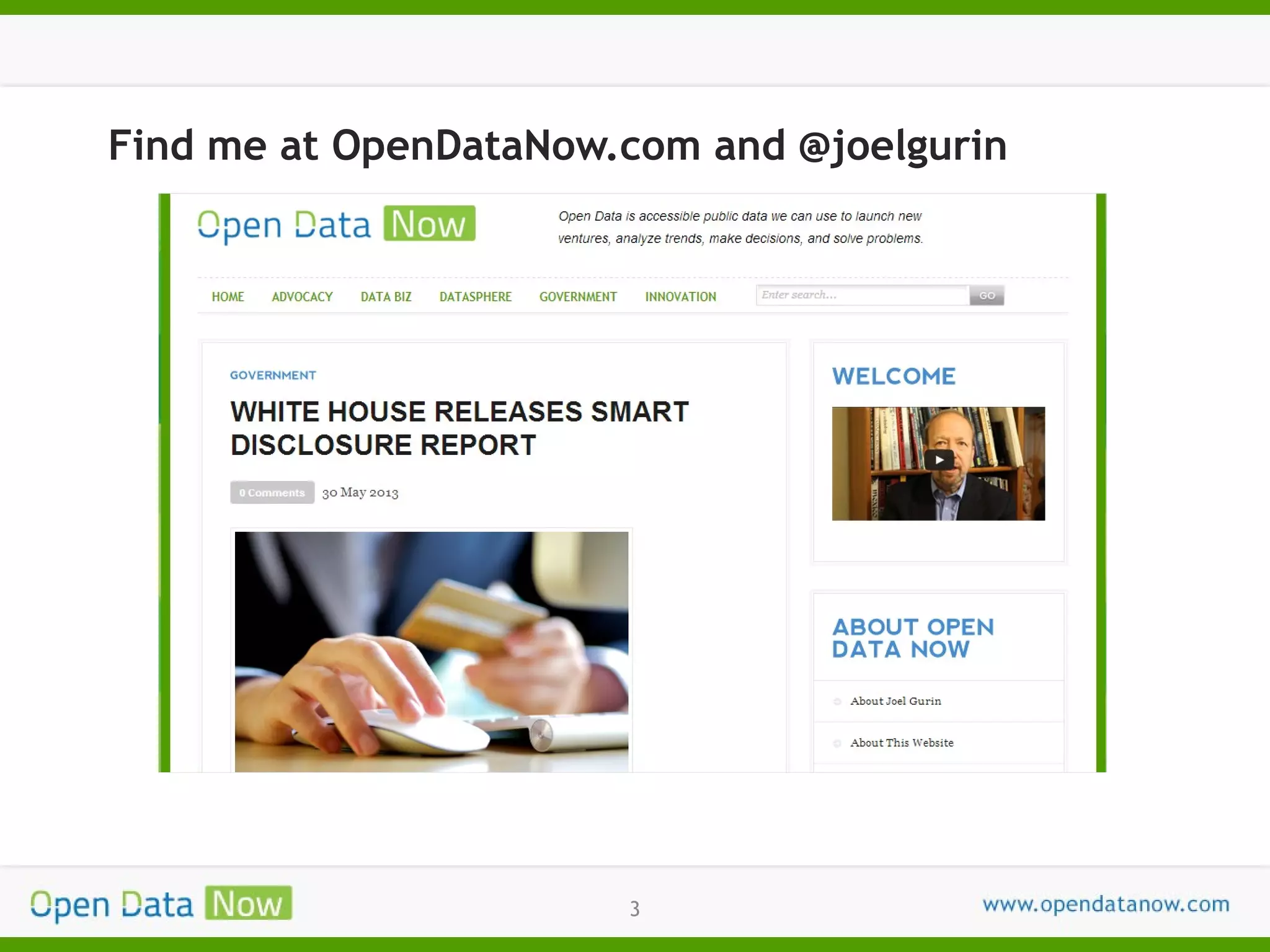
Find me at OpenDataNow.com and @joelgurin

3
Setting the Stage
My Journey Through the Datasphere

4
Setting the Stage

The GovLab’s Central Hypothesis
When governments and institutions open
themselves to diverse participation and
collaborative problem-solving, and partner
with citizens to make decisions, they are more
effective and legitimate.
Setting the Stage

Open Data: Accessible, public data that
people, companies, and organizations
can use to launch new ventures, analyze
patterns and trends, make data-driven
decisions, and solve complex problems.

6
Setting the Stage
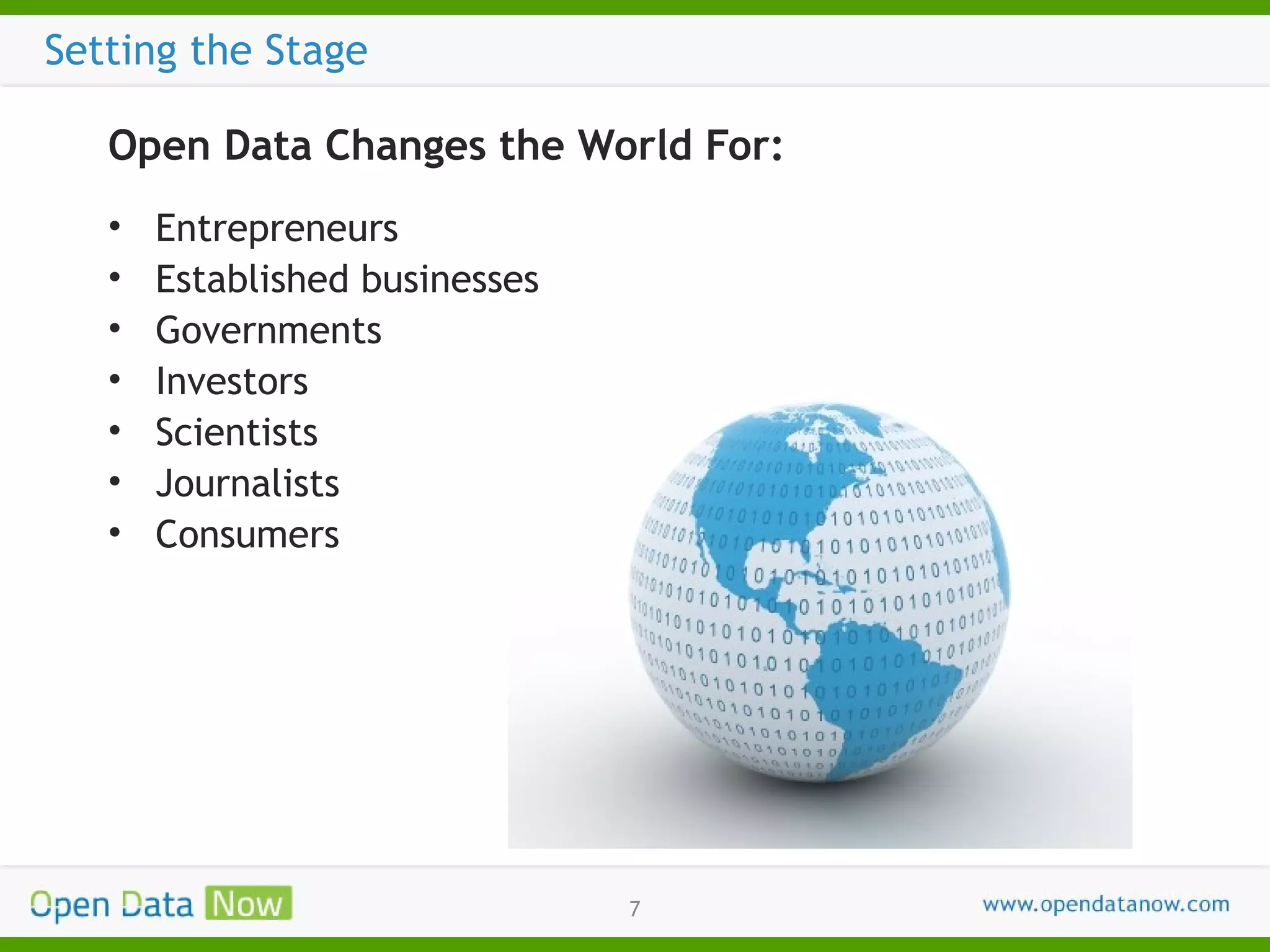
Open Data Changes the World For:
•
•
•
•
•
•
•

Entrepreneurs
Established businesses
Governments
Investors
Scientists
Journalists
Consumers

7
Setting the Stage

What Open Data Isn’t

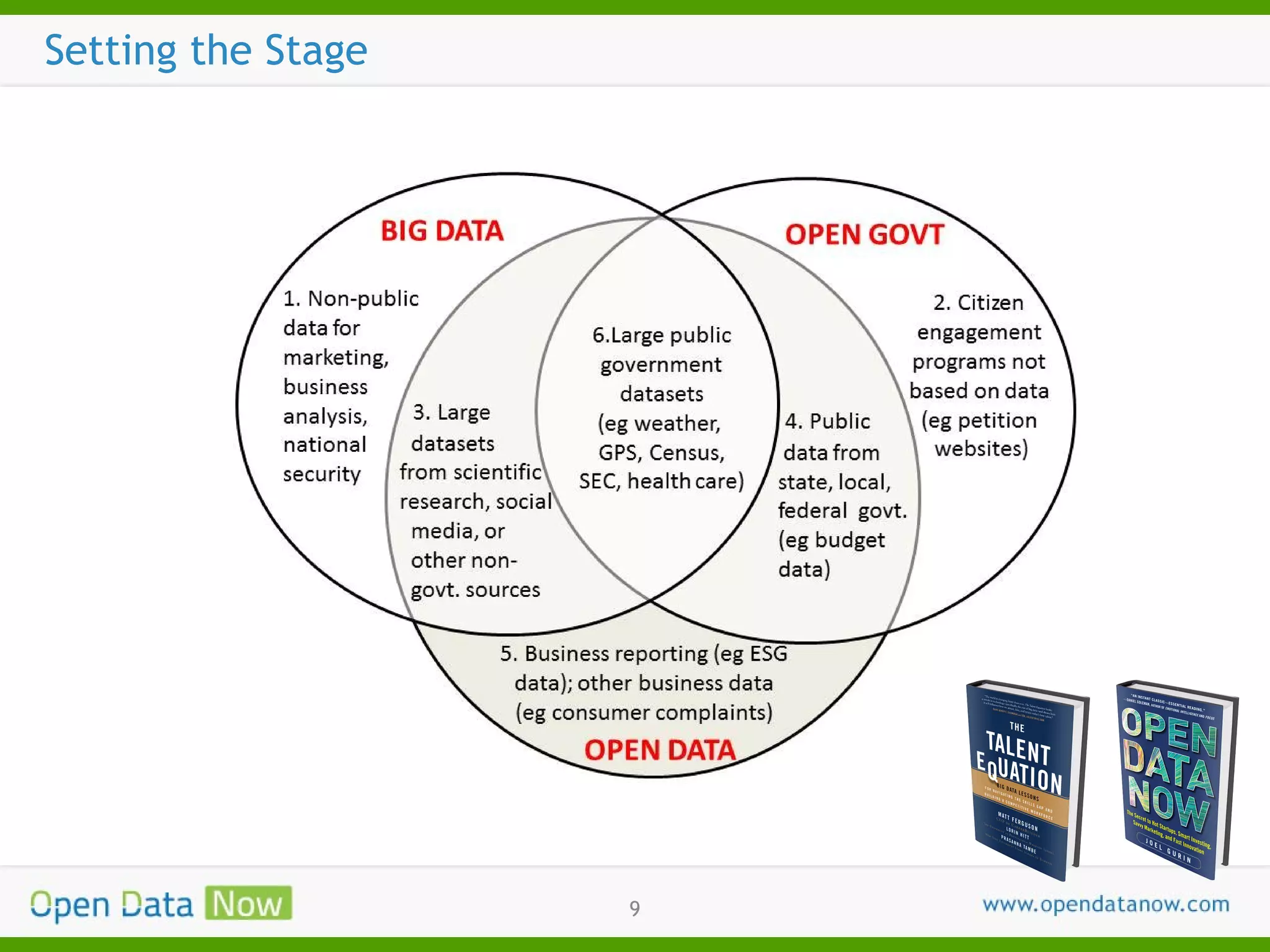
• Big Data ≠ Open Data ≠ Open
Government
• Big Data: Really, really big datasets
• Open Government: Transparency,
participation, collaboration – with or
without data

8
Setting the Stage

9
Liberating Federal Data
Federal Data
Open Data Becomes a Priority

[Open Data is] going to help launch more
businesses. . . . It’s going to help more
entrepreneurs come up with products and
services that we haven’t even imagined yet.

President Barack Obama

11
Federal Data
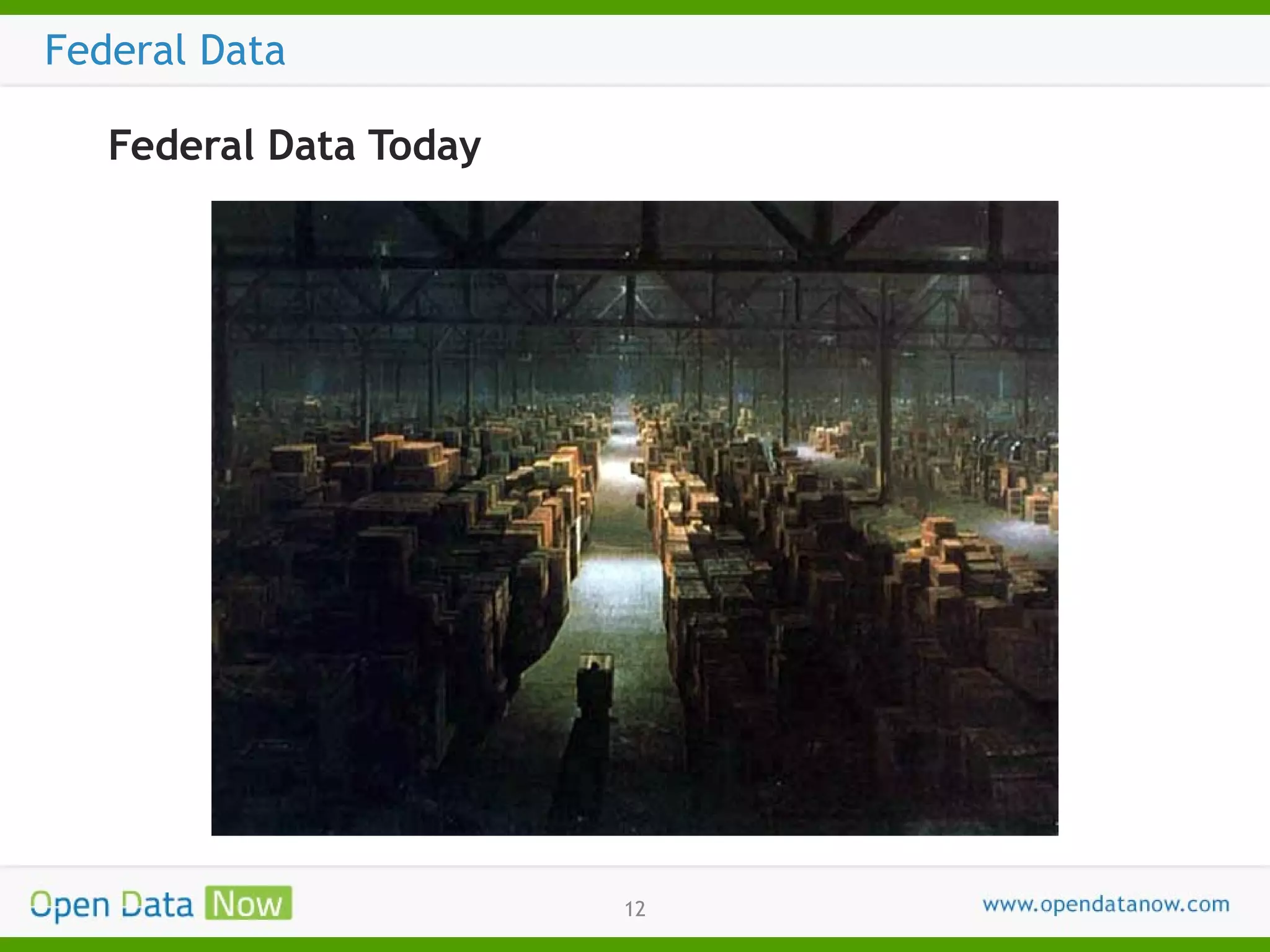
Federal Data Today

12
Federal Data
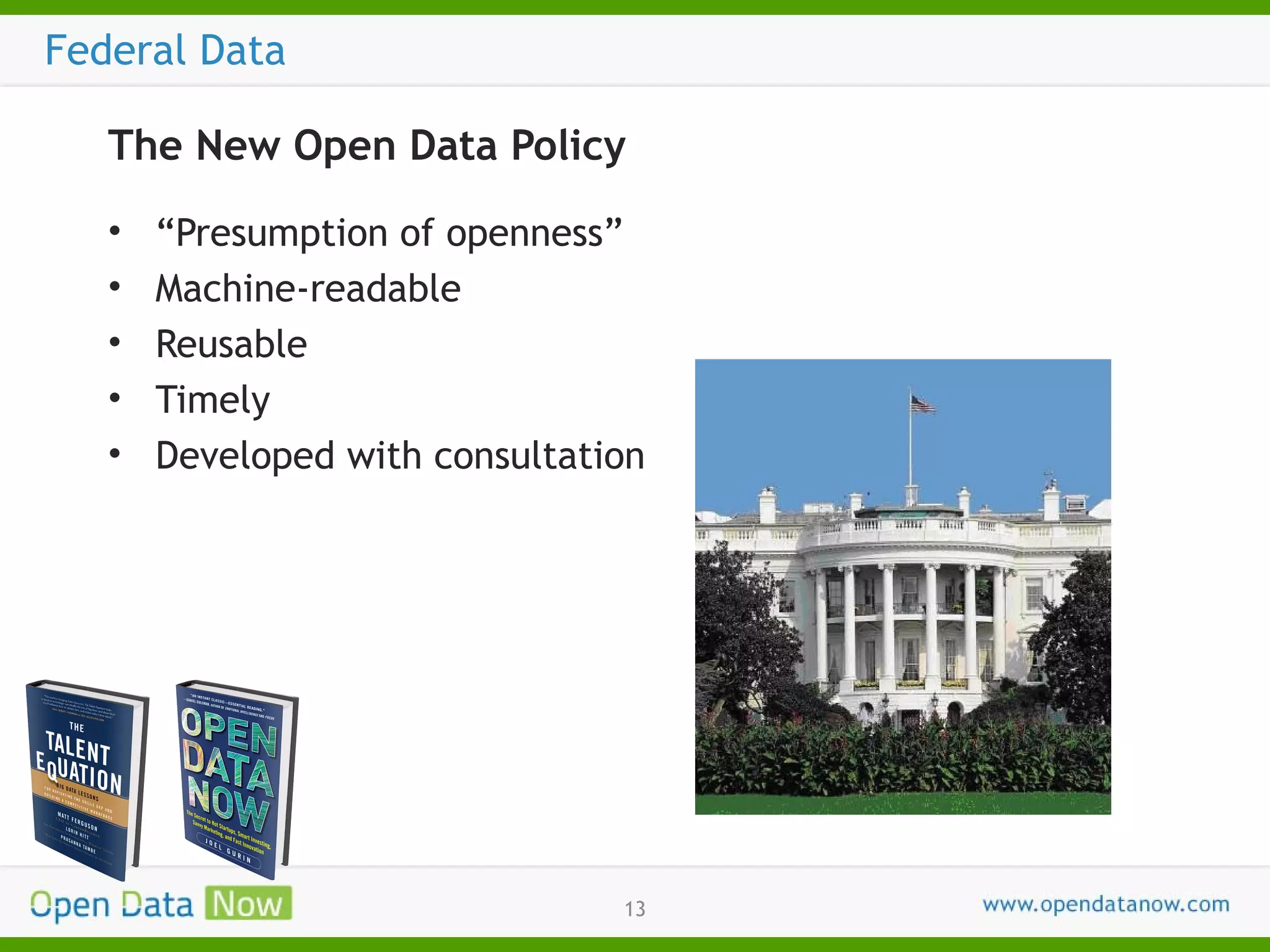
The New Open Data Policy
•
•
•
•
•

“Presumption of openness”
Machine-readable
Reusable
Timely
Developed with consultation

13
Federal Data
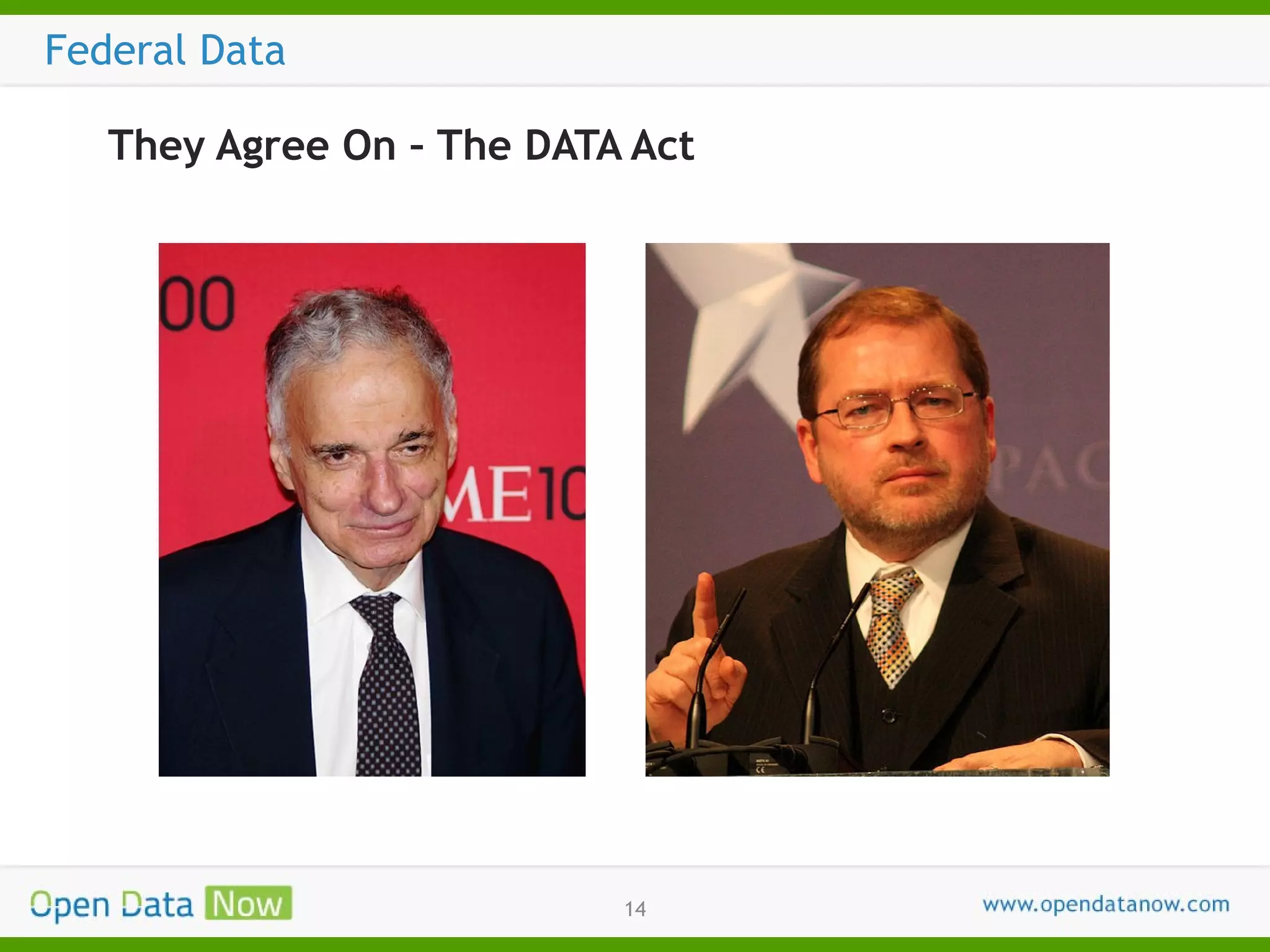
They Agree On – The DATA Act

14
Data-Driven States and Cities
State and City Data
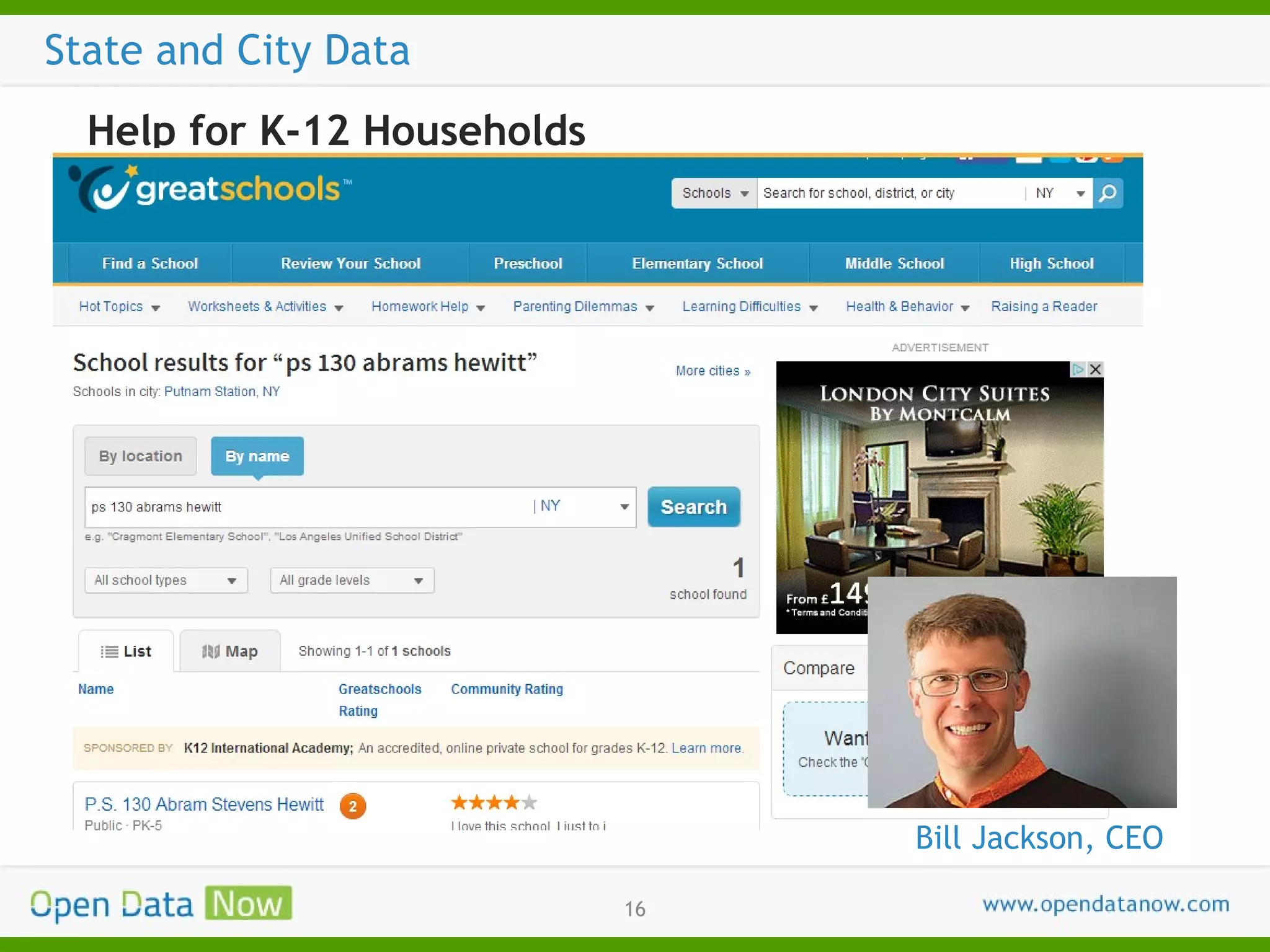
Help for K-12 Households

Bill Jackson, CEO
16
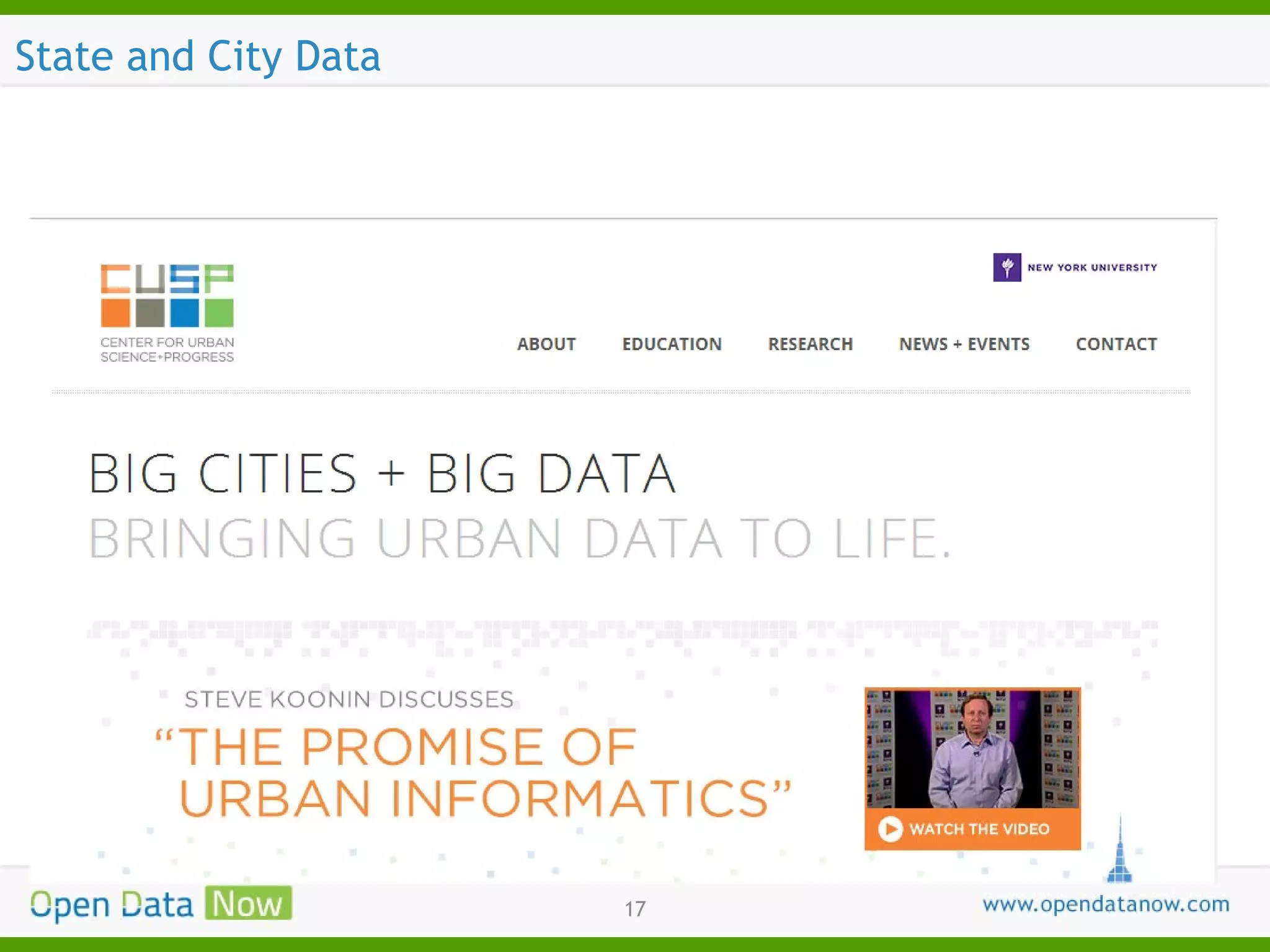
State and City Data

17
Data-Driven Cities

How Wired Cities Use New Data
•Optimize operations
•Monitor infrastructure conditions
•Plan infrastructure
•Public health
•Emergency management

18
State and City Data

•
•
•
•

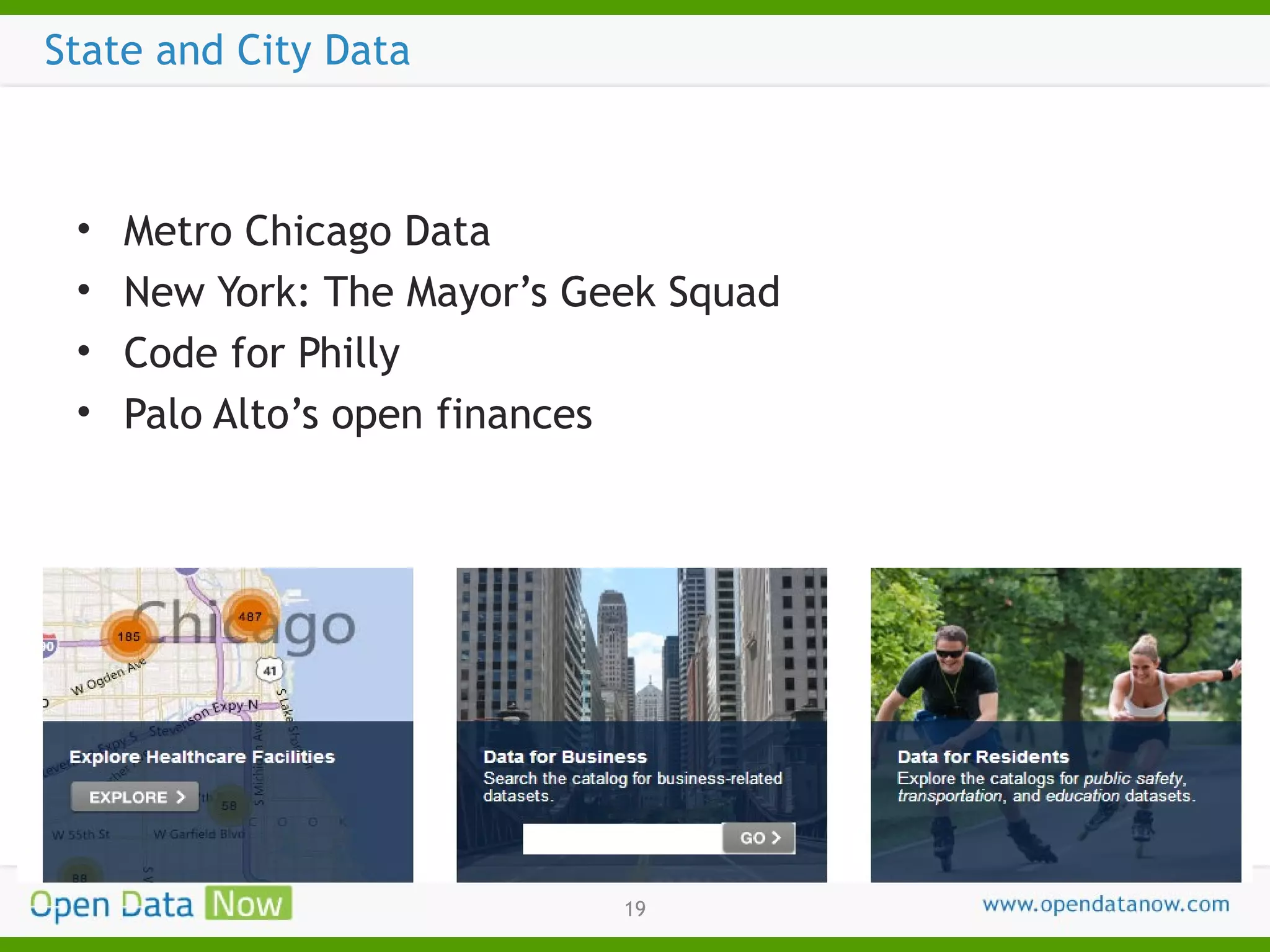
Metro Chicago Data
New York: The Mayor’s Geek Squad
Code for Philly
Palo Alto’s open finances

19
State and City Data
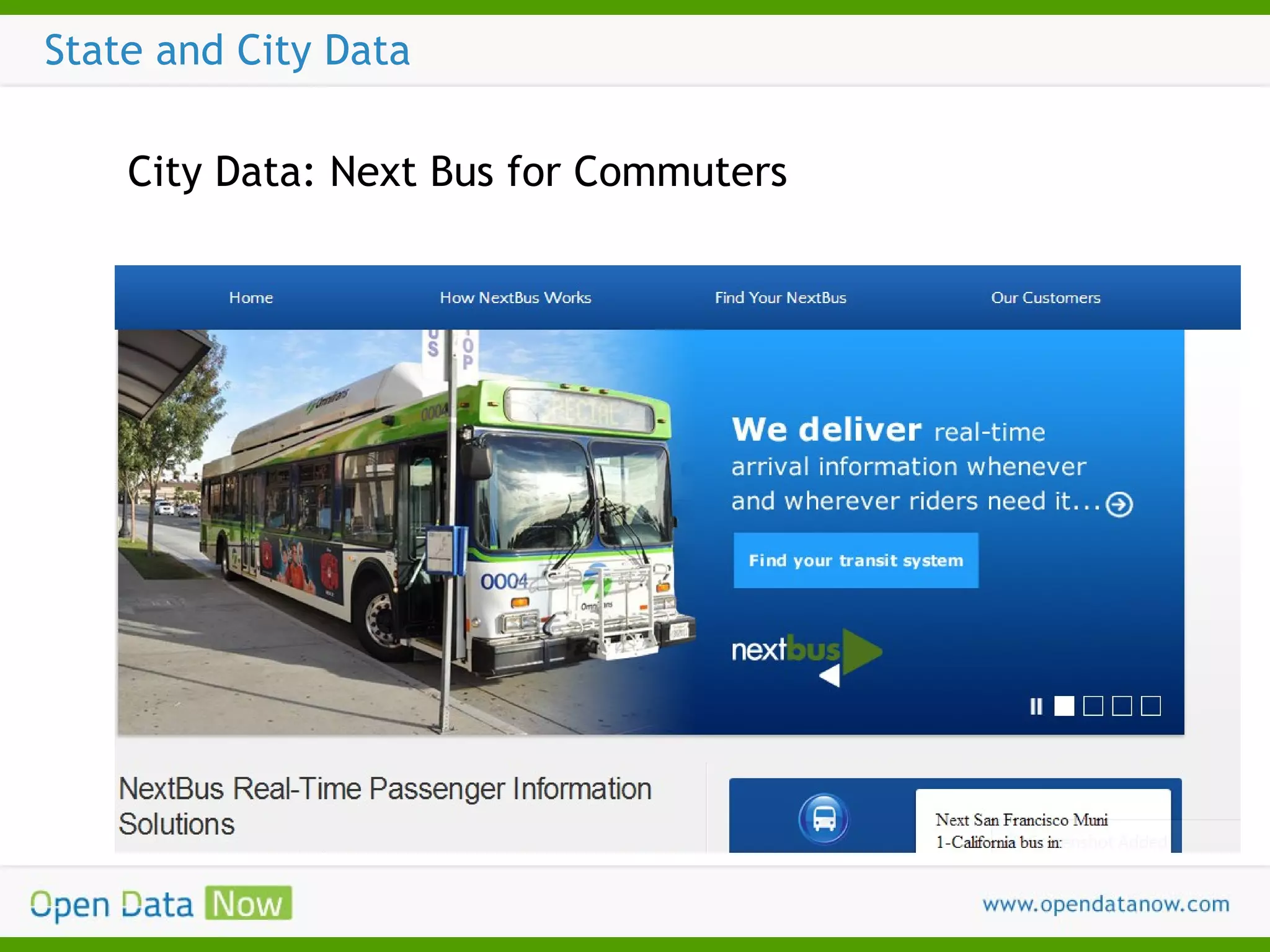
City Data: Next Bus for Commuters
State and City Data

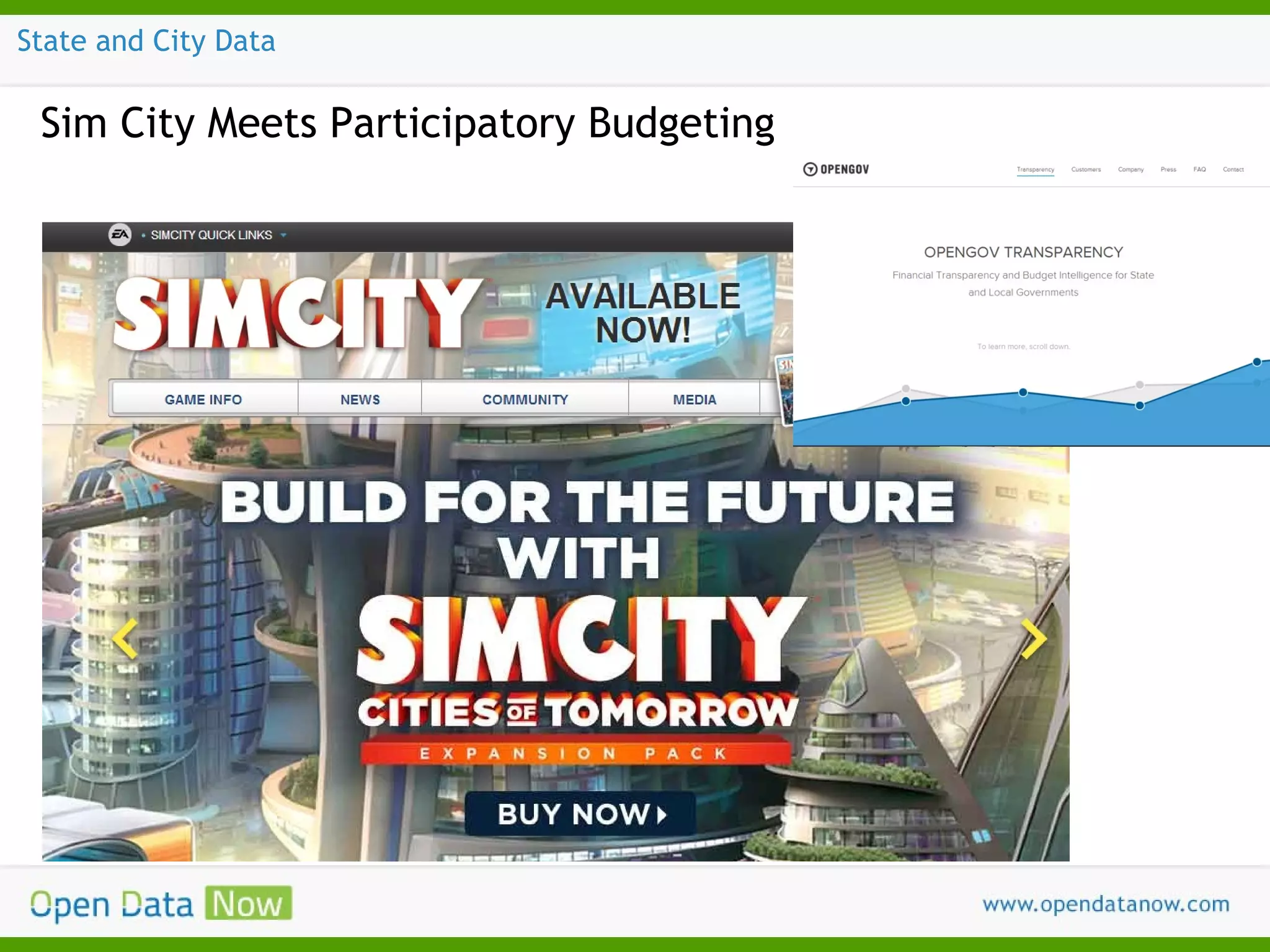
Sim City Meets Participatory Budgeting
State and City Data
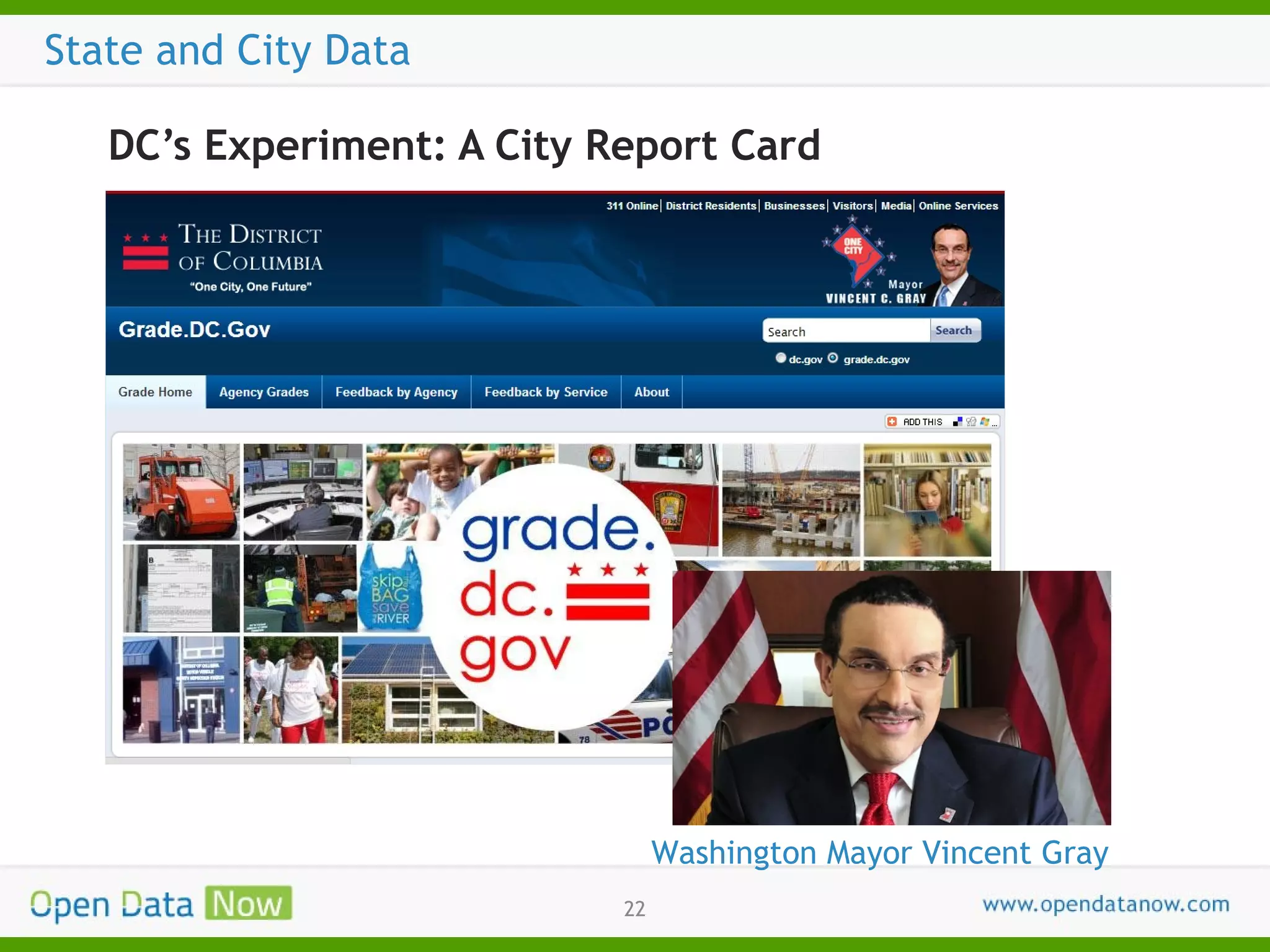
DC’s Experiment: A City Report Card

Washington Mayor Vincent Gray
22
State and City Data
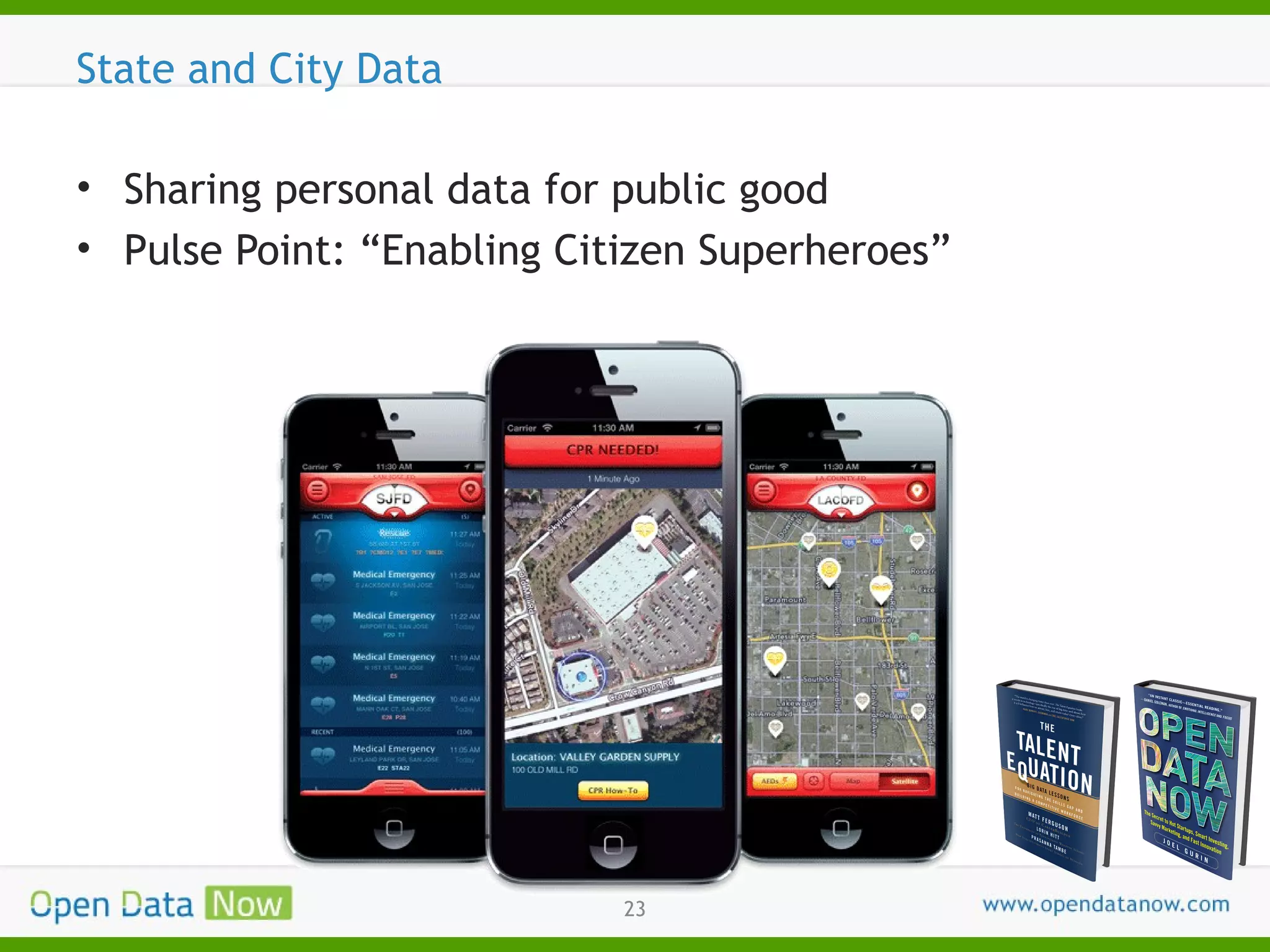
• Sharing personal data for public good
• Pulse Point: “Enabling Citizen Superheroes”

23
Open Data Shapes Reputation and Brands
Reputation and Brands
Social Media: 2 Billion Tweets a Week

25
Reputation and Brands
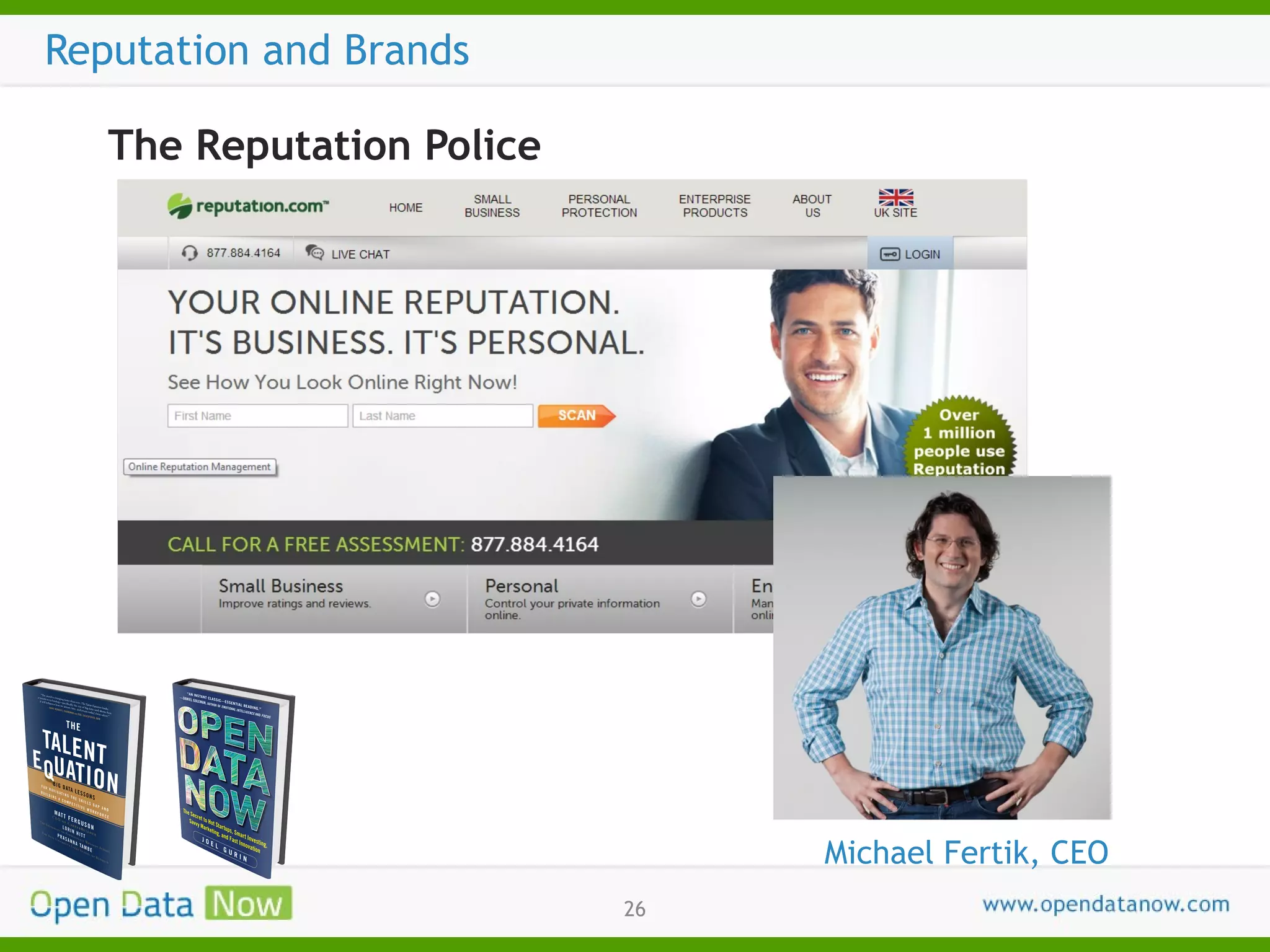
The Reputation Police

Michael Fertik, CEO
26
Reputation and Brands
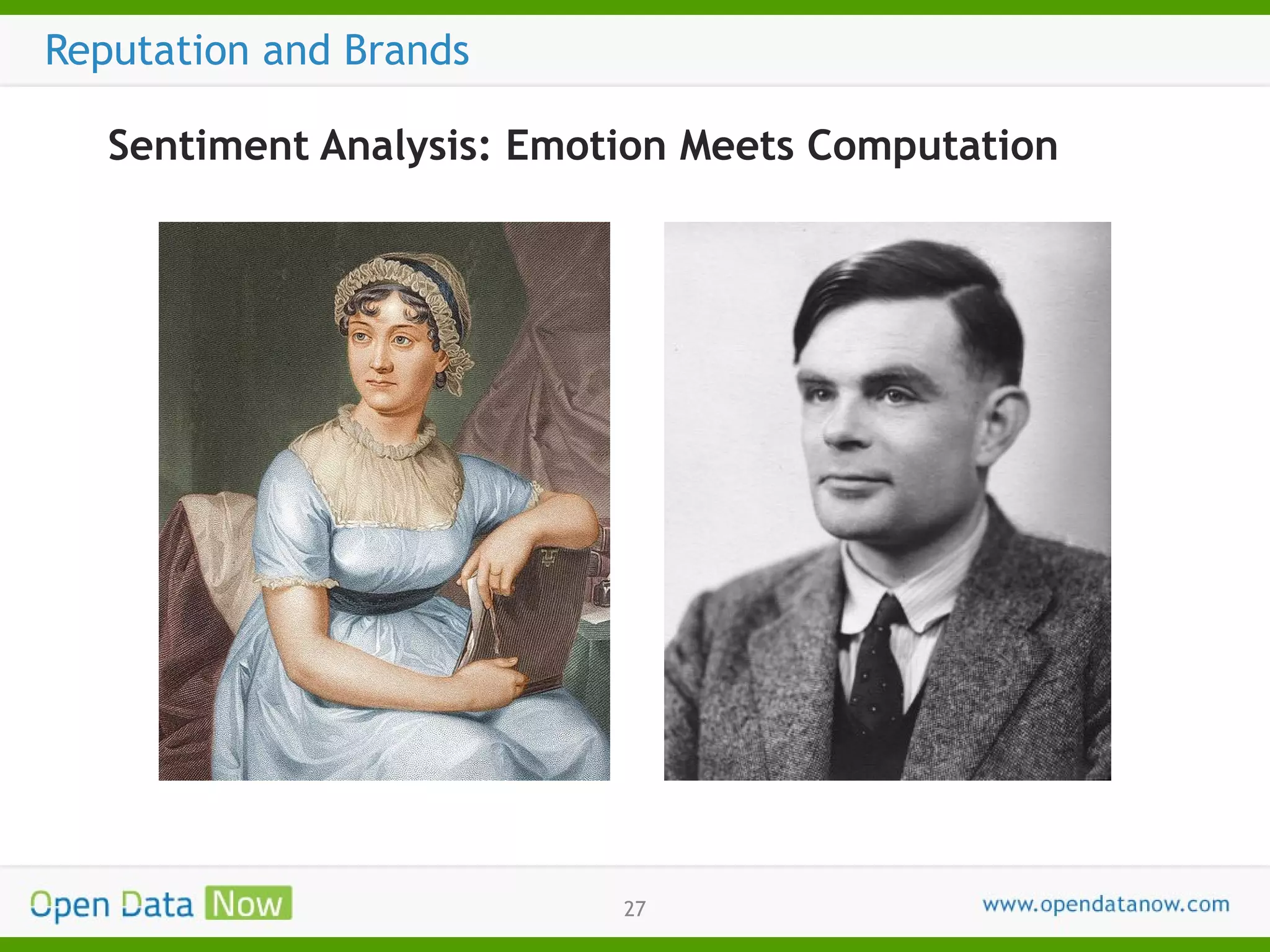
Sentiment Analysis: Emotion Meets Computation

27
Reputation and Brands
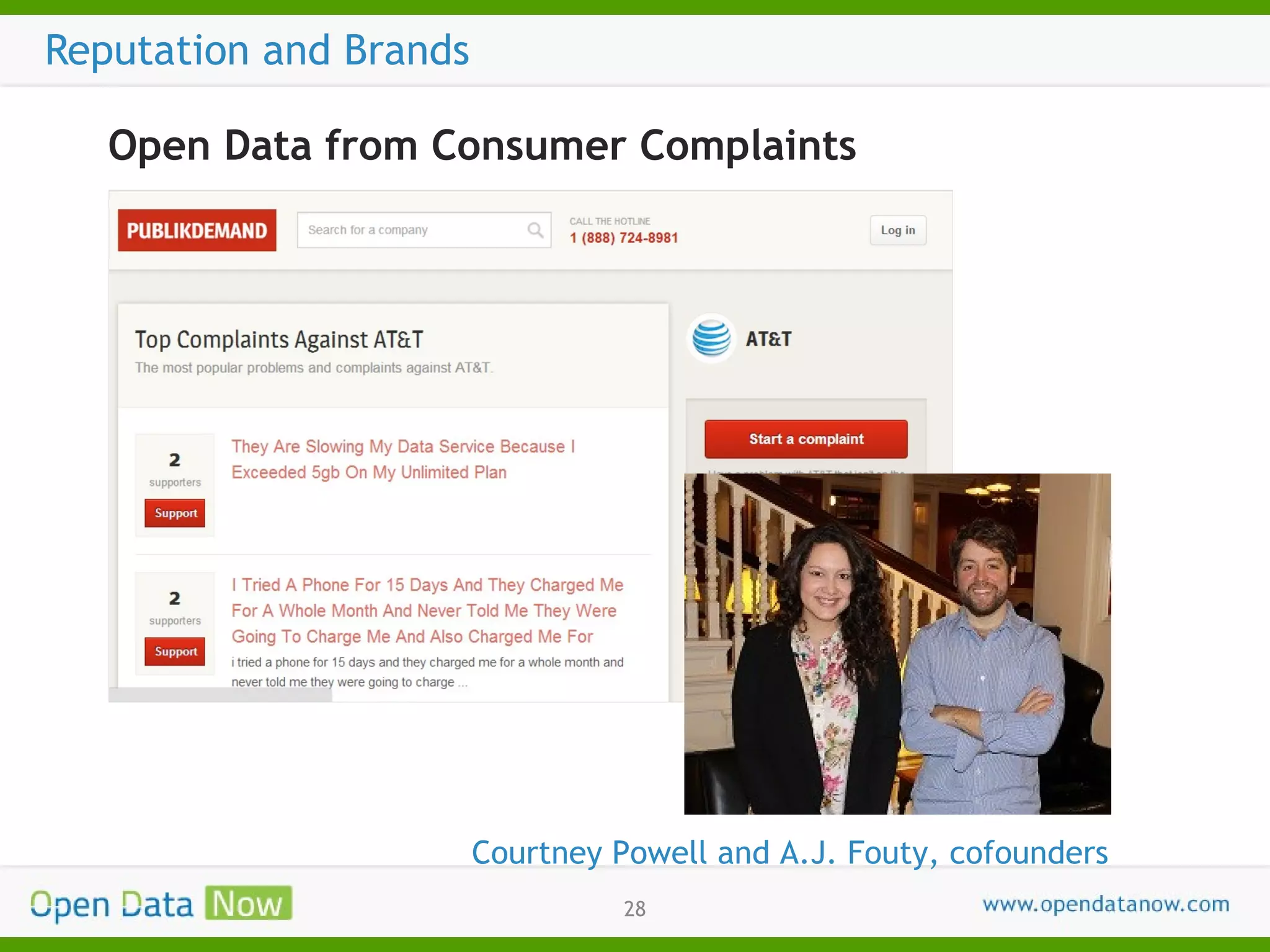
Open Data from Consumer Complaints

Courtney Powell and A.J. Fouty, cofounders
28
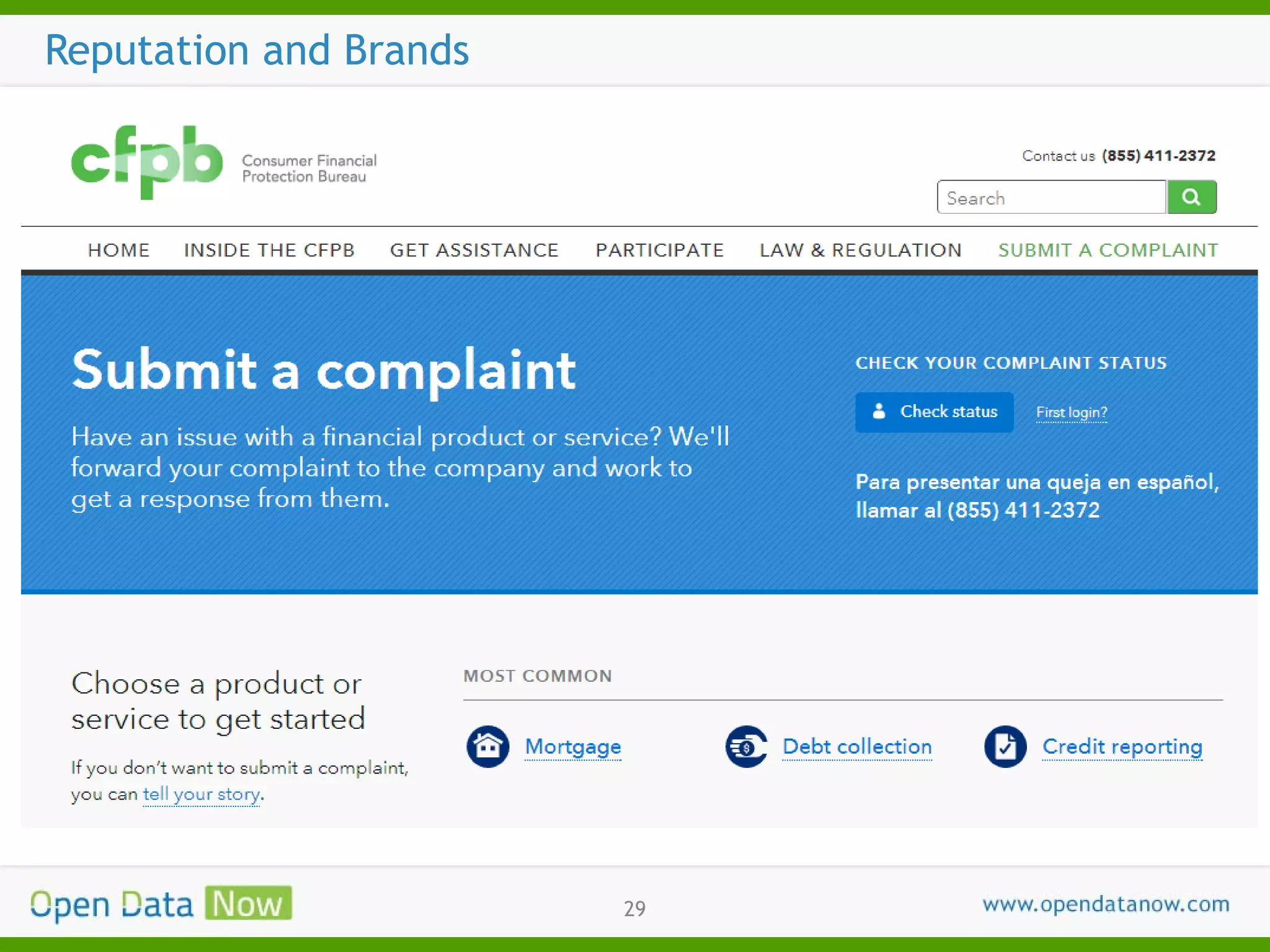
Reputation and Brands

29
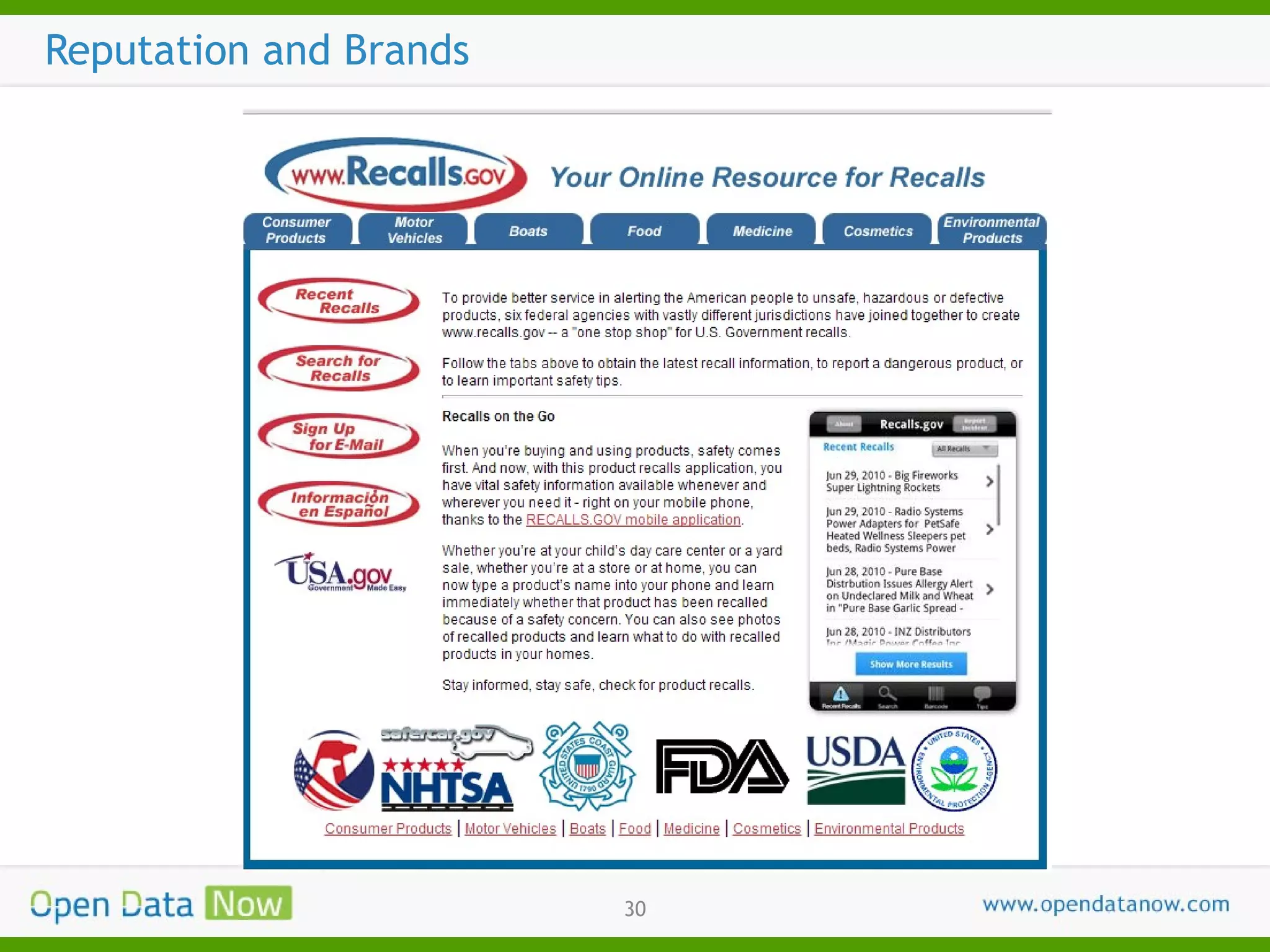
Reputation and Brands

30
Driving Business Growth
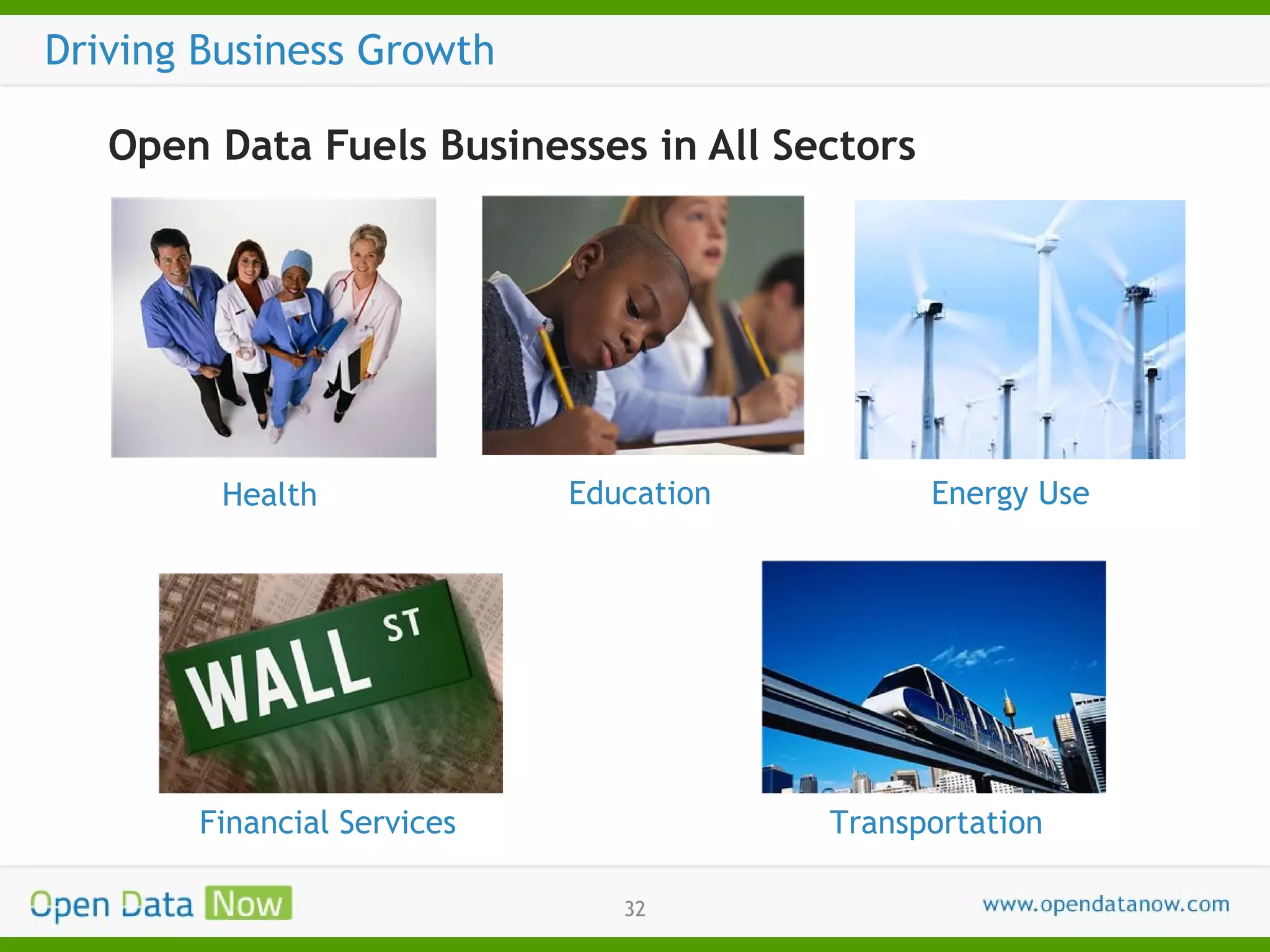
Open Data Fuels Businesses in All Sectors

Health

Education

Financial Services

Energy Use

Transportation
32
Driving Business Growth
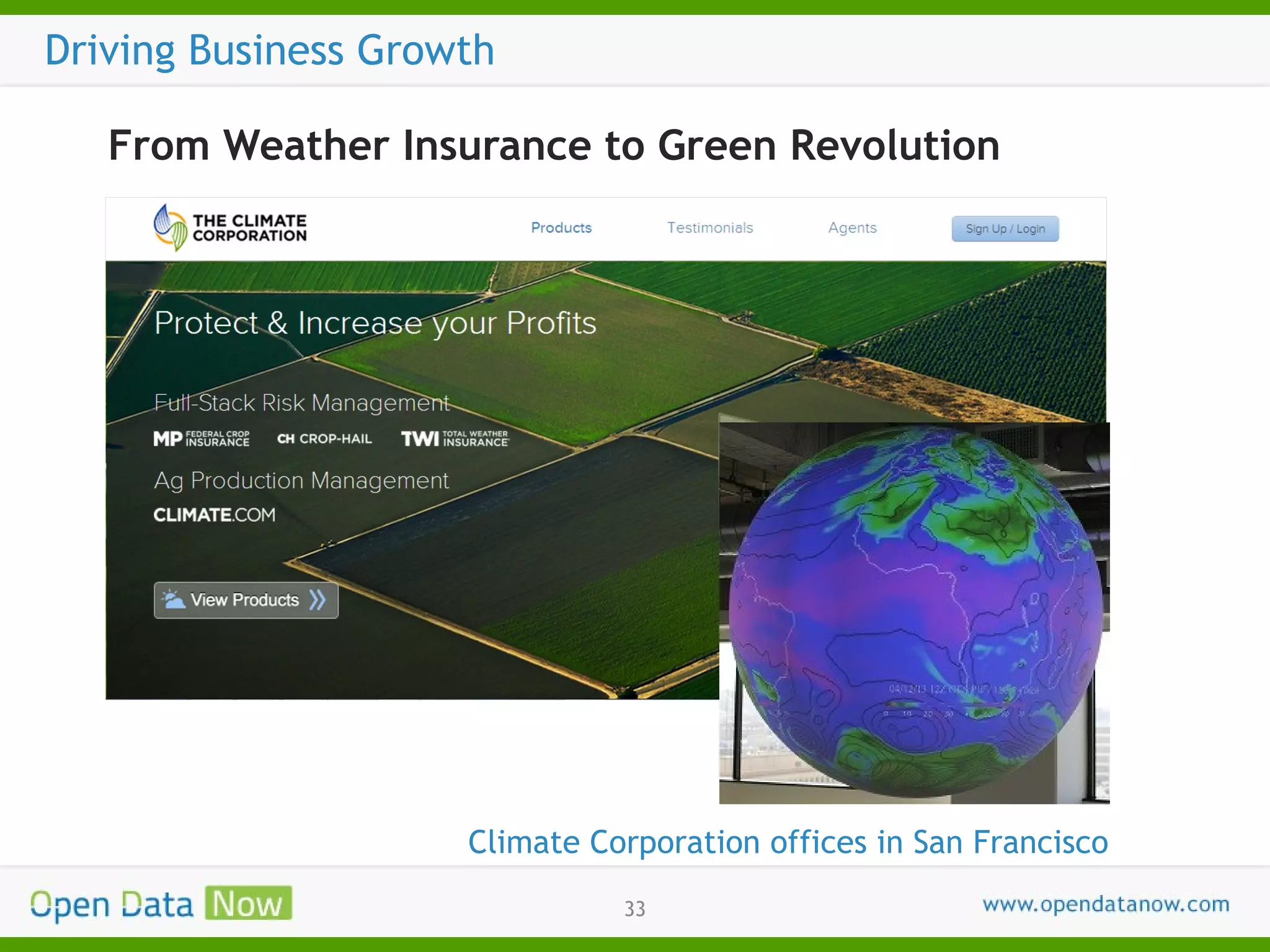
From Weather Insurance to Green Revolution

Climate Corporation offices in San Francisco
33
Driving Business Growth
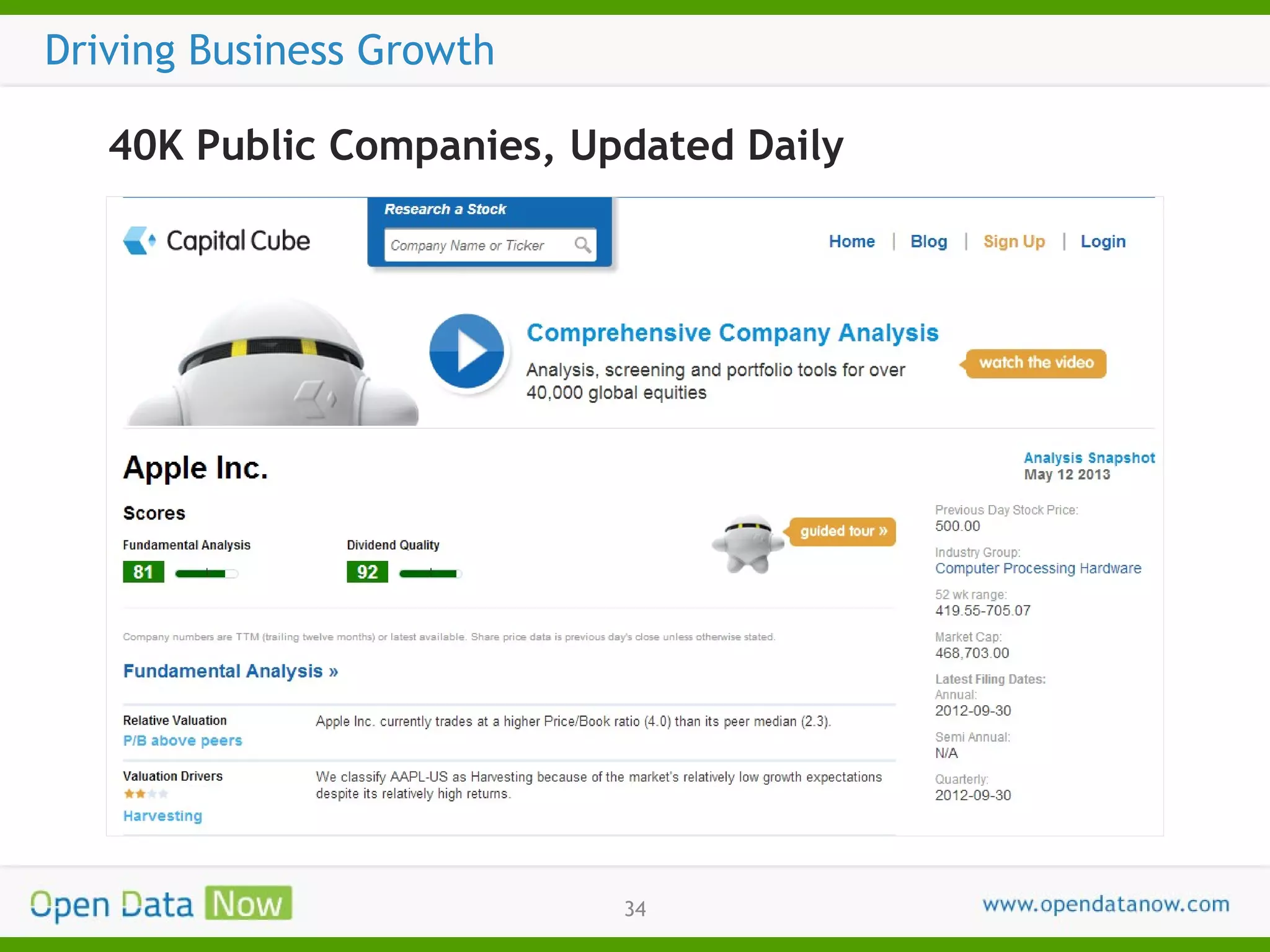
40K Public Companies, Updated Daily

34
Driving Business Growth
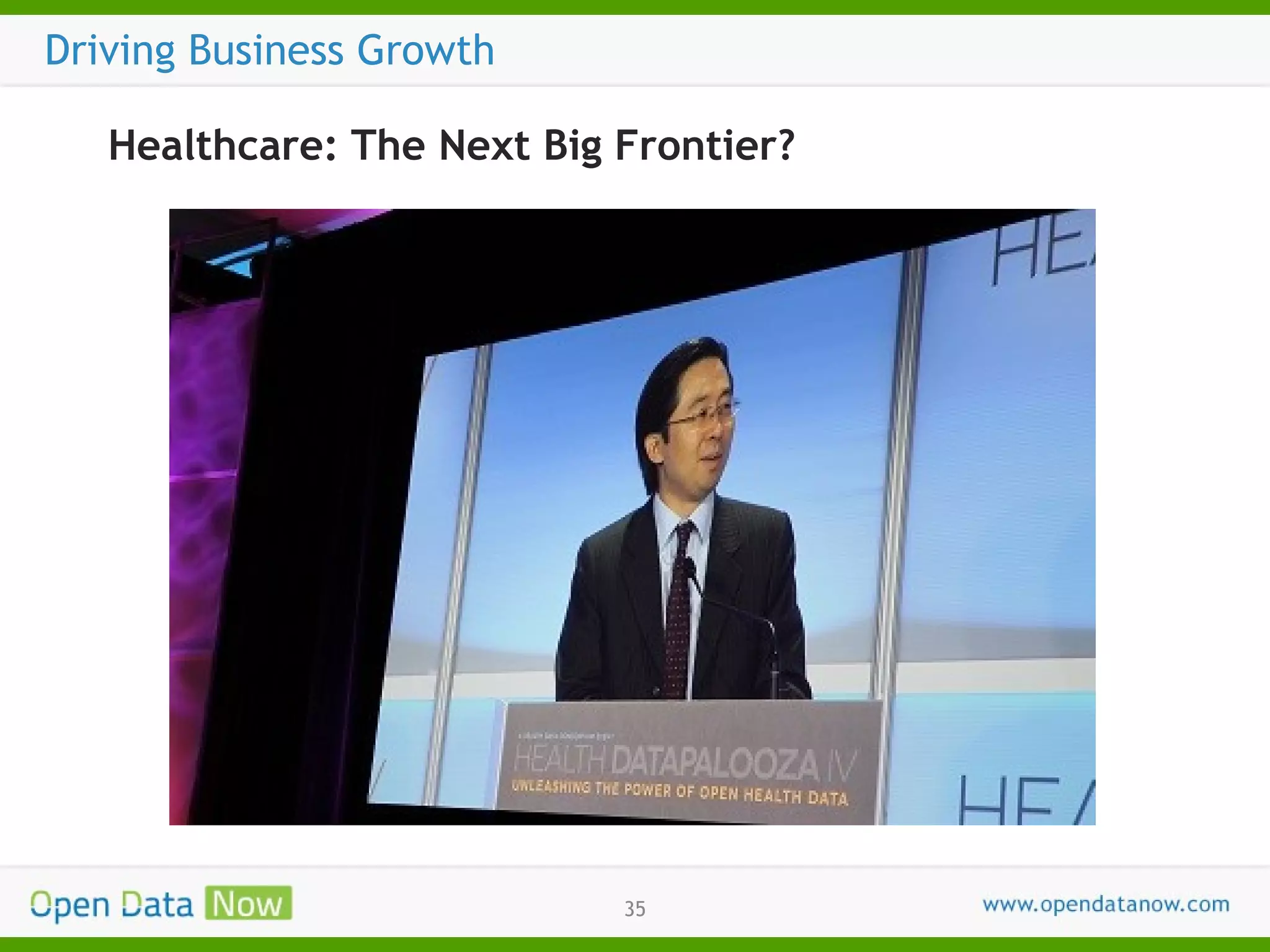
Healthcare: The Next Big Frontier?

35
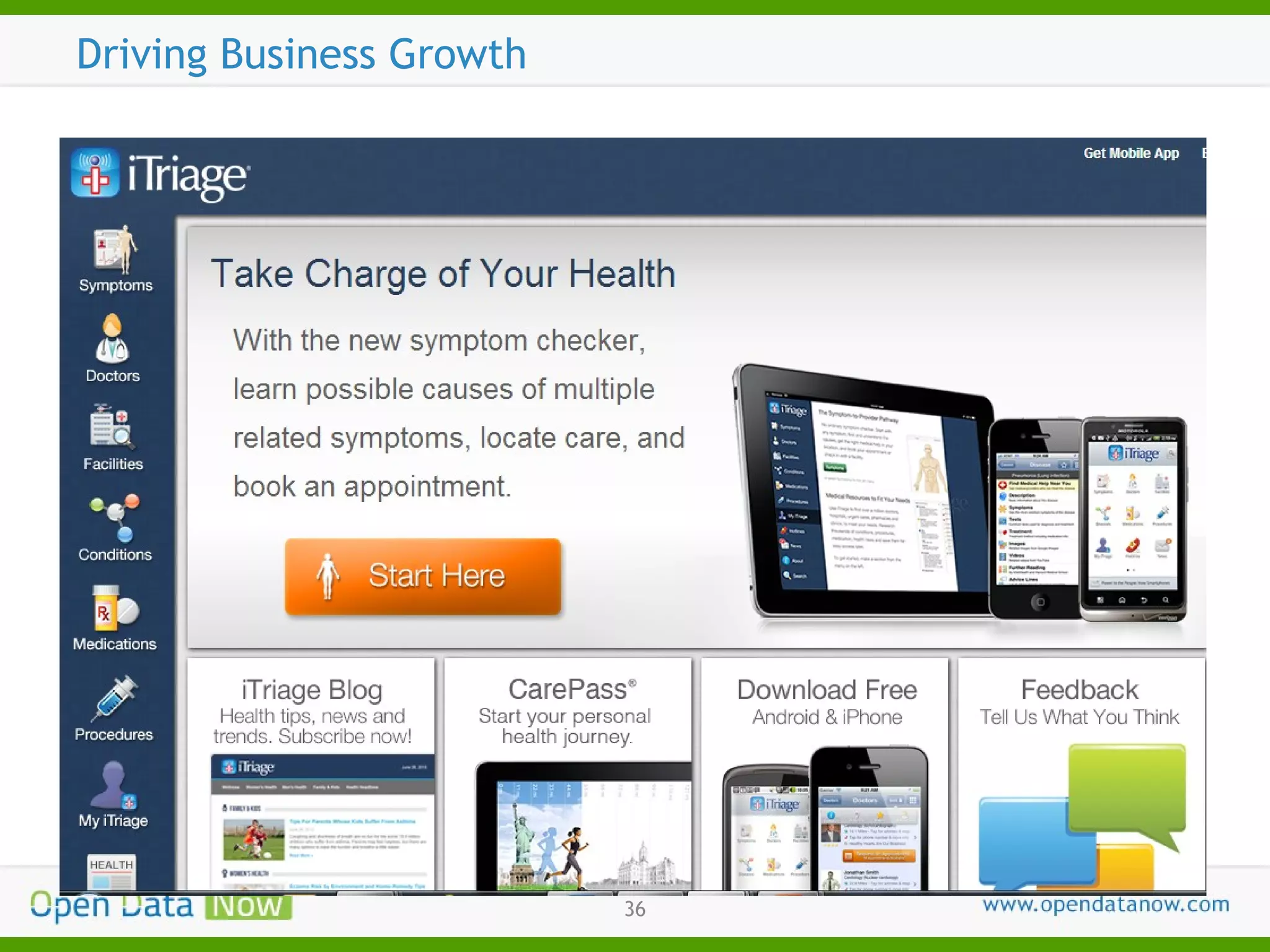
Driving Business Growth

36
Driving Business Growth
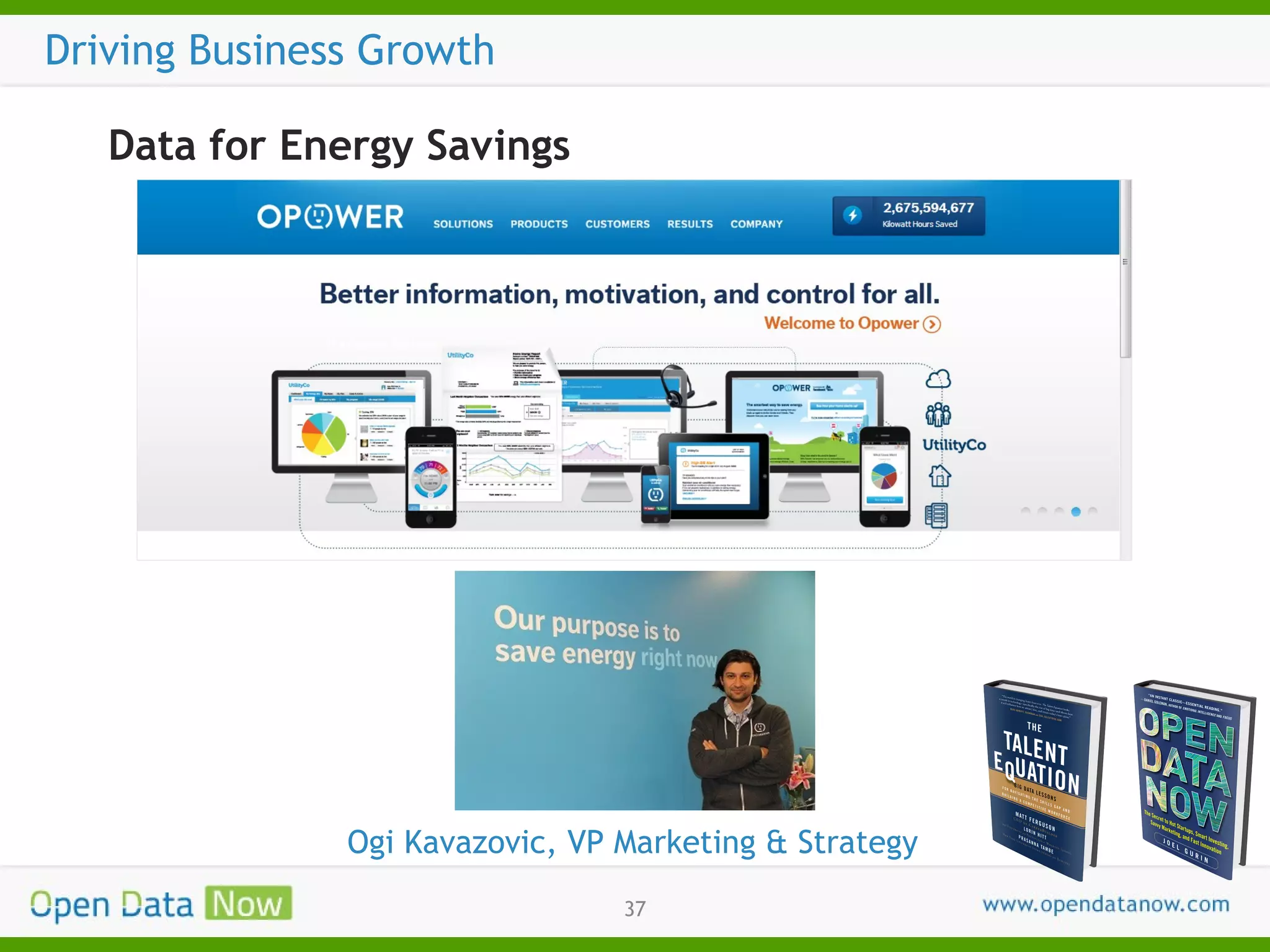
Data for Energy Savings

Ogi Kavazovic, VP Marketing & Strategy
37
Driving Business Growth
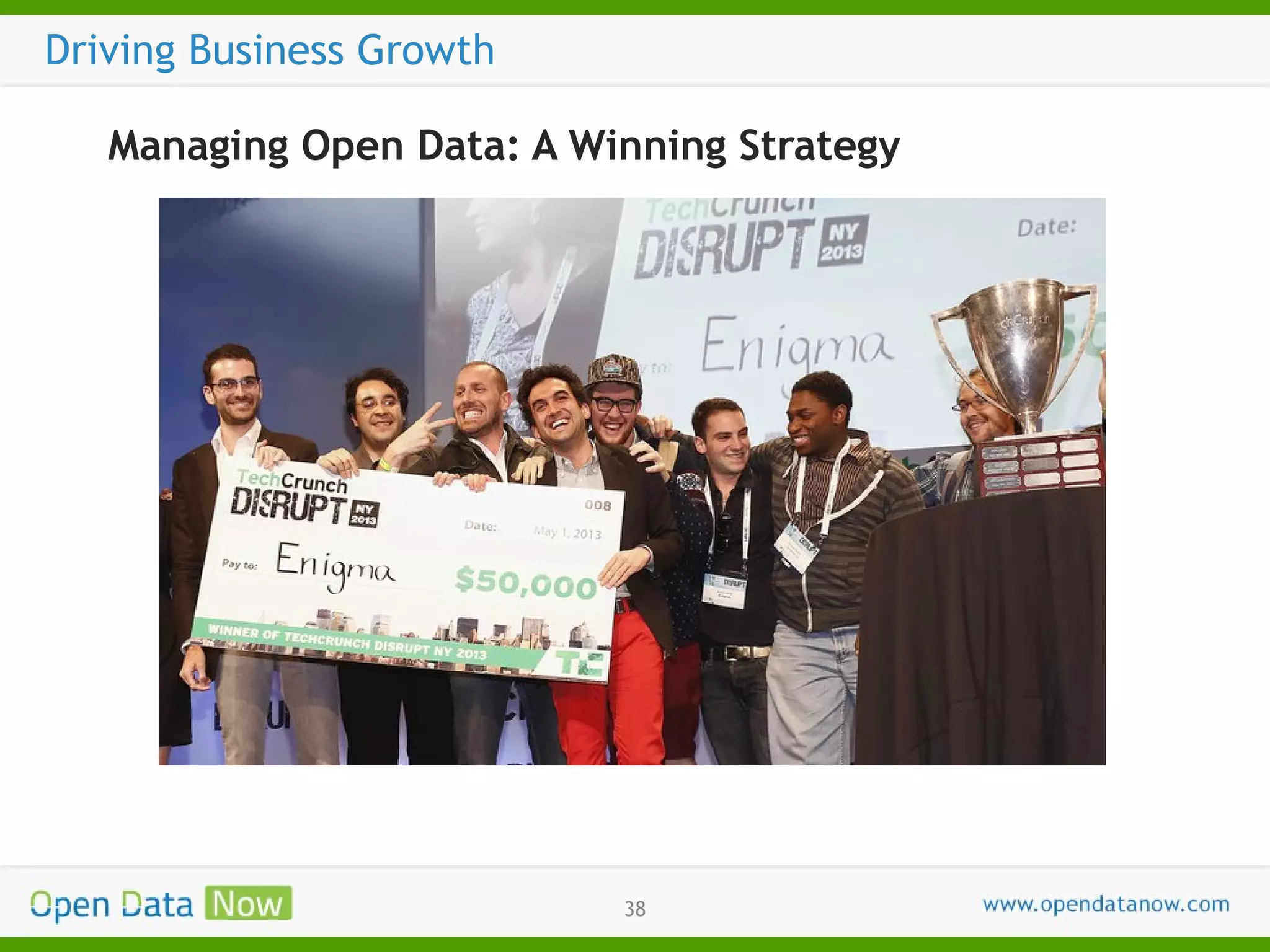
Managing Open Data: A Winning Strategy

38
Finding the Value: The Open Data 500
Open Data 500
What’s the Value of Open Data?
•
•
•
•
•
•

McKinsey study: $3 trillion annually worldwide
30 to 140 billion euros for Europe’s public sector data
2 to 9 billion British pounds
$30 billion for U.S. weather data
Tens of billions for U.S. GPS data
Hundreds of billions for U.S. health data

40
Open Data 500

41
Open Data 500
Open Data 500: Assessing the Value Rigorously
• Criteria:
– U.S. based
– National or regional scale (mostly federal data)
– Open Data must be key to business

•
•
•
•

More than 500 companies contacted so far
Wide range of sectors covered
Partnering with Open Data Institute to replicate in the U.K.
Interest from 15 other countries at Open Government
Partnership

www.OpenData500.com
42
Open Data 500

43
Big Data and HR
Prasanna Tambe
NYU Stern School of Business
ptambe@stern.nyu.edu
Leading with Data:
Boost Your ROI with Open and Big Data
February 26, 2014
Existing sources of HR data
•

Data collected during recruiting, hiring
•

•

Data routinely collected by organizations
•

•

employment histories (resumes), skills, interview and test
evaluations

performance reviews, task and project evaluations

Administrative labor market data
•

regional and industry data on skills, wages, occupations
But “digital breadcrumbs” are creating a data
revolution
(courtesy Erik Brynjolfsson)

Clickstream/Page views/Web transactions
Email messages
Mobile phone/GPS/Location data
Web links/Blog references/Facebook
Google/Bing/Yahoo Searches
ERP/CRM/SCM transactions
RFID (Radio Frequency Identification), Bar Code
Data
Real-time machinery diagnostics/engines/equipment
Stock market transactions
Twitter feeds
Wikipedia updates
Online Databases of resumes
Emerging sources of HR and workforce data
•

Online/Internet data
•

•

Digital traces from work activities
•

•

internal knowledge boards, internal corporate network activity, finegrained measures of project and task performance

Social and physical network data
•

•

labor market level information on skills and experience, discussion board
posts, software and projects posted online

employee referrals, person-to-person communications, sociometric
badges, email networks, internal digital chatter, video and camera data

Data generated through new assessment tools
•

online assessment (e.g. MOOCs), test-based video games
Vast increase on data on spatial and temporal
movements
•

Micro-measurement of personal productivity

•

Team productivity

•

Organizational productivity
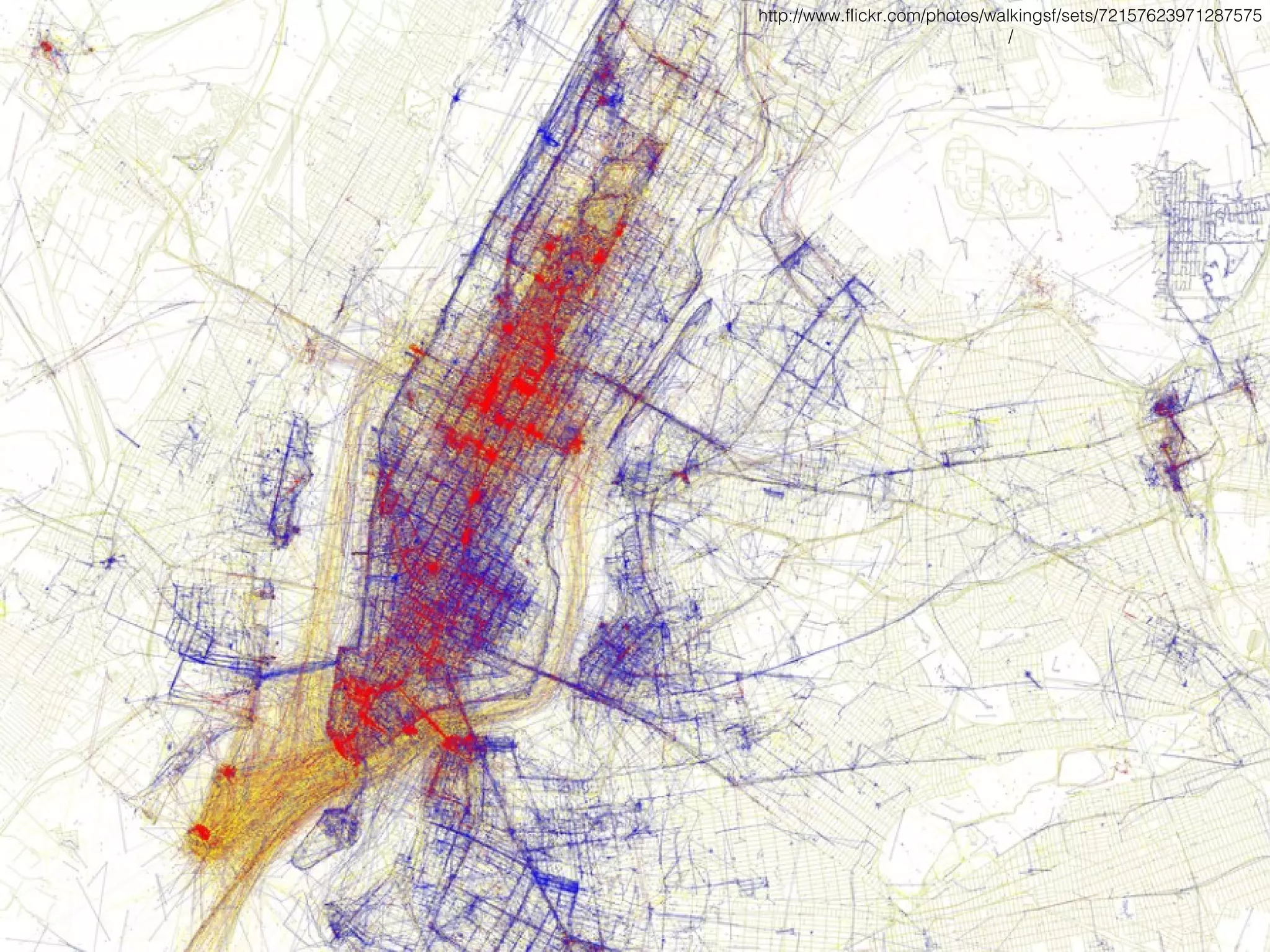
http://www.flickr.com/photos/walkingsf/sets/72157623971287575
/
How can the big data "microscope" aid
workforce related decisions?
•

Remove cognitive biases and reliance on intuition
• W don't know what makes us productive (especially
e
information workers)

•

Enables quantification of the impact of HR-related decisions
•

W is our inability to retain engineers costing us?
hat
How are employers using analytics?
now

near future?

•

Predicting retention/turnover
for high-skill employees

•

Where are we likely to have skill
gaps in ten years?

•

How desk location affects
information flows

•

What is the return on investment
to a specific HR policy?

•

Using internal communications
to predict employee
performance

•

Can applicant profiles based on
Internet data outperform
traditional 'signals' (e.g.
education)?

•

What (other) job titles predict
success in the opening I am
trying to fill?
Lessons learned (so far)

•

Data is not a substitute for conceptualization

•

Knowing the right questions to ask (domain expertise) is
critically important

•

The interest in analytics is likely to outpace results in the
short-run as employers put the right pieces in place

•

But we are likely to see a significant increase in the number
of ways data is used for HR-related decision-making within a
few years
Potential barriers to using analytics

•

A new generation of technical and analytic
skills

•

Collection and management of new data
sources

•

Policies regarding data collection and use
(privacy)
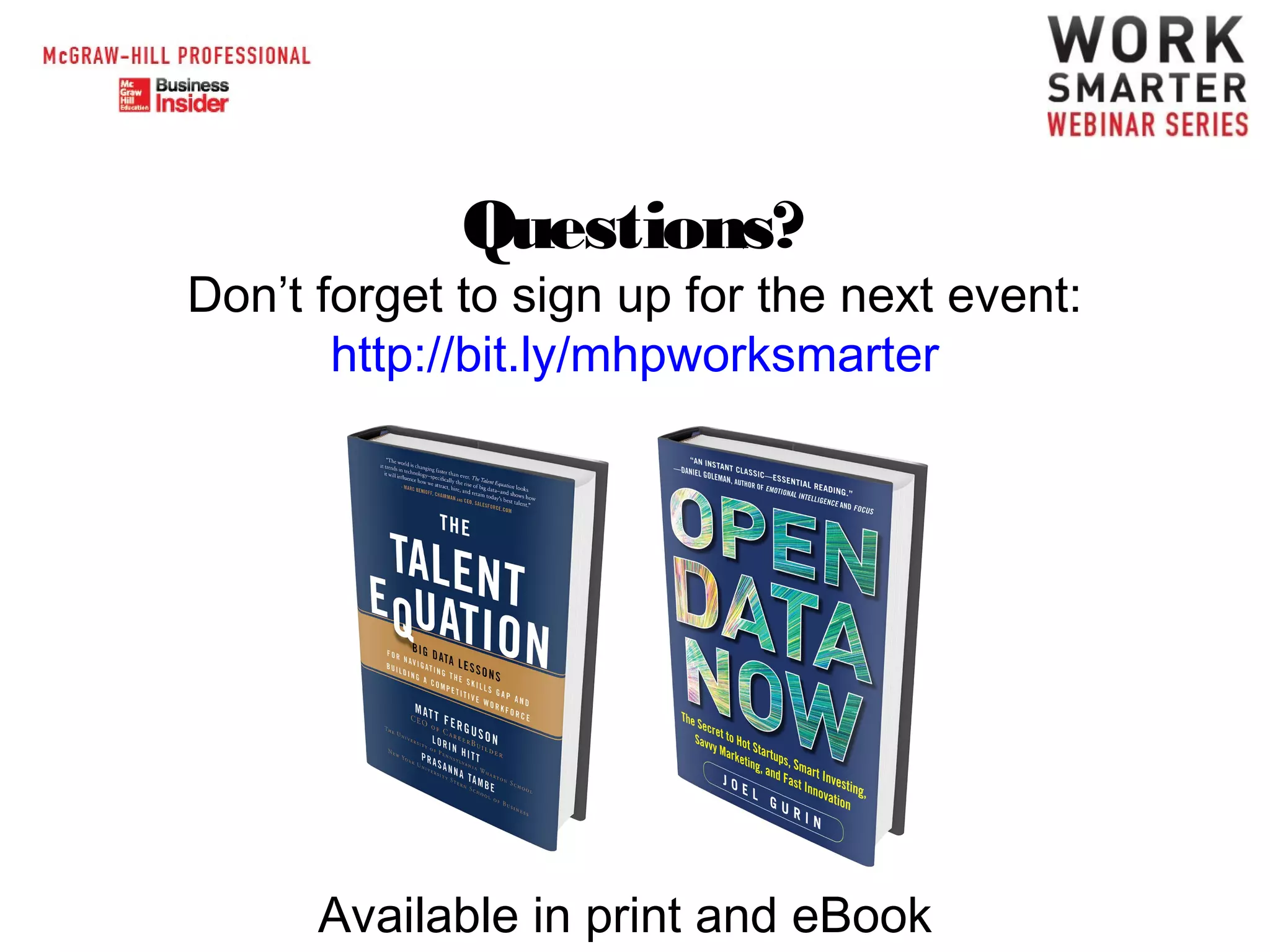
Questions?

Don’t forget to sign up for the next event:
http://bit.ly/mhpworksmarter

Available in print and eBook

Leading with Data: Boost Your ROI with Open and Big Data

  • 1.
    Leading with Data: BoostYour ROI with Open and Big Data Join the conversation with @MHBusiness @sonnytambe @JoelGurin Use #worksmarter
  • 2.
  • 3.
    Find me atOpenDataNow.com and @joelgurin 3
  • 4.
    Setting the Stage MyJourney Through the Datasphere 4
  • 5.
    Setting the Stage TheGovLab’s Central Hypothesis When governments and institutions open themselves to diverse participation and collaborative problem-solving, and partner with citizens to make decisions, they are more effective and legitimate.
  • 6.
    Setting the Stage OpenData: Accessible, public data that people, companies, and organizations can use to launch new ventures, analyze patterns and trends, make data-driven decisions, and solve complex problems. 6
  • 7.
    Setting the Stage OpenData Changes the World For: • • • • • • • Entrepreneurs Established businesses Governments Investors Scientists Journalists Consumers 7
  • 8.
    Setting the Stage WhatOpen Data Isn’t • Big Data ≠ Open Data ≠ Open Government • Big Data: Really, really big datasets • Open Government: Transparency, participation, collaboration – with or without data 8
  • 9.
  • 10.
  • 11.
    Federal Data Open DataBecomes a Priority [Open Data is] going to help launch more businesses. . . . It’s going to help more entrepreneurs come up with products and services that we haven’t even imagined yet. President Barack Obama 11
  • 12.
  • 13.
    Federal Data The NewOpen Data Policy • • • • • “Presumption of openness” Machine-readable Reusable Timely Developed with consultation 13
  • 14.
    Federal Data They AgreeOn – The DATA Act 14
  • 15.
  • 16.
    State and CityData Help for K-12 Households Bill Jackson, CEO 16
  • 17.
  • 18.
    Data-Driven Cities How WiredCities Use New Data •Optimize operations •Monitor infrastructure conditions •Plan infrastructure •Public health •Emergency management 18
  • 19.
    State and CityData • • • • Metro Chicago Data New York: The Mayor’s Geek Squad Code for Philly Palo Alto’s open finances 19
  • 20.
    State and CityData City Data: Next Bus for Commuters
  • 21.
    State and CityData Sim City Meets Participatory Budgeting
  • 22.
    State and CityData DC’s Experiment: A City Report Card Washington Mayor Vincent Gray 22
  • 23.
    State and CityData • Sharing personal data for public good • Pulse Point: “Enabling Citizen Superheroes” 23
  • 24.
    Open Data ShapesReputation and Brands
  • 25.
    Reputation and Brands SocialMedia: 2 Billion Tweets a Week 25
  • 26.
    Reputation and Brands TheReputation Police Michael Fertik, CEO 26
  • 27.
    Reputation and Brands SentimentAnalysis: Emotion Meets Computation 27
  • 28.
    Reputation and Brands OpenData from Consumer Complaints Courtney Powell and A.J. Fouty, cofounders 28
  • 29.
  • 30.
  • 31.
  • 32.
    Driving Business Growth OpenData Fuels Businesses in All Sectors Health Education Financial Services Energy Use Transportation 32
  • 33.
    Driving Business Growth FromWeather Insurance to Green Revolution Climate Corporation offices in San Francisco 33
  • 34.
    Driving Business Growth 40KPublic Companies, Updated Daily 34
  • 35.
    Driving Business Growth Healthcare:The Next Big Frontier? 35
  • 36.
  • 37.
    Driving Business Growth Datafor Energy Savings Ogi Kavazovic, VP Marketing & Strategy 37
  • 38.
    Driving Business Growth ManagingOpen Data: A Winning Strategy 38
  • 39.
    Finding the Value:The Open Data 500
  • 40.
    Open Data 500 What’sthe Value of Open Data? • • • • • • McKinsey study: $3 trillion annually worldwide 30 to 140 billion euros for Europe’s public sector data 2 to 9 billion British pounds $30 billion for U.S. weather data Tens of billions for U.S. GPS data Hundreds of billions for U.S. health data 40
  • 41.
  • 42.
    Open Data 500 OpenData 500: Assessing the Value Rigorously • Criteria: – U.S. based – National or regional scale (mostly federal data) – Open Data must be key to business • • • • More than 500 companies contacted so far Wide range of sectors covered Partnering with Open Data Institute to replicate in the U.K. Interest from 15 other countries at Open Government Partnership www.OpenData500.com 42
  • 43.
  • 44.
    Big Data andHR Prasanna Tambe NYU Stern School of Business ptambe@stern.nyu.edu Leading with Data: Boost Your ROI with Open and Big Data February 26, 2014
  • 45.
    Existing sources ofHR data • Data collected during recruiting, hiring • • Data routinely collected by organizations • • employment histories (resumes), skills, interview and test evaluations performance reviews, task and project evaluations Administrative labor market data • regional and industry data on skills, wages, occupations
  • 46.
    But “digital breadcrumbs”are creating a data revolution (courtesy Erik Brynjolfsson) Clickstream/Page views/Web transactions Email messages Mobile phone/GPS/Location data Web links/Blog references/Facebook Google/Bing/Yahoo Searches ERP/CRM/SCM transactions RFID (Radio Frequency Identification), Bar Code Data Real-time machinery diagnostics/engines/equipment Stock market transactions Twitter feeds Wikipedia updates Online Databases of resumes
  • 47.
    Emerging sources ofHR and workforce data • Online/Internet data • • Digital traces from work activities • • internal knowledge boards, internal corporate network activity, finegrained measures of project and task performance Social and physical network data • • labor market level information on skills and experience, discussion board posts, software and projects posted online employee referrals, person-to-person communications, sociometric badges, email networks, internal digital chatter, video and camera data Data generated through new assessment tools • online assessment (e.g. MOOCs), test-based video games
  • 48.
    Vast increase ondata on spatial and temporal movements • Micro-measurement of personal productivity • Team productivity • Organizational productivity
  • 49.
  • 50.
    How can thebig data "microscope" aid workforce related decisions? • Remove cognitive biases and reliance on intuition • W don't know what makes us productive (especially e information workers) • Enables quantification of the impact of HR-related decisions • W is our inability to retain engineers costing us? hat
  • 51.
    How are employersusing analytics? now near future? • Predicting retention/turnover for high-skill employees • Where are we likely to have skill gaps in ten years? • How desk location affects information flows • What is the return on investment to a specific HR policy? • Using internal communications to predict employee performance • Can applicant profiles based on Internet data outperform traditional 'signals' (e.g. education)? • What (other) job titles predict success in the opening I am trying to fill?
  • 52.
    Lessons learned (sofar) • Data is not a substitute for conceptualization • Knowing the right questions to ask (domain expertise) is critically important • The interest in analytics is likely to outpace results in the short-run as employers put the right pieces in place • But we are likely to see a significant increase in the number of ways data is used for HR-related decision-making within a few years
  • 53.
    Potential barriers tousing analytics • A new generation of technical and analytic skills • Collection and management of new data sources • Policies regarding data collection and use (privacy)
  • 54.
    Questions? Don’t forget tosign up for the next event: http://bit.ly/mhpworksmarter Available in print and eBook

Editor's Notes

  • #45 I will plan to take about 20-25 minutes First 10 minutes on emerging types of data Last 10 minutes no how firms might use it Last 5 minutes on what employers should be thinking about Then we will shift to Q & A. TWO POINTS: Data that can be useful for HR decision-making is rapidly expanding! Some thoughts on what HR Professionals should be thinking about for a smooth transition
  • #46 Go quickly through these – there may be others, not meant to be a comprehensive list Firms already routinely use these …
  • #47 Digital traces of online activity have lead to an explosion in the availability of data of all types Great for social-science research and for data-driven decision-making. What’s new? 1. Evidence of on-the-job performance 2. Scale (hundreds of millions of observations)
  • #48 But these are new! An expanding world of data that are going to eventually be useful for HR-decision making. Useful for building applicant profiles and learning about candidates. (Privacy is important, but defer to later)
  • #49 The granularity of the data that is being recorded is the big shift here. Enables really fine-grained track of how and where and on what we are spending our time.
  • #50 An example-at the city level-of spatial and temporal mapping of people’s movements. Used the city level because it’s easy to visualize. Huge boon for urban planners and designers. Why can’t the same thing be done for organizations or for workflow?
  • #51 1. Data helps us uncover insights about what is productive from a workflow standpoint. We don’t know how our email behavior, who we hear from, when we hear from them, message content, impact productivity, but the tools are becoming available that allow us to do that. Much of what we know relies on intuition, but much of that is wrong. This also applies to “life” productivity, not just productivity at work. 2. “you can manage what you can measure” … helps to provide economic metrics that can be useful for managerial decision-making
  • #52 The second is high-impact? What is the ROI on work-from-home? The last of these brings up an important point …. Is it good for workers?
  • #53 Without conceptualization, too much data can be a hindrance. It’s difficult to manage, and you are just awash in data. Lot of interest right now, but it may take some time to see results. This is nothing new. Technology cycles always involve a lot of upfront investment, and then 3-5 years later, results.
  • #54 (maybe skip)?