Will, joe, tom and finns A2 Coursework Production
CHOOSING OUR BRIEFWe chose brief 10, which was:A short film in its entirety, lasting approximately five minutes, which may be live action or animated or a combination of both, together with two of the following ancillary textsa poster for the filma film magazine review page featuring the film.Out of all the briefs we felt most confident doing this one, however we were perfectly aware of the challenges that lay ahead. After a week or so we had come up with the plot to our film. It was called the pop up and it was going to be about a young man who is bored at work one day when suddenly a pop up appears on his computer screen advertising that he can stop time with one click. He clicks it, not expecting anything to happen and suddenly time freezes. The rest of the film is about him having fun in the office and enjoying his new found power, however there is a dramatic twist at the end!
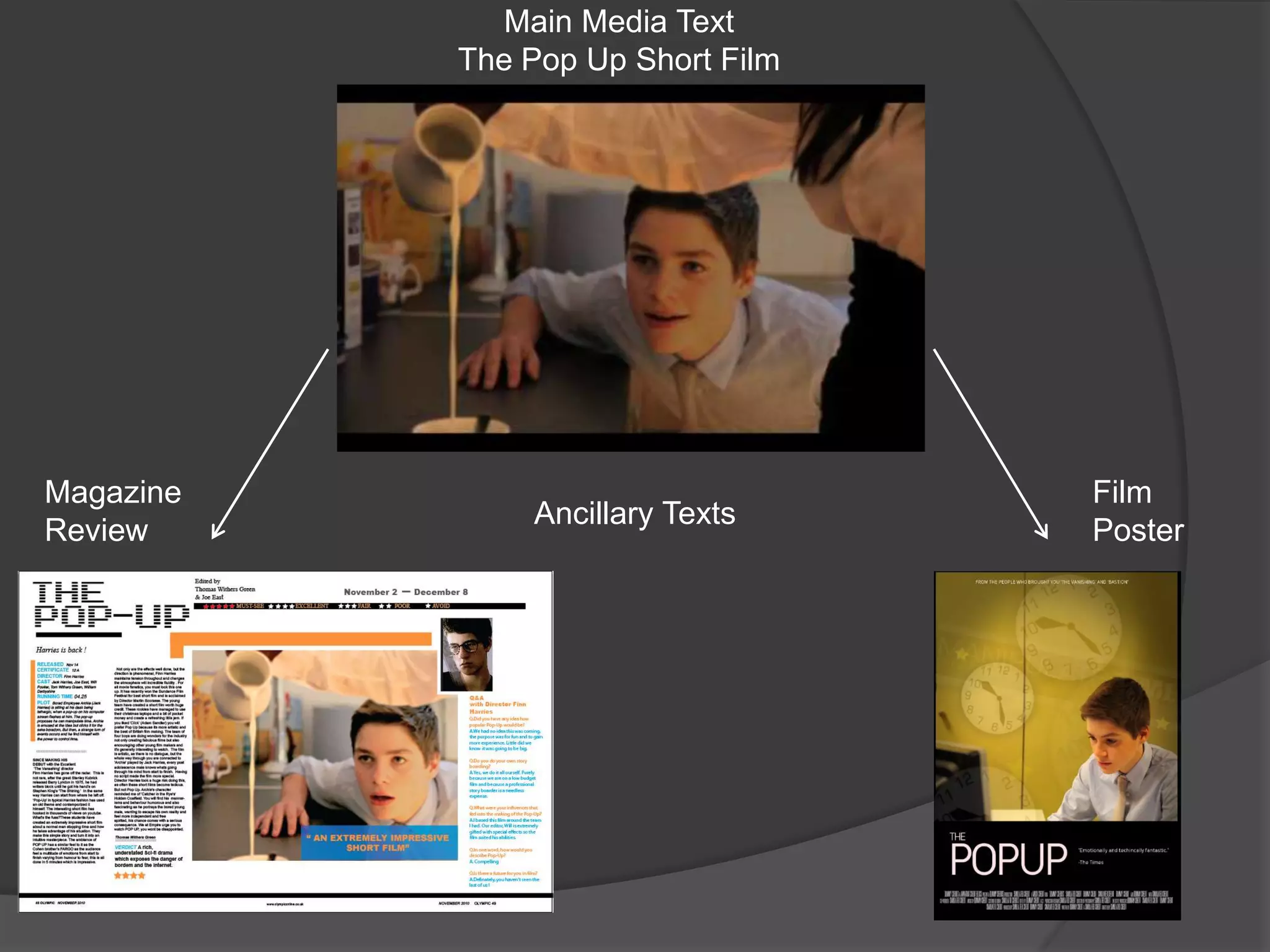
Main Media TextThe Pop Up Short FilmMagazine ReviewFilm PosterAncillary Texts
PLANNINGThe plot to our film was quite complicated. Although it was all going to be filmed inside an office with one exterior shot, the main character is constantly walking around and exploring the office while five other cast members have to keep the continuity and stay where they were when he froze time. We had to make sure we were following basic rules like not crossing the line and one of the hardest things to work out was when and how we would be applying the effect of time stopping.To carry this out in the short amount of time we had (1 day) we devised a treatment for the film which had everything in it that we felt we would need on the day. This treatment was key to the speed of filming and the level of organisation. The next couple of slides will take you through what we created as well as giving you an insight into how we made the film.
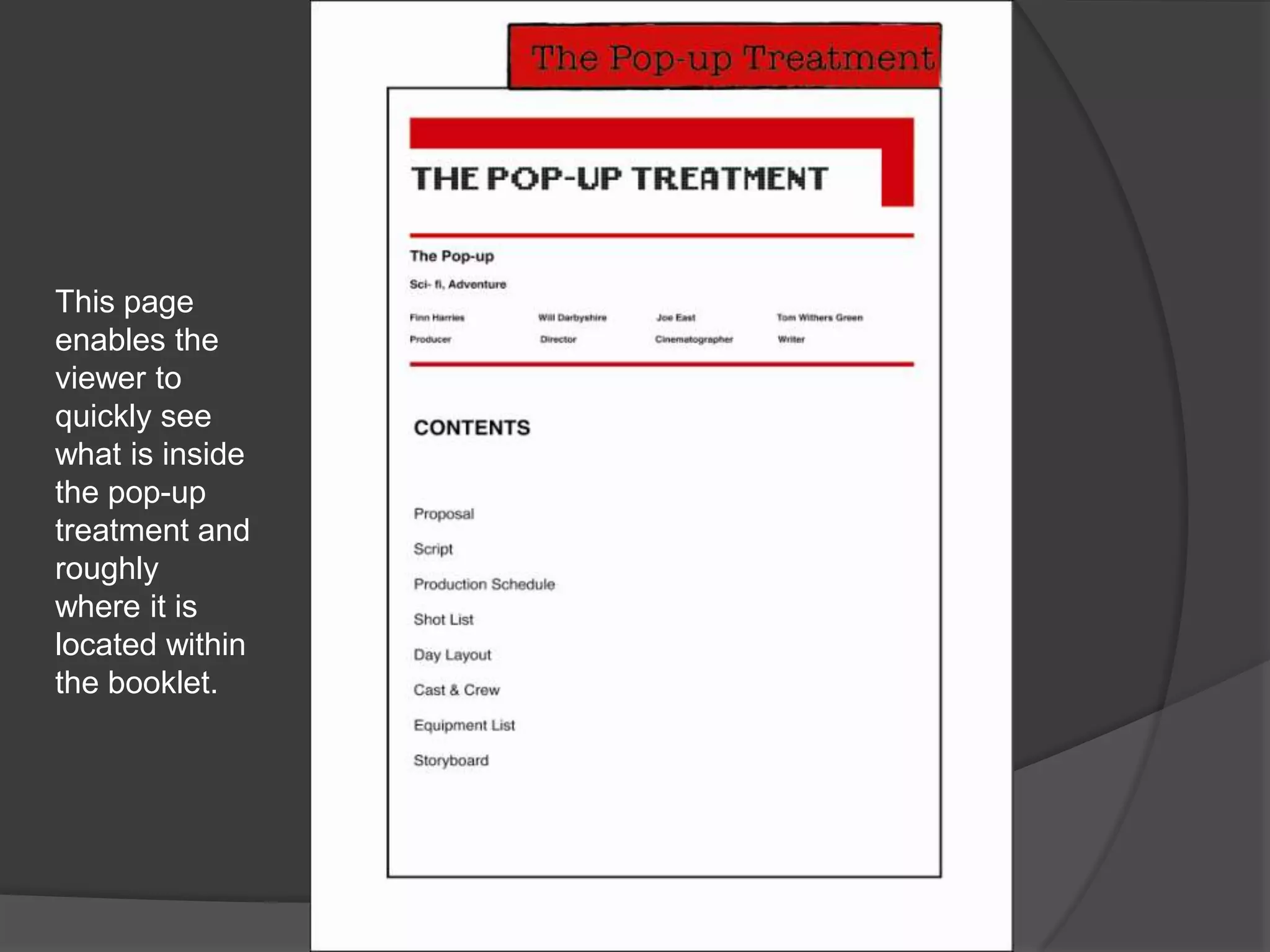
This page enables the viewer to quickly see what is inside the pop-up treatment and roughly where it is located within the booklet.
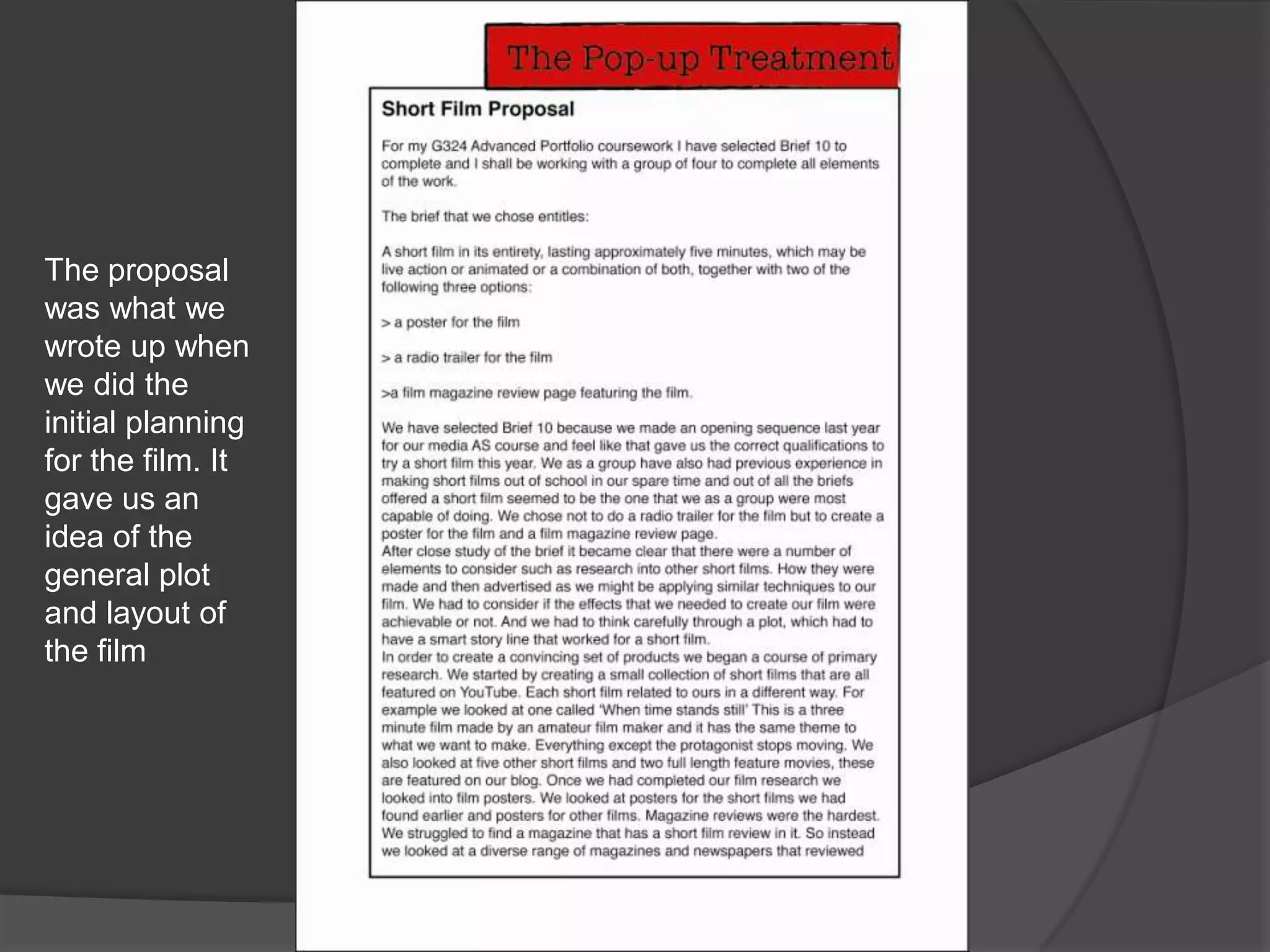
The proposal was what we wrote up when we did the initial planning for the film. It gave us an idea of the general plot and layout of the film
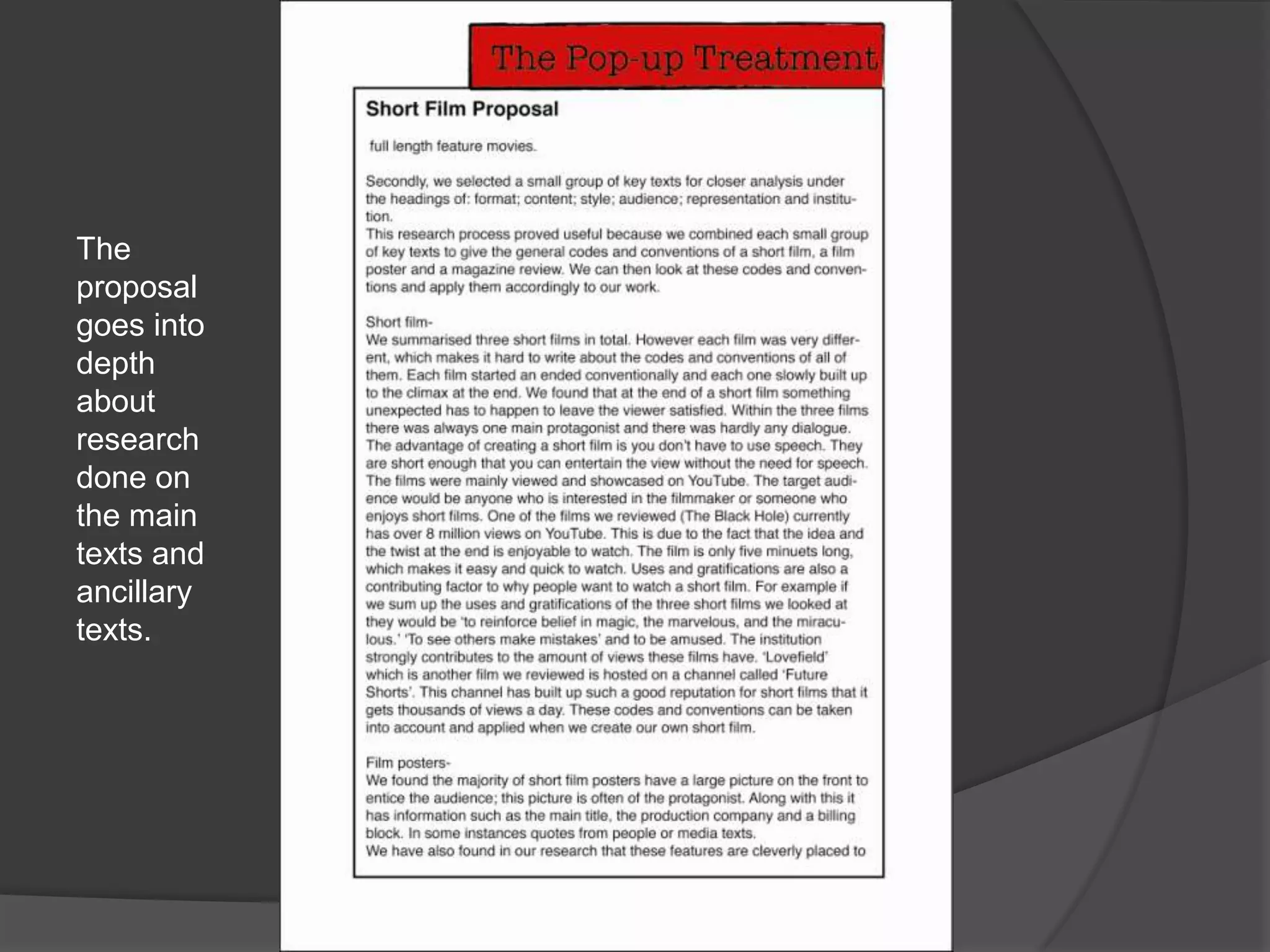
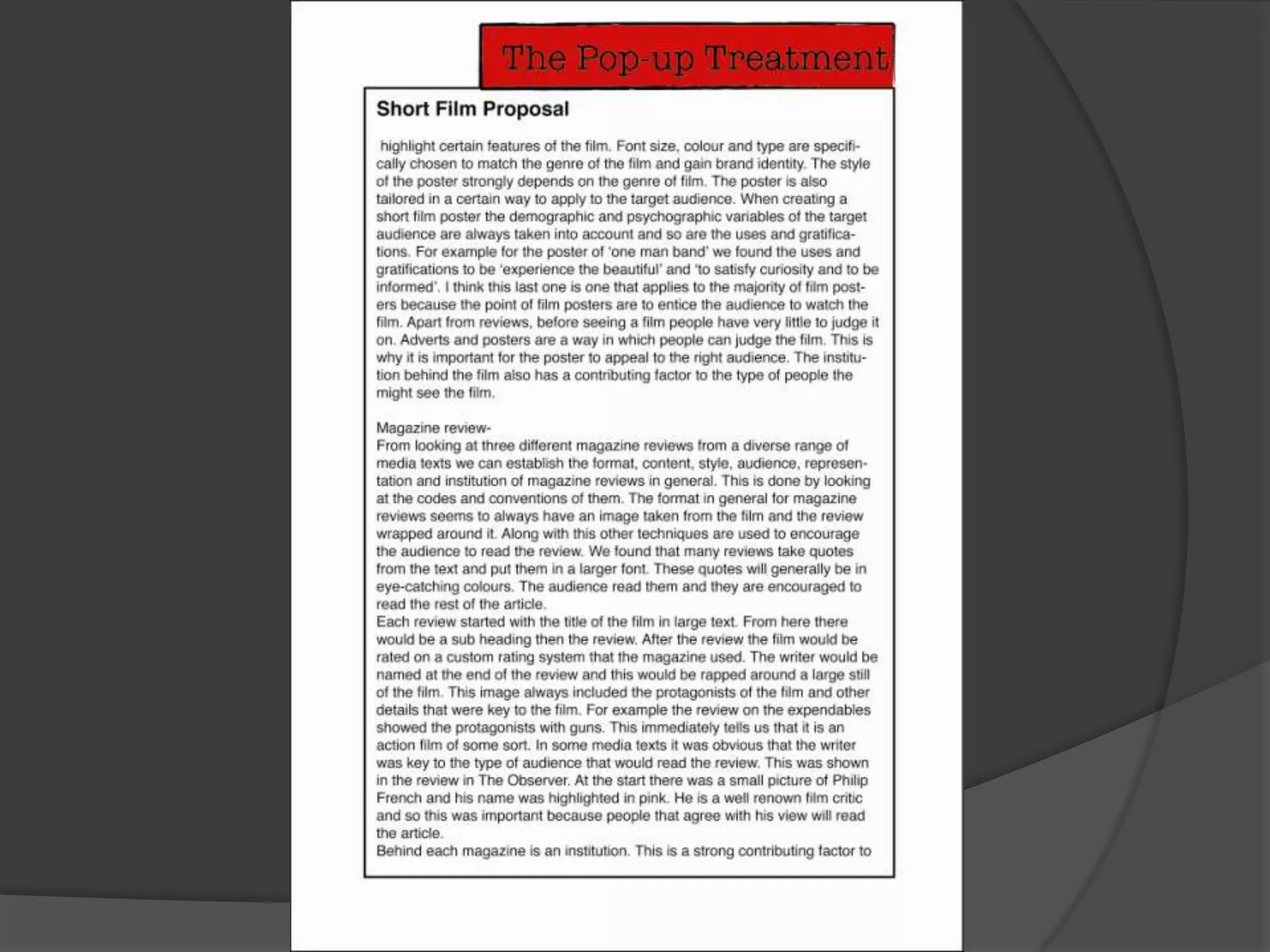
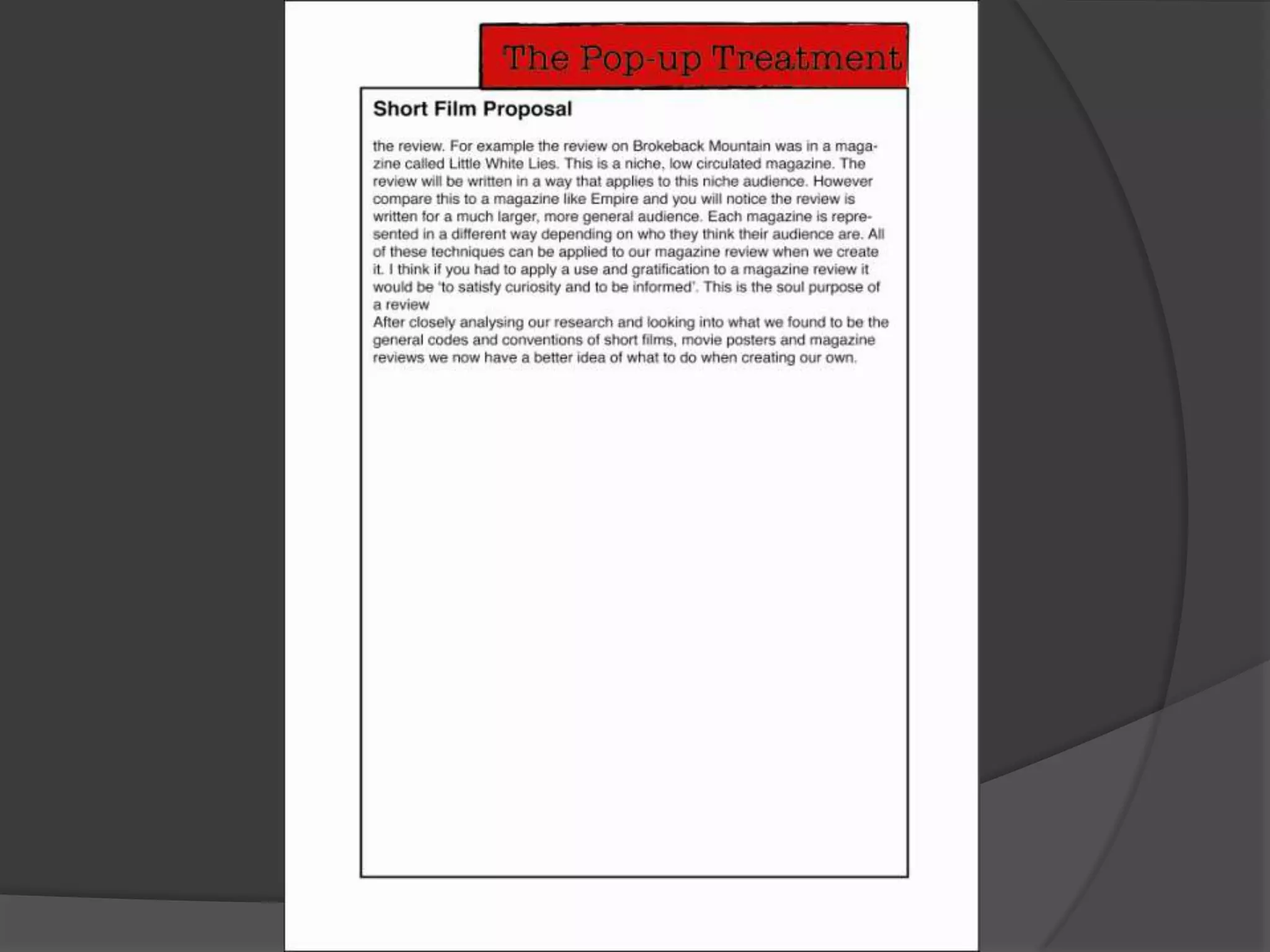
The proposal goes into depth about research done on the main texts and ancillary texts.
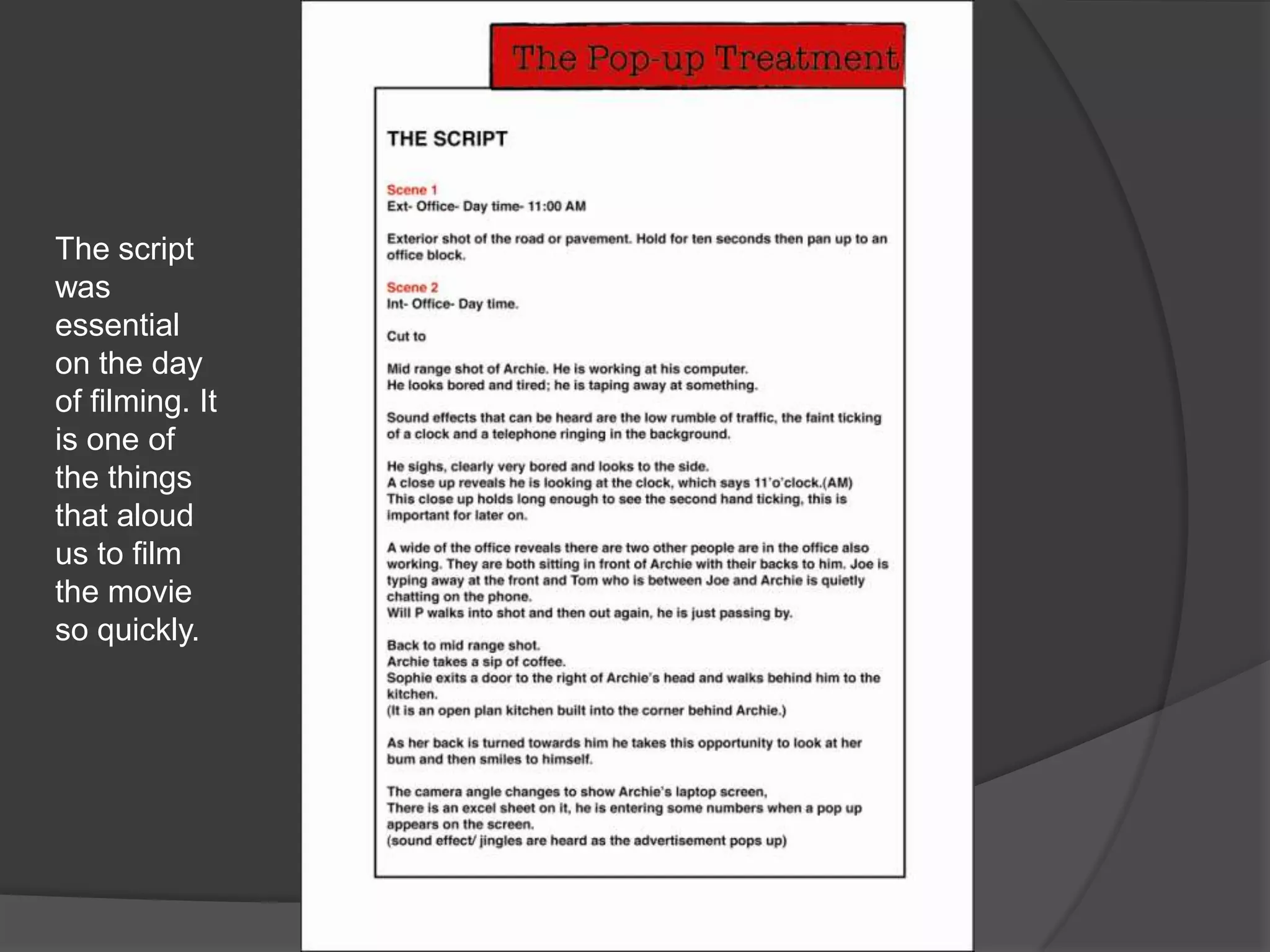
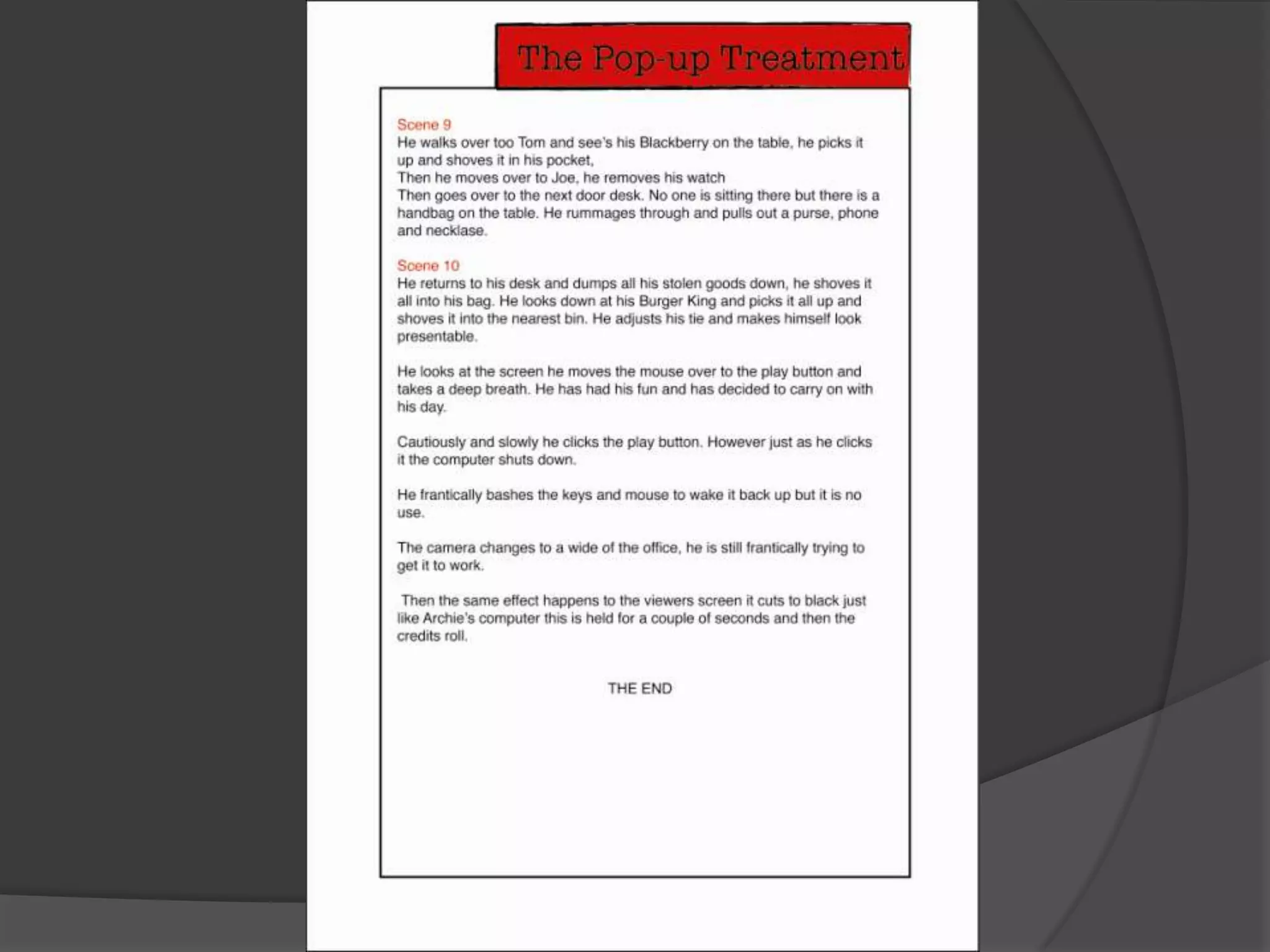
The script was essential on the day of filming. It is one of the things that aloud us to film the movie so quickly.
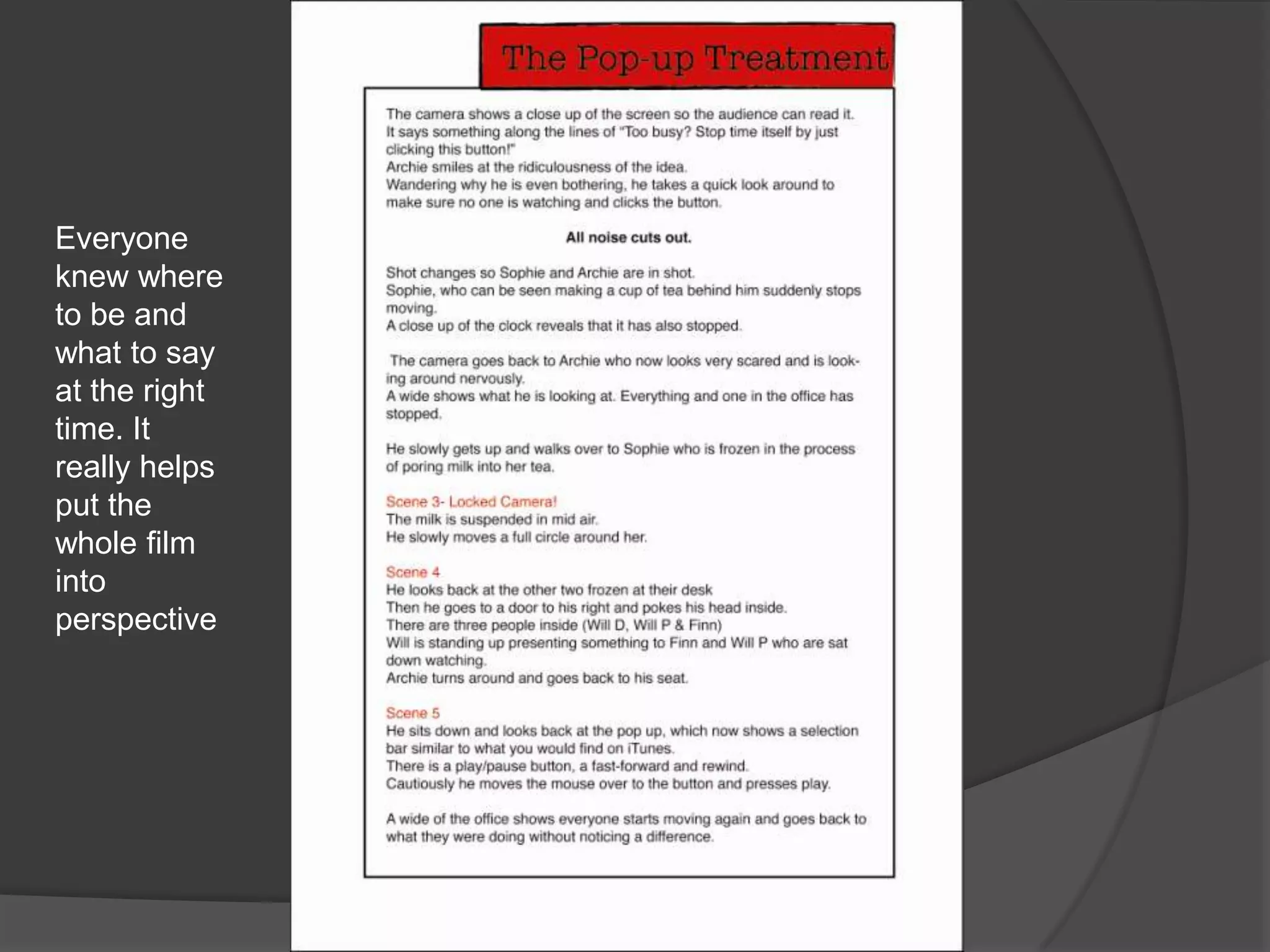
Everyone knew where to be and what to say at the right time. It really helps  put the whole film into perspective
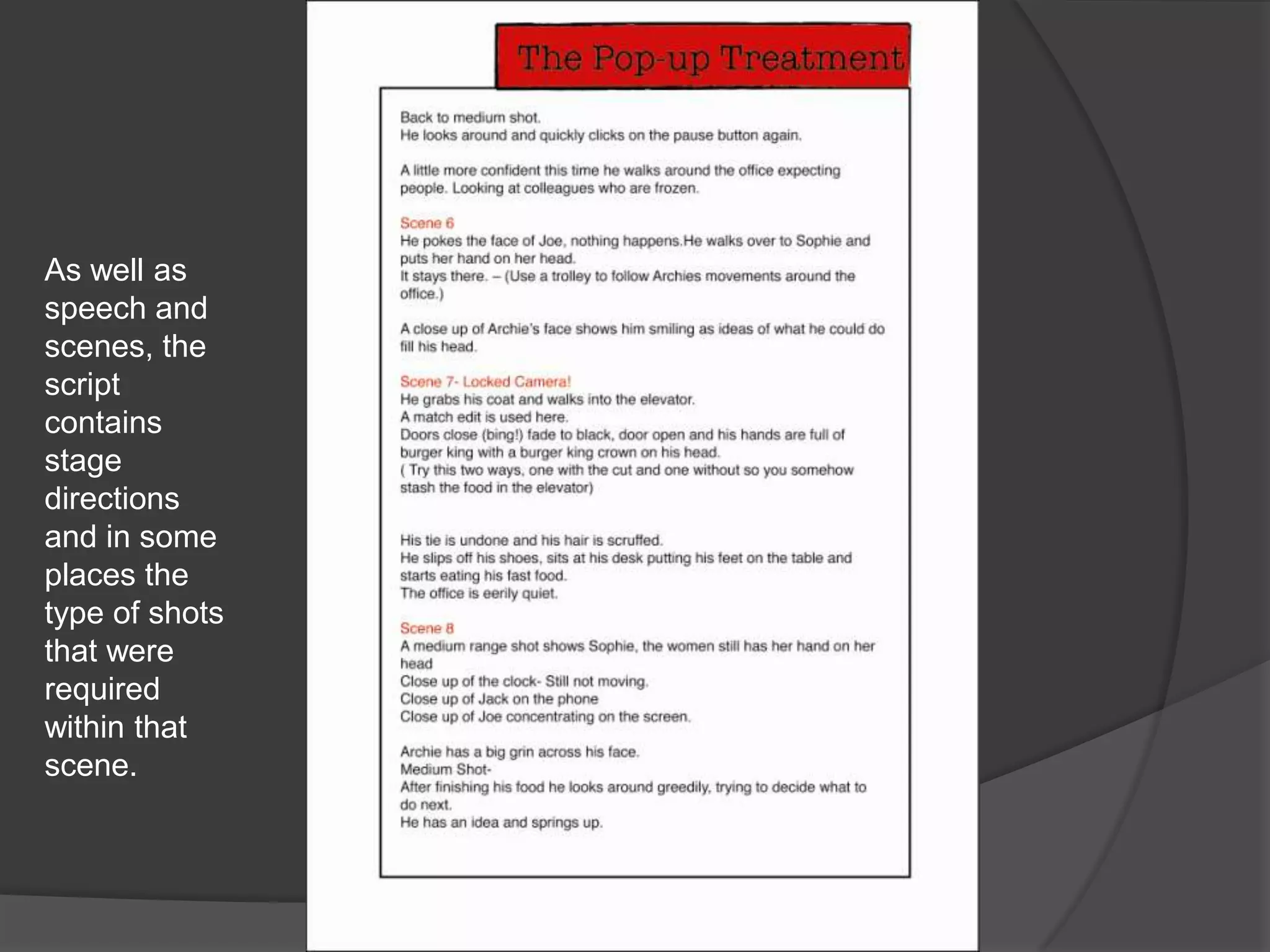
As well as speech and scenes, the script contains stage directions and in some places the type of shots that were required within that scene.
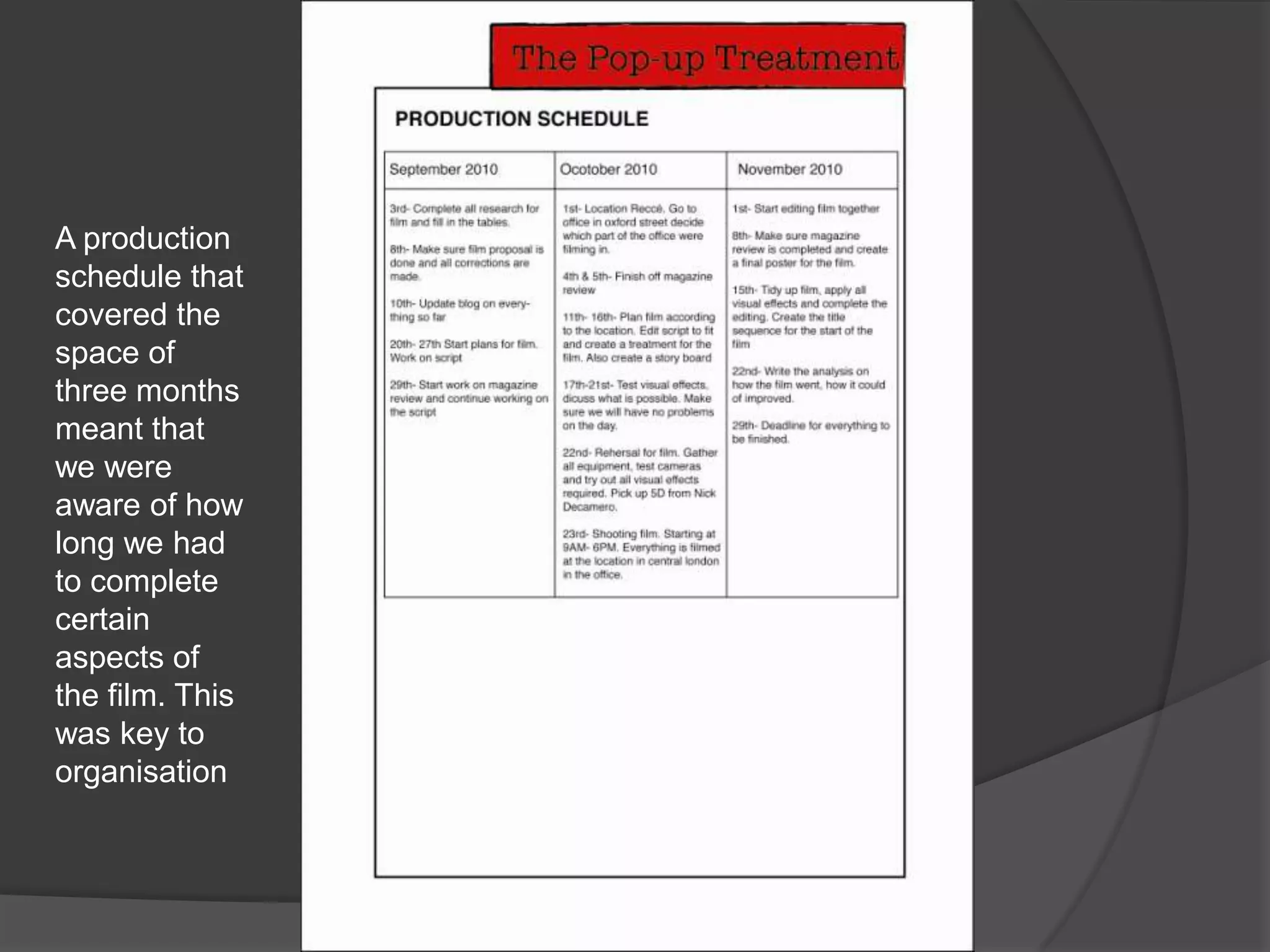
A production schedule that covered the space of three months meant that we were aware of how long we had to complete certain aspects of the film. This was key to organisation
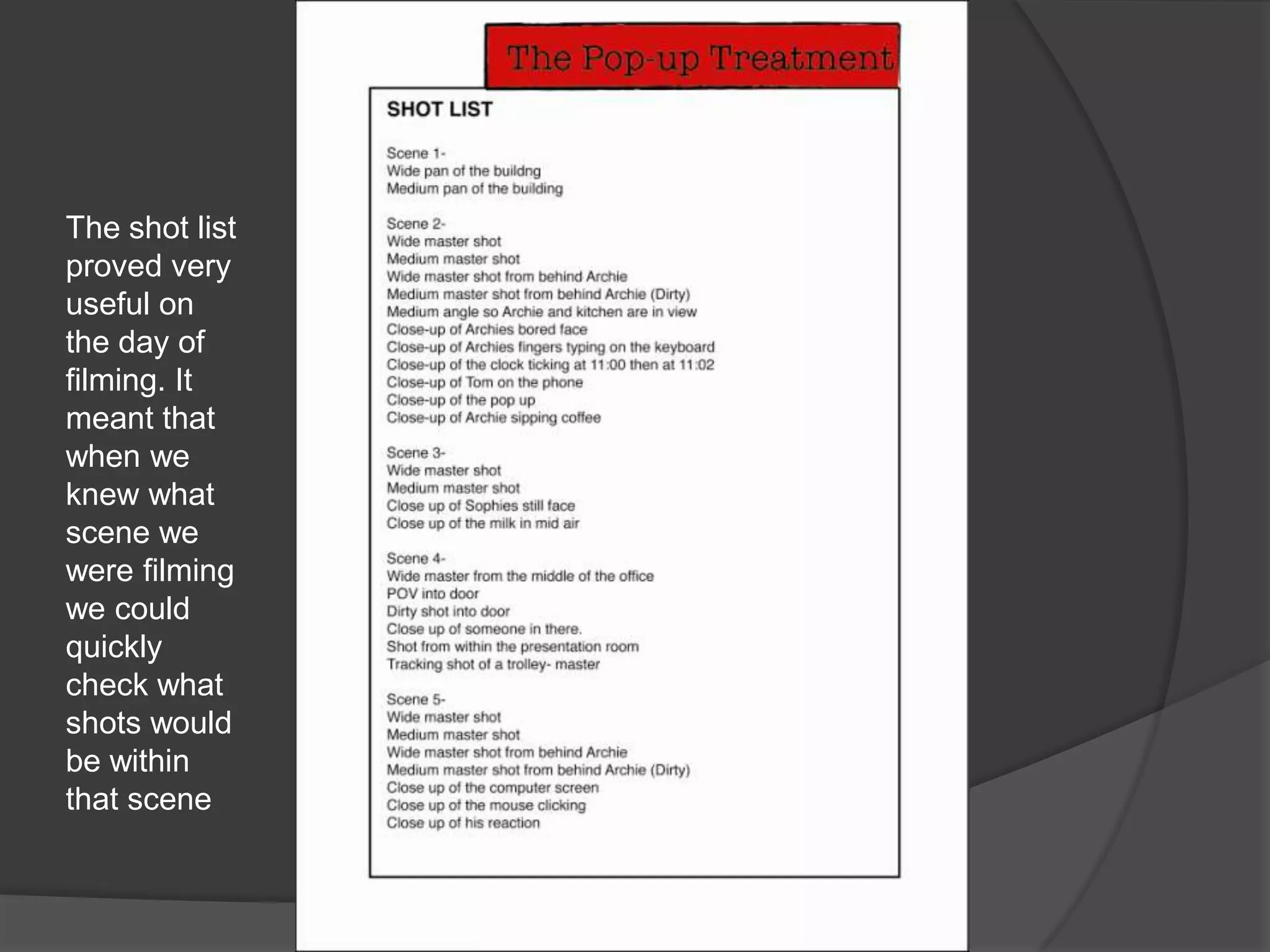
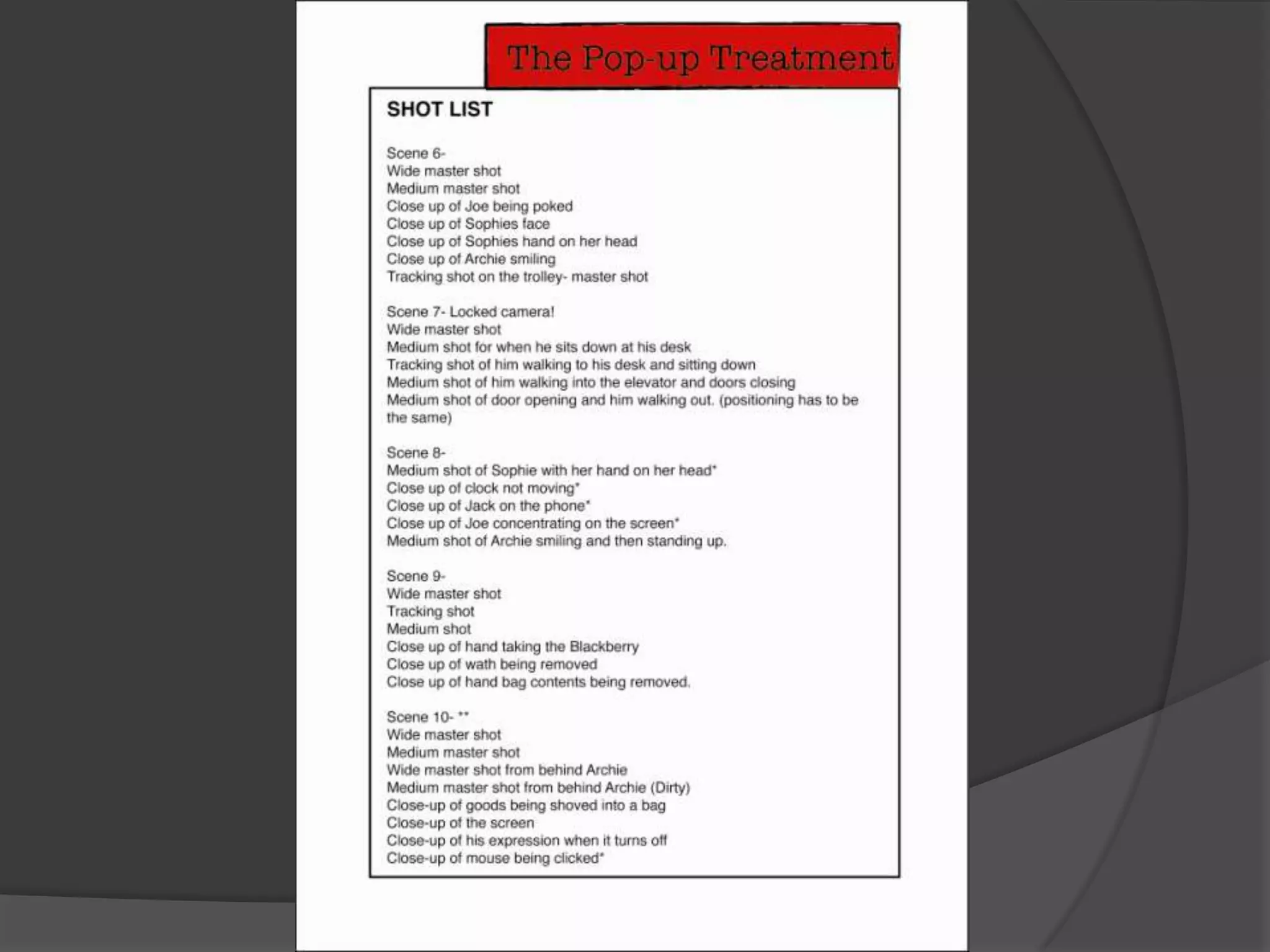
The shot list proved very useful on the day of filming. It meant that when we knew what scene we were filming we could quickly check what shots would be within that scene
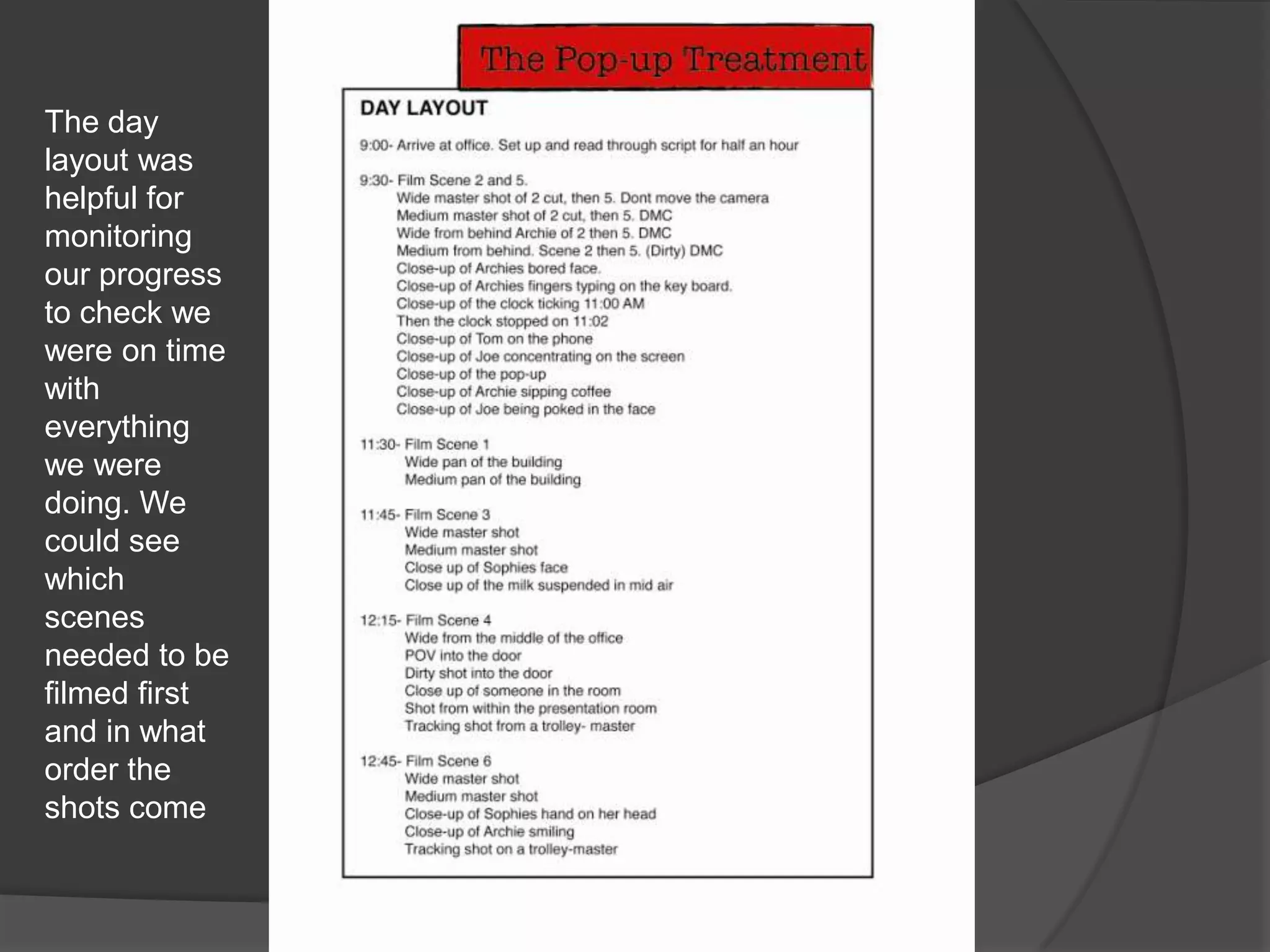
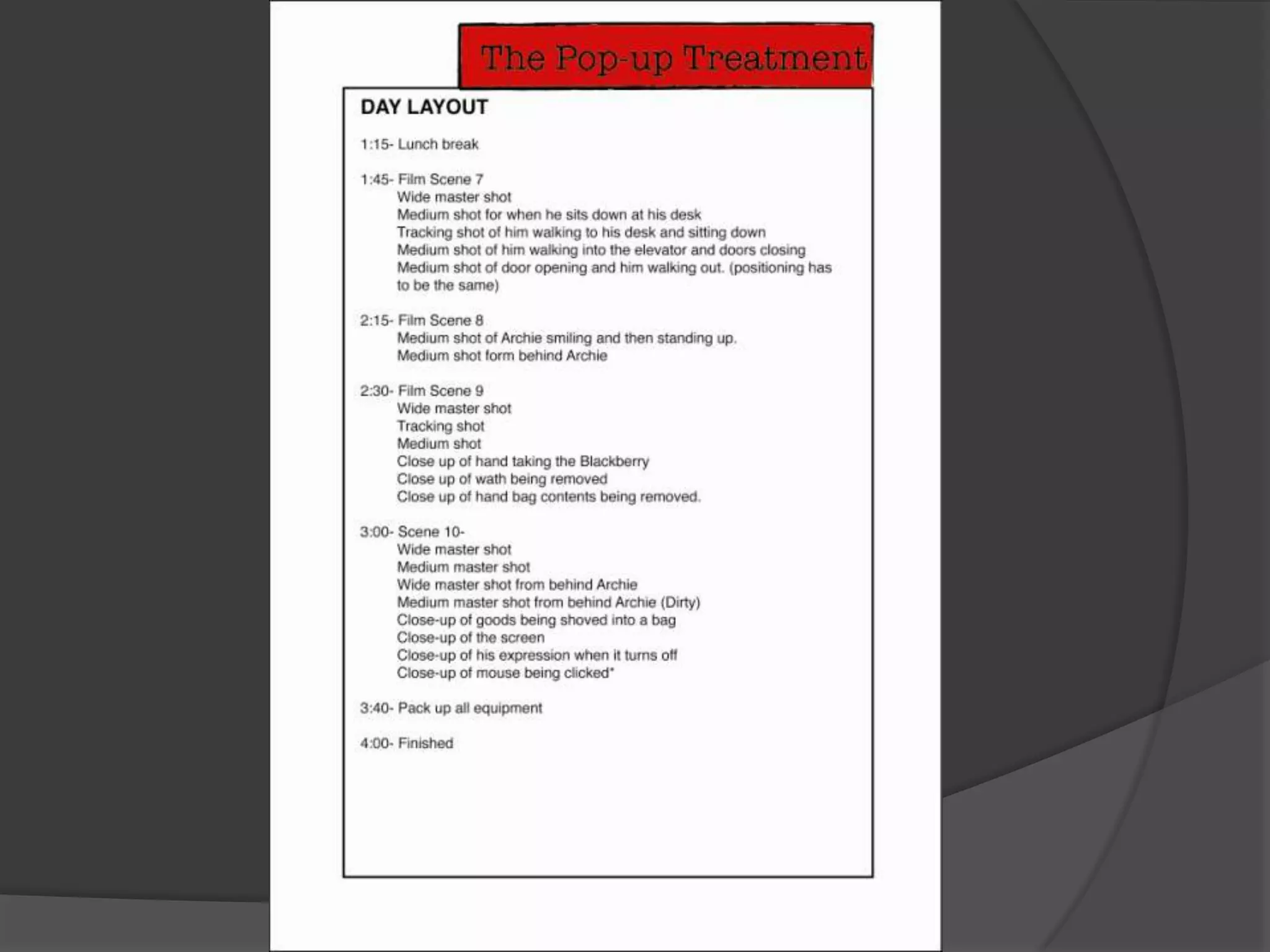
The day layout was helpful for monitoring our progress to check we were on time with everything we were doing. We could see which scenes needed to be filmed first and in what order the shots come
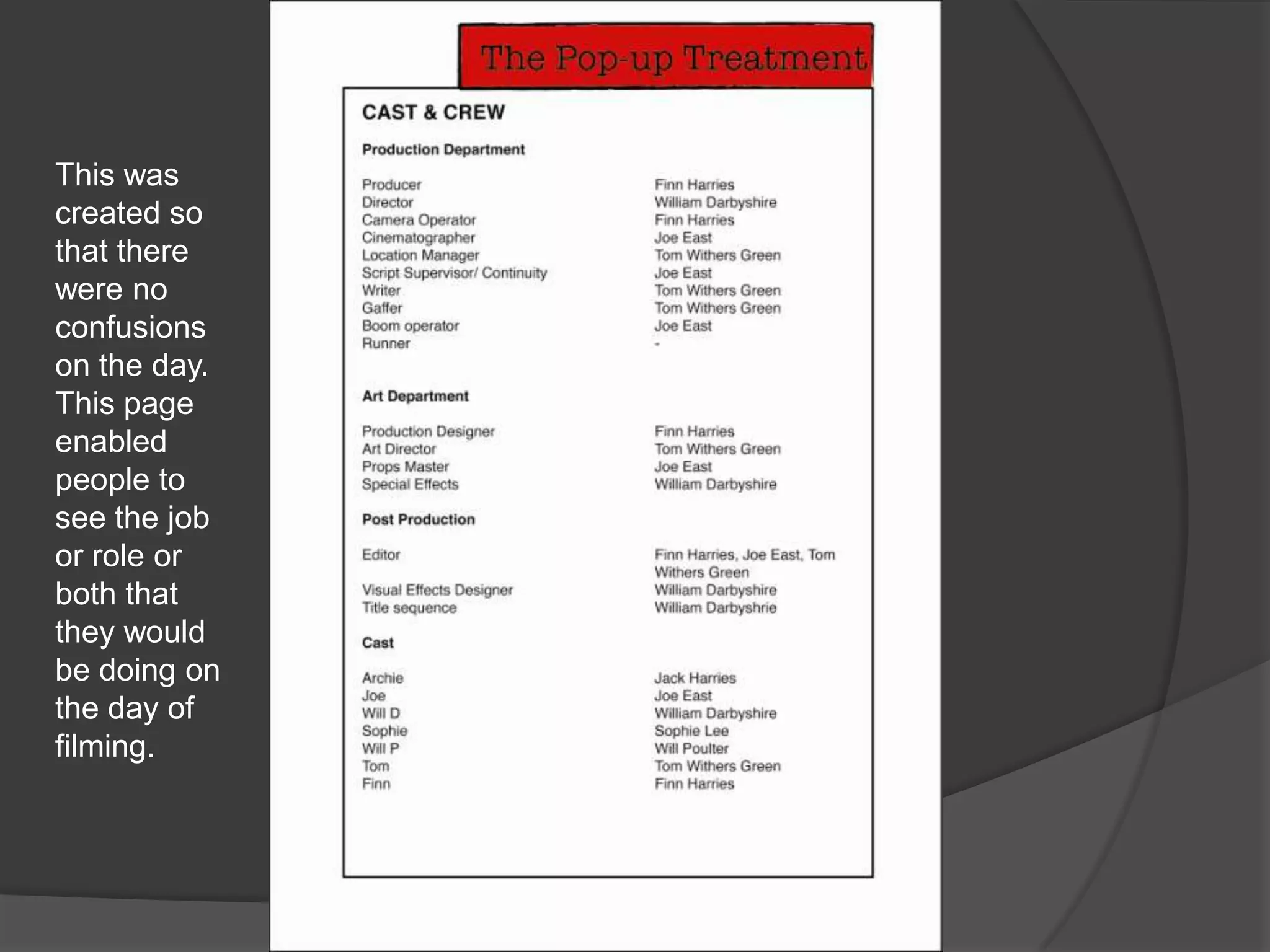
This was created so that there were no confusions on the day. This page enabled people to see the job or role or both that they would be doing on the day of filming.
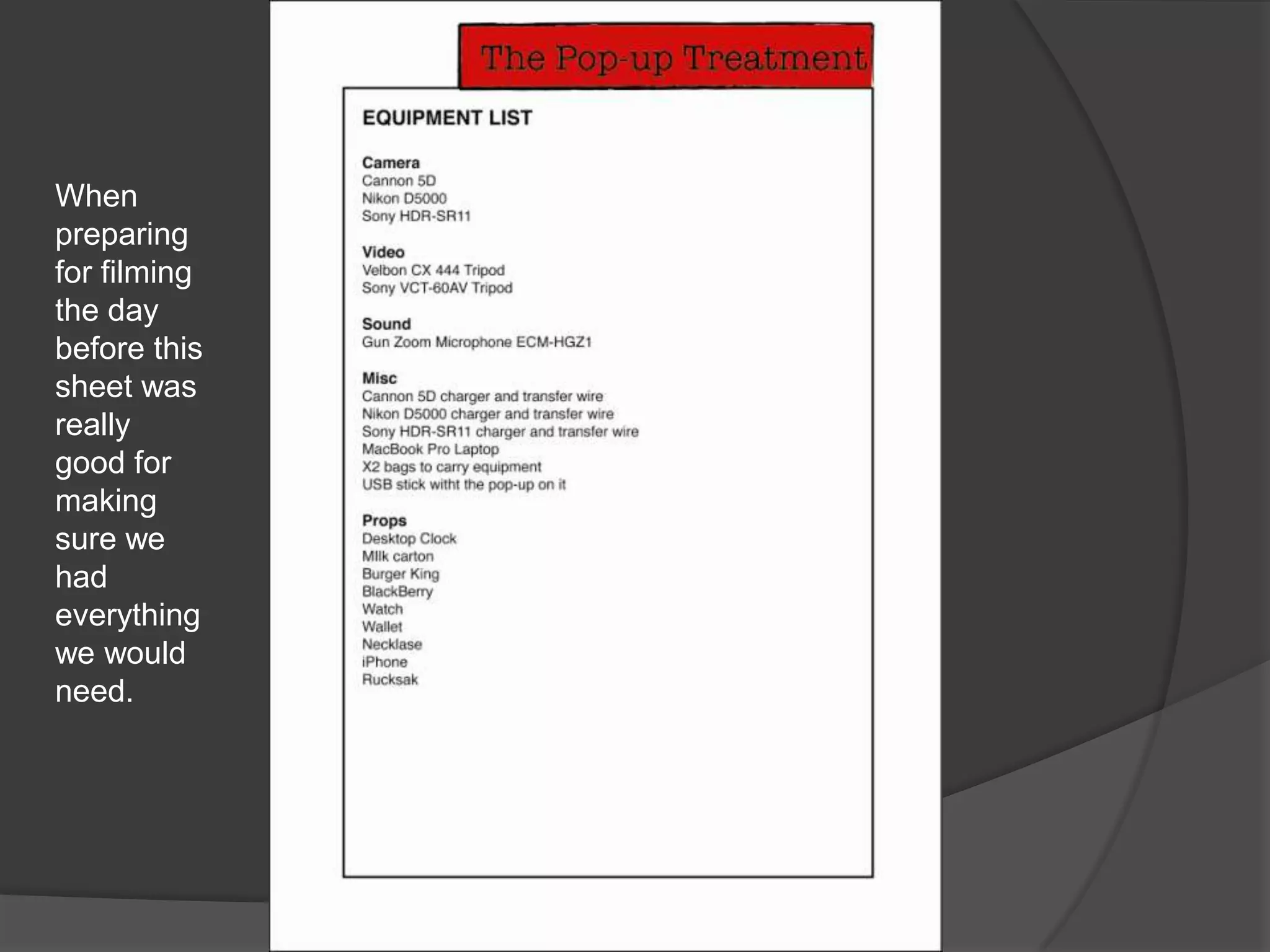
When preparing for filming the day before this sheet was really good for making sure we had everything we would need.
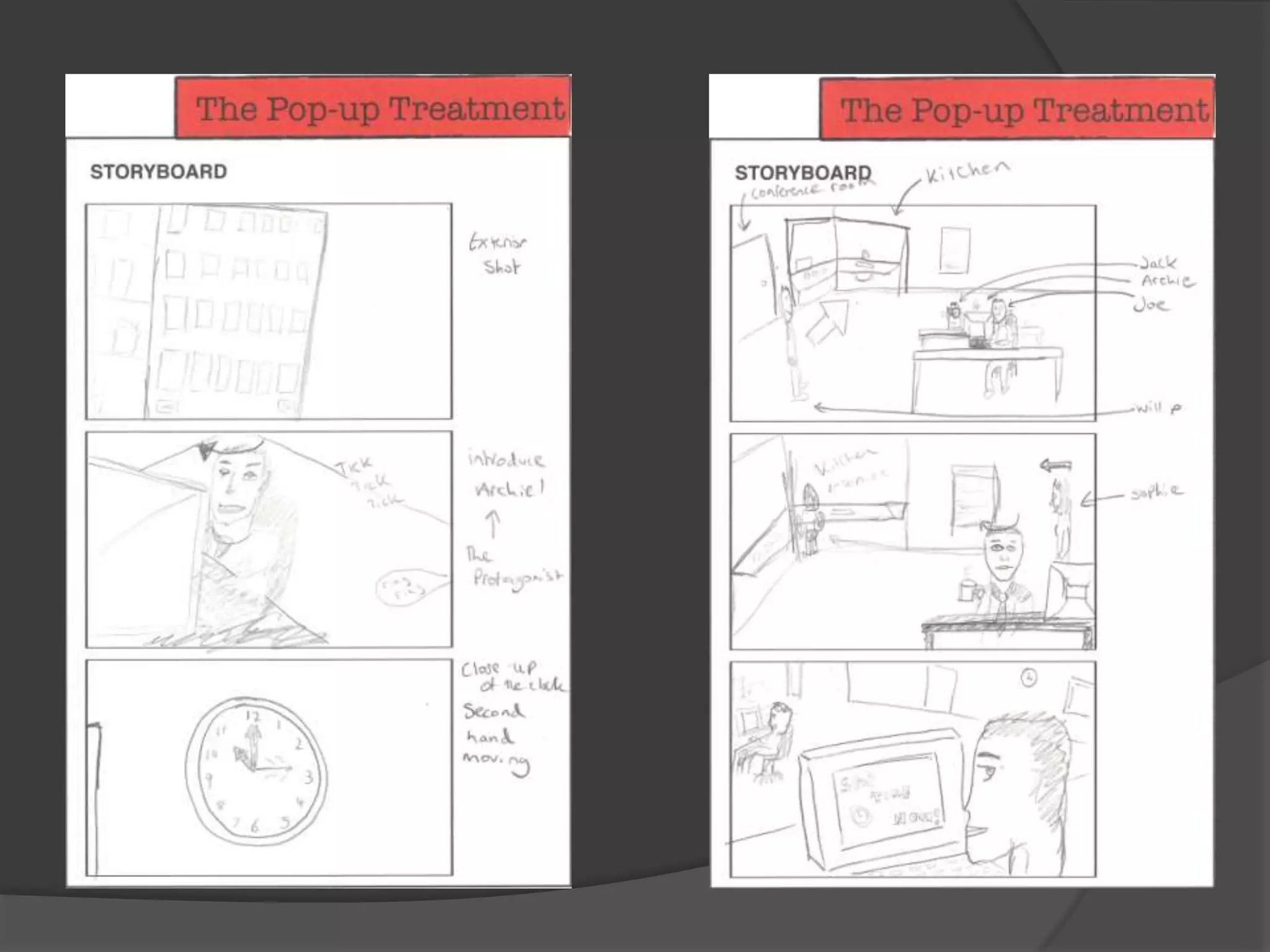
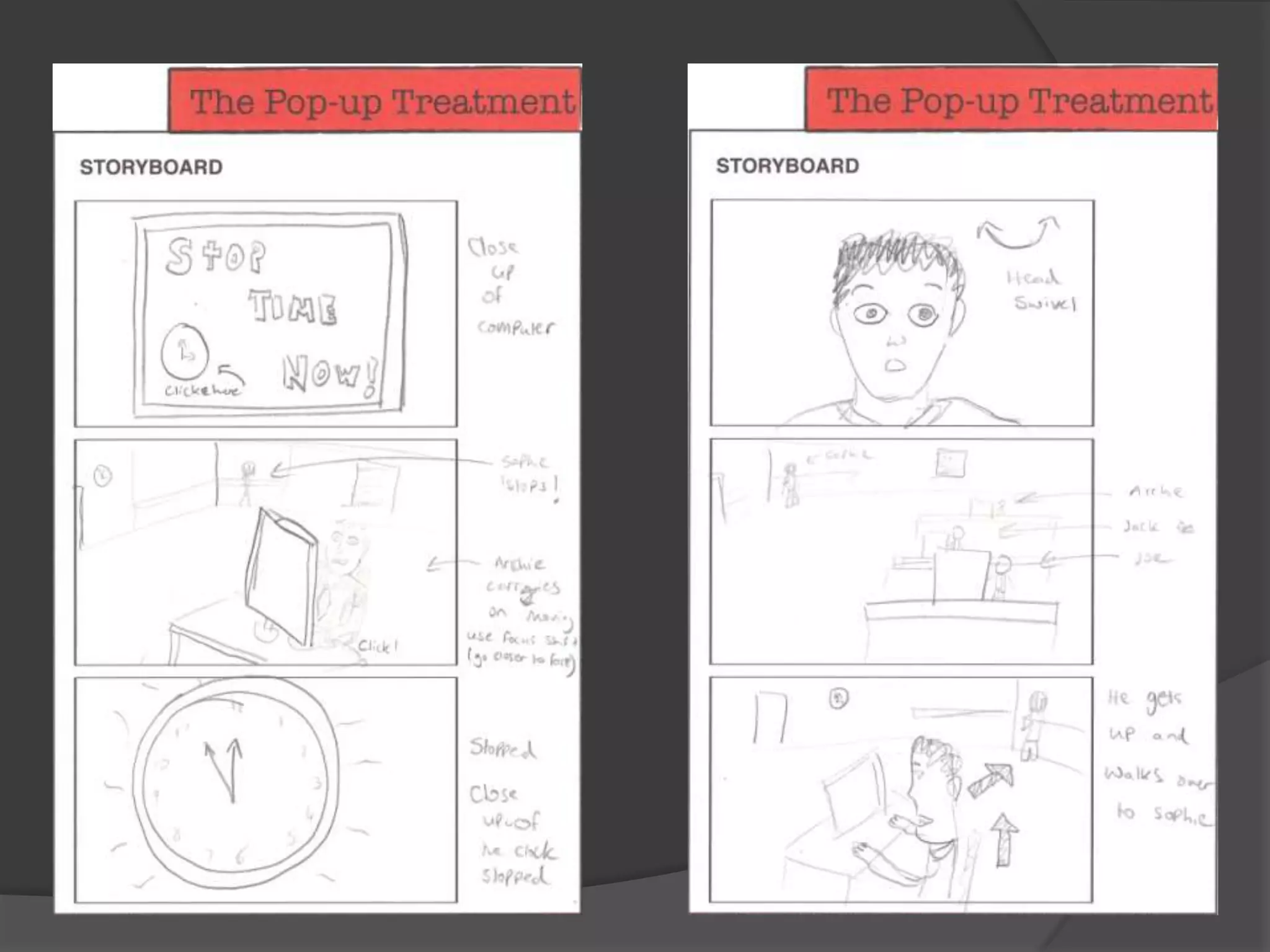
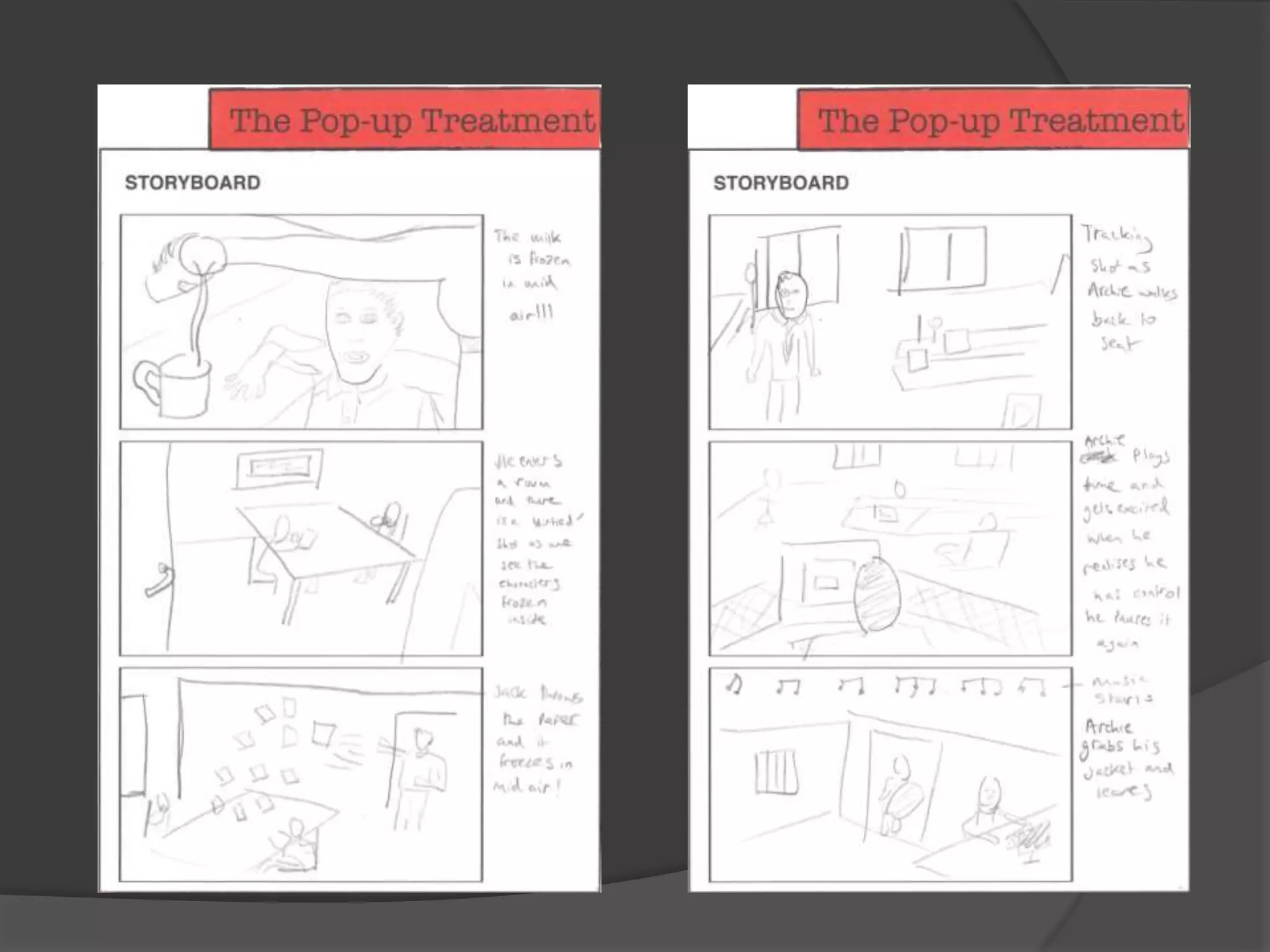
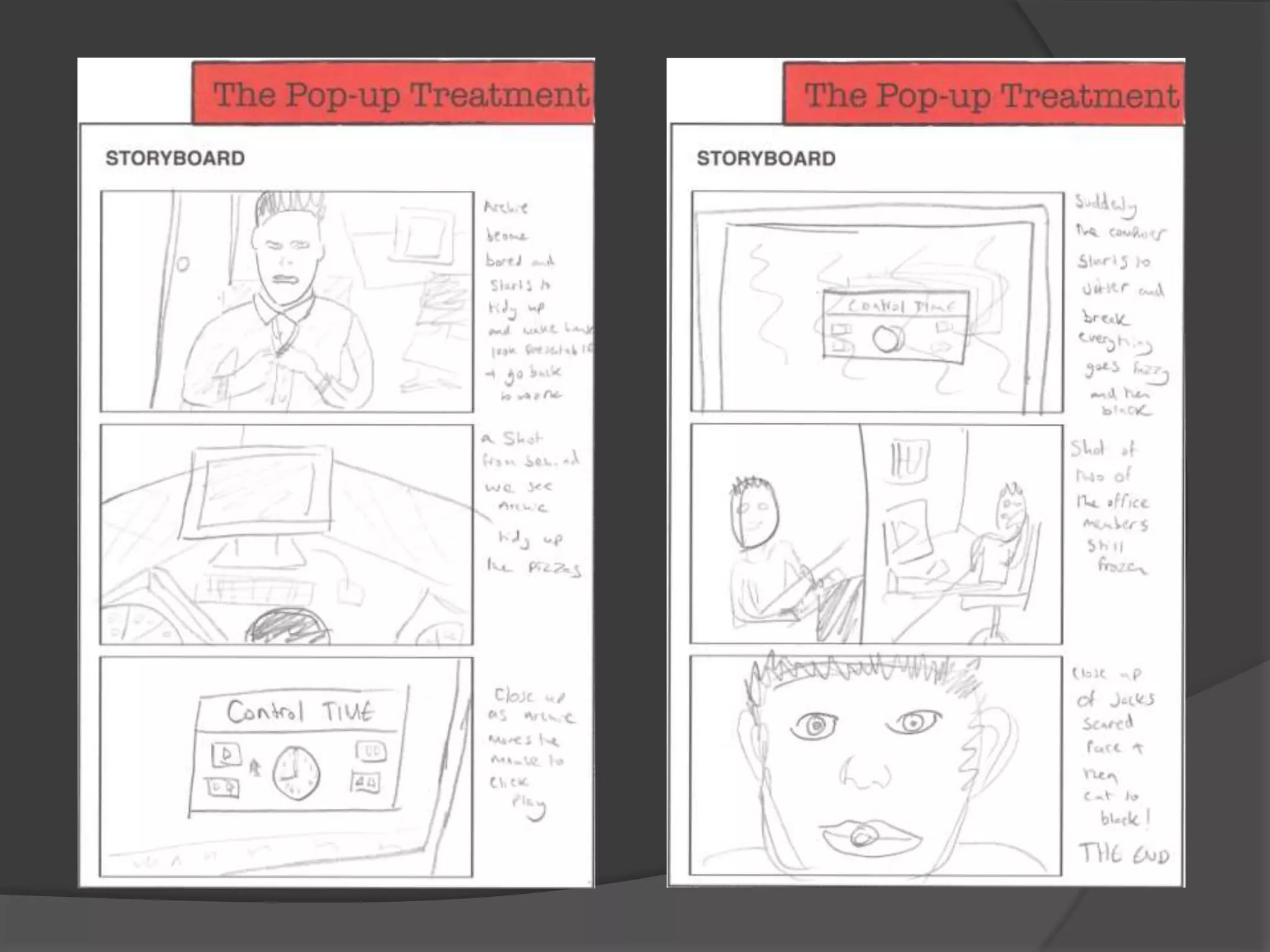
STORYBOARDOne of the best ways to plan a film and really work out all the technicalities of it is to create a story board.The next five slides show the 10 page story board that we created before filming the film. This helped us know what angles to shoot and in what positions. It really cuts filming time on the day if you have a rough idea of where your going to put the camera.This was all only possible because we had scouted the office a week before the shoot
Target MarketA target market is a smaller segment of a mass market which your specific product or service is aimed at. In our case, ‘The Pop Up’ is a short film. As a group we attempted to specify our short film to fit our chosen age for the short film to appeal to. Our chosen target market was between the ages of 13 and 30. We felt this was the right viewing age for our film because, as a group we believed ‘The Pop Up’ would appeal to this specific age group the most. When choosing our target market, we had many things to consider. Firstly, the content and genre of ‘The Pop Up.’ The genre is sci-fi therefore the short film will apply to viewers who like the sci-fi genre. We had to consider things such as explicit language for example as these types of things would mean the short film wouldn’t apply to people as young as 13.   I feel ‘The Pop Up’ mainly appeals to the younger generation. This is partly due to websites such as YouTube and Vimeo. Short films are becoming more and more popular with younger people due to their inability to maintain interest in a longer narrative. Due to short films being quick and snappy, younger people seem to be able to remain concentrated on the narrative and don’t lose interest.
Research LinksShort Films The Black Hole - http://www.youtube.com/watch?v=P5_Msrdg3Hk Who’s Gonna Save My Sole - http://www.youtube.com/user/futureshorts#p/c/AA848728072276E2/0/mhxK2IOywVE Lovefield - http://www.youtube.com/watch?v=4meeZifCVro When Time Stands Still - http://www.youtube.com/watch?v=ftAUJS3ML5I Philips Carousel - http://www.youtube.com/watch?v=C5yhxqkJiAQ Virus Short Film - http://www.youtube.com/watch?v=ItnNFEKiMt4 Click - http://www.youtube.com/watch?v=448jZuA5Y1I  Posters One Man Band - http://4.bp.blogspot.com/_mES7YIequyY/TInsx_PZEaI/AAAAAAAAABo/v4SaI-v0hao/s1600/one-man-band-poster-02.jpg Logorama - http://2.bp.blogspot.com/_mES7YIequyY/TInq3HTGapI/AAAAAAAAABg/OsCUWyHHsKw/s1600/logorama-poster.jpg Little Terrorist - http://4.bp.blogspot.com/_mES7YIequyY/TIZbZjZ5j2I/AAAAAAAAABY/ql9SRCR72wE/s1600/little-terrorist.jpg 
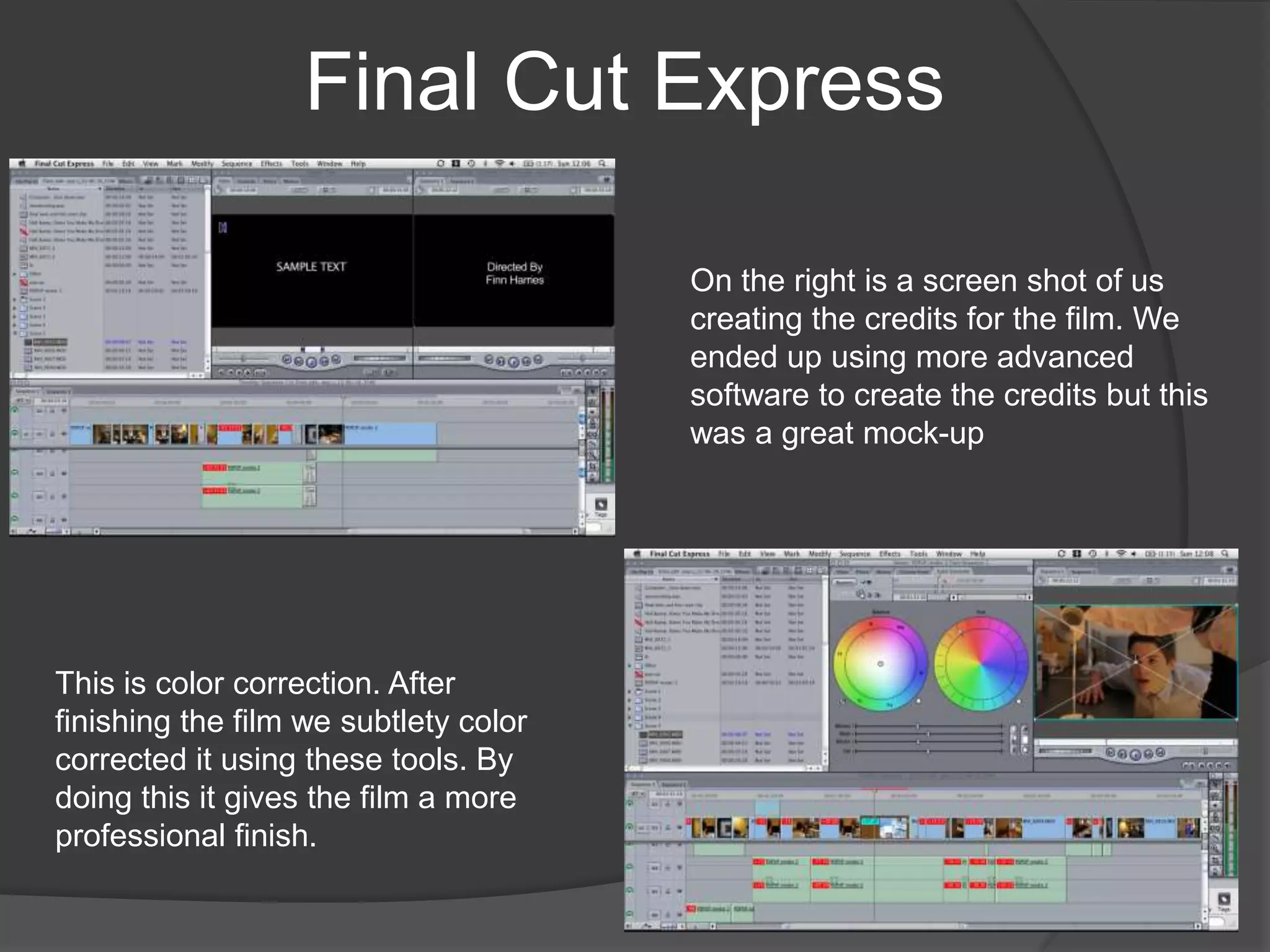
Final Cut ExpressThese are two screen shots from a film editing software called Final Cut Express. This is what we edited the majority of our film on. On the left you can see the timeline and how the film has been constructedOn the right is a screen shot showing how you can use final cut to manipulate audio. We used these features to put in sound effects, songs and other audio.
Final Cut ExpressOn the right is a screen shot of us creating the credits for the film. We ended up using more advanced software to create the credits but this was a great mock-upThis is color correction. After finishing the film we subtlety color corrected it using these tools. By doing this it gives the film a more professional finish.
EffectsVisual effects are a big aspect in our film. We knew we were setting our selves a challenge when we came up with the plot. Along the way we had many problems with the effects. Although we managed to sort most of them out, a few still remain. The software we used to create these effects is called Adobe After Effects and on the next couple of slides you will get a preview of how it works.
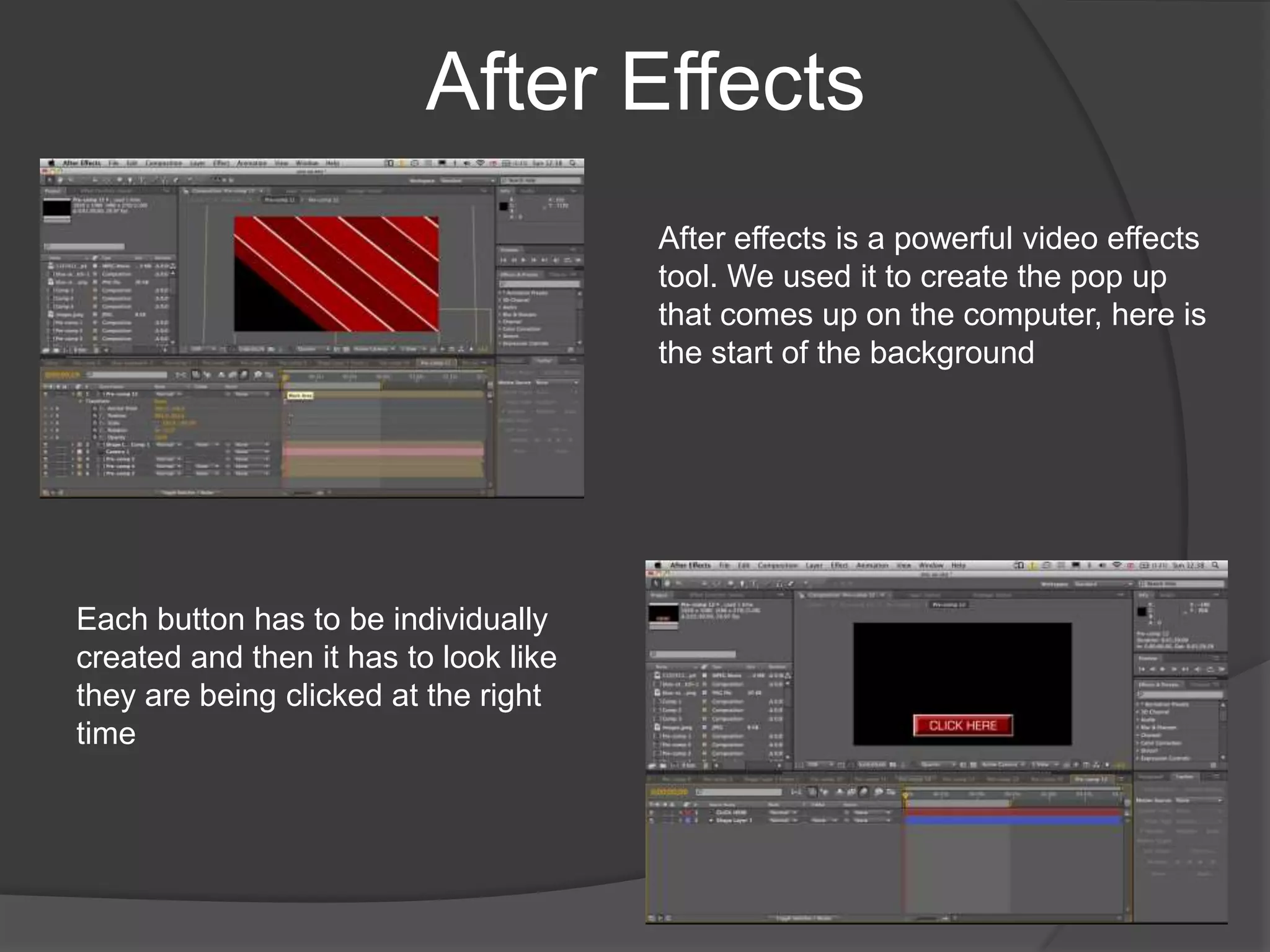
After EffectsAfter effects is a powerful video effects tool. We used it to create the pop up that comes up on the computer, here is the start of the backgroundEach button has to be individually created and then it has to look like they are being clicked at the right time
After EffectsThe moving clock was a challenge but we finally worked out how to get everything going at the same timeHere you can see the nearly finished pop up with all the graphics and eye catching colours that you might expect a normal pop-up to have.
The Pop-up  Poster
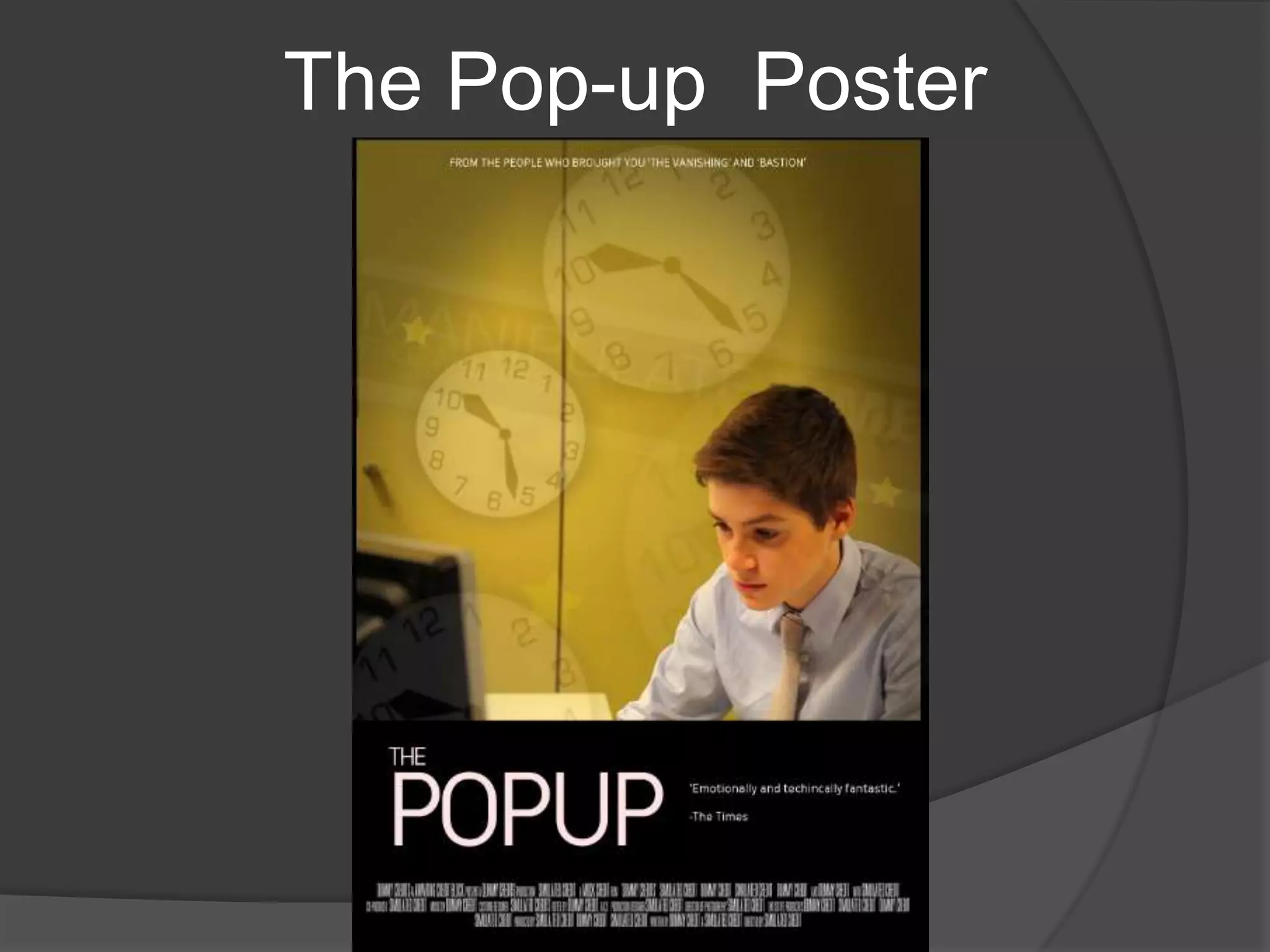
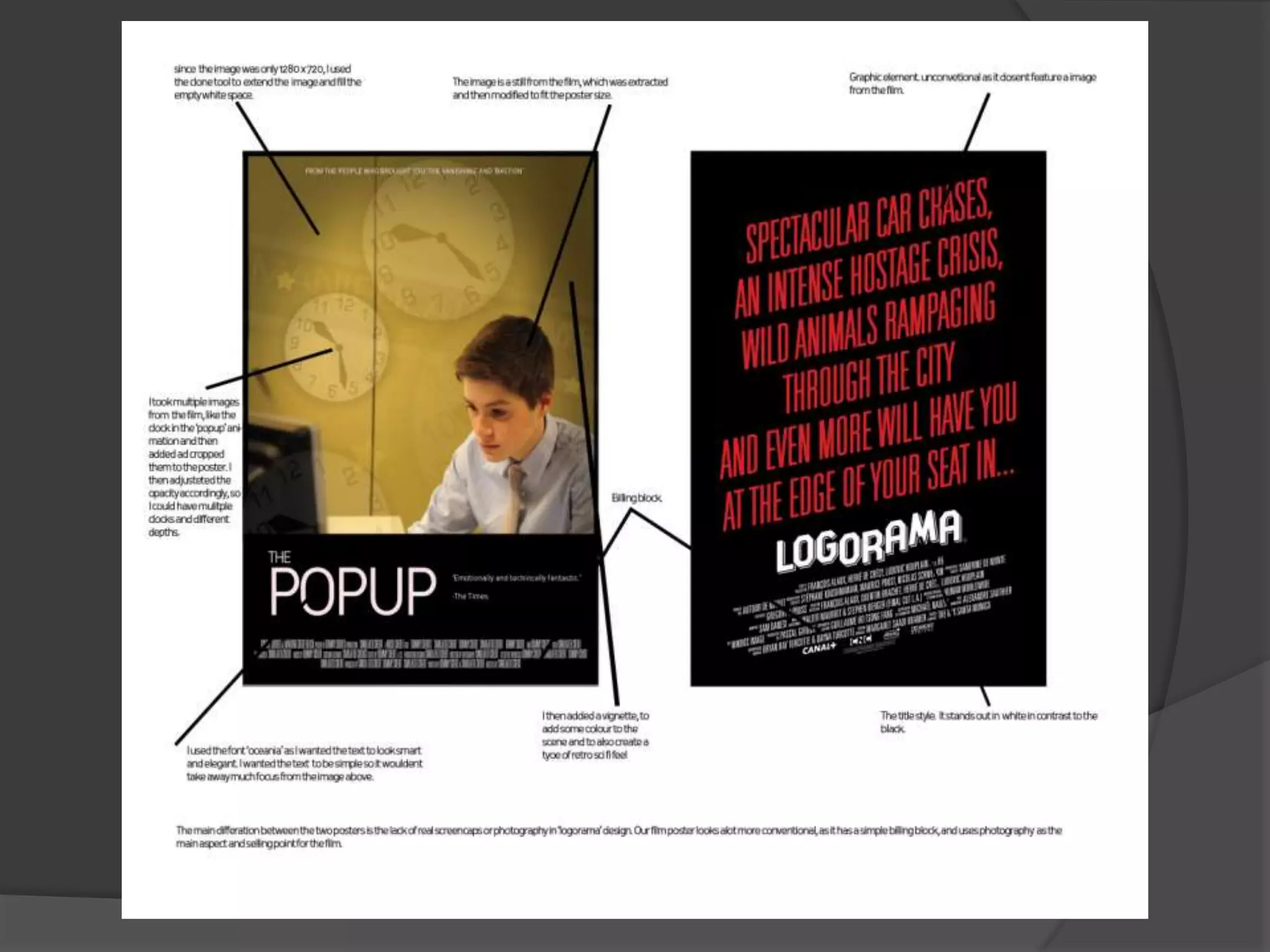
PhotoshopI took a screenshot from the film, and then added them into photoshop. I then used the stamp tool, to fill in the rest of the poster. The stamp tool bascilly takes the surrounding textures of the image, and allows you to brush excess textures on, effectively making a image bigger, or in our case filling the rest of the poster.
PhotoshopI then added additional things like clocks and stars, to relate to our film. I also added a black border.To finish it I put the title and the credits in a  block at the bottom
Magazine Review
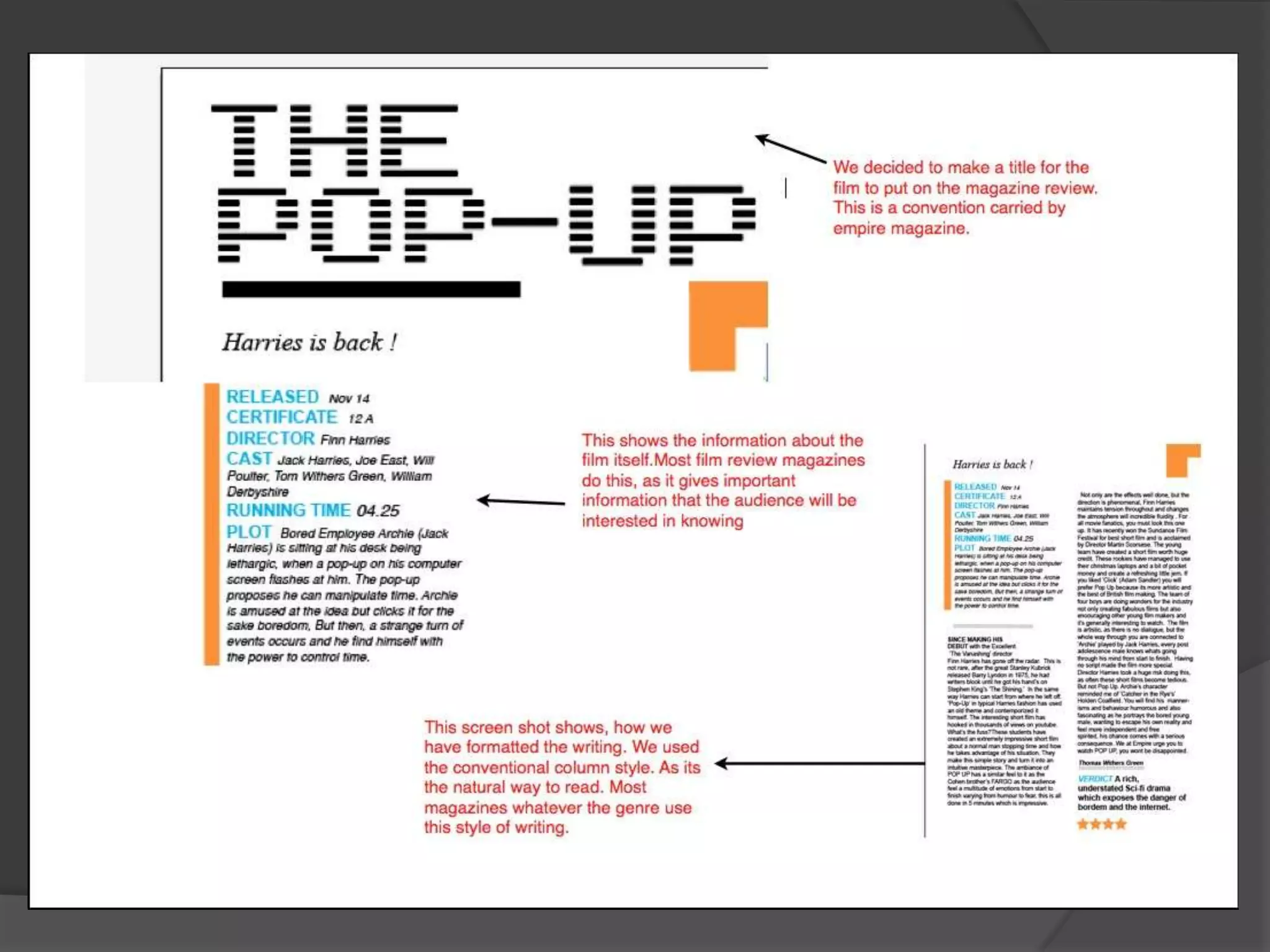
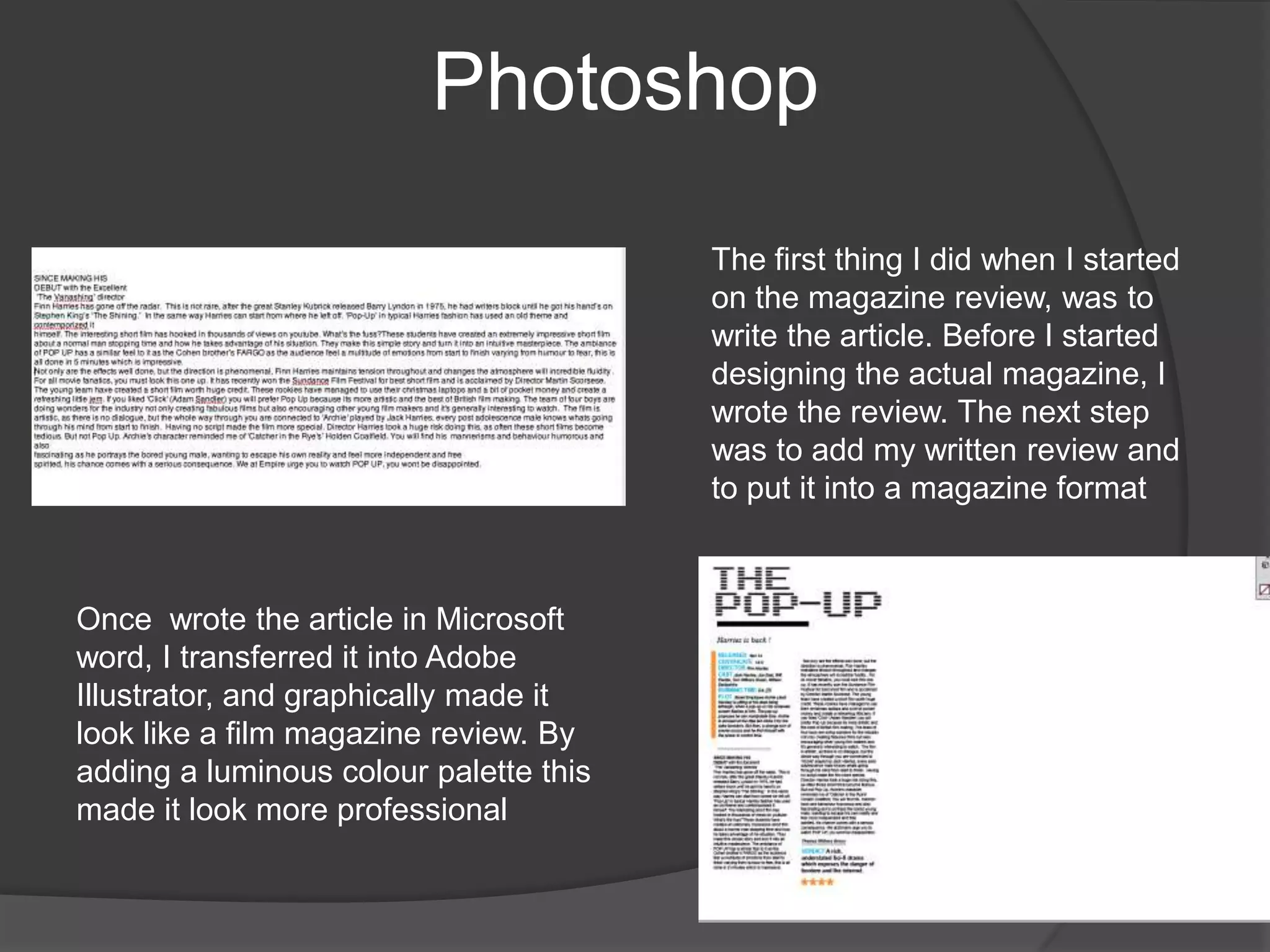
PhotoshopThe first thing I did when I started on the magazine review, was to write the article. Before I started designing the actual magazine, I wrote the review. The next step was to add my written review and to put it into a magazine format Once  wrote the article in Microsoft word, I transferred it into Adobe Illustrator, and graphically made it look like a film magazine review. By adding a luminous colour palette this made it look more professional
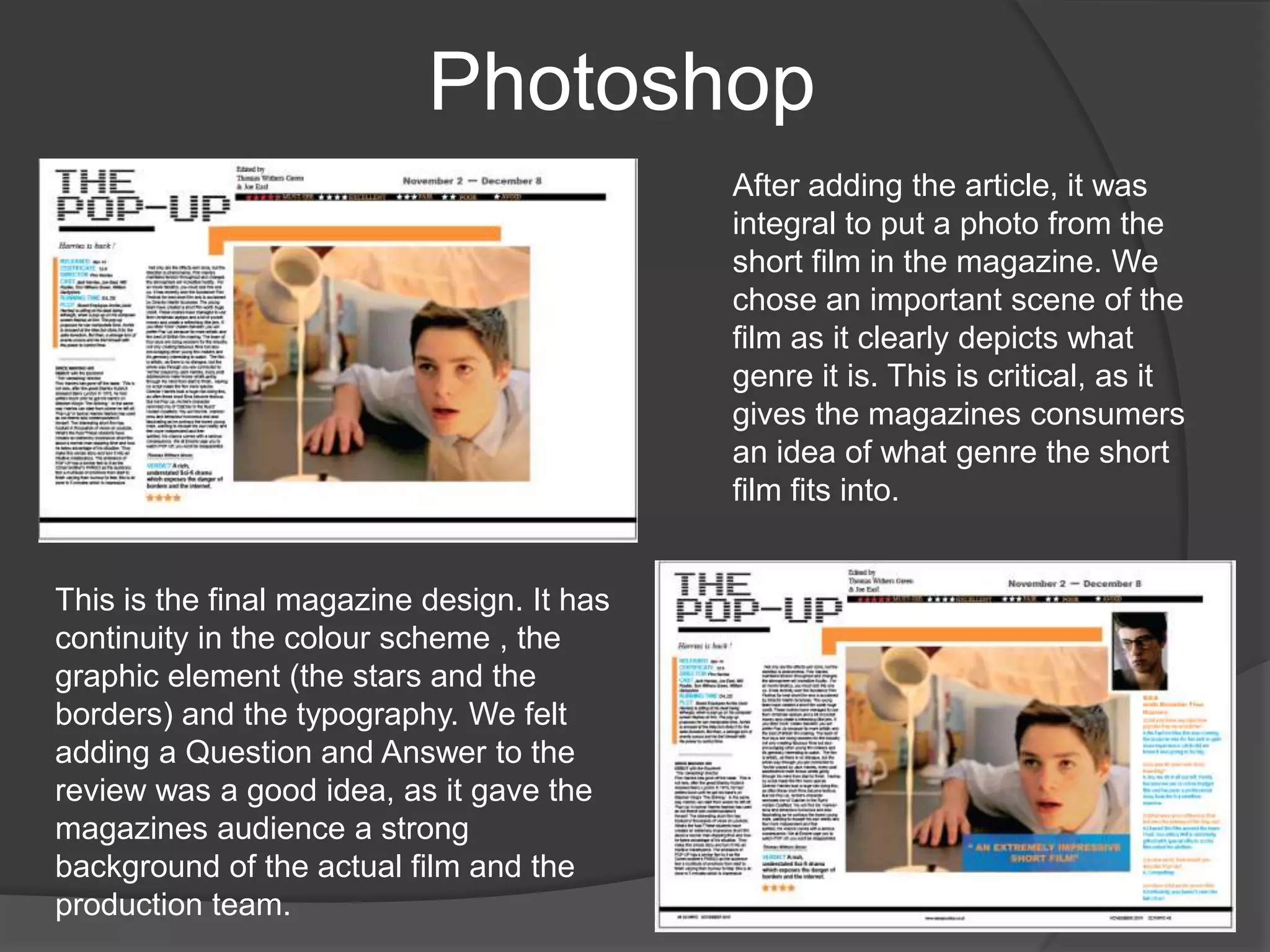
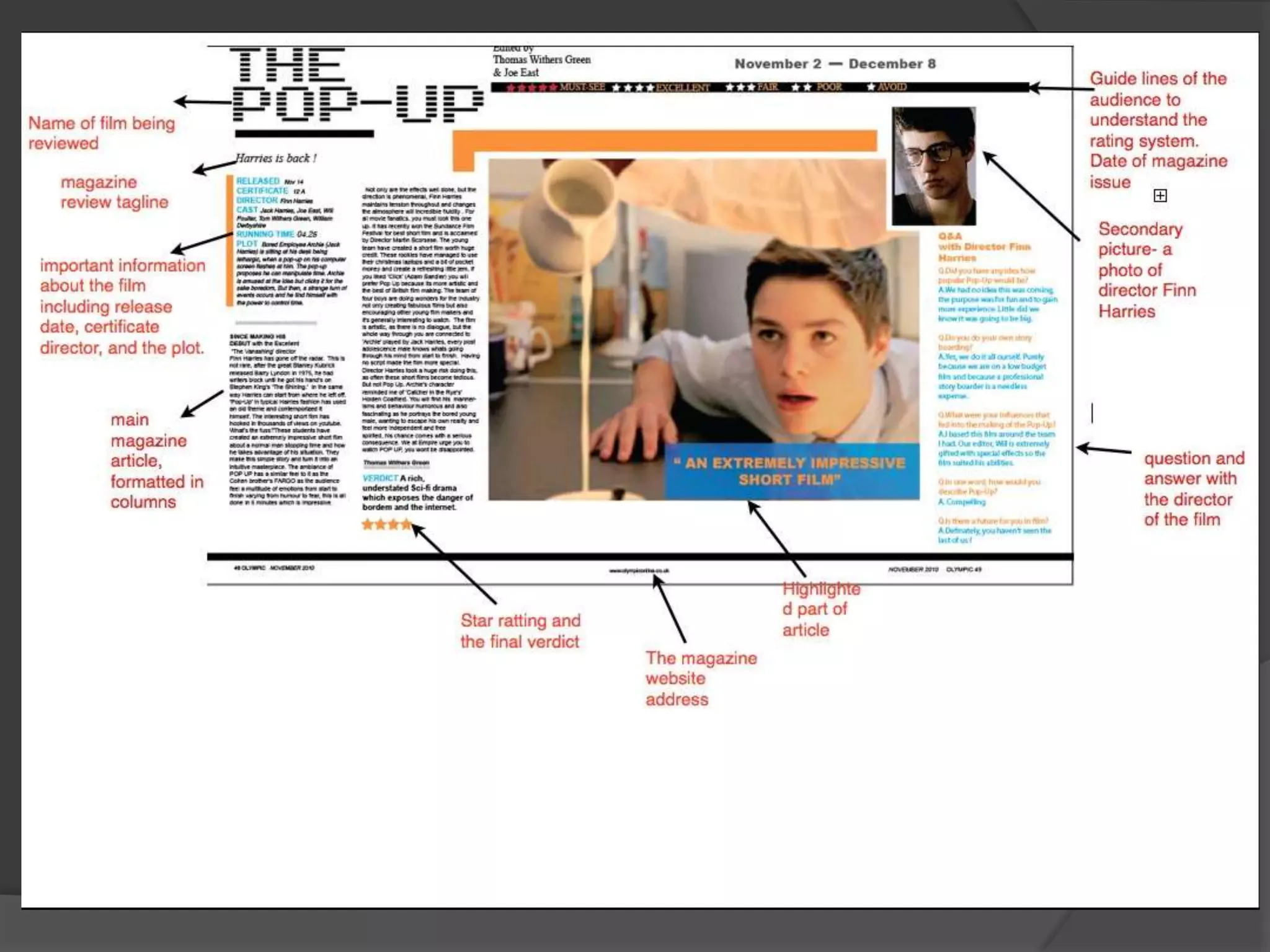
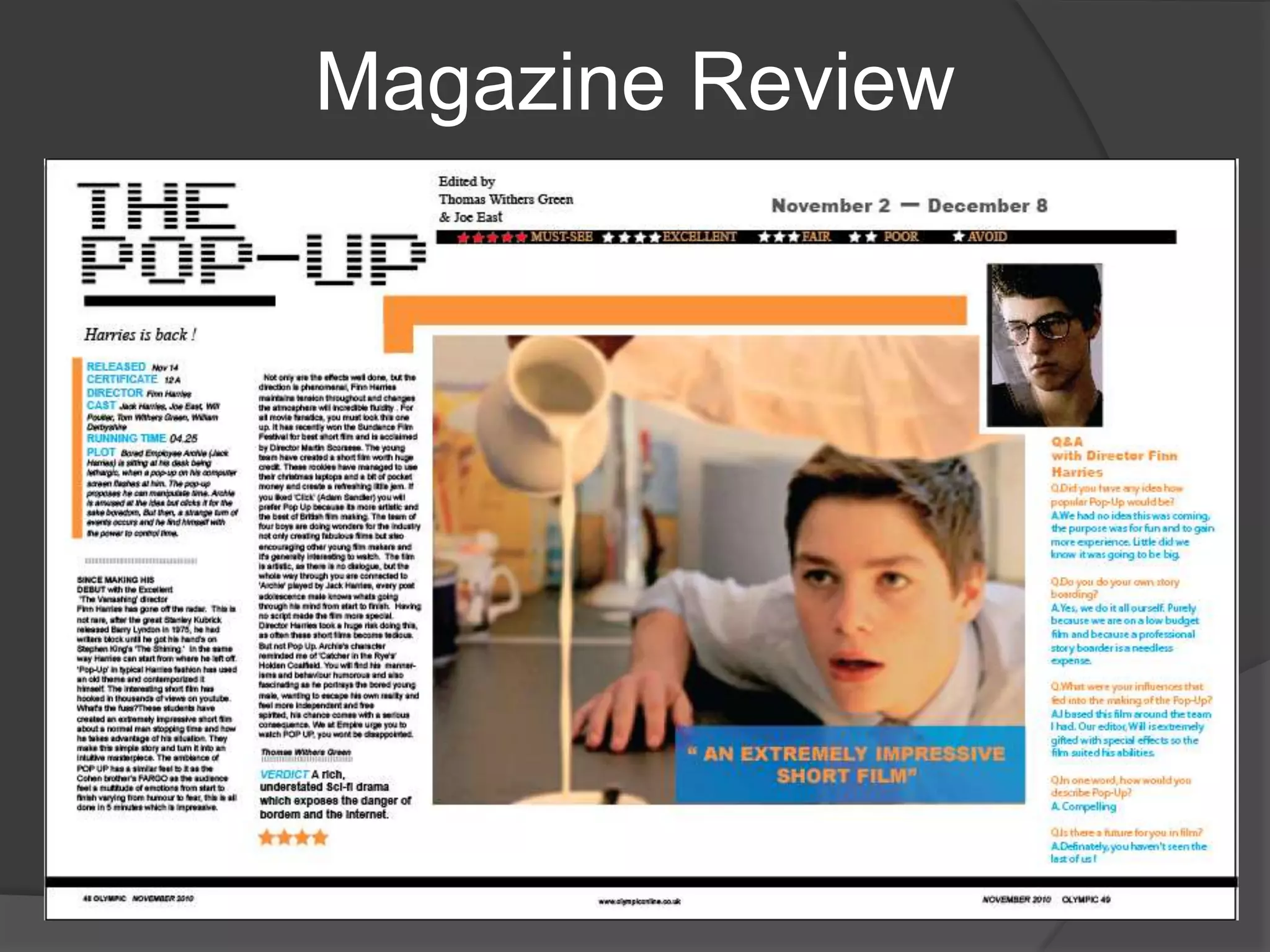
PhotoshopAfter adding the article, it was integral to put a photo from the short film in the magazine. We chose an important scene of the film as it clearly depicts what genre it is. This is critical, as it gives the magazines consumers an idea of what genre the short film fits into.This is the final magazine design. It has continuity in the colour scheme , the graphic element (the stars and the borders) and the typography. We felt adding a Question and Answer to the review was a good idea, as it gave the magazines audience a strong background of the actual film and the production team.
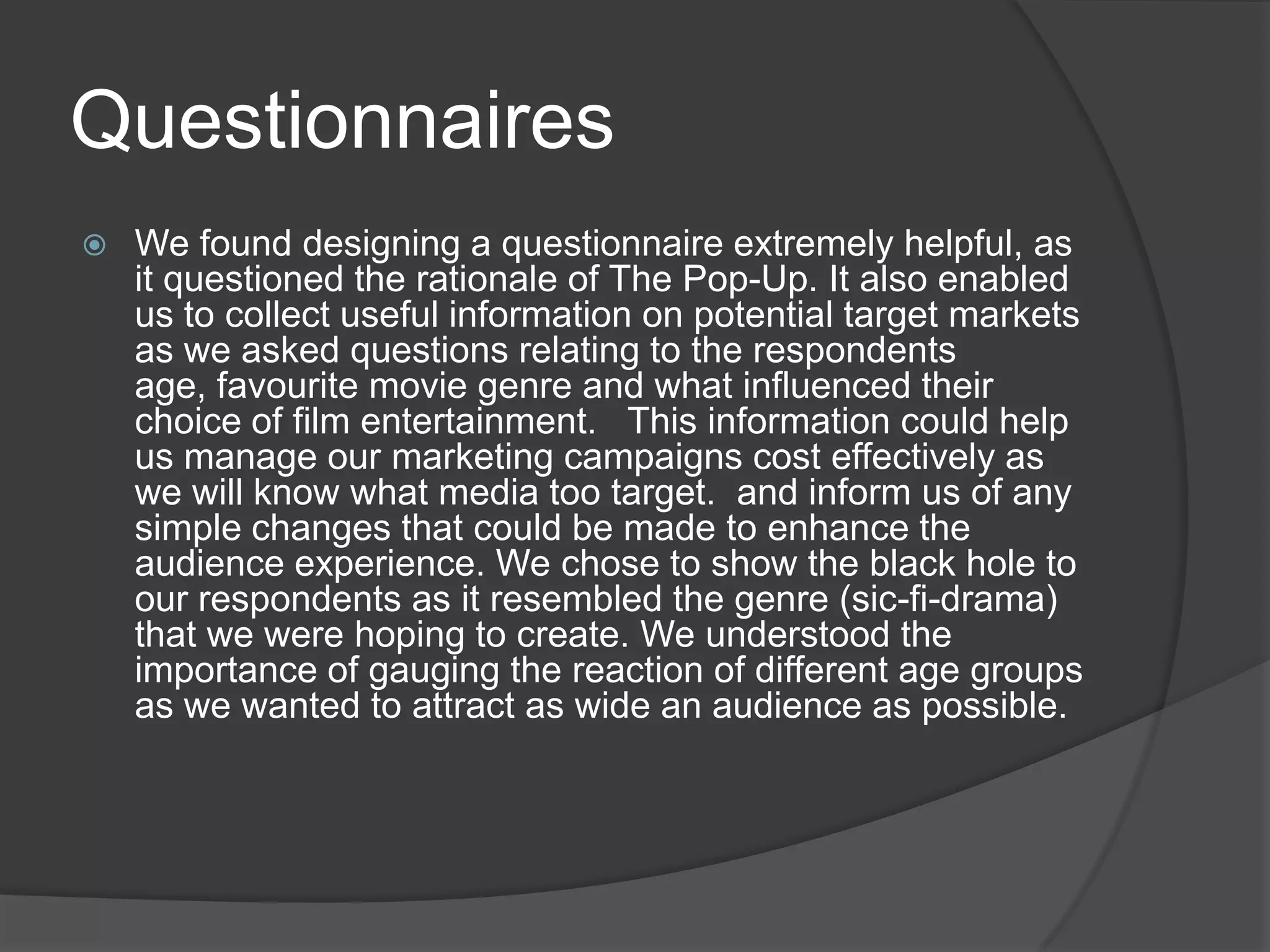
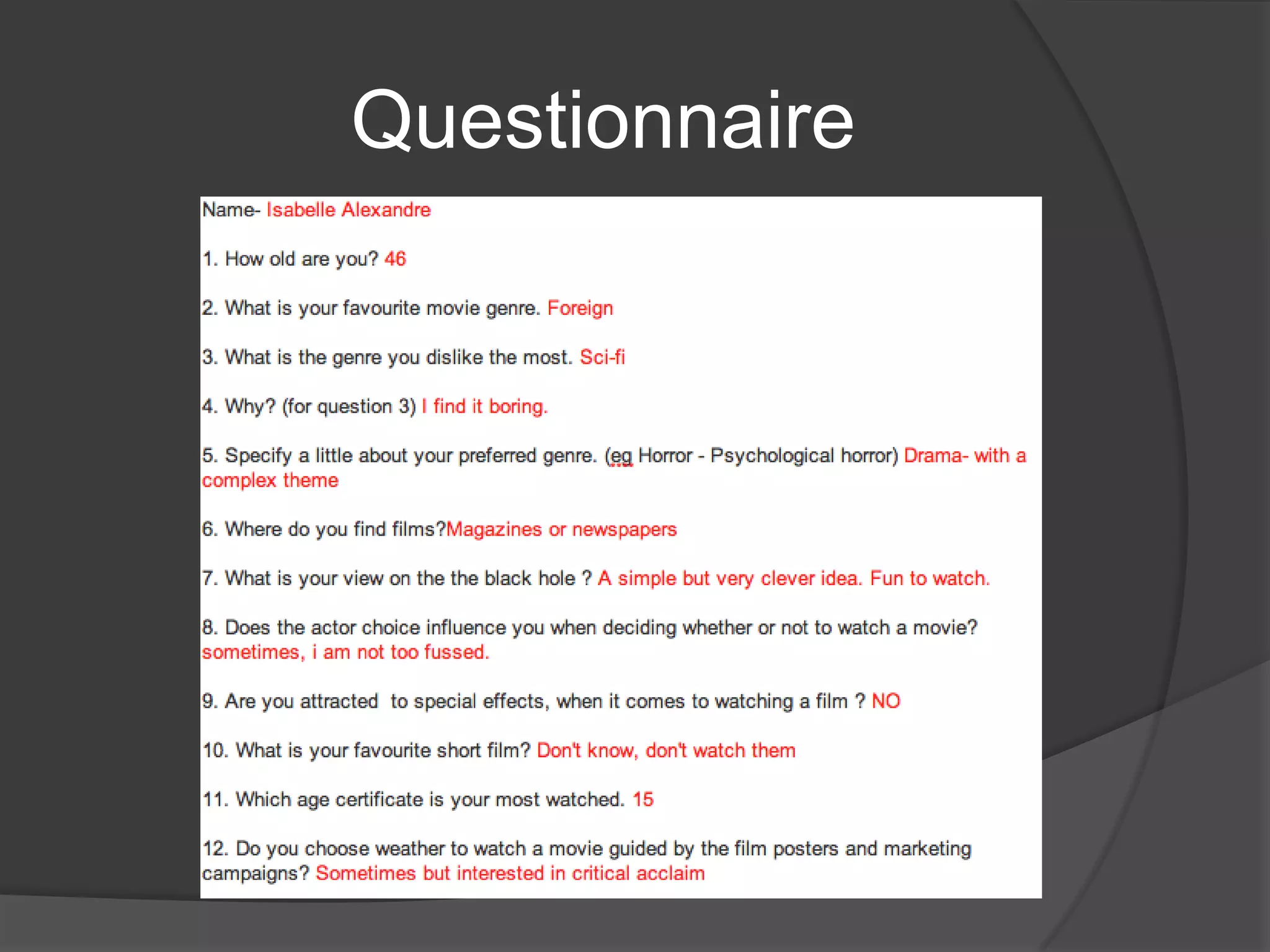
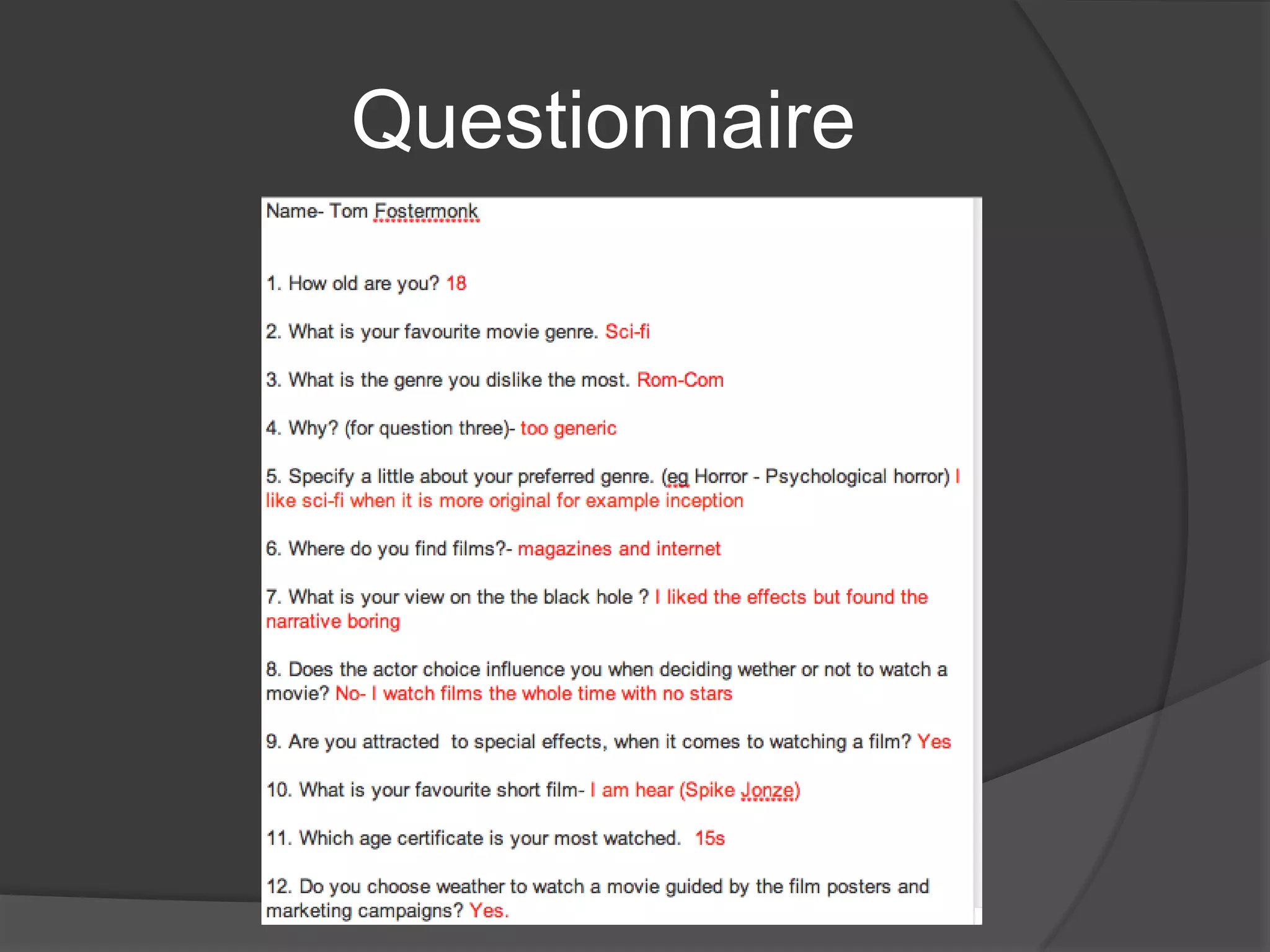
QuestionnairesWe found designing a questionnaire extremely helpful, as it questioned the rationale of The Pop-Up. It also enabled us to collect useful information on potential target markets as we asked questions relating to the respondents age, favourite movie genre and what influenced their choice of film entertainment.   This information could help us manage our marketing campaigns cost effectively as we will know what media too target.  and inform us of any simple changes that could be made to enhance the audience experience. We chose to show the black hole to our respondents as it resembled the genre (sic-fi-drama) that we were hoping to create. We understood the importance of gauging the reaction of different age groups as we wanted to attract as wide an audience as possible.
Questionnaire
Questionnaire
Questionnaire
Questionnaire
Q1- In what ways does your media product use, develop or challenge forms and conventions of real media products?The short film ‘The Popup’ challenges and sticks to real media conventions.  Short films have a strict set of conventions such as ending in disequilibrium or having a complex narrative and although The Popup sticks to these ideas, it also rebels against it by maintaining a linear, circular narrative for a long duration of the plot.A convention of short film is to stick a genre and expand on it, but our media product challenges this convention as it has a mixture of different conventions. For example our film is a scifi, but at times can be humorous. We see a small relationship between two characters in the film, and therefore the film could be interpreted as a romance.Another convention of short film is to have a complex narrative or to end the film in disequilibrium.  Our film sticks to this convention and challenges it, as our film ends in disequilibrium but has a very straightforward plot and only starts to develop into something else in the last minute. Having this variation allows less confusion, and ends with a interesting surprise.Throughout film, representation is extremely important. We see a variation of female and male gaze. The idea of ‘gaze’ is to show the audience the directors or characters point of view. For example in the popup we wanted our main male character to ‘check out’ the woman, and we communicated this by having a shot of a woman making tea, and a man peeking over his desk to take a look. This is a example of male gaze, and gives the audience primarily a sense of who is directing the film.  Since there was no variation of male and female gaze, we did stick to this convention.Although the film has multiple genres within it, the film is primarily for a young adult age. Recently, there has been big interest in the Internet and the ‘modern age’ and so featuring this idea in our film, would appeal to a younger audience. We stuck to this convention of a target audience rather than making something, which would appeal to every age.
Q2-How effective is the combination of your main product and ancillary texts?We created a poster and a magazine review as the ancillary texts to our main product over choosing to do a radio advert. We felt as a group that we could do best in these because of our individual skills. It was vital to design these in a way that was both realistic and keep a brand identity that meant it was easy to see that they both related to the same film.
We felt as a group that the combination of our main product and ancillary texts was effective because they felt like a realistic magazine review and film poster. We created this realism by doing thorough research into other film posters and magazine reviews of short films like the little terrorist. We carefully analysed the techniques used and applied them to our project.
For the poster we used certain elements from the film to illustrate the basic story line, which we hoped would entice the correct demographic audience. We were careful to put in elements like clocks and a guy at a computer to show the overall theme of the film. For the magazine review we found ‘main stream’ magazines like Empire included a variety of content within their reviews like questionnaires and film information. We applied this technique to our own magazine review by putting in a questionnaire from the director.
Researching into posters and reviews, our group realised the importance of having ancillary texts in the real world of media. A film strongly relies on its reviews and posters to increase its views and bring in the right demographic audience. I think the realism that we tried to put into our poster and magazine review on top of strongly considering our target audience creates an effective combination between the main product and ancillary texts. Q3- What have you learned from your audience feedback?As a group we found audience feedback very helpful as we needed their opinions to help construct our film to the best of our ability.

The Pop-Up- Media Evaluation

  • 1.
    Will, joe, tomand finns A2 Coursework Production
  • 2.
    CHOOSING OUR BRIEFWechose brief 10, which was:A short film in its entirety, lasting approximately five minutes, which may be live action or animated or a combination of both, together with two of the following ancillary textsa poster for the filma film magazine review page featuring the film.Out of all the briefs we felt most confident doing this one, however we were perfectly aware of the challenges that lay ahead. After a week or so we had come up with the plot to our film. It was called the pop up and it was going to be about a young man who is bored at work one day when suddenly a pop up appears on his computer screen advertising that he can stop time with one click. He clicks it, not expecting anything to happen and suddenly time freezes. The rest of the film is about him having fun in the office and enjoying his new found power, however there is a dramatic twist at the end!
  • 3.
    Main Media TextThePop Up Short FilmMagazine ReviewFilm PosterAncillary Texts
  • 4.
    PLANNINGThe plot toour film was quite complicated. Although it was all going to be filmed inside an office with one exterior shot, the main character is constantly walking around and exploring the office while five other cast members have to keep the continuity and stay where they were when he froze time. We had to make sure we were following basic rules like not crossing the line and one of the hardest things to work out was when and how we would be applying the effect of time stopping.To carry this out in the short amount of time we had (1 day) we devised a treatment for the film which had everything in it that we felt we would need on the day. This treatment was key to the speed of filming and the level of organisation. The next couple of slides will take you through what we created as well as giving you an insight into how we made the film.
  • 5.
    This page enablesthe viewer to quickly see what is inside the pop-up treatment and roughly where it is located within the booklet.
  • 6.
    The proposal waswhat we wrote up when we did the initial planning for the film. It gave us an idea of the general plot and layout of the film
  • 7.
    The proposal goesinto depth about research done on the main texts and ancillary texts.
  • 10.
    The script wasessential on the day of filming. It is one of the things that aloud us to film the movie so quickly.
  • 11.
    Everyone knew whereto be and what to say at the right time. It really helps put the whole film into perspective
  • 12.
    As well asspeech and scenes, the script contains stage directions and in some places the type of shots that were required within that scene.
  • 14.
    A production schedulethat covered the space of three months meant that we were aware of how long we had to complete certain aspects of the film. This was key to organisation
  • 15.
    The shot listproved very useful on the day of filming. It meant that when we knew what scene we were filming we could quickly check what shots would be within that scene
  • 17.
    The day layoutwas helpful for monitoring our progress to check we were on time with everything we were doing. We could see which scenes needed to be filmed first and in what order the shots come
  • 19.
    This was createdso that there were no confusions on the day. This page enabled people to see the job or role or both that they would be doing on the day of filming.
  • 20.
    When preparing forfilming the day before this sheet was really good for making sure we had everything we would need.
  • 21.
    STORYBOARDOne of thebest ways to plan a film and really work out all the technicalities of it is to create a story board.The next five slides show the 10 page story board that we created before filming the film. This helped us know what angles to shoot and in what positions. It really cuts filming time on the day if you have a rough idea of where your going to put the camera.This was all only possible because we had scouted the office a week before the shoot
  • 27.
    Target MarketA targetmarket is a smaller segment of a mass market which your specific product or service is aimed at. In our case, ‘The Pop Up’ is a short film. As a group we attempted to specify our short film to fit our chosen age for the short film to appeal to. Our chosen target market was between the ages of 13 and 30. We felt this was the right viewing age for our film because, as a group we believed ‘The Pop Up’ would appeal to this specific age group the most. When choosing our target market, we had many things to consider. Firstly, the content and genre of ‘The Pop Up.’ The genre is sci-fi therefore the short film will apply to viewers who like the sci-fi genre. We had to consider things such as explicit language for example as these types of things would mean the short film wouldn’t apply to people as young as 13.  I feel ‘The Pop Up’ mainly appeals to the younger generation. This is partly due to websites such as YouTube and Vimeo. Short films are becoming more and more popular with younger people due to their inability to maintain interest in a longer narrative. Due to short films being quick and snappy, younger people seem to be able to remain concentrated on the narrative and don’t lose interest.
  • 28.
    Research LinksShort Films TheBlack Hole - http://www.youtube.com/watch?v=P5_Msrdg3Hk Who’s Gonna Save My Sole - http://www.youtube.com/user/futureshorts#p/c/AA848728072276E2/0/mhxK2IOywVE Lovefield - http://www.youtube.com/watch?v=4meeZifCVro When Time Stands Still - http://www.youtube.com/watch?v=ftAUJS3ML5I Philips Carousel - http://www.youtube.com/watch?v=C5yhxqkJiAQ Virus Short Film - http://www.youtube.com/watch?v=ItnNFEKiMt4 Click - http://www.youtube.com/watch?v=448jZuA5Y1I  Posters One Man Band - http://4.bp.blogspot.com/_mES7YIequyY/TInsx_PZEaI/AAAAAAAAABo/v4SaI-v0hao/s1600/one-man-band-poster-02.jpg Logorama - http://2.bp.blogspot.com/_mES7YIequyY/TInq3HTGapI/AAAAAAAAABg/OsCUWyHHsKw/s1600/logorama-poster.jpg Little Terrorist - http://4.bp.blogspot.com/_mES7YIequyY/TIZbZjZ5j2I/AAAAAAAAABY/ql9SRCR72wE/s1600/little-terrorist.jpg 
  • 29.
    Final Cut ExpressTheseare two screen shots from a film editing software called Final Cut Express. This is what we edited the majority of our film on. On the left you can see the timeline and how the film has been constructedOn the right is a screen shot showing how you can use final cut to manipulate audio. We used these features to put in sound effects, songs and other audio.
  • 30.
    Final Cut ExpressOnthe right is a screen shot of us creating the credits for the film. We ended up using more advanced software to create the credits but this was a great mock-upThis is color correction. After finishing the film we subtlety color corrected it using these tools. By doing this it gives the film a more professional finish.
  • 31.
    EffectsVisual effects area big aspect in our film. We knew we were setting our selves a challenge when we came up with the plot. Along the way we had many problems with the effects. Although we managed to sort most of them out, a few still remain. The software we used to create these effects is called Adobe After Effects and on the next couple of slides you will get a preview of how it works.
  • 32.
    After EffectsAfter effectsis a powerful video effects tool. We used it to create the pop up that comes up on the computer, here is the start of the backgroundEach button has to be individually created and then it has to look like they are being clicked at the right time
  • 33.
    After EffectsThe movingclock was a challenge but we finally worked out how to get everything going at the same timeHere you can see the nearly finished pop up with all the graphics and eye catching colours that you might expect a normal pop-up to have.
  • 34.
  • 35.
    PhotoshopI took ascreenshot from the film, and then added them into photoshop. I then used the stamp tool, to fill in the rest of the poster. The stamp tool bascilly takes the surrounding textures of the image, and allows you to brush excess textures on, effectively making a image bigger, or in our case filling the rest of the poster.
  • 36.
    PhotoshopI then addedadditional things like clocks and stars, to relate to our film. I also added a black border.To finish it I put the title and the credits in a block at the bottom
  • 38.
  • 39.
    PhotoshopThe first thingI did when I started on the magazine review, was to write the article. Before I started designing the actual magazine, I wrote the review. The next step was to add my written review and to put it into a magazine format Once  wrote the article in Microsoft word, I transferred it into Adobe Illustrator, and graphically made it look like a film magazine review. By adding a luminous colour palette this made it look more professional
  • 40.
    PhotoshopAfter adding thearticle, it was integral to put a photo from the short film in the magazine. We chose an important scene of the film as it clearly depicts what genre it is. This is critical, as it gives the magazines consumers an idea of what genre the short film fits into.This is the final magazine design. It has continuity in the colour scheme , the graphic element (the stars and the borders) and the typography. We felt adding a Question and Answer to the review was a good idea, as it gave the magazines audience a strong background of the actual film and the production team.
  • 43.
    QuestionnairesWe found designinga questionnaire extremely helpful, as it questioned the rationale of The Pop-Up. It also enabled us to collect useful information on potential target markets as we asked questions relating to the respondents age, favourite movie genre and what influenced their choice of film entertainment. This information could help us manage our marketing campaigns cost effectively as we will know what media too target. and inform us of any simple changes that could be made to enhance the audience experience. We chose to show the black hole to our respondents as it resembled the genre (sic-fi-drama) that we were hoping to create. We understood the importance of gauging the reaction of different age groups as we wanted to attract as wide an audience as possible.
  • 44.
  • 45.
  • 46.
  • 47.
  • 48.
    Q1- In whatways does your media product use, develop or challenge forms and conventions of real media products?The short film ‘The Popup’ challenges and sticks to real media conventions. Short films have a strict set of conventions such as ending in disequilibrium or having a complex narrative and although The Popup sticks to these ideas, it also rebels against it by maintaining a linear, circular narrative for a long duration of the plot.A convention of short film is to stick a genre and expand on it, but our media product challenges this convention as it has a mixture of different conventions. For example our film is a scifi, but at times can be humorous. We see a small relationship between two characters in the film, and therefore the film could be interpreted as a romance.Another convention of short film is to have a complex narrative or to end the film in disequilibrium. Our film sticks to this convention and challenges it, as our film ends in disequilibrium but has a very straightforward plot and only starts to develop into something else in the last minute. Having this variation allows less confusion, and ends with a interesting surprise.Throughout film, representation is extremely important. We see a variation of female and male gaze. The idea of ‘gaze’ is to show the audience the directors or characters point of view. For example in the popup we wanted our main male character to ‘check out’ the woman, and we communicated this by having a shot of a woman making tea, and a man peeking over his desk to take a look. This is a example of male gaze, and gives the audience primarily a sense of who is directing the film. Since there was no variation of male and female gaze, we did stick to this convention.Although the film has multiple genres within it, the film is primarily for a young adult age. Recently, there has been big interest in the Internet and the ‘modern age’ and so featuring this idea in our film, would appeal to a younger audience. We stuck to this convention of a target audience rather than making something, which would appeal to every age.
  • 49.
    Q2-How effective isthe combination of your main product and ancillary texts?We created a poster and a magazine review as the ancillary texts to our main product over choosing to do a radio advert. We felt as a group that we could do best in these because of our individual skills. It was vital to design these in a way that was both realistic and keep a brand identity that meant it was easy to see that they both related to the same film.
  • 50.
    We felt asa group that the combination of our main product and ancillary texts was effective because they felt like a realistic magazine review and film poster. We created this realism by doing thorough research into other film posters and magazine reviews of short films like the little terrorist. We carefully analysed the techniques used and applied them to our project.
  • 51.
    For the posterwe used certain elements from the film to illustrate the basic story line, which we hoped would entice the correct demographic audience. We were careful to put in elements like clocks and a guy at a computer to show the overall theme of the film. For the magazine review we found ‘main stream’ magazines like Empire included a variety of content within their reviews like questionnaires and film information. We applied this technique to our own magazine review by putting in a questionnaire from the director.
  • 52.
    Researching into postersand reviews, our group realised the importance of having ancillary texts in the real world of media. A film strongly relies on its reviews and posters to increase its views and bring in the right demographic audience. I think the realism that we tried to put into our poster and magazine review on top of strongly considering our target audience creates an effective combination between the main product and ancillary texts. Q3- What have you learned from your audience feedback?As a group we found audience feedback very helpful as we needed their opinions to help construct our film to the best of our ability.
  • 53.
    We soon learntgaining audience feedback was an integral part of research and resulted in successfully producing our short film. Before we started constructing our short film, we produced a questionnaire.
  • 54.
    The questions helpedus gain an understanding and an idea of what our specific audience expected from our short film. For example, one of the questions was; what is your favourite short film? The reoccurring answer was a short film called ‘The Black Hole.’ This helped us adopt similar styles from ‘The Black Hole’ including editing techniques, cinematography and sound. This Primary research enabled us to reach our audiences expectations. Not only did the feedback help us with initial planning and production, but also it later pointed out errors within the short film we needed to adjust.
  • 55.
    The audience feedbackpointed out the weaknesses of our film that helped us know what to change to suit our audience. For example; initially, we had a weak ending to the film that didn’t have a clear narrative. Through our audience feedback, we learnt we needed to adjust the ending in order to satisfy our viewers and our own needs.
  • 56.
     In conclusion. Asa group, we found the audience feedback one of the most important aspects of our production as it gave us the knowledge from the onlookers opinion.Q4- How did you use media technologies in the construction and research, planning and evaluation stages?The first piece of equipment we used was a Macbook Pro. This form of computer was ideal for our needs. Macintosh software enabled us to use the appropriate facilities in order to create a successful end product. The specific software we used was only available on Mac computers, hence our choice to use them. 
  • 57.
    We foundweb 2.0 a fantastic source for finding real media texts to research. We found short films on Youtube, Vimeo and metacafe such as ‘The Little Terrorist’, ‘The Black Hole’ and ‘Love Field’’ these research material we found on the internet helped us adopt similar styles from ‘The Black Hole’ including editing techniques, cinematography and sound. We also used simple software to help organize each other, for instance ‘edexel’ spreadsheet, gave us a time table of when we could start the production process.
  • 58.
    We createda blog, so when the team wasn’t together, individually we could upload our own work. Final Cut Express, iMovie and After Effects were the three programmes we used in the creation of ‘The Pop Up.’ This programme was used to edit the original footage. We spent an long time editing our work at the short film was heavily reliant of special effects, most notably when we used a freeze frame to show that time was at a standstill. We used more Adobe software for print designs (magazine review and the film poster). Photoshop was used for the poster design, as we manipulated and original photograph and turned it into a poster. Adobe Illustrator was used for the magazine review, It helped us add graphic elements, and a colour scheme to make the final review look more professional. 
  • 59.
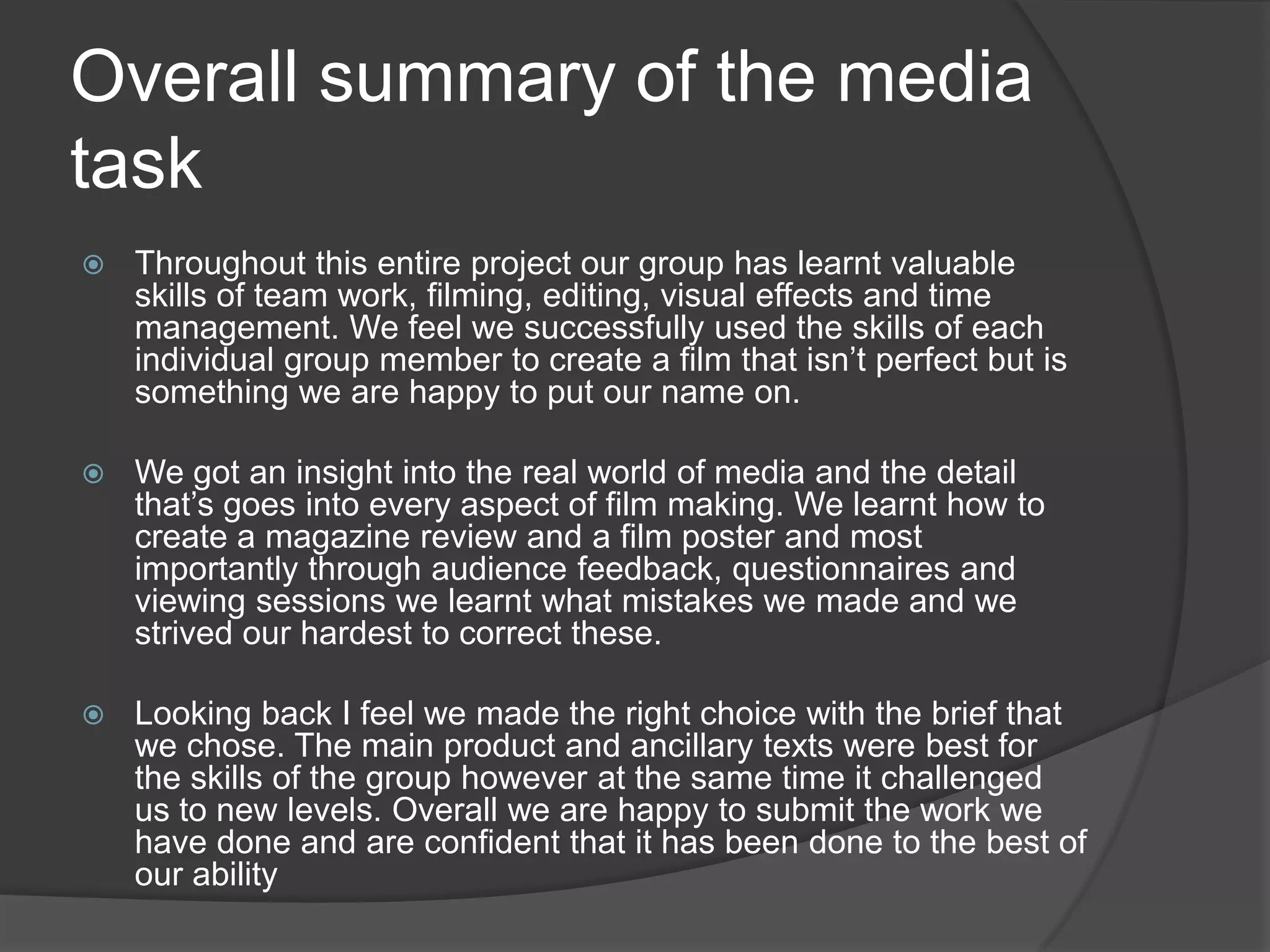
    We useda wide range of technological equipment for the production process including a Canon 5D as our filming equipment, flash (for lighting effects) Nikon D5000, Sony HDR-SR11. Throughout ‘The Pop-Up’ project we used many different media technologies, they all helped us with the construction, research and the evaluation. As you can see we used Microsoft Powerpoint for the evaluation stage. All the software’s used played there own part in the whole entire production of ‘The Pop-Up’Overall summary of the media task Throughout this entire project our group has learnt valuable skills of team work, filming, editing, visual effects and time management. We feel we successfully used the skills of each individual group member to create a film that isn’t perfect but is something we are happy to put our name on.We got an insight into the real world of media and the detail that’s goes into every aspect of film making. We learnt how to create a magazine review and a film poster and most importantly through audience feedback, questionnaires and viewing sessions we learnt what mistakes we made and we strived our hardest to correct these. Looking back I feel we made the right choice with the brief that we chose. The main product and ancillary texts were best for the skills of the group however at the same time it challenged us to new levels. Overall we are happy to submit the work we have done and are confident that it has been done to the best of our ability