Dr. A.P.J. Abdul Kalam Institute of Forensic Science And Criminology
Bundelkhand University Jhansi (U.P.)
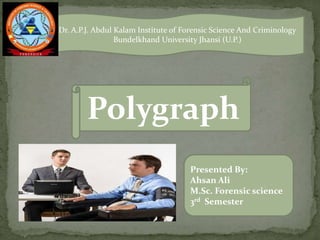
Polygraph
Presented By:
Ahsan Ali
M.Sc. Forensic science
3rd Semester
Polygraph ( Lie Detector )
Cesare lombroso- Invented in 1895 device to measure change
in blood pressure
John Augustus Larson- Invented in 1921. also known as
Father of polygraph He is medical student at the university of
California at Berkely.
Leonarde Keeler- He is co inventer of the polygraph. He
develop the cardio pneumo psychogram. Capable of detection
Deception Technices.
INTRODUCTION
It lliterally means 'many writing’. It is derived from two
Greek words 'poly’ which means many and ‘graphs’ which
means writing.
“A polygraph, popularly referred to as a lie detector test.it
is a device or procedure that measures and records several
physiological indicators such as blood pressure,pulse ,
respiration and skin conductivity while a person is asked
and answeres a series of questions.
Development
In India
In India lie detector or truth verification
technique was introduced first time at Delhi in
central forensics science lab. Under the central
bureau of investigation.
A lie detection division was established in year
1972.
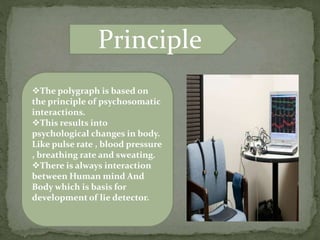
Principle
The polygraph is based on
the principle of psychosomatic
interactions.
This results into
psychological changes in body.
Like pulse rate , blood pressure
, breathing rate and sweating.
There is always interaction
between Human mind And
Body which is basis for
development of lie detector.
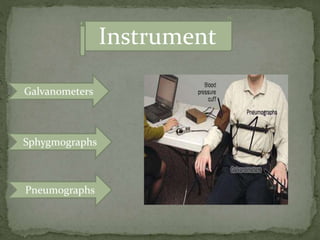
Instrument
Sphygmographs
Galvanometers
Pneumographs
Phases of test
PRE TEST- The examiner discusses the test
issues with the subjects and review the test
question that will be asked.
TESTING PHASE – Subjects psychological
responses are recorded as the subject answers
the question.
POST TEST –Examiner reviews the data
obtained and interprets the polygram.
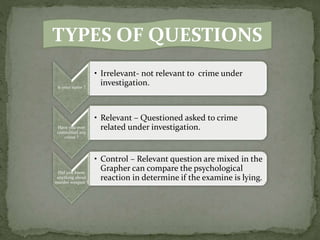
TYPES OF QUESTIONS
Is your name ?
• Irrelevant- not relevant to crime under
investigation.
Have you ever
committed any
crime ?
• Relevant – Questioned asked to crime
related under investigation.
Did you know
anything about
murder weapon ?
• Control – Relevant question are mixed in the
Grapher can compare the psychological
reaction in determine if the examine is lying.
Accuracy
This test Provides 90 – 95 %
Accuracy , with the competent
examiner and good working
condition of machine.
Legal Aspects of
Polygraph test in India
Article 20 ( 3) – Self incrimination ,
no man is bound to witness against
himself.
Who should not take polygraph
test ?
 Person with serious heart
condition.
 Pregnant women.
 Mentally Incompetence.
 Nerve damage or paralysis.
 Any person who has stroke or is
an epileptic ( person who is in pain ,
headache , toothache )
Objectives of test :
 To verify veracity of statement or complaint
 Replace third degree method of interrogation.
 To examine white collar criminals, cyber
criminal etc.
 To differentiating between guilty and
innocent.
REFERENCES
Forensic science in criminal
investigation and trials By B.R. Sharma.
Forensic Psychology sixth edition By
Joanna Pozzulo , Craig Bennel ,
Adelle Forth
Introduction to Forensic And
Criminal Psychology sixth edition
By Dennis howitt.
Thank
you

polygraph ppt Ahsan.pptx

  • 1.
    Dr. A.P.J. AbdulKalam Institute of Forensic Science And Criminology Bundelkhand University Jhansi (U.P.) Polygraph Presented By: Ahsan Ali M.Sc. Forensic science 3rd Semester
  • 2.
    Polygraph ( LieDetector ) Cesare lombroso- Invented in 1895 device to measure change in blood pressure John Augustus Larson- Invented in 1921. also known as Father of polygraph He is medical student at the university of California at Berkely. Leonarde Keeler- He is co inventer of the polygraph. He develop the cardio pneumo psychogram. Capable of detection Deception Technices.
  • 3.
    INTRODUCTION It lliterally means'many writing’. It is derived from two Greek words 'poly’ which means many and ‘graphs’ which means writing. “A polygraph, popularly referred to as a lie detector test.it is a device or procedure that measures and records several physiological indicators such as blood pressure,pulse , respiration and skin conductivity while a person is asked and answeres a series of questions.
  • 4.
    Development In India In Indialie detector or truth verification technique was introduced first time at Delhi in central forensics science lab. Under the central bureau of investigation. A lie detection division was established in year 1972.
  • 5.
    Principle The polygraph isbased on the principle of psychosomatic interactions. This results into psychological changes in body. Like pulse rate , blood pressure , breathing rate and sweating. There is always interaction between Human mind And Body which is basis for development of lie detector.
  • 6.
  • 7.
    Phases of test PRETEST- The examiner discusses the test issues with the subjects and review the test question that will be asked. TESTING PHASE – Subjects psychological responses are recorded as the subject answers the question. POST TEST –Examiner reviews the data obtained and interprets the polygram.
  • 8.
    TYPES OF QUESTIONS Isyour name ? • Irrelevant- not relevant to crime under investigation. Have you ever committed any crime ? • Relevant – Questioned asked to crime related under investigation. Did you know anything about murder weapon ? • Control – Relevant question are mixed in the Grapher can compare the psychological reaction in determine if the examine is lying.
  • 9.
    Accuracy This test Provides90 – 95 % Accuracy , with the competent examiner and good working condition of machine.
  • 10.
    Legal Aspects of Polygraphtest in India Article 20 ( 3) – Self incrimination , no man is bound to witness against himself.
  • 11.
    Who should nottake polygraph test ?  Person with serious heart condition.  Pregnant women.  Mentally Incompetence.  Nerve damage or paralysis.  Any person who has stroke or is an epileptic ( person who is in pain , headache , toothache )
  • 12.
    Objectives of test:  To verify veracity of statement or complaint  Replace third degree method of interrogation.  To examine white collar criminals, cyber criminal etc.  To differentiating between guilty and innocent.
  • 13.
    REFERENCES Forensic science incriminal investigation and trials By B.R. Sharma. Forensic Psychology sixth edition By Joanna Pozzulo , Craig Bennel , Adelle Forth Introduction to Forensic And Criminal Psychology sixth edition By Dennis howitt.
  • 14.