The Plan
What makes a good Plan?
• A thoroughly researched Problem/Introduction--if there's
  nothing wrong in the first place, why come up with a Plan to
  solve it?
• A solid engagement with Theoretical Frameworks--if you
  don't know the bigger reasons behind how and why experts
  tried to solve this Problem, why would anyone listen to you?
• A detailed evaluation of concrete Models of Success--if you
  are going to be proposing something, you'll need to see how
  your own ideas stack up against what is already out there.
• Rigorous fieldwork (this applies to both Problem and
  Paradigm): you can't find everything you need to know
  online or in scholarly journals--there are people on the
  ground who have invaluable knowledge about your subject,
  and your project will not be complete without that
  knowledge.
Cost

• There are several limiting factors to your Plan, and cost is
  the most significant.
• This type of proposal is designed to be narrow in scope and
  low-cost--everything you propose must be justified by
  research and fieldwork.
• Think of $30,000 as your limit, unless you have some very
  good research with Models of Success and funding that
  makes it seem like you could actually raise more money.
• By starting small, you can always grow later on if your
  project works.
Year Zero

• A good way to limit the scope of your Plan but also allow
  room for future possibilities is to think in terms of phases.
• Your proposal is aimed at Year Zero or Phase One. This is
  the stage of the Plan that should be the most thoroughly
  described, with step-by-step procedures for getting it off of
  the ground.
• In other words, if I gave you the money tomorrow, you
  should be able to start spending it to begin your project
  immediately.
• Leave bigger thoughts to future stages, which you may
  include in your Plan, but make sure that you give the most
  detail on how you will get started in that first stage.
Connections - Paradigm
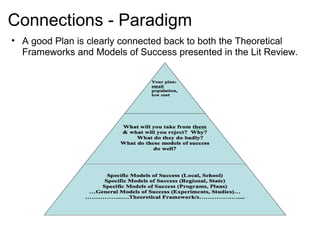
• A good Plan is clearly connected back to both the Theoretical
  Frameworks and Models of Success presented in the Lit Review.
Connections - Problem

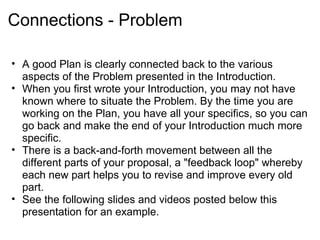
• A good Plan is clearly connected back to the various
  aspects of the Problem presented in the Introduction.
• When you first wrote your Introduction, you may not have
  known where to situate the Problem. By the time you are
  working on the Plan, you have all your specifics, so you can
  go back and make the end of your Introduction much more
  specific.
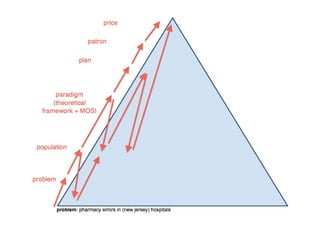
• There is a back-and-forth movement between all the
  different parts of your proposal, a "feedback loop" whereby
  each new part helps you to revise and improve every old
  part.
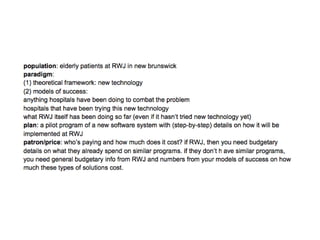
• See the following slides and videos posted below this
  presentation for an example.
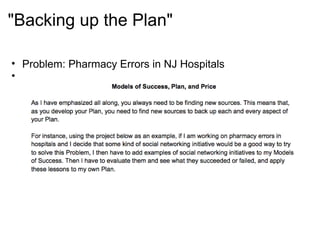
"Backing up the Plan"

• Problem: Pharmacy Errors in NJ Hospitals
•
The Plan
The Plan

The Plan

  • 1.
  • 2.
    What makes agood Plan? • A thoroughly researched Problem/Introduction--if there's nothing wrong in the first place, why come up with a Plan to solve it? • A solid engagement with Theoretical Frameworks--if you don't know the bigger reasons behind how and why experts tried to solve this Problem, why would anyone listen to you? • A detailed evaluation of concrete Models of Success--if you are going to be proposing something, you'll need to see how your own ideas stack up against what is already out there. • Rigorous fieldwork (this applies to both Problem and Paradigm): you can't find everything you need to know online or in scholarly journals--there are people on the ground who have invaluable knowledge about your subject, and your project will not be complete without that knowledge.
  • 3.
    Cost • There areseveral limiting factors to your Plan, and cost is the most significant. • This type of proposal is designed to be narrow in scope and low-cost--everything you propose must be justified by research and fieldwork. • Think of $30,000 as your limit, unless you have some very good research with Models of Success and funding that makes it seem like you could actually raise more money. • By starting small, you can always grow later on if your project works.
  • 4.
    Year Zero • Agood way to limit the scope of your Plan but also allow room for future possibilities is to think in terms of phases. • Your proposal is aimed at Year Zero or Phase One. This is the stage of the Plan that should be the most thoroughly described, with step-by-step procedures for getting it off of the ground. • In other words, if I gave you the money tomorrow, you should be able to start spending it to begin your project immediately. • Leave bigger thoughts to future stages, which you may include in your Plan, but make sure that you give the most detail on how you will get started in that first stage.
  • 5.
    Connections - Paradigm •A good Plan is clearly connected back to both the Theoretical Frameworks and Models of Success presented in the Lit Review.
  • 6.
    Connections - Problem •A good Plan is clearly connected back to the various aspects of the Problem presented in the Introduction. • When you first wrote your Introduction, you may not have known where to situate the Problem. By the time you are working on the Plan, you have all your specifics, so you can go back and make the end of your Introduction much more specific. • There is a back-and-forth movement between all the different parts of your proposal, a "feedback loop" whereby each new part helps you to revise and improve every old part. • See the following slides and videos posted below this presentation for an example.
  • 7.
    "Backing up thePlan" • Problem: Pharmacy Errors in NJ Hospitals •