“ High Performance Collaboration – The Jump to Light Speed " Invited Talk National Center for Supercomputing Applications University of Illinois, Urbana-Champaign Urbana, IL May 4, 2006 Dr. Larry Smarr Director, California Institute for Telecommunications and Information Technology; Harry E. Gruber Professor,  Dept. of Computer Science and Engineering Jacobs School of Engineering, UCSD
Abstract NCSA has been a leader in innovation of new modes of networked collaboration for over fifteen years.  The vision painted in the 1989 Science by Satellite demonstration at Siggraph in which distance becomes eliminated is finally nearing reality.  I will review highlights of NCSA's pioneering work and then describe some recent experiments that Calit2 has been involved in.  With the emergence of dedicated 10 gigabit/s optical backplanes on a planetary scale, the notion of shared telepresence is becoming achievable.
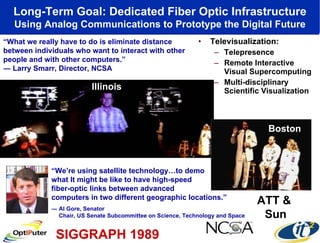
Televisualization: Telepresence Remote Interactive Visual Supercomputing Multi-disciplinary Scientific Visualization Long-Term Goal: Dedicated Fiber Optic Infrastructure  Using Analog Communications to Prototype the Digital Future “ We’re using satellite technology…to demo what It might be like to have high-speed  fiber-optic links between advanced  computers in two different geographic locations.” ― Al Gore, Senator Chair, US Senate Subcommittee on Science, Technology and Space Illinois Boston SIGGRAPH 1989 ATT &  Sun “ What we really have to do is eliminate distance between individuals who want to interact with other people and with other computers.” ― Larry Smarr, Director, NCSA
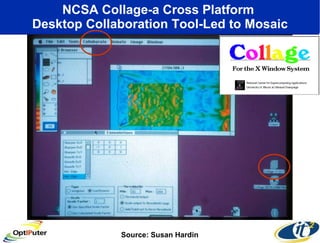
NCSA Collage-a Cross Platform  Desktop Collaboration Tool-Led to Mosaic Source: Susan Hardin
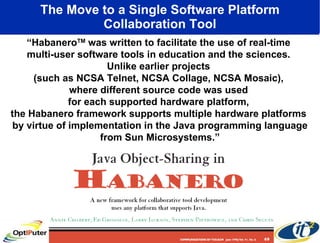
The Move to a Single Software Platform Collaboration Tool “ Habanero TM  was written to facilitate the use of real-time  multi-user software tools in education and the sciences.  Unlike earlier projects  (such as NCSA Telnet, NCSA Collage, NCSA Mosaic),  where different source code was used  for each supported hardware platform,  the Habanero framework supports multiple hardware platforms  by virtue of implementation in the Java programming language from Sun Microsystems.”
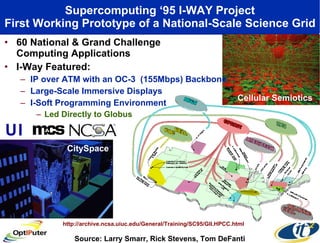
Supercomputing ‘95 I-WAY Project First Working Prototype of a National-Scale Science Grid 60 National & Grand Challenge  Computing Applications I-Way Featured: IP over ATM with an OC-3  (155Mbps) Backbone Large-Scale Immersive Displays I-Soft Programming Environment Led Directly to Globus UIC   http://archive.ncsa.uiuc.edu/General/Training/SC95/GII.HPCC.html CitySpace Cellular Semiotics Source: Larry Smarr, Rick Stevens, Tom DeFanti
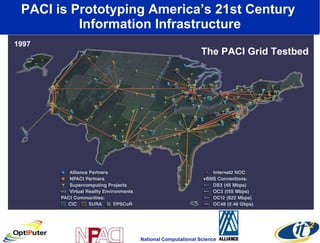
PACI is Prototyping America’s 21st Century  Information Infrastructure The PACI Grid Testbed 1997 National Computational Science
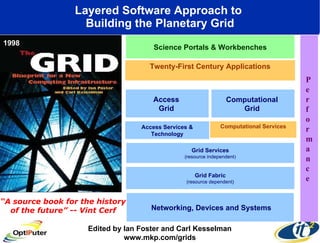
Layered Software Approach to  Building the Planetary Grid Edited by Ian Foster and Carl Kesselman www.mkp.com/grids “ A source book for the history of the future” -- Vint Cerf 1998 Science Portals & Workbenches Twenty-First Century Applications Computational Services P e r f o r m a n c e Networking, Devices and Systems Grid Services (resource independent ) Grid Fabric (resource dependent) Access Services & Technology Access  Grid   Computational  Grid
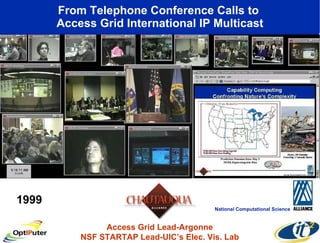
From Telephone Conference Calls to  Access Grid International IP Multicast Access Grid Lead-Argonne NSF STARTAP Lead-UIC’s Elec. Vis. Lab 1999 National Computational Science
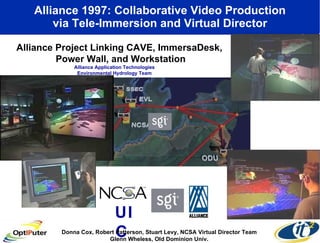
Alliance 1997: Collaborative Video Production via Tele-Immersion and Virtual Director Alliance Project Linking CAVE, ImmersaDesk,  Power Wall, and Workstation UIC   Donna Cox, Robert Patterson, Stuart Levy, NCSA Virtual Director Team Glenn Wheless, Old Dominion Univ. Alliance Application Technologies Environmental Hydrology Team
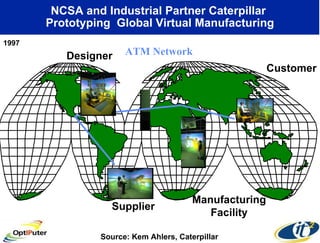
NCSA and Industrial Partner Caterpillar  Prototyping  Global Virtual Manufacturing Customer Manufacturing Facility Supplier Designer ATM Network Source: Kem Ahlers, Caterpillar 1997
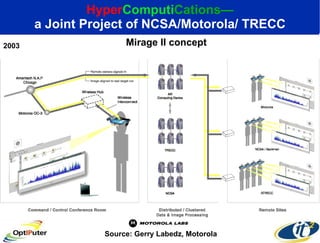
Hyper Computi Cations— a Joint Project of NCSA/Motorola/ TRECC Mirage II concept Source: Gerry Labedz, Motorola 2003
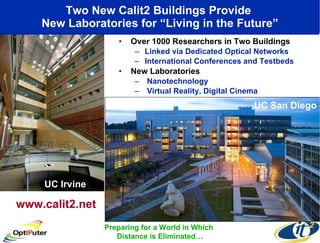
Two New Calit2 Buildings Provide  New Laboratories for “Living in the Future” Over 1000 Researchers in Two Buildings Linked via Dedicated Optical Networks International Conferences and Testbeds New Laboratories Nanotechnology Virtual Reality, Digital Cinema UC Irvine www.calit2.net Preparing for a World in Which  Distance is Eliminated… UC San Diego
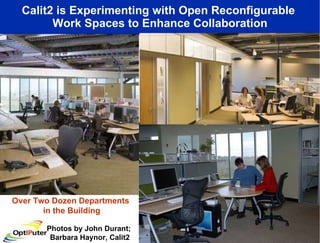
Calit2 is Experimenting with Open Reconfigurable  Work Spaces to Enhance Collaboration Photos by John Durant;  Barbara Haynor, Calit2 Over Two Dozen Departments  in the Building
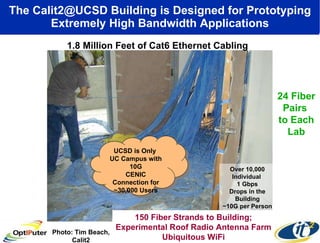
The Calit2@UCSD Building is Designed for Prototyping Extremely High Bandwidth Applications 1.8 Million Feet of Cat6 Ethernet Cabling 150 Fiber Strands to Building; Experimental Roof Radio Antenna Farm Ubiquitous WiFi Photo: Tim Beach, Calit2 Over 10,000 Individual  1 Gbps Drops in the Building ~10G per Person  UCSD is Only  UC Campus with 10G CENIC Connection for ~30,000 Users 24 Fiber Pairs  to Each Lab
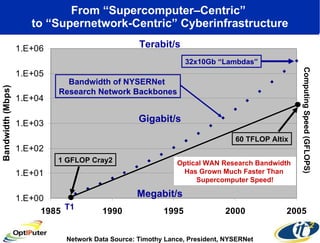
From “Supercomputer–Centric”  to “Supernetwork-Centric” Cyberinfrastructure Megabit/s Gigabit/s Terabit/s Network Data Source: Timothy Lance, President, NYSERNet 32x10Gb “Lambdas” 1 GFLOP Cray2 60 TFLOP Altix Bandwidth of NYSERNet  Research Network Backbones T1 Optical WAN Research Bandwidth  Has Grown Much Faster Than  Supercomputer Speed! Computing Speed (GFLOPS)
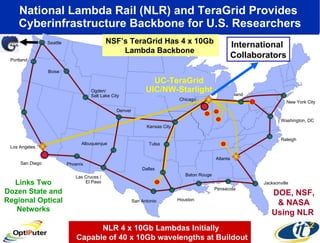
National Lambda Rail (NLR) and TeraGrid Provides  Cyberinfrastructure Backbone for U.S. Researchers NLR 4 x 10Gb Lambdas Initially Capable of 40 x 10Gb wavelengths at Buildout Links Two Dozen State and Regional Optical Networks DOE, NSF, & NASA Using NLR  San Francisco Pittsburgh Cleveland San Diego Los Angeles Portland Seattle Pensacola Baton Rouge Houston San Antonio Las Cruces / El Paso Phoenix New York City Washington, DC Raleigh Jacksonville Dallas Tulsa Atlanta Kansas City Denver Ogden/ Salt Lake City Boise Albuquerque UC-TeraGrid UIC/NW-Starlight Chicago International  Collaborators NSF’s TeraGrid Has 4 x 10Gb  Lambda Backbone
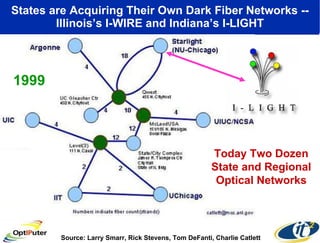
States are Acquiring Their Own Dark Fiber Networks -- Illinois’s I-WIRE and Indiana’s I-LIGHT Source: Larry Smarr, Rick Stevens, Tom DeFanti, Charlie Catlett Today Two Dozen State and Regional Optical Networks 1999
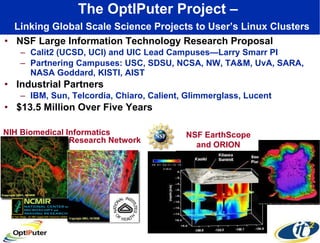
The OptIPuter Project –    Linking Global Scale Science Projects to User’s Linux Clusters NSF Large Information Technology Research Proposal Calit2 (UCSD, UCI) and UIC Lead Campuses—Larry Smarr PI Partnering Campuses: USC, SDSU, NCSA, NW, TA&M, UvA, SARA, NASA Goddard, KISTI, AIST Industrial Partners IBM, Sun, Telcordia, Chiaro, Calient, Glimmerglass, Lucent $13.5 Million Over Five Years NIH Biomedical Informatics NSF EarthScope and ORION Research Network
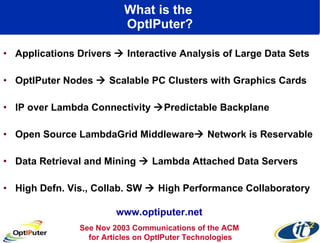
What is the  OptIPuter? Applications Drivers    Interactive Analysis of Large Data Sets OptIPuter Nodes    Scalable PC Clusters with Graphics Cards IP over Lambda Connectivity   Predictable Backplane  Open Source LambdaGrid Middleware   Network is Reservable Data Retrieval and Mining    Lambda Attached Data Servers High Defn. Vis., Collab. SW    High Performance Collaboratory See Nov 2003 Communications of the ACM  for Articles on OptIPuter Technologies www.optiputer.net
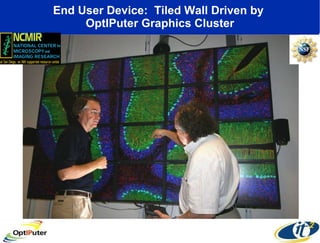
End User Device:  Tiled Wall Driven by  OptIPuter Graphics Cluster
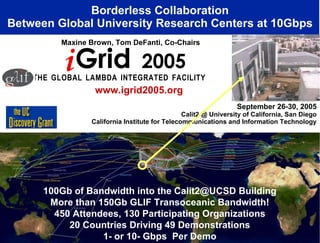
September 26-30, 2005 Calit2 @ University of California, San Diego California Institute for Telecommunications and Information Technology Borderless Collaboration Between Global University Research Centers at 10Gbps T   H   E  G   L   O   B   A   L  L   A   M   B   D   A  I   N   T   E   G   R   A   T   E   D  F   A   C   I   L   I   T   Y   Maxine Brown, Tom DeFanti, Co-Chairs www.igrid2005.org 100Gb of Bandwidth into the Calit2@UCSD Building More than 150Gb GLIF Transoceanic Bandwidth! 450 Attendees, 130 Participating Organizations 20 Countries Driving 49 Demonstrations 1- or 10- Gbps  Per Demo i Grid  2005
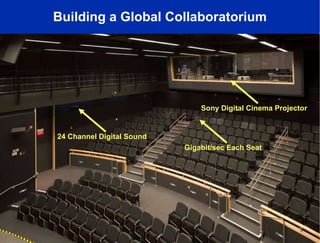
Building a Global Collaboratorium Sony Digital Cinema Projector 24 Channel Digital Sound Gigabit/sec Each Seat
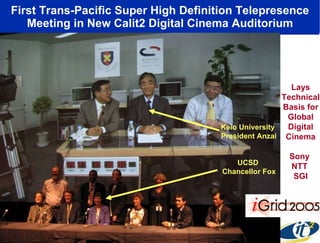
First Trans-Pacific Super High Definition Telepresence Meeting in New Calit2 Digital Cinema Auditorium Lays Technical Basis for Global Digital Cinema Sony  NTT  SGI Keio University  President Anzai UCSD  Chancellor Fox
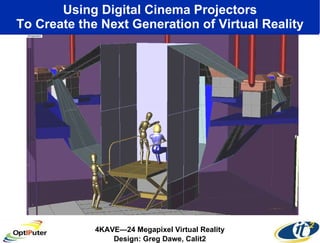
Using Digital Cinema Projectors To Create the Next Generation of Virtual Reality 4KAVE—24 Megapixel Virtual Reality Design: Greg Dawe, Calit2
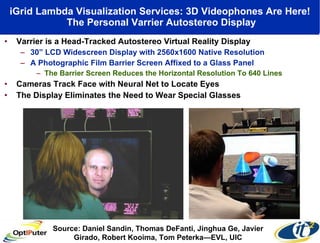
iGrid Lambda Visualization Services: 3D Videophones Are Here!  The Personal Varrier Autostereo Display Varrier is a Head-Tracked Autostereo Virtual Reality Display 30” LCD Widescreen Display with 2560x1600 Native Resolution A Photographic Film Barrier Screen Affixed to a Glass Panel  The Barrier Screen Reduces the Horizontal Resolution To 640 Lines  Cameras Track Face with Neural Net to Locate Eyes The Display Eliminates the Need to Wear Special Glasses Source: Daniel Sandin, Thomas DeFanti, Jinghua Ge, Javier Girado, Robert Kooima, Tom Peterka—EVL, UIC
PI Larry Smarr
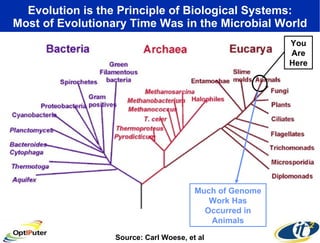
Evolution is the Principle of Biological Systems: Most of Evolutionary Time Was in the Microbial World Source: Carl Woese, et al You Are Here Much of Genome Work Has Occurred in Animals
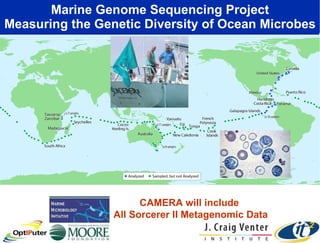
Marine Genome Sequencing Project Measuring the Genetic Diversity of Ocean Microbes CAMERA will include  All Sorcerer II Metagenomic Data
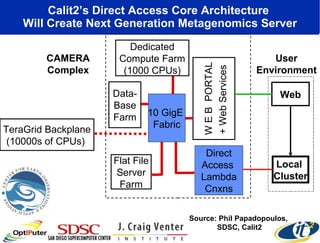
Calit2’s Direct Access Core Architecture  Will Create Next Generation Metagenomics Server Source: Phil Papadopoulos,  SDSC, Calit2 + Web Services User Environment CAMERA Complex Flat File Server Farm TeraGrid Backplane (10000s of CPUs)  W E B  PORTAL Web Local  Cluster Direct Access  Lambda Cnxns Dedicated Compute Farm (1000 CPUs) Data- Base Farm 10 GigE  Fabric
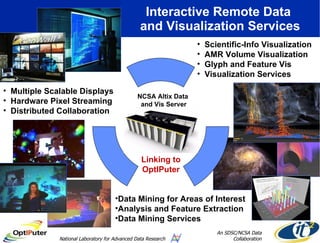
Interactive Remote Data  and Visualization Services Multiple Scalable Displays Hardware Pixel Streaming Distributed Collaboration Scientific-Info Visualization AMR Volume Visualization Glyph and Feature Vis Visualization Services Data Mining for Areas of Interest Analysis and Feature Extraction Data Mining Services NCSA Altix Data  and Vis Server Linking to OptIPuter An SDSC/NCSA Data Collaboration National Laboratory for Advanced Data Research
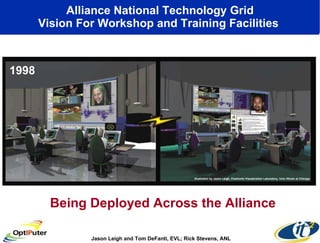
Alliance National Technology Grid Vision For Workshop and Training Facilities  Being Deployed Across the Alliance Jason Leigh and Tom DeFanti, EVL; Rick Stevens, ANL 1998
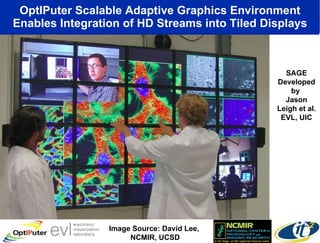
OptIPuter Scalable Adaptive Graphics Environment Enables Integration of HD Streams into Tiled Displays Image Source: David Lee,  NCMIR, UCSD SAGE Developed by  Jason Leigh et al. EVL, UIC
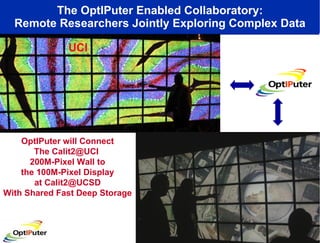
The OptIPuter Enabled Collaboratory: Remote Researchers Jointly Exploring Complex Data OptIPuter will Connect The Calit2@UCI  200M-Pixel Wall to the 100M-Pixel Display at Calit2@UCSD With Shared Fast Deep Storage “ SunScreen” Run by Sun Opteron Cluster UCI UCSD
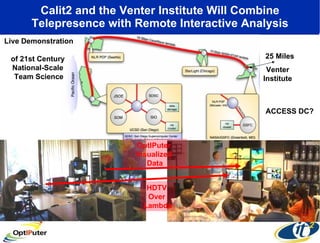
Calit2 and the Venter Institute Will Combine Telepresence with Remote Interactive Analysis Live Demonstration  of 21st Century  National-Scale  Team Science ACCESS DC? OptIPuter  Visualized  Data HDTV  Over  Lambda 25 Miles Venter Institute
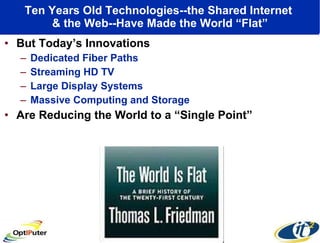
Ten Years Old Technologies--the Shared Internet  & the Web--Have Made the World “Flat” But Today’s Innovations Dedicated Fiber Paths Streaming HD TV Large Display Systems Massive Computing and Storage Are Reducing the World to a “Single Point”

High Performance Collaboration – The Jump to Light Speed

  • 1.
    “ High PerformanceCollaboration – The Jump to Light Speed " Invited Talk National Center for Supercomputing Applications University of Illinois, Urbana-Champaign Urbana, IL May 4, 2006 Dr. Larry Smarr Director, California Institute for Telecommunications and Information Technology; Harry E. Gruber Professor, Dept. of Computer Science and Engineering Jacobs School of Engineering, UCSD
  • 2.
    Abstract NCSA hasbeen a leader in innovation of new modes of networked collaboration for over fifteen years. The vision painted in the 1989 Science by Satellite demonstration at Siggraph in which distance becomes eliminated is finally nearing reality. I will review highlights of NCSA's pioneering work and then describe some recent experiments that Calit2 has been involved in. With the emergence of dedicated 10 gigabit/s optical backplanes on a planetary scale, the notion of shared telepresence is becoming achievable.
  • 3.
    Televisualization: Telepresence RemoteInteractive Visual Supercomputing Multi-disciplinary Scientific Visualization Long-Term Goal: Dedicated Fiber Optic Infrastructure Using Analog Communications to Prototype the Digital Future “ We’re using satellite technology…to demo what It might be like to have high-speed fiber-optic links between advanced computers in two different geographic locations.” ― Al Gore, Senator Chair, US Senate Subcommittee on Science, Technology and Space Illinois Boston SIGGRAPH 1989 ATT & Sun “ What we really have to do is eliminate distance between individuals who want to interact with other people and with other computers.” ― Larry Smarr, Director, NCSA
  • 4.
    NCSA Collage-a CrossPlatform Desktop Collaboration Tool-Led to Mosaic Source: Susan Hardin
  • 5.
    The Move toa Single Software Platform Collaboration Tool “ Habanero TM was written to facilitate the use of real-time multi-user software tools in education and the sciences. Unlike earlier projects (such as NCSA Telnet, NCSA Collage, NCSA Mosaic), where different source code was used for each supported hardware platform, the Habanero framework supports multiple hardware platforms by virtue of implementation in the Java programming language from Sun Microsystems.”
  • 6.
    Supercomputing ‘95 I-WAYProject First Working Prototype of a National-Scale Science Grid 60 National & Grand Challenge Computing Applications I-Way Featured: IP over ATM with an OC-3 (155Mbps) Backbone Large-Scale Immersive Displays I-Soft Programming Environment Led Directly to Globus UIC http://archive.ncsa.uiuc.edu/General/Training/SC95/GII.HPCC.html CitySpace Cellular Semiotics Source: Larry Smarr, Rick Stevens, Tom DeFanti
  • 7.
    PACI is PrototypingAmerica’s 21st Century Information Infrastructure The PACI Grid Testbed 1997 National Computational Science
  • 8.
    Layered Software Approachto Building the Planetary Grid Edited by Ian Foster and Carl Kesselman www.mkp.com/grids “ A source book for the history of the future” -- Vint Cerf 1998 Science Portals & Workbenches Twenty-First Century Applications Computational Services P e r f o r m a n c e Networking, Devices and Systems Grid Services (resource independent ) Grid Fabric (resource dependent) Access Services & Technology Access Grid Computational Grid
  • 9.
    From Telephone ConferenceCalls to Access Grid International IP Multicast Access Grid Lead-Argonne NSF STARTAP Lead-UIC’s Elec. Vis. Lab 1999 National Computational Science
  • 10.
    Alliance 1997: CollaborativeVideo Production via Tele-Immersion and Virtual Director Alliance Project Linking CAVE, ImmersaDesk, Power Wall, and Workstation UIC Donna Cox, Robert Patterson, Stuart Levy, NCSA Virtual Director Team Glenn Wheless, Old Dominion Univ. Alliance Application Technologies Environmental Hydrology Team
  • 11.
    NCSA and IndustrialPartner Caterpillar Prototyping Global Virtual Manufacturing Customer Manufacturing Facility Supplier Designer ATM Network Source: Kem Ahlers, Caterpillar 1997
  • 12.
    Hyper Computi Cations—a Joint Project of NCSA/Motorola/ TRECC Mirage II concept Source: Gerry Labedz, Motorola 2003
  • 13.
    Two New Calit2Buildings Provide New Laboratories for “Living in the Future” Over 1000 Researchers in Two Buildings Linked via Dedicated Optical Networks International Conferences and Testbeds New Laboratories Nanotechnology Virtual Reality, Digital Cinema UC Irvine www.calit2.net Preparing for a World in Which Distance is Eliminated… UC San Diego
  • 14.
    Calit2 is Experimentingwith Open Reconfigurable Work Spaces to Enhance Collaboration Photos by John Durant; Barbara Haynor, Calit2 Over Two Dozen Departments in the Building
  • 15.
    The Calit2@UCSD Buildingis Designed for Prototyping Extremely High Bandwidth Applications 1.8 Million Feet of Cat6 Ethernet Cabling 150 Fiber Strands to Building; Experimental Roof Radio Antenna Farm Ubiquitous WiFi Photo: Tim Beach, Calit2 Over 10,000 Individual 1 Gbps Drops in the Building ~10G per Person UCSD is Only UC Campus with 10G CENIC Connection for ~30,000 Users 24 Fiber Pairs to Each Lab
  • 16.
    From “Supercomputer–Centric” to “Supernetwork-Centric” Cyberinfrastructure Megabit/s Gigabit/s Terabit/s Network Data Source: Timothy Lance, President, NYSERNet 32x10Gb “Lambdas” 1 GFLOP Cray2 60 TFLOP Altix Bandwidth of NYSERNet Research Network Backbones T1 Optical WAN Research Bandwidth Has Grown Much Faster Than Supercomputer Speed! Computing Speed (GFLOPS)
  • 17.
    National Lambda Rail(NLR) and TeraGrid Provides Cyberinfrastructure Backbone for U.S. Researchers NLR 4 x 10Gb Lambdas Initially Capable of 40 x 10Gb wavelengths at Buildout Links Two Dozen State and Regional Optical Networks DOE, NSF, & NASA Using NLR San Francisco Pittsburgh Cleveland San Diego Los Angeles Portland Seattle Pensacola Baton Rouge Houston San Antonio Las Cruces / El Paso Phoenix New York City Washington, DC Raleigh Jacksonville Dallas Tulsa Atlanta Kansas City Denver Ogden/ Salt Lake City Boise Albuquerque UC-TeraGrid UIC/NW-Starlight Chicago International Collaborators NSF’s TeraGrid Has 4 x 10Gb Lambda Backbone
  • 18.
    States are AcquiringTheir Own Dark Fiber Networks -- Illinois’s I-WIRE and Indiana’s I-LIGHT Source: Larry Smarr, Rick Stevens, Tom DeFanti, Charlie Catlett Today Two Dozen State and Regional Optical Networks 1999
  • 19.
    The OptIPuter Project– Linking Global Scale Science Projects to User’s Linux Clusters NSF Large Information Technology Research Proposal Calit2 (UCSD, UCI) and UIC Lead Campuses—Larry Smarr PI Partnering Campuses: USC, SDSU, NCSA, NW, TA&M, UvA, SARA, NASA Goddard, KISTI, AIST Industrial Partners IBM, Sun, Telcordia, Chiaro, Calient, Glimmerglass, Lucent $13.5 Million Over Five Years NIH Biomedical Informatics NSF EarthScope and ORION Research Network
  • 20.
    What is the OptIPuter? Applications Drivers  Interactive Analysis of Large Data Sets OptIPuter Nodes  Scalable PC Clusters with Graphics Cards IP over Lambda Connectivity  Predictable Backplane Open Source LambdaGrid Middleware  Network is Reservable Data Retrieval and Mining  Lambda Attached Data Servers High Defn. Vis., Collab. SW  High Performance Collaboratory See Nov 2003 Communications of the ACM for Articles on OptIPuter Technologies www.optiputer.net
  • 21.
    End User Device: Tiled Wall Driven by OptIPuter Graphics Cluster
  • 22.
    September 26-30, 2005Calit2 @ University of California, San Diego California Institute for Telecommunications and Information Technology Borderless Collaboration Between Global University Research Centers at 10Gbps T H E G L O B A L L A M B D A I N T E G R A T E D F A C I L I T Y Maxine Brown, Tom DeFanti, Co-Chairs www.igrid2005.org 100Gb of Bandwidth into the Calit2@UCSD Building More than 150Gb GLIF Transoceanic Bandwidth! 450 Attendees, 130 Participating Organizations 20 Countries Driving 49 Demonstrations 1- or 10- Gbps Per Demo i Grid 2005
  • 23.
    Building a GlobalCollaboratorium Sony Digital Cinema Projector 24 Channel Digital Sound Gigabit/sec Each Seat
  • 24.
    First Trans-Pacific SuperHigh Definition Telepresence Meeting in New Calit2 Digital Cinema Auditorium Lays Technical Basis for Global Digital Cinema Sony NTT SGI Keio University President Anzai UCSD Chancellor Fox
  • 25.
    Using Digital CinemaProjectors To Create the Next Generation of Virtual Reality 4KAVE—24 Megapixel Virtual Reality Design: Greg Dawe, Calit2
  • 26.
    iGrid Lambda VisualizationServices: 3D Videophones Are Here! The Personal Varrier Autostereo Display Varrier is a Head-Tracked Autostereo Virtual Reality Display 30” LCD Widescreen Display with 2560x1600 Native Resolution A Photographic Film Barrier Screen Affixed to a Glass Panel The Barrier Screen Reduces the Horizontal Resolution To 640 Lines Cameras Track Face with Neural Net to Locate Eyes The Display Eliminates the Need to Wear Special Glasses Source: Daniel Sandin, Thomas DeFanti, Jinghua Ge, Javier Girado, Robert Kooima, Tom Peterka—EVL, UIC
  • 27.
  • 28.
    Evolution is thePrinciple of Biological Systems: Most of Evolutionary Time Was in the Microbial World Source: Carl Woese, et al You Are Here Much of Genome Work Has Occurred in Animals
  • 29.
    Marine Genome SequencingProject Measuring the Genetic Diversity of Ocean Microbes CAMERA will include All Sorcerer II Metagenomic Data
  • 30.
    Calit2’s Direct AccessCore Architecture Will Create Next Generation Metagenomics Server Source: Phil Papadopoulos, SDSC, Calit2 + Web Services User Environment CAMERA Complex Flat File Server Farm TeraGrid Backplane (10000s of CPUs) W E B PORTAL Web Local Cluster Direct Access Lambda Cnxns Dedicated Compute Farm (1000 CPUs) Data- Base Farm 10 GigE Fabric
  • 31.
    Interactive Remote Data and Visualization Services Multiple Scalable Displays Hardware Pixel Streaming Distributed Collaboration Scientific-Info Visualization AMR Volume Visualization Glyph and Feature Vis Visualization Services Data Mining for Areas of Interest Analysis and Feature Extraction Data Mining Services NCSA Altix Data and Vis Server Linking to OptIPuter An SDSC/NCSA Data Collaboration National Laboratory for Advanced Data Research
  • 32.
    Alliance National TechnologyGrid Vision For Workshop and Training Facilities Being Deployed Across the Alliance Jason Leigh and Tom DeFanti, EVL; Rick Stevens, ANL 1998
  • 33.
    OptIPuter Scalable AdaptiveGraphics Environment Enables Integration of HD Streams into Tiled Displays Image Source: David Lee, NCMIR, UCSD SAGE Developed by Jason Leigh et al. EVL, UIC
  • 34.
    The OptIPuter EnabledCollaboratory: Remote Researchers Jointly Exploring Complex Data OptIPuter will Connect The Calit2@UCI 200M-Pixel Wall to the 100M-Pixel Display at Calit2@UCSD With Shared Fast Deep Storage “ SunScreen” Run by Sun Opteron Cluster UCI UCSD
  • 35.
    Calit2 and theVenter Institute Will Combine Telepresence with Remote Interactive Analysis Live Demonstration of 21st Century National-Scale Team Science ACCESS DC? OptIPuter Visualized Data HDTV Over Lambda 25 Miles Venter Institute
  • 36.
    Ten Years OldTechnologies--the Shared Internet & the Web--Have Made the World “Flat” But Today’s Innovations Dedicated Fiber Paths Streaming HD TV Large Display Systems Massive Computing and Storage Are Reducing the World to a “Single Point”