Zero Trust Commandments
THE rules of the road
Mark Simos
Zero Trust Architecture Forum Co-Chair
Lead Cybersecurity Architect, Microsoft
aka.ms/markslist
Also co-authors of Zero Trust Playbook
(ZeroTrustPlaybook.com)
20% Discount: 20ZERO
Nikhil Kumar
Zero Trust Architecture Forum Co-Chair
Founder and President, ApTSi
email: nikhil@ap-tech-solns.com
LinkedIn: https://www.linkedin.com/in/nikhilkumar/
Agenda
• Zero Trust Overview
• Core Challenges of Security and Zero Trust
• Zero Trust Commandments
Applying them in practice across IT/OT/IoT
Enabling sustainability and sustainable security
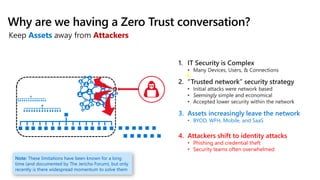
Why are we having a Zero Trust conversation?
3. Assets increasingly leave the network
• BYOD, WFH, Mobile, and SaaS
4. Attackers shift to identity attacks
• Phishing and credential theft
• Security teams often overwhelmed
Note: These limitations have been known for a long
time (and documented by The Jericho Forum), but only
recently is there widespread momentum to solve them
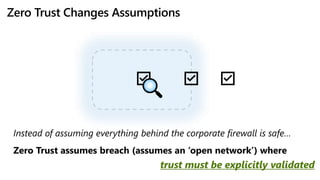
Zero Trust Changes Assumptions
trust must be explicitly validated
Key Industry Guidance
The Open Group
Focused on integration
with business and
IT/Enterprise/Security
architecture
US National Institute
of Standards and
Technology (NIST)
Focused on architecture
and implementation with
available technology
Many other organizations are contributing valuable perspectives and guidance like the Cybersecurity
and Infrastructure Security Agency (CISA), Cloud Security Alliance (CSA), and some technology vendors
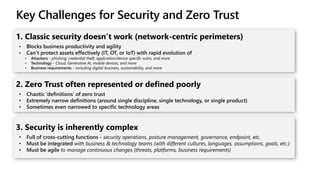
Key Challenges for Security and Zero Trust
• Attackers - phishing, credential theft, application/device specific vulns, and more
• Technology - Cloud, Generative AI, mobile devices, and more
• Business requirements - including digital business, sustainability, and more
• Full of cross-cutting functions - security operations, posture management, governance, endpoint, etc.
• Must be integrated with business & technology teams (with different cultures, languages, assumptions, goals, etc.)
• Must be agile to manage continuous changes (threats, platforms, business requirements)
• Chaotic ‘definitions’ of zero trust
• Extremely narrow definitions (around single discipline, single technology, or single product)
• Sometimes even narrowed to specific technology areas
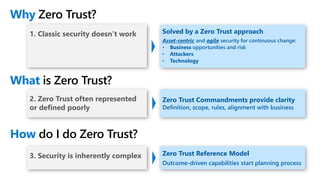
1. Classic security doesn’t work
3. Security is inherently complex
2. Zero Trust often represented
or defined poorly
Zero Trust Commandments provide clarity
Definition, scope, rules, alignment with business
Solved by a Zero Trust approach
Asset-centric and agile security for continuous change:
• Business opportunities and risk
• Attackers
• Technology
Zero Trust Reference Model
Outcome-driven capabilities start planning process
Why Zero Trust?
What is Zero Trust?
How do I do Zero Trust?
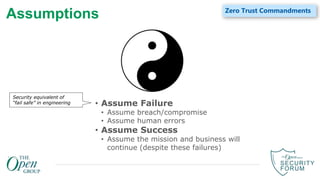
Assumptions
• Assume Failure
• Assume breach/compromise
• Assume human errors
• Assume Success
• Assume the mission and business will
continue (despite these failures)
Security equivalent of
“fail safe” in engineering
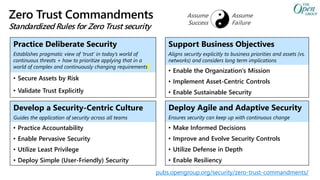
Zero Trust Commandments
Standardized Rules for Zero Trust security
Practice Deliberate Security
Establishes pragmatic view of ‘trust’ in today’s world of
continuous threats + how to prioritize applying that in a
world of complex and continuously changing requirements
• Secure Assets by Risk
• Validate Trust Explicitly
Develop a Security-Centric Culture
Guides the application of security across all teams
• Practice Accountability
• Enable Pervasive Security
• Utilize Least Privilege
• Deploy Simple (User-Friendly) Security
Support Business Objectives
Aligns security explicitly to business priorities and assets (vs.
networks) and considers long term implications
• Enable the Organization’s Mission
• Implement Asset-Centric Controls
• Enable Sustainable Security
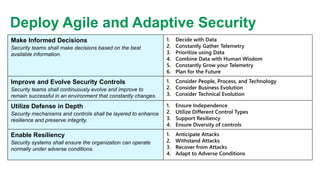
Deploy Agile and Adaptive Security
Ensures security can keep up with continuous change
• Make Informed Decisions
• Improve and Evolve Security Controls
• Utilize Defense in Depth
• Enable Resiliency
pubs.opengroup.org/security/zero-trust-commandments/
Assume
Failure
Assume
Success
Practice Deliberate Security
Secure Assets by Risk
Security controls shall be designed to protect
business assets appropriate to required
security posture, business value, and
associated risk.
1. Map Technology to Business
2. Classify Information Assets –
3. Increase Security for Sensitive Assets
4. Reduce Unneeded Sensitivity
5. Stay Current
Validate Trust Explicitly
Security assurance shall rely on explicitly
validating trust decisions using all relevant
available information and telemetry
1. Verify Access Control
2. Verify Application Development.
3. Verify Technology Supply Chain
4. Verify Asset Configuration
5. Verify Incident Processes
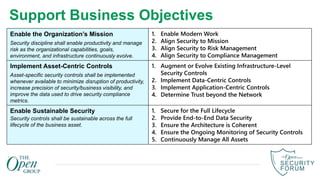
Support Business Objectives
Enable the Organization’s Mission
Security discipline shall enable productivity and manage
risk as the organizational capabilities, goals,
environment, and infrastructure continuously evolve.
1. Enable Modern Work
2. Align Security to Mission
3. Align Security to Risk Management
4. Align Security to Compliance Management
Implement Asset-Centric Controls
Asset-specific security controls shall be implemented
whenever available to minimize disruption of productivity,
increase precision of security/business visibility, and
improve the data used to drive security compliance
metrics.
1. Augment or Evolve Existing Infrastructure-Level
Security Controls
2. Implement Data-Centric Controls
3. Implement Application-Centric Controls
4. Determine Trust beyond the Network
Enable Sustainable Security
Security controls shall be sustainable across the full
lifecycle of the business asset.
1. Secure for the Full Lifecycle
2. Provide End-to-End Data Security
3. Ensure the Architecture is Coherent
4. Ensure the Ongoing Monitoring of Security Controls
5. Continuously Manage All Assets
Develop a Security-Centric Culture
Practice Accountability
The entities responsible for accessing and handling assets
shall be responsible for their protection and survival throughout
their lifetime.
1. Assign Asset Ownership
2. Ensure Understanding of Ownership
3. Define Security Impact Correctly
4. Assign Security Risk to Organizational Leadership
5. Assign Security Risk to Asset Owners
Enable Pervasive Security
Security discipline shall be explicitly included in the culture,
norms, and processes throughout the organization.
1. Integrate in Business Environment
2. Integrate in Technical Environment
3. Incorporate Security Education and Awareness Training
4. Apply Security to the Organization's Ecosystem
Utilize Least Privilege
Access to systems and data shall be provided only as required,
and access shall be removed when no longer required.
1. Grant Just Enough Access
2. Grant Just-in-Time Access
3. Utilize Adaptive Access
Deploy Simple (User-Friendly) Security
Security mechanisms shall be as simple and user-friendly as
possible while retaining functionality and remaining pervasive,
practicable, and scalable.
1. Simplify Human Experience
2. Simplify Security
3. Provide Clarity
4. Configure before Customize
5. Enable Salability
6. Combine Building Blocks
Make Informed Decisions
Security teams shall make decisions based on the best
available information.
1. Decide with Data
2. Constantly Gather Telemetry
3. Prioritize using Data
4. Combine Data with Human Wisdom
5. Constantly Grow your Telemetry
6. Plan for the Future
Improve and Evolve Security Controls
Security teams shall continuously evolve and improve to
remain successful in an environment that constantly changes.
1. Consider People, Process, and Technology
2. Consider Business Evolution
3. Consider Technical Evolution
Utilize Defense in Depth
Security mechanisms and controls shall be layered to enhance
resilience and preserve integrity.
1. Ensure Independence
2. Utilize Different Control Types
3. Support Resiliency
4. Ensure Diversity of controls
Enable Resiliency
Security systems shall ensure the organization can operate
normally under adverse conditions.
1. Anticipate Attacks
2. Withstand Attacks
3. Recover from Attacks
4. Adapt to Adverse Conditions
Deploy Agile and Adaptive Security
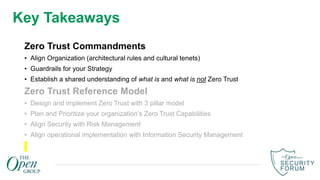
Key Takeaways
Zero Trust Commandments
• Align Organization (architectural rules and cultural tenets)
• Guardrails for your Strategy
• Establish a shared understanding of what is and what is not Zero Trust
Zero Trust Reference Model
• Design and implement Zero Trust with 3 pillar model
• Plan and Prioritize your organization’s Zero Trust Capabilities
• Align Security with Risk Management
• Align operational implementation with Information Security Management
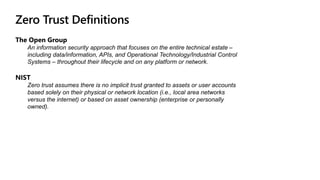
Zero Trust Definitions
An information security approach that focuses on the entire technical estate –
including data/information, APIs, and Operational Technology/Industrial Control
Systems – throughout their lifecycle and on any platform or network.
Zero trust assumes there is no implicit trust granted to assets or user accounts
based solely on their physical or network location (i.e., local area networks
versus the internet) or based on asset ownership (enterprise or personally
owned).
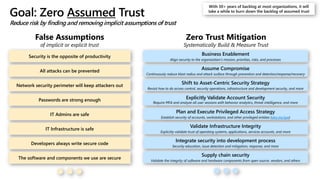
Security is the opposite of productivity Business Enablement
Align security to the organization’s mission, priorities, risks, and processes
Assume Compromise
Continuously reduce blast radius and attack surface through prevention and detection/response/recovery
All attacks can be prevented
Shift to Asset-Centric Security Strategy
Revisit how to do access control, security operations, infrastructure and development security, and more
Explicitly Validate Account Security
Require MFA and analyze all user sessions with behavior analytics, threat intelligence, and more
Network security perimeter will keep attackers out
Passwords are strong enough
IT Admins are safe
IT Infrastructure is safe
Goal: Zero Assumed Trust
Reduce risk by finding and removing implicit assumptions of trust
Developers always write secure code
The software and components we use are secure
Plan and Execute Privileged Access Strategy
Establish security of accounts, workstations, and other privileged entities (aka.ms/spa)
Validate Infrastructure Integrity
Explicitly validate trust of operating systems, applications, services accounts, and more
Integrate security into development process
Security education, issue detection and mitigation, response, and more
Supply chain security
Validate the integrity of software and hardware components from open source. vendors, and others
False Assumptions
of implicit or explicit trust
Zero Trust Mitigation
Systematically Build & Measure Trust
With 30+ years of backlog at most organizations, it will
take a while to burn down the backlog of assumed trust
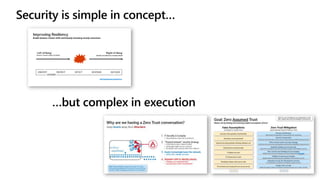
Security is simple in concept…
…but complex in execution
Improving Resiliency
Enable business mission while continuously increasing security assurances
IDENTIFY PROTECT DETECT RESPOND RECOVER
GOVERN
‘Left of Bang’
Prevent or lessen impact of attacks
‘Right of Bang’
Rapidly and effectively manage attacks
NIST Cybersecurity Framework v2
Security reduces risk
Security risk affects the whole organization, not just an individual workload/project
Security reduces chances that bad things happen + reduces damage when they do
Security problems are created by human attackers
Adversaries have a motivation (mission, profit, recognition/promotion/etc. from boss)
Adversaries have a model (espionage, data theft, extortion, ransomware, multiple, etc.)
Security teams have unique culture and history
Mission driven, deeply care about the organization, and often ignored 
…but have been overly technical/network focused for a long time
Overview – Security Truths and Observations
Zero Trust Reference Model
Mark Simos
Zero Trust Architecture Forum Co-Chair
Lead Cybersecurity Architect, Microsoft
aka.ms/markslist
Also co-authors of Zero Trust Playbook
(ZeroTrustPlaybook.com)
20% Discount: 20ZERO
Nikhil Kumar
Zero Trust Architecture Forum Co-Chair
Founder and President, ApTSi
email: nikhil@ap-tech-solns.com
LinkedIn: https://www.linkedin.com/in/nikhilkumar/
Agenda
• Security Challenges
• Zero Trust Components
• Zero Trust Capabilities
• Zero Trust Integration and Adoption
• Early Case Studies: Microsoft, Zero Trust Playbook
• Key Takeaways
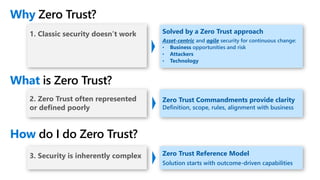
1. Classic security doesn’t work
3. Security is inherently complex
2. Zero Trust often represented
or defined poorly
Zero Trust Commandments provide clarity
Definition, scope, rules, alignment with business
Solved by a Zero Trust approach
Asset-centric and agile security for continuous change:
• Business opportunities and risk
• Attackers
• Technology
Zero Trust Reference Model
Solution starts with outcome-driven capabilities
Why Zero Trust?
What is Zero Trust?
How do I do Zero Trust?
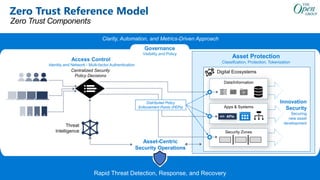
Zero Trust Reference Model
Digital Ecosystems
Zero Trust Components
Data/Information
Apps & Systems
Security Zones
Distributed Policy
Enforcement Points (PEPs)
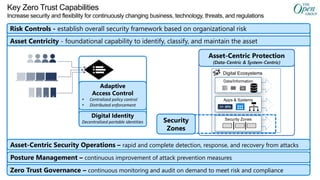
Key Zero Trust Capabilities
Increase security and flexibility for continuously changing business, technology, threats, and regulations
Posture Management – continuous improvement of attack prevention measures
Asset-Centric Protection
(Data-Centric & System-Centric)
Risk Controls - establish overall security framework based on organizational risk
Asset-Centric Security Operations – rapid and complete detection, response, and recovery from attacks
Digital Ecosystems
Data/Information
Apps & Systems
Security Zones
Adaptive
Access Control
• Centralized policy control
• Distributed enforcement
Digital Identity
Decentralized portable identities
Zero Trust Governance – continuous monitoring and audit on demand to meet risk and compliance
Security
Zones
Asset Centricity - foundational capability to identify, classify, and maintain the asset
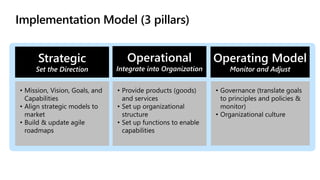
Implementation Model (3 pillars)
Operational Operating Model
Strategic
• Mission, Vision, Goals, and
Capabilities
• Align strategic models to
market
• Build & update agile
roadmaps
• Provide products (goods)
and services
• Set up organizational
structure
• Set up functions to enable
capabilities
• Governance (translate goals
to principles and policies &
monitor)
• Organizational culture
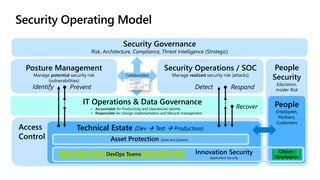
People
Security
Education,
Insider Risk
Access
Control
Technical Estate (Dev  Test  Production)
Security Operating Model
Posture Management
Manage potential security risk
(vulnerabilities)
Security Operations / SOC
Manage realized security risk (attacks)
IT Operations & Data Governance
Detect Respond
Recover
Prevent
Identify
• Accountable for Productivity and Operational Uptime
• Responsible for change implementation and lifecycle management
Collaboration
Security Governance
Risk, Architecture, Compliance, Threat Intelligence (Strategic)
People
Employees,
Partners,
Customers
Innovation Security
Application Security
Citizen
Developers
DevOps Teams
Asset Protection (Data and Systems)
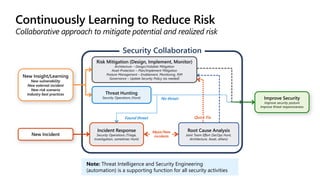
PostureManagement
Continuously Learning to Reduce Risk
Collaborative approach to mitigate potential and realized risk
No threat
Found threat
Security Collaboration
Quick Fix
Major/New
incidents
Note: Threat Intelligence and Security Engineering
(automation) is a supporting function for all security activities
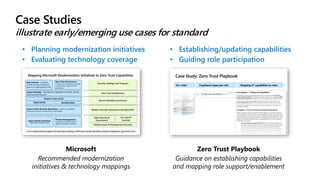
Case Studies
illustrate early/emerging use cases for standard
• Planning modernization initiatives
• Evaluating technology coverage
• Establishing/updating capabilities
• Guiding role participation
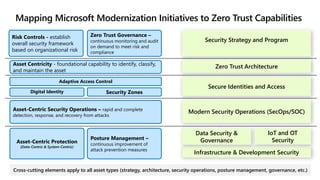
Mapping Microsoft Modernization Initiatives to Zero Trust Capabilities
Cross-cutting elements apply to all asset types (strategy, architecture, security operations, posture management, governance, etc.)
Secure Identities and Access
Modern Security Operations (SecOps/SOC)
Infrastructure & Development Security
Data Security &
Governance
IoT and OT
Security
Security Strategy and Program
Zero Trust Architecture
Risk Controls - establish
overall security framework
based on organizational risk
Asset Centricity - foundational capability to identify, classify,
and maintain the asset
Asset-Centric Protection
(Data-Centric & System-Centric)
Security Zones
Posture Management –
continuous improvement of
attack prevention measures
Asset-Centric Security Operations – rapid and complete
detection, response, and recovery from attacks
Zero Trust Governance –
continuous monitoring and audit
on demand to meet risk and
compliance
Adaptive Access Control
Digital Identity
Asset Protection
Classification, Protection, Tokenization
Digital Ecosystems
Microsoft Security Capability Mapping
The Open Group Zero Trust Components
Rapid Threat Detection, Response, and Recovery
Asset-Centric
Security Operations
Governance
Visibility and Policy
Data/Information
Apps & Systems
Security Zones
Access Control
Identity and Network - Multi-factor Authentication
Innovation
Security
Microsoft Entra
Conditional Access
Defender for Endpoint
Endpoint Detection and
Response (EDR)
Intune
Device Management
Microsoft Sentinel
• Security Information and Event
Management (SIEM)
• Security Orchestration, Automation, and
Response (SOAR)
Microsoft Defender
Defender for Identity Defender for Cloud
Defender for Cloud Apps
Defender for Endpoint Defender for Office 365
Security telemetry from across the environment
Microsoft
Purview
65+ Trillion signals per
day of security context
Microsoft Entra
Conditional Access
Azure Firewall (Illumio partnership)
Defender for
APIs (preview)
GitHub Advanced Security
& Azure DevOps Security
Secure development and
software supply chain
Entra Internet Access
Entra Private Access
Defender for Cloud
Azure Arc
Microsoft Purview
Microsoft Priva
Distributed Policy
Enforcement Points (PEPs)
Microsoft Entra ID
Entra ID Governance
ID Protection
Workload ID
Defender for Identity
Capability # Capability Level Architectural Building Block (ABB) Microsoft Technology
ACSO-1 Asset-Centric Security Operations 1 Asset-Centric Security Operations Platform (ABB-ACSOP-1) Process Guidance in Security ADS Module 3
ACSO-1.1 Rapid Incident Response 2 Asset-Centric Security Operations Platform (ABB-ACSOP-1) Process Guidance in Security ADS Module 3
ACSO-1.2 Incident Management 2 Case Management (ABB-ACSOP-1.2) Process Guidance in Security ADS Module 3
ACSO-1.2.1 Case Management 3 Case Management (ABB-ACSOP-1.2) Microsoft 365 Defender
Microsoft Sentinel
ACSO-1.2.2 Major Incident Management 3 Major Incident Management (ABB-ACSOP-1.3) Process Guidance in Security ADS Module 3
ACSO-1.3 SecOps Business Intelligence 2 SecOps Business Intelligence Platform (ABB-ACSOP-1.5) PowerBI
ACSO-1.4 Threat Hunting and Detection Tuning 2 Threat Hunting (ABB-ACSOP-1.6) Process Guidance in Security ADS Module 3
ACSO-1.4.1 Threat Hunting 3 Threat Hunting (ABB-ACSOP-1.6) Process Guidance in Security ADS Module 3
ACSO-1.4.2 Detection Tuning 3 Detection Tuning (ABB-ACSOP-1.10) Process Guidance in Security ADS Module 3
ACSO-1.4.3 Purple Teaming 3 Purple Teaming (ABB-ACSOP-1.10.1) Process Guidance in Security ADS Module 3
ACSO-1.4.3.1 Red Teaming 4 Red Teaming (ABB-ACSOP-1.10.1.1) Process Guidance in Security ADS Module 3
ACSO-1.5 Threat Intelligence 2 Threat Intelligence Platform (ABB-ACSOP-1.11) Microsoft Defender Threat Intelligence
ACSO-1.6 Asset-type specific attack detection 2 Extended detection and response (XDR) (ABB-ACSOP-1.1) Microsoft 365 Defender
Microsoft Defender for Cloud
ACSO-1.7 Security Information and Event
Management (SIEM)
2 SIEM (ABB-ACSOP-1.7) Microsoft Sentinel
ACSO-1.7.1 Security Data Lake Capability 3 Security Data Lake (ABB-ACSOP-1.7.1) Microsoft Azure Data Explorer (ADX)
ACSO-1.8 Security orchestration, automation, and
response (SOAR)
2 SOAR (ABB-ACSOP-1.4) Microsoft 365 Defender (AutoIR)
Microsoft Sentinel
ACSO-1.9 Advanced Security Analytics 2 Intelligent Anomaly Detection (ABB-ACSOP-1.8)
Intelligent Behavior Analytics (ABB-ACSOP-1.9)
Microsoft 365 Defender
Microsoft Defender for Cloud
Microsoft Sentinel
ACSO-1.10 Integrated Threat Intelligence Feeds 2 Extended detection and response (XDR) (ABB-ACSOP-1.1)
SIEM (ABB-ACSOP-1.7)
Microsoft 365 Defender
Microsoft Defender for Cloud
Microsoft Sentinel
ACSO-1.11 SecOps Custom Development 2 SecOps Custom Development Tools (ABB-ACSOP-1.12) Microsoft Azure DevOps Services
GitHub / GitHub Advanced Security
 Role mission and purpose
 Role creation and evolution
 Key role relationships
 Required skills and knowledge
 Tooling and capabilities
 Zero Trust impact and imperatives for each role
 Playbook stage involvement for each role
 Day in the life of Zero Trust for each role
 Defining and measuring success
50+ roles Mapping ZT capabilities to roles
9 guidance types per role
Investigation Analysts
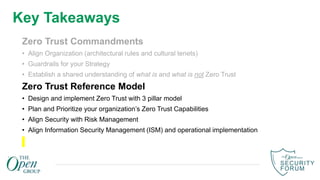
Key Takeaways
Zero Trust Commandments
• Align Organization (architectural rules and cultural tenets)
• Guardrails for your Strategy
• Establish a shared understanding of what is and what is not Zero Trust
Zero Trust Reference Model
• Design and implement Zero Trust with 3 pillar model
• Plan and Prioritize your organization’s Zero Trust Capabilities
• Align Security with Risk Management
• Align Information Security Management (ISM) and operational implementation
Constraints (requirements)
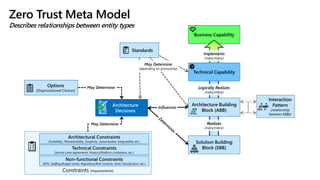
Standards
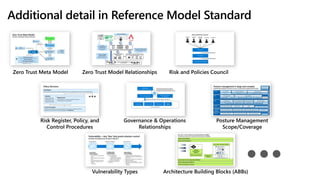
Zero Trust Meta Model
Describes relationships between entity types
Architectural Constraints
(Scalability, Maintainability, Simplicity, Automatable, Integratable, etc.)
Non-functional Constraints
(KPIs, Staffing/Budget Limits, Regulatory/Risk Controls, Data Classification, etc.)
Options
(Organizational Choices)
Business Capability
Architecture
Decisions
Solution Building
Block (SBB)
Technical Capability
Architecture Building
Block (ABB)
Interaction
Pattern
(relationship
between ABBs)
Technical Constraints
(Service Level Agreements, Product/Platform Limitations, etc.)
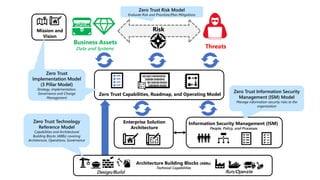
Threats
Risk
Business Assets
Data and Systems
Mission and
Vision
Information Security Management (ISM)
People, Policy, and Processes
Zero Trust Information Security
Management (ISM) Model
Manage information security risks to the
organization
Zero Trust Risk Model
Evaluate Risk and Prioritize/Plan Mitigations
Zero Trust Capabilities, Roadmap, and Operating Model
Enterprise Solution
Architecture
Zero Trust
Implementation Model
(3 Pillar Model)
Strategy, Implementation,
Governance and Change
Management
Architecture Building Blocks (ABBs)
Technical Capabilities
Design/Build Run/Operate
Zero Trust Technology
Reference Model
Capabilities and Architectural
Building Blocks (ABBs) covering
Architecture, Operations, Governance
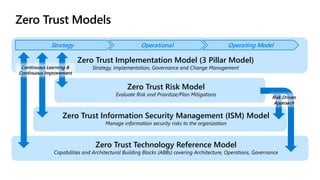
Zero Trust Implementation Model (3 Pillar Model)
Strategy, Implementation, Governance and Change Management
Zero Trust Technology Reference Model
Capabilities and Architectural Building Blocks (ABBs) covering Architecture, Operations, Governance
Zero Trust Information Security Management (ISM) Model
Manage information security risks to the organization
Zero Trust Risk Model
Evaluate Risk and Prioritize/Plan Mitigations
Strategy Operational
Zero Trust Models
Operating Model
Continuous Learning &
Continuous Improvement
Risk Driven
Approach
Standard
Clearly define the
expected outcome,
reasons/risks, and
scope of the policy
Control Procedures
describe best practices on how to implement and assess compliance with the
standards and requirements. [often grouped into baseline(s)]
Risk Register
Ensures that security risk is linked to organizational risk management frameworks and methodologies
Policy Structure
Requirements
specify details on how the standard should be
interpreted and implemented
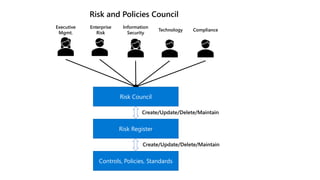
Executive
Mgmt.
Enterprise
Risk
Information
Security
Technology Compliance
Risk Council
Risk Register
Controls, Policies, Standards
Create/Update/Delete/Maintain
Risk and Policies Council
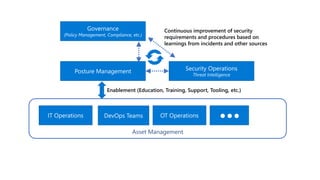
Posture Management
OT Operations
Governance
(Policy Management, Compliance, etc.)
DevOps Teams
IT Operations
Security Operations
Threat Intelligence
Asset Management
Enablement (Education, Training, Support, Tooling, etc.)
Continuous improvement of security
requirements and procedures based on
learnings from incidents and other sources
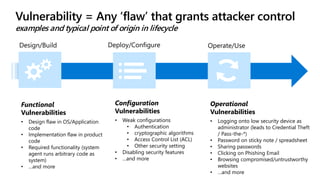
Vulnerability = Any ‘flaw’ that grants attacker control
examples and typical point of origin in lifecycle
Design/Build Deploy/Configure Operate/Use
Operational
Vulnerabilities
• Logging onto low security device as
administrator (leads to Credential Theft
/ Pass-the-*)
• Password on sticky note / spreadsheet
• Sharing passwords
• Clicking on Phishing Email
• Browsing compromised/untrustworthy
websites
• …and more
Configuration
Vulnerabilities
• Weak configurations
• Authentication
• cryptographic algorithms
• Access Control List (ACL)
• Other security setting
• Disabling security features
• …and more
Functional
Vulnerabilities
• Design flaw in OS/Application
code
• Implementation flaw in product
code
• Required functionality (system
agent runs arbitrary code as
system)
• …and more
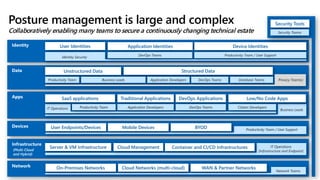
Posture Management
Manage potential security risk (vulnerabilities)
Posture management is large and complex
Collaboratively enabling many teams to secure a continuously changing technical estate
Identity Security
DevOps Teams Productivity Team / User Support
Security Teams
Productivity Team Business Leads Application Developers DevOps Teams Database Teams
Productivity Team / User Support
Business Leads
IT Operations Application Developers DevOps Teams Citizen Developers
Productivity Team
Network Teams
IT Operations
(Infrastructure and Endpoint)
(Multi-Cloud
and Hybrid)
Privacy Team(s)
Key Zero Trust Architecture Building Blocks (ABBs)
Foundational components to enable technical and business capabilities
Posture Management Platform
Asset-Centric Protection Platform
Risk Controls Platform
Asset-Centric Security Operations Platform
Digital Ecosystems
Data/Information
Apps & Systems
Security Zones
Adaptive
Access Control
Platform
Digital Identity Platform
Zero Trust Governance Platform
Security Zones
Platform
Asset Centricity Platform

The Open Group - ZT Commandments and Reference Model.pptx

  • 1.
    Zero Trust Commandments THErules of the road Mark Simos Zero Trust Architecture Forum Co-Chair Lead Cybersecurity Architect, Microsoft aka.ms/markslist Also co-authors of Zero Trust Playbook (ZeroTrustPlaybook.com) 20% Discount: 20ZERO Nikhil Kumar Zero Trust Architecture Forum Co-Chair Founder and President, ApTSi email: nikhil@ap-tech-solns.com LinkedIn: https://www.linkedin.com/in/nikhilkumar/
  • 2.
    Agenda • Zero TrustOverview • Core Challenges of Security and Zero Trust • Zero Trust Commandments Applying them in practice across IT/OT/IoT Enabling sustainability and sustainable security
  • 3.
    Why are wehaving a Zero Trust conversation? 3. Assets increasingly leave the network • BYOD, WFH, Mobile, and SaaS 4. Attackers shift to identity attacks • Phishing and credential theft • Security teams often overwhelmed Note: These limitations have been known for a long time (and documented by The Jericho Forum), but only recently is there widespread momentum to solve them
  • 4.
    Zero Trust ChangesAssumptions trust must be explicitly validated
  • 5.
    Key Industry Guidance TheOpen Group Focused on integration with business and IT/Enterprise/Security architecture US National Institute of Standards and Technology (NIST) Focused on architecture and implementation with available technology Many other organizations are contributing valuable perspectives and guidance like the Cybersecurity and Infrastructure Security Agency (CISA), Cloud Security Alliance (CSA), and some technology vendors
  • 6.
    Key Challenges forSecurity and Zero Trust • Attackers - phishing, credential theft, application/device specific vulns, and more • Technology - Cloud, Generative AI, mobile devices, and more • Business requirements - including digital business, sustainability, and more • Full of cross-cutting functions - security operations, posture management, governance, endpoint, etc. • Must be integrated with business & technology teams (with different cultures, languages, assumptions, goals, etc.) • Must be agile to manage continuous changes (threats, platforms, business requirements) • Chaotic ‘definitions’ of zero trust • Extremely narrow definitions (around single discipline, single technology, or single product) • Sometimes even narrowed to specific technology areas
  • 7.
    1. Classic securitydoesn’t work 3. Security is inherently complex 2. Zero Trust often represented or defined poorly Zero Trust Commandments provide clarity Definition, scope, rules, alignment with business Solved by a Zero Trust approach Asset-centric and agile security for continuous change: • Business opportunities and risk • Attackers • Technology Zero Trust Reference Model Outcome-driven capabilities start planning process Why Zero Trust? What is Zero Trust? How do I do Zero Trust?
  • 8.
    Assumptions • Assume Failure •Assume breach/compromise • Assume human errors • Assume Success • Assume the mission and business will continue (despite these failures) Security equivalent of “fail safe” in engineering Zero Trust Commandments
  • 9.
    Zero Trust Commandments StandardizedRules for Zero Trust security Practice Deliberate Security Establishes pragmatic view of ‘trust’ in today’s world of continuous threats + how to prioritize applying that in a world of complex and continuously changing requirements • Secure Assets by Risk • Validate Trust Explicitly Develop a Security-Centric Culture Guides the application of security across all teams • Practice Accountability • Enable Pervasive Security • Utilize Least Privilege • Deploy Simple (User-Friendly) Security Support Business Objectives Aligns security explicitly to business priorities and assets (vs. networks) and considers long term implications • Enable the Organization’s Mission • Implement Asset-Centric Controls • Enable Sustainable Security Deploy Agile and Adaptive Security Ensures security can keep up with continuous change • Make Informed Decisions • Improve and Evolve Security Controls • Utilize Defense in Depth • Enable Resiliency pubs.opengroup.org/security/zero-trust-commandments/ Assume Failure Assume Success
  • 10.
    Practice Deliberate Security SecureAssets by Risk Security controls shall be designed to protect business assets appropriate to required security posture, business value, and associated risk. 1. Map Technology to Business 2. Classify Information Assets – 3. Increase Security for Sensitive Assets 4. Reduce Unneeded Sensitivity 5. Stay Current Validate Trust Explicitly Security assurance shall rely on explicitly validating trust decisions using all relevant available information and telemetry 1. Verify Access Control 2. Verify Application Development. 3. Verify Technology Supply Chain 4. Verify Asset Configuration 5. Verify Incident Processes
  • 11.
    Support Business Objectives Enablethe Organization’s Mission Security discipline shall enable productivity and manage risk as the organizational capabilities, goals, environment, and infrastructure continuously evolve. 1. Enable Modern Work 2. Align Security to Mission 3. Align Security to Risk Management 4. Align Security to Compliance Management Implement Asset-Centric Controls Asset-specific security controls shall be implemented whenever available to minimize disruption of productivity, increase precision of security/business visibility, and improve the data used to drive security compliance metrics. 1. Augment or Evolve Existing Infrastructure-Level Security Controls 2. Implement Data-Centric Controls 3. Implement Application-Centric Controls 4. Determine Trust beyond the Network Enable Sustainable Security Security controls shall be sustainable across the full lifecycle of the business asset. 1. Secure for the Full Lifecycle 2. Provide End-to-End Data Security 3. Ensure the Architecture is Coherent 4. Ensure the Ongoing Monitoring of Security Controls 5. Continuously Manage All Assets
  • 12.
    Develop a Security-CentricCulture Practice Accountability The entities responsible for accessing and handling assets shall be responsible for their protection and survival throughout their lifetime. 1. Assign Asset Ownership 2. Ensure Understanding of Ownership 3. Define Security Impact Correctly 4. Assign Security Risk to Organizational Leadership 5. Assign Security Risk to Asset Owners Enable Pervasive Security Security discipline shall be explicitly included in the culture, norms, and processes throughout the organization. 1. Integrate in Business Environment 2. Integrate in Technical Environment 3. Incorporate Security Education and Awareness Training 4. Apply Security to the Organization's Ecosystem Utilize Least Privilege Access to systems and data shall be provided only as required, and access shall be removed when no longer required. 1. Grant Just Enough Access 2. Grant Just-in-Time Access 3. Utilize Adaptive Access Deploy Simple (User-Friendly) Security Security mechanisms shall be as simple and user-friendly as possible while retaining functionality and remaining pervasive, practicable, and scalable. 1. Simplify Human Experience 2. Simplify Security 3. Provide Clarity 4. Configure before Customize 5. Enable Salability 6. Combine Building Blocks
  • 13.
    Make Informed Decisions Securityteams shall make decisions based on the best available information. 1. Decide with Data 2. Constantly Gather Telemetry 3. Prioritize using Data 4. Combine Data with Human Wisdom 5. Constantly Grow your Telemetry 6. Plan for the Future Improve and Evolve Security Controls Security teams shall continuously evolve and improve to remain successful in an environment that constantly changes. 1. Consider People, Process, and Technology 2. Consider Business Evolution 3. Consider Technical Evolution Utilize Defense in Depth Security mechanisms and controls shall be layered to enhance resilience and preserve integrity. 1. Ensure Independence 2. Utilize Different Control Types 3. Support Resiliency 4. Ensure Diversity of controls Enable Resiliency Security systems shall ensure the organization can operate normally under adverse conditions. 1. Anticipate Attacks 2. Withstand Attacks 3. Recover from Attacks 4. Adapt to Adverse Conditions Deploy Agile and Adaptive Security
  • 14.
    Key Takeaways Zero TrustCommandments • Align Organization (architectural rules and cultural tenets) • Guardrails for your Strategy • Establish a shared understanding of what is and what is not Zero Trust Zero Trust Reference Model • Design and implement Zero Trust with 3 pillar model • Plan and Prioritize your organization’s Zero Trust Capabilities • Align Security with Risk Management • Align operational implementation with Information Security Management
  • 15.
    Zero Trust Definitions Aninformation security approach that focuses on the entire technical estate – including data/information, APIs, and Operational Technology/Industrial Control Systems – throughout their lifecycle and on any platform or network. Zero trust assumes there is no implicit trust granted to assets or user accounts based solely on their physical or network location (i.e., local area networks versus the internet) or based on asset ownership (enterprise or personally owned).
  • 16.
    Security is theopposite of productivity Business Enablement Align security to the organization’s mission, priorities, risks, and processes Assume Compromise Continuously reduce blast radius and attack surface through prevention and detection/response/recovery All attacks can be prevented Shift to Asset-Centric Security Strategy Revisit how to do access control, security operations, infrastructure and development security, and more Explicitly Validate Account Security Require MFA and analyze all user sessions with behavior analytics, threat intelligence, and more Network security perimeter will keep attackers out Passwords are strong enough IT Admins are safe IT Infrastructure is safe Goal: Zero Assumed Trust Reduce risk by finding and removing implicit assumptions of trust Developers always write secure code The software and components we use are secure Plan and Execute Privileged Access Strategy Establish security of accounts, workstations, and other privileged entities (aka.ms/spa) Validate Infrastructure Integrity Explicitly validate trust of operating systems, applications, services accounts, and more Integrate security into development process Security education, issue detection and mitigation, response, and more Supply chain security Validate the integrity of software and hardware components from open source. vendors, and others False Assumptions of implicit or explicit trust Zero Trust Mitigation Systematically Build & Measure Trust With 30+ years of backlog at most organizations, it will take a while to burn down the backlog of assumed trust
  • 17.
    Security is simplein concept… …but complex in execution
  • 18.
    Improving Resiliency Enable businessmission while continuously increasing security assurances IDENTIFY PROTECT DETECT RESPOND RECOVER GOVERN ‘Left of Bang’ Prevent or lessen impact of attacks ‘Right of Bang’ Rapidly and effectively manage attacks NIST Cybersecurity Framework v2
  • 19.
    Security reduces risk Securityrisk affects the whole organization, not just an individual workload/project Security reduces chances that bad things happen + reduces damage when they do Security problems are created by human attackers Adversaries have a motivation (mission, profit, recognition/promotion/etc. from boss) Adversaries have a model (espionage, data theft, extortion, ransomware, multiple, etc.) Security teams have unique culture and history Mission driven, deeply care about the organization, and often ignored  …but have been overly technical/network focused for a long time Overview – Security Truths and Observations
  • 20.
    Zero Trust ReferenceModel Mark Simos Zero Trust Architecture Forum Co-Chair Lead Cybersecurity Architect, Microsoft aka.ms/markslist Also co-authors of Zero Trust Playbook (ZeroTrustPlaybook.com) 20% Discount: 20ZERO Nikhil Kumar Zero Trust Architecture Forum Co-Chair Founder and President, ApTSi email: nikhil@ap-tech-solns.com LinkedIn: https://www.linkedin.com/in/nikhilkumar/
  • 21.
    Agenda • Security Challenges •Zero Trust Components • Zero Trust Capabilities • Zero Trust Integration and Adoption • Early Case Studies: Microsoft, Zero Trust Playbook • Key Takeaways
  • 22.
    1. Classic securitydoesn’t work 3. Security is inherently complex 2. Zero Trust often represented or defined poorly Zero Trust Commandments provide clarity Definition, scope, rules, alignment with business Solved by a Zero Trust approach Asset-centric and agile security for continuous change: • Business opportunities and risk • Attackers • Technology Zero Trust Reference Model Solution starts with outcome-driven capabilities Why Zero Trust? What is Zero Trust? How do I do Zero Trust?
  • 23.
    Zero Trust ReferenceModel Digital Ecosystems Zero Trust Components Data/Information Apps & Systems Security Zones Distributed Policy Enforcement Points (PEPs)
  • 24.
    Key Zero TrustCapabilities Increase security and flexibility for continuously changing business, technology, threats, and regulations Posture Management – continuous improvement of attack prevention measures Asset-Centric Protection (Data-Centric & System-Centric) Risk Controls - establish overall security framework based on organizational risk Asset-Centric Security Operations – rapid and complete detection, response, and recovery from attacks Digital Ecosystems Data/Information Apps & Systems Security Zones Adaptive Access Control • Centralized policy control • Distributed enforcement Digital Identity Decentralized portable identities Zero Trust Governance – continuous monitoring and audit on demand to meet risk and compliance Security Zones Asset Centricity - foundational capability to identify, classify, and maintain the asset
  • 25.
    Implementation Model (3pillars) Operational Operating Model Strategic • Mission, Vision, Goals, and Capabilities • Align strategic models to market • Build & update agile roadmaps • Provide products (goods) and services • Set up organizational structure • Set up functions to enable capabilities • Governance (translate goals to principles and policies & monitor) • Organizational culture
  • 26.
    People Security Education, Insider Risk Access Control Technical Estate(Dev  Test  Production) Security Operating Model Posture Management Manage potential security risk (vulnerabilities) Security Operations / SOC Manage realized security risk (attacks) IT Operations & Data Governance Detect Respond Recover Prevent Identify • Accountable for Productivity and Operational Uptime • Responsible for change implementation and lifecycle management Collaboration Security Governance Risk, Architecture, Compliance, Threat Intelligence (Strategic) People Employees, Partners, Customers Innovation Security Application Security Citizen Developers DevOps Teams Asset Protection (Data and Systems)
  • 27.
    PostureManagement Continuously Learning toReduce Risk Collaborative approach to mitigate potential and realized risk No threat Found threat Security Collaboration Quick Fix Major/New incidents Note: Threat Intelligence and Security Engineering (automation) is a supporting function for all security activities
  • 29.
    Case Studies illustrate early/emerginguse cases for standard • Planning modernization initiatives • Evaluating technology coverage • Establishing/updating capabilities • Guiding role participation
  • 30.
    Mapping Microsoft ModernizationInitiatives to Zero Trust Capabilities Cross-cutting elements apply to all asset types (strategy, architecture, security operations, posture management, governance, etc.) Secure Identities and Access Modern Security Operations (SecOps/SOC) Infrastructure & Development Security Data Security & Governance IoT and OT Security Security Strategy and Program Zero Trust Architecture Risk Controls - establish overall security framework based on organizational risk Asset Centricity - foundational capability to identify, classify, and maintain the asset Asset-Centric Protection (Data-Centric & System-Centric) Security Zones Posture Management – continuous improvement of attack prevention measures Asset-Centric Security Operations – rapid and complete detection, response, and recovery from attacks Zero Trust Governance – continuous monitoring and audit on demand to meet risk and compliance Adaptive Access Control Digital Identity
  • 31.
    Asset Protection Classification, Protection,Tokenization Digital Ecosystems Microsoft Security Capability Mapping The Open Group Zero Trust Components Rapid Threat Detection, Response, and Recovery Asset-Centric Security Operations Governance Visibility and Policy Data/Information Apps & Systems Security Zones Access Control Identity and Network - Multi-factor Authentication Innovation Security Microsoft Entra Conditional Access Defender for Endpoint Endpoint Detection and Response (EDR) Intune Device Management Microsoft Sentinel • Security Information and Event Management (SIEM) • Security Orchestration, Automation, and Response (SOAR) Microsoft Defender Defender for Identity Defender for Cloud Defender for Cloud Apps Defender for Endpoint Defender for Office 365 Security telemetry from across the environment Microsoft Purview 65+ Trillion signals per day of security context Microsoft Entra Conditional Access Azure Firewall (Illumio partnership) Defender for APIs (preview) GitHub Advanced Security & Azure DevOps Security Secure development and software supply chain Entra Internet Access Entra Private Access Defender for Cloud Azure Arc Microsoft Purview Microsoft Priva Distributed Policy Enforcement Points (PEPs) Microsoft Entra ID Entra ID Governance ID Protection Workload ID Defender for Identity
  • 32.
    Capability # CapabilityLevel Architectural Building Block (ABB) Microsoft Technology ACSO-1 Asset-Centric Security Operations 1 Asset-Centric Security Operations Platform (ABB-ACSOP-1) Process Guidance in Security ADS Module 3 ACSO-1.1 Rapid Incident Response 2 Asset-Centric Security Operations Platform (ABB-ACSOP-1) Process Guidance in Security ADS Module 3 ACSO-1.2 Incident Management 2 Case Management (ABB-ACSOP-1.2) Process Guidance in Security ADS Module 3 ACSO-1.2.1 Case Management 3 Case Management (ABB-ACSOP-1.2) Microsoft 365 Defender Microsoft Sentinel ACSO-1.2.2 Major Incident Management 3 Major Incident Management (ABB-ACSOP-1.3) Process Guidance in Security ADS Module 3 ACSO-1.3 SecOps Business Intelligence 2 SecOps Business Intelligence Platform (ABB-ACSOP-1.5) PowerBI ACSO-1.4 Threat Hunting and Detection Tuning 2 Threat Hunting (ABB-ACSOP-1.6) Process Guidance in Security ADS Module 3 ACSO-1.4.1 Threat Hunting 3 Threat Hunting (ABB-ACSOP-1.6) Process Guidance in Security ADS Module 3 ACSO-1.4.2 Detection Tuning 3 Detection Tuning (ABB-ACSOP-1.10) Process Guidance in Security ADS Module 3 ACSO-1.4.3 Purple Teaming 3 Purple Teaming (ABB-ACSOP-1.10.1) Process Guidance in Security ADS Module 3 ACSO-1.4.3.1 Red Teaming 4 Red Teaming (ABB-ACSOP-1.10.1.1) Process Guidance in Security ADS Module 3 ACSO-1.5 Threat Intelligence 2 Threat Intelligence Platform (ABB-ACSOP-1.11) Microsoft Defender Threat Intelligence ACSO-1.6 Asset-type specific attack detection 2 Extended detection and response (XDR) (ABB-ACSOP-1.1) Microsoft 365 Defender Microsoft Defender for Cloud ACSO-1.7 Security Information and Event Management (SIEM) 2 SIEM (ABB-ACSOP-1.7) Microsoft Sentinel ACSO-1.7.1 Security Data Lake Capability 3 Security Data Lake (ABB-ACSOP-1.7.1) Microsoft Azure Data Explorer (ADX) ACSO-1.8 Security orchestration, automation, and response (SOAR) 2 SOAR (ABB-ACSOP-1.4) Microsoft 365 Defender (AutoIR) Microsoft Sentinel ACSO-1.9 Advanced Security Analytics 2 Intelligent Anomaly Detection (ABB-ACSOP-1.8) Intelligent Behavior Analytics (ABB-ACSOP-1.9) Microsoft 365 Defender Microsoft Defender for Cloud Microsoft Sentinel ACSO-1.10 Integrated Threat Intelligence Feeds 2 Extended detection and response (XDR) (ABB-ACSOP-1.1) SIEM (ABB-ACSOP-1.7) Microsoft 365 Defender Microsoft Defender for Cloud Microsoft Sentinel ACSO-1.11 SecOps Custom Development 2 SecOps Custom Development Tools (ABB-ACSOP-1.12) Microsoft Azure DevOps Services GitHub / GitHub Advanced Security
  • 33.
     Role missionand purpose  Role creation and evolution  Key role relationships  Required skills and knowledge  Tooling and capabilities  Zero Trust impact and imperatives for each role  Playbook stage involvement for each role  Day in the life of Zero Trust for each role  Defining and measuring success 50+ roles Mapping ZT capabilities to roles 9 guidance types per role Investigation Analysts
  • 34.
    Key Takeaways Zero TrustCommandments • Align Organization (architectural rules and cultural tenets) • Guardrails for your Strategy • Establish a shared understanding of what is and what is not Zero Trust Zero Trust Reference Model • Design and implement Zero Trust with 3 pillar model • Plan and Prioritize your organization’s Zero Trust Capabilities • Align Security with Risk Management • Align Information Security Management (ISM) and operational implementation
  • 35.
    Constraints (requirements) Standards Zero TrustMeta Model Describes relationships between entity types Architectural Constraints (Scalability, Maintainability, Simplicity, Automatable, Integratable, etc.) Non-functional Constraints (KPIs, Staffing/Budget Limits, Regulatory/Risk Controls, Data Classification, etc.) Options (Organizational Choices) Business Capability Architecture Decisions Solution Building Block (SBB) Technical Capability Architecture Building Block (ABB) Interaction Pattern (relationship between ABBs) Technical Constraints (Service Level Agreements, Product/Platform Limitations, etc.)
  • 36.
    Threats Risk Business Assets Data andSystems Mission and Vision Information Security Management (ISM) People, Policy, and Processes Zero Trust Information Security Management (ISM) Model Manage information security risks to the organization Zero Trust Risk Model Evaluate Risk and Prioritize/Plan Mitigations Zero Trust Capabilities, Roadmap, and Operating Model Enterprise Solution Architecture Zero Trust Implementation Model (3 Pillar Model) Strategy, Implementation, Governance and Change Management Architecture Building Blocks (ABBs) Technical Capabilities Design/Build Run/Operate Zero Trust Technology Reference Model Capabilities and Architectural Building Blocks (ABBs) covering Architecture, Operations, Governance
  • 37.
    Zero Trust ImplementationModel (3 Pillar Model) Strategy, Implementation, Governance and Change Management Zero Trust Technology Reference Model Capabilities and Architectural Building Blocks (ABBs) covering Architecture, Operations, Governance Zero Trust Information Security Management (ISM) Model Manage information security risks to the organization Zero Trust Risk Model Evaluate Risk and Prioritize/Plan Mitigations Strategy Operational Zero Trust Models Operating Model Continuous Learning & Continuous Improvement Risk Driven Approach
  • 38.
    Standard Clearly define the expectedoutcome, reasons/risks, and scope of the policy Control Procedures describe best practices on how to implement and assess compliance with the standards and requirements. [often grouped into baseline(s)] Risk Register Ensures that security risk is linked to organizational risk management frameworks and methodologies Policy Structure Requirements specify details on how the standard should be interpreted and implemented
  • 39.
    Executive Mgmt. Enterprise Risk Information Security Technology Compliance Risk Council RiskRegister Controls, Policies, Standards Create/Update/Delete/Maintain Create/Update/Delete/Maintain Risk and Policies Council
  • 40.
    Posture Management OT Operations Governance (PolicyManagement, Compliance, etc.) DevOps Teams IT Operations Security Operations Threat Intelligence Asset Management Enablement (Education, Training, Support, Tooling, etc.) Continuous improvement of security requirements and procedures based on learnings from incidents and other sources
  • 41.
    Vulnerability = Any‘flaw’ that grants attacker control examples and typical point of origin in lifecycle Design/Build Deploy/Configure Operate/Use Operational Vulnerabilities • Logging onto low security device as administrator (leads to Credential Theft / Pass-the-*) • Password on sticky note / spreadsheet • Sharing passwords • Clicking on Phishing Email • Browsing compromised/untrustworthy websites • …and more Configuration Vulnerabilities • Weak configurations • Authentication • cryptographic algorithms • Access Control List (ACL) • Other security setting • Disabling security features • …and more Functional Vulnerabilities • Design flaw in OS/Application code • Implementation flaw in product code • Required functionality (system agent runs arbitrary code as system) • …and more
  • 42.
    Posture Management Manage potentialsecurity risk (vulnerabilities) Posture management is large and complex Collaboratively enabling many teams to secure a continuously changing technical estate Identity Security DevOps Teams Productivity Team / User Support Security Teams Productivity Team Business Leads Application Developers DevOps Teams Database Teams Productivity Team / User Support Business Leads IT Operations Application Developers DevOps Teams Citizen Developers Productivity Team Network Teams IT Operations (Infrastructure and Endpoint) (Multi-Cloud and Hybrid) Privacy Team(s)
  • 43.
    Key Zero TrustArchitecture Building Blocks (ABBs) Foundational components to enable technical and business capabilities Posture Management Platform Asset-Centric Protection Platform Risk Controls Platform Asset-Centric Security Operations Platform Digital Ecosystems Data/Information Apps & Systems Security Zones Adaptive Access Control Platform Digital Identity Platform Zero Trust Governance Platform Security Zones Platform Asset Centricity Platform