Energy Management
10:30 Energy Management as a Profession
Version 2.0
11th November 2015
Energy Managers (EM). Where is the next generation of EM’s coming from?
Agenda
1. Introduction
2. Myth Busters!!
3. npower’s Energy Management Journey
4. Energy Managers – Who are they?
5. Future generations of Energy Managers
6. Educate them on what?
7. Where do we go next?
2
1. Introductions
Who am I to talk about Energy Management?
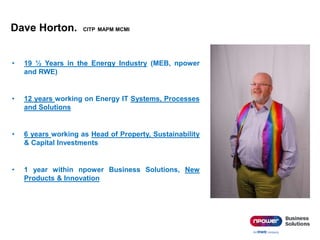
Dave Horton. CITP MAPM MCMI
• 19 ½ Years in the Energy Industry (MEB, npower
and RWE)
• 12 years working on Energy IT Systems, Processes
and Solutions
• 6 years working as Head of Property, Sustainability
& Capital Investments
• 1 year within npower Business Solutions, New
Products & Innovation
2. Myth Busters
Some of the comments I hear often
Myth Busters.
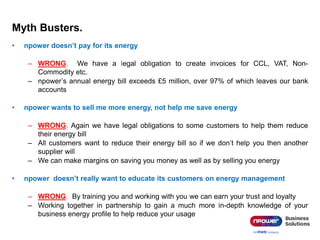
• npower doesn’t pay for its energy
– WRONG. We have a legal obligation to create invoices for CCL, VAT, Non-
Commodity etc.
– npower’s annual energy bill exceeds £5 million, over 97% of which leaves our bank
accounts
• npower wants to sell me more energy, not help me save energy
– WRONG. Again we have legal obligations to some customers to help them reduce
their energy bill
– All customers want to reduce their energy bill so if we don’t help you then another
supplier will
– We can make margins on saving you money as well as by selling you energy
• npower doesn’t really want to educate its customers on energy management
– WRONG. By training you and working with you we can earn your trust and loyalty
– Working together in partnership to gain a much more in-depth knowledge of your
business energy profile to help reduce your usage
3. npower’s Energy Management
Journey
Where we were and our journey?
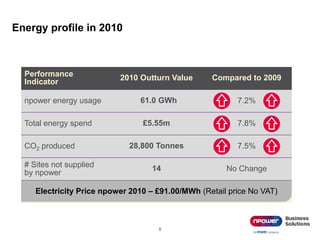
Energy profile in 2010
8
Performance
Indicator
2010 Outturn Value Compared to 2009
npower energy usage 61.0 GWh 7.2%
Total energy spend £5.55m 7.8%
CO2 produced 28,800 Tonnes 7.5%
# Sites not supplied
by npower
14 No Change
Electricity Price npower 2010 – £91.00/MWh (Retail price No VAT)
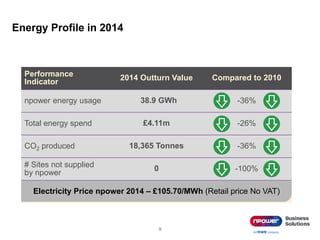
Energy Profile in 2014
9
Performance
Indicator
2014 Outturn Value Compared to 2010
npower energy usage 38.9 GWh -36%
Total energy spend £4.11m -26%
CO2 produced 18,365 Tonnes -36%
# Sites not supplied
by npower
0 -100%
Electricity Price npower 2014 – £105.70/MWh (Retail price No VAT)
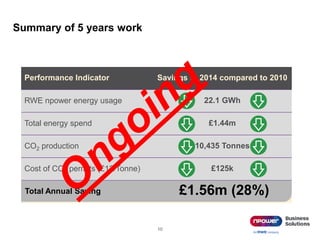
Summary of 5 years work
10
Performance Indicator Savings in 2014 compared to 2010
RWE npower energy usage 22.1 GWh
Total energy spend £1.44m
CO2 production 10,435 Tonnes
Cost of CO2 permits (£12/Tonne) £125k
Total Annual Saving £1.56m (28%)
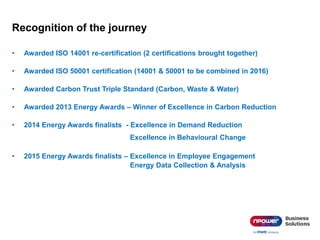
Recognition of the journey
• Awarded ISO 14001 re-certification (2 certifications brought together)
• Awarded ISO 50001 certification (14001 & 50001 to be combined in 2016)
• Awarded Carbon Trust Triple Standard (Carbon, Waste & Water)
• Awarded 2013 Energy Awards – Winner of Excellence in Carbon Reduction
• 2014 Energy Awards finalists - Excellence in Demand Reduction
Excellence in Behavioural Change
• 2015 Energy Awards finalists – Excellence in Employee Engagement
Energy Data Collection & Analysis
4. Energy Managers
Who and what are they?
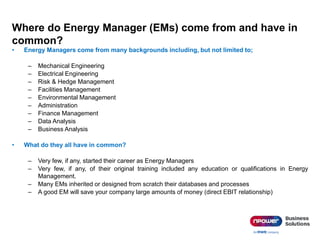
Where do Energy Manager (EMs) come from and have in
common?
• Energy Managers come from many backgrounds including, but not limited to;
– Mechanical Engineering
– Electrical Engineering
– Risk & Hedge Management
– Facilities Management
– Environmental Management
– Administration
– Finance Management
– Data Analysis
– Business Analysis
• What do they all have in common?
– Very few, if any, started their career as Energy Managers
– Very few, if any, of their original training included any education or qualifications in Energy
Management.
– Many EMs inherited or designed from scratch their databases and processes
– A good EM will save your company large amounts of money (direct EBIT relationship)
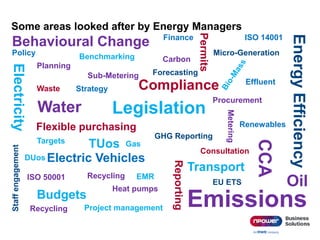
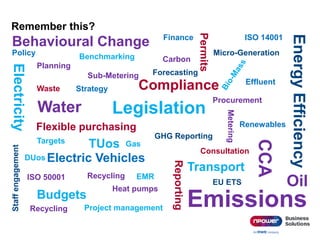
Some areas looked after by Energy Managers
Legislation
Compliance
Electricity
Gas
Oil
Finance
Budgets
Forecasting
Water
ISO 50001
ISO 14001
Benchmarking
Consultation
Carbon
Waste
Recycling
EnergyEfficiency
Project management
Reporting
Targets
EMR
Strategy
Policy
Staffengagement
Behavioural Change
Transport
Emissions
GHG Reporting
Permits
EU ETS
CCA
DUos
TUos
Flexible purchasing Renewables
Electric Vehicles
Effluent
Procurement
Recycling
Micro-Generation
Heat pumps
Metering
Sub-Metering
Planning
• Someone targeted to provide a reduction in overall energy costs
• Someone targeted to ensure compliance with all relevant legislation
• Someone targeted to look at wider Utility costs and legislation
– Waste
– Water
– Transport
– Energy Efficiency projects
• Someone who can create, plan and implement the relevant strategy and projects
specific to their business to reduce costs
• Someone who understands the wider trends, theories and impacts of legislation
and technology around energy, water, transport and waste
• Someone who can challenge the status quo and think laterally when looking at
energy, water, waste and transport
15
What can an Energy Manager provide your business?
What can an Energy Manager provide your people?
• Role Model
– A good Energy Manager will be an example of good practise when looking across
energy usage, waste disposal etc.
• Understanding
– A good Energy Manager will provide the information people need to understand the
impacts of their actions at home and in the office
• Motivation
– Through education and behavioural change campaigns a good Energy Manager will
motivate your people to save energy, recycle waste and cut back on water usage
• Leadership
– Through example, through training and innovation your Energy Manager will lead
your business to reduce its costs, reduce your emissions and recycle your waste
Where are the future generation of Energy Managers
coming from?
17
5. Future generations of EM’s
Starts with education from the youngest age
Current and Future Energy Managers need:
19
• Education in schools (LEC Awards for schools)
• Employee education and engagement campaigns
• Formal training courses and qualification paths
• Inclusion in University degree courses
• Apprenticeships
• Post graduate degrees
• On the job training
• Recognised job profiles, roles and responsibilities for Energy Managers (Hayes
etc.)
• Recognition of the wider utility management roles most Energy Managers
undertake
Educate the current.
• Next 10 years
– Many of Energy Managers are already in the work place so will need re-training and
upskilling
– Formal education courses with mentoring and help through accredited bodies, e.g.
EMA
– Post graduate training and qualifications, utilising current degree course modules with
newly created specific modules
– Recognition of Energy Managers and their value with recognised salary bands
– Behavioural change campaigns and staff awareness, looking for the Energy
Managers of tomorrow
– Apprenticeships within Energy Management, which includes the wider environmental
arena
Educate the Future
• Next 10-20 years
– Start education in schools now from the age of 7 onwards
– Incorporate Energy Management in to GCSE’s and degree courses
– Exit education in to Junior Energy Management roles
– Formal on the job training and qualifications (equivalent to CIMA)
– Potential centrally recognised Chartered status for Energy Managers
– Job descriptions and profiles recognised across the industry and recruitment
companies
– Build in Energy and Carbon management to all aspects of projects and business
6. Educate EM’s on what?
What needs to be on the syllabus?
Remember this?
Legislation
Compliance
Electricity
Gas
Oil
Finance
Budgets
Forecasting
Water
ISO 50001
ISO 14001
Benchmarking
Consultation
Carbon
Waste
Recycling
EnergyEfficiency
Project management
Reporting
Targets
EMR
Strategy
Policy
Staffengagement
Behavioural Change
Transport
Emissions
GHG Reporting
Permits
EU ETS
CCA
DUos
TUos
Flexible purchasing Renewables
Electric Vehicles
Effluent
Procurement
Recycling
Micro-Generation
Heat pumps
Metering
Sub-Metering
Planning
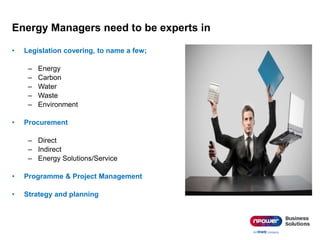
Energy Managers need to be experts in
• Legislation covering, to name a few;
– Energy
– Carbon
– Water
– Waste
– Environment
• Procurement
– Direct
– Indirect
– Energy Solutions/Service
• Programme & Project Management
• Strategy and planning
Energy Managers need to be experts in (cont’d)
• Budget Management
– Operational expenditure (bills)
– Capital expenditure (projects)
– Energy Performance Contracts (EPCs)
• Transport
– Emissions
– Strategy & Policy to reduce
– Fleet management
• Energy & Carbon Policy & Strategy creation
• Business case development
• Stakeholder engagement
25
Energy Managers need to be experts in (cont’d)
• Building management, including;
– Building Management Systems (BMS)
– HVAC (Heating, Ventilation, Air Conditioning)
– Waste water
– Waste food
– Waste sewage & effluent
– Lighting
• Data Analysis, invoice validation & payment
• The Energy Industry
• The Water Industry
• The Waste Industry
• and much, much more…………..
26
7. Where do we go next?
What do we need to do together?
Behavioural Change & Staff Engagement
• Begin education in schools
– npower Climate Cops and Little Green Finger type campaigns, matched to meet the
current curriculum
– Low Energy Schools – Gold, Silver and Bronze awards from LEC with E-Learning
tools
– School energy and waste saving projects
– Inclusion into GCSE curriculum for energy and waste management at home and in
the work place/school
• Educating employees (for home and work)
– Energy and Recycling staff awareness campaigns
– Employee incentives and competitions for energy/waste saving ideas and projects
– Basic qualifications through E-learning tools (Low Energy Company/EMA Certificates)
– Company incentives, case studies including reduced energy costs, reduced
emissions, increased recycling and lower waste disposal costs
Recognised Energy Manager Career Path
• Junior Energy Managers
– Apprenticeship in place and recognised by Dept. Business, Innovations and Skills
– Membership of relevant bodies e.g. Energy Managers Association
– Constant review and re-training/up-skilling as legislation and technology change
– Recognised Job Description and salary banding though processes such as “The Hay
Group Guide Chart Profile Method of Job Evaluation”
– Extend the Apprenticeship recognition throughout EU countries
• Senior Energy Managers
– Discussion and planning in place with Keele and Warwick University to look at degree
and post graduate degrees in Energy Management
– Recognition of approved courses and modules throughout EU Countries
– Recognised Job Description and salary banding though processes such as “The Hay
Group Guide Chart Profile Method of Job Evaluation”
– Membership of relevant bodies e.g. Energy Managers Association
Wider Energy Managers Remit
Whilst Energy is the main remit of an Energy Manager, many other areas of
responsibility and budgets are often assigned to the Energy Manager’s role.
Some of these include, but aren’t limited to
– Building HVAC system management and replacements
– Energy Assessment and Measurement & Verification
– Behavioural Changes and Motivation
– Regulatory & Legal Compliance and Carbon Management
– Energy Management and Strategy/Plan
– Waste Management
– Procurement
– Transport emissions and reporting
– Water Management
– Effects on energy and water by IT Data Centres and projects
– Project Management
Training and advise in all the above and many more subjects to make a rounded
Energy Manager
Summary
• Address what Energy Manager roles are going forward
• Start the education as early as possible
• Work with schools, universities, business and government to put in formal training
through the school and university curriculum and further education
• Create recognised job profiles and salary bands for Energy Managers
• Ensure we address the wider role of many Energy Manager which can include
waste, water, transport, procurement, legislative compliance etc….
• Start this work as soon as possible
8. Thank Your for Listening
Any Questions Please
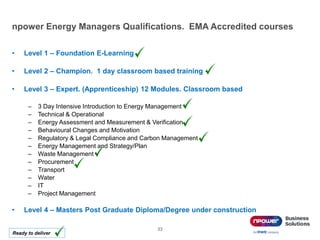
npower Energy Managers Qualifications. EMA Accredited courses
33
• Level 1 – Foundation E-Learning
• Level 2 – Champion. 1 day classroom based training
• Level 3 – Expert. (Apprenticeship) 12 Modules. Classroom based
– 3 Day Intensive Introduction to Energy Management
– Technical & Operational
– Energy Assessment and Measurement & Verification
– Behavioural Changes and Motivation
– Regulatory & Legal Compliance and Carbon Management
– Energy Management and Strategy/Plan
– Waste Management
– Procurement
– Transport
– Water
– IT
– Project Management
• Level 4 – Masters Post Graduate Diploma/Degree under construction
Ready to deliver

EXEX Presentation Nov 2015 Ver 3_0 FINAL

  • 1.
    Energy Management 10:30 EnergyManagement as a Profession Version 2.0 11th November 2015 Energy Managers (EM). Where is the next generation of EM’s coming from?
  • 2.
    Agenda 1. Introduction 2. MythBusters!! 3. npower’s Energy Management Journey 4. Energy Managers – Who are they? 5. Future generations of Energy Managers 6. Educate them on what? 7. Where do we go next? 2
  • 3.
    1. Introductions Who amI to talk about Energy Management?
  • 4.
    Dave Horton. CITPMAPM MCMI • 19 ½ Years in the Energy Industry (MEB, npower and RWE) • 12 years working on Energy IT Systems, Processes and Solutions • 6 years working as Head of Property, Sustainability & Capital Investments • 1 year within npower Business Solutions, New Products & Innovation
  • 5.
    2. Myth Busters Someof the comments I hear often
  • 6.
    Myth Busters. • npowerdoesn’t pay for its energy – WRONG. We have a legal obligation to create invoices for CCL, VAT, Non- Commodity etc. – npower’s annual energy bill exceeds £5 million, over 97% of which leaves our bank accounts • npower wants to sell me more energy, not help me save energy – WRONG. Again we have legal obligations to some customers to help them reduce their energy bill – All customers want to reduce their energy bill so if we don’t help you then another supplier will – We can make margins on saving you money as well as by selling you energy • npower doesn’t really want to educate its customers on energy management – WRONG. By training you and working with you we can earn your trust and loyalty – Working together in partnership to gain a much more in-depth knowledge of your business energy profile to help reduce your usage
  • 7.
    3. npower’s EnergyManagement Journey Where we were and our journey?
  • 8.
    Energy profile in2010 8 Performance Indicator 2010 Outturn Value Compared to 2009 npower energy usage 61.0 GWh 7.2% Total energy spend £5.55m 7.8% CO2 produced 28,800 Tonnes 7.5% # Sites not supplied by npower 14 No Change Electricity Price npower 2010 – £91.00/MWh (Retail price No VAT)
  • 9.
    Energy Profile in2014 9 Performance Indicator 2014 Outturn Value Compared to 2010 npower energy usage 38.9 GWh -36% Total energy spend £4.11m -26% CO2 produced 18,365 Tonnes -36% # Sites not supplied by npower 0 -100% Electricity Price npower 2014 – £105.70/MWh (Retail price No VAT)
  • 10.
    Summary of 5years work 10 Performance Indicator Savings in 2014 compared to 2010 RWE npower energy usage 22.1 GWh Total energy spend £1.44m CO2 production 10,435 Tonnes Cost of CO2 permits (£12/Tonne) £125k Total Annual Saving £1.56m (28%)
  • 11.
    Recognition of thejourney • Awarded ISO 14001 re-certification (2 certifications brought together) • Awarded ISO 50001 certification (14001 & 50001 to be combined in 2016) • Awarded Carbon Trust Triple Standard (Carbon, Waste & Water) • Awarded 2013 Energy Awards – Winner of Excellence in Carbon Reduction • 2014 Energy Awards finalists - Excellence in Demand Reduction Excellence in Behavioural Change • 2015 Energy Awards finalists – Excellence in Employee Engagement Energy Data Collection & Analysis
  • 12.
    4. Energy Managers Whoand what are they?
  • 13.
    Where do EnergyManager (EMs) come from and have in common? • Energy Managers come from many backgrounds including, but not limited to; – Mechanical Engineering – Electrical Engineering – Risk & Hedge Management – Facilities Management – Environmental Management – Administration – Finance Management – Data Analysis – Business Analysis • What do they all have in common? – Very few, if any, started their career as Energy Managers – Very few, if any, of their original training included any education or qualifications in Energy Management. – Many EMs inherited or designed from scratch their databases and processes – A good EM will save your company large amounts of money (direct EBIT relationship)
  • 14.
    Some areas lookedafter by Energy Managers Legislation Compliance Electricity Gas Oil Finance Budgets Forecasting Water ISO 50001 ISO 14001 Benchmarking Consultation Carbon Waste Recycling EnergyEfficiency Project management Reporting Targets EMR Strategy Policy Staffengagement Behavioural Change Transport Emissions GHG Reporting Permits EU ETS CCA DUos TUos Flexible purchasing Renewables Electric Vehicles Effluent Procurement Recycling Micro-Generation Heat pumps Metering Sub-Metering Planning
  • 15.
    • Someone targetedto provide a reduction in overall energy costs • Someone targeted to ensure compliance with all relevant legislation • Someone targeted to look at wider Utility costs and legislation – Waste – Water – Transport – Energy Efficiency projects • Someone who can create, plan and implement the relevant strategy and projects specific to their business to reduce costs • Someone who understands the wider trends, theories and impacts of legislation and technology around energy, water, transport and waste • Someone who can challenge the status quo and think laterally when looking at energy, water, waste and transport 15 What can an Energy Manager provide your business?
  • 16.
    What can anEnergy Manager provide your people? • Role Model – A good Energy Manager will be an example of good practise when looking across energy usage, waste disposal etc. • Understanding – A good Energy Manager will provide the information people need to understand the impacts of their actions at home and in the office • Motivation – Through education and behavioural change campaigns a good Energy Manager will motivate your people to save energy, recycle waste and cut back on water usage • Leadership – Through example, through training and innovation your Energy Manager will lead your business to reduce its costs, reduce your emissions and recycle your waste
  • 17.
    Where are thefuture generation of Energy Managers coming from? 17
  • 18.
    5. Future generationsof EM’s Starts with education from the youngest age
  • 19.
    Current and FutureEnergy Managers need: 19 • Education in schools (LEC Awards for schools) • Employee education and engagement campaigns • Formal training courses and qualification paths • Inclusion in University degree courses • Apprenticeships • Post graduate degrees • On the job training • Recognised job profiles, roles and responsibilities for Energy Managers (Hayes etc.) • Recognition of the wider utility management roles most Energy Managers undertake
  • 20.
    Educate the current. •Next 10 years – Many of Energy Managers are already in the work place so will need re-training and upskilling – Formal education courses with mentoring and help through accredited bodies, e.g. EMA – Post graduate training and qualifications, utilising current degree course modules with newly created specific modules – Recognition of Energy Managers and their value with recognised salary bands – Behavioural change campaigns and staff awareness, looking for the Energy Managers of tomorrow – Apprenticeships within Energy Management, which includes the wider environmental arena
  • 21.
    Educate the Future •Next 10-20 years – Start education in schools now from the age of 7 onwards – Incorporate Energy Management in to GCSE’s and degree courses – Exit education in to Junior Energy Management roles – Formal on the job training and qualifications (equivalent to CIMA) – Potential centrally recognised Chartered status for Energy Managers – Job descriptions and profiles recognised across the industry and recruitment companies – Build in Energy and Carbon management to all aspects of projects and business
  • 22.
    6. Educate EM’son what? What needs to be on the syllabus?
  • 23.
    Remember this? Legislation Compliance Electricity Gas Oil Finance Budgets Forecasting Water ISO 50001 ISO14001 Benchmarking Consultation Carbon Waste Recycling EnergyEfficiency Project management Reporting Targets EMR Strategy Policy Staffengagement Behavioural Change Transport Emissions GHG Reporting Permits EU ETS CCA DUos TUos Flexible purchasing Renewables Electric Vehicles Effluent Procurement Recycling Micro-Generation Heat pumps Metering Sub-Metering Planning
  • 24.
    Energy Managers needto be experts in • Legislation covering, to name a few; – Energy – Carbon – Water – Waste – Environment • Procurement – Direct – Indirect – Energy Solutions/Service • Programme & Project Management • Strategy and planning
  • 25.
    Energy Managers needto be experts in (cont’d) • Budget Management – Operational expenditure (bills) – Capital expenditure (projects) – Energy Performance Contracts (EPCs) • Transport – Emissions – Strategy & Policy to reduce – Fleet management • Energy & Carbon Policy & Strategy creation • Business case development • Stakeholder engagement 25
  • 26.
    Energy Managers needto be experts in (cont’d) • Building management, including; – Building Management Systems (BMS) – HVAC (Heating, Ventilation, Air Conditioning) – Waste water – Waste food – Waste sewage & effluent – Lighting • Data Analysis, invoice validation & payment • The Energy Industry • The Water Industry • The Waste Industry • and much, much more………….. 26
  • 27.
    7. Where dowe go next? What do we need to do together?
  • 28.
    Behavioural Change &Staff Engagement • Begin education in schools – npower Climate Cops and Little Green Finger type campaigns, matched to meet the current curriculum – Low Energy Schools – Gold, Silver and Bronze awards from LEC with E-Learning tools – School energy and waste saving projects – Inclusion into GCSE curriculum for energy and waste management at home and in the work place/school • Educating employees (for home and work) – Energy and Recycling staff awareness campaigns – Employee incentives and competitions for energy/waste saving ideas and projects – Basic qualifications through E-learning tools (Low Energy Company/EMA Certificates) – Company incentives, case studies including reduced energy costs, reduced emissions, increased recycling and lower waste disposal costs
  • 29.
    Recognised Energy ManagerCareer Path • Junior Energy Managers – Apprenticeship in place and recognised by Dept. Business, Innovations and Skills – Membership of relevant bodies e.g. Energy Managers Association – Constant review and re-training/up-skilling as legislation and technology change – Recognised Job Description and salary banding though processes such as “The Hay Group Guide Chart Profile Method of Job Evaluation” – Extend the Apprenticeship recognition throughout EU countries • Senior Energy Managers – Discussion and planning in place with Keele and Warwick University to look at degree and post graduate degrees in Energy Management – Recognition of approved courses and modules throughout EU Countries – Recognised Job Description and salary banding though processes such as “The Hay Group Guide Chart Profile Method of Job Evaluation” – Membership of relevant bodies e.g. Energy Managers Association
  • 30.
    Wider Energy ManagersRemit Whilst Energy is the main remit of an Energy Manager, many other areas of responsibility and budgets are often assigned to the Energy Manager’s role. Some of these include, but aren’t limited to – Building HVAC system management and replacements – Energy Assessment and Measurement & Verification – Behavioural Changes and Motivation – Regulatory & Legal Compliance and Carbon Management – Energy Management and Strategy/Plan – Waste Management – Procurement – Transport emissions and reporting – Water Management – Effects on energy and water by IT Data Centres and projects – Project Management Training and advise in all the above and many more subjects to make a rounded Energy Manager
  • 31.
    Summary • Address whatEnergy Manager roles are going forward • Start the education as early as possible • Work with schools, universities, business and government to put in formal training through the school and university curriculum and further education • Create recognised job profiles and salary bands for Energy Managers • Ensure we address the wider role of many Energy Manager which can include waste, water, transport, procurement, legislative compliance etc…. • Start this work as soon as possible
  • 32.
    8. Thank Yourfor Listening Any Questions Please
  • 33.
    npower Energy ManagersQualifications. EMA Accredited courses 33 • Level 1 – Foundation E-Learning • Level 2 – Champion. 1 day classroom based training • Level 3 – Expert. (Apprenticeship) 12 Modules. Classroom based – 3 Day Intensive Introduction to Energy Management – Technical & Operational – Energy Assessment and Measurement & Verification – Behavioural Changes and Motivation – Regulatory & Legal Compliance and Carbon Management – Energy Management and Strategy/Plan – Waste Management – Procurement – Transport – Water – IT – Project Management • Level 4 – Masters Post Graduate Diploma/Degree under construction Ready to deliver

Editor's Notes

  • #2 1
  • #3 2
  • #4 3
  • #5 IT Project and Programme management across infrastructure and business process impact on IT systems. Managed IT Refresh programmes in excess of £30 million Head of Sustainability with budgets for energy in excess of £6 million p.a. Capital investment budgets in excess of £10-£15 million p.a.
  • #7 Commodity versus non commodity is around 61%-39% respectively Energy sales margins for larger industrial customers are normally between 1% and 2% Gross Margin Retention is the cheapest option for us, it costs to close down an account and it costs even more to find and obtain new customers Business proposition. I can save you £1 million this year and I will charge you £100,000 or 10% of the savings. Base on 1.5% gross margin on energy If you don’t save the energy (£1 million) npower make £15,000 gross margin If npower help reduce your energy cost by £1 million it stands to make £100,000 so £85, 000 more than doing nothing WIN-WIN
  • #8 7
  • #9 8
  • #10 Savings created by Benchmarking of buildings, properties and business units and clear upgrade standards and specifications put in place Building Management System interrogation, upgrades and connectivity Many quick wins implemented before moving onto technical energy efficiency projects ISO50001 obtained Incorporated waste and transport into systems
  • #11 Near 14% increase in Energy wholesale costs Near 35% reduction in energy spend through good energy management processes and systems This is an ONGOING process with reviews, lessons learnt from projects, regular internal and external benchmarking. Technical standards in place for FM, Fit out and refurbishment contractors Savings easily pay for the additional FTE
  • #12 Various other Energy Awards wins and finalists around energy supplier or the year, energy buyer of the year etc. Benefits: For our employees: brilliant place to work For our customers: showcase how an energy company manages it’s energy, we become our own success story for our existing systems and energy monitoring software For the company: significant cost savings Achieved awards and accreditation that help increase our credibility on the market Environmental benefits: by reducing carbon emissions across our sites we comply with the 2020 government targets of reducing CO2 emissions Conclusions: Companies are constantly looking to cut costs – effective energy management is a way to do it The importance of data collection and analysis to understand current consumption and identify money-saving and carbon intensity-reducing opportunities If we can showcase how we manage energy across our sites and Group-wide we start leading by example for our customers, gain their trust and credibility
  • #15 Very small representation I think of subject covered by a good Energy Manager
  • #16 15
  • #18 What formal routes do we have for new Energy Managers today
  • #20 Climate cops and Green Little fingers for school education Foundation and Champion level EMA training. What people do at home they will bring into the office A formal route from GCSE – Degree level for energy managers. A job of the now and the future with energy being ever more expensive Degree modules, apprenticeships giving routes into Energy Management from various education directions Needs to be a recognised job through Hayes and other HR companies with pay scales etc. Do we just have an Energy Manager or should the Energy Manager be a specialist within a Utilities Management job
  • #24 Very small representation I think of subject covered by a good Energy Manager
  • #26 .
  • #27 .
  • #33 32