THE MUSCULAR SYSTEM
FUNCTIONS
•Facilitate Movement
•Maintain good posture
•Produce heat
THE MUSCULAR SYSTEM
TYPE OF MUSCLES
•Skeletal muscle
•Smooth muscle
•Cardiac muscle
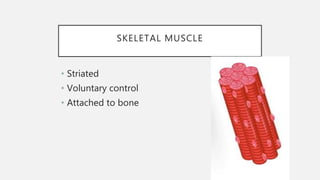
SKELETAL MUSCLE
• Striated
• Voluntary control
• Attached to bone
CARDIAC MUSCLE
• Involuntary control
• Striated
• Found in the Heart
SMOOTH MUSCLE
• Involuntary control
• Found in the digestive tract and blood vessels
HOW MUSCLES WORK
• Over 600 muscles in the body.
• Muscles work in pairs to provide movement.
• One muscle contract while the other relaxes.
• Movement is produced when muscles contract.
• Muscles bulge and shorten when contracted and return to their
normal length when they are relaxed.
TYPES OF CONTRACTIONS
• Isotonic contractions
• Isometric Contractions
ISOTONIC CONTRACTIONS
• Occurs when there is a change in the length of a
muscle causes movement.
Two types
• Concentric contractions: which occurs when a
muscle shortens.
• Eccentric contractions: Which occurs when a
muscle is gradually released and returns to its
original length.
ISOMETRIC CONTRACTIONS
• Occurs when there is no change in the length of the muscle and do not
cause movement.
Examples:
• Pushing against a wall.
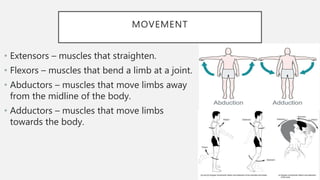
MOVEMENT
• Extensors – muscles that straighten.
• Flexors – muscles that bend a limb at a joint.
• Abductors – muscles that move limbs away
from the midline of the body.
• Adductors – muscles that move limbs
towards the body.
EFFECTS OF EXERCISE ON THE
MUSCULAR SYSTEM
• Makes muscles stronger and more efficient.
• Improves muscles tone. (readiness for a muscles to respond)
• Encourages good posture
• Increases muscle size (hypertrophy)
• Reduces the risk of muscle wasting away. (atrophy)
HOME WORK
1. What are functions of the Muscular system?
2. List the 3 types of muscles.
3. Identify 4 types of movement.
4. What type of muscle is found in the heart?
5. State 3 effects of exercise of the muscular system.
(15 Marks)

The muscular system

  • 1.
  • 4.
    FUNCTIONS •Facilitate Movement •Maintain goodposture •Produce heat THE MUSCULAR SYSTEM
  • 5.
    TYPE OF MUSCLES •Skeletalmuscle •Smooth muscle •Cardiac muscle
  • 6.
    SKELETAL MUSCLE • Striated •Voluntary control • Attached to bone
  • 7.
    CARDIAC MUSCLE • Involuntarycontrol • Striated • Found in the Heart
  • 8.
    SMOOTH MUSCLE • Involuntarycontrol • Found in the digestive tract and blood vessels
  • 9.
    HOW MUSCLES WORK •Over 600 muscles in the body. • Muscles work in pairs to provide movement. • One muscle contract while the other relaxes. • Movement is produced when muscles contract. • Muscles bulge and shorten when contracted and return to their normal length when they are relaxed.
  • 10.
    TYPES OF CONTRACTIONS •Isotonic contractions • Isometric Contractions
  • 11.
    ISOTONIC CONTRACTIONS • Occurswhen there is a change in the length of a muscle causes movement. Two types • Concentric contractions: which occurs when a muscle shortens. • Eccentric contractions: Which occurs when a muscle is gradually released and returns to its original length.
  • 12.
    ISOMETRIC CONTRACTIONS • Occurswhen there is no change in the length of the muscle and do not cause movement. Examples: • Pushing against a wall.
  • 13.
    MOVEMENT • Extensors –muscles that straighten. • Flexors – muscles that bend a limb at a joint. • Abductors – muscles that move limbs away from the midline of the body. • Adductors – muscles that move limbs towards the body.
  • 14.
    EFFECTS OF EXERCISEON THE MUSCULAR SYSTEM • Makes muscles stronger and more efficient. • Improves muscles tone. (readiness for a muscles to respond) • Encourages good posture • Increases muscle size (hypertrophy) • Reduces the risk of muscle wasting away. (atrophy)
  • 15.
    HOME WORK 1. Whatare functions of the Muscular system? 2. List the 3 types of muscles. 3. Identify 4 types of movement. 4. What type of muscle is found in the heart? 5. State 3 effects of exercise of the muscular system. (15 Marks)