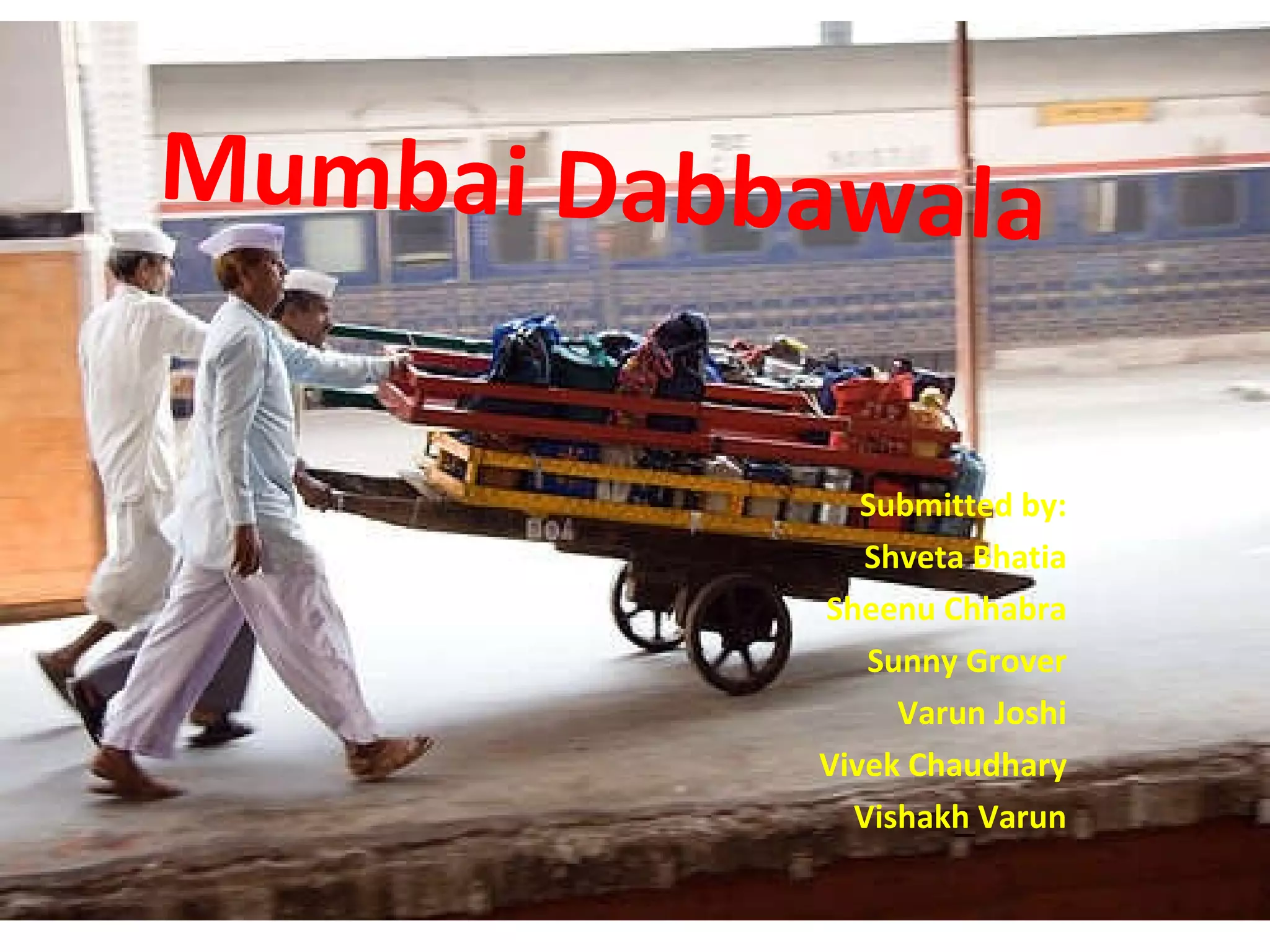
Mumbai Dabbawala Submitted by: Shveta Bhatia Sheenu Chhabra Sunny Grover Varun Joshi Vivek Chaudhary Vishakh Varun
History  :  Started in 1890 Charitable trust  :  Registered in 1956 Avg. Literacy Rate  :  8th Grade Schooling Employee Strength  :  5000 Number of Tiffin's  :  2,00,000 Tiffin Boxes    i.e 4,00,000  transactions every day Time taken  :  3 hrs Total area coverage  :  60 Kms to 70 Kms Nutan Mumbai Tiffin Box Suppliers Association
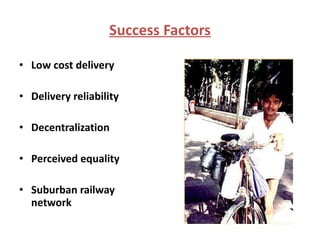
Success Factors Low cost delivery Delivery reliability Decentralization Perceived equality Suburban railway network
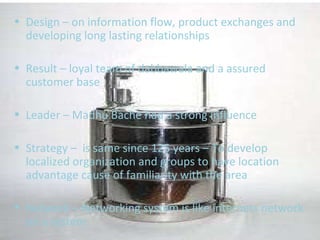
Design – on information flow, product exchanges and developing long lasting relationships Result – loyal team of dabbawala and a assured customer base Leader – Madhu Bache had a strong influence Strategy –  is same since 125 years – To develop localized organization and groups to have location advantage cause of familiarity with the area Network – Networking system is like internets network on a system
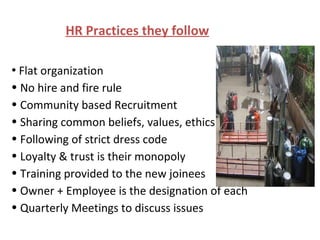
HR Practices they follow Flat organization No hire and fire rule Community based Recruitment  Sharing common beliefs, values, ethics Following of strict dress code Loyalty & trust is their monopoly Training provided to the new joinees Owner + Employee is the designation of each Quarterly Meetings to discuss issues
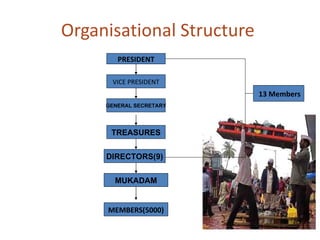
Organisational Structure  PRESIDENT VICE PRESIDENT MEMBERS(5000) 13 Members TREASURES DIRECTORS(9) MUKADAM GENERAL SECRETARY
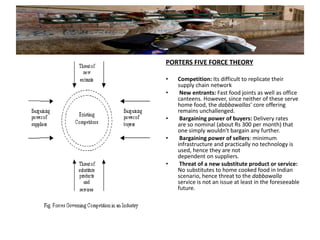
PORTERS FIVE FORCE THEORY Competition:  Its difficult to replicate their supply chain network  New entrants:  Fast food joints as well as office canteens. However, since neither of these serve home food, the  dabbawallas ' core offering remains unchallenged.  Bargaining power of buyers:  Delivery rates are so nominal (about Rs 300 per month) that one simply wouldn't bargain any further.  Bargaining power of sellers : minimum infrastructure and practically no technology is used, hence they are not dependent on suppliers.  Threat of a new substitute product or service:  No   substitutes to home cooked food in Indian scenario, hence threat to the  dabbawalla  service is not an issue at least in the foreseeable future.
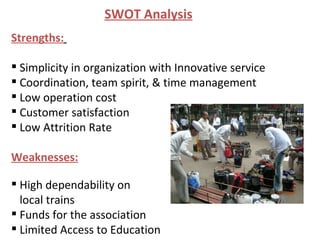
Strengths:   Simplicity in organization with Innovative service  Coordination, team spirit, & time management Low operation cost Customer satisfaction Low Attrition Rate Weaknesses: High dependability on local trains Funds for the association Limited Access to Education SWOT Analysis
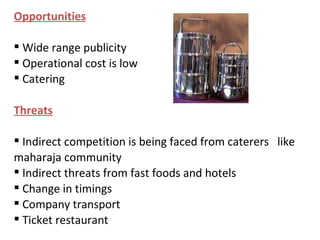
Opportunities Wide range publicity  Operational cost is low  Catering Threats Indirect competition is being faced from caterers  like maharaja community  Indirect threats from fast foods and hotels Change in timings Company transport Ticket restaurant
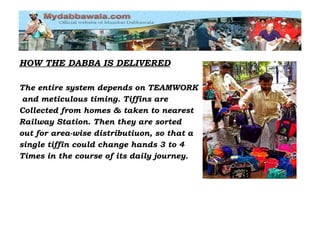
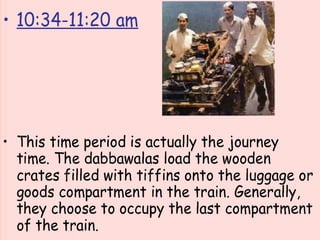
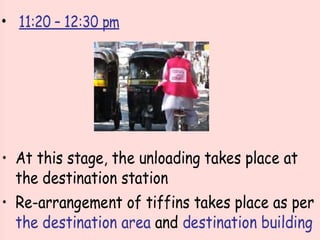
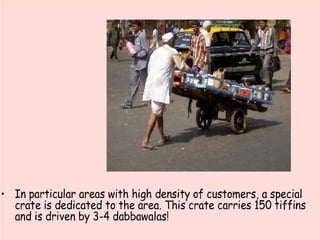
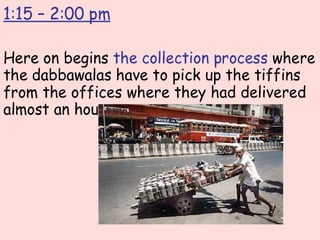
HOW THE DABBA IS DELIVERED The entire system depends on TEAMWORK and meticulous timing. Tiffins are  Collected from homes & taken to nearest  Railway Station. Then they are sorted out for area-wise distributiuon, so that a  single tiffin could change hands 3 to 4  Times in the course of its daily journey.
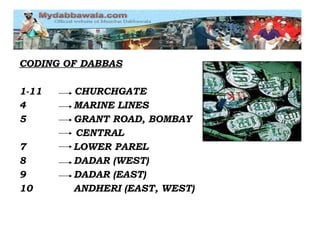
CODING OF DABBAS 1-11   CHURCHGATE MARINE LINES GRANT ROAD, BOMBAY  CENTRAL LOWER PAREL DADAR (WEST) DADAR (EAST) ANDHERI (EAST, WEST)


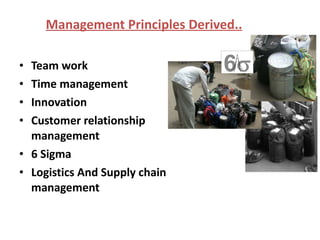
Management Principles Derived.. Team work   Time management Innovation Customer relationship management 6 Sigma Logistics And Supply chain management
Documentaries  made by  :  BBC ,UTV, MTV, ZEE TV, AAJ TAK, TV TODAY, SAHARA SAMAY, STAR TV, CNBC TV 18, CNN, SONY TV, TV TOKYO, NDTV. CASE STUDY  made by :   ICFAI Press Hyderabad & Bangalore Richard Ivey School of Business – Canada Also, Included in a subject in Graduate School of Journalism University of California, Berkeley Invitations  from  :  CII for conference held in Bangalore, IIML, IIMA, CII Cochin, CII Delhi, Dr. Reddy’s Lab Foundation Hyderabad, SCMHRD Pune, SCMHRD Nasik, Sadahana – Pune, Rotary Club – Bangalore, NIQR at Chennai Radio:   German Radio Network, Radio Mirchi, Radio Mid-day, FM – Gold, BBC Radio, Radio City Their Achievements
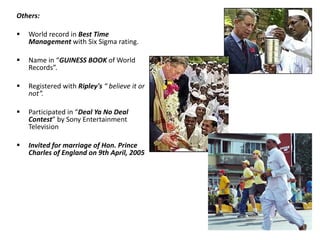
Others: World record in  Best Time Management   with Six Sigma rating. Name in “ GUINESS BOOK  of World Records”. Registered with  Ripley's  “ believe it or not”. Participated in “ Deal Ya No Deal Contest ” by Sony Entertainment Television Invited for marriage of Hon. Prince Charles of England on 9th April, 2005
Conclusion & Recommendation With high team spirit & time management with the low operations cost they are giving full customer satisfaction. The recommendation is that they are highly dependent on local trains so they must be prepared in case if the local trains stop working. They have to be prepared about the competition which they are facing from hotels & fast food chains. They have high range publicity so based on that they can enter other cities also.
 

Mumbai Dabbawala

  • 1.
    Mumbai Dabbawala Submittedby: Shveta Bhatia Sheenu Chhabra Sunny Grover Varun Joshi Vivek Chaudhary Vishakh Varun
  • 2.
    History : Started in 1890 Charitable trust : Registered in 1956 Avg. Literacy Rate : 8th Grade Schooling Employee Strength : 5000 Number of Tiffin's : 2,00,000 Tiffin Boxes i.e 4,00,000 transactions every day Time taken : 3 hrs Total area coverage : 60 Kms to 70 Kms Nutan Mumbai Tiffin Box Suppliers Association
  • 3.
    Success Factors Lowcost delivery Delivery reliability Decentralization Perceived equality Suburban railway network
  • 4.
    Design – oninformation flow, product exchanges and developing long lasting relationships Result – loyal team of dabbawala and a assured customer base Leader – Madhu Bache had a strong influence Strategy – is same since 125 years – To develop localized organization and groups to have location advantage cause of familiarity with the area Network – Networking system is like internets network on a system
  • 5.
    HR Practices theyfollow Flat organization No hire and fire rule Community based Recruitment Sharing common beliefs, values, ethics Following of strict dress code Loyalty & trust is their monopoly Training provided to the new joinees Owner + Employee is the designation of each Quarterly Meetings to discuss issues
  • 6.
    Organisational Structure PRESIDENT VICE PRESIDENT MEMBERS(5000) 13 Members TREASURES DIRECTORS(9) MUKADAM GENERAL SECRETARY
  • 7.
    PORTERS FIVE FORCETHEORY Competition: Its difficult to replicate their supply chain network New entrants: Fast food joints as well as office canteens. However, since neither of these serve home food, the dabbawallas ' core offering remains unchallenged. Bargaining power of buyers: Delivery rates are so nominal (about Rs 300 per month) that one simply wouldn't bargain any further. Bargaining power of sellers : minimum infrastructure and practically no technology is used, hence they are not dependent on suppliers. Threat of a new substitute product or service: No substitutes to home cooked food in Indian scenario, hence threat to the dabbawalla service is not an issue at least in the foreseeable future.
  • 8.
    Strengths: Simplicity in organization with Innovative service Coordination, team spirit, & time management Low operation cost Customer satisfaction Low Attrition Rate Weaknesses: High dependability on local trains Funds for the association Limited Access to Education SWOT Analysis
  • 9.
    Opportunities Wide rangepublicity Operational cost is low Catering Threats Indirect competition is being faced from caterers like maharaja community Indirect threats from fast foods and hotels Change in timings Company transport Ticket restaurant
  • 10.
    HOW THE DABBAIS DELIVERED The entire system depends on TEAMWORK and meticulous timing. Tiffins are Collected from homes & taken to nearest Railway Station. Then they are sorted out for area-wise distributiuon, so that a single tiffin could change hands 3 to 4 Times in the course of its daily journey.
  • 11.
    CODING OF DABBAS1-11 CHURCHGATE MARINE LINES GRANT ROAD, BOMBAY CENTRAL LOWER PAREL DADAR (WEST) DADAR (EAST) ANDHERI (EAST, WEST)
  • 12.
  • 13.
  • 14.
  • 15.
  • 16.
  • 17.
  • 18.
  • 19.
    Management Principles Derived..Team work Time management Innovation Customer relationship management 6 Sigma Logistics And Supply chain management
  • 20.
    Documentaries madeby : BBC ,UTV, MTV, ZEE TV, AAJ TAK, TV TODAY, SAHARA SAMAY, STAR TV, CNBC TV 18, CNN, SONY TV, TV TOKYO, NDTV. CASE STUDY made by : ICFAI Press Hyderabad & Bangalore Richard Ivey School of Business – Canada Also, Included in a subject in Graduate School of Journalism University of California, Berkeley Invitations from : CII for conference held in Bangalore, IIML, IIMA, CII Cochin, CII Delhi, Dr. Reddy’s Lab Foundation Hyderabad, SCMHRD Pune, SCMHRD Nasik, Sadahana – Pune, Rotary Club – Bangalore, NIQR at Chennai Radio: German Radio Network, Radio Mirchi, Radio Mid-day, FM – Gold, BBC Radio, Radio City Their Achievements
  • 21.
    Others: World recordin Best Time Management with Six Sigma rating. Name in “ GUINESS BOOK of World Records”. Registered with Ripley's “ believe it or not”. Participated in “ Deal Ya No Deal Contest ” by Sony Entertainment Television Invited for marriage of Hon. Prince Charles of England on 9th April, 2005
  • 22.
    Conclusion & RecommendationWith high team spirit & time management with the low operations cost they are giving full customer satisfaction. The recommendation is that they are highly dependent on local trains so they must be prepared in case if the local trains stop working. They have to be prepared about the competition which they are facing from hotels & fast food chains. They have high range publicity so based on that they can enter other cities also.
  • 23.