The Most Significant
Change Method:
Background
Jessica Fehringer, PhD, MHS
MEASURE Evaluation
October 29, 2016
American Evaluation Association
Conference — Atlanta
• Participatory approach
• Assess change/impact from perspective of
participants
• Participants and stakeholders involved in
process of collection and analysis
• Participants give personal stories of
significant change, directly or indirectly
related to intervention
• Stories typically analyzed and filtered through
various organization levels
MSC: What Is It?
MSC: Domains of Change
• “Domains of change”
• Broad categories of possible SC stories
• Deliberately fuzzy
• NOT indicators
• Examples:
• Change in quality of people’s lives
• Change in attitude or behaviors
• Change in community participation
MSC: Useful When…
• A program adapts to different or
changing contexts, leading to differences
in implementation and outcomes
• Cause-and-effect is poorly understood
• Multiple intervention components
• Evaluation focused on learning, not just
accountability
MSC: Strengths
• Flexible, captures broader range of results
• Goal-free, no predetermined success
• Simple process
• Complementary to/addresses limitations of
other more traditional methods
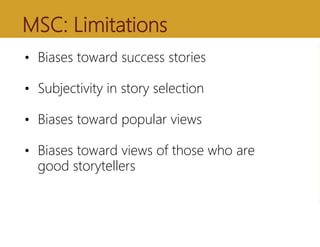
MSC: Limitations
• Biases toward success stories
• Subjectivity in story selection
• Biases toward popular views
• Biases toward views of those who are
good storytellers
This presentation was produced with the support of the United States Agency for
International Development (USAID) under the terms of MEASURE Evaluation
cooperative agreement AID-OAA-L-14-00004. MEASURE Evaluation is
implemented by the Carolina Population Center, University of North Carolina at
Chapel Hill in partnership with ICF International; John Snow, Inc.; Management
Sciences for Health; Palladium; and Tulane University. Views expressed are not
necessarily those of USAID or the United States government.
www.measureevaluation.org

The Most Significant Change Method: Background

  • 1.
    The Most Significant ChangeMethod: Background Jessica Fehringer, PhD, MHS MEASURE Evaluation October 29, 2016 American Evaluation Association Conference — Atlanta
  • 2.
    • Participatory approach •Assess change/impact from perspective of participants • Participants and stakeholders involved in process of collection and analysis • Participants give personal stories of significant change, directly or indirectly related to intervention • Stories typically analyzed and filtered through various organization levels MSC: What Is It?
  • 3.
    MSC: Domains ofChange • “Domains of change” • Broad categories of possible SC stories • Deliberately fuzzy • NOT indicators • Examples: • Change in quality of people’s lives • Change in attitude or behaviors • Change in community participation
  • 4.
    MSC: Useful When… •A program adapts to different or changing contexts, leading to differences in implementation and outcomes • Cause-and-effect is poorly understood • Multiple intervention components • Evaluation focused on learning, not just accountability
  • 5.
    MSC: Strengths • Flexible,captures broader range of results • Goal-free, no predetermined success • Simple process • Complementary to/addresses limitations of other more traditional methods
  • 6.
    MSC: Limitations • Biasestoward success stories • Subjectivity in story selection • Biases toward popular views • Biases toward views of those who are good storytellers
  • 7.
    This presentation wasproduced with the support of the United States Agency for International Development (USAID) under the terms of MEASURE Evaluation cooperative agreement AID-OAA-L-14-00004. MEASURE Evaluation is implemented by the Carolina Population Center, University of North Carolina at Chapel Hill in partnership with ICF International; John Snow, Inc.; Management Sciences for Health; Palladium; and Tulane University. Views expressed are not necessarily those of USAID or the United States government. www.measureevaluation.org