The Moon is a small rock that takes just a month
(twenty-eight days) to orbit the Earth.
Phases of The Moon
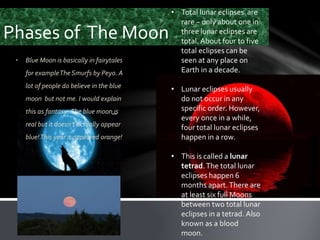
• Blue Moon is basically in fairytales
for exampleThe Smurfs by Peyo. A
lot of people do believe in the blue
moon but not me. I would explain
this as fantasy. The blue moon is
real but it doesn’t actually appear
blue!This year it appeared orange!
• Total lunar eclipses are
rare – only about one in
three lunar eclipses are
total. About four to five
total eclipses can be
seen at any place on
Earth in a decade.
• Lunar eclipses usually
do not occur in any
specific order. However,
every once in a while,
four total lunar eclipses
happen in a row.
• This is called a lunar
tetrad.The total lunar
eclipses happen 6
months apart.There are
at least six full Moons
between two total lunar
eclipses in a tetrad. Also
known as a blood
moon.
What is the moon?
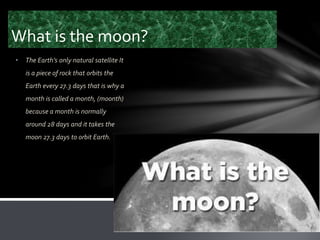
• The Earth’s only natural satellite It
is a piece of rock that orbits the
Earth every 27.3 days that is why a
month is called a month, (moonth)
because a month is normally
around 28 days and it takes the
moon 27.3 days to orbit Earth.
Where is the moon?
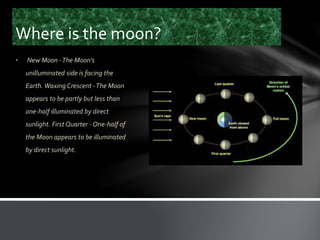
• New Moon -The Moon's
unilluminated side is facing the
Earth. Waxing Crescent -The Moon
appears to be partly but less than
one-half illuminated by direct
sunlight. First Quarter - One-half of
the Moon appears to be illuminated
by direct sunlight.
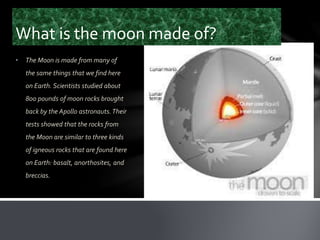
What is the moon made of?
• The Moon is made from many of
the same things that we find here
on Earth. Scientists studied about
800 pounds of moon rocks brought
back by the Apollo astronauts.Their
tests showed that the rocks from
the Moon are similar to three kinds
of igneous rocks that are found here
on Earth: basalt, anorthosites, and
breccias.
Visiting the moon.
• A moon landing is the arrival of a spacecraft on the
surface of the Moon. This includes both manned and
unmanned (robotic) missions. The first human-made
object to reach the surface of the Moon was the Soviet
Union's Luna 2 mission, on 13 September 1959.[3]
• The United States' Apollo 11 was the first manned
mission to land on the Moon, on 20 July 1969.[4] There
have been six manned U.S landings (between 1969 and
1972) and numerous unmanned landings, with no soft
landings happening from 22 August 1976 until 14
December 2013.
• To date, the United States is the only country to have
successfully conducted manned missions to the Moon.
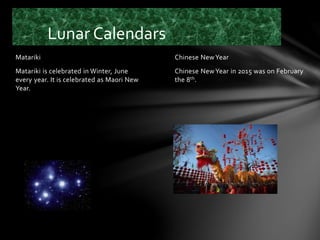
Chinese NewYear
Chinese NewYear in 2015 was on February
the 8th.
Matariki
Matariki is celebrated in Winter, June
every year. It is celebrated as Maori New
Year.
Lunar Calendars
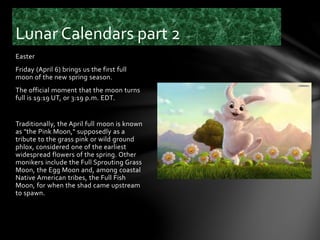
Easter
Friday (April 6) brings us the first full
moon of the new spring season.
The official moment that the moon turns
full is 19:19 UT, or 3:19 p.m. EDT.
Traditionally, the April full moon is known
as "the Pink Moon," supposedly as a
tribute to the grass pink or wild ground
phlox, considered one of the earliest
widespread flowers of the spring. Other
monikers include the Full Sprouting Grass
Moon, the Egg Moon and, among coastal
Native American tribes, the Full Fish
Moon, for when the shad came upstream
to spawn.
Lunar Calendars part 2
What else does the moon do?
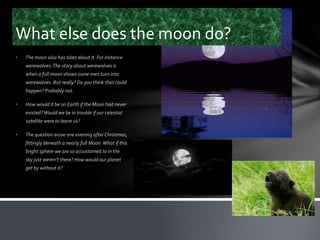
• The moon also has tales about it. For instance
werewolves.The story about werewolves is
when a full moon shows some men turn into
werewolves. But really? Do you think that could
happen? Probably not.
• How would it be on Earth if the Moon had never
existed?Would we be in trouble if our celestial
satellite were to leave us?
• The question arose one evening after Christmas,
fittingly beneath a nearly full Moon.What if this
bright sphere we are so accustomed to in the
sky just weren’t there? How would our planet
get by without it?
What else does the moon do? Part 2
• A few consequences come immediately to mind: Neil
Armstrong’s life would have been less exciting. Audrey Hepburn
wouldn’t have sat on the stairs with a guitar and played “Moon
River” in the movie Breakfast at Tiffany’s. And the myth of
werewolves wouldn’t have existed – at least not in the form we
know it today.
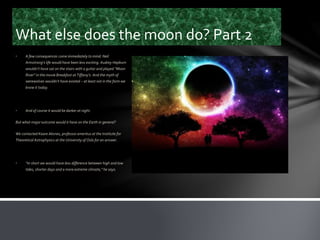
• And of course it would be darker at night.
But what major outcome would it have on the Earth in general?
We contacted Kaare Aksnes, professor emeritus at the Institute for
Theoretical Astrophysics at the University of Oslo for an answer.
• “In short we would have less difference between high and low
tides, shorter days and a more extreme climate,” he says.
More info about the Blue moon
A Blue moon is when there are two full
moons in one calendar month.The next
Blue moon will occur in 2018 January
31, an unexpected twist will happen.
Another Blue moon will be in March 31
2018 too! Can’t wait. I wonder if it will
actually be blue! Probably not.

The moon alistair

  • 1.
    The Moon isa small rock that takes just a month (twenty-eight days) to orbit the Earth.
  • 2.
    Phases of TheMoon • Blue Moon is basically in fairytales for exampleThe Smurfs by Peyo. A lot of people do believe in the blue moon but not me. I would explain this as fantasy. The blue moon is real but it doesn’t actually appear blue!This year it appeared orange! • Total lunar eclipses are rare – only about one in three lunar eclipses are total. About four to five total eclipses can be seen at any place on Earth in a decade. • Lunar eclipses usually do not occur in any specific order. However, every once in a while, four total lunar eclipses happen in a row. • This is called a lunar tetrad.The total lunar eclipses happen 6 months apart.There are at least six full Moons between two total lunar eclipses in a tetrad. Also known as a blood moon.
  • 3.
    What is themoon? • The Earth’s only natural satellite It is a piece of rock that orbits the Earth every 27.3 days that is why a month is called a month, (moonth) because a month is normally around 28 days and it takes the moon 27.3 days to orbit Earth.
  • 4.
    Where is themoon? • New Moon -The Moon's unilluminated side is facing the Earth. Waxing Crescent -The Moon appears to be partly but less than one-half illuminated by direct sunlight. First Quarter - One-half of the Moon appears to be illuminated by direct sunlight.
  • 5.
    What is themoon made of? • The Moon is made from many of the same things that we find here on Earth. Scientists studied about 800 pounds of moon rocks brought back by the Apollo astronauts.Their tests showed that the rocks from the Moon are similar to three kinds of igneous rocks that are found here on Earth: basalt, anorthosites, and breccias.
  • 6.
    Visiting the moon. •A moon landing is the arrival of a spacecraft on the surface of the Moon. This includes both manned and unmanned (robotic) missions. The first human-made object to reach the surface of the Moon was the Soviet Union's Luna 2 mission, on 13 September 1959.[3] • The United States' Apollo 11 was the first manned mission to land on the Moon, on 20 July 1969.[4] There have been six manned U.S landings (between 1969 and 1972) and numerous unmanned landings, with no soft landings happening from 22 August 1976 until 14 December 2013. • To date, the United States is the only country to have successfully conducted manned missions to the Moon.
  • 7.
    Chinese NewYear Chinese NewYearin 2015 was on February the 8th. Matariki Matariki is celebrated in Winter, June every year. It is celebrated as Maori New Year. Lunar Calendars
  • 8.
    Easter Friday (April 6)brings us the first full moon of the new spring season. The official moment that the moon turns full is 19:19 UT, or 3:19 p.m. EDT. Traditionally, the April full moon is known as "the Pink Moon," supposedly as a tribute to the grass pink or wild ground phlox, considered one of the earliest widespread flowers of the spring. Other monikers include the Full Sprouting Grass Moon, the Egg Moon and, among coastal Native American tribes, the Full Fish Moon, for when the shad came upstream to spawn. Lunar Calendars part 2
  • 9.
    What else doesthe moon do? • The moon also has tales about it. For instance werewolves.The story about werewolves is when a full moon shows some men turn into werewolves. But really? Do you think that could happen? Probably not. • How would it be on Earth if the Moon had never existed?Would we be in trouble if our celestial satellite were to leave us? • The question arose one evening after Christmas, fittingly beneath a nearly full Moon.What if this bright sphere we are so accustomed to in the sky just weren’t there? How would our planet get by without it?
  • 10.
    What else doesthe moon do? Part 2 • A few consequences come immediately to mind: Neil Armstrong’s life would have been less exciting. Audrey Hepburn wouldn’t have sat on the stairs with a guitar and played “Moon River” in the movie Breakfast at Tiffany’s. And the myth of werewolves wouldn’t have existed – at least not in the form we know it today. • And of course it would be darker at night. But what major outcome would it have on the Earth in general? We contacted Kaare Aksnes, professor emeritus at the Institute for Theoretical Astrophysics at the University of Oslo for an answer. • “In short we would have less difference between high and low tides, shorter days and a more extreme climate,” he says.
  • 11.
    More info aboutthe Blue moon A Blue moon is when there are two full moons in one calendar month.The next Blue moon will occur in 2018 January 31, an unexpected twist will happen. Another Blue moon will be in March 31 2018 too! Can’t wait. I wonder if it will actually be blue! Probably not.