THE MONASTERY SETTELEMENT
Case study of the Buddhist monastery
BY- ANUSHA FATIMA
MAULANA AZAD NATIONAL INSTITUTE OF TECHNOLOGY, BHOPAL
INTRODUCTION
A monastery is a complex of buildings comprising the domestic quarters and
workplaces of monastics, whether monks, and whether living in communities or
alone (hermits). A monastery generally includes a place reserved for prayer which
may be a chapel, church or temple, and may also serve as an oratory. In England
the word monastery was also applied to the habitation of a bishop and
the cathedral clergy who lived apart from the lay community.
Those living the monastic life are known by the generic terms monks (men)
and nuns (women). In modern English, they are also known by the gender-neutral
term "monastics." The word monk originated from the Greekmonachos "monk",
itself from monos meaning "alone". Monks did not live in monasteries at first,
rather, they began by living alone, as the word monos might suggest. As more
people took on the lives of monks, living alone in the wilderness, they started to
come together and model themselves after the original monks nearby.
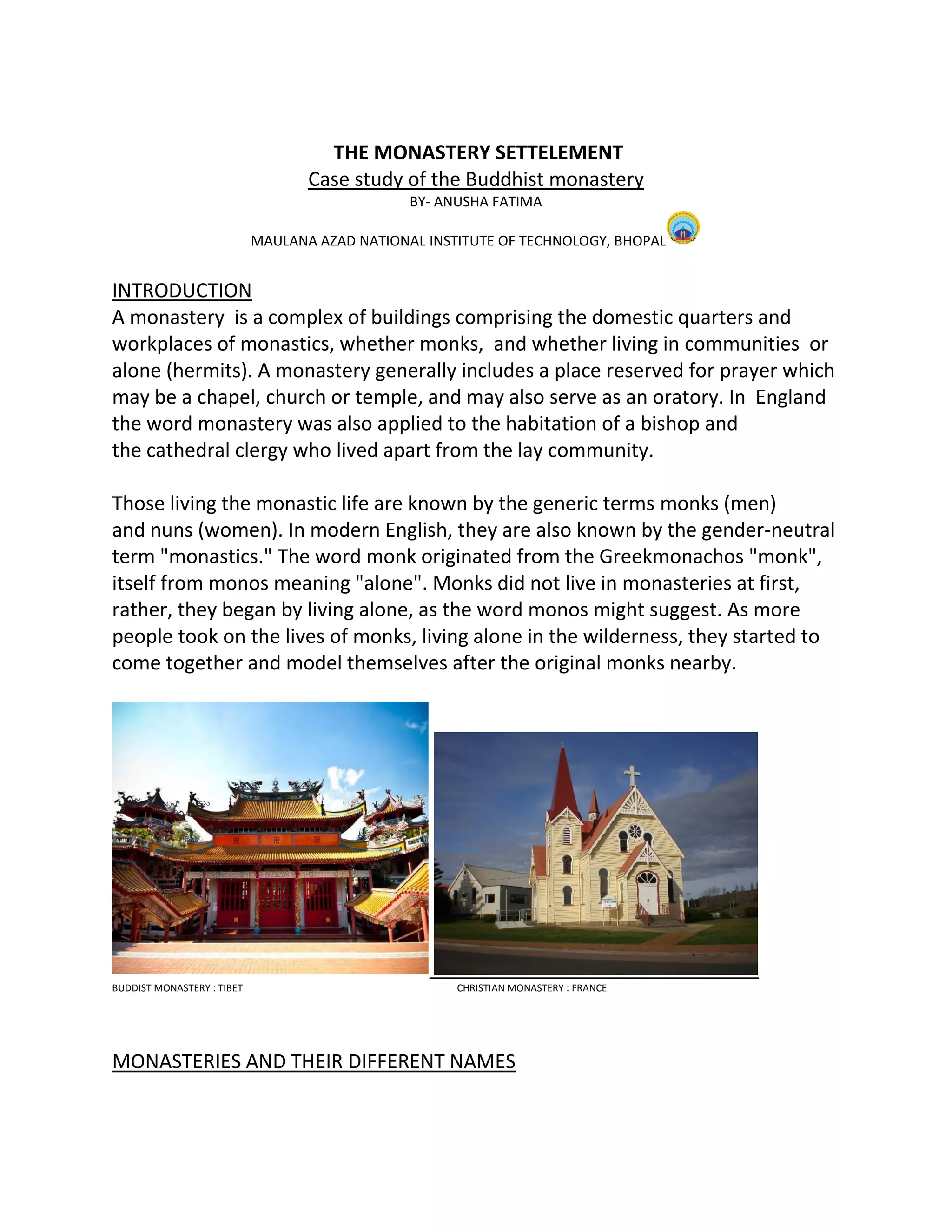
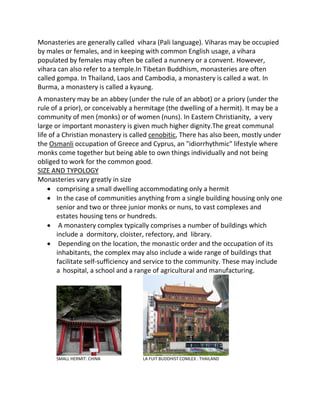
BUDDIST MONASTERY : TIBET CHRISTIAN MONASTERY : FRANCE
MONASTERIES AND THEIR DIFFERENT NAMES
Monasteries are generally called vihara (Pali language). Viharas may be occupied
by males or females, and in keeping with common English usage, a vihara
populated by females may often be called a nunnery or a convent. However,
vihara can also refer to a temple.In Tibetan Buddhism, monasteries are often
called gompa. In Thailand, Laos and Cambodia, a monastery is called a wat. In
Burma, a monastery is called a kyaung.
A monastery may be an abbey (under the rule of an abbot) or a priory (under the
rule of a prior), or conceivably a hermitage (the dwelling of a hermit). It may be a
community of men (monks) or of women (nuns). In Eastern Christianity, a very
large or important monastery is given much higher dignity.The great communal
life of a Christian monastery is called cenobitic, There has also been, mostly under
the Osmanli occupation of Greece and Cyprus, an "idiorrhythmic" lifestyle where
monks come together but being able to own things individually and not being
obliged to work for the common good.
SIZE AND TYPOLOGY
Monasteries vary greatly in size
 comprising a small dwelling accommodating only a hermit
 In the case of communities anything from a single building housing only one
senior and two or three junior monks or nuns, to vast complexes and
estates housing tens or hundreds.
 A monastery complex typically comprises a number of buildings which
include a dormitory, cloister, refectory, and library.
 Depending on the location, the monastic order and the occupation of its
inhabitants, the complex may also include a wide range of buildings that
facilitate self-sufficiency and service to the community. These may include
a hospital, a school and a range of agricultural and manufacturing.
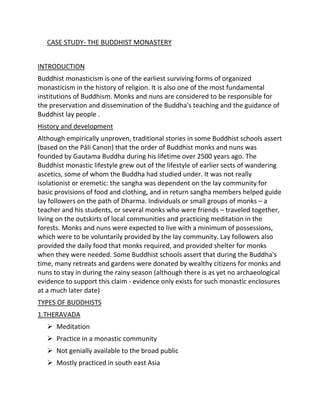
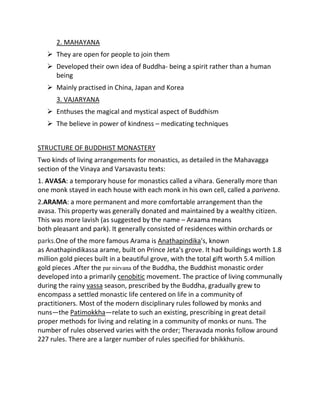
SMALL HERMIT: CHINA LA FUIT BUDDHIST COMLEX : THAILAND
CASE STUDY- THE BUDDHIST MONASTERY
INTRODUCTION
Buddhist monasticism is one of the earliest surviving forms of organized
monasticism in the history of religion. It is also one of the most fundamental
institutions of Buddhism. Monks and nuns are considered to be responsible for
the preservation and dissemination of the Buddha's teaching and the guidance of
Buddhist lay people .
History and development
Although empirically unproven, traditional stories in some Buddhist schools assert
(based on the Pāli Canon) that the order of Buddhist monks and nuns was
founded by Gautama Buddha during his lifetime over 2500 years ago. The
Buddhist monastic lifestyle grew out of the lifestyle of earlier sects of wandering
ascetics, some of whom the Buddha had studied under. It was not really
isolationist or eremetic: the sangha was dependent on the lay community for
basic provisions of food and clothing, and in return sangha members helped guide
lay followers on the path of Dharma. Individuals or small groups of monks – a
teacher and his students, or several monks who were friends – traveled together,
living on the outskirts of local communities and practicing meditation in the
forests. Monks and nuns were expected to live with a minimum of possessions,
which were to be voluntarily provided by the lay community. Lay followers also
provided the daily food that monks required, and provided shelter for monks
when they were needed. Some Buddhist schools assert that during the Buddha's
time, many retreats and gardens were donated by wealthy citizens for monks and
nuns to stay in during the rainy season (although there is as yet no archaeological
evidence to support this claim - evidence only exists for such monastic enclosures
at a much later date)
TYPES OF BUDDHISTS
1.THERAVADA
 Meditation
 Practice in a monastic community
 Not genially available to the broad public
 Mostly practiced in south east Asia
2. MAHAYANA
 They are open for people to join them
 Developed their own idea of Buddha- being a spirit rather than a human
being
 Mainly practised in China, Japan and Korea
3. VAJARYANA
 Enthuses the magical and mystical aspect of Buddhism
 The believe in power of kindness – medicating techniques
STRUCTURE OF BUDDHIST MONASTERY
Two kinds of living arrangements for monastics, as detailed in the Mahavagga
section of the Vinaya and Varsavastu texts:
1. AVASA: a temporary house for monastics called a vihara. Generally more than
one monk stayed in each house with each monk in his own cell, called a parivena.
2.ARAMA: a more permanent and more comfortable arrangement than the
avasa. This property was generally donated and maintained by a wealthy citizen.
This was more lavish (as suggested by the name – Araama means
both pleasant and park). It generally consisted of residences within orchards or
parks.One of the more famous Arama is Anathapindika's, known
as Anathapindikassa arame, built on Prince Jeta's grove. It had buildings worth 1.8
million gold pieces built in a beautiful grove, with the total gift worth 5.4 million
gold pieces .After the par nirvana of the Buddha, the Buddhist monastic order
developed into a primarily cenobitic movement. The practice of living communally
during the rainy vassa season, prescribed by the Buddha, gradually grew to
encompass a settled monastic life centered on life in a community of
practitioners. Most of the modern disciplinary rules followed by monks and
nuns—the Patimokkha—relate to such an existing, prescribing in great detail
proper methods for living and relating in a community of monks or nuns. The
number of rules observed varies with the order; Theravada monks follow around
227 rules. There are a larger number of rules specified for bhikkhunis.
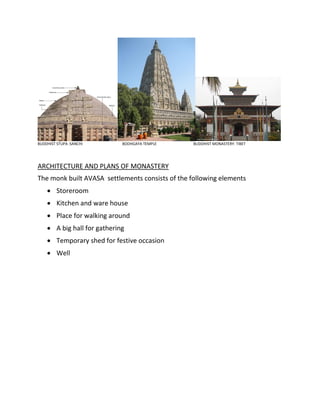
STUPAS
Stupas are solid structures that
typically cannot be entered and were
constructed to contain sacred
Buddhist relics that are hidden from
view (and vandals) in containers
buried at their core or in the walls
TEMPLES
place of worship somewhat similar to a church
Local temples are essentially self sufficient and rely
on their own lands and support from the local lay
community to keep going. Property belongs to the
community. There is not a hierarchy of priest, bishops
and archbishops like there is Christianity.; Buddhist
temples usually contain numerous Buddha statues.
The central Buddha images are often surrounded by
burning incense sticks and offerings of fruit and
flowers. Some contain the ashes or bone reliquaries
of popular holy man. Many Buddhist temples face
south and sometimes to the east, but never to the
north and west which are regarded as unlucky
directions according to Chinese feng shui. Many
temples are entered through the left door and exited
through the right
MONASTERIES
which contain living quarters
and meditation cells for monks.
BUDDHIST STUPA :SANCHI BODHGAYA TEMPLE BUDDHIST MONASTERY: TIBET
ARCHITECTURE AND PLANS OF MONASTERY
The monk built AVASA settlements consists of the following elements
 Storeroom
 Kitchen and ware house
 Place for walking around
 A big hall for gathering
 Temporary shed for festive occasion
 Well
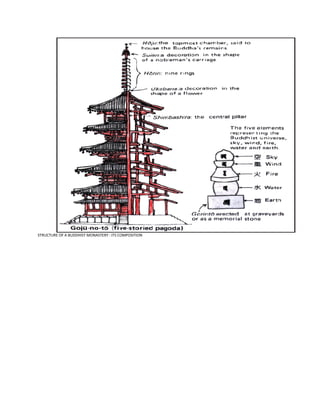
STRUCTURE OF A BUDDHIST MONASTERY : ITS COMPOSITION
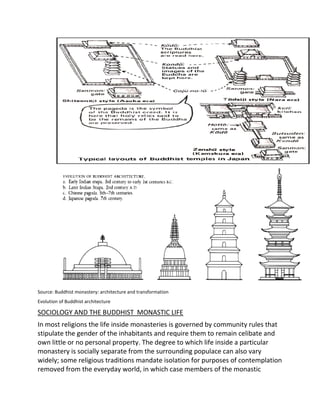
Source: Buddhist monastery: architecture and transformation
Evolution of Buddhist architecture
SOCIOLOGY AND THE BUDDHIST MONASTIC LIFE
In most religions the life inside monasteries is governed by community rules that
stipulate the gender of the inhabitants and require them to remain celibate and
own little or no personal property. The degree to which life inside a particular
monastery is socially separate from the surrounding populace can also vary
widely; some religious traditions mandate isolation for purposes of contemplation
removed from the everyday world, in which case members of the monastic
community may spend most of their time isolated even from each other. Others
focus on interacting with the local communities to provide services, such as
teaching, medical care. Some monastic communities are only occupied seasonally,
depending both on the traditions involved and the local weather, and people may
be part of a monastic community for periods ranging from a few days at a time to
almost an entire lifetime.
The life within the walls of a monastery may be supported in several ways: by
manufacturing and selling goods, often agricultural products, by donations
or alms,by rental or investment incomes, and by funds from other organizations
within the religion, which in the past formed the traditional support of
monasteries. There has been a long tradition of Buddhist monasteries providing
hospitable, charitable and hospital services. Monasteries have often been
associated with the provision of education and the encouragement of scholarship
and research, which has led to the establishment of schools and colleges and the
association with universities.Buddhist monastic life has adapted to modern
society by offering computer services, accounting services and management as
well as modern hospital and educational administration. Monks and nuns are
expected to fulfill a variety of roles in the Buddhist community. First and
foremost, they are expected to preserve the doctrine and discipline now known
as Buddhism. They are also expected to provide a living example for the laity, and
to serve as a "field of merit" for lay followers, providing laymen and women with
the opportunity to earn merit by giving gifts and support to the monks. In return
for the support of the laity, monks and nuns are expected to live an austere life
focused on the study of Buddhist doctrine, the practice of meditation, and the
observance of good moral character. The relative degree of emphasis on
meditation or study has often been debated in the Buddhist community. Many
continued to keep a relationship with their original families.
The disciplinary regulations for monks and nuns are intended to create a life that
is simple and focused, rather than one of deprivation or severe asceticism.
Celibacy is of primary importance in monastic discipline, seen as being the
preeminent factor in separating the life of a monastic from that of
a householder. Depending on the tradition and the strictness of observation,
monastics may eat only one meal a day, provided either by direct donations of
food from lay supporters, or from a monastery kitchen that is stocked (and
possibly staffed) by lay supporters.
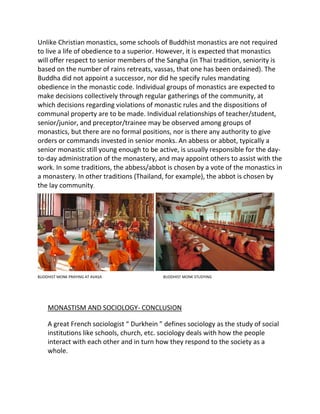
Unlike Christian monastics, some schools of Buddhist monastics are not required
to live a life of obedience to a superior. However, it is expected that monastics
will offer respect to senior members of the Sangha (in Thai tradition, seniority is
based on the number of rains retreats, vassas, that one has been ordained). The
Buddha did not appoint a successor, nor did he specify rules mandating
obedience in the monastic code. Individual groups of monastics are expected to
make decisions collectively through regular gatherings of the community, at
which decisions regarding violations of monastic rules and the dispositions of
communal property are to be made. Individual relationships of teacher/student,
senior/junior, and preceptor/trainee may be observed among groups of
monastics, but there are no formal positions, nor is there any authority to give
orders or commands invested in senior monks. An abbess or abbot, typically a
senior monastic still young enough to be active, is usually responsible for the day-
to-day administration of the monastery, and may appoint others to assist with the
work. In some traditions, the abbess/abbot is chosen by a vote of the monastics in
a monastery. In other traditions (Thailand, for example), the abbot is chosen by
the lay community.
BUDDHIST MONK PRAYING AT AVASA BUDDHIST MONK STUDYING
MONASTISM AND SOCIOLOGY- CONCLUSION
A great French sociologist “ Durkhein ” defines sociology as the study of social
institutions like schools, church, etc. sociology deals with how the people
interact with each other and in turn how they respond to the society as a
whole.
In planning context, Albert J. Reiss has defined, “sociology is the study of
social aggregates and groups in their institutional organization, of institutions
and their organization, and of the causes and consequences of changes in
institutions and social organization.” Thus monasteries plays an important
role in the organized formation of a society by encouraging qualities like
generosity, kindness and thinking for the well being of each and every
individual . Nevertheless, planning deals with making of policies and laws for
the well being of the people. Thus enhancing monastery settlements and
giving it an important place in a society will definitely help in a peaceful and
prosperous growth of society as a whole encompassing every individual be it
rich, poor , black or white. The aim of people in a society should not be just
their welfare,they should not be selfish to their needs but taking care of each
and every individual of the society- should be their sole motive.
REFERENCES
https://en.buddhism and its evolution.org/Monastic_settlement
http://www.history.upenn.edu/coursepages/hist086/material/sanchi.htm
http://www.buddhanet.net/stupa.htm

The monastery settelement anusha maam

  • 1.
    THE MONASTERY SETTELEMENT Casestudy of the Buddhist monastery BY- ANUSHA FATIMA MAULANA AZAD NATIONAL INSTITUTE OF TECHNOLOGY, BHOPAL INTRODUCTION A monastery is a complex of buildings comprising the domestic quarters and workplaces of monastics, whether monks, and whether living in communities or alone (hermits). A monastery generally includes a place reserved for prayer which may be a chapel, church or temple, and may also serve as an oratory. In England the word monastery was also applied to the habitation of a bishop and the cathedral clergy who lived apart from the lay community. Those living the monastic life are known by the generic terms monks (men) and nuns (women). In modern English, they are also known by the gender-neutral term "monastics." The word monk originated from the Greekmonachos "monk", itself from monos meaning "alone". Monks did not live in monasteries at first, rather, they began by living alone, as the word monos might suggest. As more people took on the lives of monks, living alone in the wilderness, they started to come together and model themselves after the original monks nearby. BUDDIST MONASTERY : TIBET CHRISTIAN MONASTERY : FRANCE MONASTERIES AND THEIR DIFFERENT NAMES
  • 2.
    Monasteries are generallycalled vihara (Pali language). Viharas may be occupied by males or females, and in keeping with common English usage, a vihara populated by females may often be called a nunnery or a convent. However, vihara can also refer to a temple.In Tibetan Buddhism, monasteries are often called gompa. In Thailand, Laos and Cambodia, a monastery is called a wat. In Burma, a monastery is called a kyaung. A monastery may be an abbey (under the rule of an abbot) or a priory (under the rule of a prior), or conceivably a hermitage (the dwelling of a hermit). It may be a community of men (monks) or of women (nuns). In Eastern Christianity, a very large or important monastery is given much higher dignity.The great communal life of a Christian monastery is called cenobitic, There has also been, mostly under the Osmanli occupation of Greece and Cyprus, an "idiorrhythmic" lifestyle where monks come together but being able to own things individually and not being obliged to work for the common good. SIZE AND TYPOLOGY Monasteries vary greatly in size  comprising a small dwelling accommodating only a hermit  In the case of communities anything from a single building housing only one senior and two or three junior monks or nuns, to vast complexes and estates housing tens or hundreds.  A monastery complex typically comprises a number of buildings which include a dormitory, cloister, refectory, and library.  Depending on the location, the monastic order and the occupation of its inhabitants, the complex may also include a wide range of buildings that facilitate self-sufficiency and service to the community. These may include a hospital, a school and a range of agricultural and manufacturing. SMALL HERMIT: CHINA LA FUIT BUDDHIST COMLEX : THAILAND
  • 3.
    CASE STUDY- THEBUDDHIST MONASTERY INTRODUCTION Buddhist monasticism is one of the earliest surviving forms of organized monasticism in the history of religion. It is also one of the most fundamental institutions of Buddhism. Monks and nuns are considered to be responsible for the preservation and dissemination of the Buddha's teaching and the guidance of Buddhist lay people . History and development Although empirically unproven, traditional stories in some Buddhist schools assert (based on the Pāli Canon) that the order of Buddhist monks and nuns was founded by Gautama Buddha during his lifetime over 2500 years ago. The Buddhist monastic lifestyle grew out of the lifestyle of earlier sects of wandering ascetics, some of whom the Buddha had studied under. It was not really isolationist or eremetic: the sangha was dependent on the lay community for basic provisions of food and clothing, and in return sangha members helped guide lay followers on the path of Dharma. Individuals or small groups of monks – a teacher and his students, or several monks who were friends – traveled together, living on the outskirts of local communities and practicing meditation in the forests. Monks and nuns were expected to live with a minimum of possessions, which were to be voluntarily provided by the lay community. Lay followers also provided the daily food that monks required, and provided shelter for monks when they were needed. Some Buddhist schools assert that during the Buddha's time, many retreats and gardens were donated by wealthy citizens for monks and nuns to stay in during the rainy season (although there is as yet no archaeological evidence to support this claim - evidence only exists for such monastic enclosures at a much later date) TYPES OF BUDDHISTS 1.THERAVADA  Meditation  Practice in a monastic community  Not genially available to the broad public  Mostly practiced in south east Asia
  • 4.
    2. MAHAYANA  Theyare open for people to join them  Developed their own idea of Buddha- being a spirit rather than a human being  Mainly practised in China, Japan and Korea 3. VAJARYANA  Enthuses the magical and mystical aspect of Buddhism  The believe in power of kindness – medicating techniques STRUCTURE OF BUDDHIST MONASTERY Two kinds of living arrangements for monastics, as detailed in the Mahavagga section of the Vinaya and Varsavastu texts: 1. AVASA: a temporary house for monastics called a vihara. Generally more than one monk stayed in each house with each monk in his own cell, called a parivena. 2.ARAMA: a more permanent and more comfortable arrangement than the avasa. This property was generally donated and maintained by a wealthy citizen. This was more lavish (as suggested by the name – Araama means both pleasant and park). It generally consisted of residences within orchards or parks.One of the more famous Arama is Anathapindika's, known as Anathapindikassa arame, built on Prince Jeta's grove. It had buildings worth 1.8 million gold pieces built in a beautiful grove, with the total gift worth 5.4 million gold pieces .After the par nirvana of the Buddha, the Buddhist monastic order developed into a primarily cenobitic movement. The practice of living communally during the rainy vassa season, prescribed by the Buddha, gradually grew to encompass a settled monastic life centered on life in a community of practitioners. Most of the modern disciplinary rules followed by monks and nuns—the Patimokkha—relate to such an existing, prescribing in great detail proper methods for living and relating in a community of monks or nuns. The number of rules observed varies with the order; Theravada monks follow around 227 rules. There are a larger number of rules specified for bhikkhunis.
  • 5.
    STUPAS Stupas are solidstructures that typically cannot be entered and were constructed to contain sacred Buddhist relics that are hidden from view (and vandals) in containers buried at their core or in the walls TEMPLES place of worship somewhat similar to a church Local temples are essentially self sufficient and rely on their own lands and support from the local lay community to keep going. Property belongs to the community. There is not a hierarchy of priest, bishops and archbishops like there is Christianity.; Buddhist temples usually contain numerous Buddha statues. The central Buddha images are often surrounded by burning incense sticks and offerings of fruit and flowers. Some contain the ashes or bone reliquaries of popular holy man. Many Buddhist temples face south and sometimes to the east, but never to the north and west which are regarded as unlucky directions according to Chinese feng shui. Many temples are entered through the left door and exited through the right MONASTERIES which contain living quarters and meditation cells for monks.
  • 6.
    BUDDHIST STUPA :SANCHIBODHGAYA TEMPLE BUDDHIST MONASTERY: TIBET ARCHITECTURE AND PLANS OF MONASTERY The monk built AVASA settlements consists of the following elements  Storeroom  Kitchen and ware house  Place for walking around  A big hall for gathering  Temporary shed for festive occasion  Well
  • 7.
    STRUCTURE OF ABUDDHIST MONASTERY : ITS COMPOSITION
  • 8.
    Source: Buddhist monastery:architecture and transformation Evolution of Buddhist architecture SOCIOLOGY AND THE BUDDHIST MONASTIC LIFE In most religions the life inside monasteries is governed by community rules that stipulate the gender of the inhabitants and require them to remain celibate and own little or no personal property. The degree to which life inside a particular monastery is socially separate from the surrounding populace can also vary widely; some religious traditions mandate isolation for purposes of contemplation removed from the everyday world, in which case members of the monastic
  • 9.
    community may spendmost of their time isolated even from each other. Others focus on interacting with the local communities to provide services, such as teaching, medical care. Some monastic communities are only occupied seasonally, depending both on the traditions involved and the local weather, and people may be part of a monastic community for periods ranging from a few days at a time to almost an entire lifetime. The life within the walls of a monastery may be supported in several ways: by manufacturing and selling goods, often agricultural products, by donations or alms,by rental or investment incomes, and by funds from other organizations within the religion, which in the past formed the traditional support of monasteries. There has been a long tradition of Buddhist monasteries providing hospitable, charitable and hospital services. Monasteries have often been associated with the provision of education and the encouragement of scholarship and research, which has led to the establishment of schools and colleges and the association with universities.Buddhist monastic life has adapted to modern society by offering computer services, accounting services and management as well as modern hospital and educational administration. Monks and nuns are expected to fulfill a variety of roles in the Buddhist community. First and foremost, they are expected to preserve the doctrine and discipline now known as Buddhism. They are also expected to provide a living example for the laity, and to serve as a "field of merit" for lay followers, providing laymen and women with the opportunity to earn merit by giving gifts and support to the monks. In return for the support of the laity, monks and nuns are expected to live an austere life focused on the study of Buddhist doctrine, the practice of meditation, and the observance of good moral character. The relative degree of emphasis on meditation or study has often been debated in the Buddhist community. Many continued to keep a relationship with their original families. The disciplinary regulations for monks and nuns are intended to create a life that is simple and focused, rather than one of deprivation or severe asceticism. Celibacy is of primary importance in monastic discipline, seen as being the preeminent factor in separating the life of a monastic from that of a householder. Depending on the tradition and the strictness of observation, monastics may eat only one meal a day, provided either by direct donations of food from lay supporters, or from a monastery kitchen that is stocked (and possibly staffed) by lay supporters.
  • 10.
    Unlike Christian monastics,some schools of Buddhist monastics are not required to live a life of obedience to a superior. However, it is expected that monastics will offer respect to senior members of the Sangha (in Thai tradition, seniority is based on the number of rains retreats, vassas, that one has been ordained). The Buddha did not appoint a successor, nor did he specify rules mandating obedience in the monastic code. Individual groups of monastics are expected to make decisions collectively through regular gatherings of the community, at which decisions regarding violations of monastic rules and the dispositions of communal property are to be made. Individual relationships of teacher/student, senior/junior, and preceptor/trainee may be observed among groups of monastics, but there are no formal positions, nor is there any authority to give orders or commands invested in senior monks. An abbess or abbot, typically a senior monastic still young enough to be active, is usually responsible for the day- to-day administration of the monastery, and may appoint others to assist with the work. In some traditions, the abbess/abbot is chosen by a vote of the monastics in a monastery. In other traditions (Thailand, for example), the abbot is chosen by the lay community. BUDDHIST MONK PRAYING AT AVASA BUDDHIST MONK STUDYING MONASTISM AND SOCIOLOGY- CONCLUSION A great French sociologist “ Durkhein ” defines sociology as the study of social institutions like schools, church, etc. sociology deals with how the people interact with each other and in turn how they respond to the society as a whole.
  • 11.
    In planning context,Albert J. Reiss has defined, “sociology is the study of social aggregates and groups in their institutional organization, of institutions and their organization, and of the causes and consequences of changes in institutions and social organization.” Thus monasteries plays an important role in the organized formation of a society by encouraging qualities like generosity, kindness and thinking for the well being of each and every individual . Nevertheless, planning deals with making of policies and laws for the well being of the people. Thus enhancing monastery settlements and giving it an important place in a society will definitely help in a peaceful and prosperous growth of society as a whole encompassing every individual be it rich, poor , black or white. The aim of people in a society should not be just their welfare,they should not be selfish to their needs but taking care of each and every individual of the society- should be their sole motive. REFERENCES https://en.buddhism and its evolution.org/Monastic_settlement http://www.history.upenn.edu/coursepages/hist086/material/sanchi.htm http://www.buddhanet.net/stupa.htm