Congratulations, you’re a
computational chemist.
Now what?
Molecular Modeling in the Corporate World
A presentation for Roald Hoffmann’s group
Cornell University
8 October 2013
George Fitzgerald, Ph.D.
gfitzgerald@accelrys.com
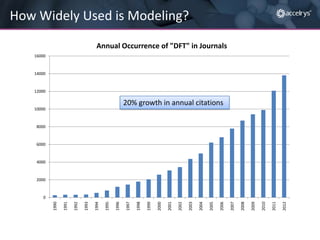
How Widely Used is Modeling?
Annual Occurrence of "DFT" in Journals
16000

14000

12000

20% growth in annual citations

10000

8000

6000

4000

2000

2012

2011

2010

2009

2008

2007

2006

2005

2004

2003

2002

2001

2000

1999

1998

1997

1996

1995

1994

1993

1992

1991

1990

0
Introduction
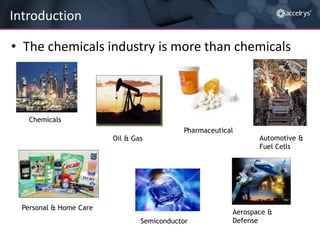
• The chemicals industry is more than chemicals

Chemicals
Oil & Gas

Pharmaceutical

Personal & Home Care
Semiconductor

Automotive &
Fuel Cells

Aerospace &
Defense
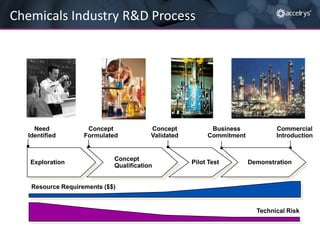
Chemicals Industry R&D Process

Need
Identified

Exploration

Concept
Formulated

Concept
Validated

Concept
Qualification

Business
Commitment

Pilot Test

Commercial
Introduction

Demonstration

Resource Requirements ($$)

Technical Risk
Chemicals Industry R&D Process
Exploration

Concept
Qualification

Pilot Test

Demonstration

Resource Requirements ($$)

Technical Risk

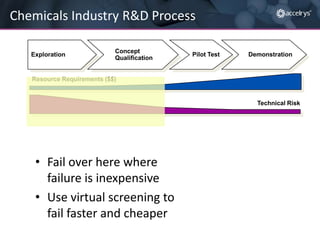
• Fail over here where
failure is inexpensive
• Use virtual screening to
fail faster and cheaper
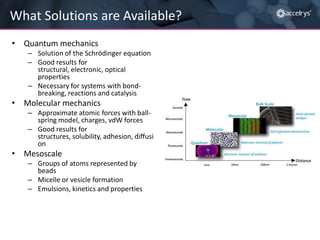
What Solutions are Available?
• Quantum mechanics
– Solution of the Schrödinger equation
– Good results for
structural, electronic, optical
properties
– Necessary for systems with bondbreaking, reactions and catalysis

• Molecular mechanics
– Approximate atomic forces with ballspring model, charges, vdW forces
– Good results for
structures, solubility, adhesion, diffusi
on

• Mesoscale
– Groups of atoms represented by
beads
– Micelle or vesicle formation
– Emulsions, kinetics and properties
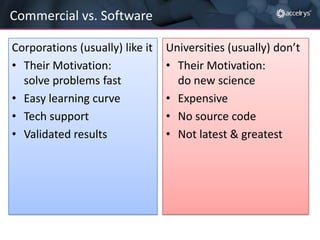
Commercial vs. Software
Corporations (usually) like it
• Their Motivation:
solve problems fast
• Easy learning curve
• Tech support
• Validated results

Universities (usually) don’t
• Their Motivation:
do new science
• Expensive
• No source code
• Not latest & greatest
What do modelers do?
• Most corporate modeling groups are service
organizations
• Work with experimental teams
– New product development
– Product improvement
– Trouble shooting

• Timeframe
– Short term: days
– Long term: ~ 6 months
Examples of Modeling Success
• P&G likes to be way ahead of its competition. They
designed an “innovative” packaging for the Folgers coffee.
– Problem was there was gas build up inside the plastic can
causing explosion.

• Boeing needs a foolproof way of bonding metal to
composite.
– Problem to solve is to improve joints and eliminate failures.

• PPG is looking for ways to speed up time-to-market next
generation photochromic lens
– They need to do this to grow the mature market while
maintaining competitive lead

• Alcoa needs better and low cost designs of Al
– With stiff and fast growing competition from plastic and
composite makers, Alcoa needs ways to compete effectively
by making new and lower cost aluminum designs, faster
prototype and testing cycles.

• BP needs to accelerate the development of “Designer “
catalysts to reduce cost and increase profitability
What does it take to be successful?
• Know how to model
– Translate problem to atomic scale
– Determine what questions modeling can answer

• Know your tools
– HF, DFT, CCSDT, MM2, UFF, DFTB,…
– Which method is right for this problem?
– Which software package, commercial or freeware?

• Know how to talk to experimentalists
– LUMO energies, autocorrelation functions = 
– Phase diagrams, reaction rates, solubility = 
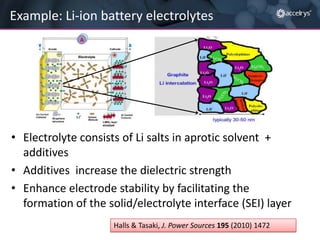
Example: Li-ion battery electrolytes

• Electrolyte consists of Li salts in aprotic solvent +
additives
• Additives increase the dielectric strength
• Enhance electrode stability by facilitating the
formation of the solid/electrolyte interface (SEI) layer
Halls & Tasaki, J. Power Sources 195 (2010) 1472
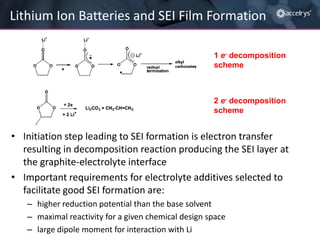
Lithium Ion Batteries and SEI Film Formation
1 e- decomposition
scheme

2 e- decomposition
scheme

• Initiation step leading to SEI formation is electron transfer
resulting in decomposition reaction producing the SEI layer at
the graphite-electrolyte interface
• Important requirements for electrolyte additives selected to
facilitate good SEI formation are:
– higher reduction potential than the base solvent
– maximal reactivity for a given chemical design space
– large dipole moment for interaction with Li
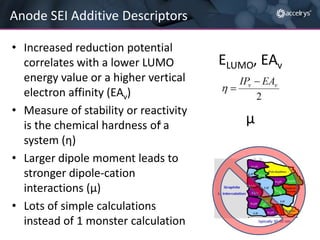
Anode SEI Additive Descriptors
• Increased reduction potential
correlates with a lower LUMO
energy value or a higher vertical
electron affinity (EAv)
• Measure of stability or reactivity
is the chemical hardness ofv a
system (η)
• Larger dipole moment leads to
stronger dipole-cation
interactions (μ)
• Lots of simple calculations
instead of 1 monster calculation

ELUMO, EAv

μ
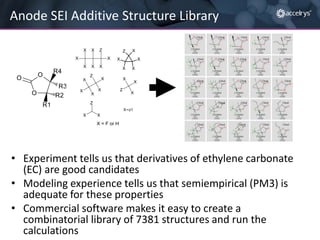
Anode SEI Additive Structure Library
X

X

Z

X

O

O

X
X

R4

X
Z

O

X
X

X
X

X

X

X

X

X

R3
R2

Z

X

X

X
Z

X
X

Z

R1

X z1

X

X

X = F or H

• Experiment tells us that derivatives of ethylene carbonate
(EC) are good candidates
• Modeling experience tells us that semiempirical (PM3) is
adequate for these properties
• Commercial software makes it easy to create a
combinatorial library of 7381 structures and run the
calculations
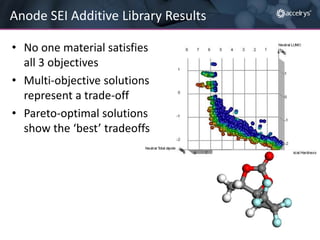
Anode SEI Additive Library Results
• No one material satisfies
all 3 objectives
• Multi-objective solutions
represent a trade-off
• Pareto-optimal solutions
show the ‘best’ tradeoffs
Li-ion Battery Summary
• The generation of virtual structure libraries can be used to
explore materials design space
• Advanced materials modeling workflows can be captured in
pipelined protocols enabling the analysis of virtual materials
libraries
• Combination of molecular modeling and data analysis can
identify leads efficiently
• Acknowledgements
– Ken Tasaki (Mitsubishi Chemicals Inc.)
– Mathew Halls (Accelrys)
– Computational resources: HP

• For details see
Halls & Tasaki, “High-throughput quantum chemistry and
virtual screening for lithium ion battery electrolyte additives,”
J. Power Sources 195 (2010) 1472
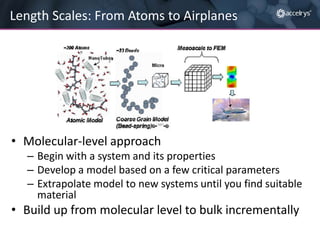
Length Scales: From Atoms to Airplanes

• Molecular-level approach
– Begin with a system and its properties
– Develop a model based on a few critical parameters
– Extrapolate model to new systems until you find suitable
material

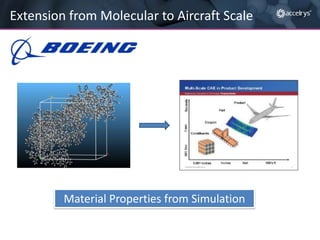
• Build up from molecular level to bulk incrementally
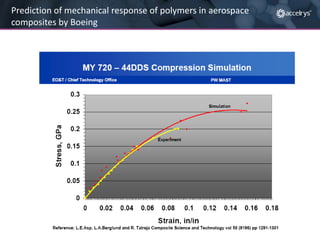
Prediction of mechanical response of polymers in aerospace
composites by Boeing
Development Approach at Boeing
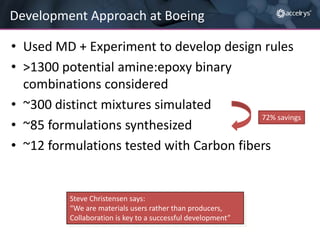
• Used MD + Experiment to develop design rules
• >1300 potential amine:epoxy binary
combinations considered
• ~300 distinct mixtures simulated
72% savings
• ~85 formulations synthesized
• ~12 formulations tested with Carbon fibers

Steve Christensen says:
“We are materials users rather than producers,
Collaboration is key to a successful development”
Extension from Molecular to Aircraft Scale

Material Properties from Simulation
Mesoscale modeling
• Mesoscale structures, such as the morphology of a
polymer blend, evolve slowly, and so are
essentially ‘frozen in’ by the materials processing
• Many materials depend for their action on the
precise form of the mesoscale units, e.g. the
micellar structure determines the success of
emulsion polymerization or the effectiveness of a
detergent
• Mesoscale structures play a crucial role in
determining material properties
Why we need mesoscale modeling?
• We need “mesoscopic” length and time scales but
– Atomistic simulation is too detailed to be usefully
applied
– Continuum modeling is too coarse

• We use mesoscale modeling, which assumes
– The phenomena at atomistic scale are at equilibrium
– Have a relaxation time much shorter than the time scale
of interest
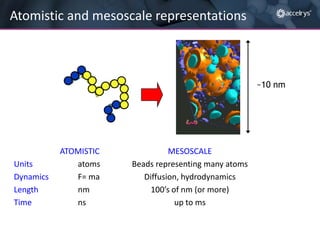
Atomistic and mesoscale representations

~10 nm

Units
Dynamics
Length
Time

ATOMISTIC
atoms
F= ma
nm
ns

MESOSCALE
Beads representing many atoms
Diffusion, hydrodynamics
100’s of nm (or more)
up to ms
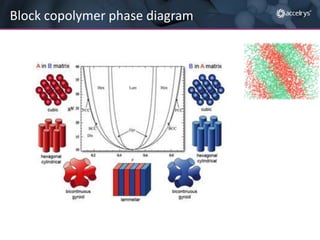
Block copolymer phase diagram
Nafion mesostructure
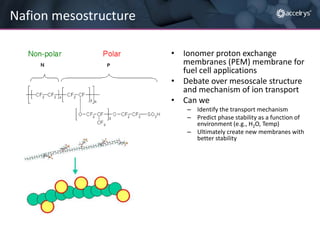
• Ionomer proton exchange
membranes (PEM) membrane for
fuel cell applications
• Debate over mesoscale structure
and mechanism of ion transport
• Can we
– Identify the transport mechanism
– Predict phase stability as a function of
environment (e.g., H2O, Temp)
– Ultimately create new membranes with
better stability
Nafion mesostructure
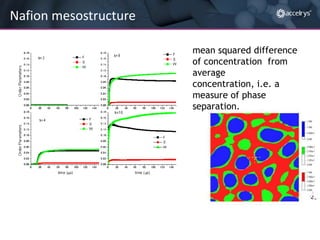
mean squared difference
of concentration from
average
concentration, i.e. a
measure of phase
separation.
Using Modeling to Optimize Biosensor Design

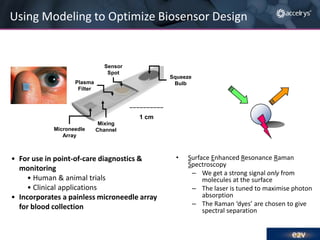
Sensor
Spot

Squeeze
Bulb

Plasma
Filter

1 cm
Microneedle
Array

Mixing
Channel

• For use in point-of-care diagnostics &
monitoring
• Human & animal trials
• Clinical applications
• Incorporates a painless microneedle array
for blood collection

•

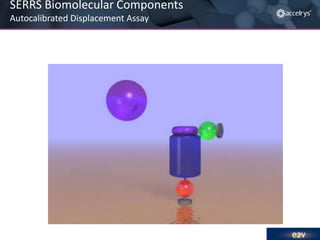
Surface Enhanced Resonance Raman
Spectroscopy
– We get a strong signal only from
molecules at the surface
– The laser is tuned to maximise photon
absorption
– The Raman ‘dyes’ are chosen to give
spectral separation
SERRS Biomolecular Components
Autocalibrated Displacement Assay
Modeling Dye-Surface Interactions

Silver [111]
Surface

GM19 Dye

Oxide Trilayer

H2O “Bridge”
Bulk Silver

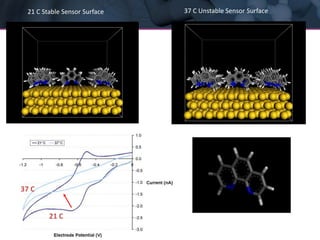
Dye-Surface Interaction
21 C Stable Sensor Surface

37 C
21 C

37 C Unstable Sensor Surface
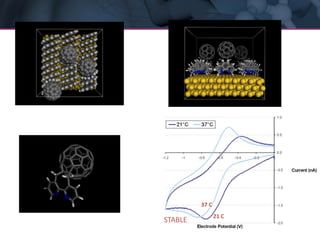
37 C

STABLE

21 C
e2v Summary
• e2v substantially improved the performance of the
biosensor by molecular modeling
– Surface binding (Forcite, DMol3, CASTEP): add Cl– Optical properties (DMol3, CASTEP): 458 nm laser

• Multidisciplinary program
– Quantum physics, computational chemistry, physical
chemistry, organic chemistry, electrochemistry, microfluidic
engineering, optical spectroscopy, numerical
modelling, machine learning, statistical
analysis, robotics, electronics and a biologist to actually use
it all.

• Despite this, it actually works!
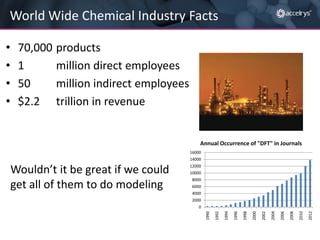
World Wide Chemical Industry Facts
70,000 products
1
million direct employees
50
million indirect employees
$2.2 trillion in revenue

Annual Occurrence of "DFT" in Journals
16000
14000
12000
10000
8000
6000
4000
2000
2012

2010

2008

2006

2004

2002

2000

1998

1996

1994

0
1992

Wouldn’t it be great if we could
get all of them to do modeling

1990

•
•
•
•
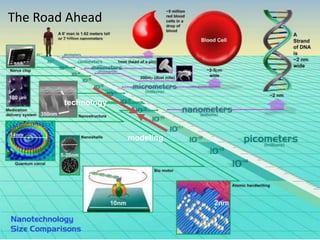
The Road Ahead

technology

modeling

Cornell Computational Chemistry Seminar

  • 1.
    Congratulations, you’re a computationalchemist. Now what? Molecular Modeling in the Corporate World A presentation for Roald Hoffmann’s group Cornell University 8 October 2013 George Fitzgerald, Ph.D. gfitzgerald@accelrys.com
  • 2.
    How Widely Usedis Modeling? Annual Occurrence of "DFT" in Journals 16000 14000 12000 20% growth in annual citations 10000 8000 6000 4000 2000 2012 2011 2010 2009 2008 2007 2006 2005 2004 2003 2002 2001 2000 1999 1998 1997 1996 1995 1994 1993 1992 1991 1990 0
  • 3.
    Introduction • The chemicalsindustry is more than chemicals Chemicals Oil & Gas Pharmaceutical Personal & Home Care Semiconductor Automotive & Fuel Cells Aerospace & Defense
  • 4.
    Chemicals Industry R&DProcess Need Identified Exploration Concept Formulated Concept Validated Concept Qualification Business Commitment Pilot Test Commercial Introduction Demonstration Resource Requirements ($$) Technical Risk
  • 5.
    Chemicals Industry R&DProcess Exploration Concept Qualification Pilot Test Demonstration Resource Requirements ($$) Technical Risk • Fail over here where failure is inexpensive • Use virtual screening to fail faster and cheaper
  • 6.
    What Solutions areAvailable? • Quantum mechanics – Solution of the Schrödinger equation – Good results for structural, electronic, optical properties – Necessary for systems with bondbreaking, reactions and catalysis • Molecular mechanics – Approximate atomic forces with ballspring model, charges, vdW forces – Good results for structures, solubility, adhesion, diffusi on • Mesoscale – Groups of atoms represented by beads – Micelle or vesicle formation – Emulsions, kinetics and properties
  • 7.
    Commercial vs. Software Corporations(usually) like it • Their Motivation: solve problems fast • Easy learning curve • Tech support • Validated results Universities (usually) don’t • Their Motivation: do new science • Expensive • No source code • Not latest & greatest
  • 8.
    What do modelersdo? • Most corporate modeling groups are service organizations • Work with experimental teams – New product development – Product improvement – Trouble shooting • Timeframe – Short term: days – Long term: ~ 6 months
  • 9.
    Examples of ModelingSuccess • P&G likes to be way ahead of its competition. They designed an “innovative” packaging for the Folgers coffee. – Problem was there was gas build up inside the plastic can causing explosion. • Boeing needs a foolproof way of bonding metal to composite. – Problem to solve is to improve joints and eliminate failures. • PPG is looking for ways to speed up time-to-market next generation photochromic lens – They need to do this to grow the mature market while maintaining competitive lead • Alcoa needs better and low cost designs of Al – With stiff and fast growing competition from plastic and composite makers, Alcoa needs ways to compete effectively by making new and lower cost aluminum designs, faster prototype and testing cycles. • BP needs to accelerate the development of “Designer “ catalysts to reduce cost and increase profitability
  • 10.
    What does ittake to be successful? • Know how to model – Translate problem to atomic scale – Determine what questions modeling can answer • Know your tools – HF, DFT, CCSDT, MM2, UFF, DFTB,… – Which method is right for this problem? – Which software package, commercial or freeware? • Know how to talk to experimentalists – LUMO energies, autocorrelation functions =  – Phase diagrams, reaction rates, solubility = 
  • 11.
    Example: Li-ion batteryelectrolytes • Electrolyte consists of Li salts in aprotic solvent + additives • Additives increase the dielectric strength • Enhance electrode stability by facilitating the formation of the solid/electrolyte interface (SEI) layer Halls & Tasaki, J. Power Sources 195 (2010) 1472
  • 12.
    Lithium Ion Batteriesand SEI Film Formation 1 e- decomposition scheme 2 e- decomposition scheme • Initiation step leading to SEI formation is electron transfer resulting in decomposition reaction producing the SEI layer at the graphite-electrolyte interface • Important requirements for electrolyte additives selected to facilitate good SEI formation are: – higher reduction potential than the base solvent – maximal reactivity for a given chemical design space – large dipole moment for interaction with Li
  • 13.
    Anode SEI AdditiveDescriptors • Increased reduction potential correlates with a lower LUMO energy value or a higher vertical electron affinity (EAv) • Measure of stability or reactivity is the chemical hardness ofv a system (η) • Larger dipole moment leads to stronger dipole-cation interactions (μ) • Lots of simple calculations instead of 1 monster calculation ELUMO, EAv μ
  • 14.
    Anode SEI AdditiveStructure Library X X Z X O O X X R4 X Z O X X X X X X X X X R3 R2 Z X X X Z X X Z R1 X z1 X X X = F or H • Experiment tells us that derivatives of ethylene carbonate (EC) are good candidates • Modeling experience tells us that semiempirical (PM3) is adequate for these properties • Commercial software makes it easy to create a combinatorial library of 7381 structures and run the calculations
  • 15.
    Anode SEI AdditiveLibrary Results • No one material satisfies all 3 objectives • Multi-objective solutions represent a trade-off • Pareto-optimal solutions show the ‘best’ tradeoffs
  • 16.
    Li-ion Battery Summary •The generation of virtual structure libraries can be used to explore materials design space • Advanced materials modeling workflows can be captured in pipelined protocols enabling the analysis of virtual materials libraries • Combination of molecular modeling and data analysis can identify leads efficiently • Acknowledgements – Ken Tasaki (Mitsubishi Chemicals Inc.) – Mathew Halls (Accelrys) – Computational resources: HP • For details see Halls & Tasaki, “High-throughput quantum chemistry and virtual screening for lithium ion battery electrolyte additives,” J. Power Sources 195 (2010) 1472
  • 17.
    Length Scales: FromAtoms to Airplanes • Molecular-level approach – Begin with a system and its properties – Develop a model based on a few critical parameters – Extrapolate model to new systems until you find suitable material • Build up from molecular level to bulk incrementally
  • 18.
    Prediction of mechanicalresponse of polymers in aerospace composites by Boeing
  • 19.
    Development Approach atBoeing • Used MD + Experiment to develop design rules • >1300 potential amine:epoxy binary combinations considered • ~300 distinct mixtures simulated 72% savings • ~85 formulations synthesized • ~12 formulations tested with Carbon fibers Steve Christensen says: “We are materials users rather than producers, Collaboration is key to a successful development”
  • 20.
    Extension from Molecularto Aircraft Scale Material Properties from Simulation
  • 21.
    Mesoscale modeling • Mesoscalestructures, such as the morphology of a polymer blend, evolve slowly, and so are essentially ‘frozen in’ by the materials processing • Many materials depend for their action on the precise form of the mesoscale units, e.g. the micellar structure determines the success of emulsion polymerization or the effectiveness of a detergent • Mesoscale structures play a crucial role in determining material properties
  • 22.
    Why we needmesoscale modeling? • We need “mesoscopic” length and time scales but – Atomistic simulation is too detailed to be usefully applied – Continuum modeling is too coarse • We use mesoscale modeling, which assumes – The phenomena at atomistic scale are at equilibrium – Have a relaxation time much shorter than the time scale of interest
  • 23.
    Atomistic and mesoscalerepresentations ~10 nm Units Dynamics Length Time ATOMISTIC atoms F= ma nm ns MESOSCALE Beads representing many atoms Diffusion, hydrodynamics 100’s of nm (or more) up to ms
  • 24.
  • 25.
    Nafion mesostructure • Ionomerproton exchange membranes (PEM) membrane for fuel cell applications • Debate over mesoscale structure and mechanism of ion transport • Can we – Identify the transport mechanism – Predict phase stability as a function of environment (e.g., H2O, Temp) – Ultimately create new membranes with better stability
  • 26.
    Nafion mesostructure mean squareddifference of concentration from average concentration, i.e. a measure of phase separation.
  • 27.
    Using Modeling toOptimize Biosensor Design Sensor Spot Squeeze Bulb Plasma Filter 1 cm Microneedle Array Mixing Channel • For use in point-of-care diagnostics & monitoring • Human & animal trials • Clinical applications • Incorporates a painless microneedle array for blood collection • Surface Enhanced Resonance Raman Spectroscopy – We get a strong signal only from molecules at the surface – The laser is tuned to maximise photon absorption – The Raman ‘dyes’ are chosen to give spectral separation
  • 28.
  • 29.
    Modeling Dye-Surface Interactions Silver[111] Surface GM19 Dye Oxide Trilayer H2O “Bridge” Bulk Silver Dye-Surface Interaction
  • 30.
    21 C StableSensor Surface 37 C 21 C 37 C Unstable Sensor Surface
  • 31.
  • 32.
    e2v Summary • e2vsubstantially improved the performance of the biosensor by molecular modeling – Surface binding (Forcite, DMol3, CASTEP): add Cl– Optical properties (DMol3, CASTEP): 458 nm laser • Multidisciplinary program – Quantum physics, computational chemistry, physical chemistry, organic chemistry, electrochemistry, microfluidic engineering, optical spectroscopy, numerical modelling, machine learning, statistical analysis, robotics, electronics and a biologist to actually use it all. • Despite this, it actually works!
  • 33.
    World Wide ChemicalIndustry Facts 70,000 products 1 million direct employees 50 million indirect employees $2.2 trillion in revenue Annual Occurrence of "DFT" in Journals 16000 14000 12000 10000 8000 6000 4000 2000 2012 2010 2008 2006 2004 2002 2000 1998 1996 1994 0 1992 Wouldn’t it be great if we could get all of them to do modeling 1990 • • • •
  • 34.

Editor's Notes

  • #11 VP of R&D or Advanced Technology or Research