MACRA 101
Understanding the basics of MACRA
Disclaimer
"This information is not intended to be legal advice and does not
intend to create an attorney-client relationship. The information
hereby presented is for educational purposes only."
2
EPI Conferences
Introduction
3
This presentation covers the
following:
• MACRA Basics
• MIPS
• Categories and Payments
• Recommended Actions
• 2019 (3rd year) and Beyond
Objectives
MACRA stands for Medicare Access and CHIP
Reauthorization Act (MACRA) and in this seminar,
you will learn the basics about this new quality
initiative.
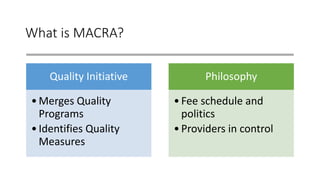
What is MACRA?
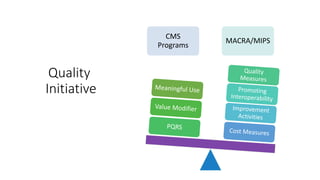
Quality Initiative
•Merges Quality
Programs
•Identifies Quality
Measures
Philosophy
•Fee schedule and
politics
•Providers in control
Quality
Initiative
CMS
Programs
MACRA/MIPS
Philosophy -
Intent
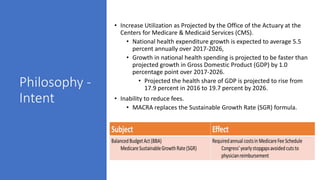
• Increase Utilization as Projected by the Office of the Actuary at the
Centers for Medicare & Medicaid Services (CMS).
• National health expenditure growth is expected to average 5.5
percent annually over 2017-2026,
• Growth in national health spending is projected to be faster than
projected growth in Gross Domestic Product (GDP) by 1.0
percentage point over 2017-2026.
• Projected the health share of GDP is projected to rise from
17.9 percent in 2016 to 19.7 percent by 2026.
• Inability to reduce fees.
• MACRA replaces the Sustainable Growth Rate (SGR) formula.
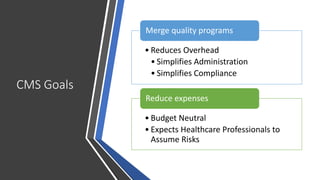
CMS Goals
• Reduces Overhead
• Simplifies Administration
• Simplifies Compliance
Merge quality programs
• Budget Neutral
• Expects Healthcare Professionals to
Assume Risks
Reduce expenses
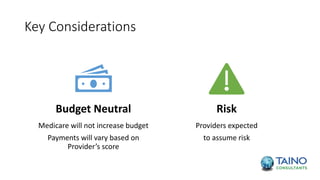
Key Considerations
Budget Neutral
Medicare will not increase budget
Payments will vary based on
Provider’s score
Risk
Providers expected
to assume risk
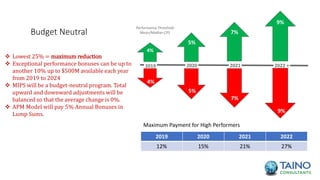
2019 2020 2021 2022 +
4%
5%
7%
9%
4%
5%
7%
9%
Budget Neutral
 Lowest 25% = maximum reduction
 Exceptional performance bonuses can be up to
another 10% up to $500M available each year
from 2019 to 2024
 MIPS will be a budget-neutral program. Total
upward and downward adjustments will be
balanced so that the average change is 0%.
 APM Model will pay 5% Annual Bonuses in
Lump Sums.
Performance Threshold
Mean/Median CPS
EPI Conferences
2019 2020 2021 2022
12% 15% 21% 27%
Maximum Payment for High Performers
Effect on
your
Bottomline
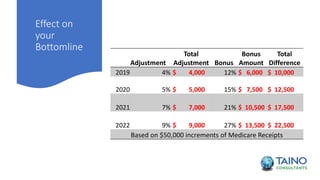
Adjustment
Total
Adjustment Bonus
Bonus
Amount
Total
Difference
2019 4% $ 4,000 12% $ 6,000 $ 10,000
2020 5% $ 5,000 15% $ 7,500 $ 12,500
2021 7% $ 7,000 21% $ 10,500 $ 17,500
2022 9% $ 9,000 27% $ 13,500 $ 22,500
Based on $50,000 increments of Medicare Receipts
Eligible Clinicians
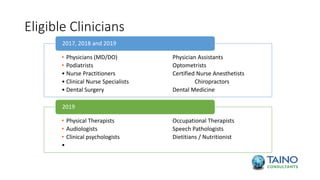
• Physicians (MD/DO) Physician Assistants
• Podiatrists Optometrists
• Nurse Practitioners Certified Nurse Anesthetists
• Clinical Nurse Specialists Chiropractors
• Dental Surgery Dental Medicine
2017, 2018 and 2019
• Physical Therapists Occupational Therapists
• Audiologists Speech Pathologists
• Clinical psychologists Dietitians / Nutritionist
•
2019
Exceptions
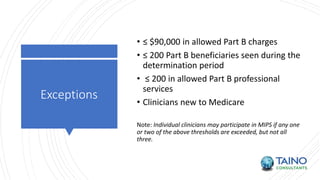
• ≤ $90,000 in allowed Part B charges
• ≤ 200 Part B beneficiaries seen during the
determination period
• ≤ 200 in allowed Part B professional
services
• Clinicians new to Medicare
Note: Individual clinicians may participate in MIPS if any one
or two of the above thresholds are exceeded, but not all
three.
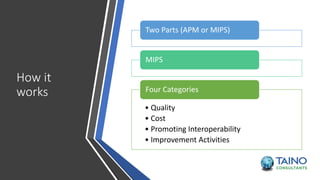
How it
works
Two Parts (APM or MIPS)
MIPS
• Quality
• Cost
• Promoting Interoperability
• Improvement Activities
Four Categories
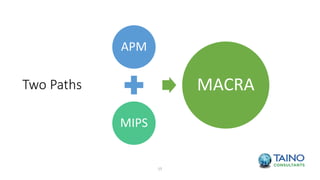
Two Paths
APM
MIPS
MACRA
15
EPI Conferences
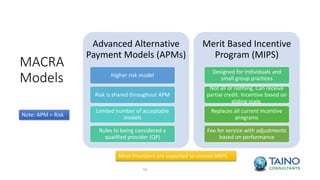
MACRA
Models
Advanced Alternative
Payment Models (APMs)
Higher risk model
Risk is shared throughout APM
Limited number of acceptable
models
Rules to being considered a
qualified provider (QP)
Merit Based Incentive
Program (MIPS)
Designed for individuals and
small group practices
Not all or nothing. Can receive
partial credit. Incentive based on
sliding scale.
Replaces all current incentive
programs
Fee for service with adjustments
based on performance
16
Note: APM = Risk
Most Providers are expected to choose MIPS
EPI Conferences
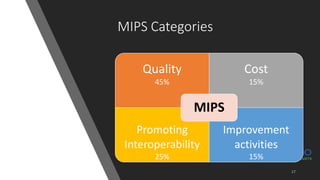
MIPS Categories
Quality
45%
Cost
15%
Promoting
Interoperability
25%
Improvement
activities
15%
MIPS
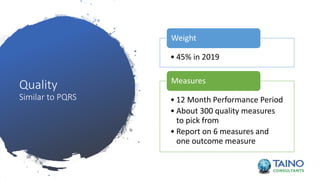
Quality
Similar to PQRS
• 45% in 2019
Weight
• 12 Month Performance Period
• About 300 quality measures
to pick from
• Report on 6 measures and
one outcome measure
Measures
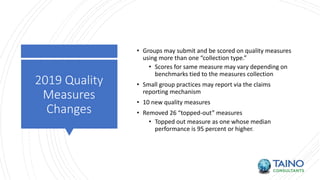
2019 Quality
Measures
Changes
• Groups may submit and be scored on quality measures
using more than one “collection type.”
• Scores for same measure may vary depending on
benchmarks tied to the measures collection
• Small group practices may report via the claims
reporting mechanism
• 10 new quality measures
• Removed 26 “topped-out” measures
• Topped out measure as one whose median
performance is 95 percent or higher.
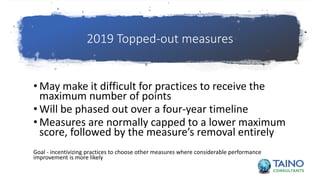
2019 Topped-out measures
• May make it difficult for practices to receive the
maximum number of points
• Will be phased out over a four-year timeline
• Measures are normally capped to a lower maximum
score, followed by the measure’s removal entirely
Goal - incentivizing practices to choose other measures where considerable performance
improvement is more likely
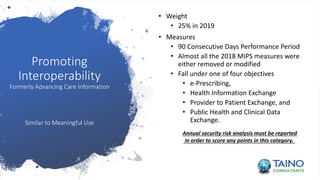
Promoting
Interoperability
Formerly Advancing Care Information
Similar to Meaningful Use
• Weight
• 25% in 2019
• Measures
• 90 Consecutive Days Performance Period
• Almost all the 2018 MIPS measures were
either removed or modified
• Fall under one of four objectives
• e-Prescribing,
• Health Information Exchange
• Provider to Patient Exchange, and
• Public Health and Clinical Data
Exchange.
Annual security risk analysis must be reported
in order to score any points in this category.
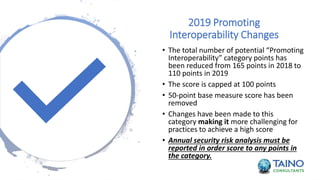
2019 Promoting
Interoperability Changes
• The total number of potential “Promoting
Interoperability” category points has
been reduced from 165 points in 2018 to
110 points in 2019
• The score is capped at 100 points
• 50-point base measure score has been
removed
• Changes have been made to this
category making it more challenging for
practices to achieve a high score
• Annual security risk analysis must be
reported in order score to any points in
the category.
2019 Promoting
Interoperability Bonus
Clinicians, groups, and virtual groups
can earn 5 bonus points each for the
submission of these optional
measures:
• Query of Prescription Drug
Monitoring (PDMP)
• Verify Opioid Treatment Agreement
Improvement
Activities
•Weight
• 15% in 2019
•Measures
• 90 Consecutive Days
Performance Period
• No change in the number of
activities that MIPS eligible
clinicians have to report
• Total of 40 points.
2019
Improvement
Activities
Change
• CMS is proposing more activities to choose
from and changes to existing activities for the
Inventory.
• Reporting
• Small practices and rural areas will keep
reporting on no more than 2 medium or 1
high-weighted activity to reach the highest
score.
• For group participation, only 1 MIPS eligible
clinician in a TIN
• 5% Promoting Interoperability bonus has been
removed
Cost
also known as
Resource Use
• Weight
• 15% in 2019
• Measures
• 12 Month Performance Period
• There is no reporting requirement
• CMS will calculate the clinician’s
performance using claims data
• Clinicians will be assessed on their
performance of Total per Capita Cost,
Medicare Spending per Beneficiary
(MSPB), and applicable episode-based
measuresSimilar to Value Based Modifier
2019 Cost
Changes
•Increased weight to 15%*
•Eight episode-based cost
measures for the 2019
performance period
•Two types of episode-based
measures approved for 2019
• Procedural measures, and
• Acute Inpatient Medical Condition
measures
* This percentage can change if the measures' minimum case volumes are not met. If there are not
enough attributed beneficiaries for any of the 10 measures to be scored, the Cost performance
category percentage will be added to the Quality performance category.
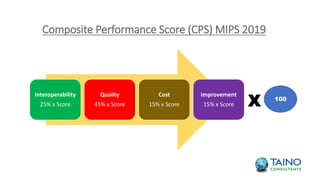
Composite Performance Score (CPS) MIPS 2019
0-100 point
scale
EPI Conferences
Interoperability
25% x Score
Quality
45% x Score
Cost
15% x Score
Improvement
15% x Score X 100
Reporting
Same Reporting Options as Year 2
• Individual
• Group
• 2 or more clinicians (NPIs) who have reassigned
their billing rights to a single TIN
• As an Advanced Alternative Payment Model
(APM) Entity
• Virtual Group
• solo practitioners and groups of 10 or fewer
eligible clinicians who come together “virtually”
(no matter what specialty or location) to
participate in MIPS for a performance period for
a year
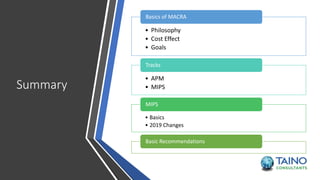
Summary
• Philosophy
• Cost Effect
• Goals
Basics of MACRA
• APM
• MIPS
Tracks
• Basics
• 2019 Changes
MIPS
Basic Recommendations
Recommended Steps
ANALYZE GUIDELINES AND
CONDUCT COST COMPARISON
REVIEW RESOURCES AND
SELECT PLAN OF ACTION
USE PROFESSIONAL
ASSISTANCE AS NEEDED
Recommended
Resources
• Visit the 2019 Quality
Requirements page and explore
the 2019 measures on the QPP
website.
• https://qpp.cms.gov/
• Review the 2019 Quality
Performance Category Fact Sheet
on the QPP Resource Library.
Dr. Jose I. Delgado
Taino Consultants Inc., CEO
DrDelgado@tainoconsultants.com
tainoconsultants.com
33
MACRA 101
April 2019

Macra 101

  • 1.
  • 2.
    Disclaimer "This information isnot intended to be legal advice and does not intend to create an attorney-client relationship. The information hereby presented is for educational purposes only." 2 EPI Conferences
  • 3.
    Introduction 3 This presentation coversthe following: • MACRA Basics • MIPS • Categories and Payments • Recommended Actions • 2019 (3rd year) and Beyond
  • 4.
    Objectives MACRA stands forMedicare Access and CHIP Reauthorization Act (MACRA) and in this seminar, you will learn the basics about this new quality initiative.
  • 5.
    What is MACRA? QualityInitiative •Merges Quality Programs •Identifies Quality Measures Philosophy •Fee schedule and politics •Providers in control
  • 6.
  • 7.
    Philosophy - Intent • IncreaseUtilization as Projected by the Office of the Actuary at the Centers for Medicare & Medicaid Services (CMS). • National health expenditure growth is expected to average 5.5 percent annually over 2017-2026, • Growth in national health spending is projected to be faster than projected growth in Gross Domestic Product (GDP) by 1.0 percentage point over 2017-2026. • Projected the health share of GDP is projected to rise from 17.9 percent in 2016 to 19.7 percent by 2026. • Inability to reduce fees. • MACRA replaces the Sustainable Growth Rate (SGR) formula.
  • 8.
    CMS Goals • ReducesOverhead • Simplifies Administration • Simplifies Compliance Merge quality programs • Budget Neutral • Expects Healthcare Professionals to Assume Risks Reduce expenses
  • 9.
    Key Considerations Budget Neutral Medicarewill not increase budget Payments will vary based on Provider’s score Risk Providers expected to assume risk
  • 10.
    2019 2020 20212022 + 4% 5% 7% 9% 4% 5% 7% 9% Budget Neutral  Lowest 25% = maximum reduction  Exceptional performance bonuses can be up to another 10% up to $500M available each year from 2019 to 2024  MIPS will be a budget-neutral program. Total upward and downward adjustments will be balanced so that the average change is 0%.  APM Model will pay 5% Annual Bonuses in Lump Sums. Performance Threshold Mean/Median CPS EPI Conferences 2019 2020 2021 2022 12% 15% 21% 27% Maximum Payment for High Performers
  • 11.
    Effect on your Bottomline Adjustment Total Adjustment Bonus Bonus Amount Total Difference 20194% $ 4,000 12% $ 6,000 $ 10,000 2020 5% $ 5,000 15% $ 7,500 $ 12,500 2021 7% $ 7,000 21% $ 10,500 $ 17,500 2022 9% $ 9,000 27% $ 13,500 $ 22,500 Based on $50,000 increments of Medicare Receipts
  • 12.
    Eligible Clinicians • Physicians(MD/DO) Physician Assistants • Podiatrists Optometrists • Nurse Practitioners Certified Nurse Anesthetists • Clinical Nurse Specialists Chiropractors • Dental Surgery Dental Medicine 2017, 2018 and 2019 • Physical Therapists Occupational Therapists • Audiologists Speech Pathologists • Clinical psychologists Dietitians / Nutritionist • 2019
  • 13.
    Exceptions • ≤ $90,000in allowed Part B charges • ≤ 200 Part B beneficiaries seen during the determination period • ≤ 200 in allowed Part B professional services • Clinicians new to Medicare Note: Individual clinicians may participate in MIPS if any one or two of the above thresholds are exceeded, but not all three.
  • 14.
    How it works Two Parts(APM or MIPS) MIPS • Quality • Cost • Promoting Interoperability • Improvement Activities Four Categories
  • 15.
  • 16.
    MACRA Models Advanced Alternative Payment Models(APMs) Higher risk model Risk is shared throughout APM Limited number of acceptable models Rules to being considered a qualified provider (QP) Merit Based Incentive Program (MIPS) Designed for individuals and small group practices Not all or nothing. Can receive partial credit. Incentive based on sliding scale. Replaces all current incentive programs Fee for service with adjustments based on performance 16 Note: APM = Risk Most Providers are expected to choose MIPS EPI Conferences
  • 17.
  • 18.
    Quality Similar to PQRS •45% in 2019 Weight • 12 Month Performance Period • About 300 quality measures to pick from • Report on 6 measures and one outcome measure Measures
  • 19.
    2019 Quality Measures Changes • Groupsmay submit and be scored on quality measures using more than one “collection type.” • Scores for same measure may vary depending on benchmarks tied to the measures collection • Small group practices may report via the claims reporting mechanism • 10 new quality measures • Removed 26 “topped-out” measures • Topped out measure as one whose median performance is 95 percent or higher.
  • 20.
    2019 Topped-out measures •May make it difficult for practices to receive the maximum number of points • Will be phased out over a four-year timeline • Measures are normally capped to a lower maximum score, followed by the measure’s removal entirely Goal - incentivizing practices to choose other measures where considerable performance improvement is more likely
  • 21.
    Promoting Interoperability Formerly Advancing CareInformation Similar to Meaningful Use • Weight • 25% in 2019 • Measures • 90 Consecutive Days Performance Period • Almost all the 2018 MIPS measures were either removed or modified • Fall under one of four objectives • e-Prescribing, • Health Information Exchange • Provider to Patient Exchange, and • Public Health and Clinical Data Exchange. Annual security risk analysis must be reported in order to score any points in this category.
  • 22.
    2019 Promoting Interoperability Changes •The total number of potential “Promoting Interoperability” category points has been reduced from 165 points in 2018 to 110 points in 2019 • The score is capped at 100 points • 50-point base measure score has been removed • Changes have been made to this category making it more challenging for practices to achieve a high score • Annual security risk analysis must be reported in order score to any points in the category.
  • 23.
    2019 Promoting Interoperability Bonus Clinicians,groups, and virtual groups can earn 5 bonus points each for the submission of these optional measures: • Query of Prescription Drug Monitoring (PDMP) • Verify Opioid Treatment Agreement
  • 24.
    Improvement Activities •Weight • 15% in2019 •Measures • 90 Consecutive Days Performance Period • No change in the number of activities that MIPS eligible clinicians have to report • Total of 40 points.
  • 25.
    2019 Improvement Activities Change • CMS isproposing more activities to choose from and changes to existing activities for the Inventory. • Reporting • Small practices and rural areas will keep reporting on no more than 2 medium or 1 high-weighted activity to reach the highest score. • For group participation, only 1 MIPS eligible clinician in a TIN • 5% Promoting Interoperability bonus has been removed
  • 26.
    Cost also known as ResourceUse • Weight • 15% in 2019 • Measures • 12 Month Performance Period • There is no reporting requirement • CMS will calculate the clinician’s performance using claims data • Clinicians will be assessed on their performance of Total per Capita Cost, Medicare Spending per Beneficiary (MSPB), and applicable episode-based measuresSimilar to Value Based Modifier
  • 27.
    2019 Cost Changes •Increased weightto 15%* •Eight episode-based cost measures for the 2019 performance period •Two types of episode-based measures approved for 2019 • Procedural measures, and • Acute Inpatient Medical Condition measures * This percentage can change if the measures' minimum case volumes are not met. If there are not enough attributed beneficiaries for any of the 10 measures to be scored, the Cost performance category percentage will be added to the Quality performance category.
  • 28.
    Composite Performance Score(CPS) MIPS 2019 0-100 point scale EPI Conferences Interoperability 25% x Score Quality 45% x Score Cost 15% x Score Improvement 15% x Score X 100
  • 29.
    Reporting Same Reporting Optionsas Year 2 • Individual • Group • 2 or more clinicians (NPIs) who have reassigned their billing rights to a single TIN • As an Advanced Alternative Payment Model (APM) Entity • Virtual Group • solo practitioners and groups of 10 or fewer eligible clinicians who come together “virtually” (no matter what specialty or location) to participate in MIPS for a performance period for a year
  • 30.
    Summary • Philosophy • CostEffect • Goals Basics of MACRA • APM • MIPS Tracks • Basics • 2019 Changes MIPS Basic Recommendations
  • 31.
    Recommended Steps ANALYZE GUIDELINESAND CONDUCT COST COMPARISON REVIEW RESOURCES AND SELECT PLAN OF ACTION USE PROFESSIONAL ASSISTANCE AS NEEDED
  • 32.
    Recommended Resources • Visit the2019 Quality Requirements page and explore the 2019 measures on the QPP website. • https://qpp.cms.gov/ • Review the 2019 Quality Performance Category Fact Sheet on the QPP Resource Library.
  • 33.
    Dr. Jose I.Delgado Taino Consultants Inc., CEO DrDelgado@tainoconsultants.com tainoconsultants.com 33 MACRA 101 April 2019