The LEGO Group
A short presentation
2016
Company snapshot 1
Our reason for being 2
The LEGO®
Strategy 3
Organisational structure 4
The LEGO Foundation 4
LEGO®
Education 5
Key figures 2015 6
Play experiences for every child 7
Highlight of LEGO®
products 10
Innovation and production 13
Innovating for children 14
Quality and safety above all else 14
Production fun facts 16
Company timeline 17
Building a better tomorrow 21
LEGO®
communities 25
LEGO.com 26
LEGO®
Club 26
LEGO®
adult fan communities 29
LEGO®
Social Media 29
Experience LEGO®
play 31
LEGO®
Build the Change 33
LEGO®
Inside Tour 33
FIRST®
LEGO®
League
and FIRST®
LEGO®
League Jr. 34
LEGO®
Brand Retail Stores 35
LEGO®
House 36
LEGOLAND®
Parks 37
Using the LEGO®
brand name 37
Contents Based on the iconic LEGO®
brick, we are
one of the world’s leading manufacturers
of play materials with headquarters
in Billund, Denmark, and main offices in
Enfield, USA, London, UK, Shanghai, China,
and Singapore.
This booklet provides highlights on how
we set out to achieve our mission to inspire
and develop the builders of tomorrow
through creative play and learning.
Inspiring and developing children through
play and learning is what we have been
dedicated to since my grandfather,
Ole Kirk Kristiansen, founded our company
in 1932 on the values that were important
to him. I believe the reason for our universal
appeal is that we have stayed true to these
core values: Imagination – Creativity – Fun
– Learning – Caring – Quality.”
— Kjeld Kirk Kristiansen, third
generation owner of the
family-owned LEGO Group
2
Our reason
for being
The most important impact
we have on the world is
providing children with fun
and exciting high-quality
LEGO®
play experiences that
develop the essential skills
and competences they need
to create a better future for
themselves and our planet.”
We are committed to emphasising play as a
significant contributor to children’s development.
Play has a profound impact on children’s
social, emotional and cognitive skills. This is
why all LEGO®
play experiences are based
on the underlying philosophy of learning and
development through play.
The LEGO System in Play is universally appealing
and has unlimited possibilities. It encourages
children around the world to engage in fun and
creative play and allows them to build anything
they can imagine.
Children’s wellbeing is our utmost concern.
Our main contribution to help children grow
up as stronger shapers of their own future
is through the playful learning our play experi-
ences deliver.
Throughout our operations, we constantly aim
higher and strive for new ways to optimise our
social and environmental footprint, ultimately
to leave a positive impact on the world our
children will inherit.
Jørgen Vig Knudstorp
President and CEO of the family-owned
LEGO Group
3
The LEGO®
Strategy
COMPANy SNAPSHOT
It is the LEGO Group’s aspiration to further
globalise and innovate the LEGO®
System
in Play through:
Sustaining core commercial
and operational momentum
We will sustain the growth of our core business,
covering children aged 1½-11, through
development of great products within existing
product lines, but also through developing and
launching new product lines. Also, we will
initiate ongoing improvement initiatives across
the entire company.
Expanding global presence
We will expand our global presence – eventually
reaching children in every country of the world.
We will do this commercially through focus
on new emerging markets such as China,
operationally through the establishment of new
factories and organisationally through the
establishment of centrally located main offices.
Leveraging digitalisation
We consider digitalisation as a way to make
our core business – physical LEGO®
play –
even more attractive and exciting. To do this,
we will leverage digitalisation over a broad
range of topics – e.g. integrating physical and
digital play, e-commerce, marketing and our
business/enterprise system.
Creating the organisation of the future
We will build a truly global and diverse
organisation to meet the adaptive challenges,
gain competitive advantage against
intensifying competition and build required
stewardship of environment, governance and
social responsibility.
4COMPANy SNAPSHOT
The LEGO Group consists of several subsidiaries,
including LEGO®
Education. 75% of the Group
is owned by the third and fourth generations of
the Kirk Kristiansen founding family, Kjeld Kirk
Kristiansen and his three children, through their
investment company KIRKBI A/S. The remaining
25% is owned by the LEGO Foundation.
Kjeld Kirk Kristiansen functioned as President
and CEO of the LEGO Group from 1979 to
2004 when Jørgen Vig Knudstorp succeeded
him as President and CEO of the LEGO Group.
Today the LEGO Group Management Board
represents four strategic business areas:
Operations, Market Management and Develop-
ment, Product and Marketing Development,
and Business Enabling.
Learn more: www.LEGO.com/aboutus
From South Africa to Ukraine, the LEGO
Foundation aims to make children’s lives better
– and communities stronger – by building
a future where learning through play empowers
children to become creative, engaged, lifelong
learners.
There is an increased global attention to the
need for children to develop stronger life
skills, including critical thinking, creativity, and
social skills. The LEGO Foundation invests
in early childhood development because
it provides exceptional returns, not just for the
chances of individual children, but also for
society as a whole.
Partnering with e.g. organisations, academic
institutions, school systems and governments
who already work within the field of play and
quality early childhood education is essential
to achieve a strong, sustained impact.
The LEGO Foundation activities are funded
through the 25% ownership of the LEGO Group.
Learn more: www.LEGOFoundation.com
Organisational
structure
The LEGO
Foundation
Based on a joint
commitment and dedication
to develop children through
play and learning, there
is a strong collaboration
between the LEGO Group,
the LEGO Foundation and
LEGO®
Education.
5
LEGO®
Education offers playful learning
experiences and teaching solutions based
on the LEGO brick, curriculum-relevant
material, and physical and digital resources
for preschool, elementary, middle school,
and afterschool.
In partnership with educators for more than
35 years, LEGO Education supports teaching
in an inspiring, engaging, and effective way.
LEGO Education’s educational solutions, which
range from the humanities to science, enable
every student to succeed by encouraging
them to become active, collaborative learners,
build skills for future challenges, and establish
a positive mind-set towards learning.
LEGO Education takes the pursuit of hands-on
learning very seriously and does this in
conjunction with educators who play a critical
role in encouraging students’ budding interest
during the span of their academic careers
in-school and in after-school programmes,
such as FIRST®
LEGO®
League and World
Robotics Olympiad.
Learn more: www.LEGOEducation.com
LEGO®
Education
COMPANy SNAPSHOT
Key figures
2015
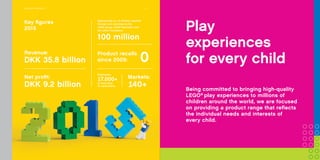
Approximate no. of children reached
through joint activities by the
LEGO Group, LEGO®
Education and
the LEGO Foundation:
100 million
Revenue:
DKK 35.8 billion
Net profit:
DKK 9.2 billion
Product recalls
since 2009:
Employees:
17,000+
of more than
70 nationalities
0
Markets:
140+
COMPANy SNAPSHOT 6
Play
experiences
for every child
Being committed to bringing high-quality
LEGO®
play experiences to millions of
children around the world, we are focused
on providing a product range that reflects
the individual needs and interests of
every child.
Key figures
2015
Approximate no. of children reached
through joint activities by the
LEGO Group, LEGO®
Education and
the LEGO Foundation:
100 million
Revenue:
DKK 35.8 billion
Net profit:
DKK 9.2 billion
Product recalls
since 2009:
Employees:
17,000+
of more than
70 nationalities
0
Markets:
140+
COMPANy SNAPSHOT 68
LEGO®
products are challenge-graduated
to reflect the fact that children grow older and
develop. Most of our products include building
instructions to provide inspiration and ensure
that children experience different building
techniques and challenges suitable for their
age and skills.
Theme-based LEGO products provide
storytelling settings that children can immerse
themselves into and further shape their own
stories around – be it LEGO owned themes
or themes based on licensed products.
Our digital offerings provide exciting avenues
to extend the physical LEGO play experience
and open up for even more fun and creative
LEGO play experiences; and LEGO online
gaming, videogames, console games, Apps,
TV series, and movies are all great means
to do this.
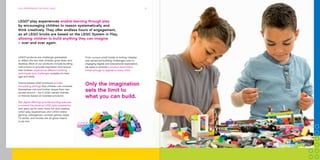
LEGO®
play experiences enable learning through play
by encouraging children to reason systematically and
think creatively. They offer endless hours of engagement,
as all LEGO bricks are based on the LEGO System in Play,
allowing children to build anything they can imagine
– over and over again.
From curious small hands to exiting roleplay
and advanced building challenges over to
engaging digital and educational exploration,
we seek to provide a product assortment
broad enough to appeal to every child.
Only the imagination
sets the limit to
what you can build.
PLAY EXPERIENCES FOR EVERY CHILD
Key figures
2015
Approximate no. of children reached
through joint activities by the
LEGO Group, LEGO®
Education and
the LEGO Foundation:
100 million
Revenue:
DKK 35.8 billion
Net profit:
DKK 9.2 billion
Product recalls
since 2009:
Employees:
17,000+
of more than
70 nationalities
0
Markets:
140+
COMPANy SNAPSHOT 610
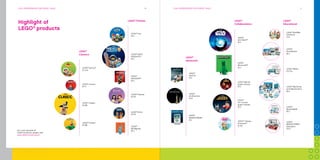
Highlight of
LEGO®
products
LEGO®
Creator
(4-99)
LEGO®
DUPLO®
(11⁄2-5)
LEGO®
Juniors
(4-7)
LEGO®
Classic
(4-99)
LEGO®
Classics
LEGO®
Minifigures
(5+)
LEGO®
City
(5+)
LEGO®
NEXO
KNIGHTS™
(5+)
LEGO®
NINJAGO™
(5+)
LEGO®
Friends
(5-12)
LEGO®
Elves
(5-12)
LEGO®
Themes
For a full overview of
LEGO®
products, please visit:
www.LEGO.com/products
PLAY EXPERIENCES FOR EVERY CHILD
LEGO®
Advanced
11
LEGO®
| Disney
Princess™
(5-12)
LEGO®
Star Wars™
(5+)
LEGO®
Minecraft™
(5+)
LEGO®
Marvel
Super Heroes
(5+)
LEGO®
DC Comics
Super Heroes
(5+)
LEGO®
Collaborations
LEGO®
MINDSTORMS®
(7+)
LEGO®
Technic
(7+)
LEGO®
Architecture
(12+)
LEGO®
MINDSTORMS®
Education
(10+)
LEGO®
BuildMe
Emotions
(3+)
LEGO®
MoreToMath
(6+)
LEGO®
WeDo
2.0 (7+)
LEGO®
Machines
and Mechanisms
(8+)
LEGO®
StoryStarter
(6+)
LEGO®
Educational
PLAY EXPERIENCES FOR EVERY CHILD
Key figures
2015
Approximate no. of children reached
through joint activities by the
LEGO Group, LEGO®
Education and
the LEGO Foundation:
100 million
Revenue:
DKK 35.8 billion
Net profit:
DKK 9.2 billion
Product recalls
since 2009:
Employees:
17,000+
of more than
70 nationalities
0
Markets:
140+
COMPANy SNAPSHOT 6
Our longstanding focus since 1932 on
providing fun and engaging play materials
of the highest quality and safety is a true
testimony that we believe children
deserve only the best.
Innovation and
production
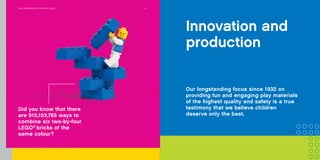
Did you know that there
are 915,103,765 ways to
combine six two-by-four
LEGO®
bricks of the
same colour?
PLAY EXPERIENCES FOR EVERY CHILD 12
Key figures
2015
Approximate no. of children reached
through joint activities by the
LEGO Group, LEGO®
Education and
the LEGO Foundation:
100 million
Revenue:
DKK 35.8 billion
Net profit:
DKK 9.2 billion
Product recalls
since 2009:
Employees:
17,000+
of more than
70 nationalities
0
Markets:
140+
COMPANy SNAPSHOT 6
Did you know that there
are 915,103,765 ways to
combine six two-by-four
LEGO®
bricks of the
same colour?
PLAY EXPERIENCES FOR EVERY CHILD 12
Legislative
toy safety
recalls
Approval
of raw
materials
Newelements
designed
Comsumerfeedback
Safety
test
LEGO
element
andmodel
assessment
Safety
control
3rd-party
approval
Production
test
Distribution
&sales
SAFETY
ASSESSMENT
TESTING
PRODUCTION
CONSUMER
INTERACTION
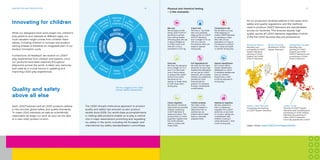
While our designers have solid insight into children’s
play patterns and interests at different ages, our
most valuable insight comes from children them-
selves. Including children in concept and product
testing phases is therefore an integrated part of our
product innovation cycle.
Furthermore, all feedback we receive on LEGO®
play experiences from children and parents, once
our products have been explored throughout
playrooms across the world, is taken very seriously
and used as a crucial source in updating and
improving LEGO play experiences.
Each LEGO®
element and all LEGO products adhere
to the strictest global safety and quality standards.
To make LEGO elements as safe as scientifically
reasonable we begin our work as soon as the idea
of a new LEGO product is born.
Innovating for children
The four stages of the LEGO
Group’s Safety Assessment
The LEGO Group’s meticulous approach to product
quality and safety has ensured us zero product
recalls since 2009. Our world-class accomplishments
in making safe products enable us to play a central
role in major associations promoting and regulating
toy safety in the world, including the European and
international toy safety standardisation committees.
Quality and safety
above all else
InnOvATIOn And prOducTIOn 14
Bite test
We simulate a child
biting LEGO®
dupLO®
elements to ensure
that nothing breaks
off during play. We use
a device shaped as
a child’s mouth and
bite with a force
equivalent to 22.5 kg.
Impact test
We drop a 1 kg metal
disc onto potential
weak points on LEGO®
dupLO®
elements
from a height of 12 cm.
This is to ensure
the element does not
break or splinter
during play.
Compression test
We simulate a young
child stepping on
certain LEGO®
elements
by pressing a metal
disc with a force
equivalent to 15 kg on
the element to ensure
that it does not break
or splinter during play.
All our production facilities adhere to the same strict
safety and quality regulations, and the methods
used to produce LEGO®
elements are standardised
across our factories. This ensures equally high
quality across all LEGO elements regardless of which
of the five LEGO factories they are produced at:
Physical and chemical testing
– a few examples:
Drop test
We drop the elements
from a height of 1.5 m
and 1.0 m five times
onto a hard surface
to ensure that LEGO®
dupLO®
and LEGO
elements do not
splinter or break when
a child drops them
during play.
Full ingredients list
We have the full ingre-
dients list of every raw
material and decoration
ink we use for LEGO®
elements. We consider
whether any additional
substance could
theoretically be
present, for example
through unintentional
contamination.
Hazard classification
We consult official
hazard classification
databases to check
if individual substances
have an inherent
hazard that a child
could be exposed to
during play.
Colour migration
We perform chemical
tests where we simulate
children subjecting
LEGO®
elements to
sweat and saliva. This
ensures that no colour
pigments migrate from
the LEGO element
when in contact with
these fluids.
Content analysis
We make a total
content analysis to
determine that no
substances are
present above legal
limits or internally
adopted limits.
Substance migration
We also determine
that no substance
migrates from LEGO®
elements, at any level
of concern, taking into
consideration that
children could put
LEGO elements in their
mouth during play.
Billund, denmark:
Moulding of LEGO®
System elements
nyíregyháza, Hungary:
Moulding and
packing of LEGO®
System and LEGO
dupLO®
elements, and
processing of LEGO
dupLO elements
Monterrey, Mexico:
Moulding and
processing of LEGO®
System elements,
packing of LEGO
System and LEGO
dupLO®
elements
Kladno, czech republic:
processing and packing
of LEGO®
System elements
Jiaxing, china:
packing of LEGO®
System
elements (also moulding and
processing of LEGO System
elements and packing of
LEGO dupLO®
elements
once fully operational in 2017)
Learn more: www.LEGO.com/responsibility
15
Key figures
2015
Approximate no. of children reached
through joint activities by the
LEGO Group, LEGO®
Education and
the LEGO Foundation:
100 million
Revenue:
DKK 35.8 billion
Net profit:
DKK 9.2 billion
Product recalls
since 2009:
Employees:
17,000+
of more than
70 nationalities
0
Markets:
140+
COMPANy SNAPSHOT 6
Did you know that there
are 915,103,765 ways to
combine six two-by-four
LEGO®
bricks of the
same colour?
PLAY EXPERIENCES FOR EVERY CHILD 12
LEGO®
products offered in 2015:
600+ hereof 355 new, including 17 digital
– all developed by 250+ designers
representing more than 35 nationalities
No. of different types
of LEGO®
elements:
No. of different colours
used in production:
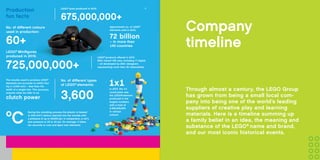
During the moulding process the plastic is heated
to 230-310o
C before injected into the moulds with
a pressure of up to 29,000 psi. In comparison, a car’s
tyre pressure is 29 to 43 psi. On average, it takes
ten seconds to cool and eject new elements
The moulds used to produce LEGO®
elements are accurate to within four
my (= 0.004 mm) – less than the
width of a single hair. This accuracy
ensures what we refer to as
clutch power
Approximate no. of LEGO®
elements sold in 2015:
LEGO®
Minifigures
produced in 2015:
LEGO®
tyres produced in 2015:
675,000,000+
60+
725,000,000+
3,600
72 billion
– in more than
140 countries
o
C
1x1In 2015, the 1x1
round plate was
the LEGO® element
produced in the
largest numbers
with a total of
2,396,000,000
in various
colours
Production
fun facts
16
Company
timeline
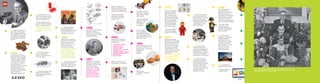
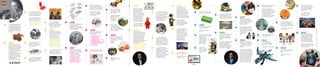
Through almost a century, the LEGO Group
has grown from being a small local com-
pany into being one of the world’s leading
suppliers of creative play and learning
materials. Here is a timeline summing up
a family belief in an idea, the meaning and
substance of the LEGO®
name and brand,
and our most iconic historical events.
1958
The LEGO®
brick is patented
with a new coupling
principle, the one we know
today, opening up to endless
building possibilities
1963
Godtfred Kirk Christiansen
announces the 10 LEGO®
characteristics:
1. Unlimited play possibilities
2. For girls, for boys
3. Enthusiasm at all ages
4. Play all year round
5. Stimulating and harmonious play
6. Endless hours of play
7. Imagination, creativity, development
8. More LEGO, greater play value
9. Always topical
10. Safety and quality
1964 The first LEGO®
build-
ing instruction is introduced
1968 The first
LEGOLAND®
Park opens
in Billund
1969
LEGO®
DUPLO®
bricks – twice
the size of a LEGO brick on
all dimensions – is launched
globally for the
youngest
children
1975 The LEGO
Group establishes
a sales office in Enfield,
USA – today representing
one of the LEGO Group's five
global main offices
1977 LEGO®
Technic is
launched – challenging
older children to build
like in real life
• Kjeld Kirk Kristiansen,
grandson of Ole Kirk
Kristiansen, joins
the company
management
1960 A fire destroys the
company’s wooden toy ware-
house and the production of
wooden toys is discontinued
1962 The LEGO®
wheel
is launched, introducing
movement to the LEGO
System in Play
1957
Godtfred Kirk Christiansen
takes over the day to day
management from his father.
He sees himself as a
manufacturer: “We want
only the best … we must
make better bricks from
even better material
on even better machinery.
We must get the best
people for our company”
1978
Kjeld Kirk Kristiansen
develops the “System
within the System” to
offer children the right
products at the right age
and for the right purpose.
New product program-
mes and themes such
as Castle, Space and
Town are launched as
part of this strategy
•
is launched bringing
role-play to LEGO play
1979
Kjeld Kirk Kristiansen
becomes CEO of the LEGO
Group. Being the first within
the owner family to hold
a formal business degree,
he brings new ideas and
renewed energy into the
company and has one primary
focus: children and their
development. “Our products
must exist on children’s own
terms. To put it simply: what
the future LEGO products
do in the heads of tomorrow’s
children is important”
1980
1984
1986
1989
•
1992
1996
•
1958
The LEGO®
brick is patented
with a new coupling
principle, the one we know
today, opening up to endless
building possibilities
1963
Godtfred Kirk Christiansen
announces the 10 LEGO®
characteristics:
1. Unlimited play possibilities
2. For girls, for boys
3. Enthusiasm at all ages
4. Play all year round
5. Stimulating and harmonious play
6. Endless hours of play
7. Imagination, creativity, development
8. More LEGO, greater play value
9. Always topical
10. Safety and quality
1964 The first LEGO®
build-
ing instruction is introduced
1968 The first
LEGOLAND®
Park opens
in Billund
1969
LEGO®
DUPLO®
bricks – twice
the size of a LEGO brick on
all dimensions – is launched
globally for the
youngest
children
1975 The LEGO
Group establishes
a sales office in Enfield,
USA – today representing
one of the LEGO Group's five
global main offices
1977 LEGO®
Technic is
launched – challenging
older children to build
like in real life
• Kjeld Kirk Kristiansen,
grandson of Ole Kirk
Kristiansen, joins
the company
management
1978
Kjeld Kirk Kristiansen
develops the “System
within the System” to
offer children the right
products at the right age
and for the right purpose.
New product program-
mes and themes such
as Castle, Space and
Town are launched as
part of this strategy
• The LEGO®
Minifigure
is launched bringing
role-play to LEGO play
1956 The LEGO Group enters
the German market and
establishes a sales company,
the first outside Denmark
1960 A fire destroys the
company’s wooden toy ware-
house and the production of
wooden toys is discontinued
1962 The LEGO®
wheel
is launched, introducing
movement to the LEGO
System in Play
1932 Master carpenter and
joiner, Ole Kirk Kristiansen,
starts making wooden toys.
As an apprenticed carpenter,
he pursues high quality and
craftsmanship in everything
he does
1957
Godtfred Kirk Christiansen
takes over the day to day
management from his father.
He sees himself as a
manufacturer: “We want
only the best … we must
make better bricks from
even better material
on even better machinery.
We must get the best
people for our company”
1946 Ole Kirk Kristiansen
orders his first plasticorders his first plastic
injection moulding machine
from Great Britain
1949 The forerunner of the
LEGO®
bricks we know today,
is launched under the name
“Automatic Binding Bricks”
• Ole Kirk Kristiansen sees
potential in plastic bricks and
tries to convince his sons:
“Have you no faith? Can’t you
see if we do this right, we
can sell these bricks all over
the world?”
1953 Automatic Binding
Bricks change name to
LEGO®
Mursten (LEGO Bricks).
The name “LEGO” is now
moulded on every brick
1979
Kjeld Kirk Kristiansen
becomes CEO of the LEGO
Group. Being the first within
the owner family to hold
a formal business degree,
he brings new ideas and
renewed energy into the
company and has one primary
focus: children and their
development. “Our products
must exist on children’s own
terms. To put it simply: what
the future LEGO products
do in the heads of tomorrow’s
children is important”
1980 The LEGO Group
establishes a department
to develop educational
material based on the belief
that LEGO®
products are
more than a toy. Today
LEGO®
Education works with
educational systems
throughout the world
1984 The LEGO Group
initiates a visionary part-
nership with MIT Media Lab
(Massachusetts Institute of
Technology) USA – the goal
being to add intelligence
and behaviour to LEGO®
play
1986 LEGO®
Technic Com-
puter Control is launched
as one of the first outcomesas one of the first outcomes
of the LEGO Group and
MIT Media Lab partnership.
LEGO products for use in
schools highly benefit
from this invention
1989
Ole Kirk Kristiansen is
inducted into the Toy
Industry Hall of Fame, USA,
with tribute payed to “an
extraordinary craftsman who
helped shape our industry
in ways too numerous to
count and more permanently
than he could have imagined”
• The LEGO®
Pirates
theme is launched.
The pirate Minifigures are
the first to have multiple
facial expressions
1992 The first LEGO®
Imagination Center opens
in Mall of America in
Bloomington, MN, USA.
Five years later, a second
one opens in Downtown
Disney, Orlando, FL, USA.
These centers form
inspiration for LEGO
Brand Retail Stores
1999
The LEGO®
brick is elected
“Toy of the Century”
• LEGOLAND®
California
opens
2000 A LEGO®
factory opens
in Kladno, Czech Republic
2001 LEGO®
Creator products,
encouraging children and
adults to build without rules
and limitations, are launched
2002
The first LEGO®
Brand Retail
Store opens in Cologne,
Germany – the same year
LEGOLAND®
Deutschland
opens
• The LEGO Learning Institute,
dedicated to researching
children’s imagination,
creativity and learning skills,
is established – today part
of the LEGO Foundation
2004
LEGO®
licensed Minifigures
no longer have yellow faces
– Harry Potter, for example,
assumes a more natural
skin tone
• The LEGO Group faces a
serious crisis and establishes
a survival and turnaround plan.
As part of this plan, Jørgen
Vig Knudstorp succeeds Kjeld
Kirk Kristiansen as President
and CEO. He revitalises the
company by reintroducing
a strong focus on the core
business – the brick and
the LEGO®
System in Play
2005 The LEGO Group sells
the LEGOLAND®
Parks to
Merlin Entertainments Group
and becomes a major share-
holder of Merlinholder of Merlin
EntertainmentsEntertainments
Group
2007
Thomas Kirk Kristiansen
joins the Board of Directors,
representing the continuation
of the Kirk Kristiansen
family ownership
1955
Godtfred Kirk Christiansen
launches the LEGO®
System
in Play as a structured
system of products – the
more bricks you have,
the more you can build.
“Our idea has been to create
a toy that prepares the child
for life – appealing to its
imagination and developing
the creative urge and joy of
creation that are the driving
forces in every human being”
1934
Combining the two Danish
words “Leg Godt,” meaning
“Play Well,” Ole Kirk Kristiansen
names his company LEGO®
– unaware that this word in
Latin means “I put together.”
As an alternative, he
considered LEGIO (= legions)
but opted finally for the
name that embodies good
quality play and commitment
towards children’s
development through play
1937 Ole Kirk Kristiansen’s son,
Godtfred Kirk Christiansen,
begins designing wooden toys
at the age of 17
1996 www.LEGO.com
goes live on March 22nd
• LEGOLAND®
Windsor
in England opens
1997 The first1997 The first1997
LEGO®
computer
game is released
– called LEGO
Island
1998 The LEGO Group and
MIT Media Lab launch LEGO®
Mindstorms®
, an®
, an®
intelligent LEGO
brick integrating
robot technology
and the LEGO
building system
LEGO Group founder, Ole Kirk Kristiansen, with his son Godtfred Kirk Christiansen
and grandson Kjeld Kirk Kristiansen. The family-owned LEGO Group is today owned
by Kjeld Kirk Kristiansen and his three children.
LEGO, the LEGO logo and the Minfigure are trademarks and/or copyrights of the LEGO Group. © 2013 The LEGO Group.
All Rights Reserved. THE LEGO MOVIE © The LEGO Group & Warner Bros. Entertainment Inc.
1958
The LEGO®
brick is patented
with a new coupling
principle, the one we know
today, opening up to endless
building possibilities
1963
Godtfred Kirk Christiansen
announces the 10 LEGO®
characteristics:
1. Unlimited play possibilities
2. For girls, for boys
3. Enthusiasm at all ages
4. Play all year round
5. Stimulating and harmonious play
6. Endless hours of play
7. Imagination, creativity, development
8. More LEGO, greater play value
9. Always topical
10. Safety and quality
1964 The first LEGO®
build-
ing instruction is introduced
1968 The first
LEGOLAND®
Park opens
in Billund
1969
LEGO®
DUPLO®
bricks – twice
the size of a LEGO brick on
all dimensions – is launched
globally for the
youngest
children
1975 The LEGO
Group establishes
a sales office in Enfield,
USA – today representing
one of the LEGO Group's five
global main offices
1977 LEGO®
Technic is
launched – challenging
older children to build
like in real life
• Kjeld Kirk Kristiansen,
grandson of Ole Kirk
Kristiansen, joins
the company
management
1978
Kjeld Kirk Kristiansen
develops the “System
within the System” to
offer children the right
products at the right age
and for the right purpose.
New product program-
mes and themes such
as Castle, Space and
Town are launched as
part of this strategy
• The LEGO®
Minifigure
is launched bringing
role-play to LEGO play
2008 A LEGO®
factory opens
in Nyíregyháza, Hungary
• Kjeld Kirk Kristiansen is
inducted into the Toy Industry
Hall of Fame, USA. The honour
is motivated by the fact that
the LEGO Group has
revolutionised the way children
play and build with bricks
2012
LEGO®
Friends is launched,
introducing a new mini-doll
figure
• LEGOLAND®
Malaysia
opens
2013 The LEGO Group opens
a new office in Singapore,
the third of the LEGO Group’s
five global main offices today
• LEGO®
Brand Retail Store
no. 100 opens
2016
LEGO®
NEXO KNIGHTS™ is
launched, bridging physical
and digital play with LEGO
bricks, episodic TV content
and a digital gaming app
that helps bring LEGO play
to live in an entirely new way
• Expected opening of LEGO®
factory in Jiaxing, China and
LEGOLAND®
Dubai
1956 The LEGO Group enters
the German market and
establishes a sales company,
the first outside Denmark
2014 The last two of the
LEGO Group’s five global
main offices are inaugurated
in London and Shanghai
respectively
• The LEGO®
Movie™
premieres in cinemas
all over the world
1960 A fire destroys the
company’s wooden toy ware-
house and the production of
wooden toys is discontinued
1962 The LEGO®
wheel
is launched, introducing
movement to the LEGO
System in Play
1932 Master carpenter and
joiner, Ole Kirk Kristiansen,
starts making wooden toys.
As an apprenticed carpenter,
he pursues high quality and
craftsmanship in everything
he does
1957
Godtfred Kirk Christiansen
takes over the day to day
management from his father.
He sees himself as a
manufacturer: “We want
only the best … we must
make better bricks from
even better material
on even better machinery.
We must get the best
people for our company”
1946 Ole Kirk Kristiansen
orders his first plasticorders his first plastic
injection moulding machine
from Great Britain
1949 The forerunner of the
LEGO®
bricks we know today,
is launched under the name
“Automatic Binding Bricks”
• Ole Kirk Kristiansen sees
potential in plastic bricks and
tries to convince his sons:
“Have you no faith? Can’t you
see if we do this right, we
can sell these bricks all over
the world?”
1953 Automatic Binding
Bricks change name to
LEGO®
Mursten (LEGO Bricks).
The name “LEGO” is now
moulded on every brick
1979
Kjeld Kirk Kristiansen
becomes CEO of the LEGO
Group. Being the first within
the owner family to hold
a formal business degree,
he brings new ideas and
renewed energy into the
company and has one primary
focus: children and their
development. “Our products
must exist on children’s own
terms. To put it simply: what
the future LEGO products
do in the heads of tomorrow’s
children is important”
1980 The LEGO Group
establishes a department
to develop educational
material based on the belief
that LEGO®
products are
more than a toy. Today
LEGO®
Education works with
educational systems
throughout the world
1984 The LEGO Group
initiates a visionary part-
nership with MIT Media Lab
(Massachusetts Institute of
Technology) USA – the goal
being to add intelligence
and behaviour to LEGO®
play
1986 LEGO®
Technic Com-
puter Control is launched
as one of the first outcomesas one of the first outcomes
of the LEGO Group and
MIT Media Lab partnership.
LEGO products for use in
schools highly benefit
from this invention
1989
Ole Kirk Kristiansen is
inducted into the Toy
Industry Hall of Fame, USA,
with tribute payed to “an
extraordinary craftsman who
helped shape our industry
in ways too numerous to
count and more permanently
than he could have imagined”
• The LEGO®
Pirates
theme is launched.
The pirate Minifigures are
the first to have multiple
facial expressions
1992 The first LEGO®
Imagination Center opens
in Mall of America in
Bloomington, MN, USA.
Five years later, a second
one opens in Downtown
Disney, Orlando, FL, USA.
These centers form
inspiration for LEGO
Brand Retail Stores
1999
The LEGO®
brick is elected
“Toy of the Century”
• LEGOLAND®
California
opens
2000 A LEGO®
factory opens
in Kladno, Czech Republic
2001 LEGO®
Creator products,
encouraging children and
adults to build without rules
and limitations, are launched
2002
The first LEGO®
Brand Retail
Store opens in Cologne,
Germany – the same year
LEGOLAND®
Deutschland
opens
• The LEGO Learning Institute,
dedicated to researching
children’s imagination,
creativity and learning skills,
is established – today part
of the LEGO Foundation
2004
LEGO®
licensed Minifigures
no longer have yellow faces
– Harry Potter, for example,
assumes a more natural
skin tone
• The LEGO Group faces a
serious crisis and establishes
a survival and turnaround plan.
As part of this plan, Jørgen
Vig Knudstorp succeeds Kjeld
Kirk Kristiansen as President
and CEO. He revitalises the
company by reintroducing
a strong focus on the core
business – the brick and
the LEGO®
System in Play
2005 The LEGO Group sells
the LEGOLAND®
Parks to
Merlin Entertainments Group
and becomes a major share-
holder of Merlinholder of Merlin
EntertainmentsEntertainments
Group
2011
LEGO®
NINJAGO™
is launched and quickly
becomes an evergreen
• LEGOLAND®
Florida opens
2007
Thomas Kirk Kristiansen
joins the Board of Directors,
representing the continuation
of the Kirk Kristiansen
family ownership
1955
Godtfred Kirk Christiansen
launches the LEGO®
System
in Play as a structured
system of products – the
more bricks you have,
the more you can build.
“Our idea has been to create
a toy that prepares the child
for life – appealing to its
imagination and developing
the creative urge and joy of
creation that are the driving
forces in every human being”
1934
Combining the two Danish
words “Leg Godt,” meaning
“Play Well,” Ole Kirk Kristiansen
names his company LEGO®
– unaware that this word in
Latin means “I put together.”
As an alternative, he
considered LEGIO (= legions)
but opted finally for the
name that embodies good
quality play and commitment
towards children’s
development through play
1937 Ole Kirk Kristiansen’s son,
Godtfred Kirk Christiansen,
begins designing wooden toys
at the age of 17
2009 A LEGO®
factory opens
in Monterrey, Mexico
Learnmore:www.lego.com/legohistory
1996 www.LEGO.com
goes live on March 22nd
• LEGOLAND®
Windsor
in England opens
1997 The first1997 The first1997
LEGO®
computer
game is released
– called LEGO
Island
1998 The LEGO Group and
MIT Media Lab launch LEGO®
Mindstorms®
, an®
, an®
intelligent LEGO
brick integrating
robot technology
and the LEGO
building system
Experience
LEGO®
play
Providing a broad variety of fun
and engaging LEGO®
brand settings,
for children and adults to explore,
is essential for us to celebrate and
discuss with our fans the many great
moments LEGO play offers.
Did you know that LEGO®
bricks produced
since 1958 are fully compatible with LEGO
bricks produced today?
20COMPANy TIMELINE
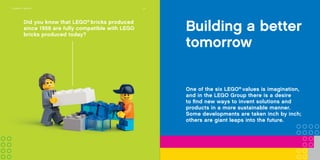
One of the six LEGO®
values is imagination,
and in the LEGO Group there is a desire
to find new ways to invent solutions and
products in a more sustainable manner.
Some developments are taken inch by inch;
others are giant leaps into the future.
Building a better
tomorrow
Did you know that LEGO®
bricks produced
since 1958 are fully compatible with LEGO
bricks produced today?
20COMPANy TIMELINE
Experience
LEGO®
play
Providing a broad variety of fun
and engaging LEGO®
brand settings,
for children and adults to explore,
is essential for us to celebrate and
discuss with our fans the many great
moments LEGO play offers.
Our ambition is to leave a positive impact on society and the
planet our children will inherit. We do this primarily through our
play materials and their contribution to children’s development,
but also through our social and environmental efforts, which we
constantly seek to advance by staying true to our longstanding
motto: Only the best is good enough. In 2015, this included:
22
Taking a major step towards our 2020 goal
to balance our global energy consumption
with renewable energy capacity by inaugurating
the Borkum riffgrund 1 offshore wind farm
with our partners. Furthermore, we managed
to improve our energy efficiency by +5.0%.
Announcing the launch of a Sustainable
Materials centre, where we will work towards
our ambition to use more sustainable materials
in all core LEGO products and packaging
by 2030.
providing the safest play experiences for
children resulting in zero product recalls
for the sixth year running.
reaching and hence supporting the learning
and development of approximately 100
million children through joint activities by
the LEGO Group, LEGO®
Education and the
LEGO Foundation.
Engaging more than 66,000 children and 3,000
employees in activities through our Local
LEGO community Engagement programme for
the benefit of children and their families in the
communities where we are present.
continuing our collaboration with unIcEF on
child rights and as part of our partnership
developing a child protection policy stipulating
our non-tolerance to child abuse in any form.
Learn more: www.LEGO.com/responsibility
BuILdInG A BETTEr TOMOrrOW
We have a responsibility as a leading
provider of quality play experiences.
We have a responsibility to everyone and
everything that we impact through our
operations. We are mindful of this, which
is why we always strive to make a positive
impact on society.”
— Thomas Kirk Kristiansen, fourth generation
owner of the family-owned LEGO Group
Did you know that LEGO®
bricks produced
since 1958 are fully compatible with LEGO
bricks produced today?
20COMPANy TIMELINE
Experience
LEGO®
play
Providing a broad variety of fun
and engaging LEGO®
brand settings,
for children and adults to explore,
is essential for us to celebrate and
discuss with our fans the many great
moments LEGO play offers.
Did you know that the LEGO Group signed
the United Nations Global Compact in 2003
as the first company in the toy industry?
We are committed to embrace, support
and enact United Nations’ directions
within the areas of human
rights, labour standards,
the environment and
anti-corruption.
BuILdInG A BETTEr TOMOrrOW 24
LEGO®
communities
It is important to the LEGO Group to have
close contact with our fans and consumers
throughout the world. And to this end,
we engage in many initiatives to strengthen
ties between us and LEGO®
enthusiasts.
Did you know that LEGO®
bricks produced
since 1958 are fully compatible with LEGO
bricks produced today?
20COMPANy TIMELINE
Experience
LEGO®
play
Providing a broad variety of fun
and engaging LEGO®
brand settings,
for children and adults to explore,
is essential for us to celebrate and
discuss with our fans the many great
moments LEGO play offers.
Did you know that the LEGO Group signed
the United Nations Global Compact in 2003
as the first company in the toy industry?
We are committed to embrace, support
and enact United Nations’ directions
within the areas of human
rights, labour standards,
the environment and
anti-corruption.
BuILdInG A BETTEr TOMOrrOW 24
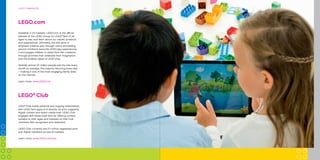
Available in 23 markets, LEGO.com is the official
website of the LEGO Group for LEGO®
fans of all
ages to play and learn about our values, products
and experiences. Ultimately, the site aims to
empower creative play through online storytelling
around children’s favourite LEGO play experiences.
It encourages children to share their own creations
through activities that celebrate their imagination
and the endless ideas of LEGO play.
Globally almost 20 million people visit the site every
month on average, the majority returning every day
– making it one of the most engaging family sites
on the internet.
Learn more: www.LEGO.com
LEGO.com
LEGO®
Club
LEGO®
Club builds personal and ongoing relationships
with LEGO fans aged 4-13 directly via print magazine,
digital content and direct mail/e-mail. LEGO Club
engages with these loyal fans by offering content
suitable to their ages and interests so that Club
members feel recognised and rewarded.
LEGO Club currently has 5.7 million registered print
and digital members across 18 markets.
Learn more: www.LEGO.com/club
26LEGO®
COMMUNITIES
Did you know that LEGO®
bricks produced
since 1958 are fully compatible with LEGO
bricks produced today?
20COMPANy TIMELINE
Experience
LEGO®
play
Providing a broad variety of fun
and engaging LEGO®
brand settings,
for children and adults to explore,
is essential for us to celebrate and
discuss with our fans the many great
moments LEGO play offers.
Did you know that the LEGO Group signed
the United Nations Global Compact in 2003
as the first company in the toy industry?
We are committed to embrace, support
and enact United Nations’ directions
within the areas of human
rights, labour standards,
the environment and
anti-corruption.
BuILdInG A BETTEr TOMOrrOW 24LEGO COMMUNITIES 29
Through close dialogue and engagement
on social media, we strive to create value for
consumers. Listening to our consumers is
a key contributor to our success, and social
platforms allow us to connect meaningfully
with our many fans across borders.
Connect with us on: Facebook, YouTube,
Instagram, Pinterest, Twitter, Google+, LinkedIn
and via the LEGO®
TV App.
LEGO®
Social MediaLEGO®
adult fan
communities
LEGO®
User Groups (LUGs) act as forums
where adult LEGO enthusiasts can share their
hobby amongst each other. The groups have
their own websites, blogs and discussion forums,
and many meet face-to-face on a regular
basis. There are currently 274 recognised LUGs
with more than 500,000 registered members;
these fans are referred to as AFOLs (Adult Fans
of LEGO).
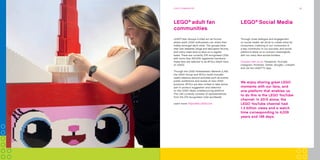
Through the LEGO Ambassador Network (LAN)
the LEGO Group and AFOLs build mutually
useful relations around activities such as events,
public exhibitions and review of new LEGO
products. AFOLs are also invited to take active
part in product suggestion and selection
on the LEGO Ideas crowdsourcing platform.
The LAN currently consists of representatives
from the 274 recognised LUGs worldwide.
Learn more: https://lan.LEGO.com
We enjoy sharing great LEGO
moments with our fans, and
one platform that enables us
to do this is the LEGO YouTube
channel. In 2015 alone, the
LEGO YouTube channel had
1.3 billion views and a watch
time corresponding to 4,039
years and 188 days.
LEGO®
COMMUNITIES
Did you know that LEGO®
bricks produced
since 1958 are fully compatible with LEGO
bricks produced today?
20COMPANy TIMELINE
Did you know that the LEGO Group signed
the United Nations Global Compact in 2003
as the first company in the toy industry?
We are committed to embrace, support
and enact United Nations’ directions
within the areas of human
rights, labour standards,
the environment and
anti-corruption.
BuILdInG A BETTEr TOMOrrOW 24
Experience
LEGO®
play
Providing a broad variety of fun
and engaging LEGO®
brand settings,
for children and adults to explore,
is essential for us to celebrate and
discuss with our fans the many great
moments LEGO play offers.
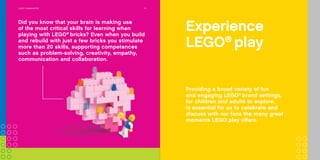
Did you know that your brain is making use
of the most critical skills for learning when
playing with LEGO®
bricks? Even when you build
and rebuild with just a few bricks you stimulate
more than 20 skills, supporting competences
such as problem-solving, creativity, empathy,
communication and collaboration.
30LEGO®
COMMUNITIES
Did you know that LEGO®
bricks produced
since 1958 are fully compatible with LEGO
bricks produced today?
20COMPANy TIMELINE
Did you know that the LEGO Group signed
the United Nations Global Compact in 2003
as the first company in the toy industry?
We are committed to embrace, support
and enact United Nations’ directions
within the areas of human
rights, labour standards,
the environment and
anti-corruption.
BuILdInG A BETTEr TOMOrrOW 24
Did you know that your brain is making use
of the most critical skills for learning when
playing with LEGO®
bricks? Even when you build
and rebuild with just a few bricks you stimulate
more than 20 skills, supporting competences
such as problem-solving, creativity, empathy,
communication and collaboration.
30LEGO®
COMMUNITIES 33
LEGO®
Inside Tour
LEGO®
Build the Change is a global nonprofit
event-based concept operated by the LEGO Group
that has existed since 2007. It is a hands-on
minds-on concept that seeks to inspire children to
express their vision and dreams of a better tomorrow
using LEGO bricks.
The events are always topic specific with outset
in surroundings children can relate to – be it their
school, city or local community. The concept
is equally relevant for LEGO Group activities and
activities by external partners who seek to give
children a voice and involve them in their thoughts
and plans about the future.
Learn more: www.LEGO.com/BuildtheChange
LEGO®
Build the
Change
Each year LEGO®
enthusiasts have the opportunity
to join the exclusive LEGO Inside Tour. During the
tour, fans learn about the company history, culture
and values; go on a factory tour; meet LEGO
employees from different business areas; and enjoy
building competitions with LEGO designers.
At the end of the tour, participants receive a unique
gift produced in close cooperation with LEGO
Group owner Kjeld Kirk Kristiansen.
Learn more: www.LEGO.com/aboutus
ExPERIENCE LEGO®
PLAy
Did you know that LEGO®
bricks produced
since 1958 are fully compatible with LEGO
bricks produced today?
20COMPANy TIMELINE
Did you know that the LEGO Group signed
the United Nations Global Compact in 2003
as the first company in the toy industry?
We are committed to embrace, support
and enact United Nations’ directions
within the areas of human
rights, labour standards,
the environment and
anti-corruption.
BuILdInG A BETTEr TOMOrrOW 24
Did you know that your brain is making use
of the most critical skills for learning when
playing with LEGO®
bricks? Even when you build
and rebuild with just a few bricks you stimulate
more than 20 skills, supporting competences
such as problem-solving, creativity, empathy,
communication and collaboration.
30LEGO®
COMMUNITIES 34
FIRST®
LEGO®
League
and FIRST®
LEGO®
League Jr.
FIRST®
LEGO®
League is an annual science
and technology team-based competition
targeted 9-16 year old children and youth who
use LEGO®
MINDSTORMS®
robots to compete.
The competition now stretching 85+ countries,
was established in 1998 as a collaboration
between the American non-profit organisation
FIRST®
(For Inspiration and Recognition of
Science and Technology) and LEGO®
Education
to increase children’s and young people’s
interest in STEM subjects (Science, Technology,
Engineering and Math’s).
In 2004 the concept was expanded to also
engage younger children aged 6-9 years in
STEM, and so FIRST®
LEGO®
League Jr. was
established, focusing on teamwork and using
LEGO Education WeDo 2.0.
The disciplines are always centred around a
real world scientific concept or challenge, such
as 21st
Century Learning (2014/15) and Waste
Innovation (2015/16). Guided by adult coaches,
teams will build and program a challenge-
related LEGO model based on own research,
imagination, teamwork, and construction ideas.
Learn more: www.FIRSTLEGOleague.org
and www.FIRSTLEGOleaguejr.org
ExPERIENCE LEGO®
PLAy 35
Through our 125 LEGO®
Brand Retail Stores
in 9 countries, we bring LEGO play to life
through an interactive and vibrant shopping
experience designed just for children.
Upon entering a LEGO Brand Retail Store,
visitors are invited to interact with LEGO play
experiences: from building personalised
LEGO Minifigures to selecting specific bricks
LEGO®
Brand
Retail Stores
in the Pick & Build wall over to watching a
LEGO product come to life through the LEGO
Digital Box. Other than offering the biggest
assortment of LEGO products in one place, play
areas to unlock one’s creativity and expert
building tips from store associates, LEGO Brand
Retail Stores also run monthly in-store activities.
Learn more: http://stores.LEGO.com
ExPERIENCE LEGO®
PLAy
Did you know that LEGO®
bricks produced
since 1958 are fully compatible with LEGO
bricks produced today?
20COMPANy TIMELINE
Did you know that the LEGO Group signed
the United Nations Global Compact in 2003
as the first company in the toy industry?
We are committed to embrace, support
and enact United Nations’ directions
within the areas of human
rights, labour standards,
the environment and
anti-corruption.
BuILdInG A BETTEr TOMOrrOW 24
Did you know that your brain is making use
of the most critical skills for learning when
playing with LEGO®
bricks? Even when you build
and rebuild with just a few bricks you stimulate
more than 20 skills, supporting competences
such as problem-solving, creativity, empathy,
communication and collaboration.
30LEGO®
COMMUNITIES 36
LEGO®
House
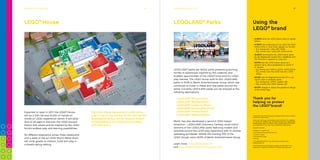
Expected to open in 2017, the LEGO®
House
will be a 23m tall and 12,000 m2
hands-on
minds-on LEGO experience centre. It will allow
fans of all ages to discover the LEGO Group’s
history and values and be inspired by the LEGO
brick’s endless play and learning possibilities.
Six different experience zones, three restaurants
and a state of the art LEGO Brand Retail Store
will invite guests to interact, build and play in
a breath-taking setting.
The LEGO House represents 21 LEGO bricks
built on top of one another. At the very top the
Masterpiece Gallery will be situated, shaped
to resemble and be a tribute to the classic
2X4 LEGO brick.
ExPERIENCE LEGO®
PLAy
LEGOLAND®
Parks Using the
LEGO®
brand
•	 ALWAYS write the LEGO brand name in capital
letters.
•	 ALWAYS use a descriptive noun after the LEGO
brand name, it must never appear on its own.
•	 E.g. wrong use: I play with LEGO.
•	 E.g. correct use: I play with LEGO bricks.
•	 ALWAYS accompany the LEGO brand name
by the Registered symbol ® in headlines and
the first time it appears in copy text.
•	 NEVER use the LEGO brand name as a
generic term, add a possessive ‘s,’ plural ‘s’
or hyphen.
•	 E.g. wrong use: LEGO’s, LEGOs, LEGO-bricks.
•	 E.g. correct use: the LEGO brand’s, LEGO
bricks.
•	 NEVER use the Registered symbol ® in con-
nection with a company name.
•	 E.g. wrong use: LEGO®
System A/S.
•	 E.g. correct use: LEGO System A/S.
•	 NEVER change or adjust the graphical design
of the LEGO logo.
Thank you for
helping us protect
the LEGO®
brand!
Produced for the LEGO Group by Corporate Brand Communications.
© 2016 The LEGO Group.
LEGO, the LEGO logo, the Minifigure, DUPLO, BIONICLE, LEGENDS
OF CHIMA, the FRIENDS logo, the MINIFIGURES logo, DIMENSIONS,
MINDSTORMS, MIxELS, NINJAGO, NExO KNIGHTS and LEGOLAND
are trademarks of the LEGO Group. ©2016 the LEGO Group.
All rights reserved.
© 2016 & ™ Lucasfilm Ltd.
™ & © Warner Bros. Entertainment Inc.
™ & © DC Comics
™ & © Marvel & Subs.
© Disney
THE LEGO® MOVIE™ © The LEGO Group & Warner Bros
Entertainment Inc.
© 2016 Mojang AB and Mojang Synergies AB. MINECRAFT is a
trademark or registered trademark of Mojang Synergies AB.
LEGOLAND®
parks are family parks presenting exciting
worlds of adventures inspired by the creativity and
endless opportunities of the LEGO®
brick and fun LEGO
play themes. The LEGO Group sold its four LEGOLAND
parks in 2005 to Merlin Entertainments Group, which has
continued to invest in these and new parks around the
world. Currently LEGOLAND parks can be enjoyed at the

following destinations:
LEGOLAND®
Billund Resort
LEGOLAND®
Windsor Resort
LEGOLAND®
California Resort
LEGOLAND®
Deutschland Resort
LEGOLAND®
Florida Resort
LEGOLAND®
Malaysia Resort
Merlin has also developed a second LEGO based
attraction – LEGOLAND Discovery Centres: small indoor
versions of the LEGOLAND parks featuring models and
activities around the LEGO play experience with 13 centres
operating worldwide. KIRKBI A/S (owning 75% of the
LEGO Group) owns 29.9% of Merlin Entertainments Group.
Learn more: www.LEGOLAND.com
and www.LEGOLANDdiscoverycenter.com
37ExPERIENCE LEGO®
PLAy
Did you know that LEGO®
bricks produced
since 1958 are fully compatible with LEGO
bricks produced today?
20COMPANy TIMELINE
Did you know that the LEGO Group signed
the United Nations Global Compact in 2003
as the first company in the toy industry?
We are committed to embrace, support
and enact United Nations’ directions
within the areas of human
rights, labour standards,
the environment and
anti-corruption.
BuILdInG A BETTEr TOMOrrOW 24
Did you know that your brain is making use
of the most critical skills for learning when
playing with LEGO®
bricks? Even when you build
and rebuild with just a few bricks you stimulate
more than 20 skills, supporting competences
such as problem-solving, creativity, empathy,
communication and collaboration.
30LEGO®
COMMUNITIES
The LEGO Group
Aastvej 1
7190 Billund
Denmark
Tel.: +45 79 50 60 70
www.LEGO.com
Learn more about the LEGO Group
and LEGO Group activities at
www.LEGO.com/aboutus

The LEGO Group_A short presentation_2016_ENG

  • 1.
    The LEGO Group Ashort presentation 2016
  • 2.
    Company snapshot 1 Ourreason for being 2 The LEGO® Strategy 3 Organisational structure 4 The LEGO Foundation 4 LEGO® Education 5 Key figures 2015 6 Play experiences for every child 7 Highlight of LEGO® products 10 Innovation and production 13 Innovating for children 14 Quality and safety above all else 14 Production fun facts 16 Company timeline 17 Building a better tomorrow 21 LEGO® communities 25 LEGO.com 26 LEGO® Club 26 LEGO® adult fan communities 29 LEGO® Social Media 29 Experience LEGO® play 31 LEGO® Build the Change 33 LEGO® Inside Tour 33 FIRST® LEGO® League and FIRST® LEGO® League Jr. 34 LEGO® Brand Retail Stores 35 LEGO® House 36 LEGOLAND® Parks 37 Using the LEGO® brand name 37 Contents Based on the iconic LEGO® brick, we are one of the world’s leading manufacturers of play materials with headquarters in Billund, Denmark, and main offices in Enfield, USA, London, UK, Shanghai, China, and Singapore. This booklet provides highlights on how we set out to achieve our mission to inspire and develop the builders of tomorrow through creative play and learning. Inspiring and developing children through play and learning is what we have been dedicated to since my grandfather, Ole Kirk Kristiansen, founded our company in 1932 on the values that were important to him. I believe the reason for our universal appeal is that we have stayed true to these core values: Imagination – Creativity – Fun – Learning – Caring – Quality.” — Kjeld Kirk Kristiansen, third generation owner of the family-owned LEGO Group
  • 3.
    2 Our reason for being Themost important impact we have on the world is providing children with fun and exciting high-quality LEGO® play experiences that develop the essential skills and competences they need to create a better future for themselves and our planet.” We are committed to emphasising play as a significant contributor to children’s development. Play has a profound impact on children’s social, emotional and cognitive skills. This is why all LEGO® play experiences are based on the underlying philosophy of learning and development through play. The LEGO System in Play is universally appealing and has unlimited possibilities. It encourages children around the world to engage in fun and creative play and allows them to build anything they can imagine. Children’s wellbeing is our utmost concern. Our main contribution to help children grow up as stronger shapers of their own future is through the playful learning our play experi- ences deliver. Throughout our operations, we constantly aim higher and strive for new ways to optimise our social and environmental footprint, ultimately to leave a positive impact on the world our children will inherit. Jørgen Vig Knudstorp President and CEO of the family-owned LEGO Group 3 The LEGO® Strategy COMPANy SNAPSHOT It is the LEGO Group’s aspiration to further globalise and innovate the LEGO® System in Play through: Sustaining core commercial and operational momentum We will sustain the growth of our core business, covering children aged 1½-11, through development of great products within existing product lines, but also through developing and launching new product lines. Also, we will initiate ongoing improvement initiatives across the entire company. Expanding global presence We will expand our global presence – eventually reaching children in every country of the world. We will do this commercially through focus on new emerging markets such as China, operationally through the establishment of new factories and organisationally through the establishment of centrally located main offices. Leveraging digitalisation We consider digitalisation as a way to make our core business – physical LEGO® play – even more attractive and exciting. To do this, we will leverage digitalisation over a broad range of topics – e.g. integrating physical and digital play, e-commerce, marketing and our business/enterprise system. Creating the organisation of the future We will build a truly global and diverse organisation to meet the adaptive challenges, gain competitive advantage against intensifying competition and build required stewardship of environment, governance and social responsibility.
  • 4.
    4COMPANy SNAPSHOT The LEGOGroup consists of several subsidiaries, including LEGO® Education. 75% of the Group is owned by the third and fourth generations of the Kirk Kristiansen founding family, Kjeld Kirk Kristiansen and his three children, through their investment company KIRKBI A/S. The remaining 25% is owned by the LEGO Foundation. Kjeld Kirk Kristiansen functioned as President and CEO of the LEGO Group from 1979 to 2004 when Jørgen Vig Knudstorp succeeded him as President and CEO of the LEGO Group. Today the LEGO Group Management Board represents four strategic business areas: Operations, Market Management and Develop- ment, Product and Marketing Development, and Business Enabling. Learn more: www.LEGO.com/aboutus From South Africa to Ukraine, the LEGO Foundation aims to make children’s lives better – and communities stronger – by building a future where learning through play empowers children to become creative, engaged, lifelong learners. There is an increased global attention to the need for children to develop stronger life skills, including critical thinking, creativity, and social skills. The LEGO Foundation invests in early childhood development because it provides exceptional returns, not just for the chances of individual children, but also for society as a whole. Partnering with e.g. organisations, academic institutions, school systems and governments who already work within the field of play and quality early childhood education is essential to achieve a strong, sustained impact. The LEGO Foundation activities are funded through the 25% ownership of the LEGO Group. Learn more: www.LEGOFoundation.com Organisational structure The LEGO Foundation Based on a joint commitment and dedication to develop children through play and learning, there is a strong collaboration between the LEGO Group, the LEGO Foundation and LEGO® Education. 5 LEGO® Education offers playful learning experiences and teaching solutions based on the LEGO brick, curriculum-relevant material, and physical and digital resources for preschool, elementary, middle school, and afterschool. In partnership with educators for more than 35 years, LEGO Education supports teaching in an inspiring, engaging, and effective way. LEGO Education’s educational solutions, which range from the humanities to science, enable every student to succeed by encouraging them to become active, collaborative learners, build skills for future challenges, and establish a positive mind-set towards learning. LEGO Education takes the pursuit of hands-on learning very seriously and does this in conjunction with educators who play a critical role in encouraging students’ budding interest during the span of their academic careers in-school and in after-school programmes, such as FIRST® LEGO® League and World Robotics Olympiad. Learn more: www.LEGOEducation.com LEGO® Education COMPANy SNAPSHOT
  • 5.
    Key figures 2015 Approximate no.of children reached through joint activities by the LEGO Group, LEGO® Education and the LEGO Foundation: 100 million Revenue: DKK 35.8 billion Net profit: DKK 9.2 billion Product recalls since 2009: Employees: 17,000+ of more than 70 nationalities 0 Markets: 140+ COMPANy SNAPSHOT 6 Play experiences for every child Being committed to bringing high-quality LEGO® play experiences to millions of children around the world, we are focused on providing a product range that reflects the individual needs and interests of every child.
  • 6.
    Key figures 2015 Approximate no.of children reached through joint activities by the LEGO Group, LEGO® Education and the LEGO Foundation: 100 million Revenue: DKK 35.8 billion Net profit: DKK 9.2 billion Product recalls since 2009: Employees: 17,000+ of more than 70 nationalities 0 Markets: 140+ COMPANy SNAPSHOT 68 LEGO® products are challenge-graduated to reflect the fact that children grow older and develop. Most of our products include building instructions to provide inspiration and ensure that children experience different building techniques and challenges suitable for their age and skills. Theme-based LEGO products provide storytelling settings that children can immerse themselves into and further shape their own stories around – be it LEGO owned themes or themes based on licensed products. Our digital offerings provide exciting avenues to extend the physical LEGO play experience and open up for even more fun and creative LEGO play experiences; and LEGO online gaming, videogames, console games, Apps, TV series, and movies are all great means to do this. LEGO® play experiences enable learning through play by encouraging children to reason systematically and think creatively. They offer endless hours of engagement, as all LEGO bricks are based on the LEGO System in Play, allowing children to build anything they can imagine – over and over again. From curious small hands to exiting roleplay and advanced building challenges over to engaging digital and educational exploration, we seek to provide a product assortment broad enough to appeal to every child. Only the imagination sets the limit to what you can build. PLAY EXPERIENCES FOR EVERY CHILD
  • 7.
    Key figures 2015 Approximate no.of children reached through joint activities by the LEGO Group, LEGO® Education and the LEGO Foundation: 100 million Revenue: DKK 35.8 billion Net profit: DKK 9.2 billion Product recalls since 2009: Employees: 17,000+ of more than 70 nationalities 0 Markets: 140+ COMPANy SNAPSHOT 610 Highlight of LEGO® products LEGO® Creator (4-99) LEGO® DUPLO® (11⁄2-5) LEGO® Juniors (4-7) LEGO® Classic (4-99) LEGO® Classics LEGO® Minifigures (5+) LEGO® City (5+) LEGO® NEXO KNIGHTS™ (5+) LEGO® NINJAGO™ (5+) LEGO® Friends (5-12) LEGO® Elves (5-12) LEGO® Themes For a full overview of LEGO® products, please visit: www.LEGO.com/products PLAY EXPERIENCES FOR EVERY CHILD LEGO® Advanced 11 LEGO® | Disney Princess™ (5-12) LEGO® Star Wars™ (5+) LEGO® Minecraft™ (5+) LEGO® Marvel Super Heroes (5+) LEGO® DC Comics Super Heroes (5+) LEGO® Collaborations LEGO® MINDSTORMS® (7+) LEGO® Technic (7+) LEGO® Architecture (12+) LEGO® MINDSTORMS® Education (10+) LEGO® BuildMe Emotions (3+) LEGO® MoreToMath (6+) LEGO® WeDo 2.0 (7+) LEGO® Machines and Mechanisms (8+) LEGO® StoryStarter (6+) LEGO® Educational PLAY EXPERIENCES FOR EVERY CHILD
  • 8.
    Key figures 2015 Approximate no.of children reached through joint activities by the LEGO Group, LEGO® Education and the LEGO Foundation: 100 million Revenue: DKK 35.8 billion Net profit: DKK 9.2 billion Product recalls since 2009: Employees: 17,000+ of more than 70 nationalities 0 Markets: 140+ COMPANy SNAPSHOT 6 Our longstanding focus since 1932 on providing fun and engaging play materials of the highest quality and safety is a true testimony that we believe children deserve only the best. Innovation and production Did you know that there are 915,103,765 ways to combine six two-by-four LEGO® bricks of the same colour? PLAY EXPERIENCES FOR EVERY CHILD 12
  • 9.
    Key figures 2015 Approximate no.of children reached through joint activities by the LEGO Group, LEGO® Education and the LEGO Foundation: 100 million Revenue: DKK 35.8 billion Net profit: DKK 9.2 billion Product recalls since 2009: Employees: 17,000+ of more than 70 nationalities 0 Markets: 140+ COMPANy SNAPSHOT 6 Did you know that there are 915,103,765 ways to combine six two-by-four LEGO® bricks of the same colour? PLAY EXPERIENCES FOR EVERY CHILD 12 Legislative toy safety recalls Approval of raw materials Newelements designed Comsumerfeedback Safety test LEGO element andmodel assessment Safety control 3rd-party approval Production test Distribution &sales SAFETY ASSESSMENT TESTING PRODUCTION CONSUMER INTERACTION While our designers have solid insight into children’s play patterns and interests at different ages, our most valuable insight comes from children them- selves. Including children in concept and product testing phases is therefore an integrated part of our product innovation cycle. Furthermore, all feedback we receive on LEGO® play experiences from children and parents, once our products have been explored throughout playrooms across the world, is taken very seriously and used as a crucial source in updating and improving LEGO play experiences. Each LEGO® element and all LEGO products adhere to the strictest global safety and quality standards. To make LEGO elements as safe as scientifically reasonable we begin our work as soon as the idea of a new LEGO product is born. Innovating for children The four stages of the LEGO Group’s Safety Assessment The LEGO Group’s meticulous approach to product quality and safety has ensured us zero product recalls since 2009. Our world-class accomplishments in making safe products enable us to play a central role in major associations promoting and regulating toy safety in the world, including the European and international toy safety standardisation committees. Quality and safety above all else InnOvATIOn And prOducTIOn 14 Bite test We simulate a child biting LEGO® dupLO® elements to ensure that nothing breaks off during play. We use a device shaped as a child’s mouth and bite with a force equivalent to 22.5 kg. Impact test We drop a 1 kg metal disc onto potential weak points on LEGO® dupLO® elements from a height of 12 cm. This is to ensure the element does not break or splinter during play. Compression test We simulate a young child stepping on certain LEGO® elements by pressing a metal disc with a force equivalent to 15 kg on the element to ensure that it does not break or splinter during play. All our production facilities adhere to the same strict safety and quality regulations, and the methods used to produce LEGO® elements are standardised across our factories. This ensures equally high quality across all LEGO elements regardless of which of the five LEGO factories they are produced at: Physical and chemical testing – a few examples: Drop test We drop the elements from a height of 1.5 m and 1.0 m five times onto a hard surface to ensure that LEGO® dupLO® and LEGO elements do not splinter or break when a child drops them during play. Full ingredients list We have the full ingre- dients list of every raw material and decoration ink we use for LEGO® elements. We consider whether any additional substance could theoretically be present, for example through unintentional contamination. Hazard classification We consult official hazard classification databases to check if individual substances have an inherent hazard that a child could be exposed to during play. Colour migration We perform chemical tests where we simulate children subjecting LEGO® elements to sweat and saliva. This ensures that no colour pigments migrate from the LEGO element when in contact with these fluids. Content analysis We make a total content analysis to determine that no substances are present above legal limits or internally adopted limits. Substance migration We also determine that no substance migrates from LEGO® elements, at any level of concern, taking into consideration that children could put LEGO elements in their mouth during play. Billund, denmark: Moulding of LEGO® System elements nyíregyháza, Hungary: Moulding and packing of LEGO® System and LEGO dupLO® elements, and processing of LEGO dupLO elements Monterrey, Mexico: Moulding and processing of LEGO® System elements, packing of LEGO System and LEGO dupLO® elements Kladno, czech republic: processing and packing of LEGO® System elements Jiaxing, china: packing of LEGO® System elements (also moulding and processing of LEGO System elements and packing of LEGO dupLO® elements once fully operational in 2017) Learn more: www.LEGO.com/responsibility 15
  • 10.
    Key figures 2015 Approximate no.of children reached through joint activities by the LEGO Group, LEGO® Education and the LEGO Foundation: 100 million Revenue: DKK 35.8 billion Net profit: DKK 9.2 billion Product recalls since 2009: Employees: 17,000+ of more than 70 nationalities 0 Markets: 140+ COMPANy SNAPSHOT 6 Did you know that there are 915,103,765 ways to combine six two-by-four LEGO® bricks of the same colour? PLAY EXPERIENCES FOR EVERY CHILD 12 LEGO® products offered in 2015: 600+ hereof 355 new, including 17 digital – all developed by 250+ designers representing more than 35 nationalities No. of different types of LEGO® elements: No. of different colours used in production: During the moulding process the plastic is heated to 230-310o C before injected into the moulds with a pressure of up to 29,000 psi. In comparison, a car’s tyre pressure is 29 to 43 psi. On average, it takes ten seconds to cool and eject new elements The moulds used to produce LEGO® elements are accurate to within four my (= 0.004 mm) – less than the width of a single hair. This accuracy ensures what we refer to as clutch power Approximate no. of LEGO® elements sold in 2015: LEGO® Minifigures produced in 2015: LEGO® tyres produced in 2015: 675,000,000+ 60+ 725,000,000+ 3,600 72 billion – in more than 140 countries o C 1x1In 2015, the 1x1 round plate was the LEGO® element produced in the largest numbers with a total of 2,396,000,000 in various colours Production fun facts 16 Company timeline Through almost a century, the LEGO Group has grown from being a small local com- pany into being one of the world’s leading suppliers of creative play and learning materials. Here is a timeline summing up a family belief in an idea, the meaning and substance of the LEGO® name and brand, and our most iconic historical events.
  • 11.
    1958 The LEGO® brick ispatented with a new coupling principle, the one we know today, opening up to endless building possibilities 1963 Godtfred Kirk Christiansen announces the 10 LEGO® characteristics: 1. Unlimited play possibilities 2. For girls, for boys 3. Enthusiasm at all ages 4. Play all year round 5. Stimulating and harmonious play 6. Endless hours of play 7. Imagination, creativity, development 8. More LEGO, greater play value 9. Always topical 10. Safety and quality 1964 The first LEGO® build- ing instruction is introduced 1968 The first LEGOLAND® Park opens in Billund 1969 LEGO® DUPLO® bricks – twice the size of a LEGO brick on all dimensions – is launched globally for the youngest children 1975 The LEGO Group establishes a sales office in Enfield, USA – today representing one of the LEGO Group's five global main offices 1977 LEGO® Technic is launched – challenging older children to build like in real life • Kjeld Kirk Kristiansen, grandson of Ole Kirk Kristiansen, joins the company management 1960 A fire destroys the company’s wooden toy ware- house and the production of wooden toys is discontinued 1962 The LEGO® wheel is launched, introducing movement to the LEGO System in Play 1957 Godtfred Kirk Christiansen takes over the day to day management from his father. He sees himself as a manufacturer: “We want only the best … we must make better bricks from even better material on even better machinery. We must get the best people for our company” 1978 Kjeld Kirk Kristiansen develops the “System within the System” to offer children the right products at the right age and for the right purpose. New product program- mes and themes such as Castle, Space and Town are launched as part of this strategy • is launched bringing role-play to LEGO play 1979 Kjeld Kirk Kristiansen becomes CEO of the LEGO Group. Being the first within the owner family to hold a formal business degree, he brings new ideas and renewed energy into the company and has one primary focus: children and their development. “Our products must exist on children’s own terms. To put it simply: what the future LEGO products do in the heads of tomorrow’s children is important” 1980 1984 1986 1989 • 1992 1996 •
  • 12.
    1958 The LEGO® brick ispatented with a new coupling principle, the one we know today, opening up to endless building possibilities 1963 Godtfred Kirk Christiansen announces the 10 LEGO® characteristics: 1. Unlimited play possibilities 2. For girls, for boys 3. Enthusiasm at all ages 4. Play all year round 5. Stimulating and harmonious play 6. Endless hours of play 7. Imagination, creativity, development 8. More LEGO, greater play value 9. Always topical 10. Safety and quality 1964 The first LEGO® build- ing instruction is introduced 1968 The first LEGOLAND® Park opens in Billund 1969 LEGO® DUPLO® bricks – twice the size of a LEGO brick on all dimensions – is launched globally for the youngest children 1975 The LEGO Group establishes a sales office in Enfield, USA – today representing one of the LEGO Group's five global main offices 1977 LEGO® Technic is launched – challenging older children to build like in real life • Kjeld Kirk Kristiansen, grandson of Ole Kirk Kristiansen, joins the company management 1978 Kjeld Kirk Kristiansen develops the “System within the System” to offer children the right products at the right age and for the right purpose. New product program- mes and themes such as Castle, Space and Town are launched as part of this strategy • The LEGO® Minifigure is launched bringing role-play to LEGO play 1956 The LEGO Group enters the German market and establishes a sales company, the first outside Denmark 1960 A fire destroys the company’s wooden toy ware- house and the production of wooden toys is discontinued 1962 The LEGO® wheel is launched, introducing movement to the LEGO System in Play 1932 Master carpenter and joiner, Ole Kirk Kristiansen, starts making wooden toys. As an apprenticed carpenter, he pursues high quality and craftsmanship in everything he does 1957 Godtfred Kirk Christiansen takes over the day to day management from his father. He sees himself as a manufacturer: “We want only the best … we must make better bricks from even better material on even better machinery. We must get the best people for our company” 1946 Ole Kirk Kristiansen orders his first plasticorders his first plastic injection moulding machine from Great Britain 1949 The forerunner of the LEGO® bricks we know today, is launched under the name “Automatic Binding Bricks” • Ole Kirk Kristiansen sees potential in plastic bricks and tries to convince his sons: “Have you no faith? Can’t you see if we do this right, we can sell these bricks all over the world?” 1953 Automatic Binding Bricks change name to LEGO® Mursten (LEGO Bricks). The name “LEGO” is now moulded on every brick 1979 Kjeld Kirk Kristiansen becomes CEO of the LEGO Group. Being the first within the owner family to hold a formal business degree, he brings new ideas and renewed energy into the company and has one primary focus: children and their development. “Our products must exist on children’s own terms. To put it simply: what the future LEGO products do in the heads of tomorrow’s children is important” 1980 The LEGO Group establishes a department to develop educational material based on the belief that LEGO® products are more than a toy. Today LEGO® Education works with educational systems throughout the world 1984 The LEGO Group initiates a visionary part- nership with MIT Media Lab (Massachusetts Institute of Technology) USA – the goal being to add intelligence and behaviour to LEGO® play 1986 LEGO® Technic Com- puter Control is launched as one of the first outcomesas one of the first outcomes of the LEGO Group and MIT Media Lab partnership. LEGO products for use in schools highly benefit from this invention 1989 Ole Kirk Kristiansen is inducted into the Toy Industry Hall of Fame, USA, with tribute payed to “an extraordinary craftsman who helped shape our industry in ways too numerous to count and more permanently than he could have imagined” • The LEGO® Pirates theme is launched. The pirate Minifigures are the first to have multiple facial expressions 1992 The first LEGO® Imagination Center opens in Mall of America in Bloomington, MN, USA. Five years later, a second one opens in Downtown Disney, Orlando, FL, USA. These centers form inspiration for LEGO Brand Retail Stores 1999 The LEGO® brick is elected “Toy of the Century” • LEGOLAND® California opens 2000 A LEGO® factory opens in Kladno, Czech Republic 2001 LEGO® Creator products, encouraging children and adults to build without rules and limitations, are launched 2002 The first LEGO® Brand Retail Store opens in Cologne, Germany – the same year LEGOLAND® Deutschland opens • The LEGO Learning Institute, dedicated to researching children’s imagination, creativity and learning skills, is established – today part of the LEGO Foundation 2004 LEGO® licensed Minifigures no longer have yellow faces – Harry Potter, for example, assumes a more natural skin tone • The LEGO Group faces a serious crisis and establishes a survival and turnaround plan. As part of this plan, Jørgen Vig Knudstorp succeeds Kjeld Kirk Kristiansen as President and CEO. He revitalises the company by reintroducing a strong focus on the core business – the brick and the LEGO® System in Play 2005 The LEGO Group sells the LEGOLAND® Parks to Merlin Entertainments Group and becomes a major share- holder of Merlinholder of Merlin EntertainmentsEntertainments Group 2007 Thomas Kirk Kristiansen joins the Board of Directors, representing the continuation of the Kirk Kristiansen family ownership 1955 Godtfred Kirk Christiansen launches the LEGO® System in Play as a structured system of products – the more bricks you have, the more you can build. “Our idea has been to create a toy that prepares the child for life – appealing to its imagination and developing the creative urge and joy of creation that are the driving forces in every human being” 1934 Combining the two Danish words “Leg Godt,” meaning “Play Well,” Ole Kirk Kristiansen names his company LEGO® – unaware that this word in Latin means “I put together.” As an alternative, he considered LEGIO (= legions) but opted finally for the name that embodies good quality play and commitment towards children’s development through play 1937 Ole Kirk Kristiansen’s son, Godtfred Kirk Christiansen, begins designing wooden toys at the age of 17 1996 www.LEGO.com goes live on March 22nd • LEGOLAND® Windsor in England opens 1997 The first1997 The first1997 LEGO® computer game is released – called LEGO Island 1998 The LEGO Group and MIT Media Lab launch LEGO® Mindstorms® , an® , an® intelligent LEGO brick integrating robot technology and the LEGO building system LEGO Group founder, Ole Kirk Kristiansen, with his son Godtfred Kirk Christiansen and grandson Kjeld Kirk Kristiansen. The family-owned LEGO Group is today owned by Kjeld Kirk Kristiansen and his three children.
  • 13.
    LEGO, the LEGOlogo and the Minfigure are trademarks and/or copyrights of the LEGO Group. © 2013 The LEGO Group. All Rights Reserved. THE LEGO MOVIE © The LEGO Group & Warner Bros. Entertainment Inc. 1958 The LEGO® brick is patented with a new coupling principle, the one we know today, opening up to endless building possibilities 1963 Godtfred Kirk Christiansen announces the 10 LEGO® characteristics: 1. Unlimited play possibilities 2. For girls, for boys 3. Enthusiasm at all ages 4. Play all year round 5. Stimulating and harmonious play 6. Endless hours of play 7. Imagination, creativity, development 8. More LEGO, greater play value 9. Always topical 10. Safety and quality 1964 The first LEGO® build- ing instruction is introduced 1968 The first LEGOLAND® Park opens in Billund 1969 LEGO® DUPLO® bricks – twice the size of a LEGO brick on all dimensions – is launched globally for the youngest children 1975 The LEGO Group establishes a sales office in Enfield, USA – today representing one of the LEGO Group's five global main offices 1977 LEGO® Technic is launched – challenging older children to build like in real life • Kjeld Kirk Kristiansen, grandson of Ole Kirk Kristiansen, joins the company management 1978 Kjeld Kirk Kristiansen develops the “System within the System” to offer children the right products at the right age and for the right purpose. New product program- mes and themes such as Castle, Space and Town are launched as part of this strategy • The LEGO® Minifigure is launched bringing role-play to LEGO play 2008 A LEGO® factory opens in Nyíregyháza, Hungary • Kjeld Kirk Kristiansen is inducted into the Toy Industry Hall of Fame, USA. The honour is motivated by the fact that the LEGO Group has revolutionised the way children play and build with bricks 2012 LEGO® Friends is launched, introducing a new mini-doll figure • LEGOLAND® Malaysia opens 2013 The LEGO Group opens a new office in Singapore, the third of the LEGO Group’s five global main offices today • LEGO® Brand Retail Store no. 100 opens 2016 LEGO® NEXO KNIGHTS™ is launched, bridging physical and digital play with LEGO bricks, episodic TV content and a digital gaming app that helps bring LEGO play to live in an entirely new way • Expected opening of LEGO® factory in Jiaxing, China and LEGOLAND® Dubai 1956 The LEGO Group enters the German market and establishes a sales company, the first outside Denmark 2014 The last two of the LEGO Group’s five global main offices are inaugurated in London and Shanghai respectively • The LEGO® Movie™ premieres in cinemas all over the world 1960 A fire destroys the company’s wooden toy ware- house and the production of wooden toys is discontinued 1962 The LEGO® wheel is launched, introducing movement to the LEGO System in Play 1932 Master carpenter and joiner, Ole Kirk Kristiansen, starts making wooden toys. As an apprenticed carpenter, he pursues high quality and craftsmanship in everything he does 1957 Godtfred Kirk Christiansen takes over the day to day management from his father. He sees himself as a manufacturer: “We want only the best … we must make better bricks from even better material on even better machinery. We must get the best people for our company” 1946 Ole Kirk Kristiansen orders his first plasticorders his first plastic injection moulding machine from Great Britain 1949 The forerunner of the LEGO® bricks we know today, is launched under the name “Automatic Binding Bricks” • Ole Kirk Kristiansen sees potential in plastic bricks and tries to convince his sons: “Have you no faith? Can’t you see if we do this right, we can sell these bricks all over the world?” 1953 Automatic Binding Bricks change name to LEGO® Mursten (LEGO Bricks). The name “LEGO” is now moulded on every brick 1979 Kjeld Kirk Kristiansen becomes CEO of the LEGO Group. Being the first within the owner family to hold a formal business degree, he brings new ideas and renewed energy into the company and has one primary focus: children and their development. “Our products must exist on children’s own terms. To put it simply: what the future LEGO products do in the heads of tomorrow’s children is important” 1980 The LEGO Group establishes a department to develop educational material based on the belief that LEGO® products are more than a toy. Today LEGO® Education works with educational systems throughout the world 1984 The LEGO Group initiates a visionary part- nership with MIT Media Lab (Massachusetts Institute of Technology) USA – the goal being to add intelligence and behaviour to LEGO® play 1986 LEGO® Technic Com- puter Control is launched as one of the first outcomesas one of the first outcomes of the LEGO Group and MIT Media Lab partnership. LEGO products for use in schools highly benefit from this invention 1989 Ole Kirk Kristiansen is inducted into the Toy Industry Hall of Fame, USA, with tribute payed to “an extraordinary craftsman who helped shape our industry in ways too numerous to count and more permanently than he could have imagined” • The LEGO® Pirates theme is launched. The pirate Minifigures are the first to have multiple facial expressions 1992 The first LEGO® Imagination Center opens in Mall of America in Bloomington, MN, USA. Five years later, a second one opens in Downtown Disney, Orlando, FL, USA. These centers form inspiration for LEGO Brand Retail Stores 1999 The LEGO® brick is elected “Toy of the Century” • LEGOLAND® California opens 2000 A LEGO® factory opens in Kladno, Czech Republic 2001 LEGO® Creator products, encouraging children and adults to build without rules and limitations, are launched 2002 The first LEGO® Brand Retail Store opens in Cologne, Germany – the same year LEGOLAND® Deutschland opens • The LEGO Learning Institute, dedicated to researching children’s imagination, creativity and learning skills, is established – today part of the LEGO Foundation 2004 LEGO® licensed Minifigures no longer have yellow faces – Harry Potter, for example, assumes a more natural skin tone • The LEGO Group faces a serious crisis and establishes a survival and turnaround plan. As part of this plan, Jørgen Vig Knudstorp succeeds Kjeld Kirk Kristiansen as President and CEO. He revitalises the company by reintroducing a strong focus on the core business – the brick and the LEGO® System in Play 2005 The LEGO Group sells the LEGOLAND® Parks to Merlin Entertainments Group and becomes a major share- holder of Merlinholder of Merlin EntertainmentsEntertainments Group 2011 LEGO® NINJAGO™ is launched and quickly becomes an evergreen • LEGOLAND® Florida opens 2007 Thomas Kirk Kristiansen joins the Board of Directors, representing the continuation of the Kirk Kristiansen family ownership 1955 Godtfred Kirk Christiansen launches the LEGO® System in Play as a structured system of products – the more bricks you have, the more you can build. “Our idea has been to create a toy that prepares the child for life – appealing to its imagination and developing the creative urge and joy of creation that are the driving forces in every human being” 1934 Combining the two Danish words “Leg Godt,” meaning “Play Well,” Ole Kirk Kristiansen names his company LEGO® – unaware that this word in Latin means “I put together.” As an alternative, he considered LEGIO (= legions) but opted finally for the name that embodies good quality play and commitment towards children’s development through play 1937 Ole Kirk Kristiansen’s son, Godtfred Kirk Christiansen, begins designing wooden toys at the age of 17 2009 A LEGO® factory opens in Monterrey, Mexico Learnmore:www.lego.com/legohistory 1996 www.LEGO.com goes live on March 22nd • LEGOLAND® Windsor in England opens 1997 The first1997 The first1997 LEGO® computer game is released – called LEGO Island 1998 The LEGO Group and MIT Media Lab launch LEGO® Mindstorms® , an® , an® intelligent LEGO brick integrating robot technology and the LEGO building system
  • 14.
    Experience LEGO® play Providing a broadvariety of fun and engaging LEGO® brand settings, for children and adults to explore, is essential for us to celebrate and discuss with our fans the many great moments LEGO play offers. Did you know that LEGO® bricks produced since 1958 are fully compatible with LEGO bricks produced today? 20COMPANy TIMELINE One of the six LEGO® values is imagination, and in the LEGO Group there is a desire to find new ways to invent solutions and products in a more sustainable manner. Some developments are taken inch by inch; others are giant leaps into the future. Building a better tomorrow
  • 15.
    Did you knowthat LEGO® bricks produced since 1958 are fully compatible with LEGO bricks produced today? 20COMPANy TIMELINE Experience LEGO® play Providing a broad variety of fun and engaging LEGO® brand settings, for children and adults to explore, is essential for us to celebrate and discuss with our fans the many great moments LEGO play offers. Our ambition is to leave a positive impact on society and the planet our children will inherit. We do this primarily through our play materials and their contribution to children’s development, but also through our social and environmental efforts, which we constantly seek to advance by staying true to our longstanding motto: Only the best is good enough. In 2015, this included: 22 Taking a major step towards our 2020 goal to balance our global energy consumption with renewable energy capacity by inaugurating the Borkum riffgrund 1 offshore wind farm with our partners. Furthermore, we managed to improve our energy efficiency by +5.0%. Announcing the launch of a Sustainable Materials centre, where we will work towards our ambition to use more sustainable materials in all core LEGO products and packaging by 2030. providing the safest play experiences for children resulting in zero product recalls for the sixth year running. reaching and hence supporting the learning and development of approximately 100 million children through joint activities by the LEGO Group, LEGO® Education and the LEGO Foundation. Engaging more than 66,000 children and 3,000 employees in activities through our Local LEGO community Engagement programme for the benefit of children and their families in the communities where we are present. continuing our collaboration with unIcEF on child rights and as part of our partnership developing a child protection policy stipulating our non-tolerance to child abuse in any form. Learn more: www.LEGO.com/responsibility BuILdInG A BETTEr TOMOrrOW We have a responsibility as a leading provider of quality play experiences. We have a responsibility to everyone and everything that we impact through our operations. We are mindful of this, which is why we always strive to make a positive impact on society.” — Thomas Kirk Kristiansen, fourth generation owner of the family-owned LEGO Group
  • 16.
    Did you knowthat LEGO® bricks produced since 1958 are fully compatible with LEGO bricks produced today? 20COMPANy TIMELINE Experience LEGO® play Providing a broad variety of fun and engaging LEGO® brand settings, for children and adults to explore, is essential for us to celebrate and discuss with our fans the many great moments LEGO play offers. Did you know that the LEGO Group signed the United Nations Global Compact in 2003 as the first company in the toy industry? We are committed to embrace, support and enact United Nations’ directions within the areas of human rights, labour standards, the environment and anti-corruption. BuILdInG A BETTEr TOMOrrOW 24 LEGO® communities It is important to the LEGO Group to have close contact with our fans and consumers throughout the world. And to this end, we engage in many initiatives to strengthen ties between us and LEGO® enthusiasts.
  • 17.
    Did you knowthat LEGO® bricks produced since 1958 are fully compatible with LEGO bricks produced today? 20COMPANy TIMELINE Experience LEGO® play Providing a broad variety of fun and engaging LEGO® brand settings, for children and adults to explore, is essential for us to celebrate and discuss with our fans the many great moments LEGO play offers. Did you know that the LEGO Group signed the United Nations Global Compact in 2003 as the first company in the toy industry? We are committed to embrace, support and enact United Nations’ directions within the areas of human rights, labour standards, the environment and anti-corruption. BuILdInG A BETTEr TOMOrrOW 24 Available in 23 markets, LEGO.com is the official website of the LEGO Group for LEGO® fans of all ages to play and learn about our values, products and experiences. Ultimately, the site aims to empower creative play through online storytelling around children’s favourite LEGO play experiences. It encourages children to share their own creations through activities that celebrate their imagination and the endless ideas of LEGO play. Globally almost 20 million people visit the site every month on average, the majority returning every day – making it one of the most engaging family sites on the internet. Learn more: www.LEGO.com LEGO.com LEGO® Club LEGO® Club builds personal and ongoing relationships with LEGO fans aged 4-13 directly via print magazine, digital content and direct mail/e-mail. LEGO Club engages with these loyal fans by offering content suitable to their ages and interests so that Club members feel recognised and rewarded. LEGO Club currently has 5.7 million registered print and digital members across 18 markets. Learn more: www.LEGO.com/club 26LEGO® COMMUNITIES
  • 18.
    Did you knowthat LEGO® bricks produced since 1958 are fully compatible with LEGO bricks produced today? 20COMPANy TIMELINE Experience LEGO® play Providing a broad variety of fun and engaging LEGO® brand settings, for children and adults to explore, is essential for us to celebrate and discuss with our fans the many great moments LEGO play offers. Did you know that the LEGO Group signed the United Nations Global Compact in 2003 as the first company in the toy industry? We are committed to embrace, support and enact United Nations’ directions within the areas of human rights, labour standards, the environment and anti-corruption. BuILdInG A BETTEr TOMOrrOW 24LEGO COMMUNITIES 29 Through close dialogue and engagement on social media, we strive to create value for consumers. Listening to our consumers is a key contributor to our success, and social platforms allow us to connect meaningfully with our many fans across borders. Connect with us on: Facebook, YouTube, Instagram, Pinterest, Twitter, Google+, LinkedIn and via the LEGO® TV App. LEGO® Social MediaLEGO® adult fan communities LEGO® User Groups (LUGs) act as forums where adult LEGO enthusiasts can share their hobby amongst each other. The groups have their own websites, blogs and discussion forums, and many meet face-to-face on a regular basis. There are currently 274 recognised LUGs with more than 500,000 registered members; these fans are referred to as AFOLs (Adult Fans of LEGO). Through the LEGO Ambassador Network (LAN) the LEGO Group and AFOLs build mutually useful relations around activities such as events, public exhibitions and review of new LEGO products. AFOLs are also invited to take active part in product suggestion and selection on the LEGO Ideas crowdsourcing platform. The LAN currently consists of representatives from the 274 recognised LUGs worldwide. Learn more: https://lan.LEGO.com We enjoy sharing great LEGO moments with our fans, and one platform that enables us to do this is the LEGO YouTube channel. In 2015 alone, the LEGO YouTube channel had 1.3 billion views and a watch time corresponding to 4,039 years and 188 days. LEGO® COMMUNITIES
  • 19.
    Did you knowthat LEGO® bricks produced since 1958 are fully compatible with LEGO bricks produced today? 20COMPANy TIMELINE Did you know that the LEGO Group signed the United Nations Global Compact in 2003 as the first company in the toy industry? We are committed to embrace, support and enact United Nations’ directions within the areas of human rights, labour standards, the environment and anti-corruption. BuILdInG A BETTEr TOMOrrOW 24 Experience LEGO® play Providing a broad variety of fun and engaging LEGO® brand settings, for children and adults to explore, is essential for us to celebrate and discuss with our fans the many great moments LEGO play offers. Did you know that your brain is making use of the most critical skills for learning when playing with LEGO® bricks? Even when you build and rebuild with just a few bricks you stimulate more than 20 skills, supporting competences such as problem-solving, creativity, empathy, communication and collaboration. 30LEGO® COMMUNITIES
  • 20.
    Did you knowthat LEGO® bricks produced since 1958 are fully compatible with LEGO bricks produced today? 20COMPANy TIMELINE Did you know that the LEGO Group signed the United Nations Global Compact in 2003 as the first company in the toy industry? We are committed to embrace, support and enact United Nations’ directions within the areas of human rights, labour standards, the environment and anti-corruption. BuILdInG A BETTEr TOMOrrOW 24 Did you know that your brain is making use of the most critical skills for learning when playing with LEGO® bricks? Even when you build and rebuild with just a few bricks you stimulate more than 20 skills, supporting competences such as problem-solving, creativity, empathy, communication and collaboration. 30LEGO® COMMUNITIES 33 LEGO® Inside Tour LEGO® Build the Change is a global nonprofit event-based concept operated by the LEGO Group that has existed since 2007. It is a hands-on minds-on concept that seeks to inspire children to express their vision and dreams of a better tomorrow using LEGO bricks. The events are always topic specific with outset in surroundings children can relate to – be it their school, city or local community. The concept is equally relevant for LEGO Group activities and activities by external partners who seek to give children a voice and involve them in their thoughts and plans about the future. Learn more: www.LEGO.com/BuildtheChange LEGO® Build the Change Each year LEGO® enthusiasts have the opportunity to join the exclusive LEGO Inside Tour. During the tour, fans learn about the company history, culture and values; go on a factory tour; meet LEGO employees from different business areas; and enjoy building competitions with LEGO designers. At the end of the tour, participants receive a unique gift produced in close cooperation with LEGO Group owner Kjeld Kirk Kristiansen. Learn more: www.LEGO.com/aboutus ExPERIENCE LEGO® PLAy
  • 21.
    Did you knowthat LEGO® bricks produced since 1958 are fully compatible with LEGO bricks produced today? 20COMPANy TIMELINE Did you know that the LEGO Group signed the United Nations Global Compact in 2003 as the first company in the toy industry? We are committed to embrace, support and enact United Nations’ directions within the areas of human rights, labour standards, the environment and anti-corruption. BuILdInG A BETTEr TOMOrrOW 24 Did you know that your brain is making use of the most critical skills for learning when playing with LEGO® bricks? Even when you build and rebuild with just a few bricks you stimulate more than 20 skills, supporting competences such as problem-solving, creativity, empathy, communication and collaboration. 30LEGO® COMMUNITIES 34 FIRST® LEGO® League and FIRST® LEGO® League Jr. FIRST® LEGO® League is an annual science and technology team-based competition targeted 9-16 year old children and youth who use LEGO® MINDSTORMS® robots to compete. The competition now stretching 85+ countries, was established in 1998 as a collaboration between the American non-profit organisation FIRST® (For Inspiration and Recognition of Science and Technology) and LEGO® Education to increase children’s and young people’s interest in STEM subjects (Science, Technology, Engineering and Math’s). In 2004 the concept was expanded to also engage younger children aged 6-9 years in STEM, and so FIRST® LEGO® League Jr. was established, focusing on teamwork and using LEGO Education WeDo 2.0. The disciplines are always centred around a real world scientific concept or challenge, such as 21st Century Learning (2014/15) and Waste Innovation (2015/16). Guided by adult coaches, teams will build and program a challenge- related LEGO model based on own research, imagination, teamwork, and construction ideas. Learn more: www.FIRSTLEGOleague.org and www.FIRSTLEGOleaguejr.org ExPERIENCE LEGO® PLAy 35 Through our 125 LEGO® Brand Retail Stores in 9 countries, we bring LEGO play to life through an interactive and vibrant shopping experience designed just for children. Upon entering a LEGO Brand Retail Store, visitors are invited to interact with LEGO play experiences: from building personalised LEGO Minifigures to selecting specific bricks LEGO® Brand Retail Stores in the Pick & Build wall over to watching a LEGO product come to life through the LEGO Digital Box. Other than offering the biggest assortment of LEGO products in one place, play areas to unlock one’s creativity and expert building tips from store associates, LEGO Brand Retail Stores also run monthly in-store activities. Learn more: http://stores.LEGO.com ExPERIENCE LEGO® PLAy
  • 22.
    Did you knowthat LEGO® bricks produced since 1958 are fully compatible with LEGO bricks produced today? 20COMPANy TIMELINE Did you know that the LEGO Group signed the United Nations Global Compact in 2003 as the first company in the toy industry? We are committed to embrace, support and enact United Nations’ directions within the areas of human rights, labour standards, the environment and anti-corruption. BuILdInG A BETTEr TOMOrrOW 24 Did you know that your brain is making use of the most critical skills for learning when playing with LEGO® bricks? Even when you build and rebuild with just a few bricks you stimulate more than 20 skills, supporting competences such as problem-solving, creativity, empathy, communication and collaboration. 30LEGO® COMMUNITIES 36 LEGO® House Expected to open in 2017, the LEGO® House will be a 23m tall and 12,000 m2 hands-on minds-on LEGO experience centre. It will allow fans of all ages to discover the LEGO Group’s history and values and be inspired by the LEGO brick’s endless play and learning possibilities. Six different experience zones, three restaurants and a state of the art LEGO Brand Retail Store will invite guests to interact, build and play in a breath-taking setting. The LEGO House represents 21 LEGO bricks built on top of one another. At the very top the Masterpiece Gallery will be situated, shaped to resemble and be a tribute to the classic 2X4 LEGO brick. ExPERIENCE LEGO® PLAy LEGOLAND® Parks Using the LEGO® brand • ALWAYS write the LEGO brand name in capital letters. • ALWAYS use a descriptive noun after the LEGO brand name, it must never appear on its own. • E.g. wrong use: I play with LEGO. • E.g. correct use: I play with LEGO bricks. • ALWAYS accompany the LEGO brand name by the Registered symbol ® in headlines and the first time it appears in copy text. • NEVER use the LEGO brand name as a generic term, add a possessive ‘s,’ plural ‘s’ or hyphen. • E.g. wrong use: LEGO’s, LEGOs, LEGO-bricks. • E.g. correct use: the LEGO brand’s, LEGO bricks. • NEVER use the Registered symbol ® in con- nection with a company name. • E.g. wrong use: LEGO® System A/S. • E.g. correct use: LEGO System A/S. • NEVER change or adjust the graphical design of the LEGO logo. Thank you for helping us protect the LEGO® brand! Produced for the LEGO Group by Corporate Brand Communications. © 2016 The LEGO Group. LEGO, the LEGO logo, the Minifigure, DUPLO, BIONICLE, LEGENDS OF CHIMA, the FRIENDS logo, the MINIFIGURES logo, DIMENSIONS, MINDSTORMS, MIxELS, NINJAGO, NExO KNIGHTS and LEGOLAND are trademarks of the LEGO Group. ©2016 the LEGO Group. All rights reserved. © 2016 & ™ Lucasfilm Ltd. ™ & © Warner Bros. Entertainment Inc. ™ & © DC Comics ™ & © Marvel & Subs. © Disney THE LEGO® MOVIE™ © The LEGO Group & Warner Bros Entertainment Inc. © 2016 Mojang AB and Mojang Synergies AB. MINECRAFT is a trademark or registered trademark of Mojang Synergies AB. LEGOLAND® parks are family parks presenting exciting worlds of adventures inspired by the creativity and endless opportunities of the LEGO® brick and fun LEGO play themes. The LEGO Group sold its four LEGOLAND parks in 2005 to Merlin Entertainments Group, which has continued to invest in these and new parks around the world. Currently LEGOLAND parks can be enjoyed at the following destinations: LEGOLAND® Billund Resort LEGOLAND® Windsor Resort LEGOLAND® California Resort LEGOLAND® Deutschland Resort LEGOLAND® Florida Resort LEGOLAND® Malaysia Resort Merlin has also developed a second LEGO based attraction – LEGOLAND Discovery Centres: small indoor versions of the LEGOLAND parks featuring models and activities around the LEGO play experience with 13 centres operating worldwide. KIRKBI A/S (owning 75% of the LEGO Group) owns 29.9% of Merlin Entertainments Group. Learn more: www.LEGOLAND.com and www.LEGOLANDdiscoverycenter.com 37ExPERIENCE LEGO® PLAy
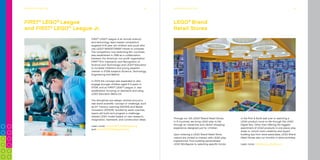
  • 23.
    Did you knowthat LEGO® bricks produced since 1958 are fully compatible with LEGO bricks produced today? 20COMPANy TIMELINE Did you know that the LEGO Group signed the United Nations Global Compact in 2003 as the first company in the toy industry? We are committed to embrace, support and enact United Nations’ directions within the areas of human rights, labour standards, the environment and anti-corruption. BuILdInG A BETTEr TOMOrrOW 24 Did you know that your brain is making use of the most critical skills for learning when playing with LEGO® bricks? Even when you build and rebuild with just a few bricks you stimulate more than 20 skills, supporting competences such as problem-solving, creativity, empathy, communication and collaboration. 30LEGO® COMMUNITIES The LEGO Group Aastvej 1 7190 Billund Denmark Tel.: +45 79 50 60 70 www.LEGO.com Learn more about the LEGO Group and LEGO Group activities at www.LEGO.com/aboutus