
Progress
Report 2012
The LEGO Group
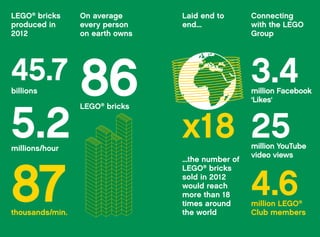
45.7billions
5.2millions/hour
87thousands/min.
86LEGO®
bricks
LEGO®
bricks
produced in
2012
Laid end to
end...
...the number of
LEGO®
bricks
sold in 2012
would reach
more than 18
times around
the world
Connecting
with the LEGO
Group
3.4million Facebook
‘Likes‘
25million YouTube
video views
x18
4.6million LEGO®
Club members
On average
every person
on earth owns
Introducing the LEGO Group
7	 The LEGO Group
14	 Sustainability – the LEGO®
way
29	 Letter from Jørgen Vig Knudstorp,
	 CEO of the LEGO Group
2012 Progress
38	Highlights
42	 The value of play and learning
47	 Respectful collaboration
The brick
59	 Playing safe – the safety of our bricks
73	 Sustainable parts – the environmental impact of
our bricks
Making LEGO®
play materials
91	 Sustainable production – reducing the impact of
making LEGO®
bricks
103	 Safe workplaces – the health & safety
of LEGO®
employees
109	 Smart people – smart products
– the LEGO Group and its people
Contents
Outside the LEGO Group
120	 In dialogue with the world
– how we listen and respond
135	 Issues in a global supply chain – our approach
149	 Playing it forward - supporting our communities
153	 Philanthropic outreach – access to quality play
and learning for children
Performance and compliance
165	Governance
172	 2012 performance data
182	 The LEGO Group’s policies, positions and
strategies
183	 About the report
185	 Assurance statement
188	 Global Reporting Initiative and United Nations
Global Compact compliance table
If you would like to read the LEGO Progress Report 2012 from a GRI perspective,
please go to Global Reporting Initiative and United Nations Global Compact
compliance table at page 188
Introducing
the LEGO
Group
The LEGO Group
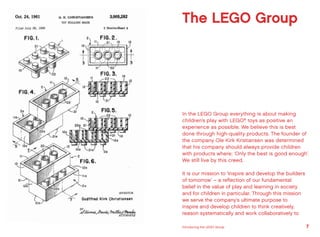
In the LEGO Group everything is about making
children’s play with LEGO®
toys as positive an
experience as possible. We believe this is best
done through high-quality products. The founder of
the company Ole Kirk Kristiansen was determined
that his company should always provide children
with products where; ‘Only the best is good enough’.
We still live by this creed.
It is our mission to ‘Inspire and develop the builders
of tomorrow’ – a reflection of our fundamental
belief in the value of play and learning in society
and for children in particular. Through this mission
we serve the company’s ultimate purpose to
inspire and develop children to think creatively,
reason systematically and work collaboratively to
7Introducing the LEGO Group
release their potential to shape their own future. As
a consequence of this it is natural for us to stand up
for, and ensure, children’s right to play.
The LEGO Group makes play experiences for
children of all ages
The range of products that the LEGO Group brings
to the market is very broad and varied, building
on the diversity, creativity and imagination of the
consumers we serve.
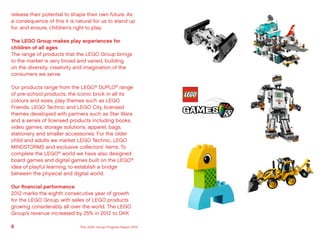
Our products range from the LEGO®
DUPLO®
range
of pre-school products, the iconic brick in all its
colours and sizes, play themes such as LEGO
Friends, LEGO Technic and LEGO City, licensed
themes developed with partners such as Star Wars
and a series of licensed products including books,
video games, storage solutions, apparel, bags,
stationery and smaller accessories. For the older
child and adults we market LEGO Technic, LEGO
MINDSTORMS and exclusive collectors’ items. To
complete the LEGO®
world we have also designed
board games and digital games built on the LEGO®
idea of playful learning, to establish a bridge
between the physical and digital world.
Our financial performance
2012 marks the eighth consecutive year of growth
for the LEGO Group, with sales of LEGO products
growing considerably all over the world. The LEGO
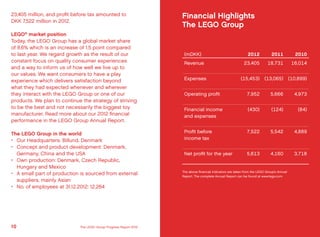
Group’s revenue increased by 25% in 2012 to DKK
8 The LEGO Group Progress Report 2012
23,405 million, and profit before tax amounted to
DKK 7,522 million in 2012.
LEGO®
market position
Today, the LEGO Group has a global market share
of 8.6% which is an increase of 1.5 point compared
to last year. We regard growth as the result of our
constant focus on quality consumer experiences
and a way to inform us of how well we live up to
our values. We want consumers to have a play
experience which delivers satisfaction beyond
what they had expected whenever and wherever
they interact with the LEGO Group or one of our
products. We plan to continue the strategy of striving
to be the best and not necessarily the biggest toy
manufacturer. Read more about our 2012 financial
performance in the LEGO Group Annual Report.
The LEGO Group in the world
•	 Our Headquarters: Billund, Denmark
•	 Concept and product development: Denmark,
Germany, China and the USA
•	 Own production: Denmark, Czech Republic,
Hungary and Mexico
•	 A small part of production is sourced from external
suppliers, mainly Asian
•	 No. of employees at 31.12.2012: 12,264
Financial Highlights
The LEGO Group
(mDKK) 2012 2011 2010
Revenue 23,405 18,731 16,014
Expenses (15,453) (13,065) (10,899)
Operating profit 7,952 5,666 4,973
Financial income
and expenses
(430) (124) (84)
Profit before
income tax
7,522 5,542 4,889
Net profit for the year 5,613 4,160 3,718
The above financial indicators are taken from the LEGO Group’s Annual
Report. The complete Annual Report can be found at www.lego.com
10 11The LEGO Group Progress Report 2012 Introducing the LEGO Group
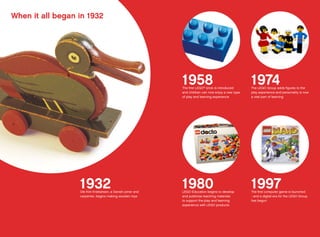
1932Ole Kirk Kristiansen, a Danish joiner and
carpenter, begins making wooden toys
When it all began in 1932
1974The LEGO Group adds figures to the
play experience and personality is now
a vital part of learning
1997The first computer game is launched
- and a digital era for the LEGO Group
has begun
1980LEGO Education begins to develop
and publicise teaching materials
to support the play and learning
experience with LEGO products
1958The first LEGO®
brick is introduced
and children can now enjoy a new type
of play and learning experience
Sustainability
– the LEGO®
way
In the LEGO Group we want to leave a positive
impact – for both our stakeholders and the wider
community. We are committed to caring for the
society that children will inherit and to inspire and
enable them to build the society of tomorrow.
This is how we describe our intent to integrate
sustainability in our business, namely as a core part
of our business strategy. Our efforts in support of
sustainability must be integrated in the way we run
our business – ‘the LEGO®
way’, where only the best
is good enough.
Our approach to sustainability grows out of Billund,
Denmark. This is where our founder Ole Kirk
Kristiansen set up his company and played an
important role in the town’s life and development
from a village of three houses and a general store
in the 1930s to a town of approximately 30,000
people today.
As the company grew out of a small, rural society, the
sense of community and obligation was there from
birth and inherited by all later generations. However,
as we become a global player in the toy industry,
and as stakeholder expectations and demands
increase, we understand that a more formalised
approach to corporate responsibility and citizenship
is necessary. This led to the LEGO Group signing
the United Nations Global Compact in 2003. The
LEGO Group strives to address its 10 principles, as
reflected in this progress report.
The LEGO Group’s promises
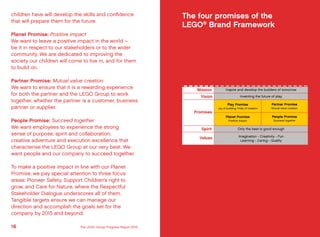
In 2008 we defined four key promises to our main
stakeholders. Now, and in the future, these set the
direction for everything we do when it comes to our
sustainability efforts and business in general.
The four promises as defined in the LEGO®
Brand
Framework:
Play Promise: Joy of building, Pride of creation
We want children of all ages to experience joy and
pride when exploring their creative potential with
our products and services. We want parents to be
certain that the playful learning experience their
14 15The LEGO Group Progress Report 2012 Introducing the LEGO Group
children have will develop the skills and confidence
that will prepare them for the future.
Planet Promise: Positive impact
We want to leave a positive impact in the world –
be it in respect to our stakeholders or to the wider
community. We are dedicated to improving the
society our children will come to live in, and for them
to build on.
Partner Promise: Mutual value creation
We want to ensure that it is a rewarding experience
for both the partner and the LEGO Group to work
together, whether the partner is a customer, business
partner or supplier.
People Promise: Succeed together
We want employees to experience the strong
sense of purpose, spirit and collaboration,
creative adventure and execution excellence that
characterise the LEGO Group at our very best. We
want people and our company to succeed together.
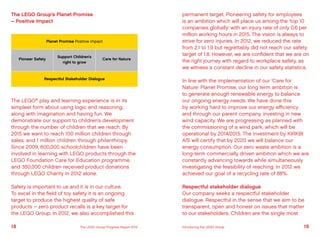
To make a positive impact in line with our Planet
Promise, we pay special attention to three focus
areas: Pioneer Safety, Support Children’s right to
grow, and Care for Nature, where the Respectful
Stakeholder Dialogue underscores all of them.
Tangible targets ensure we can manage our
direction and accomplish the goals set for the
company by 2015 and beyond.
The four promises of the
LEGO®
Brand Framework
Mission
Vision
Promises
Spirit
Values
Inspire and develop the builders of tomorrow
Inventing the future of play
Play Promise
Joy of building. Pride of creation
Planet Promise
Positive impact
Partner Promise
Mutual value creation
People Promise
Succeed together
Only the best is good enough
Imagination - Creativity - Fun
Learning - Caring - Quality
16 17The LEGO Group Progress Report 2012 Introducing the LEGO Group
The LEGO®
play and learning experience is in its
simplest form about using logic and reasoning,
along with imagination and having fun. We
demonstrate our support to children’s development
through the number of children that we reach. By
2015 we want to reach 100 million children through
sales, and 1 million children through philanthropy.
Since 2009, 600,000 schoolchildren have been
involved in learning with LEGO products through the
LEGO Foundation Care for Education programme,
and 350,000 children received product donations
through LEGO Charity in 2012 alone.
Safety is important to us and it is in our culture.
To excel in the field of toy safety it is an ongoing
target to produce the highest quality of safe
products – zero product recalls is a key target for
the LEGO Group. In 2012, we also accomplished this
Planet Promise Positive impact
Respectful Stakeholder Dialogue
Pioneer Safety Care for Nature
Support Children’s
right to grow
The LEGO Group’s Planet Promise
– Positive Impact
permanent target. Pioneering safety for employees
is an ambition which will place us among the ‘top 10
companies globally’ with an injury rate of only 0.6 per
million working hours in 2015. The vision is always to
strive for zero injuries. In 2012, we reduced the rate
from 2.1 to 1.9 but regrettably did not reach our safety
target of 1.8. However, we are confident that we are on
the right journey with regard to workplace safety, as
we witness a constant decline in our safety statistics.
In line with the implementation of our ‘Care for
Nature’ Planet Promise, our long term ambition is
to generate enough renewable energy to balance
our ongoing energy needs. We have done this
by working hard to improve our energy efficiency
and through our parent company, investing in new
wind capacity. We are progressing as planned with
the commissioning of a wind park, which will be
operational by 2014/2015. The investment by KIRKBI
A/S will certify that by 2020 we will balance our
energy consumption. Our zero waste ambition is a
long-term commercially driven ambition which we are
constantly advancing towards while simultaneously
investigating the feasibility of reaching. In 2012 we
achieved our goal of a recycling rate of 88%.
Respectful stakeholder dialogue
Our company seeks a respectful stakeholder
dialogue. Respectful in the sense that we aim to be
transparent, open and honest on issues that matter
to our stakeholders. Children are the single most
18 19The LEGO Group Progress Report 2012 Introducing the LEGO Group
important group for us to be in dialogue with. We do
this in various ways to learn everything we can about
their play wishes, expectations and ways of learning.
And part of our brand experience is interacting with
the brand and company as a customer, supplier or
employee. We work actively in ongoing relationships
with numerous toy industry associations, media, local
communities, interest groups and trade associations
to keep developing our company and the industry
towards making a greater positive impact. And we
take part in single-issue debates that we find to be
relevant for children and our products.
The issues that matter to our stakeholders
We know that each and every day – through our
products, services, play experiences and our
business operations – we have an impact on children.
We want this impact to be a positive one, leaving
children stronger and more resilient worldwide. As a
consequence, we in the LEGO Group must work with
issues that are material to our stakeholders. The eight
most material topics were arrived at using a five-step
evaluation of materiality linked to the stakeholder
engagement standard AA1000.
As part of our work to develop the second-generation
of our sustainability ambition, we are planning a new
process of engaging stakeholders to review the
material issues for the LEGO Group in 2013.
The eight most
material topics
•	product safety
•	the play and learning
experience children get from
our products, services and
operations
•	the play and learning
experience children get from
our product received through
philanthropy
•	employee safety
•	anti-corruption
•	respectful dialogue
•	climate change and
•	waste
20 The LEGO Group Progress Report 2012
Staying
sustainable
– an interview
with the owner
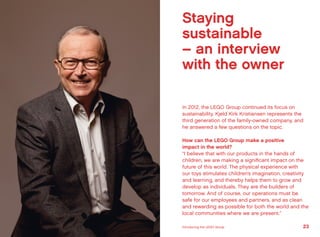
In 2012, the LEGO Group continued its focus on
sustainability. Kjeld Kirk Kristiansen represents the
third generation of the family-owned company, and
he answered a few questions on the topic.
How can the LEGO Group make a positive
impact in the world?
“I believe that with our products in the hands of
children, we are making a significant impact on the
future of this world. The physical experience with
our toys stimulates children’s imagination, creativity
and learning, and thereby helps them to grow and
develop as individuals. They are the builders of
tomorrow. And of course, our operations must be
safe for our employees and partners, and as clean
and rewarding as possible for both the world and the
local communities where we are present.”
23Introducing the LEGO Group
“The physical
experience
with our toys
stimulates
children’s
imagination,
creativity and
learning. They
are the builders
of tomorrow”
What will you do to aid this development as the
owner family?
“The LEGO values are deeply rooted in our company,
and we see it as our primary task to do everything
we can to ensure that they are still a fundamental
part of our culture. We also acknowledge that we
need to work in partnerships to deal with some of
the greater challenges that the world – and children
in particular – is facing. We will contribute with the
unique knowledge and experience we have: how
children learn and develop through play.”
Which sustainability issue do you think is the most
challenging for the LEGO Group?
“I’m truly pleased with our investments in renewable
energy and our approach to develop buildings
that can make a positive impact on society. Our
vision – to reach as many children all around the
world with LEGO experiences – must go hand in
hand with the sustainable growth of our business.
For me, maintaining and living out the LEGO values
and keeping employee motivation and consumer
satisfaction high, are a risk in a time of global growth.
I believe this could be a a potential challenge for
keeping our business sustainable in the future.”
25Introducing the LEGO Group
Playing with LEGO®
bricks
is about endless creativity
and possibilities
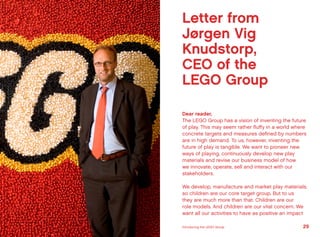
Letter from
Jørgen Vig
Knudstorp,
CEO of the
LEGO Group
Dear reader,
The LEGO Group has a vision of inventing the future
of play. This may seem rather fluffy in a world where
concrete targets and measures defined by numbers
are in high demand. To us, however, inventing the
future of play is tangible. We want to pioneer new
ways of playing, continuously develop new play
materials and revise our business model of how
we innovate, operate, sell and interact with our
stakeholders.
We develop, manufacture and market play materials,
so children are our core target group. But to us
they are much more than that. Children are our
role models. And children are our vital concern. We
want all our activities to have as positive an impact
29Introducing the LEGO Group
as possible on the world we live in today and the
planet that our children will inherit. This is reflected
in our efforts on the sustainability and responsibility
agenda. We believe that the most important
positive impact we as a company have is through
our products, services, play experiences, and the
quality and safety of our products is consequently
a key priority for the LEGO Group. Therefore, it is
satisfactory that 2012 was another year with zero
product recalls and a very strong outcome on our
Net Promoter Score, which expresses children’s and
adults’ excitement about the LEGO play experience.
In 2013 the new European Toy Safety Directive will
come into force. The LEGO Group fully supports high
safety standards, and we have spent considerable
resources in recent years to make sure that we
are fully compliant with the new and very detailed
requirements, especially within the area of chemicals.
In 2012, we also investigated the emergence of
new materials. Using the highest quality and safest
materials for our products will always be first
priority. At the same time we want to improve the
sustainability of the materials we use, and therefore
we are investigating a potential renewable solution
for our product material.
Our ambition is to use 100% renewable energy
sources by 2020, and our parent company’s
announcement in 2012, of an investment in wind
“We want all
our activities to
have as positive
an impact as
possible on the
world we live in
today and the
planet that our
children will
inherit”
30 31The LEGO Group Progress Report 2012 Introducing the LEGO Group
power, which will balance the expected future
energy consumption of the LEGO Group, is a very
important step in that direction. At the same time
it is also very encouraging that we continued to
improve our energy efficiency in 2012. Our very
ambitious target for work-related injuries was not
met in 2012. However, it is uplifting that we have
seen a positive development in workplace safety.
But as everything we do is based on our company
philosophy: ‘Only the best is good enough’, we will
continue to set and meet very ambitious goals, and
our results leave no room for complacency.
During 2013 we will be defining an updated overall
framework and strategy for all our sustainability and
responsibility efforts to update and replace our 2015
ambitions. We expect this work to be finished during
2013 in order for us to be able to put the strategy
into action from 2014/15. With this Progress Report,
we hold ourselves accountable to our stakeholders
and report on how we delivered on our sustainability
and responsibility targets in 2012. Our corporate
governance helps ensure that we also live up to
our commitment to the 10 principles of the UN
Global Compact. We signed the Compact in 2003
as the first company in the industry and continue to
support this initiative.
In 2012, our employees, management and the
third and fourth generation of the founding family
together celebrated the LEGO Group’s 80th
anniversary. It was always the ambition to run a
healthy business that behaved responsibly towards
all its stakeholders. We believe that creating value
for all our stakeholders is the only sustainable way
for us to thrive as an independent, family-owned
company. In our new framework and strategy for
sustainability and responsibility we aim to integrate
this mindset even further into the core operating
model of the company.
Jørgen Vig Knudstorp
32 33The LEGO Group Progress Report 2012 Introducing the LEGO Group
2012
Progress
Our purpose is to ‘Inspire
and develop the builders
of tomorrow’, and doing it
through play – children’s
most important work.
That it is how they learn,
develop and find meaning
in life. It is one of the most
natural and vital activities
in human life. And it is the
business we are in.
We believe that all children
in the world have the right
to play and learn with
products that are safe both
online and offline.
The LEGO®
brick has
qualities that allow you
to be artistic, scientific,
intuitive and deductive,
sensual and analytical all
at the same time. In a safe
environment, the bricks
provide play experiences
that make you comfortable
with uncertainty and able
to frame a problem. These
are the skills of those
who will build a better
tomorrow.
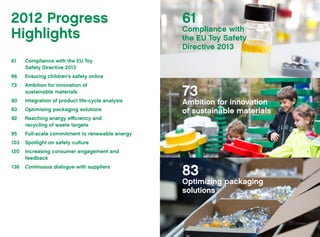
61	 Compliance with the EU Toy
Safety Directive 2013
66	 Ensuring children’s safety online
73	 Ambition for innovation of
sustainable materials
80	 Integration of product life-cycle analysis
83	 Optimising packaging solutions
92	 Reaching energy efficiency and
recycling of waste targets
95	 Full-scale commitment to renewable energy
103	 Spotlight on safety culture
120	 Increasing consumer engagement and
feedback
138	 Continuous dialogue with suppliers
2012 Progress
Highlights
61
Compliance with
the EU Toy Safety
Directive 2013
83
Optimizing packaging
solutions
73
Ambition for innovation
of sustainable materials
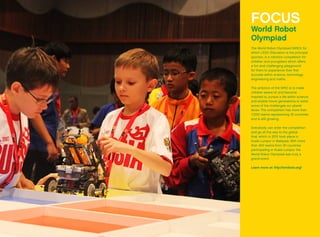
FOCUS
World Robot
Olympiad
The World Robot Olympiad (WRO), for
which LEGO Education is the principal
sponsor, is a robotics competition for
children and youngsters which offers
a fun and challenging playground
for them to experience their first
success within science, technology,
engineering and maths.
The ambition of the WRO is to make
children aware of, and become
inspired to, pursue a life within science
and enable future generations to solve
some of the challenges our planet
faces. The competition has more than
17,000 teams representing 35 countries
and is still growing.
Everybody can enter the competition
and go all the way to the global
final, which in 2012 took place in
Kuala Lumpur in Malaysia. With more
than 400 teams from 30 countries
participating in Kuala Lumpur, the
World Robot Olympiad was truly a
grand event.
Learn more at: http://wroboto.org/
The LEGO Group has a strong philosophy on play
and learning. It is part of our heritage and reflected
in our name, which is really an acronym covering two
Danish words LEg and GOdt, which translates as
‘play well’. To support the right to play as a universal
right for children comes without saying. Great
efforts are done in collaboration across the LEGO
Group including our department for educational
products and the LEGO Foundation including the
LEGO Learning Institute, which carries out academic
research in the field of play and learning. A part of
this work is our full support for the United Nations
Convention on the Rights of the Child. And as one
element of children’s right to play, we believe that all
children in the world have the right to play and learn
with products that are safe both online and offline.
The value of play
and learning
The LEGO Group and the LEGO Foundation
participate actively in supporting these
developments through a series of initiatives which all
come together to support our overall philosophy. The
next sections outline some examples.
To highlight a few we;
•	 are involved with UNESCO on “Strengthening the
Engagement of the Private Sector in Education”
•	 participate in OECD’s Innovative Learning
Environments programme
•	 work with the EU Commission for Education and
Culture to influence dialogue through panellists
•	 work with the Clinton Global Initiative committee
on Early Childhood Education
•	 are members of the Partnership for 21st Century
Skills in United States schools
•	 are members of the Global Business Coalition for
Education to promote access to education for all
and the right to quality learning experiences
•	 engage with Ministries of Education across
the world; influencing dialogue and providing
inspiration for the ministries in promoting more
playful learning environments for children
Improving childhood in partnership
It is a fact that childhood – and thereby the
possibilities of the individual child to develop to
its full potential and contribute meaningfully as
a global citizen – looks very different in different
locations of the world.
43The LEGO Group Progress Report 2012 2012 Progress42
Just consider a few facts, from UNESCO, such as:
•	 1 billion children are being deprived of one or
more services essential to their survival and
development
•	 51 million children are unregistered at birth,
leaving them without access to social security
and health care
•	 67 million children do not attend primary school
– a number which rises markedly for secondary
and tertiary schooling
These are huge global sustainability challenges
and one that the LEGO Group alone will have
difficulty addressing. It requires the concerted
effort of many parties in the public, private and
civil sectors. We recognise that the LEGO Group
can play a part in this effort, leveraging our
global brand and relationship with children in all
corners of the globe. By collaborating in relevant
partnerships we believe we can have a positive
impact on the child-rights situation.
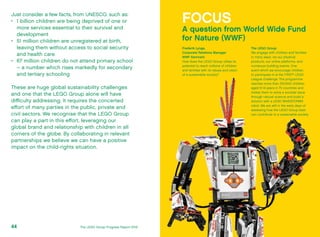
FOCUS
A question from World Wide Fund
for Nature (WWF)
Frederik Lynge,
Corporate Relations Manager
WWF Denmark:
How does the LEGO Group utilise its
potential to reach millions of children
and families with its values and vision
of a sustainable society?
The LEGO Group:
We engage with children and families
in many ways: via our physical
products, our online platforms, and
numerous building events. One
event which we encourage children
to participate in is the FIRST®
LEGO
League challenge. The programme
reaches more than 200,000 children
aged 9-14 years in 70 countries and
invites them to solve a societal issue
through natural science and build a
solution with a LEGO MINDSTORMS
robot. We are still in the early days of
assessing how the LEGO Group best
can contribute to a sustainable society.
The LEGO Group Progress Report 201244
We acknowledge the importance of the United
Nations Convention on the Rights of the Child,
and child rights are integrated in our ongoing
human rights impact assessment, in order for us to
understand and plan how we, as a business, can
best and most meaningfully support child rights
in the future.
We also support the Children’s Rights & Business
Principles, which through 10 principles encompass
the areas where a business potentially impacts
children’s rights, negatively as well as positively. We
support all 10 principles, however we want to focus
where our impact is greatest, and according to our
analysis this is:
Respectful
collaboration
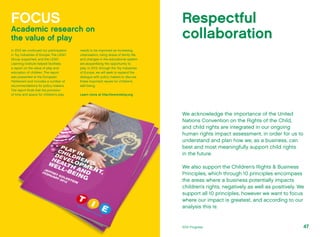
FOCUS
Academic research on
the value of play
In 2012 we continued our participation
in Toy Industries of Europe. The LEGO
Group supported, and the LEGO
Learning Institute helped facilitate,
a report on the value of play and
education of children. The report
was presented at the European
Parliament and includes a number of
recommendations for policy makers.
The report finds that the provision
of time and space for children’s play
needs to be improved as increasing
urbanisation, rising stress of family life,
and changes in the educational system
are jeopardising the opportunity to
play. In 2013, through the Toy Industries
of Europe, we will seek to expand the
dialogue with policy makers to discuss
these important issues for children’s
well being.
Learn more at http://www.tietoy.org
472012 Progress
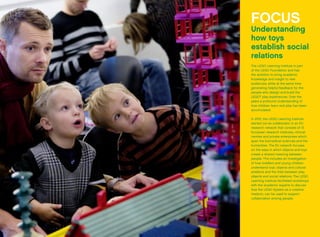
FOCUS
Understanding
how toys
­establish social
relations
The LEGO Learning Institute is part
of the LEGO Foundation and has
the ambition to bring academic
knowledge and insight to new
audiences, while at the same time
generating helpful feedback for the
people who design and build the
LEGO®
play experiences. Over the
years a profound understanding of
how children learn and play has been
accumulated.
In 2012, the LEGO Learning Institute
started out as collaborator in an EU
research network that consists of 13
European research institutes, clinical
centres and private enterprises which
span the biomedical sciences and the
humanities. The EU network focuses
on the ways in which objects and toys
create a shared meaning between
people. This includes an investigation
of how toddlers and young children
understand toys, objects and cultural
artefacts and the links between play
objects and social relations. The LEGO
Learning Institute facilitated workshops
with the academic experts to discuss
how the LEGO System as a creative
medium, can be used to support
collaboration among people.
a focus on children and children’s development,
learning and creativity.
One initiative was the LEGO Foundation’s donation
of LEGO Education Innovation Studio (LEIS)
and teaching courses to all schools in Billund
Municipality. The new specialist classroom gives
students an opportunity to work far more creatively
with problem solving, thereby bringing other skills
into the learning process. The knowledge and
experiences from the LEIS initiative will be shared
with other projects.
The LEGO Foundation will establish an international
kindergarten and school of top standards based on
the LEGO methodology, showcasing how this can be
applied in an institutional setting. The two facilities
will make it easier to attract both non-Danish
employees and Danish families to Billund. The school
will open in August 2013.
To give children and parents from across the world
a fun and informative insight into LEGO play, values
and history when visiting Billund, a new experience
centre is expected to be inaugurated in 2016. The
centre will combine academic knowledge about the
developmental aspects of play with the brick itself –
to enable children and their parents to see and feel
what LEGO play offers.
Principle 5: Ensure that products and services are
safe, and seek to support children’s rights through
them – through our strong product-safety focus.
Read more on page 61.
Principle 6: Use marketing and advertising that
respect and support children’s rights – where we
work to set high standards for our own marketing,
both offline and online. Read more on page 135.
Principle 7: Respect and support children’s rights in
relation to the environment and to land acquisition
and use. Read more on page 90.
Principles 1 and 10: Meet their responsibility to
respect children’s rights and commit to supporting
the human rights of children and reinforce
community and government efforts to protect and
fulfil children’s rights – where we collaborate with
UNICEF and Save the Children. Read more on page
45 and 151.
The Town of Billund, Denmark: Capital of Children
In 2012, the LEGO Foundation and Billund
Municipality founded the Capital of Children
Company to explore a unified vision to develop
Billund into a special place for, about and with
children – a Capital of Children. The town will
become a national as well as an international
gathering point for children – attracting
businesses, researchers and many others with
51The LEGO Group Progress Report 2012 2012 Progress50
FOCUS
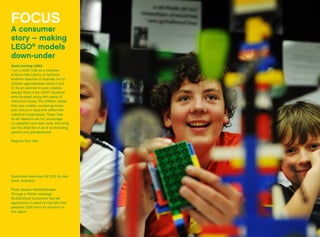
A consumer
story – making
LEGO®
models
down-under
Good morning LEGO,
I run a LEGO Club as a volunteer
at Mona Vale Library on Sydney’s
Northern Beaches in Australia. It’s for
children aged between about 3 and
12. It’s an exercise in pure, creative
energy! Most of the LEGO®
products
were donated, along with plenty of
instruction books. The children create
their own models, combining bricks
and colours in ways that reflect their
individual imaginations. These ‘free-
for-all’ sessions are fun, encourage
co-operation and team work, and bring
out the LEGO fan in all of us (including
parents and grandparents)!
Regards from Alan
(Submitted November 25, 2012, by Alan
Smith, Australia.)
Photo: Braden Fastier/Newspix
Through a Twitter campaign
(#LEGOstory) consumers had the
opportunity to submit a mail with their
personal LEGO story for inclusion in
this report.
The
brick
The LEGO Group has
promised to take the
lead in respect of safety
towards consumers.
This means working to
ensure that children can
always play safely with
LEGO®
products. That
promise makes product
safety a top priority for
both physical and digital
products.
In 2012 the LEGO Group’s
corporate reputation was
positioned as the 10th
best among companies
in the global survey by
Reputation Institute.
57The LEGO Group Progress Report 2012 The brick56
Indicator Product recalls (a
2012 dedication 0
2012 realisation 0
•	 Systematical risk assessment (mechanical and chemical)
in product development
•	 Systematic approach to identify potential product safety
risks and address by solid action plans
•	 Fast response to potential quality and product safety
issues reported by consumers
2013 roadmap •	 Proactive identification of risks
•	 Focus on early stages of product development
2013 target 0
With everything we do to make our products safe,
and the marketing of them appropriate for children,
we live up to our commitment to act where we can in
terms of children’s rights, in support of the Children’s
Rights and Business principles no 5. ‘Ensure
that products and services are safe, and seek to
support children’s rights through them’ and no 6.
‘Use marketing and advertising that respects and
supports children’s rights’.
The overall indicator used to monitor product safety
is the number of product recalls we perform in
a year. Since 2004 we have performed only two
product recalls. Again in 2012 we met our target
of zero product recalls, and this will also be our
target for 2013. In addition, we take the feedback
Playing safe
– the safety of
our bricks
Product safety
59The LEGO Group Progress Report 2012 The brick58
with mechanical testing of elements from the
start of production proper, and regular spot
checks are carried out during production with
both measurements and tests. In addition, normal
chemical tests are performed on raw materials. This
level of analysis goes beyond compliance with legal
requirements but is applied to ensure that only the
absolute safest and cleanest materials are used.
We believe that in setting the highest standard for
traceability, safety and performance of chemical
safety assessments, we ensure our compliance with
laws and regulations as well as industry standards
for the production of toys.
Having this deep knowledge of the raw materials we
use to make our products places the LEGO Group
in a stronger position when it comes to anticipating
or responding to changes in requirements from new
legislation, new scientific information, and when we
want to initiate and implement changes of our own.
Preparing for a new directive
One example is the chemical requirements from
the new European Toy Safety Directive, which will
come into effect in 2013. The new directive lays down
more stringent demands for materials and related
documentation, which we fully support.
The LEGO Group has interpreted the new Directive
in the strictest manner and significant resources
we get from hundreds of thousand of consumers
through our Net Promoter Score survey to find out
if consumers experience any safety-related issues
with the product. You can read more about this in the
section ‘In dialogue with the world – how we listen
and respond’ on page 122.
Starting at the very beginning
Our focus on product safety starts with the materials
we use. We work with raw-material suppliers and
approve materials based on our ingredients lists. To
our knowledge, this is unique in the toy industry. We
adopt the most advanced measures to manage the
chemistry and chemicals that go into making LEGO®
products and to minimise the risks to health and
environment that these chemicals present. And we
believe in producing high quality products that last
year after year, maybe for generations.
On top of the chemical safety assessment of the
materials used, all new LEGO elements will already
at the drawing board undergo a safety assessment
regarding mechanical/physical safety, electrical
safety, hygiene, and flammability. Only when an
element has been internally approved in the
assessment can it be used in a new LEGO product.
Assessment at the element level is only the first
step in an approval and control process that also
includes an entire safety assessment for each
new LEGO model. A toy safety report concludes
61The LEGO Group Progress Report 2012 The brick60
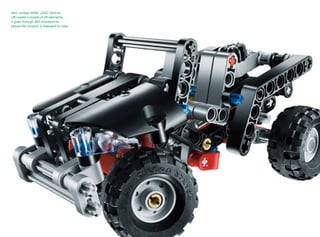
Item number 8066: LEGO Technic
Off-roader consists of 141 elements.
It goes through 443 checkpoints
before the product is released for sale.
have been spent on screening our material portfolio
and verifying compliance of every single substance
and each raw material. Our internal processes and
IT-systems allow us to be in complete control of the
detailed documentation that is linked to every single
LEGO product and the raw materials that have been
used to produce it.
A LEGO®
building set is not finally released for sale
to consumers until we have verified that all the
necessary test reports, certificates and approvals are
in place. To illustrate the amount of documentation
needed before a LEGO®
product is released to the
market, we can use a random item number 8066
which is the LEGO Technic Off-roader consisting of
141 elements. For this product our IT system monitors
443 checkpoints which all have to be confirmed
before the item receives the final internal approval
and is released for sale.
Our way of performing safety assessments at both
the element and model level has been in place for
many years but as a response to the new Directive
we have chosen to expand and refine it. In order
for our assessments to fully cover all possible
chemical aspects, the LEGO Group has invested
heavily in testing all raw materials, to reconfirm that
they contain only substances which are listed on
the ingredients lists which we have approved one
by one for every plastic resin, decoration ink, etc. To
make this possible we have expanded our team of
65The brick
chemical experts whose main task it is to evaluate
and communicate the list of ingredients we require
from all our suppliers of raw materials.
All LEGO®
play materials comply with all the
regulations in our many different markets, the
European and the US toy regulations being the two
of greatest significance. Our quality policy and our
ISO 9001 certified quality-management system forms
the basis for quality control and the continuous
monitoring we perform.
This is the LEGO®
way of ensuring that all our
building sets are safe in every respect and also of a
high and consistent quality which our customers and
consumers can always trust as – ‘Only the best is
good enough’.
Ensuring children’s safety online
Children spend more and more time playing online.
They see it as a natural extension of the physical
world and boundaries between the two are blurring.
As a consequence, our commitment to support
children’s right to protection and safety – as stated
in the Children’s Rights and Business Principles –
now also extends to the online world.
We expanded our focus on online safety in 2012.
We joined forces with the UK-based Safer Internet
Centre and celebrated the Safer Internet Day in
February, where the LEGO Group’s staff participated
in discussions with children and parents to better
understand the challenges and opportunities
experienced by them. Efforts like these are
fundamental for the LEGO Group to learn about the
realities a child’s life online brings with it.
We support and comply with the Federal Trade
Commission’s Child Online Privacy Protection Act
(COPPA) as well as articles of the 1989 United
Nation’s Children’s Rights Convention, stating,
amongst other rights, that children have the right to
participate in play and the right to protection. For
example, in accordance with COPPA rules, we do not
engage directly with children under the age of 13 on
third-party social media platforms, where we find we
cannot fully moderate and protect children.
67The LEGO Group Progress Report 2012 The brick66
FOCUS
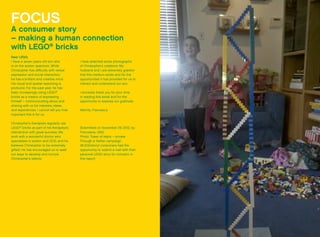
A consumer story
– making a human connection
with LEGO®
bricks
Dear LEGO,
I have a seven years old son who
is on the autism spectrum. While
Christopher has difficulty with verbal
expression and social interaction,
he has a brilliant and creative mind.
His visual and spatial reasoning is
profound. For the past year, he has
been increasingly using LEGO®
bricks as a means of expressing
himself – communicating about and
sharing with us his interests, ideas,
and experiences. I cannot tell you how
important this is for us.
Christopher’s therapists regularly use
LEGO®
bricks as part of his therapeutic
intervention with great success. We
work with a wonderful doctor who
specialises in autism and OCD, and he
believes Christopher to be extremely
gifted. He has encouraged us to seek
out ways to develop and nurture
Christopher’s talents.
I have attached some photographs
of Christopher’s creations. My
husband and I are extremely grateful
that this medium exists and for the
opportunities it has provided for us to
interact and understand our son.
I sincerely thank you for your time
in reading this email and for the
opportunity to express our gratitude.
Warmly, Francesca
(Submitted on November 29, 2012, by
Francesca, USA)
Photo: Tower of stairs – private
Through a Twitter campaign
(#LEGOstory) consumers had the
opportunity to submit a mail with their
personal LEGO story for inclusion in
this report.
Stay true to our promise
to leave a better world for
our children
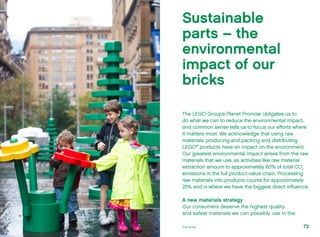
The LEGO Group’s Planet Promise obligates us to
do what we can to reduce the environmental impact,
and common sense tells us to focus our efforts where
it matters most. We acknowledge that using raw
materials, producing and packing and distributing
LEGO®
products have an impact on the environment.
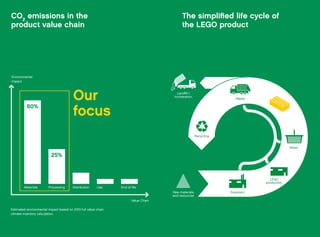
Our greatest environmental impact arises from the raw
materials that we use, as activities like raw material
extraction amount to approximately 60% of total CO2
emissions in the full product-value chain. Processing
raw materials into products counts for approximately
25% and is where we have the biggest direct influence.
A new materials strategy
Our consumers deserve the highest quality
and safest materials we can possibly use in the
Sustainable
parts – the
environmental
impact of our
bricks
73The brick
Distribution Use End of life
Value Chain
Environmental
impact
25%
60%
ProcessingMaterials
Our
focus
CO2
emissions in the
product value chain
Landfill /
Incineration
Suppliers
LEGO
production
Retail
Waste
Recycling
Raw materials
and resources
The simplified life cycle of
the LEGO product
Estimated environmental impact based on 2010 full value chain
climate inventory calculation.
75The brick
manufacture of our products, and that will always
be our first priority. As stated in our Planet Promise,
we want to make a positive impact. This goes for
the LEGO Group itself but we also work closely with
our supply chain to do the same. We are therefore
constantly on the lookout for product materials which
minimise the environmental impact.
The LEGO Group has a long-term ambition to use
only sustainable materials and investigate our use
of fossil fuels in relation to our products. The fact
of the matter is that it is a necessary ambition if
we are to stay true to our promise to leave a better
world for our children.
First steps
As a consequence, the LEGO Group will actively
engage in activities to ensure development of future
materials. We are exploring co-operation with both
large, established and smaller, cutting-edge material
suppliers with a view to developing partly and fully
bio-based materials which are suitable for LEGO®
products and production.
The present materials are carefully selected and
refined to perfection over the years regarding their
physical properties. These unique properties like
strength, durability, clutch power and color fastness
makes the building system possible and thereby
constitutes the basis for the overall LEGO®
experience.
Maintaining these properties in the LEGO®
bricks after
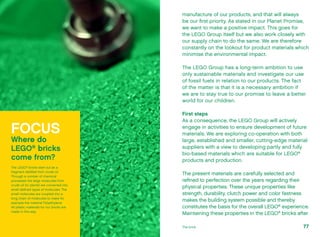
FOCUS
Where do
LEGO®
bricks
come from?
The LEGO®
bricks start out as a
fragment distilled from crude oil.
Through a number of chemical
processes the large molecules from
crude oil (or plants) are converted into
small defined types of molecules. The
small molecules are coupled into a
long chain of molecules to make for
example the material Polyethylene.
All plastic materials for our bricks are
made in this way.
77The brick
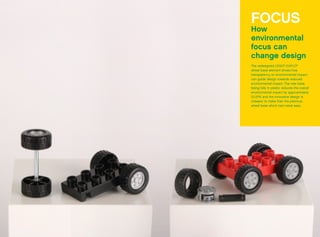
FOCUS
How
environmental
focus can
change design
The redesigned LEGO®
DUPLO®
wheel base element shows how
transparency on environmental impact
can guide design towards reduced
environmental impact. The new base
being fully in plastic reduces the overall
environmental impact by approximately
10-20% and the innovative design is
cheaper to make than the previous
wheel base which had metal axes.
a shift to an alternative material, makes the search
a real challenge. Maintaining these properties is a
prerequisite for the unique LEGO play experience.
Co-operative
Targets will be set to reduce material production’s
CO2
footprint. We will advocate an ambitious target
for reducing energy consumption (CO2
equivalence)
in the material value chain – from nature to brick.
The exact target will be defined together with
partners in this massive development project. The
sheer scope alone of such an effort makes it a
partnership-based effort. Many steps are involved
in covering the entire value chain from oil/plant to
the moulding machine, and the development of the
machinery and processes necessary to produce
plastic can best be tackled in co-operation. It may
also involve a number of different industries.
Taking environmental impact into account
Two full CO2
value chain assessments done in 2007/8
and in 2010/11 clearly show that material choice has a
big environmental impact. Raw material production is
not part of the LEGO Group’s operational boundaries,
and the direct influence is therefore limited. However,
the choice of product material is part of the design
process for the LEGO products and we have
developed two generic Life Cycle Assessment (LCA)
models to be used in development of packaging and
elements. The models are the starting point in making
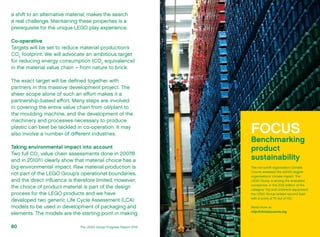
FOCUS
Benchmarking
product
sustainability
The non-profit organisation Climate
Counts assesses the world’s largest
organisations’ climate impact. The
LEGO Group is among the evaluated
companies. In the 2012 edition of the
category ‘Toy and children’s equipment’,
the LEGO Group ranked second best
with a score of 70 out of 100.
Read more at:
http://climatecounts.org
The LEGO Group Progress Report 201280
the environmental impact transparent to designers
thereby enabling evaluation of different choices.
Optimizing our packaging solution – making
smaller boxes from certified wood
After close dialogue and collaboration efforts
with some of our main stakeholders, the LEGO
Group will begin in 2013 to reduce the size of its
product packaging. This is in line with our life-cycle
analyses which show that packaging constitutes
approximately 15% of the environmental impact from
a full value-chain perspective.
Back in 2011 we began the work of gaining full
traceability of the fibre based raw material we use
for packaging materials in order to reduce the
environmental impact.
We focus on:
•	 Reducing the amount of packaging
•	 Using recycled fibre-based raw materials when it
is possible and on average at least 75%
•	 Securing sustainable sourcing via FSC certification
We are ahead of schedule with our implementation
and projections are that carbon emissions from the
product packaging will be reduced by 10% once
fully implemented. By implementing smaller boxes a
reduction of 18% of the cardboard used is achieved,
which is approximately 4000 tonnes a year. In line
with our target, we use and will continue to use on
FOCUS
18% reduction
in product
packaging
A substantial decrease in the size of
LEGO product packaging will take
effect in 2013, after a series of positive
pilot tests conducted in partnership
with retailers. Reducing the amount
of packaging by 18% by 2015 at the
latest has several advantages: less
environmental impact through savings
on materials and transport, consumers
can better handle the packaging, and
retailers have room for more items on
their shelves.
With most of the product range in
the new smaller boxes already on
shelves in 2013, an initial reduction of
about 12% has already been gained.
Reducing the size of boxes is a
fine balancing act – it must still be
relatively easy for LEGO employees
to pack the boxes. The actual LEGO®
bricks in the boxes will be the same,
providing the same quality building
and play experience as always.
83The brick
average a minimum of 75% recycled materials for our
primary LEGO box packaging.
Sourcing certified paper materials
In 2012 we arranged with our suppliers to begin
delivering the print and packaging we use for our
core products and large parts of our marketing
materials as wood based materials certified by the
Forest Stewardship Council (FSC). Specifically, the
print and packaging materials are based on fibres
from FSC, certified forests, reclaimed/recycled fibres
and fibres from FSC Controlled Wood. This is one
way we take on responsibility in the fight against
deforestation – helping to support children’s right to
a healthy environment.
By 2013 we aim for all print and packaging for core
LEGO®
products and the main part of all marketing
materials to be FSC certified, and we will begin to
label it as such by 2014. The ambition is that by 2015 all
paper used by the LEGO Group for printed materials,
packaging, building instructions, brochures and in
store materials will be FSC certified. At the same time,
the LEGO Group will impose the same requirement on
its partners producing licensed products.
FOCUS
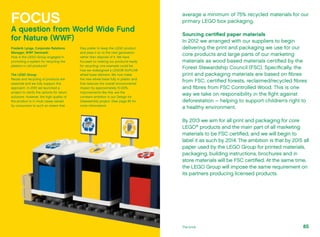
A question from World Wide Fund
for Nature (WWF)
Frederik Lynge, Corporate Relations
Manager, WWF Denmark:
How is the LEGO Group engaged in
promoting a system for recycling the
plastics in old products?
The LEGO Group:
Reuse and recycling of products are
essential and we fully support this
approach. In 2010 we launched a
project to clarify the options for return
solutions. However, the high quality of
the product is in most cases valued
by consumers to such an extent that
they prefer to keep the LEGO product
and pass it on to the next generation
rather than dispose of it. We have
focused on making our products ready
for recycling; one example could be
how we redesigned a LEGO® DUPLO®
wheel base element. We now make
the new wheel base fully in plastic and
that reduces the overall environmental
impact by approximately 10-20%.
Improvements like this, are the
constant ambition in our Design for
Disassembly project. (See page 80 for
more information).
85The brick
Making LEGO®
play materials
The builders of tomorrow
deserve that we do what
we can to mitigate climate
change. In the LEGO Group
we acknowledge that
our activities contribute
to man-made climate
change, and we dedicate
projects and resources to
contribute to protecting
children’s right to live in a
healthy environment both
now and in the future.
This is in line with principle
no. 7: Respect and support
children’s rights in relation
to the environment and
to land acquisition and
use, in our commitment to
the Children’s Rights and
Business Principles.
89The LEGO Group Progress Report 2012 Making LEGO® play materials88
LEGO®
products are manufactured mainly at our own
four sites around the world as we believe it makes
sense to produce where we use. With a global, yet
regionally founded, production setup we stay close
to our markets and reduce our environmental impact
as we reduce our transportation. Our locations are
certified according to the environmental standard
ISO 14001, and global as well as local initiatives are
applied to reduce the environmental impact of our
production processes.
Our main focus is on energy efficiency and waste.
Our target is to gain a 2.5% energy efficiency
improvement year on year towards 2015. Our
ultimate, long-term aspiration is to have zero waste
which we are progressing towards, and in 2013 we
want to reach a rate of 90% recycling.
Sustainable
production –
reducing the
impact of making
LEGO®
bricks
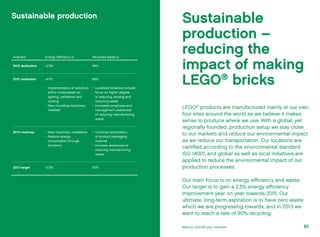
Indicator Energy Efficiency (x Recycled waste (z
2012 dedication +2.5% 88%
2012 realisation +4.1%
•	 Implementation of solutions
within compressed air,
lighting, ventilation and
cooling
•	 New moulding machinery
installed
88%
•	 Localized ­initiatives include
focus on higher degree
of reducing, reusing and
recycling waste
•	 Increased ­employee and
management awareness
of reducing manufacturing
waste
2013 roadmap •	 New machinery installation
•	 Reduce energy
consumption through
insulation
•	 Continue optimization
of product packaging
material
•	 Increase awareness of
reducing manufacturing
waste
2013 target +2.5% 90%
Sustainable production
91The LEGO Group Progress Report 2012 Making LEGO® play materials90
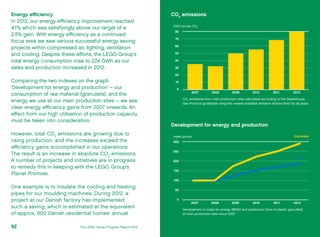
1000 tonnes CO2
80
70
60
50
40
30
20
10
0
2007
2007
2008
2008
2009
2009
2010
2010
2011
2011
2012
2012
Index points Granulate
Energy
300
250
200
150
100
50
0
Development in index for energy (MWh) and production (tons of plastic granulate)
at main production sites since 2007.
CO2
emissions from main production sites calculated according to the Greenhouse
Gas Protocol guidelines using the newest available emission factors fixed for all years.
Energy efficiency
In 2012, our energy efficiency improvement reached
4.1% which was satisfyingly above our target of a
2.5% gain. With energy efficiency as a continued
focus area we saw various successful energy saving
projects within compressed air, lighting, ventilation
and cooling. Despite these efforts, the LEGO Group’s
total energy consumption rose to 224 GWh as our
sales and production increased in 2012.
Comparing the two indexes on the graph
‘Development for energy and production’ – our
consumption of raw material (granulate), and the
energy we use at our main production sites – we see
clear energy efficiency gains from 2007 onwards. An
effect from our high utilisation of production capacity
must be taken into consideration.
However, total CO2
emissions are growing due to
rising production, and the increases exceed the
efficiency gains accomplished in our operations.
The result is an increase in absolute CO2
emissions.
A number of projects and initiatives are in progress
to remedy this in keeping with the LEGO Group’s
Planet Promise.
One example is to insulate the cooling and heating
pipes for our moulding machines. During 2012, a
project at our Danish factory has implemented
such a saving, which is estimated at the equivalent
of approx. 600 Danish residential homes’ annual
CO2
emissions
Development for energy and production
93The LEGO Group Progress Report 2012 Making LEGO® play materials92
electricity consumption. In 2013, the project will be
expanded to an additional factory.
Breaking the old mould
Moulding of bricks is where the majority of our
energy consumption takes place. In view of this,
we initiated a machine optimisation project in 2012,
which on selected bricks will enable faster and
more efficient production hereby, reducing energy
consumption. In 2013 it is planned to install the new
moulding machines. Further installation of machines
is expected to happen progressively towards 2015.
Full-scale commitment to renewable energy
In early 2012, KIRKBI A/S, the holding and investment
company of the Kirk Kristiansen family which owns
75% of the LEGO Group, committed to a substantial
investment in renewable electricity through the
development of an offshore wind farm in Germany.
The investment demonstrates commitment from
the LEGO Group to deliver its Planet Promise,
making a positive impact, and reaching its target of
using 100% renewable energy by 2020. When fully
operational the wind farm will go a long way to help
us meet our 2020 renewable target.
Our future footprint
The LEGO Group currently expects to continue
expanding its global manufacturing footprint. Further
focus on climate change is therefore a central part of
the sustainability strategy process that will run in 2013.
95Making LEGO® play materials
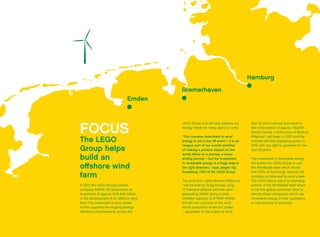
Emden
Bremerhaven
Hamburg
FOCUS
The LEGO
Group helps
build an
offshore wind
farm
In 2012 the LEGO Group’s parent
company KIRKBI A/S announced an
investment of approx. EUR 400 million
in the development of an offshore wind
farm. The investment in wind power
further supports the ongoing energy
efficiency improvements across the
LEGO Group and will help balance our
energy needs for many years to come.
“This massive investment in wind
energy is not a one off event – it is an
integral part of our overall ambition
of making a positive impact on the
world. We’re on a journey, a never
ending journey – but the investment
in renewable energy is a huge step in
the right direction,” says Jørgen Vig
Knudstorp, CEO of the LEGO Group.
The wind farm called Borkum Riffgrund
1 will be built by Dong Energy using
77 Siemens offshore turbines each
generating 3.6MW giving a total
installed capacity of 277MW. KIRKBI
A/S will own one third of the wind
farm’s production of electric power
– equivalent to the output of more
than 25 wind turbines and equal to
the consumption of approx. 100,000
Danish homes. Construction of Borkum
Riffgrund 1 will begin in 2013 and the
turbines will start supplying power in
2015, with the right to generate for the
next 25 years.
The investment in renewable energy
will qualify the LEGO Group to use
the WindMade label which shows
that 100% of the energy used by the
company is balanced by wind power.
The LEGO Group was a co-founding
partner of the WindMade label which
is the first global consumer label to
identify those companies which use
renewable energy in their operations
or manufacture of products.
Making green money from plastic
waste in production
In the production facility in Billund, Denmark, LEGO®
employees made a test with a container full of
already discarded plastic waste, which showed that
more than 60% of what was in the container could
be recycled. This led to new signage and waste
collection areas making it easy to sort the plastic.
Saving 60% of the waste which was previously sent
for incineration will help the LEGO Group towards
the goal of recycling all waste and will generate
substantial savings on the cost of handling waste.
Working towards generating no waste
Our approach is firstly to try and reduce the amount
of waste we generate, and then reuse any waste
material where possible, and finally recycle almost
everything that is left. As a result, zero waste is our
long term ambition and one which we continue to
make progress on.
In 2013 the LEGO Group will initiate a detailed
assessment that will not only identify the sources of
waste but also the necessary steps to eliminate our
waste generation. At the same time we will increase
our recycling target to 90% in 2013. We believe that
a sustainable approach to our business will have
a positive impact on the environment and our key
stakeholders.
Water usage
In 2012, the increase in the LEGO Group’s production
meant that we used a total of 279,000 m3 of water.
In the LEGO Group we acknowledge that water
is a constrained resource and one of the most
important to protect because access to water is
directly linked to access to drinking water and to
continuously ensuring food safety around the world.
Water usage is an area that we will investigate in
more depth to better understand and assess where
to focus our future efforts.
99The LEGO Group Progress Report 2012 Making LEGO® play materials98
FOCUS
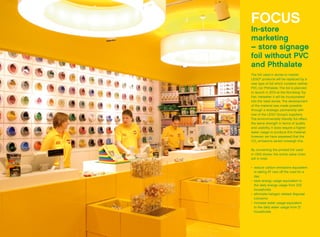
In-store
marketing
– store signage
foil without PVC
and Phthalate
The foil used in stores to market
LEGO®
products will be replaced by a
new type of foil which contains neither
PVC nor Phthalate. The foil is planned
to launch in 2013 at the Nürnberg Toy
Fair. Hereafter it will be incorporated
into the retail stores. The development
of the material was made possible
through a strategic partnership with
one of the LEGO Group’s suppliers.
The environmentally friendly foil offers
the same strength in terms of quality
and usability. It does require a higher
water usage to produce this material,
however, we have assessed that the
CO2
emissions saved outweigh this.
By converting the printed foil used
in 1300 stores, the entire value chain
will in total:
•	 reduce carbon emissions equivalent
to taking 57 cars off the road for a
day
•	 save energy usage equivalent to
the daily energy usage from 202
households
•	 eliminate halogen related disposal
concerns
•	 increase water usage equivalent
to the daily water usage from 21
households
Safe workplaces
– the health &
safety of LEGO®
employees
Safety is a top priority for the LEGO Group, both for
our consumers and for the people who work for and
with us. We are relentlessly committed to finding
new ways of working and to continuously improve
our performance and culture in relation to health
and safety.
A safer place to work – changing behaviour
In 2012 we maintained our ambition of being
acknowledged as one of the top companies in the
world for employee safety by 2015. Our injury rate
was 1.9 injuries per million working hours, down from
2.1 in 2011. This undertaking has been a result of
decisive internal efforts throughout the organisation.
Regrettably, this was above our 2012 target of 1.8. In
order to improve we continue to advocate and apply
Indicator Injury rate (h
2012 dedication 1.8
2012 realisation 1.9
•	 Greater focus on reducing the Brand Retail store injury rate
•	 Improved identification and implementation of best
practices
•	 Continue to unify safety policies at all sites
2013 roadmap •	 Strengthen the corporate safety culture through behavior
and awareness initiatives
•	 Reinforce the global presence of the Global EHS team
•	 Document safety procedures and ensure global usage
2013 target 1.5
Work safety
103The LEGO Group Progress Report 2012 Making LEGO® play materials102
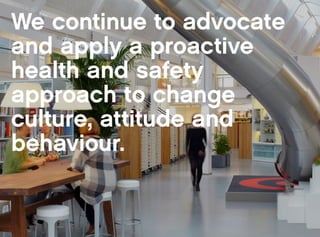
We continue to advocate
and apply a proactive
health and safety
approach to change
culture, attitude and
behaviour.
a proactive health and safety approach to change
culture, attitude and behaviour.
In 2012 we continued to strengthen our Global
Environment Health and Safety Community to secure
localised knowledge and be able to share and
implement it globally, so best practices can raise the
overall capability of the organisation.
In continuation of our strides to make the LEGO
Group the safest workplace possible we are looking
to identify new areas and ways to build sustainable
health and safety behaviour in the organisation.
Having improved employee safety hugely in the
manufacturing areas over the past few years, we see
further improvement to be mainly through awareness
campaigns and training programmes to raise the
health and safety awareness of the employees in
offices and in our own Brand Retail stores.
No major non-conformities
In 2012, we had no major Environment, Health and
Safety non-conformities registered at our external
certification audits. Having put a spotlight on our
Billund facility after we received nine major non-
conformities in 2011, we are very pleased that our
dedicated employees have solved these matters
and that we saw no major non-conformities in 2012.
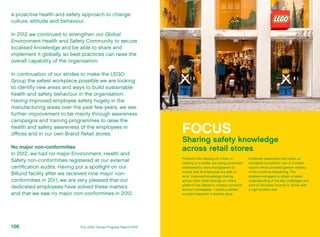
FOCUS
Sharing safety knowledge
across retail stores
Problems like slipping on a floor or
twisting on a ladder are being proactively
addressed by store management to
ensure that all employees are safe at
work. Improved knowledge sharing
across retail stores through an online
platform has helped to embed corrective
actions immediately – before a similar
accident happens in another store.
Employee awareness has meant an
increased completion rate of incident
reports which provides greater visibility
of the incidents happening. This
enables managers to obtain a better
understanding of the key challenges and
work to eliminate hazards in stores with
a high incident rate.
The LEGO Group Progress Report 2012106
Employee safety is a first priority for the LEGO
Group and it is a core part of our culture. As well
as providing a strong safety culture, the company
wants to have satisfied and motivated employees.
In 2012 we measured the Employee Net Promoter
Score and were glad to get the feedback from our
employees and a score of 56%.
Employee motivation and satisfaction
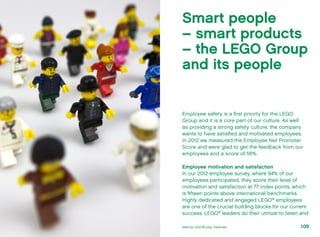
In our 2012 employee survey, where 94% of our
employees participated, they score their level of
motivation and satisfaction at 77 index points, which
is fifteen points above international benchmarks.
Highly dedicated and engaged LEGO®
employees
are one of the crucial building blocks for our current
success. LEGO®
leaders do their utmost to listen and
Smart people
– smart products
– the LEGO Group
and its people
109Making LEGO® play materials
react to employees’ feedback, and it is our long-term
target to provide a workplace which our employees
value 10 index points ahead of our benchmarks.
The high score in motivation, satisfaction and
engagement is related to our values, culture and
reputation, according to our employees. Across
the world, our employees said that having an
extraordinary job with exciting tasks and great
colleagues, while working for a company with a
strong culture and values, is what fuels motivation
more than anything else.
Attracting the right people
In 2012 the number of employees in the LEGO
Group increased by 1474 to a total at 12,264 and in
the next few years we expect to welcome around
5,000 new colleagues. In order to sustain our
growth and high level of motivation, it is important
that all new colleagues understand and live our
unique LEGO culture. Therefore, we strengthened
the integration of new employees in 2012 with a
pre-boarding web site and through assigning a
personal Brickmate to each new employee to help
the new starter get the best possible introduction.
Surveys show that employee motivation and
engagement after the first 100 days is high.
Attracting new employees requires spotlighting
the LEGO Group as an attractive workplace and
its employer value proposition. The LEGO Group
Indicator Motivation and satisfaction (l
Employee Net
Promoter Score (k
2012 dedication +10 62%
2012 realisation +15
•	 An extraordinary daily job,
and immediate leaders
who are responsive and
dedicated
•	 Continued to build
company values, culture
and reputation
56%
•	 Implementing and adapting
to major organizational
changes
2013 roadmap •	 Make motivation and
engagement an ongoing
agenda point for leadership
decisions
•	 Maintain high level of
motivation and satisfaction
in the company overall
•	 Leverage potential of
strategic clarity, culture and
new ways of working to
increase share of company
ambassadors
•	 Strengthen follow up
dialogue and actions from
the employee survey
2013 target +10 62%
Employee engagement
111The LEGO Group Progress Report 2012 Making LEGO® play materials110
FOCUS
Providing a
hands-on/
minds-on
approach
to Chinese
schools
Since 2010, the LEGO Foundation
has worked with partners in China to
distribute boxes with LEGO®
or LEGO®
DUPLO®
bricks to kindergartens
and primary schools, as well as
training teachers and students from
a university in the LEGO learning
methodology.
The purpose – and challenge – of
the project is to make more room for
creative and playful learning in the
Chinese educational system. The
outcome so far has been positive, as
of 2012 more than 100,000 children
have had access to the materials and
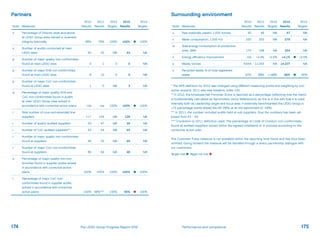
approximately 1000 teachers have
been trained. Teachers have been
genuinely interested, and the schools’
very accommodating.
is recognised in several countries as a top 100
employer of choice and was in 2012 acknowledged
as one of the Top 100 Most in Demand Employers by
the professional networking site LinkedIn.
Compensating and rewarding a global workforce
From 2012 our implemented Reward Framework
provides employees with market based reward
packages linked to performance in line with local
standards whilst supporting the LEGO Group’s
performance culture. Employee benefits are
benchmarked against local practices, however,
we work on a global benefits strategy to provide
direction in principle on which benefits are enforced
to reflect the LEGO Group’s values and culture.
Cultural and gender diversity
In 2012 the LEGO Group recruited 11% more women
to higher level leadership positions (Directors and
above), bringing the total percentage to 34 and above
our target of 30%. It indicates that recruitment in the
LEGO Group is moving in the right direction to meet
our ambitions with regard to gender diversity at this
level. Our target for 2013 is to recruit 30% or above.
In the LEGO Group we want our employees to reflect
the variety of society in general with regards to
culture, backgrounds and way of thinking. And we
believe that through a focus on diversity in respect of
culture and gender we strengthen our organization,
products and our relationships to our stakeholders.
The LEGO Group Progress Report 2012112
In 2012 our Corporate Management consisted of
male employees from six different nationalities. To
gain a more diversified composition is a stepwise
process for such a high level decision body, but the
current composition is found unsatisfactory. To drive
forth the agenda, a dedicated team with our CEO as
chairman has taken the initiative to spearhead the
diversity agenda with a hands-on approach.
Across the world,
our employees
said that having
an extraordinary
job with exciting
tasks and great
colleagues, while
working for a
company with a
strong culture and
values, is what fuels
motivation more
than anything else.
115Making LEGO® play materials
Outside the
LEGO Group
In the LEGO Group we
acknowledge that we are
only a small company in
a big world. However, we
want to have the most
fruitful dialogue with those
people and organisations
who we believe can
positively empower
children, those we call the
‘Builders of Tomorrow’.
We engage with everybody
outside the LEGO Group
who can help to improve
our products and advocate
our standpoints – in line
with our promises to work
for the right to play, to
care for nature, to make
safe toys, to support the
development of creativity
and problem solving
abilities, and to do this in a
respectful way that creates
value for both society and
the LEGO Group.
119The LEGO Group Progress Report 2012 Outside the LEGO Group118
The very first thing we as the LEGO Group must do
is to listen to our stakeholders, only then can we
respond appropriately. Through listening and actively
engaging in dialogue we can hope to positively
influence the global issues that affect children and
the LEGO Group and its products.
Talking to consumers and hearing what they say
We want to give all our consumers a quality play
experience and also to find out how satisfied they
are. And we believe that producing high quality
products which last year after year, maybe for
generations, while bringing children endless hours of
fun, is the best way to achieve this. When consumers
are satisfied with us, they will return, buy again, and
tell their friends. Therefore, we focus our efforts on
In dialogue
with the world
– how we listen
and respond
Indicator Net Promoter Score (c
Consumer complaint
call rate (b
2012 dedication 102 index <=550
2012 realisation 105 index
•	 Extremely successful
new product lines and
improvement of the Shop
at Home post purchase
experience
•	 Focus on delivering
exceptional service and
proactively communicating
across business areas to
escalate and solve issues
792
•	 New call centre in Asia
enable more consumers to
get in contact with us
•	 Increase in average amount
of elements per box deems
more service calls
•	 US consumers call
consumer service more
often than other regions
2013 roadmap •	 Improve overall shopping
experience
•	 Extend the LEGO.com
experience across digital
devices
•	 Improve our online
consumer service
•	 Optimize monitoring and
analysis of consumer call
trends
•	 Faster, quarterly
deployment of corrective
actions
2013 target 105 index <=900
Consumer satisfaction
121The LEGO Group Progress Report 2012 Outside the LEGO Group120
FOCUS
Making play possible for
refugee children
Serbia hosts the largest number of
refugees in Europe (70,000) and over
200,000 internally displaced people. In
collaboration with the United Nations
High Commissioner for Refugees, the
LEGO Foundation has reached more
than 11,000 children at 245 locations
throughout Serbia by donating 600
boxes of play material.
All children had multiple benefits from
this donation, both immediate and long-
term. Playing with LEGO®
bricks helped
them learn through interaction, taught
them how to share and learn from each
other, underpinned their communication
and manual skills, as well as built
on the children’s reasoning, which
includes matching, comparing and
other activities. This will also enhance
socialising between refugee and
displaced children with their domestic
peers, and thus facilitate their integration
into their immediate surroundings, which
is a good basis for their inclusion in the
local community later.
improving the consumer experience. To measure
consumer satisfaction we use the recognised
indicator Net Promoter Score®
(NPS).
In 2012, more than 625,000 consumers gave us
feedback, which is an increase of 25% from 2011,
with the resulting Net Promoter Score reaching an
index of 105. We exceeded our target due to our
team of exceptionally dedicated service employees
all over the world who continue to provide superior
consumer service, the keen excitement around our
product lines, and improved experiences in LEGO.
com content and shop areas.
One way we also listen to our consumers is through
a series of specialised call centres. Since 2005
we have collected, analysed and categorised the
feedback we receive to detect a pattern and drive
business decisions and actions to designate main
areas for improvement.
Using social media to reach the world of consumers
Our social media presence is growing rapidly, and
in 2012 we reached more than 3.4 million fans on
Facebook – and some weeks reaching more than 25
million people worldwide through campaigns. In 2012
the LEGO Group launched a new YouTube channel,
dedicated to delivering cool LEGO®
experiences to
families worldwide. The new channel has already had
more than 25 million views. The most seen video of
2012 was “The LEGO Story” with more than 3.2 million
123Outside the LEGO Group
views. For our corporate communication we have
approximately 50,000 followers on Twitter and 38,000
on Google+. The LEGO®
CUUSOO crowd sourcing
platform reached more than 500,000 unique monthly
visitors and the user generated ideas have so far
resulted in four new consumer LEGO products.
The LEGO Group as partner and collaborator on
regulations and standards
Where appropriate, the LEGO Group assists
governments and organisations in the development
and understanding of new toy regulations and
standards. We strive to ensure that our external
activities, discussions and recommendations
benefit all stakeholders and are conducted in a
transparent and professional manner in accordance
with our policies.
In 2012 the LEGO Group’s toy safety experts
visited Hong Kong and China in the company of
European Commission representatives, to explain
the new EU Toy Safety Directive and the supporting
new European safety standards to Chinese toy
manufacturers, authorities and test laboratories.
The LEGO Group also assisted the EU Commission
in elaborating guidelines for the interpretation
of the new Toy Safety Directive. We also work
collaboratively in the US with the Consumer Product
Safety Commission to share safety compliance
practices that can be adapted for small businesses.
With more than 3.2 million views
“The LEGO Story” was the most
seen video on The LEGO Group’s
YouTube channel in 2012.The LEGO Group Progress Report 2012124
FOCUS
A backpack full
of LEGO®
toys
Travelling the world as a LEGO®
employee, I know always to have
something with me to play with – and
our latest trek in Vietnam was no
different. One day, walking through the
beautiful valleys we approached a tiny
village on a hillside.
Quickly a group of children gathered
around us and helped us the last few
meters to a house where we could
spend the night. The owner had two
kids aged 6-8 years old. We showed
our appreciation and gave the children
a small box of LEGO®
bricks, and
not long after they found out how
to master the toy and assembly the
model. More children gathered around
and now they all shared the fun.
A wonderful vacation and remarkable
to see how children with no previous
knowledge could adapt and learn the
skills.
Story submitted internally by Lonnie
Almy, project supporter, Billund,
Denmark.
We also take an active part in the development of
new toy safety standards in the European Committee
for Standardisation, the International Organisation for
Standardisation, as well as in the US standardisation
organisation, ASTM International. The LEGO Group
has a long history of chairing both European and
international standardisation committees and
participating in many industry work groups.
We expanded our dialogue efforts with regulators
in 2012, to advocate intellectual property rights, toy
safety and marketing to children, as these are key
issues for the LEGO Group, the LEGO®
brand and
our products. On an ongoing basis we participate
in international and regional associations such as
the Toy Industries of Europe, the US Toy Industry
Association, the European brand organisation, and
the World Federation of Advertisers. In Europe alone,
we are active members of 15 Toy Associations and
in nine countries the LEGO Group is on the board of
the toy association.
In 2012, the LEGO Group had many stakeholder
visitors and answered numerous questionnaires;
however we were unable to accommodate a request
by the International Consumer Research and Testing
(IRCT) to visit two facilities. All information requested
by the IRCT has been provided. We welcome all new
visits and questions and we will be as open and
transparent as our operations allow.
FOCUS
A social media protest
At the beginning of 2012 the LEGO
Group experienced a campaign
against LEGO®
Friends, our new
product envisioned to have an appeal
towards girls. Approximately 62,000
people signed a petition asking us
to market the same products equally
towards boys and girls.
Parents across the world thought we
were launching a LEGO®
experience
that was less creative than
products we market
for boys. After the
product came out,
families with girls
realised that LEGO®
Friends
products contain just the same
number of bricks and building
complexity as a comparable
product in, for example, the LEGO®
City product line. Having cleared
up this misunderstanding, we were
able to continue the constructive
dialogue online with both parents and
the activist movements behind the
criticism. Their input has helped and
inspired us to develop products and
marketing which will bring greater
creative construction play to girls in
the future.
The LEGO Group Progress Report 2012128
The LEGO Group
advertisement from
France 2012 by Grey
Translation:
Top left: “Their creativity
will make you forgive
anything”.
Bottom right: “Are
you ready to forgive
anything?”
Boundaries for marketing to children
Knowing as much as we do about children and
play can present us with a dilemma when trying
to influence children to wish for a LEGO®
product.
We do our utmost to communicate the genuine
play experience children can expect from a LEGO®
product. However, when communicating with children,
we are sensitive to the fact that children may
perceive marketing messages differently from adults.
In 2012 we reviewed our internal principles and
our corporate standard on marketing to children
together with key internal marketers. Our support
in 2012 to Media Smart, a UK originated Media
Literacy Programme, led to the development of the
‘Digital Adwise Parent Pack’ to help parents and
children identify and understand the adverts and
commercial material they collectively encounter in
the online world. You can find the material at
http://www.mediasmart.org.uk/
Overall we work actively to ensure that our marketing
is conducted responsibly and lives up to our
stakeholders’ expectations. An example would
be how we work to integrate the Children’s Rights
and Business Principles no. 6 ‘Use marketing and
advertising with respect and support children’s
rights’ in our daily marketing approach.
FOCUS
A question from UNICEF
Bo Viktor Nylund, Senior Advisor,
Corporate Social Responsibility,
Private Fundraising and Partnerships
Division, UNICEF:
You have introduced a product for
girls recently. It is very positive that the
report relates to concerns raised from
customers in this regard. But, how do
your products in general support equal
play and life opportunities for boys
and girls?
The LEGO Group:
We always aim to listen carefully to
our customers, and we introduced
LEGO®
Friends to add more choice for
children. Research shows that girls as
well as boys are interested in creative
construction play – historically, however,
we have failed to attract many girls. ­
We therefore invited some of these girls
to tell us what would be an interesting
setting for them, if they were to play with
construction toys – the development of
LEGO®
Friends was the direct result of
this participatory process.
We aim to include as many children
as possible in construction play, and
are therefore pleased to have reached
even more children, mostly girls, this
time. The road is now open for them to
discover other of our diverse products,
all available for children of both sexes
– we know that e.g. Harry Potter and
LEGO®
City have been very popular
among girls.
133Outside the LEGO Group
As a global company we face global issues and
challenges. We depend on the partnerships we have
with our many global partners. In fact, we have made
them a promise that requires us to have mutual
benefit for our co-operation. Through our approach
we want to play an active part in improving the
wellbeing for all employees in our supply chain as
this helps protect our company’s strong reputation.
Approach based on human rights
The LEGO Group experiences a growing expectation
from society in general and from Non Governmental
Organisations that we elevate the promotion of
internationally acknowledged human rights. We fully
support this expansion, as we recognise that we
impact upon a wide range of human rights through
Issues in a global
supply chain
– our approach
135Outside the LEGO Group
our business activities. As evidenced throughout
this progress report, the LEGO Group is already
protecting and supporting human rights in many ways.
Examples are children’s right to play, and the rights of
employees to a safe and healthy work environment.
We find that dealing with human rights in a business
context is a massive task with wide-ranging aspects
and dilemmas, which is why we began developing
a human-rights strategy in 2011. A key component
of the strategy process is a human-rights impact
assessment of our value chain. The impact
assessment will lead to a list of potential risks and
leadership opportunities, which in turn will direct our
human-rights strategy to where the LEGO Group can
have a positive impact. We expected the work to be
finalised and adopted in 2012. However, it has proved
a more complex task than we foresaw and we have
decided to take the time needed to do it right. We
estimate the work will be completed in 2013.
Our Code of Conduct
As a part of our human rights profile, we encourage
our suppliers and business partners to respect
their employees’ human rights, including providing
them with decent working conditions. Since 1997
we have required that our suppliers and business
partners sign our Code of Conduct. In order to follow
their performance and continuous improvement,
we monitor compliance via independent on-site
audits – and we engage in proactive co-operation
Indicator
Major Code of Conduct non-conformities
at suppliers solved (t
2012 dedication 100%
2012 realisation 90%
•	 More stringent follow-up procedures
•	 Less flexibility regarding extension of deadlines
2013 roadmap •	 Continuous focus on working hours
•	 Capacity building with suppliers
2013 target 100%
Code of Conduct
137The LEGO Group Progress Report 2012 Outside the LEGO Group136
and capacity building of our suppliers to promote
sustainable supply chains. In 2012 we reviewed
our own audit management system resulting in an
improved alignment of processes globally.
The LEGO Group had 70 core-line suppliers located
in high-risk and intermediate-risk countries with
possible human rights issues in 2012. During the year
we performed 44 audits at these facilities.
With a resolution rate for 2012 at 90%, we did not
succeed in resolving our target of 100% of major
non conformities found at our suppliers. While we
are adamant that they will be solved, we prioritise
openness and integrity in the dialogue over simple
timeline compliance. For example, we missed our
2012 target because we extended the deadline for
compliance for five findings, but in doing that we
were able to reach a satisfactory solution for two of
them already in January 2013. Furthermore we
had to terminate our co-operation with one supplier
in Asia due to lack of willingness to solve the issue.
We believe in capacity-building of suppliers as the
best way to make progress and avoid copying past
mistakes to new parts of the world. We also find it
equally important to be willing to take the tough
decisions and cease a partnership if no progress is
possible – even if it comes at a cost to business.
FOCUS
A spotlight on working
hours in China
Working conditions at our suppliers
in China continues to be a focus area
for us and we do whatever possible
to build capacity and be transparent.
The Pearl River delta where most of
our Chinese suppliers are situated
is currently struggling with labour
shortages. This combined with even
more competition due to the slowdown
of the global economy means, the
issue seems to be as important as
ever. We also find that migrant workers
want to work more in order to support
their families and not be away from
home any longer than necessary.
In 2012 our commitment to safe
and good working conditions was
strengthened. We issued a new
Code of Conduct which we will be
implementing now and in the years
ahead. Our requirement of a maximum
working week of 60 hours has been
made more explicit as well as our
commitment to proper remuneration.
The full code is available on our
website.
The LEGO Group Progress Report 2012138
Child labour must not be engaged in or benefited from.
Forced or compulsory labour must not be used or
benefited from.
Physical punishment, threats of violence or other
forms of mental or physical coercion or abuse must
not be used.
Employees must at a minimum be paid the local
minimum wage for a standard working week, or the
industry benchmark, whichever is higher.
The rights of the employees to choose to be a
member of a trade union and to bargain collectively
as permitted by local laws and regulations must not
be interfered with or restricted.
Discrimination, directly or indirectly, in hiring and
employment practices on grounds of race, colour,
sex, language, religion, political or other opinion,
age, national, social or ethnic origin, property, sexual
orientation, birth or other status must not be engaged
in or supported.
Code of Conduct
highlights
In 2012 we developed a working hours control tool
and we also seek to solve social issues by improving
the effectiveness of our suppliers through a more
LEAN manufacturing process. Better utilisation of
the production hardware improves the business of
our supplier and allows them to adjust, for example,
working hours.
The 2012 edition of the Code of Conduct
In 2012, the fifth edition of the LEGO Group’s Code
of Conduct was published. It features a stronger
emphasis on ensuring that our suppliers live up
to the highest local legislation and international
standards and recommendations from, for
example, United Nations and International Labour
Organisation (ILO).
The Code also extends and formulates more precise
requirements towards our sub-suppliers and ensures
that all employees, including migrant workers and
other vulnerable populations such as home-workers,
are secured a respectable work environment. One
example is the requirement that no worker works
more than 60 hours a week.
As an addition to the 2012 Code of Conduct all
suppliers should set specific targets in relation to
environmental improvements and set specific targets
to drive down waste, energy usage and emissions,
alongside recycling products and embedding new
environmental friendly technologies.
141The LEGO Group Progress Report 2012 Outside the LEGO Group140
With all our suppliers we strive to actively engage
and implement the fifth edition of our Code of
Conduct. However, we do expect full implementation
to be adopted in stages in some of the human rights
high risk countries we operate in. To enforce our
position we will leverage the influence we have to
seek the needed progress.
Responsible Code of Conduct for
Outbound Licensing Partners
The LEGO Group requires all of its licensing partners
to provide written assurance that their vendors
comply with the LEGO Group Code of Conduct. In
2012 we made sure that licensing partners and their
vendors audit their suppliers in risk countries on an
annual basis. This is the same requirement we have
towards our own suppliers.
Collaborating with the industry – ICTI Care Process
In 2012, the LEGO Group had 14 suppliers certified
by the ICTI Care Process in Asia. The LEGO Group
has access to the audit reports and reviews them
continuously. Should there be any major non-
conformities with the LEGO Group standards, the
LEGO Group will contact the suppliers and, if relevant,
conduct on-site inspection to check if corrective
action is implemented. Also in 2012 the ICTI Care
Process announced that from 2013 they will launch a
more ambitious seal which factories can obtain only
if they adhere to a 60 hour working week, although
allowing up to 66 hours of overtime in a twelve week
period per year. The LEGO Group was pleased to
witness this necessary progress as this is closer
to alignment with the LEGO Group requirements.
The LEGO Group has been committed to the ICTI
(International Council of Toy industries) Care Process
since 1 January 2006 (Date Certain commitment).
Whistle-blower – a way to speak up
Our whistle-blower infrastructure gives employees the
opportunity to report behaviour they consider to be in
violation of the guidelines that safeguard the integrity
and policies of the LEGO Group, as well as any law
or regulation. Employees decide whether he or she
wants to be anonymous. All reports are sent directly to
the LEGO Group’s General Counsel. Employees can
communicate in their local language and guidance
text is available in our five company languages. The
existence of the whistle blower infrastructure has been
communicated in articles on our intranet, as part of
an E-learning program mandatory for all Directors and
levels above, and a handbook on business conduct
is given to all employees as part of introduction in
Denmark. The whistle blower link can be accessed by
employees from the front page of our intranet.
Business Integrity
Doing business in most countries of the world
we need to respond to the issue of widespread
corruption. According to the United Nations Global
Compact, corruption adds 10% to the cost of doing
business. We see those resources as a missed
143The LEGO Group Progress Report 2012 Outside the LEGO Group142
chance to invest in children’s opportunities and
future. In addition, corruption obstructs children’s
right to have access to social services such as
schooling and health care.
In 2012 100% of all employees at Director level
and above completed our biennial e-learning
training programme in business integrity. Additional
employees working directly with customers and
suppliers have completed the training programme.
The training programme explains the LEGO Group’s
position on several business conduct areas, e.g.
bribery, antitrust and facilitation payments.
Competition compliance
It is imperative for the LEGO Group that its business
operations reflect real and full compliance with
relevant competition laws. Violation of competition
laws would let children, their parents and our
customers down, and could also severely
compromise the public reputation of the LEGO
Group and expose it to costly and time-consuming
investigations and litigation. Further, significant fines
could result from violations of competition rules, and
the company could even face additional claims for
damages from customers and competitors.
Share operational knowledge
– partners in production
With some strategic partners within our operation,
we maintain an open book principle to enable
benchmarking of the financial costs related to
production. Through this we are able to compare
our internal production cost globally and share
key insights with partners on optimisation of the
manufacture expenditure. The openness allows us
to better understand the supplier’s pricing model
and work with them on the fixed, semi fixed and fully
variable costs thereby giving both partners a more
focused way of reviewing the overall costs.
Tax and other economic impacts
Tax is a major aspect of business in the community.
On the wider agenda, the economic impact of our
business on society is based on the direct and
indirect employment and associated money flows,
including tax paid. In 2012 the corporate tax bill for
the LEGO Group was DKK 1,909 million, which implies
an effective tax rate of 25.4%.
145The LEGO Group Progress Report 2012 Outside the LEGO Group144
FOCUS
Engaging with licensing partners
Through a licensing partnership,
a Chinese based manufacturer
produced a series of LEGO®
licensed books at their facilities. An
independent undercover investigation
by ‘Students & Scholars Against
Corporate Misbehavior group’
(SACOM) reported a malpractice in
regards to working practices at the
facility, which is a breach to the LEGO
Group’s Code of Conduct.
The audit process had identified
similar concerns and engagement
with the partner to solve the issues
at hand has been prioritised. The
manufacture of the licensed product
has now been moved to another
facility complying with the LEGO
Group’s Code of Conduct.
Subsequent to the SACOM report, an
extended audit looked into the culture
of the manufacturer, because if a
business and its partnerships are to
be sustainable, a compatible ethical
culture must be in place. This has
contributed to the creation of evolved
social accountability programmes that
look to root causes and acknowledge
the responsibilities and influences
along the entire supply chain.
Responsible purchasing means
using your spend in a way that
supports and impacts cultural, social
and workplace change. We ensure
suppliers that we will support their
development, and we are constantly
refining the tools available to do this.
However, it is made clear that there
will be commercial consequences
if the supplier continues to be non-
compliant. The supplier in question
has responded positively by improving
their working culture and practices,
and is actively engaged in an on-going
process of improvement. This social
accountability programme will be
rolled out to all suppliers.
All licensing partners must comply with
the Code of Conduct and audit their
suppliers on an annual basis.
An integrated part of our corporate citizenship is
nurturing and supporting communities that are
affected by the LEGO Group’s activities. From the
local community hosting our production facilities, to
the community of people caring for the LEGO®
brand
and playing with LEGO®
play materials, to the global
community, the LEGO Group has an important part
to play as an advocate for children.
To engage locally, value creation is key for both
the recipient and the LEGO Group, in the form of
building relationships and developing partnerships
as part of our employer branding. We are proud
of the many activities and ideas our company and
products inspire but, we also see a need for more
transparency in our engagement with stakeholders,
Playing it forward
– supporting our
communities
149Outside the LEGO Group
and more opportunities for generating value through
synergies. To achieve this, we are currently revising
our strategy for our local community engagement,
to focus on more opportunities for collaboration
and to strengthen the relationships and community
presence we have already developed.
FOCUS
Local community engagement
in Kladno, Czech Republic
The contribution from the LEGO Group
helped to build non-barrier access to
the grammar school in Kladno which
allows disabled kids on a wheelchair
to attend classes. Furthermore, the
cooperation between the LEGO Group
and the charity organisation Drop of
Hope and Dr. Claun helped to make
the time children spent in the hospital
a bit more fun.
The LEGO Group Progress Report 2012150
Engaging with the community under the LEGO®
brand is to a very large extent carried out through a
number of foundations set up by the Kirk Kristiansen
family over time; the primary one in terms of
outreach being the LEGO Foundation.
In 2012, the total value of donated products and
financial support from the LEGO Foundation, LEGO
Charity and the family foundations was DKK 148
million. In collaboration with international partners such
as UNHCR, UNICEF, Save the Children, Médicins Sans
Frontiéres, Danish Church Aid and the Danish Refugee
Council, the LEGO Foundation donated 21,030 LEGO
Charity boxes and 36,470 LEGO sets which reached
children in more than 90 countries around the world,
from Guatemala and Ghana to Malaysia and Moldova.
Philanthropic
outreach –
access to quality
play and learning
for children
153Outside the LEGO Group
The LEGO Foundation
The LEGO Foundation was founded in 1986, and it
holds 25% of the LEGO Group shares. The activities
are based on the belief that all children should have
access to quality play and learning experiences.
The LEGO Foundation has a goal of creating impact
by inspiring and developing children and youth to
become active citizens – and to empower them
to create a better future for themselves – through
fun, creativity and high quality learning. This is done
through programmes such as LEGO Charity, Care for
Education and Care for LEGO Local Communities.
Since 2009, 600,000 students have been involved
in learning with LEGO®
product through the LEGO
Foundation Care for Education programme, and
350,000 children received product donations through
LEGO Charity in 2012 alone.
The work of the LEGO Foundation is based on the
LEGO®
Brand Framework and like the LEGO Group, the
LEGO Foundation’s mission is to “Inspire and develop
the builders of tomorrow”. Through product donations,
grants, education support, teacher education and
research, LEGO products and hands-on learning
experiences are made accessible to children all over
the world, irrespective of their social status.
Programmes under the LEGO Foundation: LEGO Charity
The aim of LEGO Charity is to donate LEGO®
products to underprivileged children around the
world. LEGO Charity supports everything from
minor projects where passionate individuals bring
happiness and creative play to local children, to
long-term projects in co-operation with partners
such as United Nations High Commissioner for
Refugees and Save the Children.
All LEGO Charity products are packed by LEGO®
employees or retirees, who are now doing valuable
voluntary work. Over five years ago the first retirees
volunteered for what began as packing Christmas
presents for children at Danish hospitals. It has now
grown to involve more than 175 retired employees,
which each pack LEGO Charity boxes twice a
month. We are very proud to have such dedicated
retired staff.
In 2012 LEGO Charity packed 21,030 Charity boxes
and donated 76,650 LEGO sets and comfort bags
that spread joy and play to children all over the
world. A LEGO Charity box contains eight to ten kilos
of either LEGO elements or LEGO DUPLO®
elements.
Care for Education
This LEGO Foundation programme supports
children from preschool age up to senior high
school and combines product donations with
training for teachers and child-care workers in the
LEGO learning philosophy – System for Learning.
The programme supports development and
improvement of kindergartens, schools and school
155The LEGO Group Progress Report 2012 Outside the LEGO Group154
FOCUS
A play-break for
underprivileged
Filipino children
At the beginning of 2012, the American
non-profit organisation, Project
PEARLS, received a donation from
LEGO Charity of six LEGO®
Play
boxes and six LEGO®
DUPLO®
Play
boxes. The organisation provides
help to children in the Ulingan slum
community of Manila. Activities include
distributing food, providing medical
assistance and education. The Ulingan
community counts about 400 families.
The LEGO®
bricks are now used
in Project PEARLS’ Brain Booster
Programme. The programme runs
every Saturday and 150-200 children
take part. The activity provides the
children with a play-break from their
everyday and an opportunity to learn
skills. Volunteers teach the children
to read, write and count. They offer to
help with homework and the children
can cut, glue and draw – and now also
build, play and learn with LEGO®
bricks.
systems. Key to this is giving the tools to provide
a form of education which motivates children
to become involved students, capable of and
interested in becoming active members of society.
The programme supports projects in various
countries from Mexico to Ukraine, China, Brazil, India
and South Africa. Care for Education works closely
with local ministries of education, NGOs, foundations
and private enterprises. In addition to products and
training, the programme supports research and
organisational development.
Care for Education also aims at supporting after
school activities such as FIRST LEGO League or
World Robotic Olympiad competitions. In 2012, around
200 teams of youngsters were supported through
product donations, coaching and travel grants so they
too could join these popular robotic competitions. A
special effort is made to collaborate with IT companies
like American National Instruments to secure quality
coaching for some of these teams and help them to
eventually get on a path to higher education.
The LEGO Group Progress Report 2012158
FOCUS
Crazy Divas
robotic adventure
For the last four years, the LEGO Foundation
and the UBS Optimus Foundation have
helped improve access to education for
children in the whole Atteridgeville township
(a community of 250,000 inhabitants near
Pretoria). However, it became clear that when
the students exit the primary school after 7th
grade, they also leave the project and their
talents are no longer nurtured going forward.
So the local LEGO Foundation partner,
Hands on Technologies (HOT) set up a
resource center in the township offering
robotic after-school classes. The first
resource center was opened in April 2012 as
a small pilot hosting 40 children, and soon
after teams which would compete in the
national World Robotic Olympiad (WRO) were
formed – one of them being ‘the Crazy Divas’
– a team of three girls.
These three girls showed so much talent,
enthusiasm and passion that they managed
to finish second on the WRO competition in
South Africa. This is a remarkable achievement
for three teenage girls who got their first LEGO
MINDSTORMS experiences just five months
before. Sponsored by the LEGO Foundation,
the Crazy Divas went to the international WRO
event in Malaysia in November 2012. Leaving
their country for the first time, the three Divas
travelled all the way to Kuala Lumpur with
a high level of excitement and motivation.
Competition was tough and though they did
not win, they fought with bravery and smiles all
the way as they faced teams from all over the
world. The Crazy Divas loved every minute of
their experience and the ability to represent
their community and promised themselves
to practice and keep learning – so they can
return and win.
Performance
and
compliance
162 163Performance and complianceThe LEGO Group Progress Report 2012
The LEGO Group is owned 75% by KIRKBI A/S and
25% is owned by the LEGO Foundation through an
investment company. KIRKBI A/S is the holding and
investment company of the Kirk Kristiansen Family.
Operating responsibly and according to good
governance is a major priority for the LEGO Group.
Good governance in a family-owned company
Corporate governance exists to ensure that
directors act in the owners’ interest. In the LEGO®
context, the separation of owners’ interests from that
of the directors is less of an issue, as the owners
are on the Board of Directors and close to the day
to day business. Therefore, the LEGO Group has
adopted the governance standards to make sense
in the context of family ownership that employs
Governance
165Performance and compliance
a professional management team and has an
independent Board of Directors.
Since the establishment of the LEGO Group in
1932, the company has been privately owned by
the Kirk Kristiansen family. Our approach to good
corporate governance is focused on combining
the strengths and benefits of being privately
owned with good corporate governance for listed
companies. A benefit associated with being
privately owned by few family owners include
having owners close to the business with strong
industry knowledge and strong values, which can
be inspiring and supporting for the development of
the company and the employees. Other benefits of
family ownership are the ability to have long-term
focus and to move fast and be agile in response to
changes in the business environment.
Board of Directors
The LEGO Group’s Board of Directors consists of
seven members. Three of these are considered
dependent on the company; two due to ownership
of KIRKBI A/S, and one due to being in the
management of the parent company, KIRKBI
A/S. The Chairman and three other members are
considered to be independent.
As a family-owned business, it is important to
maintain a professional management of the company,
including a strong and competent board of directors.
The LEGO Group has a decade-long practice of
electing the Chairman from among the independent
board members. The owners work to ensure
professional board management, including the
definition of required board competencies to ensure
a diverse and complementary composition of the
board, regular board self-assessments, competitive
compensation paid to the board of directors, and
clear and specific rules on the mandate for each of
the management bodies in the LEGO Group.
Furthermore, as a family-owned company, the LEGO
Group is more exposed to the risks involved in
the handover from one generation to the next. To
mitigate this risk, a plan has been prepared and
implemented that secures high involvement of the
next generation of the family owners in company
matters related to the ownership.
Corporate Management
The LEGO Group Management Board and Corporate
Management team, consist of 22 members
organised in three main areas: Operations, Marketing
and Business Enabling.
The LEGO Group Management Board consists of the
President and Chief Executive Officer, Jørgen Vig
Knudstorp, the Chief Financial Officer, John Goodwin,
the Chief Operating Officer, Bali Padda and the Chief
Marketing Officer, Mads Nipper. The Management
Board reports to the Board of Directors.
166 167Performance and complianceThe LEGO Group Progress Report 2012
Corporate Management (CM)
M
anagement Board (M
B
)
Operati
ons Mar
keting
Business
Enabling
CEO
Product
Group1
ProductGroup2Europe
Am
ericas
&
Pacific
Asia & Emerging
Markets
Innovation
& Consumer
Marketing
C
orporate
Affairs
Corporate
Finance
Corporate
IT
Executive
HREurope Moulding
& Europe DUPLO
ValueChain
innovation
Engineering
&
Q
uality
Procurement
AmericasManufacturing
EU Packing
ShopperMarketing &
Channel Dev.
SupplyChain
Planning&
Distribution
Organisational structure The Group Management Board together with 18 Senior
Vice Presidents forms the Corporate Management,
which is the LEGO Group’s daily management
body. The cross-functional nature of Corporate
Management facilitates collaboration, quick decision-
making and clear authority delegation.
Corporate Compliance Board
The LEGO Group also has a Corporate Compliance
Board which is the highest decision board with
respect to non-compliance issues in the LEGO
Group.
The Corporate Compliance Board reviews that:
•	 external regulation is observed in the LEGO
Group;
•	 corporate policies and standards are developed
in accordance with the strategic direction, position
and values of the LEGO Group, as well as external
regulation;
•	 non-compliances to external regulation and
corporate policies and standards are addressed;
•	 ethical issues are addressed in the spirit of the
LEGO®
brand and values and relevant guidance
for the organisation is available.
The decision making members are the CFO
(Chairman), the General Counsel and the head
of Corporate Affairs. The board has an explicit
obligation to report to the Board of Directors on
compliance matters.
168 169Performance and complianceThe LEGO Group Progress Report 2012
Creating value with four promises
The LEGO Group has a strong focus on ensuring
the balance between the value created for the
owners, and value creation for the remaining
stakeholders of the company such as consumers,
employees, customers and other partners. The
owner family’s business philosophy is that creating
value for the company’s stakeholders will also
result in long-term value creation for the owners.
The LEGO®
Brand Framework, including its four
promises to various stakeholder groups, supports
this thinking, and therefore is the core foundation
for how we do business.
Policies
The LEGO Group has a framework of 12 corporate
policies, which all provide position and guidance
on issues. For example our Responsibility Policy
ensures that our spirit and company values are not
compromised. Our Health and Safety Policy helps
to ensure that all our activities are planned and
executed in accordance with sustaining a healthy
and safe working environment.
Please see an overview in the section ‘The LEGO
Group’s policies, positions and strategies‘ on page 184.
170 The LEGO Group Progress Report 2012
2012
Performance
Data
Consumers
Note Measures
2010
Results
2011
Results
2012
Targets
2012
Results
2013
Targets
a Number of product recalls 0 0 0 0 0
b Consumer complaint call rate 779 623 <=550 792 <=900
c Net Promoter Score Index®
120 120 102* 105 105
Employees
Note Measures
2010
Results
2011
Results
2012
Targets
2012
Results
2013
Targets
1, d Number of employees 9,843 10,790 N/A 12,264 N/A
1 Female 48.6% 47.4% N/A 47.4% N/A
1 Male 51.3% 52.6% N/A 52.6% N/A
Average age 36.5 36.4 N/A 36.3 N/A
2, f Rate of employee turnover 9.3% 8.1% N/A 8.8% N/A
e,j Director level and above promotions
­(externally recruited or internally
­appointed) of female employees 32% 23% >=30% 34% >=30%
g Sick leave 2.2% 2.1% <=2.3% 1.9% 2.2%
3 Number of injuries with absence 44 36 N/A 37 N/A
h Injury rate 3.0 2.1 <=1.8 1.9 <=1.5
i Absence rate due to injuries 0.29 0.35 <=0.20 0.18 <=0.14
m Work-life range to global scorecard +4 +6 +0 +6 +0
l Motivation and satisfaction +12 +14 +10 +15 +10
k Employee Net Promoter Score** 60% 62% 62% 56% 62%
172 173Performance and complianceThe LEGO Group Progress Report 2012
Partners
Note Measures
2010
Results
2011
Results
2012
Targets
2012
Results
2013
Targets
n Percentage of Director level and above
at LEGO Group sites trained in business
integrity biennially 98% 79% 100% 100% 100%
o Number of audits conducted at main
LEGO sites 20 20 N/A 23 N/A
p Number of major quality non-conformities­
found at main LEGO sites 5 1 0 0 N/A
p Number of major EHS non-conformities
found at main LEGO sites 8 10 0 0 N/A
p Number of major CoC non-conformities
found at LEGO sites 1 0 N/A 3 N/A
q Percentage of major quality, EHS and
CoC non-conformities found in audits
at main LEGO Group sites solved in
accordance­with corrective action plans n/a n/a 100% 100% 100%
r Total number of core and extended line
suppliers 117 154 N/A 139 N/A
r Number of quality audited suppliers 33 47 N/A 32 N/A
r Number of CoC audited suppliers*** 33 54 N/A 44 N/A
r Number of major quality non-conformities­
found at suppliers 26 33 N/A 20 N/A
r Number of major CoC non-conformities
found at suppliers 66 64 N/A 46 N/A
s Percentage of major quality non-con-
formities found in supplier audits solved
in accordance with corrective action
plans 100% 100% 100% 100% 100%
t Percentage of major CoC non-
conformities­found in supplier audits
solved in accordance with corrective
action plans 100% 98%**** 100% 90% 100%
Surrounding environment
Note Measures
2010
Results
2011
Results
2012
Targets
2012
Results
2013
Targets
u Raw materials, plastic, 1,000 tonnes 42 49 N/A 57 N/A
v Water consumption, 1,000 m3 220 225 N/A 279 N/A
w Total energy consumption at production
sites, GWh 174 198 N/A 224 N/A
x Energy efficiency improvement n/a +2.4% +2.5% +4.1% +2.5%
y Waste, tonnes 9.644 11.055 N/A 14.237 N/A
z Recycled waste, % of total registered
waste 87% 88% <=88% 88% 90%
* The NPS definition for 2012 was changed using different measuring points and weighting by con-
sumer impacts. 2011 was new baseline, index 100.
** In 2012, the Employee Net Promoter Score is reported as a percentage (reflecting how the metric
is fundamentally calculated as %promoters minus %detractors), as this is in line with how it is used
internally both as Leadership target and focus area. If externally benchmarked the LEGO Group is
+72 percentage points ahead the EEI (56% vs an EEI benchmark of -16%).
*** In 2011, the number included audits held at sub suppliers, thus the numbers has been ad-
justed from 61 - 54.
**** Correction to 2011 definition used: The percentage of Code of Conduct non-conformities
found at audited suppliers solved within the agreed timeframe or in process according to the
corrective action plan.
The Customer Pulse measure is not available within the reporting time frame and has thus been
omitted. Going forward the measure will be handled through a direct partnership dialogue with
our customers.
Target met Taget not met
174 175Performance and complianceThe LEGO Group Progress Report 2012
Note 5
Third party audits for main LEGO Group sites
Code of
Conduct
ISO
9001
ISO
14001
OHSAS
18001
Billund, Denmark 39 23-24 23-24 23-24
Kladno, (MC) Czech Republic 40 40 40 40
Kladno, (Production) Czech Republic 40 40 40 40
Nyíregyháza, Hungary 47 35 35 35
Monterrey, Mexico 37 38 38 38
Hong Kong, China 44
Slough, UK 36
Enfield, USA 38
Munich, Germany 36
Total number of audits 4 6 5 8
Total number of major non-conformities 3 0 0 0
Note 6
Total number of suppliers split on
Code of Conduct risk assessment Direct Extended Total
Hong Kong / China 14 17 31
Mexico 13 0 13
High-risk countries, total 27 17 44
Czech Republic 7
Hungary 5
Italy 2
Japan 1
Korea 0
Poland 0 1
Slovakia 4
Romania 2
Taiwan 0 1
USA 3
Intermediate-risk countries, total 24 2 26
Notes to performance data
Note 1
Total number of employees 2010 2011 2012
Female 4,790 5,118 5,812
Male 5,053 5,672 6,452
Total 9,843 10,790 12,264
Asia 184 219 224
Americas and Oceania 2,751 3,286 4,135
Europe 6,908 7,285 7,905
Total 9,843 10,790 12,264
Top management 47 50 54
Management 310 335 370
Other 9,486 10,405 11,840
Total 9,843 10,790 12,264
Note 2
New hires, rehires and terminations 2010 2011 2012
New hires and rehires 2,731 1,754 2,219
Terminations 753 759 1,305
Dismissed 367 336 396
Note 3
Number of injuries with absence 2010 2011 2012
Americas 6 10 14
Europe 38 26 23
Total 44 36 37
Note 4
Injury rate per million working hours 2010 2011 2012
Americas 1.8 2.4 2.7
Europe 3.3 2.0 1.6
Total 3.0 2.1 1.9
176 177Performance and complianceThe LEGO Group Progress Report 2012
Accounting
policies
Data has been calculated by consolidating
data for the parent company (LEGO A/S) with
data for all subsidiaries. Consolidation is based
on data of a uniform nature and calculated
using the same methods. However, data
relating to health and safety includes only data
from plants with more than 100 employees.
Similarly, environmental data relates only
to production facilities. The measurement
method remains unchanged from last year.
Data measurement methods and the basis of
calculations are addressed below.
Consumers
a) Number of product recalls
Product recalls are calculated as launched
products recalled from the market due to
product safety issues and calculated per
stock keeping unit.
b) Consumer complaint call rate
The consumer complaint call rate is calculated
as the number of consumer complaints
received relating to products launched in
the year of reporting as a parts per million
(ppm) of the number of products sold in the
launch year. Due to the substantial Christmas
trade, and in order to give a true and fair view,
complaints received in January of the following
year are also included in the calculation,
corresponding to a 13-month period.
c) Net Promoter Score Index®
In connection with consumer contacts and the
LEGO Group’s online sales, randomly selected
consumers are asked how likely they are, on
a scale from 0-10 (10 = best), to recommend
the purchased product or service to others.
The development in promoters – levels 9 and
10 – minus the development in detractors –
levels 6-0 - is calculated and shown in this
Progress Report with 2005 as index basis.
Employees
d) Number of employees
Comprises all employees paid by the LEGO
Group, including permanently employed staff,
contractually employed staff, and trainees. The
statement is calculated at the end of the year
and measured as headcount.
e) Job classification
Top Management comprises all employees at
Vice President level or above. Management
comprises Senior Directors and Directors.
The director level and above consists of
Senior Management and Management. Other
employees are included in the group “Others”.
f) Rate of employee turnover
Employee turnover is measured as the
number of permanent employees who have
voluntarily left the LEGO Group during the
reporting period compared to the average
number of permanent employees during the
reporting period. The average is calculated on
the basis of monthly data. The number of new
employments and rehires as well as dismissals
is also stated.
g) Sick leave
Sick leave is calculated as time lost due to
the employees’ own illness. The sick leave
is calculated as the number of absence
hours as a percentage of the total number of
working hours excluding holidays and non-
business days. Only data from sites with more
than 100 employees and LEGO®
Brand Retail
stores is included.
h) Injury rate per million working hours
The number of occupational injuries is
calculated as the number of occupational
injuries resulting in at least one day’s absence
following the day of the injury. The rate of
occupational injuries is calculated per million
working hours. Only data from sites with more
than 100 employees and LEGO®
Brand Retail
stores is included.
Austria 3
Canada 0
Denmark 24 7
Germany 13 4
UK 3 1
Netherlands 1
Switzerland 2
Sweden 11
Low-risk countries, total 57 12 69
Total 57 12 139
Note 7
Total number of BOM suppliers audited Code of Conduct Quality
Total number of BOM audits 44 32
High-risk countries 33
Intermediate-risk countries 11
Note 8
Total number of major Code of Conduct ­non-conformities found at suppliers
High-risk countries 39
Intermediate-risk countries 7
Total 46
The audits provide a basis for dialogue with the suppliers, and the major non-conformities set the
main focus for the continuous improvement process. The 46 major non-conformities for the Code of
Conduct area can be summarised as:
•	 10 related to working hours
•	 9 related to wages
•	 related to environment
•	 22 related to health & safety
•	 related to under age labour
•	 related to freedom of association
•	 related to employment terms
•	 related to disciplinary practices
•	 related to integrity, transparency and corruption
•	 5 related to monitoring and evaluation
178 179Performance and complianceThe LEGO Group Progress Report 2012
i) Absence rate due to injuries
The number of absence hours as a
consequence of occupational injuries. The
rate is calculated per 1,000 working hours,
and the absence is calculated from the day
following the injury. Only data from sites with
more than 100 employees and LEGO®
Brand
Retail stores are included.
j) Director level and above promotions
(externally recruited or internally appointed)
of female employees. The number of female
director levels and above promotions
(externally recruited or internally appointed)
is shown as a percentage of all promotions
into the director level and above group of
employees.
k) Employee Net Promoter Score
At the end of the reporting year a survey,
the Employee Pulse, is carried out in which
all employees are asked to evaluate the
LEGO Group as a workplace. The questions
cover a wide range of the areas included in
the LEGO Group strategy and measure the
employees’ motivation and commitment. The
results are used to identify significant target
areas at Group and departmental level. New
measure is Employee Net Promoter Score
(E-NPS) based on the results for the Pulse
question “I would recommend the LEGO
Group as an employer to other people”. The
E-NPS is calculated by subtracting number of
detractors (1-6 on the 10-point scale) from the
number of active promoters (answering 9-10).
The 13 largest LEGO Group employment
countries are included in the calculation.
l) Motivation & Satisfaction
The Motivation & Satisfaction index is based
on a LEGO® Motivation & Satisfaction score
calculated on the basis of 4 questions in our
annual employee engagement survey “the
LEGO Pulse” (1. I always look forward to going
to work., 2. I feel motivated in my job., 3. From
an overall point of view, how satisfied are you
with your job at the LEGO Group?., 4. Imagine
the perfect place of work. How close is this
ideal to your place of work?) and compared to
a comparable benchmark called “LEGO EEI”
which is calculated as a weighted average of
the EEI (European Employee Index) results for
the eleven largest LEGO® employee countries.
m) Work‑life range to global scorecard
The Worklife balance index is based on a
LEGO® Worklife balance index score on the
basis of one question in our annual employee
engagement survey “the LEGO Pulse” (I feel
good about the workload in my job) and
compared to a comparable benchmark called
“LEGO EEI” which is calculated as a weighted
average of the EEI (European Employee
Index) results for the eleven largest LEGO®
employee countries.
Partners
n) Percentage of director level and above
at LEGO sites trained in business integrity
biennially
The percentage is calculated as director
level and above (employed for more than
three months) having completed the
e-learning programme in Business Conduct
biennially as a percentage of all director
level and above (employed for more than
three months) in the LEGO Group.
o) Number of audits conducted at main LEGO
Group sites
The number of audits conducted at LEGO
Group sites is calculated as third-party audits
connected to the certification process or
voluntary Code of Conduct audits.
p) Number of major non-conformities found at
main LEGO Group sites (Quality/EHS/CoC)
The number of major quality, EHS and Code of
Conduct non-conformities found during third
party audits conducted at LEGO Group sites.
q) Percentage of major quality, EHS and Code
of Conduct non-conformities found at audits
at main LEGO sites solved in accordance with
corrective action plans
The percentage of major quality, EHS and
Code of Conduct nonconformities found by
third-party audits at main LEGO Group sites
which have a deadline for the corrective
action in the reporting year and which have
been solved within the agreed deadline.
r) Data relating to suppliers and
business partners
The number of suppliers includes the LEGO
Group’s active direct suppliers calculated at
the end of the reporting period. The number
is broken down into direct suppliers and
extended line suppliers. Direct suppliers
deliver bill of material (BOM) components
whereas extended line suppliers primarily
deliver merchandise. Suppliers do not include
indirect purchases. The number of suppliers
who have been audited is calculated as
the number of suppliers visited with a view
to formalised monitoring and reporting of
compliance with quality standards or Code
of Conduct. The number of significant
discrepancies is reported. These form the
basis of the continued dialogue with the
suppliers in order to continuously work on
improvements.
s) Percentage of major quality non-
conformities found at supplier audits solved in
accordance with corrective action plans
The percentage of major quality non-
conformities found at suppliers which have a
deadline for the corrective action plan in the
reporting year and which have been solved
within the agreed deadline.
t) Percentage of major Code of Conduct non-
conformities found at supplier audits solved in
accordance with corrective action plans
The percentage of major Code of Conduct
non-conformities found at audited suppliers
which have a deadline for the corrective
action in the reporting year and which have
been solved before the agreed deadline.
Non-conformities found at ICTI Care certified
suppliers are not included.
Surrounding environment
u) Raw materials
Raw materials are calculated as plastic
granulate used in manufacturing at LEGO
Group sites.
v) Water consumption
Water consumption is calculated as the
quantity of water supplied to the LEGO
Group. Only data from LEGO Group sites with
production is included.
w) Energy consumption
Energy consumption is calculated as the total
energy in the form of electricity and heating
supplied to the LEGO Group. Only data from
the LEGO Group sites with production is
included.
x) Energy efficiency improvement
The energy efficiency improvement is
calculated as the rate between energy
consumption and raw materials used. The
data is shown with the previous year as
baseline. Only data from LEGO Group sites
with production is included.
y) Waste
Waste is calculated as the recorded quantities
of waste disposed of by the LEGO Group. Only
data from LEGO Group sites with production
is included.
z) Recycled waste
The recycled waste percentage is calculated
as the recycled quantities of waste disposed
compared to total quantities of waste
disposed. Only data from LEGO Group sites
with production is included.
180 181Performance and complianceThe LEGO Group Progress Report 2012
The LEGO Group’s
policies, positions
and strategies
Our Policies http://aboutus.LEGO.com/en-us/LEGO-group/
corporate-policies/
Our commitments United Nations Global Compact:
http://aboutus.LEGO.com/en-us/LEGO-group/
code-of-conduct/global-compact/
ICTI Care:
http://aboutus.LEGO.com/en-us/LEGO-group/
code-of-conduct/icti-care/
Sustainability positions http://aboutus.LEGO.com/en-us/sustainability/
Strategies and targets http://aboutus.LEGO.com/en-us/sustainability/
goals-and-progress/
Certificates US Product Safety Compliance – ECERT:
http://aboutus.LEGO.com/en-us/LEGO-group/
product-safety/
Code of Conduct (7 languages) http://aboutus.LEGO.com/en-us/LEGO-group/
code-of-conduct/
Information on Product Recalls	 http://service.LEGO.com/en-us/product-recalls/
Corporate News http://aboutus.LEGO.com/en-us/news-room/
The LEGO Group Progress Report archive http://aboutus.LEGO.com/en-us/sustainability/
goals-and-progress/progress-report/
Visit the LEGO Group http://aboutus.LEGO.com/en-us/LEGO-group/
programmes-and-visits/
About the Report
This Progress Report 2012 and the Annual Report
2012 summarise the reporting commitments and
the sustainable development initiatives of the LEGO
Group in 2012.
The purpose of the Progress Report 2012 is to provide
our stakeholders with a fair and balanced picture of
our sustainability efforts in 2012. The report provides
an overview of our activities, practices, goals and
results. The Progress Report 2012 also serves as our
annual communication on progress in sustainability,
as required by the United Nations Global Compact.
The report is the statutory statement on Corporate
Social Responsibility according to section 99a of the
Danish Financial Statements Act.
The report is developed in accordance with the main
reporting principles of the Sustainability Reporting
Guidelines from the Global Reporting Initiative (GRI).
182 183Performance and complianceThe LEGO Group Progress Report 2012
We are also inspired by the voluntary standard AA1000
Accountability Principles drawn up by the Institute of
Social and Ethical Accountability (AccountAbility).
The basis of the report, the scope, and the materiality
determination are all based on a dialogue with main
stakeholders about issues that are material to them.
For the 2012 report, we have applied the same
model as we have used since 2008 for selecting
sustainability content. Earlier reports can be found
on our website at www.LEGO.com
Any forward-looking announcements on
expectations in relation to the performance of the
LEGO Group are subject to risks and uncertainties
which may be beyond the control of the LEGO
Group. For this reason, actual results may vary from
the proclamations made herein.
Assurance
statement
Assurance Statement for LEGO Group’s
stakeholders from the independent auditor
We have reviewed the consolidated non-financial
data of the LEGO Group’s Progress Report for 2012 as
expressed on pages 172-178.
Criteria for preparation of the Progress
Report’s non financial data
The criteria for preparation of the Progress
Report’s non-financial data are the accounting
policies described on pages 179-181. These contain
information concerning which of the Group’s business
areas and activities are included in the reporting,
types of data, and Management’s reasons for
choosing the data included. The non-financial data
are factored in accordance with the accounting
policies described on pages 179-181.
Read more: http://aboutus.LEGO.com/sustainability
184 185Performance and complianceThe LEGO Group Progress Report 2012
Conclusion regarding the 2012 Progress Report’s
non-financial data
Based on our review, nothing has come to our
attention causing us not to believe that the
consolidated non-financial data of the Progress
Report of LEGO Group for 2012 have been presented
in accordance with the stated criteria.
Copenhagen, 21 February 2013
PricewaterhouseCoopers
Statsautoriseret Revisionspartnerselskab
Mogens Nørgaard Mogensen
State Authorised Public Accountant
Henrik Trangeled Kristensen
State Authorised Public Accountant
Delegation of responsibility
Company Management is responsible for preparing
the Progress Report’s non-financial data, including for
establishing registration and internal control systems
with a view to ensuring reliable reporting, specifying
acceptable reporting criteria as well as choosing data
to be collected. Our responsibility is, on the basis of
our work, to express an opinion on the 2012 Progress
Report’s non-financial data.
Scope of our work
We have planned and completed our work in
accordance with the International Auditing Standard
ISAE 3000 (assurance engagements other than audits
or review of historical financial information) for the
purpose of obtaining limited assurance that the non-
financial data presented on pages 172-178 have been
computed in accordance with the stated criteria.
The obtained assurance is limited compared to that
of an engagement with reasonable assurance. Our
work has thus - based on assessment of materiality
and risk - comprised inquiries regarding applied
registration systems and procedures, review of
data used in connection with preparation of the
2012 non-financial data, and review of underlying
documentation, including review of whether the
scope of the 2012 non-financial data complies with
described accounting policies for the 2012 non-
financial data. During the review process, we have
visited entities in Billund, Nyiregyhaza and Slough.
186 187Performance and complianceThe LEGO Group Progress Report 2012
Global Reporting
Initiative and UN
Global Compact
index
1. Strategy and Analysis
GRI Indicator Page in PR*
Page
in FR**
Reporting
level
UN
GCP*** Comments
1.1 Statement from the most senior
decision maker in the organisation
Introducing the
LEGO Group;
28-33 1/1
1.2 Description of key impacts, risks,
and opportunities
Introducing the
LEGO Group;
28-33, 18-21 1/1
2. Organizational Profile
GRI Indicator Page in PR*
Page
in FR**
Reporting
level
UN
GCP*** Comments
2.1 Name of organization Introducing the
LEGO Group;
7, 163 1/1
2.2 Primary brands, products, and/
or services
Introducing the
LEGO Group; 8 1/1
2.3 Operational structure of the
organization, including main divisions,
operating companies, subsidiaries,
and joint ventures
Performance
and compli-
ance; 163-167
61 1/1
2.4 Location of organization’s
­headquarters
Introducing
the LEGO
Group; 10 1/1
2.5 Number of countries in which the
organisation operates, and names of
countries with either major operations
or which are specifically relevant to
the sustainability issues covered in
the report
Introducing
the LEGO
Group; 10
1/1
2.6 Nature of ownership and
legal form
Performance
and compli-
ance; 163-164 1/1
2.7 Markets served (including geo-
graphic breakdown, sectors served,
and types of customers/beneficiaries) 1/1
188 189Performance and complianceThe LEGO Group Progress Report 2012
GRI Indicator Page in PR*
Page
in FR**
Reporting
level
UN
GCP*** Comments
2.8 Scale of the reporting
­organization
Performance
and compli-
ance; 181 1/1
2.8.1 Number of employees Introducing
the LEGO
Group; 10 1/1
2.8.2 Number of operations Introducing
the LEGO
Group; 10 1/1
2.8.3 Net sales 12 1/1
2.8.4 Total capitalization broken down
in terms of debt and equity 14-15 1/1
2.8.5 Quantity of products or
services provided 12 1/1
2.9 Significant changes during the
reporting period regarding size,
­structure, or ownership
Performance
and compli-
ance; 183 1/1
2.10 Awards received’ in the
reporting period 1/1 ****
3. Report Parameters
GRI Indicator Page in PR*
Page
in FR**
Reporting
level
UN
GCP*** Comments
3.1 Reporting period
(e.g. fiscal/calendar year) for
­information provided
Performance
and compli-
ance; 183-184 1/1
3.2 Date of most recent previous
report
Performance
and compli-
ance; 184 1/1
3.3 Reporting cycle (annual, biennial,
etc.)
Performance
and compli-
ance; 183 1/1
3.4 Contact point for questions
­regarding the report or its contents
Performance
and compli-
ance; 198 1/1
GRI Indicator Page in PR*
Page
in FR**
Reporting
level
UN
GCP*** Comments
3.5 Process for defining report
content
Introducing the
LEGO Group;
20-21 1/1
3.6 Boundary of the report Performance
and compli-
ance; 183-184 1/1
3.7 State any specific limitations on
the scope or boundary of the report
Performance
and compli-
ance; 183-184 1/1
3.8 Basis for reporting on joint ven-
tures, subsidiaries, leased facilities,
outsourced operations, and other
entities that can significantly affect
comparability from period to period
and/or between organizations
Performance
and compli-
ance; 183-184
1/1
3.9 Data measurement techniques
and the bases of calculations, includ-
ing assumptions and techniques
underlying estimations applied to
the compilation of the Indicators and
other information in the report
Performance
and compli-
ance; 179-181
1/1
3.10 Explanation of the effect of any
re-statement of information provided
in earlier reports, and the reasons for
such re-statement
No re-state-
ments made in
2012
1/1
3.11 Significant changes from previ-
ous reporting periods in the scope,
boundary, or measurement methods
applied in the report
No changes
made in 2012
1/1
3.12 Table identifying the location of
the Standard Disclosures in the report
Performance
and compli-
ance; 188-197
3.13 Policy and current practice with
regard to seeking external assurance
for the report
Performance
and compli-
ance; 185-187 1/1
190 191Performance and complianceThe LEGO Group Progress Report 2012
4 Governance, Commitments, and Engagement
GRI Indicator Page in PR*
Page
in FR**
Reporting
level
UN
GCP*** Comments
4.1 Governance structure of the
organization, including committees
under the highest governance body
responsible for specific tasks, such
as setting strategy or organizational
oversight
Performance
and compli-
ance; 165-167
1/1
4.2 Indicate whether the Chair of the
highest governance body is also an
executive officer
Performance
and compli-
ance; 167-169 1/1
4.3 For organizations that have a
unitary board structure, state the
number and gender of members of
the highest governance body that are
independent and/or non-executive
members
Performance
and compli-
ance; 114,
165-167
1/1
4.4 Mechanisms for shareholders and
employees to provide recommen-
dations or direction to the highest
governance body
Outside the
LEGO Group;
109-111, 143
1/1
4.7 Process for determining the com-
position, qualifications, and expertise
of the members of the highest
governance body and its committees,
including any consideration of gender
and other indicators of diversity
Performance
and compli-
ance; 164-169
1/2
4.8 Internally developed state-
ments of mission or values, codes of
conduct, and principles relevant to
economic, environmental, and social
performance and the status of their
implementation
Outside the
LEGO Group;
135-143
Performance
and compli-
ance; 182 1/1
4.9 Procedures of the highest
governance body for overseeing the
organization’s identification and man-
agement of economic, environmental,
and social performance
Performance
and compli-
ance; 165-167
1/2
4.14 List of stakeholder groups
engaged by the organization 1/1 *****
GRI Indicator Page in PR*
Page
in FR**
Reporting
level
UN
GCP*** Comments
4.15 Basis for identification and
selection of stakeholders with whom
to engage.
Introducing the
LEGO Group;
20-21 1/1
4.16 Approaches to stakeholder
engagement, including frequency of
engagement by type and by stake-
holder group
Outside the
LEGO Group;
120-133
1/1
Economic
GRI Indicator Page in PR*
Page
in FR**
Reporting
level
UN
GCP*** Comments
EC1. Direct economic value gener-
ated and distributed, including
revenues, operating costs, employee
compensation, donations and other
community investments, retained
earnings, and payments to capital
providers and governments
Outside the
LEGO Group;
172
9 1/2
EC 2. Financial implications and
other risks and opportunities for the
organization’s activities due to climate
change
Introducing the
LEGO Group;
28-33
1/1 7
Environment
GRI Indicator Page in PR*
Page
in FR**
Reporting
level
UN
GCP*** Comments
EN1. Materials used by weight or
volume
Making LEGO®
play materials;
91 1/2 8
EN3. Direct energy consumption by
primary energy source
Making LEGO®
play materials;
92-93 1/2 8 ÷ split
192 193Performance and complianceThe LEGO Group Progress Report 2012
GRI Indicator Page in PR*
Page
in FR**
Reporting
level
UN
GCP*** Comments
EN4. Indirect energy consumption by
primary source
Making LEGO®
play materials;
92-93 1/2 8 ÷ split
EN5. Energy saved due to
­conservation and efficiency
­improvements
Making LEGO®
play materials;
92-93 1/2 8, 9
÷ improve-
ments
EN6. Initiatives to provide energy-
efficient or renewable energy based
products and services, and
­reductions in energy requirements as
a result of these initiatives
Making LEGO®
play materials;
92
1/2 8, 9
EN8. Total water withdrawal by source Making LEGO®
play materials;
109 1/2 8 ÷ source
EN16. Total direct and indirect
­greenhouse gas emissions by weight
Making LEGO®
play materials;
93 1/2 8
÷ total
scope 1+2
EN18. Initiatives to reduce green-
house gas emissions and reductions
achieved
Making LEGO®
play materials;
93
1/2 7, 8, 9
÷ quanti-
fied CO2
reduction
EN22. Total weight of waste by type
and disposal method
Making LEGO®
play materials;
98-99 1/2 8 ÷ type
EN26. Initiatives to mitigate
­environmental impacts of products
and services, and extent of impact
mitigation
Making LEGO®
play materials;
90-99
1/2 7, 8, 9
Labor Practices and Decent Work
GRI Indicator Page in PR*
Page
in FR**
Reporting
level
UN
GCP*** Comments
LA1. Total workforce by employment
type, employment contract, and
region, broken down by gender
Performance
and compli-
ance; 176 1/1
LA2. Total number and rate of new
employee hires and employee
­turnover by age group, gender, and
region
Performance
and compli-
ance; 176
1/2 6
÷ age
group
LA7. Rates of injury, occupational
diseases, lost days, and absenteeism,­
and total number of work-related
fatalities, by region and by gender
Making LEGO®
play materials;
102-107
Performance
and compli-
ance; 176 1/2 1
÷ by
gender
LA13. Composition of governance
bodies and breakdown of employees
per employee category according
to gender, age group, minority group
membership, and other indicators of
diversity
Making LEGO®
play materials;
115
1/2 1, 6
Only gov-
ernance
bodies
Human Rights Performance
GRI Indicator Page in PR*
Page
in FR**
Reporting
level
UN
GCP*** Comments
HR2. Percentage of significant suppli-
ers, contractors, and other business
partners that have undergone human
rights screening, and actions taken
Outside the
LEGO Group;
136-143
Performance
and compli-
ance; 174 1/2
1, 2, 3,
4, 5, 6
HR6. Operations and significant sup-
pliers identified as having significant
risk for incidents of child labor, and
measures taken to contribute to the
effective abolition of child labor
Performance
and compli-
ance; 176-178
1/2 1, 2, 5
194 195Performance and complianceThe LEGO Group Progress Report 2012
Society Performance
GRI Indicator Page in PR*
Page
in FR**
Reporting
level
UN
GCP*** Comments
SO1. Percentage of operations with
implemented local community en-
gagement, impact assessments, and
development programmes
Outside the
LEGO Group;
149-161
1/2
SO3. Percentage of employees
trained in organization’s anti-corrup-
tion policies and procedures
Outside the
LEGO Group;
144 1/2 10
SO5. Public policy positions and
participation in public policy develop-
ment and lobbying
1/1
1,2, 3,
4, 5, 6,
7, 8, 9,
10 ******
Product Responsibility Performance
GRI Indicator Page in PR*
Page
in FR**
Reporting
level
UN
GCP*** Comments
PR2. Total number of incidents of
non-compliance with regulations and
voluntary codes concerning health
and safety impacts of products and
services during their life cycle, by
type of outcomes
The brick;
58-60
1/2 1
PR5. Practices related to customer
satisfaction, including results of sur-
veys measuring customer satisfaction
Outside the
LEGO Group;
120-128 1/2
PR6. Programmes for adherence to
laws, standards, and voluntary codes
related to marketing communications,
including advertising, promotion, and
sponsorship
Outside the
LEGO Group;
133
1/2 ÷ by type
Notes
*	 The LEGO Group Progress Report 2012
**	 The LEGO Group Financial Report 2012
*** 	 United Nations Global Compact Principle
**** 	 Walmart: Toy Supplier of the Year 2011 (Q1 2012 to LEGO Systems A/S)
	 The Mexican Centre of Philantrophy: Socially Responsible Business
	 (Q1 2012 to LEGO Operaciones de Mexico)
	 Toys ‘R’ Us: Vendor of the Year (Q4 2012 to LEGO South Africa)
	 Not the exhaustive list.
*****	 Consumers (Children); Customers/Suppliers; Employees; Toy industry associations;
	 Media; Local communities; Interest groups and trade associations
******	 The LEGO Group currently chairs: The International Standardisation Organisation’s
	 Technical Committee for the Safety of Toys; The European Standardisation
	 Organisation’s Technical Committee for the Safety of Toys; Toy Industry of Europe’s
	 Membership Committee; Toy Industry Association’s board of directors; Toy Industry
	 Association’s (US) Safety, Standards and Technical Committee
196 197Performance and complianceThe LEGO Group Progress Report 2012
Photo copyrights
Page
6: The LEGO Group
9: The LEGO Group
12/13: The LEGO Group
22: The LEGO Group
26/27: The LEGO Group
28: The LEGO Group
39: The LEGO Group
40/41: The LEGO Group
45: The LEGO Group
46: The LEGO Group
48/49: The LEGO Group
52/53: Braden Fastier/Newspix
62/63:The LEGO Group
64: The LEGO Group
68/69: Francesca - private
70/71:The LEGO Group
72:The LEGO Group
76: The LEGO Group
78/79: The LEGO Group
81: The LEGO Group
82: The LEGO Group
84: The LEGO Group
86/87: The LEGO Group
94: The LEGO Group
100/101: The LEGO Group
104/105: The LEGO Group
107: The LEGO Group
108: The LEGO Group
113: The LEGO Group
116/117: The LEGO Group
122: The LEGO Group
125: The LEGO Group
126/127: Lonnie Almy - private
129: The LEGO Group
130/131: The LEGO Group
134: The LEGO Group
147: Anna Jarmolowicz
148: The LEGO Foundation
151: The LEGO Foundation
152: The LEGO Foundation
157/158: The LEGO Foundation
159: The LEGO Group
160/161: The LEGO Foundation
164: The LEGO Group
171: The LEGO Group
200-201: Anna Jarmolowicz
The LEGO Group
Progress Report 2012
is published for the LEGO Group by
Corporate Communications.
Editor in chief: Charlotte Simonsen,
Senior Director, Corporate Communications.
Contact point for questions: Morten
Vestberg, Sustainability Communication
Manager, Corporate Communications,
sustainability@LEGO.com
Aastvej 1
DK-7190 Billund, Denmark
Telephone: +45 79 50 60 70
CVR-no: 54 56 25 19
Reporting year: January 1
– December 31 2012
Design: Kontrapunkt A/S
Print: Scanprint a/s
Paper: Munken Print White 18
and Invercote G
Copies: 7000
Read more about the LEGO Group:
http://aboutus.LEGO.com/sustainability
LEGO®
, the LEGO®
logo, DUPLO,
LEGENDS OF CHIMA, HEROICA,
MINDSTORMS and the Minifigure are
trademarks of the LEGO Group.
©2013 The LEGO Group
Net Promoter®
, NPS®
and Net Promoter
Score®
are trademarks of Satmetrix
Systems Inc, Bain & Company and Fred
Reichheld. No. 001
Annual Report
In the Annual Report
you will find detailed
information on the
LEGO Group’s financial
results for 2012.
aboutus.LEGO.com
The LEGO Group
Aastvej
7190 Billund
Denmark
Tel.: +45 79 50 60 70
www.LEGO.com

Progress report2012

  • 1.
  • 2.
    45.7billions 5.2millions/hour 87thousands/min. 86LEGO® bricks LEGO® bricks produced in 2012 Laid endto end... ...the number of LEGO® bricks sold in 2012 would reach more than 18 times around the world Connecting with the LEGO Group 3.4million Facebook ‘Likes‘ 25million YouTube video views x18 4.6million LEGO® Club members On average every person on earth owns
  • 3.
    Introducing the LEGOGroup 7 The LEGO Group 14 Sustainability – the LEGO® way 29 Letter from Jørgen Vig Knudstorp, CEO of the LEGO Group 2012 Progress 38 Highlights 42 The value of play and learning 47 Respectful collaboration The brick 59 Playing safe – the safety of our bricks 73 Sustainable parts – the environmental impact of our bricks Making LEGO® play materials 91 Sustainable production – reducing the impact of making LEGO® bricks 103 Safe workplaces – the health & safety of LEGO® employees 109 Smart people – smart products – the LEGO Group and its people Contents Outside the LEGO Group 120 In dialogue with the world – how we listen and respond 135 Issues in a global supply chain – our approach 149 Playing it forward - supporting our communities 153 Philanthropic outreach – access to quality play and learning for children Performance and compliance 165 Governance 172 2012 performance data 182 The LEGO Group’s policies, positions and strategies 183 About the report 185 Assurance statement 188 Global Reporting Initiative and United Nations Global Compact compliance table If you would like to read the LEGO Progress Report 2012 from a GRI perspective, please go to Global Reporting Initiative and United Nations Global Compact compliance table at page 188
  • 4.
  • 5.
    The LEGO Group Inthe LEGO Group everything is about making children’s play with LEGO® toys as positive an experience as possible. We believe this is best done through high-quality products. The founder of the company Ole Kirk Kristiansen was determined that his company should always provide children with products where; ‘Only the best is good enough’. We still live by this creed. It is our mission to ‘Inspire and develop the builders of tomorrow’ – a reflection of our fundamental belief in the value of play and learning in society and for children in particular. Through this mission we serve the company’s ultimate purpose to inspire and develop children to think creatively, reason systematically and work collaboratively to 7Introducing the LEGO Group
  • 6.
    release their potentialto shape their own future. As a consequence of this it is natural for us to stand up for, and ensure, children’s right to play. The LEGO Group makes play experiences for children of all ages The range of products that the LEGO Group brings to the market is very broad and varied, building on the diversity, creativity and imagination of the consumers we serve. Our products range from the LEGO® DUPLO® range of pre-school products, the iconic brick in all its colours and sizes, play themes such as LEGO Friends, LEGO Technic and LEGO City, licensed themes developed with partners such as Star Wars and a series of licensed products including books, video games, storage solutions, apparel, bags, stationery and smaller accessories. For the older child and adults we market LEGO Technic, LEGO MINDSTORMS and exclusive collectors’ items. To complete the LEGO® world we have also designed board games and digital games built on the LEGO® idea of playful learning, to establish a bridge between the physical and digital world. Our financial performance 2012 marks the eighth consecutive year of growth for the LEGO Group, with sales of LEGO products growing considerably all over the world. The LEGO Group’s revenue increased by 25% in 2012 to DKK 8 The LEGO Group Progress Report 2012
  • 7.
    23,405 million, andprofit before tax amounted to DKK 7,522 million in 2012. LEGO® market position Today, the LEGO Group has a global market share of 8.6% which is an increase of 1.5 point compared to last year. We regard growth as the result of our constant focus on quality consumer experiences and a way to inform us of how well we live up to our values. We want consumers to have a play experience which delivers satisfaction beyond what they had expected whenever and wherever they interact with the LEGO Group or one of our products. We plan to continue the strategy of striving to be the best and not necessarily the biggest toy manufacturer. Read more about our 2012 financial performance in the LEGO Group Annual Report. The LEGO Group in the world • Our Headquarters: Billund, Denmark • Concept and product development: Denmark, Germany, China and the USA • Own production: Denmark, Czech Republic, Hungary and Mexico • A small part of production is sourced from external suppliers, mainly Asian • No. of employees at 31.12.2012: 12,264 Financial Highlights The LEGO Group (mDKK) 2012 2011 2010 Revenue 23,405 18,731 16,014 Expenses (15,453) (13,065) (10,899) Operating profit 7,952 5,666 4,973 Financial income and expenses (430) (124) (84) Profit before income tax 7,522 5,542 4,889 Net profit for the year 5,613 4,160 3,718 The above financial indicators are taken from the LEGO Group’s Annual Report. The complete Annual Report can be found at www.lego.com 10 11The LEGO Group Progress Report 2012 Introducing the LEGO Group
  • 8.
    1932Ole Kirk Kristiansen,a Danish joiner and carpenter, begins making wooden toys When it all began in 1932 1974The LEGO Group adds figures to the play experience and personality is now a vital part of learning 1997The first computer game is launched - and a digital era for the LEGO Group has begun 1980LEGO Education begins to develop and publicise teaching materials to support the play and learning experience with LEGO products 1958The first LEGO® brick is introduced and children can now enjoy a new type of play and learning experience
  • 9.
    Sustainability – the LEGO® way Inthe LEGO Group we want to leave a positive impact – for both our stakeholders and the wider community. We are committed to caring for the society that children will inherit and to inspire and enable them to build the society of tomorrow. This is how we describe our intent to integrate sustainability in our business, namely as a core part of our business strategy. Our efforts in support of sustainability must be integrated in the way we run our business – ‘the LEGO® way’, where only the best is good enough. Our approach to sustainability grows out of Billund, Denmark. This is where our founder Ole Kirk Kristiansen set up his company and played an important role in the town’s life and development from a village of three houses and a general store in the 1930s to a town of approximately 30,000 people today. As the company grew out of a small, rural society, the sense of community and obligation was there from birth and inherited by all later generations. However, as we become a global player in the toy industry, and as stakeholder expectations and demands increase, we understand that a more formalised approach to corporate responsibility and citizenship is necessary. This led to the LEGO Group signing the United Nations Global Compact in 2003. The LEGO Group strives to address its 10 principles, as reflected in this progress report. The LEGO Group’s promises In 2008 we defined four key promises to our main stakeholders. Now, and in the future, these set the direction for everything we do when it comes to our sustainability efforts and business in general. The four promises as defined in the LEGO® Brand Framework: Play Promise: Joy of building, Pride of creation We want children of all ages to experience joy and pride when exploring their creative potential with our products and services. We want parents to be certain that the playful learning experience their 14 15The LEGO Group Progress Report 2012 Introducing the LEGO Group
  • 10.
    children have willdevelop the skills and confidence that will prepare them for the future. Planet Promise: Positive impact We want to leave a positive impact in the world – be it in respect to our stakeholders or to the wider community. We are dedicated to improving the society our children will come to live in, and for them to build on. Partner Promise: Mutual value creation We want to ensure that it is a rewarding experience for both the partner and the LEGO Group to work together, whether the partner is a customer, business partner or supplier. People Promise: Succeed together We want employees to experience the strong sense of purpose, spirit and collaboration, creative adventure and execution excellence that characterise the LEGO Group at our very best. We want people and our company to succeed together. To make a positive impact in line with our Planet Promise, we pay special attention to three focus areas: Pioneer Safety, Support Children’s right to grow, and Care for Nature, where the Respectful Stakeholder Dialogue underscores all of them. Tangible targets ensure we can manage our direction and accomplish the goals set for the company by 2015 and beyond. The four promises of the LEGO® Brand Framework Mission Vision Promises Spirit Values Inspire and develop the builders of tomorrow Inventing the future of play Play Promise Joy of building. Pride of creation Planet Promise Positive impact Partner Promise Mutual value creation People Promise Succeed together Only the best is good enough Imagination - Creativity - Fun Learning - Caring - Quality 16 17The LEGO Group Progress Report 2012 Introducing the LEGO Group
  • 11.
    The LEGO® play andlearning experience is in its simplest form about using logic and reasoning, along with imagination and having fun. We demonstrate our support to children’s development through the number of children that we reach. By 2015 we want to reach 100 million children through sales, and 1 million children through philanthropy. Since 2009, 600,000 schoolchildren have been involved in learning with LEGO products through the LEGO Foundation Care for Education programme, and 350,000 children received product donations through LEGO Charity in 2012 alone. Safety is important to us and it is in our culture. To excel in the field of toy safety it is an ongoing target to produce the highest quality of safe products – zero product recalls is a key target for the LEGO Group. In 2012, we also accomplished this Planet Promise Positive impact Respectful Stakeholder Dialogue Pioneer Safety Care for Nature Support Children’s right to grow The LEGO Group’s Planet Promise – Positive Impact permanent target. Pioneering safety for employees is an ambition which will place us among the ‘top 10 companies globally’ with an injury rate of only 0.6 per million working hours in 2015. The vision is always to strive for zero injuries. In 2012, we reduced the rate from 2.1 to 1.9 but regrettably did not reach our safety target of 1.8. However, we are confident that we are on the right journey with regard to workplace safety, as we witness a constant decline in our safety statistics. In line with the implementation of our ‘Care for Nature’ Planet Promise, our long term ambition is to generate enough renewable energy to balance our ongoing energy needs. We have done this by working hard to improve our energy efficiency and through our parent company, investing in new wind capacity. We are progressing as planned with the commissioning of a wind park, which will be operational by 2014/2015. The investment by KIRKBI A/S will certify that by 2020 we will balance our energy consumption. Our zero waste ambition is a long-term commercially driven ambition which we are constantly advancing towards while simultaneously investigating the feasibility of reaching. In 2012 we achieved our goal of a recycling rate of 88%. Respectful stakeholder dialogue Our company seeks a respectful stakeholder dialogue. Respectful in the sense that we aim to be transparent, open and honest on issues that matter to our stakeholders. Children are the single most 18 19The LEGO Group Progress Report 2012 Introducing the LEGO Group
  • 12.
    important group forus to be in dialogue with. We do this in various ways to learn everything we can about their play wishes, expectations and ways of learning. And part of our brand experience is interacting with the brand and company as a customer, supplier or employee. We work actively in ongoing relationships with numerous toy industry associations, media, local communities, interest groups and trade associations to keep developing our company and the industry towards making a greater positive impact. And we take part in single-issue debates that we find to be relevant for children and our products. The issues that matter to our stakeholders We know that each and every day – through our products, services, play experiences and our business operations – we have an impact on children. We want this impact to be a positive one, leaving children stronger and more resilient worldwide. As a consequence, we in the LEGO Group must work with issues that are material to our stakeholders. The eight most material topics were arrived at using a five-step evaluation of materiality linked to the stakeholder engagement standard AA1000. As part of our work to develop the second-generation of our sustainability ambition, we are planning a new process of engaging stakeholders to review the material issues for the LEGO Group in 2013. The eight most material topics • product safety • the play and learning experience children get from our products, services and operations • the play and learning experience children get from our product received through philanthropy • employee safety • anti-corruption • respectful dialogue • climate change and • waste 20 The LEGO Group Progress Report 2012
  • 13.
    Staying sustainable – an interview withthe owner In 2012, the LEGO Group continued its focus on sustainability. Kjeld Kirk Kristiansen represents the third generation of the family-owned company, and he answered a few questions on the topic. How can the LEGO Group make a positive impact in the world? “I believe that with our products in the hands of children, we are making a significant impact on the future of this world. The physical experience with our toys stimulates children’s imagination, creativity and learning, and thereby helps them to grow and develop as individuals. They are the builders of tomorrow. And of course, our operations must be safe for our employees and partners, and as clean and rewarding as possible for both the world and the local communities where we are present.” 23Introducing the LEGO Group
  • 14.
    “The physical experience with ourtoys stimulates children’s imagination, creativity and learning. They are the builders of tomorrow” What will you do to aid this development as the owner family? “The LEGO values are deeply rooted in our company, and we see it as our primary task to do everything we can to ensure that they are still a fundamental part of our culture. We also acknowledge that we need to work in partnerships to deal with some of the greater challenges that the world – and children in particular – is facing. We will contribute with the unique knowledge and experience we have: how children learn and develop through play.” Which sustainability issue do you think is the most challenging for the LEGO Group? “I’m truly pleased with our investments in renewable energy and our approach to develop buildings that can make a positive impact on society. Our vision – to reach as many children all around the world with LEGO experiences – must go hand in hand with the sustainable growth of our business. For me, maintaining and living out the LEGO values and keeping employee motivation and consumer satisfaction high, are a risk in a time of global growth. I believe this could be a a potential challenge for keeping our business sustainable in the future.” 25Introducing the LEGO Group
  • 15.
    Playing with LEGO® bricks isabout endless creativity and possibilities
  • 16.
    Letter from Jørgen Vig Knudstorp, CEOof the LEGO Group Dear reader, The LEGO Group has a vision of inventing the future of play. This may seem rather fluffy in a world where concrete targets and measures defined by numbers are in high demand. To us, however, inventing the future of play is tangible. We want to pioneer new ways of playing, continuously develop new play materials and revise our business model of how we innovate, operate, sell and interact with our stakeholders. We develop, manufacture and market play materials, so children are our core target group. But to us they are much more than that. Children are our role models. And children are our vital concern. We want all our activities to have as positive an impact 29Introducing the LEGO Group
  • 17.
    as possible onthe world we live in today and the planet that our children will inherit. This is reflected in our efforts on the sustainability and responsibility agenda. We believe that the most important positive impact we as a company have is through our products, services, play experiences, and the quality and safety of our products is consequently a key priority for the LEGO Group. Therefore, it is satisfactory that 2012 was another year with zero product recalls and a very strong outcome on our Net Promoter Score, which expresses children’s and adults’ excitement about the LEGO play experience. In 2013 the new European Toy Safety Directive will come into force. The LEGO Group fully supports high safety standards, and we have spent considerable resources in recent years to make sure that we are fully compliant with the new and very detailed requirements, especially within the area of chemicals. In 2012, we also investigated the emergence of new materials. Using the highest quality and safest materials for our products will always be first priority. At the same time we want to improve the sustainability of the materials we use, and therefore we are investigating a potential renewable solution for our product material. Our ambition is to use 100% renewable energy sources by 2020, and our parent company’s announcement in 2012, of an investment in wind “We want all our activities to have as positive an impact as possible on the world we live in today and the planet that our children will inherit” 30 31The LEGO Group Progress Report 2012 Introducing the LEGO Group
  • 18.
    power, which willbalance the expected future energy consumption of the LEGO Group, is a very important step in that direction. At the same time it is also very encouraging that we continued to improve our energy efficiency in 2012. Our very ambitious target for work-related injuries was not met in 2012. However, it is uplifting that we have seen a positive development in workplace safety. But as everything we do is based on our company philosophy: ‘Only the best is good enough’, we will continue to set and meet very ambitious goals, and our results leave no room for complacency. During 2013 we will be defining an updated overall framework and strategy for all our sustainability and responsibility efforts to update and replace our 2015 ambitions. We expect this work to be finished during 2013 in order for us to be able to put the strategy into action from 2014/15. With this Progress Report, we hold ourselves accountable to our stakeholders and report on how we delivered on our sustainability and responsibility targets in 2012. Our corporate governance helps ensure that we also live up to our commitment to the 10 principles of the UN Global Compact. We signed the Compact in 2003 as the first company in the industry and continue to support this initiative. In 2012, our employees, management and the third and fourth generation of the founding family together celebrated the LEGO Group’s 80th anniversary. It was always the ambition to run a healthy business that behaved responsibly towards all its stakeholders. We believe that creating value for all our stakeholders is the only sustainable way for us to thrive as an independent, family-owned company. In our new framework and strategy for sustainability and responsibility we aim to integrate this mindset even further into the core operating model of the company. Jørgen Vig Knudstorp 32 33The LEGO Group Progress Report 2012 Introducing the LEGO Group
  • 19.
  • 20.
    Our purpose isto ‘Inspire and develop the builders of tomorrow’, and doing it through play – children’s most important work. That it is how they learn, develop and find meaning in life. It is one of the most natural and vital activities in human life. And it is the business we are in. We believe that all children in the world have the right to play and learn with products that are safe both online and offline. The LEGO® brick has qualities that allow you to be artistic, scientific, intuitive and deductive, sensual and analytical all at the same time. In a safe environment, the bricks provide play experiences that make you comfortable with uncertainty and able to frame a problem. These are the skills of those who will build a better tomorrow.
  • 21.
    61 Compliance withthe EU Toy Safety Directive 2013 66 Ensuring children’s safety online 73 Ambition for innovation of sustainable materials 80 Integration of product life-cycle analysis 83 Optimising packaging solutions 92 Reaching energy efficiency and recycling of waste targets 95 Full-scale commitment to renewable energy 103 Spotlight on safety culture 120 Increasing consumer engagement and feedback 138 Continuous dialogue with suppliers 2012 Progress Highlights 61 Compliance with the EU Toy Safety Directive 2013 83 Optimizing packaging solutions 73 Ambition for innovation of sustainable materials
  • 22.
    FOCUS World Robot Olympiad The WorldRobot Olympiad (WRO), for which LEGO Education is the principal sponsor, is a robotics competition for children and youngsters which offers a fun and challenging playground for them to experience their first success within science, technology, engineering and maths. The ambition of the WRO is to make children aware of, and become inspired to, pursue a life within science and enable future generations to solve some of the challenges our planet faces. The competition has more than 17,000 teams representing 35 countries and is still growing. Everybody can enter the competition and go all the way to the global final, which in 2012 took place in Kuala Lumpur in Malaysia. With more than 400 teams from 30 countries participating in Kuala Lumpur, the World Robot Olympiad was truly a grand event. Learn more at: http://wroboto.org/
  • 23.
    The LEGO Grouphas a strong philosophy on play and learning. It is part of our heritage and reflected in our name, which is really an acronym covering two Danish words LEg and GOdt, which translates as ‘play well’. To support the right to play as a universal right for children comes without saying. Great efforts are done in collaboration across the LEGO Group including our department for educational products and the LEGO Foundation including the LEGO Learning Institute, which carries out academic research in the field of play and learning. A part of this work is our full support for the United Nations Convention on the Rights of the Child. And as one element of children’s right to play, we believe that all children in the world have the right to play and learn with products that are safe both online and offline. The value of play and learning The LEGO Group and the LEGO Foundation participate actively in supporting these developments through a series of initiatives which all come together to support our overall philosophy. The next sections outline some examples. To highlight a few we; • are involved with UNESCO on “Strengthening the Engagement of the Private Sector in Education” • participate in OECD’s Innovative Learning Environments programme • work with the EU Commission for Education and Culture to influence dialogue through panellists • work with the Clinton Global Initiative committee on Early Childhood Education • are members of the Partnership for 21st Century Skills in United States schools • are members of the Global Business Coalition for Education to promote access to education for all and the right to quality learning experiences • engage with Ministries of Education across the world; influencing dialogue and providing inspiration for the ministries in promoting more playful learning environments for children Improving childhood in partnership It is a fact that childhood – and thereby the possibilities of the individual child to develop to its full potential and contribute meaningfully as a global citizen – looks very different in different locations of the world. 43The LEGO Group Progress Report 2012 2012 Progress42
  • 24.
    Just consider afew facts, from UNESCO, such as: • 1 billion children are being deprived of one or more services essential to their survival and development • 51 million children are unregistered at birth, leaving them without access to social security and health care • 67 million children do not attend primary school – a number which rises markedly for secondary and tertiary schooling These are huge global sustainability challenges and one that the LEGO Group alone will have difficulty addressing. It requires the concerted effort of many parties in the public, private and civil sectors. We recognise that the LEGO Group can play a part in this effort, leveraging our global brand and relationship with children in all corners of the globe. By collaborating in relevant partnerships we believe we can have a positive impact on the child-rights situation. FOCUS A question from World Wide Fund for Nature (WWF) Frederik Lynge, Corporate Relations Manager WWF Denmark: How does the LEGO Group utilise its potential to reach millions of children and families with its values and vision of a sustainable society? The LEGO Group: We engage with children and families in many ways: via our physical products, our online platforms, and numerous building events. One event which we encourage children to participate in is the FIRST® LEGO League challenge. The programme reaches more than 200,000 children aged 9-14 years in 70 countries and invites them to solve a societal issue through natural science and build a solution with a LEGO MINDSTORMS robot. We are still in the early days of assessing how the LEGO Group best can contribute to a sustainable society. The LEGO Group Progress Report 201244
  • 25.
    We acknowledge theimportance of the United Nations Convention on the Rights of the Child, and child rights are integrated in our ongoing human rights impact assessment, in order for us to understand and plan how we, as a business, can best and most meaningfully support child rights in the future. We also support the Children’s Rights & Business Principles, which through 10 principles encompass the areas where a business potentially impacts children’s rights, negatively as well as positively. We support all 10 principles, however we want to focus where our impact is greatest, and according to our analysis this is: Respectful collaboration FOCUS Academic research on the value of play In 2012 we continued our participation in Toy Industries of Europe. The LEGO Group supported, and the LEGO Learning Institute helped facilitate, a report on the value of play and education of children. The report was presented at the European Parliament and includes a number of recommendations for policy makers. The report finds that the provision of time and space for children’s play needs to be improved as increasing urbanisation, rising stress of family life, and changes in the educational system are jeopardising the opportunity to play. In 2013, through the Toy Industries of Europe, we will seek to expand the dialogue with policy makers to discuss these important issues for children’s well being. Learn more at http://www.tietoy.org 472012 Progress
  • 26.
    FOCUS Understanding how toys ­establish social relations TheLEGO Learning Institute is part of the LEGO Foundation and has the ambition to bring academic knowledge and insight to new audiences, while at the same time generating helpful feedback for the people who design and build the LEGO® play experiences. Over the years a profound understanding of how children learn and play has been accumulated. In 2012, the LEGO Learning Institute started out as collaborator in an EU research network that consists of 13 European research institutes, clinical centres and private enterprises which span the biomedical sciences and the humanities. The EU network focuses on the ways in which objects and toys create a shared meaning between people. This includes an investigation of how toddlers and young children understand toys, objects and cultural artefacts and the links between play objects and social relations. The LEGO Learning Institute facilitated workshops with the academic experts to discuss how the LEGO System as a creative medium, can be used to support collaboration among people.
  • 27.
    a focus onchildren and children’s development, learning and creativity. One initiative was the LEGO Foundation’s donation of LEGO Education Innovation Studio (LEIS) and teaching courses to all schools in Billund Municipality. The new specialist classroom gives students an opportunity to work far more creatively with problem solving, thereby bringing other skills into the learning process. The knowledge and experiences from the LEIS initiative will be shared with other projects. The LEGO Foundation will establish an international kindergarten and school of top standards based on the LEGO methodology, showcasing how this can be applied in an institutional setting. The two facilities will make it easier to attract both non-Danish employees and Danish families to Billund. The school will open in August 2013. To give children and parents from across the world a fun and informative insight into LEGO play, values and history when visiting Billund, a new experience centre is expected to be inaugurated in 2016. The centre will combine academic knowledge about the developmental aspects of play with the brick itself – to enable children and their parents to see and feel what LEGO play offers. Principle 5: Ensure that products and services are safe, and seek to support children’s rights through them – through our strong product-safety focus. Read more on page 61. Principle 6: Use marketing and advertising that respect and support children’s rights – where we work to set high standards for our own marketing, both offline and online. Read more on page 135. Principle 7: Respect and support children’s rights in relation to the environment and to land acquisition and use. Read more on page 90. Principles 1 and 10: Meet their responsibility to respect children’s rights and commit to supporting the human rights of children and reinforce community and government efforts to protect and fulfil children’s rights – where we collaborate with UNICEF and Save the Children. Read more on page 45 and 151. The Town of Billund, Denmark: Capital of Children In 2012, the LEGO Foundation and Billund Municipality founded the Capital of Children Company to explore a unified vision to develop Billund into a special place for, about and with children – a Capital of Children. The town will become a national as well as an international gathering point for children – attracting businesses, researchers and many others with 51The LEGO Group Progress Report 2012 2012 Progress50
  • 28.
    FOCUS A consumer story –making LEGO® models down-under Good morning LEGO, I run a LEGO Club as a volunteer at Mona Vale Library on Sydney’s Northern Beaches in Australia. It’s for children aged between about 3 and 12. It’s an exercise in pure, creative energy! Most of the LEGO® products were donated, along with plenty of instruction books. The children create their own models, combining bricks and colours in ways that reflect their individual imaginations. These ‘free- for-all’ sessions are fun, encourage co-operation and team work, and bring out the LEGO fan in all of us (including parents and grandparents)! Regards from Alan (Submitted November 25, 2012, by Alan Smith, Australia.) Photo: Braden Fastier/Newspix Through a Twitter campaign (#LEGOstory) consumers had the opportunity to submit a mail with their personal LEGO story for inclusion in this report.
  • 29.
  • 30.
    The LEGO Grouphas promised to take the lead in respect of safety towards consumers. This means working to ensure that children can always play safely with LEGO® products. That promise makes product safety a top priority for both physical and digital products. In 2012 the LEGO Group’s corporate reputation was positioned as the 10th best among companies in the global survey by Reputation Institute. 57The LEGO Group Progress Report 2012 The brick56
  • 31.
    Indicator Product recalls(a 2012 dedication 0 2012 realisation 0 • Systematical risk assessment (mechanical and chemical) in product development • Systematic approach to identify potential product safety risks and address by solid action plans • Fast response to potential quality and product safety issues reported by consumers 2013 roadmap • Proactive identification of risks • Focus on early stages of product development 2013 target 0 With everything we do to make our products safe, and the marketing of them appropriate for children, we live up to our commitment to act where we can in terms of children’s rights, in support of the Children’s Rights and Business principles no 5. ‘Ensure that products and services are safe, and seek to support children’s rights through them’ and no 6. ‘Use marketing and advertising that respects and supports children’s rights’. The overall indicator used to monitor product safety is the number of product recalls we perform in a year. Since 2004 we have performed only two product recalls. Again in 2012 we met our target of zero product recalls, and this will also be our target for 2013. In addition, we take the feedback Playing safe – the safety of our bricks Product safety 59The LEGO Group Progress Report 2012 The brick58
  • 32.
    with mechanical testingof elements from the start of production proper, and regular spot checks are carried out during production with both measurements and tests. In addition, normal chemical tests are performed on raw materials. This level of analysis goes beyond compliance with legal requirements but is applied to ensure that only the absolute safest and cleanest materials are used. We believe that in setting the highest standard for traceability, safety and performance of chemical safety assessments, we ensure our compliance with laws and regulations as well as industry standards for the production of toys. Having this deep knowledge of the raw materials we use to make our products places the LEGO Group in a stronger position when it comes to anticipating or responding to changes in requirements from new legislation, new scientific information, and when we want to initiate and implement changes of our own. Preparing for a new directive One example is the chemical requirements from the new European Toy Safety Directive, which will come into effect in 2013. The new directive lays down more stringent demands for materials and related documentation, which we fully support. The LEGO Group has interpreted the new Directive in the strictest manner and significant resources we get from hundreds of thousand of consumers through our Net Promoter Score survey to find out if consumers experience any safety-related issues with the product. You can read more about this in the section ‘In dialogue with the world – how we listen and respond’ on page 122. Starting at the very beginning Our focus on product safety starts with the materials we use. We work with raw-material suppliers and approve materials based on our ingredients lists. To our knowledge, this is unique in the toy industry. We adopt the most advanced measures to manage the chemistry and chemicals that go into making LEGO® products and to minimise the risks to health and environment that these chemicals present. And we believe in producing high quality products that last year after year, maybe for generations. On top of the chemical safety assessment of the materials used, all new LEGO elements will already at the drawing board undergo a safety assessment regarding mechanical/physical safety, electrical safety, hygiene, and flammability. Only when an element has been internally approved in the assessment can it be used in a new LEGO product. Assessment at the element level is only the first step in an approval and control process that also includes an entire safety assessment for each new LEGO model. A toy safety report concludes 61The LEGO Group Progress Report 2012 The brick60
  • 33.
    Item number 8066:LEGO Technic Off-roader consists of 141 elements. It goes through 443 checkpoints before the product is released for sale.
  • 34.
    have been spenton screening our material portfolio and verifying compliance of every single substance and each raw material. Our internal processes and IT-systems allow us to be in complete control of the detailed documentation that is linked to every single LEGO product and the raw materials that have been used to produce it. A LEGO® building set is not finally released for sale to consumers until we have verified that all the necessary test reports, certificates and approvals are in place. To illustrate the amount of documentation needed before a LEGO® product is released to the market, we can use a random item number 8066 which is the LEGO Technic Off-roader consisting of 141 elements. For this product our IT system monitors 443 checkpoints which all have to be confirmed before the item receives the final internal approval and is released for sale. Our way of performing safety assessments at both the element and model level has been in place for many years but as a response to the new Directive we have chosen to expand and refine it. In order for our assessments to fully cover all possible chemical aspects, the LEGO Group has invested heavily in testing all raw materials, to reconfirm that they contain only substances which are listed on the ingredients lists which we have approved one by one for every plastic resin, decoration ink, etc. To make this possible we have expanded our team of 65The brick
  • 35.
    chemical experts whosemain task it is to evaluate and communicate the list of ingredients we require from all our suppliers of raw materials. All LEGO® play materials comply with all the regulations in our many different markets, the European and the US toy regulations being the two of greatest significance. Our quality policy and our ISO 9001 certified quality-management system forms the basis for quality control and the continuous monitoring we perform. This is the LEGO® way of ensuring that all our building sets are safe in every respect and also of a high and consistent quality which our customers and consumers can always trust as – ‘Only the best is good enough’. Ensuring children’s safety online Children spend more and more time playing online. They see it as a natural extension of the physical world and boundaries between the two are blurring. As a consequence, our commitment to support children’s right to protection and safety – as stated in the Children’s Rights and Business Principles – now also extends to the online world. We expanded our focus on online safety in 2012. We joined forces with the UK-based Safer Internet Centre and celebrated the Safer Internet Day in February, where the LEGO Group’s staff participated in discussions with children and parents to better understand the challenges and opportunities experienced by them. Efforts like these are fundamental for the LEGO Group to learn about the realities a child’s life online brings with it. We support and comply with the Federal Trade Commission’s Child Online Privacy Protection Act (COPPA) as well as articles of the 1989 United Nation’s Children’s Rights Convention, stating, amongst other rights, that children have the right to participate in play and the right to protection. For example, in accordance with COPPA rules, we do not engage directly with children under the age of 13 on third-party social media platforms, where we find we cannot fully moderate and protect children. 67The LEGO Group Progress Report 2012 The brick66
  • 36.
    FOCUS A consumer story –making a human connection with LEGO® bricks Dear LEGO, I have a seven years old son who is on the autism spectrum. While Christopher has difficulty with verbal expression and social interaction, he has a brilliant and creative mind. His visual and spatial reasoning is profound. For the past year, he has been increasingly using LEGO® bricks as a means of expressing himself – communicating about and sharing with us his interests, ideas, and experiences. I cannot tell you how important this is for us. Christopher’s therapists regularly use LEGO® bricks as part of his therapeutic intervention with great success. We work with a wonderful doctor who specialises in autism and OCD, and he believes Christopher to be extremely gifted. He has encouraged us to seek out ways to develop and nurture Christopher’s talents. I have attached some photographs of Christopher’s creations. My husband and I are extremely grateful that this medium exists and for the opportunities it has provided for us to interact and understand our son. I sincerely thank you for your time in reading this email and for the opportunity to express our gratitude. Warmly, Francesca (Submitted on November 29, 2012, by Francesca, USA) Photo: Tower of stairs – private Through a Twitter campaign (#LEGOstory) consumers had the opportunity to submit a mail with their personal LEGO story for inclusion in this report.
  • 37.
    Stay true toour promise to leave a better world for our children
  • 38.
    The LEGO Group’sPlanet Promise obligates us to do what we can to reduce the environmental impact, and common sense tells us to focus our efforts where it matters most. We acknowledge that using raw materials, producing and packing and distributing LEGO® products have an impact on the environment. Our greatest environmental impact arises from the raw materials that we use, as activities like raw material extraction amount to approximately 60% of total CO2 emissions in the full product-value chain. Processing raw materials into products counts for approximately 25% and is where we have the biggest direct influence. A new materials strategy Our consumers deserve the highest quality and safest materials we can possibly use in the Sustainable parts – the environmental impact of our bricks 73The brick
  • 39.
    Distribution Use Endof life Value Chain Environmental impact 25% 60% ProcessingMaterials Our focus CO2 emissions in the product value chain Landfill / Incineration Suppliers LEGO production Retail Waste Recycling Raw materials and resources The simplified life cycle of the LEGO product Estimated environmental impact based on 2010 full value chain climate inventory calculation. 75The brick
  • 40.
    manufacture of ourproducts, and that will always be our first priority. As stated in our Planet Promise, we want to make a positive impact. This goes for the LEGO Group itself but we also work closely with our supply chain to do the same. We are therefore constantly on the lookout for product materials which minimise the environmental impact. The LEGO Group has a long-term ambition to use only sustainable materials and investigate our use of fossil fuels in relation to our products. The fact of the matter is that it is a necessary ambition if we are to stay true to our promise to leave a better world for our children. First steps As a consequence, the LEGO Group will actively engage in activities to ensure development of future materials. We are exploring co-operation with both large, established and smaller, cutting-edge material suppliers with a view to developing partly and fully bio-based materials which are suitable for LEGO® products and production. The present materials are carefully selected and refined to perfection over the years regarding their physical properties. These unique properties like strength, durability, clutch power and color fastness makes the building system possible and thereby constitutes the basis for the overall LEGO® experience. Maintaining these properties in the LEGO® bricks after FOCUS Where do LEGO® bricks come from? The LEGO® bricks start out as a fragment distilled from crude oil. Through a number of chemical processes the large molecules from crude oil (or plants) are converted into small defined types of molecules. The small molecules are coupled into a long chain of molecules to make for example the material Polyethylene. All plastic materials for our bricks are made in this way. 77The brick
  • 41.
    FOCUS How environmental focus can change design Theredesigned LEGO® DUPLO® wheel base element shows how transparency on environmental impact can guide design towards reduced environmental impact. The new base being fully in plastic reduces the overall environmental impact by approximately 10-20% and the innovative design is cheaper to make than the previous wheel base which had metal axes.
  • 42.
    a shift toan alternative material, makes the search a real challenge. Maintaining these properties is a prerequisite for the unique LEGO play experience. Co-operative Targets will be set to reduce material production’s CO2 footprint. We will advocate an ambitious target for reducing energy consumption (CO2 equivalence) in the material value chain – from nature to brick. The exact target will be defined together with partners in this massive development project. The sheer scope alone of such an effort makes it a partnership-based effort. Many steps are involved in covering the entire value chain from oil/plant to the moulding machine, and the development of the machinery and processes necessary to produce plastic can best be tackled in co-operation. It may also involve a number of different industries. Taking environmental impact into account Two full CO2 value chain assessments done in 2007/8 and in 2010/11 clearly show that material choice has a big environmental impact. Raw material production is not part of the LEGO Group’s operational boundaries, and the direct influence is therefore limited. However, the choice of product material is part of the design process for the LEGO products and we have developed two generic Life Cycle Assessment (LCA) models to be used in development of packaging and elements. The models are the starting point in making FOCUS Benchmarking product sustainability The non-profit organisation Climate Counts assesses the world’s largest organisations’ climate impact. The LEGO Group is among the evaluated companies. In the 2012 edition of the category ‘Toy and children’s equipment’, the LEGO Group ranked second best with a score of 70 out of 100. Read more at: http://climatecounts.org The LEGO Group Progress Report 201280
  • 43.
    the environmental impacttransparent to designers thereby enabling evaluation of different choices. Optimizing our packaging solution – making smaller boxes from certified wood After close dialogue and collaboration efforts with some of our main stakeholders, the LEGO Group will begin in 2013 to reduce the size of its product packaging. This is in line with our life-cycle analyses which show that packaging constitutes approximately 15% of the environmental impact from a full value-chain perspective. Back in 2011 we began the work of gaining full traceability of the fibre based raw material we use for packaging materials in order to reduce the environmental impact. We focus on: • Reducing the amount of packaging • Using recycled fibre-based raw materials when it is possible and on average at least 75% • Securing sustainable sourcing via FSC certification We are ahead of schedule with our implementation and projections are that carbon emissions from the product packaging will be reduced by 10% once fully implemented. By implementing smaller boxes a reduction of 18% of the cardboard used is achieved, which is approximately 4000 tonnes a year. In line with our target, we use and will continue to use on FOCUS 18% reduction in product packaging A substantial decrease in the size of LEGO product packaging will take effect in 2013, after a series of positive pilot tests conducted in partnership with retailers. Reducing the amount of packaging by 18% by 2015 at the latest has several advantages: less environmental impact through savings on materials and transport, consumers can better handle the packaging, and retailers have room for more items on their shelves. With most of the product range in the new smaller boxes already on shelves in 2013, an initial reduction of about 12% has already been gained. Reducing the size of boxes is a fine balancing act – it must still be relatively easy for LEGO employees to pack the boxes. The actual LEGO® bricks in the boxes will be the same, providing the same quality building and play experience as always. 83The brick
  • 44.
    average a minimumof 75% recycled materials for our primary LEGO box packaging. Sourcing certified paper materials In 2012 we arranged with our suppliers to begin delivering the print and packaging we use for our core products and large parts of our marketing materials as wood based materials certified by the Forest Stewardship Council (FSC). Specifically, the print and packaging materials are based on fibres from FSC, certified forests, reclaimed/recycled fibres and fibres from FSC Controlled Wood. This is one way we take on responsibility in the fight against deforestation – helping to support children’s right to a healthy environment. By 2013 we aim for all print and packaging for core LEGO® products and the main part of all marketing materials to be FSC certified, and we will begin to label it as such by 2014. The ambition is that by 2015 all paper used by the LEGO Group for printed materials, packaging, building instructions, brochures and in store materials will be FSC certified. At the same time, the LEGO Group will impose the same requirement on its partners producing licensed products. FOCUS A question from World Wide Fund for Nature (WWF) Frederik Lynge, Corporate Relations Manager, WWF Denmark: How is the LEGO Group engaged in promoting a system for recycling the plastics in old products? The LEGO Group: Reuse and recycling of products are essential and we fully support this approach. In 2010 we launched a project to clarify the options for return solutions. However, the high quality of the product is in most cases valued by consumers to such an extent that they prefer to keep the LEGO product and pass it on to the next generation rather than dispose of it. We have focused on making our products ready for recycling; one example could be how we redesigned a LEGO® DUPLO® wheel base element. We now make the new wheel base fully in plastic and that reduces the overall environmental impact by approximately 10-20%. Improvements like this, are the constant ambition in our Design for Disassembly project. (See page 80 for more information). 85The brick
  • 45.
  • 46.
    The builders oftomorrow deserve that we do what we can to mitigate climate change. In the LEGO Group we acknowledge that our activities contribute to man-made climate change, and we dedicate projects and resources to contribute to protecting children’s right to live in a healthy environment both now and in the future. This is in line with principle no. 7: Respect and support children’s rights in relation to the environment and to land acquisition and use, in our commitment to the Children’s Rights and Business Principles. 89The LEGO Group Progress Report 2012 Making LEGO® play materials88
  • 47.
    LEGO® products are manufacturedmainly at our own four sites around the world as we believe it makes sense to produce where we use. With a global, yet regionally founded, production setup we stay close to our markets and reduce our environmental impact as we reduce our transportation. Our locations are certified according to the environmental standard ISO 14001, and global as well as local initiatives are applied to reduce the environmental impact of our production processes. Our main focus is on energy efficiency and waste. Our target is to gain a 2.5% energy efficiency improvement year on year towards 2015. Our ultimate, long-term aspiration is to have zero waste which we are progressing towards, and in 2013 we want to reach a rate of 90% recycling. Sustainable production – reducing the impact of making LEGO® bricks Indicator Energy Efficiency (x Recycled waste (z 2012 dedication +2.5% 88% 2012 realisation +4.1% • Implementation of solutions within compressed air, lighting, ventilation and cooling • New moulding machinery installed 88% • Localized ­initiatives include focus on higher degree of reducing, reusing and recycling waste • Increased ­employee and management awareness of reducing manufacturing waste 2013 roadmap • New machinery installation • Reduce energy consumption through insulation • Continue optimization of product packaging material • Increase awareness of reducing manufacturing waste 2013 target +2.5% 90% Sustainable production 91The LEGO Group Progress Report 2012 Making LEGO® play materials90
  • 48.
    1000 tonnes CO2 80 70 60 50 40 30 20 10 0 2007 2007 2008 2008 2009 2009 2010 2010 2011 2011 2012 2012 Indexpoints Granulate Energy 300 250 200 150 100 50 0 Development in index for energy (MWh) and production (tons of plastic granulate) at main production sites since 2007. CO2 emissions from main production sites calculated according to the Greenhouse Gas Protocol guidelines using the newest available emission factors fixed for all years. Energy efficiency In 2012, our energy efficiency improvement reached 4.1% which was satisfyingly above our target of a 2.5% gain. With energy efficiency as a continued focus area we saw various successful energy saving projects within compressed air, lighting, ventilation and cooling. Despite these efforts, the LEGO Group’s total energy consumption rose to 224 GWh as our sales and production increased in 2012. Comparing the two indexes on the graph ‘Development for energy and production’ – our consumption of raw material (granulate), and the energy we use at our main production sites – we see clear energy efficiency gains from 2007 onwards. An effect from our high utilisation of production capacity must be taken into consideration. However, total CO2 emissions are growing due to rising production, and the increases exceed the efficiency gains accomplished in our operations. The result is an increase in absolute CO2 emissions. A number of projects and initiatives are in progress to remedy this in keeping with the LEGO Group’s Planet Promise. One example is to insulate the cooling and heating pipes for our moulding machines. During 2012, a project at our Danish factory has implemented such a saving, which is estimated at the equivalent of approx. 600 Danish residential homes’ annual CO2 emissions Development for energy and production 93The LEGO Group Progress Report 2012 Making LEGO® play materials92
  • 49.
    electricity consumption. In2013, the project will be expanded to an additional factory. Breaking the old mould Moulding of bricks is where the majority of our energy consumption takes place. In view of this, we initiated a machine optimisation project in 2012, which on selected bricks will enable faster and more efficient production hereby, reducing energy consumption. In 2013 it is planned to install the new moulding machines. Further installation of machines is expected to happen progressively towards 2015. Full-scale commitment to renewable energy In early 2012, KIRKBI A/S, the holding and investment company of the Kirk Kristiansen family which owns 75% of the LEGO Group, committed to a substantial investment in renewable electricity through the development of an offshore wind farm in Germany. The investment demonstrates commitment from the LEGO Group to deliver its Planet Promise, making a positive impact, and reaching its target of using 100% renewable energy by 2020. When fully operational the wind farm will go a long way to help us meet our 2020 renewable target. Our future footprint The LEGO Group currently expects to continue expanding its global manufacturing footprint. Further focus on climate change is therefore a central part of the sustainability strategy process that will run in 2013. 95Making LEGO® play materials
  • 50.
    Emden Bremerhaven Hamburg FOCUS The LEGO Group helps buildan offshore wind farm In 2012 the LEGO Group’s parent company KIRKBI A/S announced an investment of approx. EUR 400 million in the development of an offshore wind farm. The investment in wind power further supports the ongoing energy efficiency improvements across the LEGO Group and will help balance our energy needs for many years to come. “This massive investment in wind energy is not a one off event – it is an integral part of our overall ambition of making a positive impact on the world. We’re on a journey, a never ending journey – but the investment in renewable energy is a huge step in the right direction,” says Jørgen Vig Knudstorp, CEO of the LEGO Group. The wind farm called Borkum Riffgrund 1 will be built by Dong Energy using 77 Siemens offshore turbines each generating 3.6MW giving a total installed capacity of 277MW. KIRKBI A/S will own one third of the wind farm’s production of electric power – equivalent to the output of more than 25 wind turbines and equal to the consumption of approx. 100,000 Danish homes. Construction of Borkum Riffgrund 1 will begin in 2013 and the turbines will start supplying power in 2015, with the right to generate for the next 25 years. The investment in renewable energy will qualify the LEGO Group to use the WindMade label which shows that 100% of the energy used by the company is balanced by wind power. The LEGO Group was a co-founding partner of the WindMade label which is the first global consumer label to identify those companies which use renewable energy in their operations or manufacture of products.
  • 51.
    Making green moneyfrom plastic waste in production In the production facility in Billund, Denmark, LEGO® employees made a test with a container full of already discarded plastic waste, which showed that more than 60% of what was in the container could be recycled. This led to new signage and waste collection areas making it easy to sort the plastic. Saving 60% of the waste which was previously sent for incineration will help the LEGO Group towards the goal of recycling all waste and will generate substantial savings on the cost of handling waste. Working towards generating no waste Our approach is firstly to try and reduce the amount of waste we generate, and then reuse any waste material where possible, and finally recycle almost everything that is left. As a result, zero waste is our long term ambition and one which we continue to make progress on. In 2013 the LEGO Group will initiate a detailed assessment that will not only identify the sources of waste but also the necessary steps to eliminate our waste generation. At the same time we will increase our recycling target to 90% in 2013. We believe that a sustainable approach to our business will have a positive impact on the environment and our key stakeholders. Water usage In 2012, the increase in the LEGO Group’s production meant that we used a total of 279,000 m3 of water. In the LEGO Group we acknowledge that water is a constrained resource and one of the most important to protect because access to water is directly linked to access to drinking water and to continuously ensuring food safety around the world. Water usage is an area that we will investigate in more depth to better understand and assess where to focus our future efforts. 99The LEGO Group Progress Report 2012 Making LEGO® play materials98
  • 52.
    FOCUS In-store marketing – store signage foilwithout PVC and Phthalate The foil used in stores to market LEGO® products will be replaced by a new type of foil which contains neither PVC nor Phthalate. The foil is planned to launch in 2013 at the Nürnberg Toy Fair. Hereafter it will be incorporated into the retail stores. The development of the material was made possible through a strategic partnership with one of the LEGO Group’s suppliers. The environmentally friendly foil offers the same strength in terms of quality and usability. It does require a higher water usage to produce this material, however, we have assessed that the CO2 emissions saved outweigh this. By converting the printed foil used in 1300 stores, the entire value chain will in total: • reduce carbon emissions equivalent to taking 57 cars off the road for a day • save energy usage equivalent to the daily energy usage from 202 households • eliminate halogen related disposal concerns • increase water usage equivalent to the daily water usage from 21 households
  • 53.
    Safe workplaces – thehealth & safety of LEGO® employees Safety is a top priority for the LEGO Group, both for our consumers and for the people who work for and with us. We are relentlessly committed to finding new ways of working and to continuously improve our performance and culture in relation to health and safety. A safer place to work – changing behaviour In 2012 we maintained our ambition of being acknowledged as one of the top companies in the world for employee safety by 2015. Our injury rate was 1.9 injuries per million working hours, down from 2.1 in 2011. This undertaking has been a result of decisive internal efforts throughout the organisation. Regrettably, this was above our 2012 target of 1.8. In order to improve we continue to advocate and apply Indicator Injury rate (h 2012 dedication 1.8 2012 realisation 1.9 • Greater focus on reducing the Brand Retail store injury rate • Improved identification and implementation of best practices • Continue to unify safety policies at all sites 2013 roadmap • Strengthen the corporate safety culture through behavior and awareness initiatives • Reinforce the global presence of the Global EHS team • Document safety procedures and ensure global usage 2013 target 1.5 Work safety 103The LEGO Group Progress Report 2012 Making LEGO® play materials102
  • 54.
    We continue toadvocate and apply a proactive health and safety approach to change culture, attitude and behaviour.
  • 55.
    a proactive healthand safety approach to change culture, attitude and behaviour. In 2012 we continued to strengthen our Global Environment Health and Safety Community to secure localised knowledge and be able to share and implement it globally, so best practices can raise the overall capability of the organisation. In continuation of our strides to make the LEGO Group the safest workplace possible we are looking to identify new areas and ways to build sustainable health and safety behaviour in the organisation. Having improved employee safety hugely in the manufacturing areas over the past few years, we see further improvement to be mainly through awareness campaigns and training programmes to raise the health and safety awareness of the employees in offices and in our own Brand Retail stores. No major non-conformities In 2012, we had no major Environment, Health and Safety non-conformities registered at our external certification audits. Having put a spotlight on our Billund facility after we received nine major non- conformities in 2011, we are very pleased that our dedicated employees have solved these matters and that we saw no major non-conformities in 2012. FOCUS Sharing safety knowledge across retail stores Problems like slipping on a floor or twisting on a ladder are being proactively addressed by store management to ensure that all employees are safe at work. Improved knowledge sharing across retail stores through an online platform has helped to embed corrective actions immediately – before a similar accident happens in another store. Employee awareness has meant an increased completion rate of incident reports which provides greater visibility of the incidents happening. This enables managers to obtain a better understanding of the key challenges and work to eliminate hazards in stores with a high incident rate. The LEGO Group Progress Report 2012106
  • 56.
    Employee safety isa first priority for the LEGO Group and it is a core part of our culture. As well as providing a strong safety culture, the company wants to have satisfied and motivated employees. In 2012 we measured the Employee Net Promoter Score and were glad to get the feedback from our employees and a score of 56%. Employee motivation and satisfaction In our 2012 employee survey, where 94% of our employees participated, they score their level of motivation and satisfaction at 77 index points, which is fifteen points above international benchmarks. Highly dedicated and engaged LEGO® employees are one of the crucial building blocks for our current success. LEGO® leaders do their utmost to listen and Smart people – smart products – the LEGO Group and its people 109Making LEGO® play materials
  • 57.
    react to employees’feedback, and it is our long-term target to provide a workplace which our employees value 10 index points ahead of our benchmarks. The high score in motivation, satisfaction and engagement is related to our values, culture and reputation, according to our employees. Across the world, our employees said that having an extraordinary job with exciting tasks and great colleagues, while working for a company with a strong culture and values, is what fuels motivation more than anything else. Attracting the right people In 2012 the number of employees in the LEGO Group increased by 1474 to a total at 12,264 and in the next few years we expect to welcome around 5,000 new colleagues. In order to sustain our growth and high level of motivation, it is important that all new colleagues understand and live our unique LEGO culture. Therefore, we strengthened the integration of new employees in 2012 with a pre-boarding web site and through assigning a personal Brickmate to each new employee to help the new starter get the best possible introduction. Surveys show that employee motivation and engagement after the first 100 days is high. Attracting new employees requires spotlighting the LEGO Group as an attractive workplace and its employer value proposition. The LEGO Group Indicator Motivation and satisfaction (l Employee Net Promoter Score (k 2012 dedication +10 62% 2012 realisation +15 • An extraordinary daily job, and immediate leaders who are responsive and dedicated • Continued to build company values, culture and reputation 56% • Implementing and adapting to major organizational changes 2013 roadmap • Make motivation and engagement an ongoing agenda point for leadership decisions • Maintain high level of motivation and satisfaction in the company overall • Leverage potential of strategic clarity, culture and new ways of working to increase share of company ambassadors • Strengthen follow up dialogue and actions from the employee survey 2013 target +10 62% Employee engagement 111The LEGO Group Progress Report 2012 Making LEGO® play materials110
  • 58.
    FOCUS Providing a hands-on/ minds-on approach to Chinese schools Since2010, the LEGO Foundation has worked with partners in China to distribute boxes with LEGO® or LEGO® DUPLO® bricks to kindergartens and primary schools, as well as training teachers and students from a university in the LEGO learning methodology. The purpose – and challenge – of the project is to make more room for creative and playful learning in the Chinese educational system. The outcome so far has been positive, as of 2012 more than 100,000 children have had access to the materials and approximately 1000 teachers have been trained. Teachers have been genuinely interested, and the schools’ very accommodating. is recognised in several countries as a top 100 employer of choice and was in 2012 acknowledged as one of the Top 100 Most in Demand Employers by the professional networking site LinkedIn. Compensating and rewarding a global workforce From 2012 our implemented Reward Framework provides employees with market based reward packages linked to performance in line with local standards whilst supporting the LEGO Group’s performance culture. Employee benefits are benchmarked against local practices, however, we work on a global benefits strategy to provide direction in principle on which benefits are enforced to reflect the LEGO Group’s values and culture. Cultural and gender diversity In 2012 the LEGO Group recruited 11% more women to higher level leadership positions (Directors and above), bringing the total percentage to 34 and above our target of 30%. It indicates that recruitment in the LEGO Group is moving in the right direction to meet our ambitions with regard to gender diversity at this level. Our target for 2013 is to recruit 30% or above. In the LEGO Group we want our employees to reflect the variety of society in general with regards to culture, backgrounds and way of thinking. And we believe that through a focus on diversity in respect of culture and gender we strengthen our organization, products and our relationships to our stakeholders. The LEGO Group Progress Report 2012112
  • 59.
    In 2012 ourCorporate Management consisted of male employees from six different nationalities. To gain a more diversified composition is a stepwise process for such a high level decision body, but the current composition is found unsatisfactory. To drive forth the agenda, a dedicated team with our CEO as chairman has taken the initiative to spearhead the diversity agenda with a hands-on approach. Across the world, our employees said that having an extraordinary job with exciting tasks and great colleagues, while working for a company with a strong culture and values, is what fuels motivation more than anything else. 115Making LEGO® play materials
  • 60.
  • 61.
    In the LEGOGroup we acknowledge that we are only a small company in a big world. However, we want to have the most fruitful dialogue with those people and organisations who we believe can positively empower children, those we call the ‘Builders of Tomorrow’. We engage with everybody outside the LEGO Group who can help to improve our products and advocate our standpoints – in line with our promises to work for the right to play, to care for nature, to make safe toys, to support the development of creativity and problem solving abilities, and to do this in a respectful way that creates value for both society and the LEGO Group. 119The LEGO Group Progress Report 2012 Outside the LEGO Group118
  • 62.
    The very firstthing we as the LEGO Group must do is to listen to our stakeholders, only then can we respond appropriately. Through listening and actively engaging in dialogue we can hope to positively influence the global issues that affect children and the LEGO Group and its products. Talking to consumers and hearing what they say We want to give all our consumers a quality play experience and also to find out how satisfied they are. And we believe that producing high quality products which last year after year, maybe for generations, while bringing children endless hours of fun, is the best way to achieve this. When consumers are satisfied with us, they will return, buy again, and tell their friends. Therefore, we focus our efforts on In dialogue with the world – how we listen and respond Indicator Net Promoter Score (c Consumer complaint call rate (b 2012 dedication 102 index <=550 2012 realisation 105 index • Extremely successful new product lines and improvement of the Shop at Home post purchase experience • Focus on delivering exceptional service and proactively communicating across business areas to escalate and solve issues 792 • New call centre in Asia enable more consumers to get in contact with us • Increase in average amount of elements per box deems more service calls • US consumers call consumer service more often than other regions 2013 roadmap • Improve overall shopping experience • Extend the LEGO.com experience across digital devices • Improve our online consumer service • Optimize monitoring and analysis of consumer call trends • Faster, quarterly deployment of corrective actions 2013 target 105 index <=900 Consumer satisfaction 121The LEGO Group Progress Report 2012 Outside the LEGO Group120
  • 63.
    FOCUS Making play possiblefor refugee children Serbia hosts the largest number of refugees in Europe (70,000) and over 200,000 internally displaced people. In collaboration with the United Nations High Commissioner for Refugees, the LEGO Foundation has reached more than 11,000 children at 245 locations throughout Serbia by donating 600 boxes of play material. All children had multiple benefits from this donation, both immediate and long- term. Playing with LEGO® bricks helped them learn through interaction, taught them how to share and learn from each other, underpinned their communication and manual skills, as well as built on the children’s reasoning, which includes matching, comparing and other activities. This will also enhance socialising between refugee and displaced children with their domestic peers, and thus facilitate their integration into their immediate surroundings, which is a good basis for their inclusion in the local community later. improving the consumer experience. To measure consumer satisfaction we use the recognised indicator Net Promoter Score® (NPS). In 2012, more than 625,000 consumers gave us feedback, which is an increase of 25% from 2011, with the resulting Net Promoter Score reaching an index of 105. We exceeded our target due to our team of exceptionally dedicated service employees all over the world who continue to provide superior consumer service, the keen excitement around our product lines, and improved experiences in LEGO. com content and shop areas. One way we also listen to our consumers is through a series of specialised call centres. Since 2005 we have collected, analysed and categorised the feedback we receive to detect a pattern and drive business decisions and actions to designate main areas for improvement. Using social media to reach the world of consumers Our social media presence is growing rapidly, and in 2012 we reached more than 3.4 million fans on Facebook – and some weeks reaching more than 25 million people worldwide through campaigns. In 2012 the LEGO Group launched a new YouTube channel, dedicated to delivering cool LEGO® experiences to families worldwide. The new channel has already had more than 25 million views. The most seen video of 2012 was “The LEGO Story” with more than 3.2 million 123Outside the LEGO Group
  • 64.
    views. For ourcorporate communication we have approximately 50,000 followers on Twitter and 38,000 on Google+. The LEGO® CUUSOO crowd sourcing platform reached more than 500,000 unique monthly visitors and the user generated ideas have so far resulted in four new consumer LEGO products. The LEGO Group as partner and collaborator on regulations and standards Where appropriate, the LEGO Group assists governments and organisations in the development and understanding of new toy regulations and standards. We strive to ensure that our external activities, discussions and recommendations benefit all stakeholders and are conducted in a transparent and professional manner in accordance with our policies. In 2012 the LEGO Group’s toy safety experts visited Hong Kong and China in the company of European Commission representatives, to explain the new EU Toy Safety Directive and the supporting new European safety standards to Chinese toy manufacturers, authorities and test laboratories. The LEGO Group also assisted the EU Commission in elaborating guidelines for the interpretation of the new Toy Safety Directive. We also work collaboratively in the US with the Consumer Product Safety Commission to share safety compliance practices that can be adapted for small businesses. With more than 3.2 million views “The LEGO Story” was the most seen video on The LEGO Group’s YouTube channel in 2012.The LEGO Group Progress Report 2012124
  • 65.
    FOCUS A backpack full ofLEGO® toys Travelling the world as a LEGO® employee, I know always to have something with me to play with – and our latest trek in Vietnam was no different. One day, walking through the beautiful valleys we approached a tiny village on a hillside. Quickly a group of children gathered around us and helped us the last few meters to a house where we could spend the night. The owner had two kids aged 6-8 years old. We showed our appreciation and gave the children a small box of LEGO® bricks, and not long after they found out how to master the toy and assembly the model. More children gathered around and now they all shared the fun. A wonderful vacation and remarkable to see how children with no previous knowledge could adapt and learn the skills. Story submitted internally by Lonnie Almy, project supporter, Billund, Denmark.
  • 66.
    We also takean active part in the development of new toy safety standards in the European Committee for Standardisation, the International Organisation for Standardisation, as well as in the US standardisation organisation, ASTM International. The LEGO Group has a long history of chairing both European and international standardisation committees and participating in many industry work groups. We expanded our dialogue efforts with regulators in 2012, to advocate intellectual property rights, toy safety and marketing to children, as these are key issues for the LEGO Group, the LEGO® brand and our products. On an ongoing basis we participate in international and regional associations such as the Toy Industries of Europe, the US Toy Industry Association, the European brand organisation, and the World Federation of Advertisers. In Europe alone, we are active members of 15 Toy Associations and in nine countries the LEGO Group is on the board of the toy association. In 2012, the LEGO Group had many stakeholder visitors and answered numerous questionnaires; however we were unable to accommodate a request by the International Consumer Research and Testing (IRCT) to visit two facilities. All information requested by the IRCT has been provided. We welcome all new visits and questions and we will be as open and transparent as our operations allow. FOCUS A social media protest At the beginning of 2012 the LEGO Group experienced a campaign against LEGO® Friends, our new product envisioned to have an appeal towards girls. Approximately 62,000 people signed a petition asking us to market the same products equally towards boys and girls. Parents across the world thought we were launching a LEGO® experience that was less creative than products we market for boys. After the product came out, families with girls realised that LEGO® Friends products contain just the same number of bricks and building complexity as a comparable product in, for example, the LEGO® City product line. Having cleared up this misunderstanding, we were able to continue the constructive dialogue online with both parents and the activist movements behind the criticism. Their input has helped and inspired us to develop products and marketing which will bring greater creative construction play to girls in the future. The LEGO Group Progress Report 2012128
  • 67.
    The LEGO Group advertisementfrom France 2012 by Grey Translation: Top left: “Their creativity will make you forgive anything”. Bottom right: “Are you ready to forgive anything?”
  • 68.
    Boundaries for marketingto children Knowing as much as we do about children and play can present us with a dilemma when trying to influence children to wish for a LEGO® product. We do our utmost to communicate the genuine play experience children can expect from a LEGO® product. However, when communicating with children, we are sensitive to the fact that children may perceive marketing messages differently from adults. In 2012 we reviewed our internal principles and our corporate standard on marketing to children together with key internal marketers. Our support in 2012 to Media Smart, a UK originated Media Literacy Programme, led to the development of the ‘Digital Adwise Parent Pack’ to help parents and children identify and understand the adverts and commercial material they collectively encounter in the online world. You can find the material at http://www.mediasmart.org.uk/ Overall we work actively to ensure that our marketing is conducted responsibly and lives up to our stakeholders’ expectations. An example would be how we work to integrate the Children’s Rights and Business Principles no. 6 ‘Use marketing and advertising with respect and support children’s rights’ in our daily marketing approach. FOCUS A question from UNICEF Bo Viktor Nylund, Senior Advisor, Corporate Social Responsibility, Private Fundraising and Partnerships Division, UNICEF: You have introduced a product for girls recently. It is very positive that the report relates to concerns raised from customers in this regard. But, how do your products in general support equal play and life opportunities for boys and girls? The LEGO Group: We always aim to listen carefully to our customers, and we introduced LEGO® Friends to add more choice for children. Research shows that girls as well as boys are interested in creative construction play – historically, however, we have failed to attract many girls. ­ We therefore invited some of these girls to tell us what would be an interesting setting for them, if they were to play with construction toys – the development of LEGO® Friends was the direct result of this participatory process. We aim to include as many children as possible in construction play, and are therefore pleased to have reached even more children, mostly girls, this time. The road is now open for them to discover other of our diverse products, all available for children of both sexes – we know that e.g. Harry Potter and LEGO® City have been very popular among girls. 133Outside the LEGO Group
  • 69.
    As a globalcompany we face global issues and challenges. We depend on the partnerships we have with our many global partners. In fact, we have made them a promise that requires us to have mutual benefit for our co-operation. Through our approach we want to play an active part in improving the wellbeing for all employees in our supply chain as this helps protect our company’s strong reputation. Approach based on human rights The LEGO Group experiences a growing expectation from society in general and from Non Governmental Organisations that we elevate the promotion of internationally acknowledged human rights. We fully support this expansion, as we recognise that we impact upon a wide range of human rights through Issues in a global supply chain – our approach 135Outside the LEGO Group
  • 70.
    our business activities.As evidenced throughout this progress report, the LEGO Group is already protecting and supporting human rights in many ways. Examples are children’s right to play, and the rights of employees to a safe and healthy work environment. We find that dealing with human rights in a business context is a massive task with wide-ranging aspects and dilemmas, which is why we began developing a human-rights strategy in 2011. A key component of the strategy process is a human-rights impact assessment of our value chain. The impact assessment will lead to a list of potential risks and leadership opportunities, which in turn will direct our human-rights strategy to where the LEGO Group can have a positive impact. We expected the work to be finalised and adopted in 2012. However, it has proved a more complex task than we foresaw and we have decided to take the time needed to do it right. We estimate the work will be completed in 2013. Our Code of Conduct As a part of our human rights profile, we encourage our suppliers and business partners to respect their employees’ human rights, including providing them with decent working conditions. Since 1997 we have required that our suppliers and business partners sign our Code of Conduct. In order to follow their performance and continuous improvement, we monitor compliance via independent on-site audits – and we engage in proactive co-operation Indicator Major Code of Conduct non-conformities at suppliers solved (t 2012 dedication 100% 2012 realisation 90% • More stringent follow-up procedures • Less flexibility regarding extension of deadlines 2013 roadmap • Continuous focus on working hours • Capacity building with suppliers 2013 target 100% Code of Conduct 137The LEGO Group Progress Report 2012 Outside the LEGO Group136
  • 71.
    and capacity buildingof our suppliers to promote sustainable supply chains. In 2012 we reviewed our own audit management system resulting in an improved alignment of processes globally. The LEGO Group had 70 core-line suppliers located in high-risk and intermediate-risk countries with possible human rights issues in 2012. During the year we performed 44 audits at these facilities. With a resolution rate for 2012 at 90%, we did not succeed in resolving our target of 100% of major non conformities found at our suppliers. While we are adamant that they will be solved, we prioritise openness and integrity in the dialogue over simple timeline compliance. For example, we missed our 2012 target because we extended the deadline for compliance for five findings, but in doing that we were able to reach a satisfactory solution for two of them already in January 2013. Furthermore we had to terminate our co-operation with one supplier in Asia due to lack of willingness to solve the issue. We believe in capacity-building of suppliers as the best way to make progress and avoid copying past mistakes to new parts of the world. We also find it equally important to be willing to take the tough decisions and cease a partnership if no progress is possible – even if it comes at a cost to business. FOCUS A spotlight on working hours in China Working conditions at our suppliers in China continues to be a focus area for us and we do whatever possible to build capacity and be transparent. The Pearl River delta where most of our Chinese suppliers are situated is currently struggling with labour shortages. This combined with even more competition due to the slowdown of the global economy means, the issue seems to be as important as ever. We also find that migrant workers want to work more in order to support their families and not be away from home any longer than necessary. In 2012 our commitment to safe and good working conditions was strengthened. We issued a new Code of Conduct which we will be implementing now and in the years ahead. Our requirement of a maximum working week of 60 hours has been made more explicit as well as our commitment to proper remuneration. The full code is available on our website. The LEGO Group Progress Report 2012138
  • 72.
    Child labour mustnot be engaged in or benefited from. Forced or compulsory labour must not be used or benefited from. Physical punishment, threats of violence or other forms of mental or physical coercion or abuse must not be used. Employees must at a minimum be paid the local minimum wage for a standard working week, or the industry benchmark, whichever is higher. The rights of the employees to choose to be a member of a trade union and to bargain collectively as permitted by local laws and regulations must not be interfered with or restricted. Discrimination, directly or indirectly, in hiring and employment practices on grounds of race, colour, sex, language, religion, political or other opinion, age, national, social or ethnic origin, property, sexual orientation, birth or other status must not be engaged in or supported. Code of Conduct highlights In 2012 we developed a working hours control tool and we also seek to solve social issues by improving the effectiveness of our suppliers through a more LEAN manufacturing process. Better utilisation of the production hardware improves the business of our supplier and allows them to adjust, for example, working hours. The 2012 edition of the Code of Conduct In 2012, the fifth edition of the LEGO Group’s Code of Conduct was published. It features a stronger emphasis on ensuring that our suppliers live up to the highest local legislation and international standards and recommendations from, for example, United Nations and International Labour Organisation (ILO). The Code also extends and formulates more precise requirements towards our sub-suppliers and ensures that all employees, including migrant workers and other vulnerable populations such as home-workers, are secured a respectable work environment. One example is the requirement that no worker works more than 60 hours a week. As an addition to the 2012 Code of Conduct all suppliers should set specific targets in relation to environmental improvements and set specific targets to drive down waste, energy usage and emissions, alongside recycling products and embedding new environmental friendly technologies. 141The LEGO Group Progress Report 2012 Outside the LEGO Group140
  • 73.
    With all oursuppliers we strive to actively engage and implement the fifth edition of our Code of Conduct. However, we do expect full implementation to be adopted in stages in some of the human rights high risk countries we operate in. To enforce our position we will leverage the influence we have to seek the needed progress. Responsible Code of Conduct for Outbound Licensing Partners The LEGO Group requires all of its licensing partners to provide written assurance that their vendors comply with the LEGO Group Code of Conduct. In 2012 we made sure that licensing partners and their vendors audit their suppliers in risk countries on an annual basis. This is the same requirement we have towards our own suppliers. Collaborating with the industry – ICTI Care Process In 2012, the LEGO Group had 14 suppliers certified by the ICTI Care Process in Asia. The LEGO Group has access to the audit reports and reviews them continuously. Should there be any major non- conformities with the LEGO Group standards, the LEGO Group will contact the suppliers and, if relevant, conduct on-site inspection to check if corrective action is implemented. Also in 2012 the ICTI Care Process announced that from 2013 they will launch a more ambitious seal which factories can obtain only if they adhere to a 60 hour working week, although allowing up to 66 hours of overtime in a twelve week period per year. The LEGO Group was pleased to witness this necessary progress as this is closer to alignment with the LEGO Group requirements. The LEGO Group has been committed to the ICTI (International Council of Toy industries) Care Process since 1 January 2006 (Date Certain commitment). Whistle-blower – a way to speak up Our whistle-blower infrastructure gives employees the opportunity to report behaviour they consider to be in violation of the guidelines that safeguard the integrity and policies of the LEGO Group, as well as any law or regulation. Employees decide whether he or she wants to be anonymous. All reports are sent directly to the LEGO Group’s General Counsel. Employees can communicate in their local language and guidance text is available in our five company languages. The existence of the whistle blower infrastructure has been communicated in articles on our intranet, as part of an E-learning program mandatory for all Directors and levels above, and a handbook on business conduct is given to all employees as part of introduction in Denmark. The whistle blower link can be accessed by employees from the front page of our intranet. Business Integrity Doing business in most countries of the world we need to respond to the issue of widespread corruption. According to the United Nations Global Compact, corruption adds 10% to the cost of doing business. We see those resources as a missed 143The LEGO Group Progress Report 2012 Outside the LEGO Group142
  • 74.
    chance to investin children’s opportunities and future. In addition, corruption obstructs children’s right to have access to social services such as schooling and health care. In 2012 100% of all employees at Director level and above completed our biennial e-learning training programme in business integrity. Additional employees working directly with customers and suppliers have completed the training programme. The training programme explains the LEGO Group’s position on several business conduct areas, e.g. bribery, antitrust and facilitation payments. Competition compliance It is imperative for the LEGO Group that its business operations reflect real and full compliance with relevant competition laws. Violation of competition laws would let children, their parents and our customers down, and could also severely compromise the public reputation of the LEGO Group and expose it to costly and time-consuming investigations and litigation. Further, significant fines could result from violations of competition rules, and the company could even face additional claims for damages from customers and competitors. Share operational knowledge – partners in production With some strategic partners within our operation, we maintain an open book principle to enable benchmarking of the financial costs related to production. Through this we are able to compare our internal production cost globally and share key insights with partners on optimisation of the manufacture expenditure. The openness allows us to better understand the supplier’s pricing model and work with them on the fixed, semi fixed and fully variable costs thereby giving both partners a more focused way of reviewing the overall costs. Tax and other economic impacts Tax is a major aspect of business in the community. On the wider agenda, the economic impact of our business on society is based on the direct and indirect employment and associated money flows, including tax paid. In 2012 the corporate tax bill for the LEGO Group was DKK 1,909 million, which implies an effective tax rate of 25.4%. 145The LEGO Group Progress Report 2012 Outside the LEGO Group144
  • 75.
    FOCUS Engaging with licensingpartners Through a licensing partnership, a Chinese based manufacturer produced a series of LEGO® licensed books at their facilities. An independent undercover investigation by ‘Students & Scholars Against Corporate Misbehavior group’ (SACOM) reported a malpractice in regards to working practices at the facility, which is a breach to the LEGO Group’s Code of Conduct. The audit process had identified similar concerns and engagement with the partner to solve the issues at hand has been prioritised. The manufacture of the licensed product has now been moved to another facility complying with the LEGO Group’s Code of Conduct. Subsequent to the SACOM report, an extended audit looked into the culture of the manufacturer, because if a business and its partnerships are to be sustainable, a compatible ethical culture must be in place. This has contributed to the creation of evolved social accountability programmes that look to root causes and acknowledge the responsibilities and influences along the entire supply chain. Responsible purchasing means using your spend in a way that supports and impacts cultural, social and workplace change. We ensure suppliers that we will support their development, and we are constantly refining the tools available to do this. However, it is made clear that there will be commercial consequences if the supplier continues to be non- compliant. The supplier in question has responded positively by improving their working culture and practices, and is actively engaged in an on-going process of improvement. This social accountability programme will be rolled out to all suppliers. All licensing partners must comply with the Code of Conduct and audit their suppliers on an annual basis.
  • 76.
    An integrated partof our corporate citizenship is nurturing and supporting communities that are affected by the LEGO Group’s activities. From the local community hosting our production facilities, to the community of people caring for the LEGO® brand and playing with LEGO® play materials, to the global community, the LEGO Group has an important part to play as an advocate for children. To engage locally, value creation is key for both the recipient and the LEGO Group, in the form of building relationships and developing partnerships as part of our employer branding. We are proud of the many activities and ideas our company and products inspire but, we also see a need for more transparency in our engagement with stakeholders, Playing it forward – supporting our communities 149Outside the LEGO Group
  • 77.
    and more opportunitiesfor generating value through synergies. To achieve this, we are currently revising our strategy for our local community engagement, to focus on more opportunities for collaboration and to strengthen the relationships and community presence we have already developed. FOCUS Local community engagement in Kladno, Czech Republic The contribution from the LEGO Group helped to build non-barrier access to the grammar school in Kladno which allows disabled kids on a wheelchair to attend classes. Furthermore, the cooperation between the LEGO Group and the charity organisation Drop of Hope and Dr. Claun helped to make the time children spent in the hospital a bit more fun. The LEGO Group Progress Report 2012150
  • 78.
    Engaging with thecommunity under the LEGO® brand is to a very large extent carried out through a number of foundations set up by the Kirk Kristiansen family over time; the primary one in terms of outreach being the LEGO Foundation. In 2012, the total value of donated products and financial support from the LEGO Foundation, LEGO Charity and the family foundations was DKK 148 million. In collaboration with international partners such as UNHCR, UNICEF, Save the Children, Médicins Sans Frontiéres, Danish Church Aid and the Danish Refugee Council, the LEGO Foundation donated 21,030 LEGO Charity boxes and 36,470 LEGO sets which reached children in more than 90 countries around the world, from Guatemala and Ghana to Malaysia and Moldova. Philanthropic outreach – access to quality play and learning for children 153Outside the LEGO Group
  • 79.
    The LEGO Foundation TheLEGO Foundation was founded in 1986, and it holds 25% of the LEGO Group shares. The activities are based on the belief that all children should have access to quality play and learning experiences. The LEGO Foundation has a goal of creating impact by inspiring and developing children and youth to become active citizens – and to empower them to create a better future for themselves – through fun, creativity and high quality learning. This is done through programmes such as LEGO Charity, Care for Education and Care for LEGO Local Communities. Since 2009, 600,000 students have been involved in learning with LEGO® product through the LEGO Foundation Care for Education programme, and 350,000 children received product donations through LEGO Charity in 2012 alone. The work of the LEGO Foundation is based on the LEGO® Brand Framework and like the LEGO Group, the LEGO Foundation’s mission is to “Inspire and develop the builders of tomorrow”. Through product donations, grants, education support, teacher education and research, LEGO products and hands-on learning experiences are made accessible to children all over the world, irrespective of their social status. Programmes under the LEGO Foundation: LEGO Charity The aim of LEGO Charity is to donate LEGO® products to underprivileged children around the world. LEGO Charity supports everything from minor projects where passionate individuals bring happiness and creative play to local children, to long-term projects in co-operation with partners such as United Nations High Commissioner for Refugees and Save the Children. All LEGO Charity products are packed by LEGO® employees or retirees, who are now doing valuable voluntary work. Over five years ago the first retirees volunteered for what began as packing Christmas presents for children at Danish hospitals. It has now grown to involve more than 175 retired employees, which each pack LEGO Charity boxes twice a month. We are very proud to have such dedicated retired staff. In 2012 LEGO Charity packed 21,030 Charity boxes and donated 76,650 LEGO sets and comfort bags that spread joy and play to children all over the world. A LEGO Charity box contains eight to ten kilos of either LEGO elements or LEGO DUPLO® elements. Care for Education This LEGO Foundation programme supports children from preschool age up to senior high school and combines product donations with training for teachers and child-care workers in the LEGO learning philosophy – System for Learning. The programme supports development and improvement of kindergartens, schools and school 155The LEGO Group Progress Report 2012 Outside the LEGO Group154
  • 80.
    FOCUS A play-break for underprivileged Filipinochildren At the beginning of 2012, the American non-profit organisation, Project PEARLS, received a donation from LEGO Charity of six LEGO® Play boxes and six LEGO® DUPLO® Play boxes. The organisation provides help to children in the Ulingan slum community of Manila. Activities include distributing food, providing medical assistance and education. The Ulingan community counts about 400 families. The LEGO® bricks are now used in Project PEARLS’ Brain Booster Programme. The programme runs every Saturday and 150-200 children take part. The activity provides the children with a play-break from their everyday and an opportunity to learn skills. Volunteers teach the children to read, write and count. They offer to help with homework and the children can cut, glue and draw – and now also build, play and learn with LEGO® bricks.
  • 81.
    systems. Key tothis is giving the tools to provide a form of education which motivates children to become involved students, capable of and interested in becoming active members of society. The programme supports projects in various countries from Mexico to Ukraine, China, Brazil, India and South Africa. Care for Education works closely with local ministries of education, NGOs, foundations and private enterprises. In addition to products and training, the programme supports research and organisational development. Care for Education also aims at supporting after school activities such as FIRST LEGO League or World Robotic Olympiad competitions. In 2012, around 200 teams of youngsters were supported through product donations, coaching and travel grants so they too could join these popular robotic competitions. A special effort is made to collaborate with IT companies like American National Instruments to secure quality coaching for some of these teams and help them to eventually get on a path to higher education. The LEGO Group Progress Report 2012158
  • 82.
    FOCUS Crazy Divas robotic adventure Forthe last four years, the LEGO Foundation and the UBS Optimus Foundation have helped improve access to education for children in the whole Atteridgeville township (a community of 250,000 inhabitants near Pretoria). However, it became clear that when the students exit the primary school after 7th grade, they also leave the project and their talents are no longer nurtured going forward. So the local LEGO Foundation partner, Hands on Technologies (HOT) set up a resource center in the township offering robotic after-school classes. The first resource center was opened in April 2012 as a small pilot hosting 40 children, and soon after teams which would compete in the national World Robotic Olympiad (WRO) were formed – one of them being ‘the Crazy Divas’ – a team of three girls. These three girls showed so much talent, enthusiasm and passion that they managed to finish second on the WRO competition in South Africa. This is a remarkable achievement for three teenage girls who got their first LEGO MINDSTORMS experiences just five months before. Sponsored by the LEGO Foundation, the Crazy Divas went to the international WRO event in Malaysia in November 2012. Leaving their country for the first time, the three Divas travelled all the way to Kuala Lumpur with a high level of excitement and motivation. Competition was tough and though they did not win, they fought with bravery and smiles all the way as they faced teams from all over the world. The Crazy Divas loved every minute of their experience and the ability to represent their community and promised themselves to practice and keep learning – so they can return and win.
  • 83.
    Performance and compliance 162 163Performance andcomplianceThe LEGO Group Progress Report 2012
  • 84.
    The LEGO Groupis owned 75% by KIRKBI A/S and 25% is owned by the LEGO Foundation through an investment company. KIRKBI A/S is the holding and investment company of the Kirk Kristiansen Family. Operating responsibly and according to good governance is a major priority for the LEGO Group. Good governance in a family-owned company Corporate governance exists to ensure that directors act in the owners’ interest. In the LEGO® context, the separation of owners’ interests from that of the directors is less of an issue, as the owners are on the Board of Directors and close to the day to day business. Therefore, the LEGO Group has adopted the governance standards to make sense in the context of family ownership that employs Governance 165Performance and compliance
  • 85.
    a professional managementteam and has an independent Board of Directors. Since the establishment of the LEGO Group in 1932, the company has been privately owned by the Kirk Kristiansen family. Our approach to good corporate governance is focused on combining the strengths and benefits of being privately owned with good corporate governance for listed companies. A benefit associated with being privately owned by few family owners include having owners close to the business with strong industry knowledge and strong values, which can be inspiring and supporting for the development of the company and the employees. Other benefits of family ownership are the ability to have long-term focus and to move fast and be agile in response to changes in the business environment. Board of Directors The LEGO Group’s Board of Directors consists of seven members. Three of these are considered dependent on the company; two due to ownership of KIRKBI A/S, and one due to being in the management of the parent company, KIRKBI A/S. The Chairman and three other members are considered to be independent. As a family-owned business, it is important to maintain a professional management of the company, including a strong and competent board of directors. The LEGO Group has a decade-long practice of electing the Chairman from among the independent board members. The owners work to ensure professional board management, including the definition of required board competencies to ensure a diverse and complementary composition of the board, regular board self-assessments, competitive compensation paid to the board of directors, and clear and specific rules on the mandate for each of the management bodies in the LEGO Group. Furthermore, as a family-owned company, the LEGO Group is more exposed to the risks involved in the handover from one generation to the next. To mitigate this risk, a plan has been prepared and implemented that secures high involvement of the next generation of the family owners in company matters related to the ownership. Corporate Management The LEGO Group Management Board and Corporate Management team, consist of 22 members organised in three main areas: Operations, Marketing and Business Enabling. The LEGO Group Management Board consists of the President and Chief Executive Officer, Jørgen Vig Knudstorp, the Chief Financial Officer, John Goodwin, the Chief Operating Officer, Bali Padda and the Chief Marketing Officer, Mads Nipper. The Management Board reports to the Board of Directors. 166 167Performance and complianceThe LEGO Group Progress Report 2012
  • 86.
    Corporate Management (CM) M anagementBoard (M B ) Operati ons Mar keting Business Enabling CEO Product Group1 ProductGroup2Europe Am ericas & Pacific Asia & Emerging Markets Innovation & Consumer Marketing C orporate Affairs Corporate Finance Corporate IT Executive HREurope Moulding & Europe DUPLO ValueChain innovation Engineering & Q uality Procurement AmericasManufacturing EU Packing ShopperMarketing & Channel Dev. SupplyChain Planning& Distribution Organisational structure The Group Management Board together with 18 Senior Vice Presidents forms the Corporate Management, which is the LEGO Group’s daily management body. The cross-functional nature of Corporate Management facilitates collaboration, quick decision- making and clear authority delegation. Corporate Compliance Board The LEGO Group also has a Corporate Compliance Board which is the highest decision board with respect to non-compliance issues in the LEGO Group. The Corporate Compliance Board reviews that: • external regulation is observed in the LEGO Group; • corporate policies and standards are developed in accordance with the strategic direction, position and values of the LEGO Group, as well as external regulation; • non-compliances to external regulation and corporate policies and standards are addressed; • ethical issues are addressed in the spirit of the LEGO® brand and values and relevant guidance for the organisation is available. The decision making members are the CFO (Chairman), the General Counsel and the head of Corporate Affairs. The board has an explicit obligation to report to the Board of Directors on compliance matters. 168 169Performance and complianceThe LEGO Group Progress Report 2012
  • 87.
    Creating value withfour promises The LEGO Group has a strong focus on ensuring the balance between the value created for the owners, and value creation for the remaining stakeholders of the company such as consumers, employees, customers and other partners. The owner family’s business philosophy is that creating value for the company’s stakeholders will also result in long-term value creation for the owners. The LEGO® Brand Framework, including its four promises to various stakeholder groups, supports this thinking, and therefore is the core foundation for how we do business. Policies The LEGO Group has a framework of 12 corporate policies, which all provide position and guidance on issues. For example our Responsibility Policy ensures that our spirit and company values are not compromised. Our Health and Safety Policy helps to ensure that all our activities are planned and executed in accordance with sustaining a healthy and safe working environment. Please see an overview in the section ‘The LEGO Group’s policies, positions and strategies‘ on page 184. 170 The LEGO Group Progress Report 2012
  • 88.
    2012 Performance Data Consumers Note Measures 2010 Results 2011 Results 2012 Targets 2012 Results 2013 Targets a Numberof product recalls 0 0 0 0 0 b Consumer complaint call rate 779 623 <=550 792 <=900 c Net Promoter Score Index® 120 120 102* 105 105 Employees Note Measures 2010 Results 2011 Results 2012 Targets 2012 Results 2013 Targets 1, d Number of employees 9,843 10,790 N/A 12,264 N/A 1 Female 48.6% 47.4% N/A 47.4% N/A 1 Male 51.3% 52.6% N/A 52.6% N/A Average age 36.5 36.4 N/A 36.3 N/A 2, f Rate of employee turnover 9.3% 8.1% N/A 8.8% N/A e,j Director level and above promotions ­(externally recruited or internally ­appointed) of female employees 32% 23% >=30% 34% >=30% g Sick leave 2.2% 2.1% <=2.3% 1.9% 2.2% 3 Number of injuries with absence 44 36 N/A 37 N/A h Injury rate 3.0 2.1 <=1.8 1.9 <=1.5 i Absence rate due to injuries 0.29 0.35 <=0.20 0.18 <=0.14 m Work-life range to global scorecard +4 +6 +0 +6 +0 l Motivation and satisfaction +12 +14 +10 +15 +10 k Employee Net Promoter Score** 60% 62% 62% 56% 62% 172 173Performance and complianceThe LEGO Group Progress Report 2012
  • 89.
    Partners Note Measures 2010 Results 2011 Results 2012 Targets 2012 Results 2013 Targets n Percentageof Director level and above at LEGO Group sites trained in business integrity biennially 98% 79% 100% 100% 100% o Number of audits conducted at main LEGO sites 20 20 N/A 23 N/A p Number of major quality non-conformities­ found at main LEGO sites 5 1 0 0 N/A p Number of major EHS non-conformities found at main LEGO sites 8 10 0 0 N/A p Number of major CoC non-conformities found at LEGO sites 1 0 N/A 3 N/A q Percentage of major quality, EHS and CoC non-conformities found in audits at main LEGO Group sites solved in accordance­with corrective action plans n/a n/a 100% 100% 100% r Total number of core and extended line suppliers 117 154 N/A 139 N/A r Number of quality audited suppliers 33 47 N/A 32 N/A r Number of CoC audited suppliers*** 33 54 N/A 44 N/A r Number of major quality non-conformities­ found at suppliers 26 33 N/A 20 N/A r Number of major CoC non-conformities found at suppliers 66 64 N/A 46 N/A s Percentage of major quality non-con- formities found in supplier audits solved in accordance with corrective action plans 100% 100% 100% 100% 100% t Percentage of major CoC non- conformities­found in supplier audits solved in accordance with corrective action plans 100% 98%**** 100% 90% 100% Surrounding environment Note Measures 2010 Results 2011 Results 2012 Targets 2012 Results 2013 Targets u Raw materials, plastic, 1,000 tonnes 42 49 N/A 57 N/A v Water consumption, 1,000 m3 220 225 N/A 279 N/A w Total energy consumption at production sites, GWh 174 198 N/A 224 N/A x Energy efficiency improvement n/a +2.4% +2.5% +4.1% +2.5% y Waste, tonnes 9.644 11.055 N/A 14.237 N/A z Recycled waste, % of total registered waste 87% 88% <=88% 88% 90% * The NPS definition for 2012 was changed using different measuring points and weighting by con- sumer impacts. 2011 was new baseline, index 100. ** In 2012, the Employee Net Promoter Score is reported as a percentage (reflecting how the metric is fundamentally calculated as %promoters minus %detractors), as this is in line with how it is used internally both as Leadership target and focus area. If externally benchmarked the LEGO Group is +72 percentage points ahead the EEI (56% vs an EEI benchmark of -16%). *** In 2011, the number included audits held at sub suppliers, thus the numbers has been ad- justed from 61 - 54. **** Correction to 2011 definition used: The percentage of Code of Conduct non-conformities found at audited suppliers solved within the agreed timeframe or in process according to the corrective action plan. The Customer Pulse measure is not available within the reporting time frame and has thus been omitted. Going forward the measure will be handled through a direct partnership dialogue with our customers. Target met Taget not met 174 175Performance and complianceThe LEGO Group Progress Report 2012
  • 90.
    Note 5 Third partyaudits for main LEGO Group sites Code of Conduct ISO 9001 ISO 14001 OHSAS 18001 Billund, Denmark 39 23-24 23-24 23-24 Kladno, (MC) Czech Republic 40 40 40 40 Kladno, (Production) Czech Republic 40 40 40 40 Nyíregyháza, Hungary 47 35 35 35 Monterrey, Mexico 37 38 38 38 Hong Kong, China 44 Slough, UK 36 Enfield, USA 38 Munich, Germany 36 Total number of audits 4 6 5 8 Total number of major non-conformities 3 0 0 0 Note 6 Total number of suppliers split on Code of Conduct risk assessment Direct Extended Total Hong Kong / China 14 17 31 Mexico 13 0 13 High-risk countries, total 27 17 44 Czech Republic 7 Hungary 5 Italy 2 Japan 1 Korea 0 Poland 0 1 Slovakia 4 Romania 2 Taiwan 0 1 USA 3 Intermediate-risk countries, total 24 2 26 Notes to performance data Note 1 Total number of employees 2010 2011 2012 Female 4,790 5,118 5,812 Male 5,053 5,672 6,452 Total 9,843 10,790 12,264 Asia 184 219 224 Americas and Oceania 2,751 3,286 4,135 Europe 6,908 7,285 7,905 Total 9,843 10,790 12,264 Top management 47 50 54 Management 310 335 370 Other 9,486 10,405 11,840 Total 9,843 10,790 12,264 Note 2 New hires, rehires and terminations 2010 2011 2012 New hires and rehires 2,731 1,754 2,219 Terminations 753 759 1,305 Dismissed 367 336 396 Note 3 Number of injuries with absence 2010 2011 2012 Americas 6 10 14 Europe 38 26 23 Total 44 36 37 Note 4 Injury rate per million working hours 2010 2011 2012 Americas 1.8 2.4 2.7 Europe 3.3 2.0 1.6 Total 3.0 2.1 1.9 176 177Performance and complianceThe LEGO Group Progress Report 2012
  • 91.
    Accounting policies Data has beencalculated by consolidating data for the parent company (LEGO A/S) with data for all subsidiaries. Consolidation is based on data of a uniform nature and calculated using the same methods. However, data relating to health and safety includes only data from plants with more than 100 employees. Similarly, environmental data relates only to production facilities. The measurement method remains unchanged from last year. Data measurement methods and the basis of calculations are addressed below. Consumers a) Number of product recalls Product recalls are calculated as launched products recalled from the market due to product safety issues and calculated per stock keeping unit. b) Consumer complaint call rate The consumer complaint call rate is calculated as the number of consumer complaints received relating to products launched in the year of reporting as a parts per million (ppm) of the number of products sold in the launch year. Due to the substantial Christmas trade, and in order to give a true and fair view, complaints received in January of the following year are also included in the calculation, corresponding to a 13-month period. c) Net Promoter Score Index® In connection with consumer contacts and the LEGO Group’s online sales, randomly selected consumers are asked how likely they are, on a scale from 0-10 (10 = best), to recommend the purchased product or service to others. The development in promoters – levels 9 and 10 – minus the development in detractors – levels 6-0 - is calculated and shown in this Progress Report with 2005 as index basis. Employees d) Number of employees Comprises all employees paid by the LEGO Group, including permanently employed staff, contractually employed staff, and trainees. The statement is calculated at the end of the year and measured as headcount. e) Job classification Top Management comprises all employees at Vice President level or above. Management comprises Senior Directors and Directors. The director level and above consists of Senior Management and Management. Other employees are included in the group “Others”. f) Rate of employee turnover Employee turnover is measured as the number of permanent employees who have voluntarily left the LEGO Group during the reporting period compared to the average number of permanent employees during the reporting period. The average is calculated on the basis of monthly data. The number of new employments and rehires as well as dismissals is also stated. g) Sick leave Sick leave is calculated as time lost due to the employees’ own illness. The sick leave is calculated as the number of absence hours as a percentage of the total number of working hours excluding holidays and non- business days. Only data from sites with more than 100 employees and LEGO® Brand Retail stores is included. h) Injury rate per million working hours The number of occupational injuries is calculated as the number of occupational injuries resulting in at least one day’s absence following the day of the injury. The rate of occupational injuries is calculated per million working hours. Only data from sites with more than 100 employees and LEGO® Brand Retail stores is included. Austria 3 Canada 0 Denmark 24 7 Germany 13 4 UK 3 1 Netherlands 1 Switzerland 2 Sweden 11 Low-risk countries, total 57 12 69 Total 57 12 139 Note 7 Total number of BOM suppliers audited Code of Conduct Quality Total number of BOM audits 44 32 High-risk countries 33 Intermediate-risk countries 11 Note 8 Total number of major Code of Conduct ­non-conformities found at suppliers High-risk countries 39 Intermediate-risk countries 7 Total 46 The audits provide a basis for dialogue with the suppliers, and the major non-conformities set the main focus for the continuous improvement process. The 46 major non-conformities for the Code of Conduct area can be summarised as: • 10 related to working hours • 9 related to wages • related to environment • 22 related to health & safety • related to under age labour • related to freedom of association • related to employment terms • related to disciplinary practices • related to integrity, transparency and corruption • 5 related to monitoring and evaluation 178 179Performance and complianceThe LEGO Group Progress Report 2012
  • 92.
    i) Absence ratedue to injuries The number of absence hours as a consequence of occupational injuries. The rate is calculated per 1,000 working hours, and the absence is calculated from the day following the injury. Only data from sites with more than 100 employees and LEGO® Brand Retail stores are included. j) Director level and above promotions (externally recruited or internally appointed) of female employees. The number of female director levels and above promotions (externally recruited or internally appointed) is shown as a percentage of all promotions into the director level and above group of employees. k) Employee Net Promoter Score At the end of the reporting year a survey, the Employee Pulse, is carried out in which all employees are asked to evaluate the LEGO Group as a workplace. The questions cover a wide range of the areas included in the LEGO Group strategy and measure the employees’ motivation and commitment. The results are used to identify significant target areas at Group and departmental level. New measure is Employee Net Promoter Score (E-NPS) based on the results for the Pulse question “I would recommend the LEGO Group as an employer to other people”. The E-NPS is calculated by subtracting number of detractors (1-6 on the 10-point scale) from the number of active promoters (answering 9-10). The 13 largest LEGO Group employment countries are included in the calculation. l) Motivation & Satisfaction The Motivation & Satisfaction index is based on a LEGO® Motivation & Satisfaction score calculated on the basis of 4 questions in our annual employee engagement survey “the LEGO Pulse” (1. I always look forward to going to work., 2. I feel motivated in my job., 3. From an overall point of view, how satisfied are you with your job at the LEGO Group?., 4. Imagine the perfect place of work. How close is this ideal to your place of work?) and compared to a comparable benchmark called “LEGO EEI” which is calculated as a weighted average of the EEI (European Employee Index) results for the eleven largest LEGO® employee countries. m) Work‑life range to global scorecard The Worklife balance index is based on a LEGO® Worklife balance index score on the basis of one question in our annual employee engagement survey “the LEGO Pulse” (I feel good about the workload in my job) and compared to a comparable benchmark called “LEGO EEI” which is calculated as a weighted average of the EEI (European Employee Index) results for the eleven largest LEGO® employee countries. Partners n) Percentage of director level and above at LEGO sites trained in business integrity biennially The percentage is calculated as director level and above (employed for more than three months) having completed the e-learning programme in Business Conduct biennially as a percentage of all director level and above (employed for more than three months) in the LEGO Group. o) Number of audits conducted at main LEGO Group sites The number of audits conducted at LEGO Group sites is calculated as third-party audits connected to the certification process or voluntary Code of Conduct audits. p) Number of major non-conformities found at main LEGO Group sites (Quality/EHS/CoC) The number of major quality, EHS and Code of Conduct non-conformities found during third party audits conducted at LEGO Group sites. q) Percentage of major quality, EHS and Code of Conduct non-conformities found at audits at main LEGO sites solved in accordance with corrective action plans The percentage of major quality, EHS and Code of Conduct nonconformities found by third-party audits at main LEGO Group sites which have a deadline for the corrective action in the reporting year and which have been solved within the agreed deadline. r) Data relating to suppliers and business partners The number of suppliers includes the LEGO Group’s active direct suppliers calculated at the end of the reporting period. The number is broken down into direct suppliers and extended line suppliers. Direct suppliers deliver bill of material (BOM) components whereas extended line suppliers primarily deliver merchandise. Suppliers do not include indirect purchases. The number of suppliers who have been audited is calculated as the number of suppliers visited with a view to formalised monitoring and reporting of compliance with quality standards or Code of Conduct. The number of significant discrepancies is reported. These form the basis of the continued dialogue with the suppliers in order to continuously work on improvements. s) Percentage of major quality non- conformities found at supplier audits solved in accordance with corrective action plans The percentage of major quality non- conformities found at suppliers which have a deadline for the corrective action plan in the reporting year and which have been solved within the agreed deadline. t) Percentage of major Code of Conduct non- conformities found at supplier audits solved in accordance with corrective action plans The percentage of major Code of Conduct non-conformities found at audited suppliers which have a deadline for the corrective action in the reporting year and which have been solved before the agreed deadline. Non-conformities found at ICTI Care certified suppliers are not included. Surrounding environment u) Raw materials Raw materials are calculated as plastic granulate used in manufacturing at LEGO Group sites. v) Water consumption Water consumption is calculated as the quantity of water supplied to the LEGO Group. Only data from LEGO Group sites with production is included. w) Energy consumption Energy consumption is calculated as the total energy in the form of electricity and heating supplied to the LEGO Group. Only data from the LEGO Group sites with production is included. x) Energy efficiency improvement The energy efficiency improvement is calculated as the rate between energy consumption and raw materials used. The data is shown with the previous year as baseline. Only data from LEGO Group sites with production is included. y) Waste Waste is calculated as the recorded quantities of waste disposed of by the LEGO Group. Only data from LEGO Group sites with production is included. z) Recycled waste The recycled waste percentage is calculated as the recycled quantities of waste disposed compared to total quantities of waste disposed. Only data from LEGO Group sites with production is included. 180 181Performance and complianceThe LEGO Group Progress Report 2012
  • 93.
    The LEGO Group’s policies,positions and strategies Our Policies http://aboutus.LEGO.com/en-us/LEGO-group/ corporate-policies/ Our commitments United Nations Global Compact: http://aboutus.LEGO.com/en-us/LEGO-group/ code-of-conduct/global-compact/ ICTI Care: http://aboutus.LEGO.com/en-us/LEGO-group/ code-of-conduct/icti-care/ Sustainability positions http://aboutus.LEGO.com/en-us/sustainability/ Strategies and targets http://aboutus.LEGO.com/en-us/sustainability/ goals-and-progress/ Certificates US Product Safety Compliance – ECERT: http://aboutus.LEGO.com/en-us/LEGO-group/ product-safety/ Code of Conduct (7 languages) http://aboutus.LEGO.com/en-us/LEGO-group/ code-of-conduct/ Information on Product Recalls http://service.LEGO.com/en-us/product-recalls/ Corporate News http://aboutus.LEGO.com/en-us/news-room/ The LEGO Group Progress Report archive http://aboutus.LEGO.com/en-us/sustainability/ goals-and-progress/progress-report/ Visit the LEGO Group http://aboutus.LEGO.com/en-us/LEGO-group/ programmes-and-visits/ About the Report This Progress Report 2012 and the Annual Report 2012 summarise the reporting commitments and the sustainable development initiatives of the LEGO Group in 2012. The purpose of the Progress Report 2012 is to provide our stakeholders with a fair and balanced picture of our sustainability efforts in 2012. The report provides an overview of our activities, practices, goals and results. The Progress Report 2012 also serves as our annual communication on progress in sustainability, as required by the United Nations Global Compact. The report is the statutory statement on Corporate Social Responsibility according to section 99a of the Danish Financial Statements Act. The report is developed in accordance with the main reporting principles of the Sustainability Reporting Guidelines from the Global Reporting Initiative (GRI). 182 183Performance and complianceThe LEGO Group Progress Report 2012
  • 94.
    We are alsoinspired by the voluntary standard AA1000 Accountability Principles drawn up by the Institute of Social and Ethical Accountability (AccountAbility). The basis of the report, the scope, and the materiality determination are all based on a dialogue with main stakeholders about issues that are material to them. For the 2012 report, we have applied the same model as we have used since 2008 for selecting sustainability content. Earlier reports can be found on our website at www.LEGO.com Any forward-looking announcements on expectations in relation to the performance of the LEGO Group are subject to risks and uncertainties which may be beyond the control of the LEGO Group. For this reason, actual results may vary from the proclamations made herein. Assurance statement Assurance Statement for LEGO Group’s stakeholders from the independent auditor We have reviewed the consolidated non-financial data of the LEGO Group’s Progress Report for 2012 as expressed on pages 172-178. Criteria for preparation of the Progress Report’s non financial data The criteria for preparation of the Progress Report’s non-financial data are the accounting policies described on pages 179-181. These contain information concerning which of the Group’s business areas and activities are included in the reporting, types of data, and Management’s reasons for choosing the data included. The non-financial data are factored in accordance with the accounting policies described on pages 179-181. Read more: http://aboutus.LEGO.com/sustainability 184 185Performance and complianceThe LEGO Group Progress Report 2012
  • 95.
    Conclusion regarding the2012 Progress Report’s non-financial data Based on our review, nothing has come to our attention causing us not to believe that the consolidated non-financial data of the Progress Report of LEGO Group for 2012 have been presented in accordance with the stated criteria. Copenhagen, 21 February 2013 PricewaterhouseCoopers Statsautoriseret Revisionspartnerselskab Mogens Nørgaard Mogensen State Authorised Public Accountant Henrik Trangeled Kristensen State Authorised Public Accountant Delegation of responsibility Company Management is responsible for preparing the Progress Report’s non-financial data, including for establishing registration and internal control systems with a view to ensuring reliable reporting, specifying acceptable reporting criteria as well as choosing data to be collected. Our responsibility is, on the basis of our work, to express an opinion on the 2012 Progress Report’s non-financial data. Scope of our work We have planned and completed our work in accordance with the International Auditing Standard ISAE 3000 (assurance engagements other than audits or review of historical financial information) for the purpose of obtaining limited assurance that the non- financial data presented on pages 172-178 have been computed in accordance with the stated criteria. The obtained assurance is limited compared to that of an engagement with reasonable assurance. Our work has thus - based on assessment of materiality and risk - comprised inquiries regarding applied registration systems and procedures, review of data used in connection with preparation of the 2012 non-financial data, and review of underlying documentation, including review of whether the scope of the 2012 non-financial data complies with described accounting policies for the 2012 non- financial data. During the review process, we have visited entities in Billund, Nyiregyhaza and Slough. 186 187Performance and complianceThe LEGO Group Progress Report 2012
  • 96.
    Global Reporting Initiative andUN Global Compact index 1. Strategy and Analysis GRI Indicator Page in PR* Page in FR** Reporting level UN GCP*** Comments 1.1 Statement from the most senior decision maker in the organisation Introducing the LEGO Group; 28-33 1/1 1.2 Description of key impacts, risks, and opportunities Introducing the LEGO Group; 28-33, 18-21 1/1 2. Organizational Profile GRI Indicator Page in PR* Page in FR** Reporting level UN GCP*** Comments 2.1 Name of organization Introducing the LEGO Group; 7, 163 1/1 2.2 Primary brands, products, and/ or services Introducing the LEGO Group; 8 1/1 2.3 Operational structure of the organization, including main divisions, operating companies, subsidiaries, and joint ventures Performance and compli- ance; 163-167 61 1/1 2.4 Location of organization’s ­headquarters Introducing the LEGO Group; 10 1/1 2.5 Number of countries in which the organisation operates, and names of countries with either major operations or which are specifically relevant to the sustainability issues covered in the report Introducing the LEGO Group; 10 1/1 2.6 Nature of ownership and legal form Performance and compli- ance; 163-164 1/1 2.7 Markets served (including geo- graphic breakdown, sectors served, and types of customers/beneficiaries) 1/1 188 189Performance and complianceThe LEGO Group Progress Report 2012
  • 97.
    GRI Indicator Pagein PR* Page in FR** Reporting level UN GCP*** Comments 2.8 Scale of the reporting ­organization Performance and compli- ance; 181 1/1 2.8.1 Number of employees Introducing the LEGO Group; 10 1/1 2.8.2 Number of operations Introducing the LEGO Group; 10 1/1 2.8.3 Net sales 12 1/1 2.8.4 Total capitalization broken down in terms of debt and equity 14-15 1/1 2.8.5 Quantity of products or services provided 12 1/1 2.9 Significant changes during the reporting period regarding size, ­structure, or ownership Performance and compli- ance; 183 1/1 2.10 Awards received’ in the reporting period 1/1 **** 3. Report Parameters GRI Indicator Page in PR* Page in FR** Reporting level UN GCP*** Comments 3.1 Reporting period (e.g. fiscal/calendar year) for ­information provided Performance and compli- ance; 183-184 1/1 3.2 Date of most recent previous report Performance and compli- ance; 184 1/1 3.3 Reporting cycle (annual, biennial, etc.) Performance and compli- ance; 183 1/1 3.4 Contact point for questions ­regarding the report or its contents Performance and compli- ance; 198 1/1 GRI Indicator Page in PR* Page in FR** Reporting level UN GCP*** Comments 3.5 Process for defining report content Introducing the LEGO Group; 20-21 1/1 3.6 Boundary of the report Performance and compli- ance; 183-184 1/1 3.7 State any specific limitations on the scope or boundary of the report Performance and compli- ance; 183-184 1/1 3.8 Basis for reporting on joint ven- tures, subsidiaries, leased facilities, outsourced operations, and other entities that can significantly affect comparability from period to period and/or between organizations Performance and compli- ance; 183-184 1/1 3.9 Data measurement techniques and the bases of calculations, includ- ing assumptions and techniques underlying estimations applied to the compilation of the Indicators and other information in the report Performance and compli- ance; 179-181 1/1 3.10 Explanation of the effect of any re-statement of information provided in earlier reports, and the reasons for such re-statement No re-state- ments made in 2012 1/1 3.11 Significant changes from previ- ous reporting periods in the scope, boundary, or measurement methods applied in the report No changes made in 2012 1/1 3.12 Table identifying the location of the Standard Disclosures in the report Performance and compli- ance; 188-197 3.13 Policy and current practice with regard to seeking external assurance for the report Performance and compli- ance; 185-187 1/1 190 191Performance and complianceThe LEGO Group Progress Report 2012
  • 98.
    4 Governance, Commitments,and Engagement GRI Indicator Page in PR* Page in FR** Reporting level UN GCP*** Comments 4.1 Governance structure of the organization, including committees under the highest governance body responsible for specific tasks, such as setting strategy or organizational oversight Performance and compli- ance; 165-167 1/1 4.2 Indicate whether the Chair of the highest governance body is also an executive officer Performance and compli- ance; 167-169 1/1 4.3 For organizations that have a unitary board structure, state the number and gender of members of the highest governance body that are independent and/or non-executive members Performance and compli- ance; 114, 165-167 1/1 4.4 Mechanisms for shareholders and employees to provide recommen- dations or direction to the highest governance body Outside the LEGO Group; 109-111, 143 1/1 4.7 Process for determining the com- position, qualifications, and expertise of the members of the highest governance body and its committees, including any consideration of gender and other indicators of diversity Performance and compli- ance; 164-169 1/2 4.8 Internally developed state- ments of mission or values, codes of conduct, and principles relevant to economic, environmental, and social performance and the status of their implementation Outside the LEGO Group; 135-143 Performance and compli- ance; 182 1/1 4.9 Procedures of the highest governance body for overseeing the organization’s identification and man- agement of economic, environmental, and social performance Performance and compli- ance; 165-167 1/2 4.14 List of stakeholder groups engaged by the organization 1/1 ***** GRI Indicator Page in PR* Page in FR** Reporting level UN GCP*** Comments 4.15 Basis for identification and selection of stakeholders with whom to engage. Introducing the LEGO Group; 20-21 1/1 4.16 Approaches to stakeholder engagement, including frequency of engagement by type and by stake- holder group Outside the LEGO Group; 120-133 1/1 Economic GRI Indicator Page in PR* Page in FR** Reporting level UN GCP*** Comments EC1. Direct economic value gener- ated and distributed, including revenues, operating costs, employee compensation, donations and other community investments, retained earnings, and payments to capital providers and governments Outside the LEGO Group; 172 9 1/2 EC 2. Financial implications and other risks and opportunities for the organization’s activities due to climate change Introducing the LEGO Group; 28-33 1/1 7 Environment GRI Indicator Page in PR* Page in FR** Reporting level UN GCP*** Comments EN1. Materials used by weight or volume Making LEGO® play materials; 91 1/2 8 EN3. Direct energy consumption by primary energy source Making LEGO® play materials; 92-93 1/2 8 ÷ split 192 193Performance and complianceThe LEGO Group Progress Report 2012
  • 99.
    GRI Indicator Pagein PR* Page in FR** Reporting level UN GCP*** Comments EN4. Indirect energy consumption by primary source Making LEGO® play materials; 92-93 1/2 8 ÷ split EN5. Energy saved due to ­conservation and efficiency ­improvements Making LEGO® play materials; 92-93 1/2 8, 9 ÷ improve- ments EN6. Initiatives to provide energy- efficient or renewable energy based products and services, and ­reductions in energy requirements as a result of these initiatives Making LEGO® play materials; 92 1/2 8, 9 EN8. Total water withdrawal by source Making LEGO® play materials; 109 1/2 8 ÷ source EN16. Total direct and indirect ­greenhouse gas emissions by weight Making LEGO® play materials; 93 1/2 8 ÷ total scope 1+2 EN18. Initiatives to reduce green- house gas emissions and reductions achieved Making LEGO® play materials; 93 1/2 7, 8, 9 ÷ quanti- fied CO2 reduction EN22. Total weight of waste by type and disposal method Making LEGO® play materials; 98-99 1/2 8 ÷ type EN26. Initiatives to mitigate ­environmental impacts of products and services, and extent of impact mitigation Making LEGO® play materials; 90-99 1/2 7, 8, 9 Labor Practices and Decent Work GRI Indicator Page in PR* Page in FR** Reporting level UN GCP*** Comments LA1. Total workforce by employment type, employment contract, and region, broken down by gender Performance and compli- ance; 176 1/1 LA2. Total number and rate of new employee hires and employee ­turnover by age group, gender, and region Performance and compli- ance; 176 1/2 6 ÷ age group LA7. Rates of injury, occupational diseases, lost days, and absenteeism,­ and total number of work-related fatalities, by region and by gender Making LEGO® play materials; 102-107 Performance and compli- ance; 176 1/2 1 ÷ by gender LA13. Composition of governance bodies and breakdown of employees per employee category according to gender, age group, minority group membership, and other indicators of diversity Making LEGO® play materials; 115 1/2 1, 6 Only gov- ernance bodies Human Rights Performance GRI Indicator Page in PR* Page in FR** Reporting level UN GCP*** Comments HR2. Percentage of significant suppli- ers, contractors, and other business partners that have undergone human rights screening, and actions taken Outside the LEGO Group; 136-143 Performance and compli- ance; 174 1/2 1, 2, 3, 4, 5, 6 HR6. Operations and significant sup- pliers identified as having significant risk for incidents of child labor, and measures taken to contribute to the effective abolition of child labor Performance and compli- ance; 176-178 1/2 1, 2, 5 194 195Performance and complianceThe LEGO Group Progress Report 2012
  • 100.
    Society Performance GRI IndicatorPage in PR* Page in FR** Reporting level UN GCP*** Comments SO1. Percentage of operations with implemented local community en- gagement, impact assessments, and development programmes Outside the LEGO Group; 149-161 1/2 SO3. Percentage of employees trained in organization’s anti-corrup- tion policies and procedures Outside the LEGO Group; 144 1/2 10 SO5. Public policy positions and participation in public policy develop- ment and lobbying 1/1 1,2, 3, 4, 5, 6, 7, 8, 9, 10 ****** Product Responsibility Performance GRI Indicator Page in PR* Page in FR** Reporting level UN GCP*** Comments PR2. Total number of incidents of non-compliance with regulations and voluntary codes concerning health and safety impacts of products and services during their life cycle, by type of outcomes The brick; 58-60 1/2 1 PR5. Practices related to customer satisfaction, including results of sur- veys measuring customer satisfaction Outside the LEGO Group; 120-128 1/2 PR6. Programmes for adherence to laws, standards, and voluntary codes related to marketing communications, including advertising, promotion, and sponsorship Outside the LEGO Group; 133 1/2 ÷ by type Notes * The LEGO Group Progress Report 2012 ** The LEGO Group Financial Report 2012 *** United Nations Global Compact Principle **** Walmart: Toy Supplier of the Year 2011 (Q1 2012 to LEGO Systems A/S) The Mexican Centre of Philantrophy: Socially Responsible Business (Q1 2012 to LEGO Operaciones de Mexico) Toys ‘R’ Us: Vendor of the Year (Q4 2012 to LEGO South Africa) Not the exhaustive list. ***** Consumers (Children); Customers/Suppliers; Employees; Toy industry associations; Media; Local communities; Interest groups and trade associations ****** The LEGO Group currently chairs: The International Standardisation Organisation’s Technical Committee for the Safety of Toys; The European Standardisation Organisation’s Technical Committee for the Safety of Toys; Toy Industry of Europe’s Membership Committee; Toy Industry Association’s board of directors; Toy Industry Association’s (US) Safety, Standards and Technical Committee 196 197Performance and complianceThe LEGO Group Progress Report 2012
  • 101.
    Photo copyrights Page 6: TheLEGO Group 9: The LEGO Group 12/13: The LEGO Group 22: The LEGO Group 26/27: The LEGO Group 28: The LEGO Group 39: The LEGO Group 40/41: The LEGO Group 45: The LEGO Group 46: The LEGO Group 48/49: The LEGO Group 52/53: Braden Fastier/Newspix 62/63:The LEGO Group 64: The LEGO Group 68/69: Francesca - private 70/71:The LEGO Group 72:The LEGO Group 76: The LEGO Group 78/79: The LEGO Group 81: The LEGO Group 82: The LEGO Group 84: The LEGO Group 86/87: The LEGO Group 94: The LEGO Group 100/101: The LEGO Group 104/105: The LEGO Group 107: The LEGO Group 108: The LEGO Group 113: The LEGO Group 116/117: The LEGO Group 122: The LEGO Group 125: The LEGO Group 126/127: Lonnie Almy - private 129: The LEGO Group 130/131: The LEGO Group 134: The LEGO Group 147: Anna Jarmolowicz 148: The LEGO Foundation 151: The LEGO Foundation 152: The LEGO Foundation 157/158: The LEGO Foundation 159: The LEGO Group 160/161: The LEGO Foundation 164: The LEGO Group 171: The LEGO Group 200-201: Anna Jarmolowicz The LEGO Group Progress Report 2012 is published for the LEGO Group by Corporate Communications. Editor in chief: Charlotte Simonsen, Senior Director, Corporate Communications. Contact point for questions: Morten Vestberg, Sustainability Communication Manager, Corporate Communications, sustainability@LEGO.com Aastvej 1 DK-7190 Billund, Denmark Telephone: +45 79 50 60 70 CVR-no: 54 56 25 19 Reporting year: January 1 – December 31 2012 Design: Kontrapunkt A/S Print: Scanprint a/s Paper: Munken Print White 18 and Invercote G Copies: 7000 Read more about the LEGO Group: http://aboutus.LEGO.com/sustainability LEGO® , the LEGO® logo, DUPLO, LEGENDS OF CHIMA, HEROICA, MINDSTORMS and the Minifigure are trademarks of the LEGO Group. ©2013 The LEGO Group Net Promoter® , NPS® and Net Promoter Score® are trademarks of Satmetrix Systems Inc, Bain & Company and Fred Reichheld. No. 001
  • 103.
    Annual Report In theAnnual Report you will find detailed information on the LEGO Group’s financial results for 2012. aboutus.LEGO.com The LEGO Group Aastvej 7190 Billund Denmark Tel.: +45 79 50 60 70 www.LEGO.com