babc.com ALABAMA I DISTRICT OF COLUMBIA I FLORIDA I MISSISSIPPI I NORTH CAROLINA I TENNESSEE
Data Breach Response Planning:
Laying the Right Foundation
September 16, 2015
Presented by
Paige M. Boshell
and
Amy S. Leopard
© 2015 Bradley Arant Boult Cummings LLP
Attorneys from our Privacy and
Information Security Team
Paige M. Boshell Amy S. Leopard
• Co-Team Leader, Privacy &
Information Security Team
• Chair, AHLA Health Information and
Technology Practice Group
• Vice Chair, HIMSS Legal Task Force
• Partner, Nashville Office
• Co-Team Leader, Privacy
& Information Security
Team
• Partner, Birmingham
Office
2
© 2015 Bradley Arant Boult Cummings LLP
Cybersecurity Planning
Data Breach Plan (incident response)
Cybersecurity Program
FTC Enforcement of “Unfair” Security
Practices
FFIEC Cybersecurity Assessment Tool
(financial institutions)
Healthcare Enforcement
HIPAA Security Breach Risk Assessment
Agenda
3
© 2015 Bradley Arant Boult Cummings LLP
National Institute of Standards and Technology
(“NIST”) Cybersecurity Framework
– Defined rubric and methodology for evaluating and addressing
risk
– Technology – neutral
– Relies on existing requirements, best practices and industry
standards
– “Voluntary” for certain government contractors
– Widespread impact – downstream chain, court and regulatory
interpretations of reasonable or industry standard security
practices and programs, applicability to variety of businesses
Cybersecurity Planning
4
© 2015 Bradley Arant Boult Cummings LLP
Information Sharing and Analysis Centers (ISAC):
- ISACs are trusted entities established by Critical Infrastructure Key
Resource (CI/KR) owners and operators to provide comprehensive
sector analysis, which is shared within the sector, with other sectors,
and with government.
- Services provided by ISACs include risk mitigation, incident response,
alert and information sharing. The goal is to provide users with
accurate, actionable, and relevant information.
- Member benefits vary across the ISACs and can include: access to a
24/7 security operations center; briefings; white papers; threat calls;
webinars; and anonymous CIKR Owner/Operator reporting.
Cybersecurity Planning
5
© 2015 Bradley Arant Boult Cummings LLP
Cybersecurity Planning
FS-ISAC: industry forum for collaboration on critical
security threats facing the global financial services
sector
– Global cyber and physical threat intelligence analysis and
sharing (anonymous information sharing)
– Early warning of attacks
– Collaboration in response
– Coordination of assessment
NH – ISAC: healthcare and public health critical
infrastructure resilience
Expert guidance on avoiding and mitigating attacks
6
© 2015 Bradley Arant Boult Cummings LLP
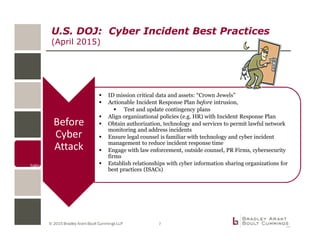
Before
Cyber
Attack
ID mission critical data and assets: “Crown Jewels”
Actionable Incident Response Plan before intrusion,
Test and update contingency plans
Align organizational policies (e.g. HR) with Incident Response Plan
Obtain authorization, technology and services to permit lawful network
monitoring and address incidents
Ensure legal counsel is familiar with technology and cyber incident
management to reduce incident response time
Engage with law enforcement, outside counsel, PR Firms, cybersecurity
firms
Establish relationships with cyber information sharing organizations for
best practices (ISACs)
U.S. DOJ: Cyber Incident Best Practices
(April 2015)
7
© 2015 Bradley Arant Boult Cummings LLP
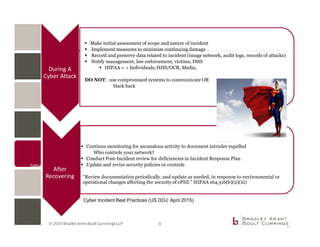
During A
Cyber Attack
After
Recovering
Continue monitoring for anomalous activity to document intruder expelled
Who controls your network?
Conduct Post-Incident review for deficiencies in Incident Response Plan
Update and revise security policies or controls
“Review documentation periodically, and update as needed, in response to environmental or
operational changes affecting the security of ePHI.” HIPAA 164.316(b)(2)(iii)
Make initial assessment of scope and nature of incident
Implement measures to minimize continuing damage
Record and preserve data related to incident (image network, audit logs, records of attacks)
Notify management, law enforcement, victims, DHS
HIPAA = > Individuals, HHS/OCR, Media,
DO NOT: use compromised systems to communicate OR
Hack back
Cyber Incident Best Practices (US DOJ: April 2015)
8
© 2015 Bradley Arant Boult Cummings LLP
FTC enforcement authority – Wyndham
2015 WL 4998121 (3d Cir. 8.24.15)
Deceptive:
– Not implementing stated privacy policies
– Misrepresenting extent to which privacy and security of information collected,
used, maintained is protected
Unfair:
– Alleged failure to implement reasonable and appropriate security measures
– Elements:
• Practice causes or is likely to cause substantial injury to consumers
• Consumers are not reasonably able to avoid injury
• Injury is not outweighed by countervailing consumer benefit, competition
– Fair notice: That a company’s conduct could fall within statute, not FTC’s
interpretation of cybersecurity practices.
• FTC has published data security guidance and data security complaints
– MUST keep abreast of FTC guidance and complaints
9
Section 5 of the FTC Act: “Unfair and Deceptive” Acts or Practices
© 2015 Bradley Arant Boult Cummings LLP
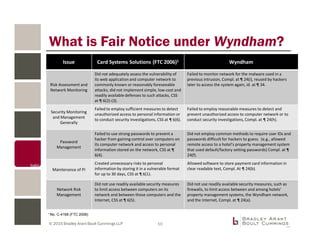
What is Fair Notice under Wyndham?
Issue Card Systems Solutions (FTC 2006)1 Wyndham
Risk Assessment and
Network Monitoring
Did not adequately assess the vulnerability of
its web application and computer network to
commonly known or reasonably foreseeable
attacks; did not implement simple, low-cost and
readily available defenses to such attacks, CSS
at ¶ 6(2)-(3).
Failed to monitor network for the malware used in a
previous intrusion, Compl. at ¶ 24(i), reused by hackers
later to access the system again, id. at ¶ 34.
Security Monitoring
and Management
Generally
Failed to employ sufficient measures to detect
unauthorized access to personal information or
to conduct security investigations, CSS at ¶ 6(6).
Failed to employ reasonable measures to detect and
prevent unauthorized access to computer network or to
conduct security investigations, Compl. at ¶ 24(h).
Password
Management
Failed to use strong passwords to prevent a
hacker from gaining control over computers on
its computer network and access to personal
information stored on the network, CSS at 
6(4).
Did not employ common methods to require user IDs and
passwords difficult for hackers to guess. (e.g., allowed
remote access to a hotel’s property management system
that used default/factory setting passwords) Compl. at 
24(f).
Maintenance of PI
Created unnecessary risks to personal
information by storing it in a vulnerable format
for up to 30 days, CSS at ¶ 6(1).
Allowed software to store payment card information in
clear readable text, Compl. At ¶ 24(b).
Network Risk
Management
Did not use readily available security measures
to limit access between computers on its
network and between those computers and the
Internet, CSS at ¶ 6(5).
Did not use readily available security measures, such as
firewalls, to limit access between and among hotels’
property management systems, the Wyndham network,
and the Internet, Compl. at ¶ 24(a).
1 No. C-4168 (FTC 2006)
10
© 2015 Bradley Arant Boult Cummings LLP
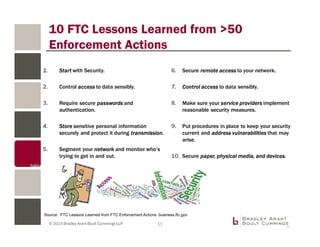
10 FTC Lessons Learned from >50
Enforcement Actions
1. Start with Security.
2. Control access to data sensibly.
3. Require secure passwords and
authentication.
4. Store sensitive personal information
securely and protect it during transmission.
5. Segment your network and monitor who’s
trying to get in and out.
6. Secure remote access to your network.
7. Control access to data sensibly.
8. Make sure your service providers implement
reasonable security measures.
9. Put procedures in place to keep your security
current and address vulnerabilities that may
arise.
10. Secure paper, physical media, and devices.
Source: FTC Lessons Learned from FTC Enforcement Actions business.ftc.gov
11
© 2015 Bradley Arant Boult Cummings LLP
FFIEC Cybersecurity Assessment Tool
FFIEC Cybersecurity Assessment Tool: intended
to help financial institutions evaluate their own
ISP and risk profile
– Inherent Risk Profile
– Cybersecurity Maturity
12
© 2015 Bradley Arant Boult Cummings LLP
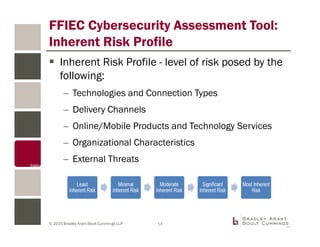
FFIEC Cybersecurity Assessment Tool:
Inherent Risk Profile
Inherent Risk Profile - level of risk posed by the
following:
– Technologies and Connection Types
– Delivery Channels
– Online/Mobile Products and Technology Services
– Organizational Characteristics
– External Threats
13
© 2015 Bradley Arant Boult Cummings LLP
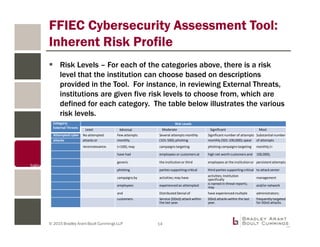
Risk Levels – For each of the categories above, there is a risk
level that the institution can choose based on descriptions
provided in the Tool. For instance, in reviewing External Threats,
institutions are given five risk levels to choose from, which are
defined for each category. The table below illustrates the various
risk levels.
FFIEC Cybersecurity Assessment Tool:
Inherent Risk Profile
14
Category:
External Threats
Risk Levels
Least Minimal Moderate Significant Most
Attempted cyber No attempted Few attempts Several attempts monthly Significant number of attempts Substantial number
attacks attacks or monthly (101-500);phishing monthly (501-100,000);spear of attempts
reconnaissance. (<100); may campaigns targeting phishing campaigns targeting monthly (>
have had employees or customers at high net worth customers and 100,000);
generic the institution or third employees at the institutionor persistentattempts
phishing parties supporting critical third parties supporting critical to attack senior
campaigns by activities; may have activities; Institution
specifically
management
employees experienced an attempted
is named in threat reports;
may and/or network
and Distributed Denial of have experienced multiple administrators;
customers. Service (DDoS) attack within
the last year.
DDoS attacks within the last
year.
frequently targeted
for DDoS attacks.
© 2015 Bradley Arant Boult Cummings LLP 15
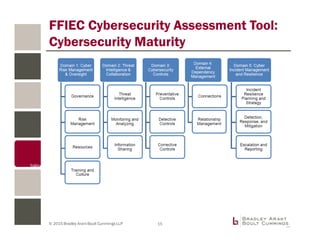
FFIEC Cybersecurity Assessment Tool:
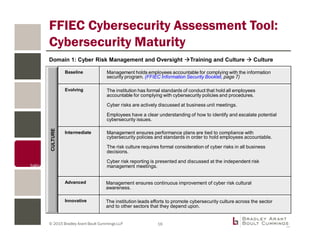
Cybersecurity Maturity
© 2015 Bradley Arant Boult Cummings LLP
CULTURE
Baseline Management holds employees accountable for complying with the information
security program. (FFIEC Information Security Booklet, page 7)
Evolving The institution has formal standards of conduct that hold all employees
accountable for complying with cybersecurity policies and procedures.
Cyber risks are actively discussed at business unit meetings.
Employees have a clear understanding of how to identify and escalate potential
cybersecurity issues.
Intermediate Management ensures performance plans are tied to compliance with
cybersecurity policies and standards in order to hold employees accountable.
The risk culture requires formal consideration of cyber risks in all business
decisions.
Cyber risk reporting is presented and discussed at the independent risk
management meetings.
Advanced Management ensures continuous improvement of cyber risk cultural
awareness.
Innovative The institution leads efforts to promote cybersecurity culture across the sector
and to other sectors that they depend upon.
16
Domain 1: Cyber Risk Management and Oversight Training and Culture Culture
FFIEC Cybersecurity Assessment Tool:
Cybersecurity Maturity
© 2015 Bradley Arant Boult Cummings LLP 17
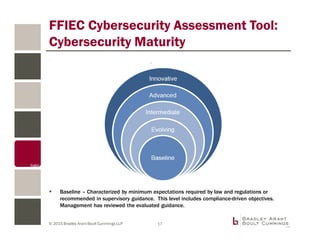
FFIEC Cybersecurity Assessment Tool:
Cybersecurity Maturity
Baseline – Characterized by minimum expectations required by law and regulations or
recommended in supervisory guidance. This level includes compliance-driven objectives.
Management has reviewed the evaluated guidance.
© 2015 Bradley Arant Boult Cummings LLP 18
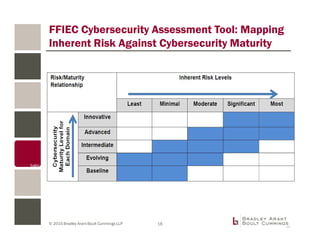
FFIEC Cybersecurity Assessment Tool: Mapping
Inherent Risk Against Cybersecurity Maturity
© 2015 Bradley Arant Boult Cummings LLP 19
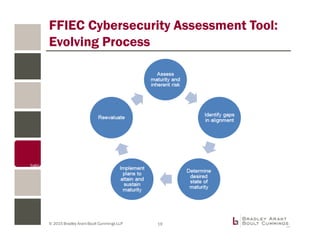
FFIEC Cybersecurity Assessment Tool:
Evolving Process
© 2015 Bradley Arant Boult Cummings LLP
FFIEC Cybersecurity Assessment Tool:
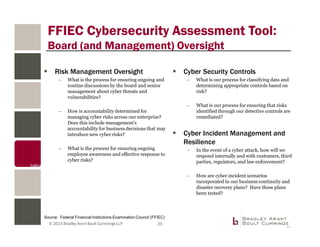
Board (and Management) Oversight
Risk Management Oversight
– What is the process for ensuring ongoing and
routine discussions by the board and senior
management about cyber threats and
vulnerabilities?
– How is accountability determined for
managing cyber risks across our enterprise?
Does this include management’s
accountability for business decisions that may
introduce new cyber risks?
– What is the process for ensuring ongoing
employee awareness and effective response to
cyber risks?
Cyber Security Controls
– What is our process for classifying data and
determining appropriate controls based on
risk?
– What is our process for ensuring that risks
identified through our detective controls are
remediated?
Cyber Incident Management and
Resilience
– In the event of a cyber attack, how will we
respond internally and with customers, third
parties, regulators, and law enforcement?
– How are cyber incident scenarios
incorporated in our business continuity and
disaster recovery plans? Have these plans
been tested?
Source: Federal Financial Institutions Examination Council (FFIEC)
20
© 2015 Bradley Arant Boult Cummings LLP
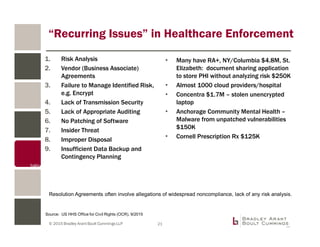
“Recurring Issues” in Healthcare Enforcement
1. Risk Analysis
2. Vendor (Business Associate)
Agreements
3. Failure to Manage Identified Risk,
e.g. Encrypt
4. Lack of Transmission Security
5. Lack of Appropriate Auditing
6. No Patching of Software
7. Insider Threat
8. Improper Disposal
9. Insufficient Data Backup and
Contingency Planning
• Many have RA+, NY/Columbia $4.8M, St.
Elizabeth: document sharing application
to store PHI without analyzing risk $250K
• Almost 1000 cloud providers/hospital
• Concentra $1.7M – stolen unencrypted
laptop
• Anchorage Community Mental Health –
Malware from unpatched vulnerabilities
$150K
• Cornell Prescription Rx $125K
Source: US HHS Office for Civil Rights (OCR), 9/2015
Resolution Agreements often involve allegations of widespread noncompliance, lack of any risk analysis.
21
© 2015 Bradley Arant Boult Cummings LLP
Questions?
Paige M. Boshell
205.521.8639
pboshell@babc.com
www.babc.com/paige-m-boshell
Amy S. Leopard
615.252.2309
aleopard@babc.com
www.babc.com/amy-s-leopard
22

Data breach-response-planning-laying-the-right-foundation

  • 1.
    babc.com ALABAMA IDISTRICT OF COLUMBIA I FLORIDA I MISSISSIPPI I NORTH CAROLINA I TENNESSEE Data Breach Response Planning: Laying the Right Foundation September 16, 2015 Presented by Paige M. Boshell and Amy S. Leopard
  • 2.
    © 2015 BradleyArant Boult Cummings LLP Attorneys from our Privacy and Information Security Team Paige M. Boshell Amy S. Leopard • Co-Team Leader, Privacy & Information Security Team • Chair, AHLA Health Information and Technology Practice Group • Vice Chair, HIMSS Legal Task Force • Partner, Nashville Office • Co-Team Leader, Privacy & Information Security Team • Partner, Birmingham Office 2
  • 3.
    © 2015 BradleyArant Boult Cummings LLP Cybersecurity Planning Data Breach Plan (incident response) Cybersecurity Program FTC Enforcement of “Unfair” Security Practices FFIEC Cybersecurity Assessment Tool (financial institutions) Healthcare Enforcement HIPAA Security Breach Risk Assessment Agenda 3
  • 4.
    © 2015 BradleyArant Boult Cummings LLP National Institute of Standards and Technology (“NIST”) Cybersecurity Framework – Defined rubric and methodology for evaluating and addressing risk – Technology – neutral – Relies on existing requirements, best practices and industry standards – “Voluntary” for certain government contractors – Widespread impact – downstream chain, court and regulatory interpretations of reasonable or industry standard security practices and programs, applicability to variety of businesses Cybersecurity Planning 4
  • 5.
    © 2015 BradleyArant Boult Cummings LLP Information Sharing and Analysis Centers (ISAC): - ISACs are trusted entities established by Critical Infrastructure Key Resource (CI/KR) owners and operators to provide comprehensive sector analysis, which is shared within the sector, with other sectors, and with government. - Services provided by ISACs include risk mitigation, incident response, alert and information sharing. The goal is to provide users with accurate, actionable, and relevant information. - Member benefits vary across the ISACs and can include: access to a 24/7 security operations center; briefings; white papers; threat calls; webinars; and anonymous CIKR Owner/Operator reporting. Cybersecurity Planning 5
  • 6.
    © 2015 BradleyArant Boult Cummings LLP Cybersecurity Planning FS-ISAC: industry forum for collaboration on critical security threats facing the global financial services sector – Global cyber and physical threat intelligence analysis and sharing (anonymous information sharing) – Early warning of attacks – Collaboration in response – Coordination of assessment NH – ISAC: healthcare and public health critical infrastructure resilience Expert guidance on avoiding and mitigating attacks 6
  • 7.
    © 2015 BradleyArant Boult Cummings LLP Before Cyber Attack ID mission critical data and assets: “Crown Jewels” Actionable Incident Response Plan before intrusion, Test and update contingency plans Align organizational policies (e.g. HR) with Incident Response Plan Obtain authorization, technology and services to permit lawful network monitoring and address incidents Ensure legal counsel is familiar with technology and cyber incident management to reduce incident response time Engage with law enforcement, outside counsel, PR Firms, cybersecurity firms Establish relationships with cyber information sharing organizations for best practices (ISACs) U.S. DOJ: Cyber Incident Best Practices (April 2015) 7
  • 8.
    © 2015 BradleyArant Boult Cummings LLP During A Cyber Attack After Recovering Continue monitoring for anomalous activity to document intruder expelled Who controls your network? Conduct Post-Incident review for deficiencies in Incident Response Plan Update and revise security policies or controls “Review documentation periodically, and update as needed, in response to environmental or operational changes affecting the security of ePHI.” HIPAA 164.316(b)(2)(iii) Make initial assessment of scope and nature of incident Implement measures to minimize continuing damage Record and preserve data related to incident (image network, audit logs, records of attacks) Notify management, law enforcement, victims, DHS HIPAA = > Individuals, HHS/OCR, Media, DO NOT: use compromised systems to communicate OR Hack back Cyber Incident Best Practices (US DOJ: April 2015) 8
  • 9.
    © 2015 BradleyArant Boult Cummings LLP FTC enforcement authority – Wyndham 2015 WL 4998121 (3d Cir. 8.24.15) Deceptive: – Not implementing stated privacy policies – Misrepresenting extent to which privacy and security of information collected, used, maintained is protected Unfair: – Alleged failure to implement reasonable and appropriate security measures – Elements: • Practice causes or is likely to cause substantial injury to consumers • Consumers are not reasonably able to avoid injury • Injury is not outweighed by countervailing consumer benefit, competition – Fair notice: That a company’s conduct could fall within statute, not FTC’s interpretation of cybersecurity practices. • FTC has published data security guidance and data security complaints – MUST keep abreast of FTC guidance and complaints 9 Section 5 of the FTC Act: “Unfair and Deceptive” Acts or Practices
  • 10.
    © 2015 BradleyArant Boult Cummings LLP What is Fair Notice under Wyndham? Issue Card Systems Solutions (FTC 2006)1 Wyndham Risk Assessment and Network Monitoring Did not adequately assess the vulnerability of its web application and computer network to commonly known or reasonably foreseeable attacks; did not implement simple, low-cost and readily available defenses to such attacks, CSS at ¶ 6(2)-(3). Failed to monitor network for the malware used in a previous intrusion, Compl. at ¶ 24(i), reused by hackers later to access the system again, id. at ¶ 34. Security Monitoring and Management Generally Failed to employ sufficient measures to detect unauthorized access to personal information or to conduct security investigations, CSS at ¶ 6(6). Failed to employ reasonable measures to detect and prevent unauthorized access to computer network or to conduct security investigations, Compl. at ¶ 24(h). Password Management Failed to use strong passwords to prevent a hacker from gaining control over computers on its computer network and access to personal information stored on the network, CSS at ¶ 6(4). Did not employ common methods to require user IDs and passwords difficult for hackers to guess. (e.g., allowed remote access to a hotel’s property management system that used default/factory setting passwords) Compl. at ¶ 24(f). Maintenance of PI Created unnecessary risks to personal information by storing it in a vulnerable format for up to 30 days, CSS at ¶ 6(1). Allowed software to store payment card information in clear readable text, Compl. At ¶ 24(b). Network Risk Management Did not use readily available security measures to limit access between computers on its network and between those computers and the Internet, CSS at ¶ 6(5). Did not use readily available security measures, such as firewalls, to limit access between and among hotels’ property management systems, the Wyndham network, and the Internet, Compl. at ¶ 24(a). 1 No. C-4168 (FTC 2006) 10
  • 11.
    © 2015 BradleyArant Boult Cummings LLP 10 FTC Lessons Learned from >50 Enforcement Actions 1. Start with Security. 2. Control access to data sensibly. 3. Require secure passwords and authentication. 4. Store sensitive personal information securely and protect it during transmission. 5. Segment your network and monitor who’s trying to get in and out. 6. Secure remote access to your network. 7. Control access to data sensibly. 8. Make sure your service providers implement reasonable security measures. 9. Put procedures in place to keep your security current and address vulnerabilities that may arise. 10. Secure paper, physical media, and devices. Source: FTC Lessons Learned from FTC Enforcement Actions business.ftc.gov 11
  • 12.
    © 2015 BradleyArant Boult Cummings LLP FFIEC Cybersecurity Assessment Tool FFIEC Cybersecurity Assessment Tool: intended to help financial institutions evaluate their own ISP and risk profile – Inherent Risk Profile – Cybersecurity Maturity 12
  • 13.
    © 2015 BradleyArant Boult Cummings LLP FFIEC Cybersecurity Assessment Tool: Inherent Risk Profile Inherent Risk Profile - level of risk posed by the following: – Technologies and Connection Types – Delivery Channels – Online/Mobile Products and Technology Services – Organizational Characteristics – External Threats 13
  • 14.
    © 2015 BradleyArant Boult Cummings LLP Risk Levels – For each of the categories above, there is a risk level that the institution can choose based on descriptions provided in the Tool. For instance, in reviewing External Threats, institutions are given five risk levels to choose from, which are defined for each category. The table below illustrates the various risk levels. FFIEC Cybersecurity Assessment Tool: Inherent Risk Profile 14 Category: External Threats Risk Levels Least Minimal Moderate Significant Most Attempted cyber No attempted Few attempts Several attempts monthly Significant number of attempts Substantial number attacks attacks or monthly (101-500);phishing monthly (501-100,000);spear of attempts reconnaissance. (<100); may campaigns targeting phishing campaigns targeting monthly (> have had employees or customers at high net worth customers and 100,000); generic the institution or third employees at the institutionor persistentattempts phishing parties supporting critical third parties supporting critical to attack senior campaigns by activities; may have activities; Institution specifically management employees experienced an attempted is named in threat reports; may and/or network and Distributed Denial of have experienced multiple administrators; customers. Service (DDoS) attack within the last year. DDoS attacks within the last year. frequently targeted for DDoS attacks.
  • 15.
    © 2015 BradleyArant Boult Cummings LLP 15 FFIEC Cybersecurity Assessment Tool: Cybersecurity Maturity
  • 16.
    © 2015 BradleyArant Boult Cummings LLP CULTURE Baseline Management holds employees accountable for complying with the information security program. (FFIEC Information Security Booklet, page 7) Evolving The institution has formal standards of conduct that hold all employees accountable for complying with cybersecurity policies and procedures. Cyber risks are actively discussed at business unit meetings. Employees have a clear understanding of how to identify and escalate potential cybersecurity issues. Intermediate Management ensures performance plans are tied to compliance with cybersecurity policies and standards in order to hold employees accountable. The risk culture requires formal consideration of cyber risks in all business decisions. Cyber risk reporting is presented and discussed at the independent risk management meetings. Advanced Management ensures continuous improvement of cyber risk cultural awareness. Innovative The institution leads efforts to promote cybersecurity culture across the sector and to other sectors that they depend upon. 16 Domain 1: Cyber Risk Management and Oversight Training and Culture Culture FFIEC Cybersecurity Assessment Tool: Cybersecurity Maturity
  • 17.
    © 2015 BradleyArant Boult Cummings LLP 17 FFIEC Cybersecurity Assessment Tool: Cybersecurity Maturity Baseline – Characterized by minimum expectations required by law and regulations or recommended in supervisory guidance. This level includes compliance-driven objectives. Management has reviewed the evaluated guidance.
  • 18.
    © 2015 BradleyArant Boult Cummings LLP 18 FFIEC Cybersecurity Assessment Tool: Mapping Inherent Risk Against Cybersecurity Maturity
  • 19.
    © 2015 BradleyArant Boult Cummings LLP 19 FFIEC Cybersecurity Assessment Tool: Evolving Process
  • 20.
    © 2015 BradleyArant Boult Cummings LLP FFIEC Cybersecurity Assessment Tool: Board (and Management) Oversight Risk Management Oversight – What is the process for ensuring ongoing and routine discussions by the board and senior management about cyber threats and vulnerabilities? – How is accountability determined for managing cyber risks across our enterprise? Does this include management’s accountability for business decisions that may introduce new cyber risks? – What is the process for ensuring ongoing employee awareness and effective response to cyber risks? Cyber Security Controls – What is our process for classifying data and determining appropriate controls based on risk? – What is our process for ensuring that risks identified through our detective controls are remediated? Cyber Incident Management and Resilience – In the event of a cyber attack, how will we respond internally and with customers, third parties, regulators, and law enforcement? – How are cyber incident scenarios incorporated in our business continuity and disaster recovery plans? Have these plans been tested? Source: Federal Financial Institutions Examination Council (FFIEC) 20
  • 21.
    © 2015 BradleyArant Boult Cummings LLP “Recurring Issues” in Healthcare Enforcement 1. Risk Analysis 2. Vendor (Business Associate) Agreements 3. Failure to Manage Identified Risk, e.g. Encrypt 4. Lack of Transmission Security 5. Lack of Appropriate Auditing 6. No Patching of Software 7. Insider Threat 8. Improper Disposal 9. Insufficient Data Backup and Contingency Planning • Many have RA+, NY/Columbia $4.8M, St. Elizabeth: document sharing application to store PHI without analyzing risk $250K • Almost 1000 cloud providers/hospital • Concentra $1.7M – stolen unencrypted laptop • Anchorage Community Mental Health – Malware from unpatched vulnerabilities $150K • Cornell Prescription Rx $125K Source: US HHS Office for Civil Rights (OCR), 9/2015 Resolution Agreements often involve allegations of widespread noncompliance, lack of any risk analysis. 21
  • 22.
    © 2015 BradleyArant Boult Cummings LLP Questions? Paige M. Boshell 205.521.8639 pboshell@babc.com www.babc.com/paige-m-boshell Amy S. Leopard 615.252.2309 aleopard@babc.com www.babc.com/amy-s-leopard 22