The Last Lesson
A story by: Alphonse Daudet
A PowerPoint presentation by:
Mrinal Ghosh, PGT (English)
About the Writer:
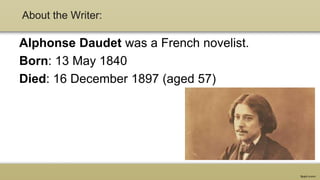
Alphonse Daudet was a French novelist.
Born: 13 May 1840
Died: 16 December 1897 (aged 57)
The Theme of the Story
The Last Lesson reflects on the
importance of one’s language for any
race and why it is crucial to safeguard
it.
The Story in Brief
The narration of this story is by a French
boy, Franz. Franz is a lazy boy. However,
in spite of his laziness, Franz likes to play
and is of a sensitive nature. Furthermore,
Franz hates his teacher M. Hamel in his
school and has no interest in studying
French.
The Story in Brief
An order has come from Berlin after taking over
the districts of Alsace and Lorraine in France
that the German language rather than the
French should be taught in the schools there.
The Story in Brief
Furthermore, it is the school French
teacher M. Hamel’s last day. This teacher
has been working
there for forty years.
The Story in Brief
• Moreover, the teacher has feelings of patriotism.
He is also full of nostalgia and grief.
• The village men also attend his ‘last lesson’ so as
to honour and respect him.
• The village is regretting and is sad that they didn’t
learn their mother tongue in their childhood.
The Story in Brief
• Franz receives a big shock when he learns that
this is his last lesson in French. He is shocked
because he does not know French.
Furthermore, on learning about the last lesson, a
sudden interest arises in him for learning
French.
• Moreover, he pays careful attention and learns
everything taught on this last day.
The Story in Brief
• Instantly, he develops liking for the teacher M.
Hamel. His feelings of hatred for him suddenly
came to an end.
• Moreover, Franz develops respect for the hard
work and sincerity of his teacher. Franz is sad
and ashamed for being unable to recite his
lesson.
The Story in Brief
• The French Teacher M. Hamel explains that
they all are at fault for lacking eagerness to
learn.
• Furthermore, he also includes himself in this
fault. He blames himself for lack of sincerity in
teaching them.
The Story in Brief
There is a reflection of his patriotism in his
praise for the French language.
He says that the French language is the most
logical and beautiful language in the world. It
seems that M. Hamel got emotional on this
occasion. Furthermore, he asks the class to
guard their language.
The Story in Brief
• He says that being close to one’s language is a
way to escape the clutches of slavery. This
language will assist them in attaining freedom
from the Germans.
The Story in Brief
• The people realize the significance of their
mother tongue.
• Moreover, they feel the
reason for their defeat is
illiteracy.
The Story in Brief
• Franz feels that it is impossible to remove one’s
language from a person.
• This is because it is something that is natural to
a person.
The Story in Brief
• This means that no matter how hard the
opposition may try, they will fail to remove
one’s language.
The End

The last lesson

  • 1.
    The Last Lesson Astory by: Alphonse Daudet A PowerPoint presentation by: Mrinal Ghosh, PGT (English)
  • 2.
    About the Writer: AlphonseDaudet was a French novelist. Born: 13 May 1840 Died: 16 December 1897 (aged 57)
  • 3.
    The Theme ofthe Story The Last Lesson reflects on the importance of one’s language for any race and why it is crucial to safeguard it.
  • 4.
    The Story inBrief The narration of this story is by a French boy, Franz. Franz is a lazy boy. However, in spite of his laziness, Franz likes to play and is of a sensitive nature. Furthermore, Franz hates his teacher M. Hamel in his school and has no interest in studying French.
  • 5.
    The Story inBrief An order has come from Berlin after taking over the districts of Alsace and Lorraine in France that the German language rather than the French should be taught in the schools there.
  • 6.
    The Story inBrief Furthermore, it is the school French teacher M. Hamel’s last day. This teacher has been working there for forty years.
  • 7.
    The Story inBrief • Moreover, the teacher has feelings of patriotism. He is also full of nostalgia and grief. • The village men also attend his ‘last lesson’ so as to honour and respect him. • The village is regretting and is sad that they didn’t learn their mother tongue in their childhood.
  • 8.
    The Story inBrief • Franz receives a big shock when he learns that this is his last lesson in French. He is shocked because he does not know French. Furthermore, on learning about the last lesson, a sudden interest arises in him for learning French. • Moreover, he pays careful attention and learns everything taught on this last day.
  • 9.
    The Story inBrief • Instantly, he develops liking for the teacher M. Hamel. His feelings of hatred for him suddenly came to an end. • Moreover, Franz develops respect for the hard work and sincerity of his teacher. Franz is sad and ashamed for being unable to recite his lesson.
  • 10.
    The Story inBrief • The French Teacher M. Hamel explains that they all are at fault for lacking eagerness to learn. • Furthermore, he also includes himself in this fault. He blames himself for lack of sincerity in teaching them.
  • 11.
    The Story inBrief There is a reflection of his patriotism in his praise for the French language. He says that the French language is the most logical and beautiful language in the world. It seems that M. Hamel got emotional on this occasion. Furthermore, he asks the class to guard their language.
  • 12.
    The Story inBrief • He says that being close to one’s language is a way to escape the clutches of slavery. This language will assist them in attaining freedom from the Germans.
  • 13.
    The Story inBrief • The people realize the significance of their mother tongue. • Moreover, they feel the reason for their defeat is illiteracy.
  • 14.
    The Story inBrief • Franz feels that it is impossible to remove one’s language from a person. • This is because it is something that is natural to a person.
  • 15.
    The Story inBrief • This means that no matter how hard the opposition may try, they will fail to remove one’s language. The End