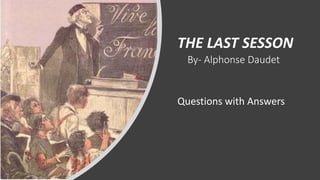
THE LAST SESSON
By- Alphonse Daudet
Questions with Answers
RECAP
 Time Period – Franco-Prussian War
 Region of Alsace and Lorraine defeated,
Conquered by Germans
Order from Berlin to teach only German language
Situation seen through the young school-going
boy Franz
French teachers asked to leave
M. Hamel, French teacher at school for past 40
years, asked to leave
RECAP
Franz late for school
School silent like Sunday school; villagers seated at the
back benches; M. Hamel dressed differently
Franz not scolded by M. Hamel for not doing homework
(rules of participles)
Everyone sentimental
For a change, M. Hamel kind and very patient in
explaining
Change in Franz- attentive, regrets not being serious
about studies, starts respecting M. Hamel
RECAP
M. Hamel describes French language as the most clear,
logical and beautiful language
Blames residents of the region for not never being
serious about studies and being in the habit of
postponing things
M. Hamel asks everyone to keep the language alive; it
will be their key to the prison
At noon, the time to leave comes; M. Hamel unable to
speak as very emotional
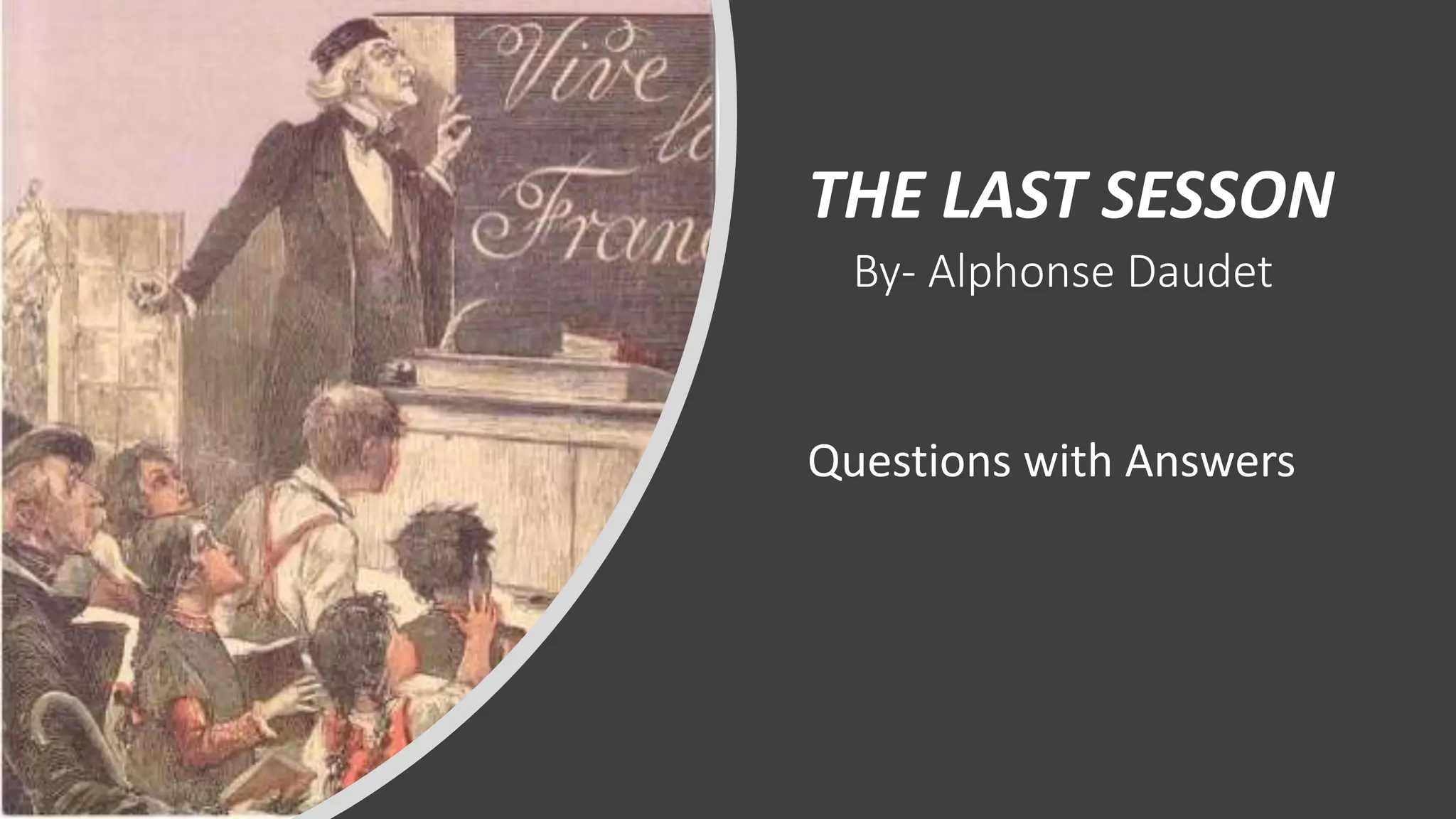
Just writes on the blackboard- Vive La France and with
a hand movement disperses everyone
NCERTQuestions
with
Answers
What was Franz expected to be prepared with for school that day?
Franz was expected to have memorized the rules of participles as his
teacher M. Hamel had said that he would question them on the topic.
What did Franz notice that was unusual about the school that day?
Usually there would be a lot of commotion, noise with the movement of
desks, raping of teacher’s ruler on the table and lessons being recited in
unison. But that day the school was very silent like Sunday morning. All
were seated and his teacher, M. Hamel, walking with his ruler under his
arm.
What had been put up on the bulletin-board?
The bulletin board in the town-hall informed the people about the Order
from Berlin which mentioned that from the next day only German language
will be taught to the students and their French teacher will have to leave.
What changes did the order from Berlin cause in school that day? (30-40
words)
Order from Berlin made everyone- the teacher M. Hamel, villagers and the
students- very sad. They regretted for never being serious about the
studies. Everyone was very sincere and attentive; and wanted to learn the
maximum that day.
What changes did the order from Berlin cause in school that day? (120 -150
words)
Order from Berlin had come to discontinue teaching of French language and start
teaching German language from the next day as France had lost the war.
This brought the life to stand-still. The news had made everyone- the teacher M.
Hamel, villagers and the students- very sad. M. Hamel had to leave next day. This
being his last French lesson he wanted to impart the maximum knowledge to all
the learners. Villagers who were present during the last lesson to express
gratitude to him for his 40 years service, felt bad for the teacher and themselves.
They regretted for postponing things and never being serious about the studies.
Everyone became sincere and attentive; and wanted to learn the maximum that
day. Franz felt guilty and realized the huge loss they all were going to have. M.
Hamel very kindly and patiently made everyone understand the value of time
and the importance of their language and requested them to keep it alive.
How did Franz’s feeling about M. Hamel and school change?(120-150 words)
After coming to know that French teaching would be discontinued as per the
order from Berlin, Franz was shocked. He realised that he didn’t know much
about his language as he had never been serious about learning. He forgot his
teacher’s ruler and crankiness. He developed a fondness and respect for M.
Hamel. The idea of being separated from him forever troubled him. He
understood the pain and agony his teacher was undergoing. And, he became
more sympathetic towards his teacher.
His school too, now, carried a different meaning. The books which he used to
consider as a burden suddenly became his old friends. He never wanted to be
separated from them. The school which he would delay in attending, he
couldn’t give up. He regretted not being attentive in his classes earlier. He
realised that with careful listening and being attentive in the class, even the
difficult concepts turned easy and could be easily understood.
The people in this story suddenly realize how precious their language is to
them. What shows you this? Why does this happen? (120-150 words)
There are many instances mentioned in the lesson that reflect people’s
realization. The crowd surrounding the bulletin-board, back benches being
occupied by the villagers, special dress worn by M. Hamel, the school as silent as
Sunday morning, sadness in the atmosphere, emotional change in Franz for the
school and his teacher, M. Hamel in solemn and pensive mood; and M. Hamel
talking about the qualities of the French language and need to keep it alive are
the indicators that refer to the realisation of the importance of their language to
them.
This realisation happens only after the order from Berlin about the
discontinuation of teaching/learning of French had come. The true worth of a
thing is realised only when it is taken away and is no longer with the people, the
same happened with the people of Alsace and Lorraine.
Franz thinks, “Will they make them sing in German, even the pigeons?”
What could this mean?
To the people, like the villagers of Alsace and Lorraine, their language is unique like their culture and
identity. No other language can replace it ever. Humans may have created boundaries which they think can
be controlled by conquering the regions but no one can conquer Nature. By making a reference to pigeons,
the author is questioning human desire to conquer Nature.
(or)
This sentence may mean that the Germans after winning the war may take the regions of France under
their rule. They may force the people of France to learn German language but the spirit of France which
flows in the hearts of people and Natural things will never be replaced by any force . The natural element/
status of France will remain the same, they would continue to have their basic communication in French
only; the way the cooing of pigeons can not be changed to any other sound.
(or)
Through this statement, the author is trying to convey the hatred French people carry in their hearts
against the Germans. They fear that the Germans will be atrocious towards them and will force each and
every one in the regions of Alsace and Lorraine to read German. No one will be spared.
Notice the underlined words in these sentences and tick the
option that best explains their meanings.
(a)“What a thunderclap these words were to me!”
The words were ___________________
(i) loud and clear.
(ii) startling and unexpected.
(iii) pleasant and welcome.
(b) “When a people are enslaved, as long as they hold fast to their language it is
as if they had the key to their prison.”
It is as if they have the key to the prison as long as they _______________
(i) do not lose their language.
(ii) are attached to their language.
(iii) quickly learn the conqueror’s language.
(c) Don’t go so fast, you will get to your school in plenty of time.
You will get to your school _______________
(i) very late.
(ii) too early.
(iii) early enough.
(d) I never saw him look so tall.
M. Hamel _____________________
(a) had grown physically taller.
(b) seemed very confident.
(c) stood on the chair.
EXTRA QUESTIONS
Reference-to-Context Type Questions
with
Value Points
For a moment I thought of running away and spending the day out
of doors. It was so warm, so bright! The birds were chirping at the
edge of the woods; and in the open field back of the sawmill the
Prussian soldiers were drilling. It was all much more tempting
• Who is I in the above lines?
Narrator; Franz
• Why did he think of running away?
Late for school; enjoyed being outside than attending school
• What was he supposed to be prepared with ?
hadn’t done the work- learning rules of participles
• What did he want to do ?
running out and spending day out
• What did he observe around him that were like temptations to him?
watching birds, soldiers drilling
When I passed the town hall there was a crowd in front of the bulletin-board.
For the last two years all our bad news had come from there
• What kind of bad news were put on the bulletin-board?
bad news- lost battles, drafts, orders of the commanding officer
• Who is I, our narrator?
Narrator- Franz
• Did he stop to read the latest news ?
No
• Whom did he meet there?
Blacksmith with his apprentice
• What did the person ( whom he met) tell him?
no need to hurry; plenty of time to reach school
• Was there a different news on that day ? What was it?
Yes; Order from Berlin – German to be taught from next day
Besides, the whole school seemed so strange and solemn. But the thing that
surprised me most was to see, on the back benches that were always empty,
the village people sitting quietly
• What did the narrator find the most surprising ?
Villagers seated on back benches
• Who was seated on the back benches? Name some of them.
Villager’s elders; old Hauser (builder), former mayor, former postmaster and
several others
• What were the other things that surprised him?
School being silent, everyone sad, M. Hamel dressed in special days clothes
• Why was the school (the people) solemn and quiet ?
Order from Berlin, last French lesson, M. Hamel to leave, German to be taught
What a thunderclap these words were to me!
• Whose words were a thunderclap?
M. Hamel’s announcement
• To whom were the words like thunderclap?
Franz - narrator
• Which words were a thunderclap?
It was the last lesson; order from Berlin- German to be taught from next
day
• Why were words a thunderclap to him?
surprised and shocked to hear the news
• Did his reaction bring any change in him ? Elaborate.
Yes; reaction towards the school and the teacher changed- started liking his
books, forgot the strictness and crankiness of his teacher, starting
respecting him
we must guard it among us and never forget it, because when a people are
enslaved, as long as they hold fast to their language it is as if they had the key
to their prison.
• Who is the speaker of these lines?
M. Hamel , French teacher
• To whom does he speak?
To the class- students and villagers
• According to the speaker, what should be guarded and never forgotten?
native (national) language
• Which language is being referred to here?
French language
• Mention some qualities of that language.
Most beautiful, clear and logical language
• Why is a language important?
Important for identity and freedom
• Which prison is being referred to?
Prison of enslavement; German conquering France
Then he turned to the blackboard, took a piece of chalk, and, bearing
on with all his might, he wrote as large as he could
• Who turned to write on the blackboard?
M. Hamel- their French teacher
• What did he write on the blackboard ?
Vive la France
• Explain- ‘bearing on with all his might’.
gaining courage, controlling his emotions
• Why did he write as large as he could ?
last words to be felt and remembered by all present there
Short Answer Type Questions
(30-40 words)
With
Value Points
Why was Franz ‘in great dread’ of being scolded that day?
Late for school and not learnt the rules of participles
What usually happened in Franz’s class when school began?
A lot of commotion and noise in the classroom, opening-closing of
desks, lessons recited in unison, teacher rapping the ruler on the
table
What announcement was made by M. Hamel at the start of the
lesson?
It was the last French lesson; order from Berlin to teach German
from the next day
What did M. Hamel say about the importance of language to enslaved
people?
Commented on the beauty of the French language; its clarity and logic
Asked all to keep it alive as it will be key to their freedom
What final words did M. Hamel write and why?
Vive la France
Was too emotional and distraught to speak; wanted people to remember
the words for a long time
How does telling the story from young Franz’s point of view affect the
reader’s reaction to the story?
Vivid, interesting and honest narration; keeps the suspense and speculation
among readers alive
What were Franz’s regrets after M. Hamel’s announcement of his last lesson?
Announcement of the last lesson; Realised didn’t know much- a lot to be
learnt; regretted missing school and never being attentive in class
What was M. Hamel’s contribution to the school in Alsace?
Had taught French language for 40 years
Why did Hauser and other villagers come to attend the last lesson?
Last French lesson; M. Hamel to leave the region after the order from Berlin;
wanted to respect and honour him for his service
LONG Answer Type Questions
(120-150 words)
With
Value Points
How does M. Hamel show his pride in his language?
• Order of Berlin took away his service of teaching French
• Teaches his last lesson with kindness and patience
• Dresses up in his special clothes – green coat, black silk cap, frilled shirt
• Reproaches himself and everyone for wasting time and postponing
things, especially learning
• Talks about the qualities of French language – most beautiful, clear and
logical
• Defines the importance of language – key to their freedom
• Requests everyone to keep it alive
• Becomes emotional, unable to speak, writes on board ‘Vive la France”
Everybody during the last lesson is filled with regret. Comment.
• Students, Teacher- M. Hamel and villagers present in the class
• Last French lesson- order from Berlin- German to be taught
• Everyone sad and regretful
• Franz, a student, for not being attentive in class, not punctual, tempted
to spend outside looking at birds chirping, soldiers drilling, etc.
• M. Hamel for giving them off when wanted to go on fishing trip, asking
students to water plants
• Villagers for missing the opportunity of learning and postponing things,
for not taking learning seriously for themselves and later for their
children
How was M. Hamel a different teacher while giving his last lesson?
• Appearance- wore different clothes- usually worn on inspection and
prize days; green coat, black silk hat, frilled shirt
• Kind and gentle – did not scold Franz for reaching late
• No rapping of ruler on the table
• With patience taught the lesson
• Reproached himself and other villagers for not being serious about
learning; advised to change priorities
• Expressed his love for language- Informed about the qualities of
their language- beauty, clarity, logical
• Requested everyone to keep the language alive- key to their
freedom
• Emotional –couldn’t speak- wrote Vive la France

QA-The Last Lesson

  • 1.
    THE LAST SESSON By-Alphonse Daudet Questions with Answers
  • 2.
    RECAP  Time Period– Franco-Prussian War  Region of Alsace and Lorraine defeated, Conquered by Germans Order from Berlin to teach only German language Situation seen through the young school-going boy Franz French teachers asked to leave M. Hamel, French teacher at school for past 40 years, asked to leave
  • 3.
    RECAP Franz late forschool School silent like Sunday school; villagers seated at the back benches; M. Hamel dressed differently Franz not scolded by M. Hamel for not doing homework (rules of participles) Everyone sentimental For a change, M. Hamel kind and very patient in explaining Change in Franz- attentive, regrets not being serious about studies, starts respecting M. Hamel
  • 4.
    RECAP M. Hamel describesFrench language as the most clear, logical and beautiful language Blames residents of the region for not never being serious about studies and being in the habit of postponing things M. Hamel asks everyone to keep the language alive; it will be their key to the prison At noon, the time to leave comes; M. Hamel unable to speak as very emotional Just writes on the blackboard- Vive La France and with a hand movement disperses everyone
  • 5.
  • 6.
    What was Franzexpected to be prepared with for school that day? Franz was expected to have memorized the rules of participles as his teacher M. Hamel had said that he would question them on the topic. What did Franz notice that was unusual about the school that day? Usually there would be a lot of commotion, noise with the movement of desks, raping of teacher’s ruler on the table and lessons being recited in unison. But that day the school was very silent like Sunday morning. All were seated and his teacher, M. Hamel, walking with his ruler under his arm.
  • 7.
    What had beenput up on the bulletin-board? The bulletin board in the town-hall informed the people about the Order from Berlin which mentioned that from the next day only German language will be taught to the students and their French teacher will have to leave. What changes did the order from Berlin cause in school that day? (30-40 words) Order from Berlin made everyone- the teacher M. Hamel, villagers and the students- very sad. They regretted for never being serious about the studies. Everyone was very sincere and attentive; and wanted to learn the maximum that day.
  • 8.
    What changes didthe order from Berlin cause in school that day? (120 -150 words) Order from Berlin had come to discontinue teaching of French language and start teaching German language from the next day as France had lost the war. This brought the life to stand-still. The news had made everyone- the teacher M. Hamel, villagers and the students- very sad. M. Hamel had to leave next day. This being his last French lesson he wanted to impart the maximum knowledge to all the learners. Villagers who were present during the last lesson to express gratitude to him for his 40 years service, felt bad for the teacher and themselves. They regretted for postponing things and never being serious about the studies. Everyone became sincere and attentive; and wanted to learn the maximum that day. Franz felt guilty and realized the huge loss they all were going to have. M. Hamel very kindly and patiently made everyone understand the value of time and the importance of their language and requested them to keep it alive.
  • 9.
    How did Franz’sfeeling about M. Hamel and school change?(120-150 words) After coming to know that French teaching would be discontinued as per the order from Berlin, Franz was shocked. He realised that he didn’t know much about his language as he had never been serious about learning. He forgot his teacher’s ruler and crankiness. He developed a fondness and respect for M. Hamel. The idea of being separated from him forever troubled him. He understood the pain and agony his teacher was undergoing. And, he became more sympathetic towards his teacher. His school too, now, carried a different meaning. The books which he used to consider as a burden suddenly became his old friends. He never wanted to be separated from them. The school which he would delay in attending, he couldn’t give up. He regretted not being attentive in his classes earlier. He realised that with careful listening and being attentive in the class, even the difficult concepts turned easy and could be easily understood.
  • 10.
    The people inthis story suddenly realize how precious their language is to them. What shows you this? Why does this happen? (120-150 words) There are many instances mentioned in the lesson that reflect people’s realization. The crowd surrounding the bulletin-board, back benches being occupied by the villagers, special dress worn by M. Hamel, the school as silent as Sunday morning, sadness in the atmosphere, emotional change in Franz for the school and his teacher, M. Hamel in solemn and pensive mood; and M. Hamel talking about the qualities of the French language and need to keep it alive are the indicators that refer to the realisation of the importance of their language to them. This realisation happens only after the order from Berlin about the discontinuation of teaching/learning of French had come. The true worth of a thing is realised only when it is taken away and is no longer with the people, the same happened with the people of Alsace and Lorraine.
  • 11.
    Franz thinks, “Willthey make them sing in German, even the pigeons?” What could this mean? To the people, like the villagers of Alsace and Lorraine, their language is unique like their culture and identity. No other language can replace it ever. Humans may have created boundaries which they think can be controlled by conquering the regions but no one can conquer Nature. By making a reference to pigeons, the author is questioning human desire to conquer Nature. (or) This sentence may mean that the Germans after winning the war may take the regions of France under their rule. They may force the people of France to learn German language but the spirit of France which flows in the hearts of people and Natural things will never be replaced by any force . The natural element/ status of France will remain the same, they would continue to have their basic communication in French only; the way the cooing of pigeons can not be changed to any other sound. (or) Through this statement, the author is trying to convey the hatred French people carry in their hearts against the Germans. They fear that the Germans will be atrocious towards them and will force each and every one in the regions of Alsace and Lorraine to read German. No one will be spared.
  • 12.
    Notice the underlinedwords in these sentences and tick the option that best explains their meanings. (a)“What a thunderclap these words were to me!” The words were ___________________ (i) loud and clear. (ii) startling and unexpected. (iii) pleasant and welcome. (b) “When a people are enslaved, as long as they hold fast to their language it is as if they had the key to their prison.” It is as if they have the key to the prison as long as they _______________ (i) do not lose their language. (ii) are attached to their language. (iii) quickly learn the conqueror’s language.
  • 13.
    (c) Don’t goso fast, you will get to your school in plenty of time. You will get to your school _______________ (i) very late. (ii) too early. (iii) early enough. (d) I never saw him look so tall. M. Hamel _____________________ (a) had grown physically taller. (b) seemed very confident. (c) stood on the chair.
  • 14.
    EXTRA QUESTIONS Reference-to-Context TypeQuestions with Value Points
  • 15.
    For a momentI thought of running away and spending the day out of doors. It was so warm, so bright! The birds were chirping at the edge of the woods; and in the open field back of the sawmill the Prussian soldiers were drilling. It was all much more tempting • Who is I in the above lines? Narrator; Franz • Why did he think of running away? Late for school; enjoyed being outside than attending school • What was he supposed to be prepared with ? hadn’t done the work- learning rules of participles • What did he want to do ? running out and spending day out • What did he observe around him that were like temptations to him? watching birds, soldiers drilling
  • 16.
    When I passedthe town hall there was a crowd in front of the bulletin-board. For the last two years all our bad news had come from there • What kind of bad news were put on the bulletin-board? bad news- lost battles, drafts, orders of the commanding officer • Who is I, our narrator? Narrator- Franz • Did he stop to read the latest news ? No • Whom did he meet there? Blacksmith with his apprentice • What did the person ( whom he met) tell him? no need to hurry; plenty of time to reach school • Was there a different news on that day ? What was it? Yes; Order from Berlin – German to be taught from next day
  • 17.
    Besides, the wholeschool seemed so strange and solemn. But the thing that surprised me most was to see, on the back benches that were always empty, the village people sitting quietly • What did the narrator find the most surprising ? Villagers seated on back benches • Who was seated on the back benches? Name some of them. Villager’s elders; old Hauser (builder), former mayor, former postmaster and several others • What were the other things that surprised him? School being silent, everyone sad, M. Hamel dressed in special days clothes • Why was the school (the people) solemn and quiet ? Order from Berlin, last French lesson, M. Hamel to leave, German to be taught
  • 18.
    What a thunderclapthese words were to me! • Whose words were a thunderclap? M. Hamel’s announcement • To whom were the words like thunderclap? Franz - narrator • Which words were a thunderclap? It was the last lesson; order from Berlin- German to be taught from next day • Why were words a thunderclap to him? surprised and shocked to hear the news • Did his reaction bring any change in him ? Elaborate. Yes; reaction towards the school and the teacher changed- started liking his books, forgot the strictness and crankiness of his teacher, starting respecting him
  • 19.
    we must guardit among us and never forget it, because when a people are enslaved, as long as they hold fast to their language it is as if they had the key to their prison. • Who is the speaker of these lines? M. Hamel , French teacher • To whom does he speak? To the class- students and villagers • According to the speaker, what should be guarded and never forgotten? native (national) language • Which language is being referred to here? French language • Mention some qualities of that language. Most beautiful, clear and logical language • Why is a language important? Important for identity and freedom • Which prison is being referred to? Prison of enslavement; German conquering France
  • 20.
    Then he turnedto the blackboard, took a piece of chalk, and, bearing on with all his might, he wrote as large as he could • Who turned to write on the blackboard? M. Hamel- their French teacher • What did he write on the blackboard ? Vive la France • Explain- ‘bearing on with all his might’. gaining courage, controlling his emotions • Why did he write as large as he could ? last words to be felt and remembered by all present there
  • 21.
    Short Answer TypeQuestions (30-40 words) With Value Points
  • 22.
    Why was Franz‘in great dread’ of being scolded that day? Late for school and not learnt the rules of participles What usually happened in Franz’s class when school began? A lot of commotion and noise in the classroom, opening-closing of desks, lessons recited in unison, teacher rapping the ruler on the table What announcement was made by M. Hamel at the start of the lesson? It was the last French lesson; order from Berlin to teach German from the next day
  • 23.
    What did M.Hamel say about the importance of language to enslaved people? Commented on the beauty of the French language; its clarity and logic Asked all to keep it alive as it will be key to their freedom What final words did M. Hamel write and why? Vive la France Was too emotional and distraught to speak; wanted people to remember the words for a long time How does telling the story from young Franz’s point of view affect the reader’s reaction to the story? Vivid, interesting and honest narration; keeps the suspense and speculation among readers alive
  • 24.
    What were Franz’sregrets after M. Hamel’s announcement of his last lesson? Announcement of the last lesson; Realised didn’t know much- a lot to be learnt; regretted missing school and never being attentive in class What was M. Hamel’s contribution to the school in Alsace? Had taught French language for 40 years Why did Hauser and other villagers come to attend the last lesson? Last French lesson; M. Hamel to leave the region after the order from Berlin; wanted to respect and honour him for his service
  • 25.
    LONG Answer TypeQuestions (120-150 words) With Value Points
  • 26.
    How does M.Hamel show his pride in his language? • Order of Berlin took away his service of teaching French • Teaches his last lesson with kindness and patience • Dresses up in his special clothes – green coat, black silk cap, frilled shirt • Reproaches himself and everyone for wasting time and postponing things, especially learning • Talks about the qualities of French language – most beautiful, clear and logical • Defines the importance of language – key to their freedom • Requests everyone to keep it alive • Becomes emotional, unable to speak, writes on board ‘Vive la France”
  • 27.
    Everybody during thelast lesson is filled with regret. Comment. • Students, Teacher- M. Hamel and villagers present in the class • Last French lesson- order from Berlin- German to be taught • Everyone sad and regretful • Franz, a student, for not being attentive in class, not punctual, tempted to spend outside looking at birds chirping, soldiers drilling, etc. • M. Hamel for giving them off when wanted to go on fishing trip, asking students to water plants • Villagers for missing the opportunity of learning and postponing things, for not taking learning seriously for themselves and later for their children
  • 28.
    How was M.Hamel a different teacher while giving his last lesson? • Appearance- wore different clothes- usually worn on inspection and prize days; green coat, black silk hat, frilled shirt • Kind and gentle – did not scold Franz for reaching late • No rapping of ruler on the table • With patience taught the lesson • Reproached himself and other villagers for not being serious about learning; advised to change priorities • Expressed his love for language- Informed about the qualities of their language- beauty, clarity, logical • Requested everyone to keep the language alive- key to their freedom • Emotional –couldn’t speak- wrote Vive la France