THE LAST LESSON
-Alphonse Daudet
(1840-1897)
INDEX
1. About the Author
2. Theme, Sub-theme, Plot
3. Characters
4. Summary
5. Key-Points
6. Vocabulary
7. Points to Ponder
8. Assignments
1840 in Nimes in
Vincent Daudet,
manufacturer.
He
France
to a
silk
began his
career as a school teacher but
later took to writing. Daudet is
remembered chiefly as a short-
story writer and novelist of
sentimental tales of provincial life
in France.
THE LAST LESSON
-Alphonse Daudet
(1840-1897)
About the Author : Alphonse
Daudet was born on 13
May
Background of the story :
The story is set at the backdrop of
the Fraco-Prussian War (1870-71) in
which
Prussia
France was
defeated
by led
by Otto
von Bismarck (1815–1898), the first
Chancellor of Germany. Prussia
then consisted of what now are the
nations of Germany, Poland and
parts of Austria. In this story the
French districts of Alsace and
Lorraine have passed into Prussian
hands.
THE LAST LESSON
THE LAST LESSON
Theme – The pain that is inflicted on the people of a
territory by its conquerors by taking away the right to
study or speak their language
Sub-Theme – Students’ and teachers’ attitude to
learning and teaching respectively
Plot – The order from Berlin – The Last Lesson
delivered by M Hamel – Its Impact
The story also highlights colonial hegemony, linguistic
chauvinism and consequences of procrastination
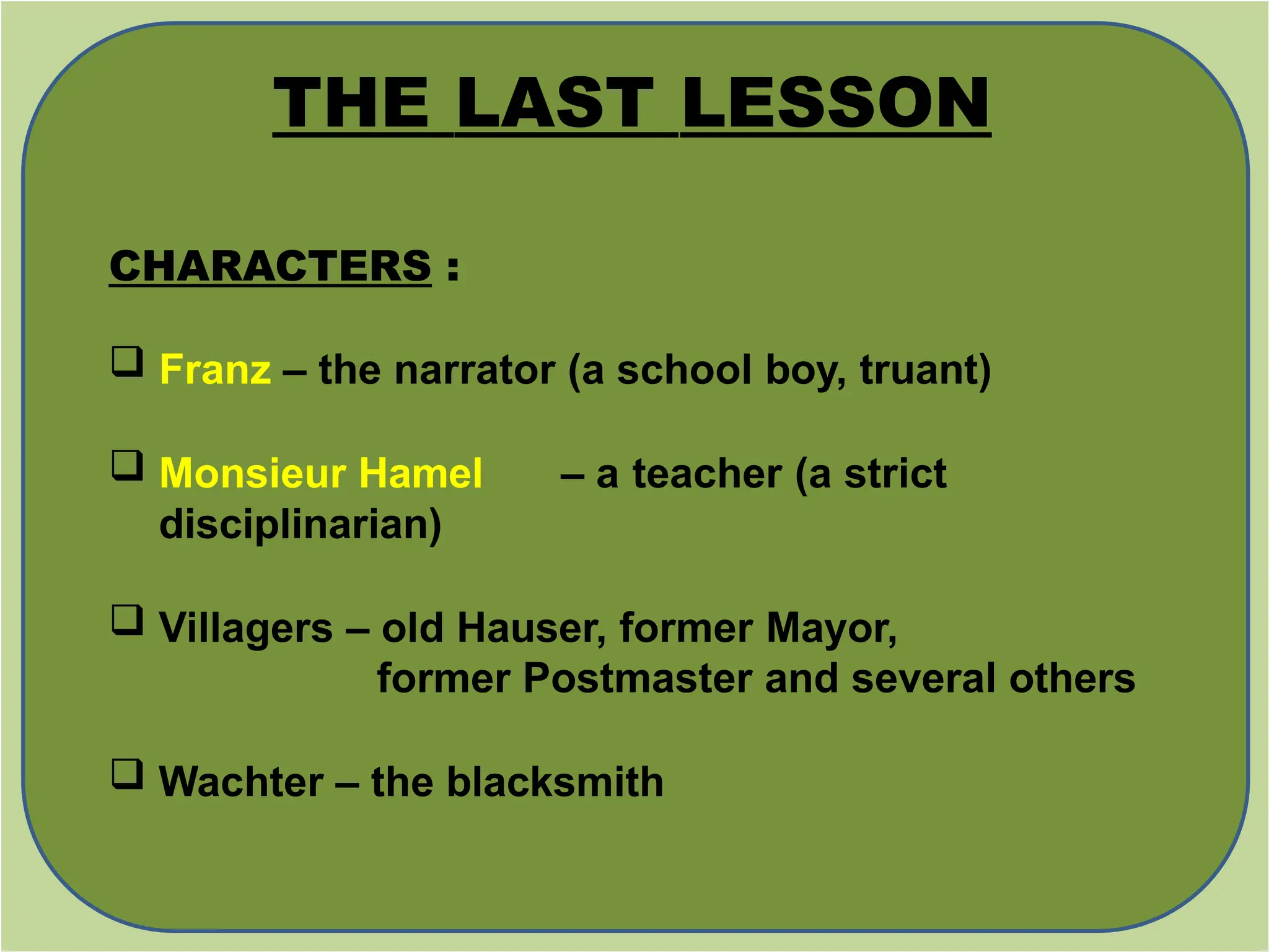
CHARACTERS :
 Franz – the narrator (a school boy, truant)
 Monsieur Hamel – a teacher (a strict
disciplinarian)
 Villagers – old Hauser, former Mayor,
former Postmaster and several others
 Wachter – the blacksmith
THE LAST LESSON
THE LAST LESSON
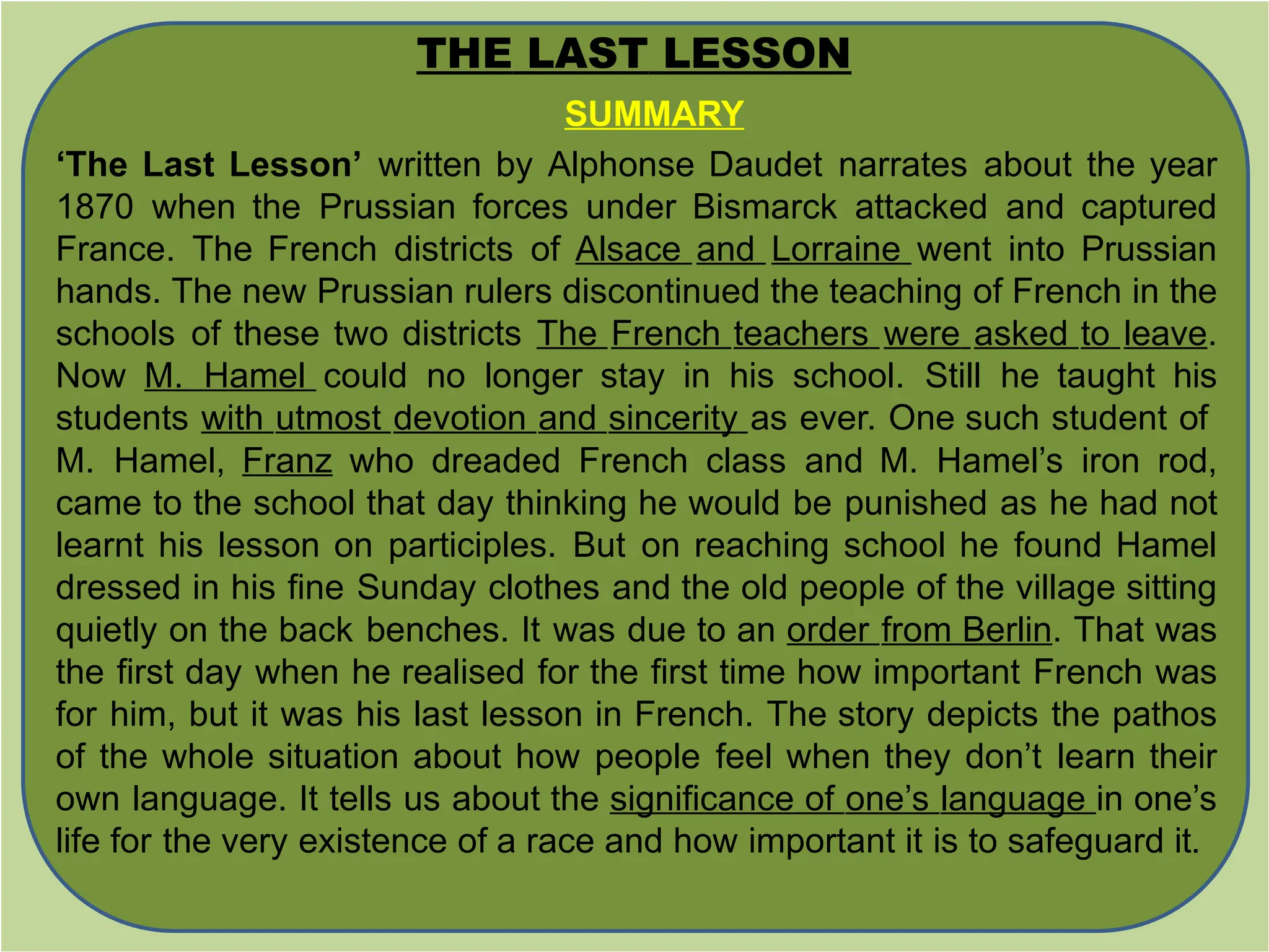
SUMMARY
‘The Last Lesson’ written by Alphonse Daudet narrates about the year
1870 when the Prussian forces under Bismarck attacked and captured
France. The French districts of Alsace and Lorraine went into Prussian
hands. The new Prussian rulers discontinued the teaching of French in the
schools of these two districts The French teachers were asked to leave.
Now M. Hamel could no longer stay in his school. Still he taught his
students with utmost devotion and sincerity as ever. One such student of
M. Hamel, Franz who dreaded French class and M. Hamel’s iron rod,
came to the school that day thinking he would be punished as he had not
learnt his lesson on participles. But on reaching school he found Hamel
dressed in his fine Sunday clothes and the old people of the village sitting
quietly on the back benches. It was due to an order from Berlin. That was
the first day when he realised for the first time how important French was
for him, but it was his last lesson in French. The story depicts the pathos
of the whole situation about how people feel when they don’t learn their
own language. It tells us about the significance of one’s language in one’s
life for the very existence of a race and how important it is to safeguard it.
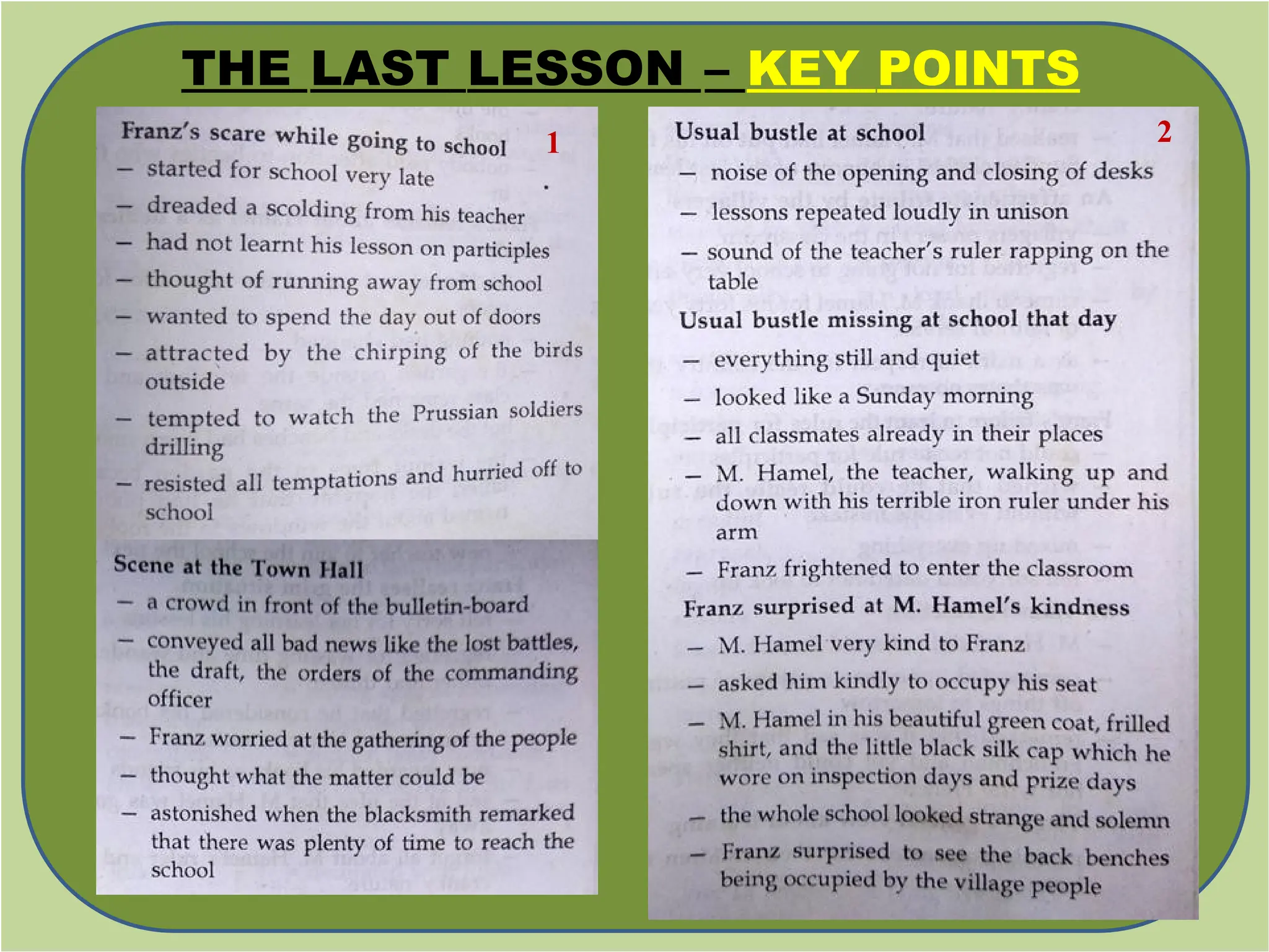
THE LAST LESSON – KEY POINTS
1 2
THE LAST LESSON – KEY POINTS
3
4
THE LAST LESSON- KEY POINTS
5
6
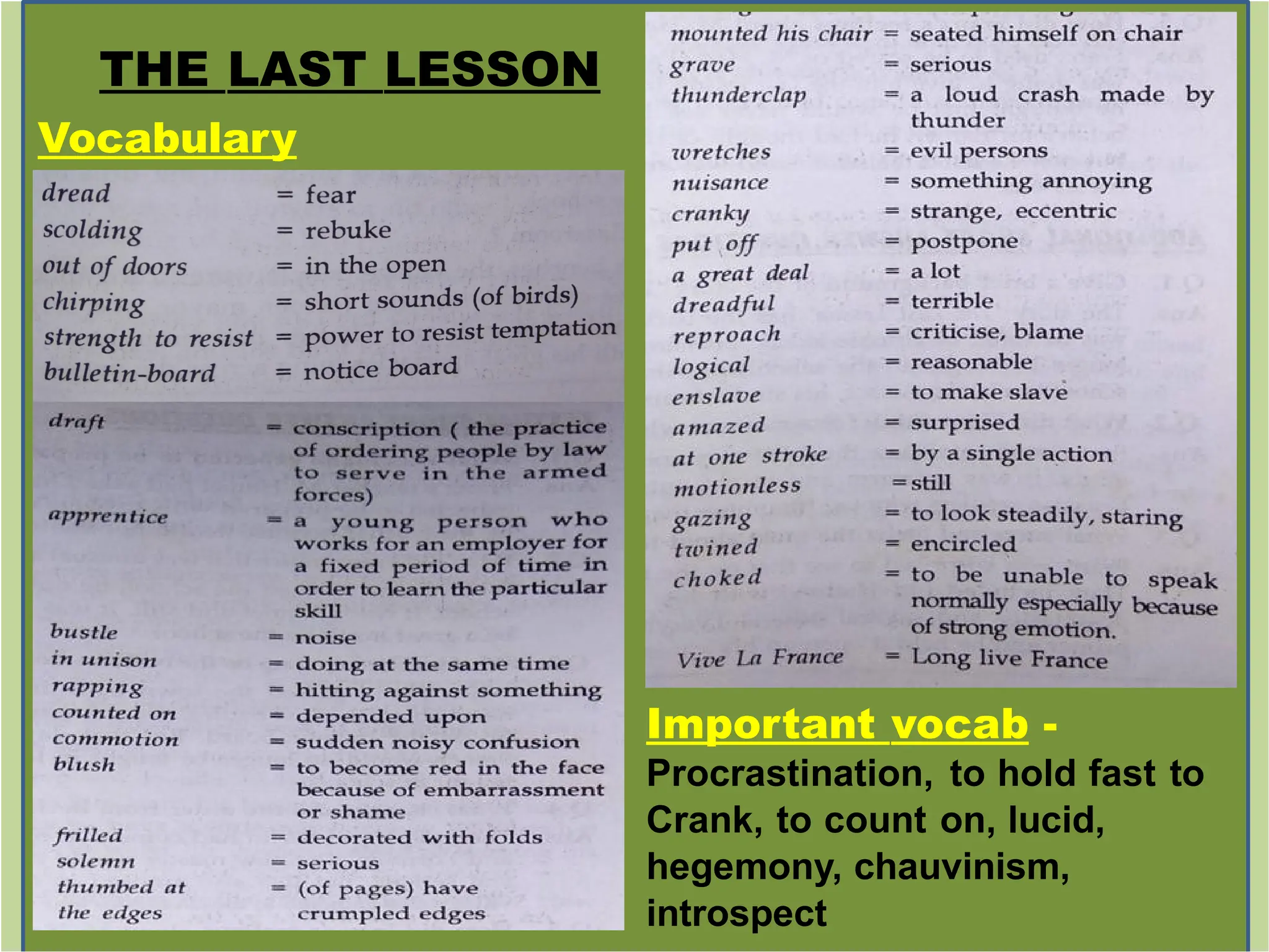
THE LAST LESSON
Vocabulary
Important vocab -
Procrastination, to hold fast to
Crank, to count on, lucid,
hegemony, chauvinism,
introspect
THE LAST LESSON
REFERENCE TO THE CONTEXT
 It was all much more tempting than the rule for participles
 What can be the matter now?
 Don’t go so fast, bub; you’ll get to your school in plenty of time!
 …as quiet as Sunday morning
I had counted on the commotion to get to my desk
without being seen
 What a thunderclap these words were to me!
…that had seemed such a nuisance a while ago…that I
couldn’t give up.
 What would I not have given to be able to say that dreadful rule
…But I got mixed up on the first words
 We’ve all a great deal to reproach ourselves with.
…when a people are enslaved, as long as they hold fast to
their language it is as if they had the key to their prison.
 …put it all into our heads at one stroke.
 Will they make them sing in German, even the pigeons?
ASSIGNMENT : QUESTIONS TO TEST
COMPREHENSION
Short Answer Questions (30-40 words)
1. What did Franz notice that was unusual about the school that day?
2. What changes did the order from Berlin cause in the school that day?
3. How did Franz’s feelings about M. Hamel and school change?
4. W hy was Franz tempted to miss the school that day?
5. How did Franz decide to enter the classroom?
6. How did M. Hamel react when Franz arrived late in the school?
7. “We have a great deal to reproach ourselves with.” Comment.
8. “W ill they make them sing in German, even the pigeons?”. Comment.
Long Answer Questions (100-125 words) :
9. “As long as you hold fast to your language, you have the key to prison”.
Comment.
10. How did M. Hamel deliver his last lesson and what was its impact on
the students and the villagers?
11.The people in the story suddenly realize how precious their
language is to them. What shows you this? W hy does this happen?
12. Draw a character sketch of M. Hamel?
THE LAST LESSON

The-Last-Lesson.pptx class 12 NCERT lesson

  • 1.
    THE LAST LESSON -AlphonseDaudet (1840-1897) INDEX 1. About the Author 2. Theme, Sub-theme, Plot 3. Characters 4. Summary 5. Key-Points 6. Vocabulary 7. Points to Ponder 8. Assignments
  • 2.
    1840 in Nimesin Vincent Daudet, manufacturer. He France to a silk began his career as a school teacher but later took to writing. Daudet is remembered chiefly as a short- story writer and novelist of sentimental tales of provincial life in France. THE LAST LESSON -Alphonse Daudet (1840-1897) About the Author : Alphonse Daudet was born on 13 May
  • 3.
    Background of thestory : The story is set at the backdrop of the Fraco-Prussian War (1870-71) in which Prussia France was defeated by led by Otto von Bismarck (1815–1898), the first Chancellor of Germany. Prussia then consisted of what now are the nations of Germany, Poland and parts of Austria. In this story the French districts of Alsace and Lorraine have passed into Prussian hands. THE LAST LESSON
  • 4.
    THE LAST LESSON Theme– The pain that is inflicted on the people of a territory by its conquerors by taking away the right to study or speak their language Sub-Theme – Students’ and teachers’ attitude to learning and teaching respectively Plot – The order from Berlin – The Last Lesson delivered by M Hamel – Its Impact The story also highlights colonial hegemony, linguistic chauvinism and consequences of procrastination
  • 5.
    CHARACTERS :  Franz– the narrator (a school boy, truant)  Monsieur Hamel – a teacher (a strict disciplinarian)  Villagers – old Hauser, former Mayor, former Postmaster and several others  Wachter – the blacksmith THE LAST LESSON
  • 6.
    THE LAST LESSON SUMMARY ‘TheLast Lesson’ written by Alphonse Daudet narrates about the year 1870 when the Prussian forces under Bismarck attacked and captured France. The French districts of Alsace and Lorraine went into Prussian hands. The new Prussian rulers discontinued the teaching of French in the schools of these two districts The French teachers were asked to leave. Now M. Hamel could no longer stay in his school. Still he taught his students with utmost devotion and sincerity as ever. One such student of M. Hamel, Franz who dreaded French class and M. Hamel’s iron rod, came to the school that day thinking he would be punished as he had not learnt his lesson on participles. But on reaching school he found Hamel dressed in his fine Sunday clothes and the old people of the village sitting quietly on the back benches. It was due to an order from Berlin. That was the first day when he realised for the first time how important French was for him, but it was his last lesson in French. The story depicts the pathos of the whole situation about how people feel when they don’t learn their own language. It tells us about the significance of one’s language in one’s life for the very existence of a race and how important it is to safeguard it.
  • 7.
    THE LAST LESSON– KEY POINTS 1 2
  • 8.
    THE LAST LESSON– KEY POINTS 3 4
  • 9.
    THE LAST LESSON-KEY POINTS 5 6
  • 10.
    THE LAST LESSON Vocabulary Importantvocab - Procrastination, to hold fast to Crank, to count on, lucid, hegemony, chauvinism, introspect
  • 11.
    THE LAST LESSON REFERENCETO THE CONTEXT  It was all much more tempting than the rule for participles  What can be the matter now?  Don’t go so fast, bub; you’ll get to your school in plenty of time!  …as quiet as Sunday morning I had counted on the commotion to get to my desk without being seen  What a thunderclap these words were to me! …that had seemed such a nuisance a while ago…that I couldn’t give up.  What would I not have given to be able to say that dreadful rule …But I got mixed up on the first words  We’ve all a great deal to reproach ourselves with. …when a people are enslaved, as long as they hold fast to their language it is as if they had the key to their prison.  …put it all into our heads at one stroke.  Will they make them sing in German, even the pigeons?
  • 12.
    ASSIGNMENT : QUESTIONSTO TEST COMPREHENSION Short Answer Questions (30-40 words) 1. What did Franz notice that was unusual about the school that day? 2. What changes did the order from Berlin cause in the school that day? 3. How did Franz’s feelings about M. Hamel and school change? 4. W hy was Franz tempted to miss the school that day? 5. How did Franz decide to enter the classroom? 6. How did M. Hamel react when Franz arrived late in the school? 7. “We have a great deal to reproach ourselves with.” Comment. 8. “W ill they make them sing in German, even the pigeons?”. Comment. Long Answer Questions (100-125 words) : 9. “As long as you hold fast to your language, you have the key to prison”. Comment. 10. How did M. Hamel deliver his last lesson and what was its impact on the students and the villagers? 11.The people in the story suddenly realize how precious their language is to them. What shows you this? W hy does this happen? 12. Draw a character sketch of M. Hamel? THE LAST LESSON