Society & Change
Vol. VI, No. 3, July-September 2012
ISSN :1997-1052 (Print), 227-202X (Online)
Kashmir Conflict: A Critical Analysis
Saifuddin Ahmed1
Anurug Chakma2
Abstract
The conflict between India and Pakistan over Kashmir which is
considered as the major obstacle in promoting regional integration as
well as in bringing peace in South Asia is one of the most intractable and
long-standing conflicts in the world. The conflict originated in 1947
along with the emergence of India and Pakistan as two separate
independent states based on the ‘Two-Nations’ theory. Scholarly
literature has found out many factors that have contributed to cause and
escalate the conflict and also to make protracted in nature. Five armed
conflicts have taken place over the Kashmir. The implications of this
protracted conflict are very far-reaching. Thousands of peoples have
become uprooted; more than 60,000 people have died; thousands of
women have lost their beloved husbands; nuclear arms race has geared
up; insecurity has increased; in spite of huge destruction and war like
situation the possibility of negotiation and compromise is still absence .
This paper is an attempt to analyze the causes and consequences of
Kashmir conflict as well as its security implications in South Asia.
Introduction
Jahangir writes: “Kashmir is a garden of eternal spring, a delightful
flower-bed and a heart-expanding heritage for dervishes. Its pleasant
meads and enchanting cascades are beyond all description. There are
running streams and fountains beyond count. Wherever the eye reaches,
there is verdure and running water. The red rose, the violet, and the
narcissus grow of themselves; in the fields there are all kinds of flowers
and all sorts of sweet-scented herbs more than can be counted.” Kashmir
is “a region of stupendous mountains surprises every other in the world”
to Younghusband, “the terrestrial paradise of the Indies” to Bernier, a
“picture of incredible beauty with its distant features half revealed half
1
Saifuddin Ahmed is a lecturer in the Department of Peace and Conflict Studies,
University of Dhaka, Bangladesh.
2
Anurag Chakma is a Research Assistant of South Asia Youth Forum for Peace and
Prosperity Society (SAYPPS), Dhaka, Bangladesh.
Kashmir Conflict: A Critical Analysis
21
concealed by magic mist” to Walter Lawrance. Nehru observes: “It has a
hundred faces and innumerable aspects, ever-changing, sometimes
smiling, sometimes sad and full of sorrow.”1
But it is a matter of great sorrow that Kashmir, the paradise of earth, is
witnessing one of the oldest protracted conflicts of the world. The dispute
over Kashmir between India and Pakistan is into a never ending cycle of
arms race and violence... No compromise could be reached over Kashmir
yet, as both the powers either claim jurisdiction over it or call it a right of
self-determination for the Kashmiri people. Centering this issue, mistrust
and hatred keep on spiraling, manifestation of which is found in long
drawn out low intensity conflict. 2
It is recognized that Kashmir conflict
has implication on the security of the South Asia. It is also the largest
obstacle for the South Asian Association for Regional Cooperation
(SAARC) to achieve its goals. It is mostly responsible for the
nuclearization in South Asia. Many compare the problem of Kashmir to
the time-bomb which blast can bring unlimited sorrows and suffering for
the people of this region. With an eye to resolve this protracted conflict,
many initiatives have been taken by both India and Pakistan, even by the
international community in different times but no progress has been made
yet.
Geographical identity of Kashmir
The state of Jumma and Kashmir is located approximately between 32o
15‟ and 37o
17‟, North latitudes and 72o
35‟ and 80o
20‟, East longititudes
with a total area of 222,236.2 sq. kms. constituting about 7% percent of
the total land area of India. The state has a strong genetic relationship
with the Himalayas, which exercises an important influence on its
geographical proximity. The state can be divided into four major parts as
under;
 The North-Western Areas and Frontiers Region, which are under
Pakistan occupation called Northern areas collectively
 Ladakah, including parts under Pakistani and Chinese Occupation
 Kashmir Division, including Muzzafarbad which is in Pakistan
Occupied Areas
 Jumma Division, including areas of Mirpur, Kotti and Poonch in
Pakistan Occupied Areas.3
The most prominent physiographical feature of Kasmir has been
described as a double-staircase, the one ascending and facing Pakistan
and the rest of India and the other descending into Tibet. To the south the
first step starts from the low Punjab hills, which run in a liive with the
Siwalik hills, its height exceedingly 1,000 feet and its breadth 10 miles.
Society & Change
Vol. VI, No. 3, July-September 2012
22
The next step is reached after crossing the PirPanjal, running from
Muzaffarbad to Kistwar. The third step is that of Great Himalays nearly
150 miles long. 4
Historical background of Kashmir
The earliest kingdoms in Kashmir, according to tradition, existed before
B. C. 2,000, known throughout its recorded history as Kashmira, in its
original Sanskrit form, the name still lives as Kashmir, in Persian spelling
Kashmir, which is its modern version. The name itself, undoubtedly, is
far more ancient.5
It is important to understand the background of the conflict that the
Hindu-Muslim communal conflict is the outcome of British imperialist
policy “Divide and Rule.” In British India, there were sharp conflicts
between these two groups of people. As a result, the British India was
divided into two parts along religious lines and India and Pakistan came
into being as two separate states based on the „Two-nation‟ theory in
1947. These two countries experienced a communal holocaust with some
800,000 causalities. Therefore it is argued that the Kashmir problem is
actually dates back to the partition of British India.6
When the British authority left the sub-continent, the princely state of
Jumma and Kashmir were under the rule of Maharajah Hari Sing who
was personally a Hindu by religion but the population of the state was
predominantly Muslims. There were certain ambiguities over the future
status of the state when the British transferred power to India and
Pakistan. The Indian independence act of 1947, in theory, left the states
legally independent when the „sovereignty of his majesty over the Indian
state‟s lapses. But in practice, such independence was ruled out when the
Secretary of the State for India, Lord Listwell declared: “We don‟t, of
course, purpose to recognize any state as separate international entity.
This meant in reality the states would have to seek accession to either one
of the two dominions in accordance with the broad principles of the
partition plan. Muslim majority states would accede to Pakistan and the
rest to India.” In these circumstances, Maharajah Hari Sing, the ruler of
the Kashmir, at first delayed and later concluded an agreement which
Pakistan accepted but India did not. Between August and September 1947
the Muslim subjects of Maharajah rose in an open revolt.7
On 22 October
1947, the peace in Jumma and Kashmir was shattered by an invasion
from Pakistan territory. Faced with a great threat to the life and honor of
his people, the ruler as well as the leaders of the National Conference, the
largest political party in the state appealed to India for urgent help.8
Maharajah fled from Srinagar to India and agreed to accede to India on26
Kashmir Conflict: A Critical Analysis
23
October 1947. The preamble of the constitution of Jumma and Kashmir
states;
“We the people of the state of Jumma and Kashmir, having
solemnly resolved, in pursuance of the accession of this state to India
which took place on the twenty-six day of October 1947, to further
define the existing relationship of state with the Union of India as an
integral part of thereof...”9
As soon as India accepted the accession and sent troops to Srinagar to
quell the rebellion and to drive out of Srinagar the invasion of the
Pakistani tribesmen. India took control over two-thirds of Jumma and
Kashmir, and Pakistan the remaining part. Since then four armed conflict
have taken place over this issue.10
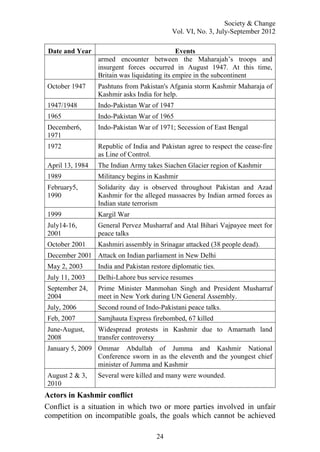
The timeline of the Kashmir conflict
was given in the following table.1 11
Table.1: Timeline of the Kashmir Conflict
Date and Year Events
1846 Kashmir is sold: The British colonial rulers of British India
Empire sold Kashmir, including its population, through a
deed of sale called the Treaty of Amritsar, to a Hindu warlord
who had no roots in the area. This warlord began calling
himself the Maharajah of Jammu and Kashmir. His was a
particularly brutal regime, memories of which persist to this
day. Several mosques were occupied and shut down by his
forces. The slaughtering of a cow was declared a crime
punishable by death.1925 to 1947: discrimination against the
Muslim majority: Maharajah Hari Singh continued this policy
of discrimination against the Kashmiri population, 94 percent
of which is Muslim.
1857 The War of independence, The Subcontinent fractured into
hundreds of states
1931 Kashmir‟s first organized protest: The people of Kashmir
hold their first organized protest against Maharajah Hari
Singh‟s cruelty. The 1931 protest led to the “Quit Kashmir”
campaign against the Maharajah in 1965, and eventually to
the Azad Kashmir movement which gained momentum a year
later.
March 3, 1940 Azad Kashmir comes into being: The Muslim Conference
adopts the Azad Kashmir Resolution on July 26, 1946 calling
for the end of autocratic rule in the region. The resolution also
claims for Kashmris the right to elect their own constituent
assembly.
August 14/15,
1947
Independence of the British-India into India and Pakistan
August 1947 Kashmiri resistance encounters Maharajah‟s troops: The first
Society & Change
Vol. VI, No. 3, July-September 2012
24
Date and Year Events
armed encounter between the Maharajah‟s troops and
insurgent forces occurred in August 1947. At this time,
Britain was liquidating its empire in the subcontinent
October 1947 Pashtuns from Pakistan's Afgania storm Kashmir Maharaja of
Kashmir asks India for help.
1947/1948 Indo-Pakistan War of 1947
1965 Indo-Pakistan War of 1965
December6,
1971
Indo-Pakistan War of 1971; Secession of East Bengal
1972 Republic of India and Pakistan agree to respect the cease-fire
as Line of Control.
April 13, 1984 The Indian Army takes Siachen Glacier region of Kashmir
1989 Militancy begins in Kashmir
February5,
1990
Solidarity day is observed throughout Pakistan and Azad
Kashmir for the alleged massacres by Indian armed forces as
Indian state terrorism
1999 Kargil War
July14-16,
2001
General Pervez Musharraf and Atal Bihari Vajpayee meet for
peace talks
October 2001 Kashmiri assembly in Srinagar attacked (38 people dead).
December 2001 Attack on Indian parliament in New Delhi
May 2, 2003 India and Pakistan restore diplomatic ties.
July 11, 2003 Delhi-Lahore bus service resumes
September 24,
2004
Prime Minister Manmohan Singh and President Musharraf
meet in New York during UN General Assembly.
July, 2006 Second round of Indo-Pakistani peace talks.
Feb, 2007 Samjhauta Express firebombed, 67 killed
June-August,
2008
Widespread protests in Kashmir due to Amarnath land
transfer controversy
January 5, 2009 Ommar Abdullah of Jumma and Kashmir National
Conference sworn in as the eleventh and the youngest chief
minister of Jumma and Kashmir
August 2 & 3,
2010
Several were killed and many were wounded.
Actors in Kashmir conflict
Conflict is a situation in which two or more parties involved in unfair
competition on incompatible goals, the goals which cannot be achieved
Kashmir Conflict: A Critical Analysis
25
by two parties. In Kashmir conflict there are three parties, it has been
recognized by the politicians and scholars, notably after seizing power,
Pakistan in 1958, President Ayub said that “there are three parties to the
Kashmir conflict- the people of Kashmir, India and Pakistan.12
India is directly involved in the conflict which becomes clearer from
the comment of Nehru: “Kashmir has been in history for thousands of
years-not always politically but essentially-a part of India, for thousands
of years. It was politically a part of India long before the British came.
Culturally,, of course, it has been one of the biggest seats of Indian
culture and learning throughout history for about 2,000 years. Some of
the first books on Indian history were written on Kashmir.” 13
he popular
language spoken in Kashmir for centuries and even in Klahanie‟s time
was a dialect derived from Sanskrit which has gradually developed into
the modern Kashmir. 14
India thinks that Kashmir is an integral part of it.
So, she will not sacrifice in the question of Kashmir anyhow. She wants
to keep the Kashmir under his control. There is a stiff resistance and
opposition against the idea of independence. Many in India view
independence of Kashmir as a risk and regard it as a time bomb as well as
think it as the surrender of Indian authority and sovereignty to Kashmir.
Therefore, it is difficult to expect India that she will relinquish parts of its
claimed territory to earn good will in search of peace.15
As a party of Kashmir conflict Pakistan states that the state accession
to India was brought about by fraud and violence. To repeat that Kashmir
is an integral part of India is utter nonsence.16
Therefore, it has been
observed that the Pakistan government under different civil and military
regimes have not only overtly supported insurgency in Kashmir but have
clandestinely been supporting them and raising the Kashmir question in
international flora when the problem of Kashmir has raised and become a
matter of discussion. Mohd. Ali Jimmah who is regarded as the father of
Pakistan urged the Kashmiri Muslims to unite with the sub-continental
co-religionists for making the „Muslim Nation‟, a reality. Zulfikar Ali
Bhutto openly spoke of dismantaling the barrier between the people of
Jumma and Kashmir and their kith and kin in Azad and Pakistan. He had
even once advocated the use of force to resolute the fight between Indian
imperialism and Kashmiri democracy. His daughter Benjir Bhutto when
became PM promised 1,000 years of war with India are often cited
examples of Pakistan involvement in Kashmir conflict.17
The Kashmiri people are itself a party of this protracted conflict. They
have been carrying out the movement of self-determination. The latest
situation of Kashmir has become very worse. People are demonstrating in
the streets peacefully, sometimes violently. The Indian security force is
brutally attacking on the peaceful demonstration. Several have been
Society & Change
Vol. VI, No. 3, July-September 2012
26
killed and many wounded in August of the running year. It is also
noteworthy that there are three sections among the people of Kashmir in
the question of their demands. One group wants independence, the
second group attachment with Pakistan and the third group wants to stay
with India.
What are the factors that have made Kashmir Conflict protracted?
Both internal and external factors have contributed to make the Kashmir
problem intractable. The deep-rooted mutual hostility between India and
Pakistan is thought to be the major factor for the Kashmir conflict. The
conflict theory argues that conflict is occurred between parties mostly on
the basis of the non-negotiable goals. The parties perceive with each
other as enemy in terms of seeking their vital interests. When their
behaviors become violent and aggressive because of the existing
contradictions, conflict escalates and takes the form of violence. In case
of Kashmir conflict we can see that the conflict has originated on the
incompatible goal, that is “possession of Kashmir”. The paties seek to
achieve this goal. Therefore, there is no any space for compromise on the
issue of Kashmir because the issue is absolutely the matter of non-
negotiable goal. To the citizens whose basic identity is with Pakistan, the
only legitimate unit of governance is Pakistan. On the other hand, the
only legitimate unit of governance is India to the citizens which basic
identity is with India. The following factors have drawn the attention of
scholars.
Division along ethnic lines
In the opinion of some conflict analysts like Ted Robert Gurr and
Michael E. Brown etc. multiethnic states or societies are more likely to
conflict-prone than homogenous states or societies. The population of
Jumma and Kashmir is divided along ethnic, religious, and linguistic
lines. The major groups are Muslims and Hindus. It is believed that
division of the population along ethnic, religious and linguistic lines is
one of prime factors for Kashmir conflict.
Political allegiances
Political allegiances are thought to be one of the contributing factors for
around 60 year‟s long Kashmir conflict. We can see that there are three
distinct political orientations in Indian-controlled Kashmir. Independence
is preferred by a decisive majority in the valley and by a sizable minority
in the Jumma region. On the other hand, there appear to be two major
different political political orientations in Pakistan-controlled Kashmir as
well as loyalty to Pakistan and support for the third option of
„independence.‟18
Kashmir Conflict: A Critical Analysis
27
Involvement of super powers
During the cold war many proxy wars between the US and Soviet Russia
took place in different parts of the world although they did not fight
directly. The South Asia also witnessed a proxy war in 1971 according to
scholars. The rivalry between these two states also manifested in the
competition of capturing the strategically important places. Kashmir, in
the view of geo-politicians and military experts, became a matter of
concentration because of its geographical importance during the cold war.
The involvement of The US and Soviet Russia has contributed to
Kashmir conflict. Since the end of the Second World War, the US started
taking a keen interest in Kashmir. Papers like New York Times and the
New York Herald Tribune started writing about the strategic importance
of the state because of its proximity to Soviet Union and its new
industrial centers. Rosinger indicated; “the interest of the US presumably
arose in part from Kashmir‟s strategic location, close to the USSR and
bordering on Afghanistan, Sinkiang, Tibet, India and Pakistan. 19
The
prime strategic objectives of the USA were taking control on Kashmir
and making it a military strategic base against the Soviet Union.20
In the
present on-going militant movement American heightened interest in
Kashmir is quite clear and visible. The American policy has changed
largely from what it was during the cold war period. It has sought to
persuade Islamabad to opt for a negotiated settlement of the Kashmir
dispute.21
The Soviet Union immediately demonstrated its vital strategic
interest after the invasion of the tribal forces from NWFP invaded in
Kashmir in October, 1947.The Strategic importance of the Kashmir to the
Soviet Union was highlighted by the Soviet Political Weekly „New
Times‟ when it asserted that “the underlying cause of war 9n Kashmir lay
in this state‟s geographical location at the juncture of several state
borders, including in particular, the Soviet Union. 22
Stalin looked at
Kashmir as a military strategic area and a spring board of Soviet‟s
communism in the Indian Sub-continent. It is clear that the Soviet Union
during Stalin‟s period had clear-cut strategic objectives for seeking
Kashmiris an „Independent Nation.‟ The Soviet wanted to convert
Kashmir into a laboratory where further and future communists
experiments could be conducted since 1953.23
Moscow spelled out the
new Soviet policy towards Kashmir with renewed emphasis on the
strategic importance of the state to the security of the Soviet Union.
Nature of politics of both India and Pakistan
The nature of politics of both India and Pakistan has been such that
resolution of Kashmir problem is not so easy and possible. Pakistan was
created on the basis of religion „Islam‟. Another factor is that Pakistan
was dominated by military peronnel for most of the time since its
Society & Change
Vol. VI, No. 3, July-September 2012
28
emergence. Therefore, Pakistan could not come in a compromise. India
politics is not also conducive for compromise with Pakistan on Kashmir
issue. Although, India was established on the basis of secular ideology,
Hindu identity has played and is still playing key role in India especially,
it becomes clear when Hindu-Chauvinistic BJP emphasized the point that
Muslims in India have been unduly pampered it has made the question of
Kashmir‟s special status in the Indian Union as enshrined in Article 370‟s
of India‟s constitution as its whipping boy.24
Islamic resurgence movements
Islamic resurgence movements particularly Islamic revolution in Iran and
Afghanistan contributed to the present political upheaval in the valley.
The success of the Iranian revolution gave confidence and grew a sense
in the minds of the people of Kashmir that if Iranians can overthrow and
defeat the Shah, why the Kashmiris can‟t overthrow the Indian
hegemony. It is Jamma‟at-i-Islami of Kashmir which became a bridge
connecting Kashmir with the overall Islamic resurgence.25
The aims and
objectives of the Jama‟ at-i-Islami emerges from the writing of its
prominent leader, Syed Ali ShaGeelani26
who in a booklet named
„Mukadima-Illaq spoke to the people of Kashmir in these words; 27
“You the nation of Kashmiri Muslims, how long will you continue
to remain easygoing slaves! Your enemies are bent upon destroying
your identity and faith.”
Militancy
Militancy in Kashmir is not wholly a new phenomenon. It has peculiar
history, the level of intensity was not as high and sophisticated as it has
become. The seeds of militancy were sown by the erstwhile Plebiscite
Front during its 22 years of political existence.in 1967; the first incident
of militancy came into being when some youth were arrested for
allegedly attempting to murder a CRPF Jawan, Charan Das in
Nawakanda area of interior Srinagar. It was again in 1968 that a group of
youth from Ghandi Memorial college determined to commence an armed
struggle in the state. No less than 80 underground cells and espionage
rings operated including Al-Fatah, Al-Baro, and Al-Kashmir in the period
between January 1960 and January 1971. The Jumma and Kashmir
Liberation Front (JKLF) is another organization which since its
emergence has been engaged in militant activities.28
1,667 insurgency
related incidents were registered, a total of 23,492 cases of crime were
registered only in 2006.29
Kashmir Conflict: A Critical Analysis
29
Social identity
Social identity, of course there are many factors, need to be taken into
account in understanding any conflict. Human needs of identity and
dignity have drawn the attention of the scholars in case of analyzing
conflict. In the opinion of many scholars, identity or threat to identity is
the foundation of numerous conflicts as well as contribute to high
intensified conflicts, terrorisms and ethnic based clashes. Kashmir
conflict is not also an exception. Racine, a social scientist, argues that the
political history of South Asia in the last fifty years has been marked by
the identity factor along with the religious, ethno-linguistic, caste-based
and other forms of diversity. The division of India sub-continent and the
emergence of Pakistan is probably the outcome of the pressure of all
these multiple identities. In fact,the existence of cultural, ethno-linguistic,
religious or other forms of identity in Kashmir have made a complex
social reality. The India controlled part of Kashmir is inhabited by four
groups-Muslims, Hindus, Buddhist and Sikhs. Each of them also belongs
to different caste, sects, ethnicity, culture and tradition. On the Pakistani
side, there is also same reality. Northern Areas is dominated by the Shia
religious community and Sunnis are the majority in AJK (Azad Jammu &
Kashmir). They belong to different culture and heritage although they
profess the religion Islam. It is also notable here that there is a growing
population in Northern Areas who do not never perceive themselves as
Kashmiri nor Pakistani.30
The rivalry between India and Pakistan is so deep-rooted which cannot
be resolved in win-win solution. Many scholars and leaders view the
Indo-Pakistan relations as zero-sum game where the gain of one is seen
the loss of the other. 31
The consequences of Kashmir Conflict
Forced Displacement and Refugees
A report states that the 1998 armed conflict between India and Pakistan
produces a large number of displaced peoples. Over 2,200 families,
comprising 11,884 persons had migrated from Doda, Udhampur, Poonch
and Rajouri regions, and more than 400 of these families took shelter in
the Talwara camp in Reasi in Udhampur district.32
According to the report
of Ministry of Home Affairs in 2005-06, around 55,476 Kashmiri Pandit
families had been displaced owing to the armed conflict in Jammu and
Kashmir since early 1990. Of them, 34,088 families had been living in
Jammu, 19,338 families in Delhi and 2,050 families in other States and
Union Territories. 33
About two lakh Hindu refugees were living in the
Jammu and Kashmir since 1947.34
Society & Change
Vol. VI, No. 3, July-September 2012
30
Death
Kashmir conflict is one of the causes of violation of human rights in
South Asia. It has resulted death of thousands of people. The table. 2
indicates the figure of death of peoples in recent times.35
It is estimated
that the number of death is between 40,000 and 67,000.
Table.2: Death row in recent years.
Year Civilians Security force personnel Terrorists Total
2006 349 168 599 1116
2007 164 121 492 777
2008 69 90 382 541
2009 55 78 244 377
2010 12 18 57 87
649 475 1774 2898
Gross human rights violation
Conflict and violence involves gross human rights violation. In a
conflicting zone, women are raped; children are killed; people are forced
to flee. Therefore, the issue of Kashmir conflict is the issue of gross
human rights violation. According to a report published in the Tribne in
March 26, 2003, hundreds of people had gone missing in the State since
the internal armed conflict began in 1990. It can also be cited that
Muzaffar Hussain Beig, the minister for Law and Finance Department of
Jammu and Kashmir, made a statement in the State Assembly in March
25, 2003 that a total of 3,744 persons had disappeared in the State from
1990 to December 2002 and 135 of them had been declared dead up to
June 2002. However, according to the Association of the Parents of
Disappeared Persons (APDP), more than 8,000 persons had disappeared
during the past 16 years of turmoil.36
It can also be added that killing of
political party workers and leaders by the armed opposition groups were
extensively reported from Jammu and Kashmir during 2006. The State
Government in a reply to a question by MLA Mohammed Yousuf
Taringami in the State Assembly in March 23, 2006 stated that a total of
39 political activists were killed by the AOGs only in the period between
January 2005 and February 2006.19 out of these 39 political activists
were the members of People's Democratic Party, 8 of National
Conference followed by Congress (5), Independent (3), CPI-M (2),
Peoples Democratic Forum (1) and Jamaat-e-Islami (1). The State
Government also stated in the reply that a total of 535 civilians were
killed during the same period.37
Kashmir Conflict: A Critical Analysis
31
Widespread violence
Widespread violence is the companion of conflict and violence. Since
1947 there have been many massacres in the Kashmir. Violence was the
life of Kashmir. There had and has no peace; no security; no happiness;
and no fair environment. Violence is still following here
Psychological Impacts
The psychological impact of conflict and violence is ever lasting. During
the war, many lost their beloved persons that injure them psychologically.
To clear it, we can take the example of Japanese who lost many things in
the world War Second. There are many such kind of stories in the region
of Kashmir.
The Vulnerability of Women
Conflict and violence cause a serious vulnerability of women.
Particularly, women and children are the sufferers of any conflict and
violence. Women and children remained extremely vulnerable. The
Government only paid a meager amount of stipend or cash relief to those
women and children whose husbands and parents were killed by the
AOGs but did not provide any help to those whose family members were
killed by the security forces. According to the report of Public
Commission on Human Rights, there were about 25,000-30,000 widows
whose husbands were brutally killed by the security forces. According to
Yateem Trust, an NGO working with orphans and widows in Kashmir,
there were about 15,308 orphans whose fathers were killed by the
security forces.39
Arms race and the security of South Asia
Neither India nor Pakistan has signed the NPT. There is a danger that
nuclear race between these two countries may go out of hand. It would
threaten both regional and global peace and security. India is a large
country with its large area and population has developed a strong
indigenous nuclear infrastructure. India produces a large amount of
unsafeguarded plutonium and it may also have the capability to produce
thermonuclear weapons.40
The US and ther other Western countries
provided assistance largely to India in the field of nuclear technology
before the export restrictions were imposed by the London supplier‟s club
in the 1970s.41
Today India has gained ability produce all nuclear
weapons‟ materials; 238,235233
U, 239
Pu,Tritium, Detrium, Maragin steel,
Conbalt-Samarium magnets and Zirconium Oxides.42
India has possessed
sophisticated aircraft that could deliver weapons to targets both in China
and Pakistan. 43
According to a report published in October last year, Pakistan so far
possesses 50-90 nuclear weapons. The report compiled by a Washington
Society & Change
Vol. VI, No. 3, July-September 2012
32
based nuclear watchdog, the Institute for Science and Security also claims
that Pakistan has 1,000-1,250 kGs. highly enriched uranium. Besides,
within last few years in collaboration with China, Pakistan has produced
Al-Khalid MBT, which called tanks of 21st
century. This arms race and
acquisition of nuclear weapons by both India and Pakistan has increased
insecurity in the South Asia.44
Initiatives to Resolve the Kashmir Conflict by Both India and
Pakistan
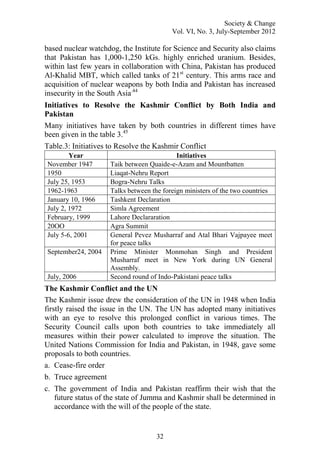
Many initiatives have taken by both countries in different times have
been given in the table 3.45
Table.3: Initiatives to Resolve the Kashmir Conflict
Year Initiatives
November 1947 Taik between Quaide-e-Azam and Mountbatten
1950 Liaqat-Nehru Report
July 25, 1953 Bogra-Nehru Talks
1962-1963 Talks between the foreign ministers of the two countries
January 10, 1966 Tashkent Declaration
July 2, 1972 Simla Agreement
February, 1999 Lahore Declararation
20OO Agra Summit
July 5-6, 2001 General Pevez Musharraf and Atal Bhari Vajpayee meet
for peace talks
September24, 2004 Prime Minister Monmohan Singh and President
Musharraf meet in New York during UN General
Assembly.
July, 2006 Second round of Indo-Pakistani peace talks
The Kashmir Conflict and the UN
The Kashmir issue drew the consideration of the UN in 1948 when India
firstly raised the issue in the UN. The UN has adopted many initiatives
with an eye to resolve this prolonged conflict in various times. The
Security Council calls upon both countries to take immediately all
measures within their power calculated to improve the situation. The
United Nations Commission for India and Pakistan, in 1948, gave some
proposals to both countries.
a. Cease-fire order
b. Truce agreement
c. The government of India and Pakistan reaffirm their wish that the
future status of the state of Jumma and Kashmir shall be determined in
accordance with the will of the people of the state.
Kashmir Conflict: A Critical Analysis
33
The Commission made another resolution on 5 January, 1949. The
Commission urged both countries to accept the principle of “the question
of the accession of the state of Jumma and Kashmir to India or Pakistan
would be decided through democratic method of a free and impartial
plebiscite.” In September 4, 1965 the Security Council adopted another
Resolution. The Resolution calls upon both the countries;
1. To take forthwith all steps for an immediate cease-fire
2. To respect the cease-fire line
3. To cooperate fully with the United Nations military observer group in
the task of supervising the observance of cease-fire
4. To report to the Council within three days on the implementation of
this Resolution.
Another Resolution was adopted too by the Security Council at its
1238th
meeting on 6 September, 1965 which calls upon the parties-
I. To cease hostilities in the entire area of conflict immediately
II. To exert every possible effort to give effect to this Resolution
III. To keep this issue under urgent and continuous review so that the
Council may determine what further steps may be necessary to
secure peace and security in the area.
But many think that the UN is absolutely failure to put the Kashmir
problem to an end. It is also equally true that the role of the UN can not
be ignored to prevent the parties from the nuclear war. It is also creating
pressure as well as encouraging the parties to reach an effective and
fruitful negotiation.46
How can the Kashmir conflict be solved?
The late Indian PM Lal Bahadur Shastri put the matter in a nutshell in his
speech at the opening session of the Tashkarent Meeting in January,
1996.“Respect for each other‟s sovereignty is essential for peace and
good relations. Once this has been clearly accepted, the whole character
of Indo-Pakistan relationship could be transformed to the benefit of the
people of both countries.”47
Scholars have provided some
recommendations to address the protracted Kashmir conflict which are as
follows;
 In terms of addressing the violent insurgency movement, also termed
as „terrorism‟, in the region, although both governments have
recognized to fight it jointly, measures such as arresting leaders and
banning schools associated with religious indoctrination may get rid of
the preachers and perpetrators of terrorism, but not the ideology nor
the underlying causes of it.
Society & Change
Vol. VI, No. 3, July-September 2012
34
 The peace process has to also address the oppressive policies and the
propaganda fuelling the movement.

Increase accountability, expanding people to people contact and the
deliberation on effective devolution of powers among different regions
to meet their aspirations.48
 The following major possible solutions have been put forward from
time to time to resolve the dispute of Kashmir.
 Plebiscite.
 Line of Control (LOC) as International Border
 Independent Kashmir.
 United Nations Trusteeship
 Good Friday Agreement.
 Exercise of cultural diplomacy.
Conclusion
The history of international relations in the region has been marked more
by conflict than co-operation. The region is experiencing the Kashmir
conflict, one of the protracted conflicts in the world which is known as
time-bomb for the South Asia. It is high time for realization of the
importance of resolution of this conflict. It is widely recognized that the
peace and prosperity of South Asia is mostly depending on the future of
this conflict.
Kashmir Conflict: A Critical Analysis
35
References
1. Cited from Sharma, B.L. (1971), “Kashmir Awakes”, Vikas Publication,
Delhi.
2. Karim, Mohd. Aminul, “Nuclear Doctrines of India and Pakistan: A
comparative Analysis”, BIISS Journal, Dhaka, pp.1-3, vol.25, no. 1, 2004.
3. Singh, Manabendra & Verma, Bharat (1994), “Kashmir: The Troubled
Frontiers”, Lancher Publications Ltd., 56 Gautam Nagar, New Delhi.
4. Maneek, B. Pithwala, “An Introduction to Kashmir” in B.L. Sharma (1971)
Kashmir Awakes, P.9.
5. Sharma, B.L. ibid..
6. Sabur, A.K. M. Abdus (1993), “Indo-Pakistan Security Relationship and the
Kargil War”, BISS Journal, Dhaka, vol. 20, no.3.
7. Barry, Buzan, (1986),” South Asian Insecurity and the Great Powers”,
MacMillan Press, Ltd, London.
8. Sharma, B.L. (1967), “Kashmir Story”, Asia Publication, London.
9. Sharma, B.L., ibid.
10. Barry, Buzan, (1986), “South Asian Insecurity and the Great Powers”,
MacMillan Press, Ltd, London.
11. Wikipedia, the free encyclopedia
12. Sharma, B.L., ibid,
13. Lawrance, Walter “the Valley of Kashmir”, cited in Maneek, B. Pithwala, “An
Introduction to Kashmir” in B.L. Sharma (1971) Kashmir Awakes, P.9.
14. M. A. Slien, “Rajatraangi”, cited in Maneek, B. Pithwala, “An Introduction to
Kashmir” in B.L. Sharma (1971) Kashmir Awakes, P.9.
15. http://www.kashmiraffairs.org/amina%20social%20identity%20and%20confli
ct.html
16. Maneek, B. Pithwala,ibid.
17. Sharma, B.L, ibid.
18. Bose, Sumantra (1999) “Kashmir: Source of Conflict, Dimensions of Peace”,
Survival, PP.. 149-171, vol. 41, no. 3
19. Barry, Buzan,Cited. opt.
20. Rosinger, Lawrance K. “India and United States cited in Barry, Buzan,
(1986),” South Asian Insecurity and the Great Powers”, MacMillan Press, Ltd,
London.
21. Pravada May 22, and June 1, 1950 cited in Barry, Buzan, ibid.
22. Barry, Buzan, (1986), “South Asian Insecurity and the Great Powers”,
MacMillan Press, Ltd, London.
23. Ibid.
24. Ghosh Partha s. (1992), International Problem in South Asia and Regional
Security,” BIISS Journal, PP. 367 – 381 vol. 3, No., 3 1992,
25. Barry, Buzan, “New Pattern of Global Security in the 21st
Century,”
International Affairs, vol. 67, no. 3, 1991.
26. Ibid.
Society & Change
Vol. VI, No. 3, July-September 2012
36
27. Sayed Ali Geelani, “Ye Bee Ek Rukh Tha Tasveer Kasmir Ka” Barry, Buzan,
cit. opt.
28. Wani, Gul, Mohd (1993) “Kashmir Politics: Problems and Prospects” Ashish
Publication, New Delhi.
29. Militancy declines but crime 13 times more, The Kashmir Times, 24 April
2007
30. http://www.kashmiraffairs.org/amina % 20 social % 20 identity % 20 and %
20 conflict. html
31. Barry, Buzan, cit. opt.
32. 'Buy me for Rs 2,000', The Tribune, 30 March 2006,
http://www.tribuneindia.com/ 2006/20060330/j & k.htm#1
33. Ministry of Home Affairs, Annual Report-2005-06, http://mha.nic.in/Annual-
Reports/ar 0506-Eng.pdf cited
fromhttp://www.achrweb.org/reports/india/AR07/ jammu.htm
34. Singh wants full citizenship for J&K refugees, The Kashmir Times, 14 March
2006 cited from
35. http://www.satp. Org./satporgtp/countries/india/terroristowfits/index.html
36. Govt faces ire over 'missing' Kashmiris, The Statesman, 13 March 2006
37. 39 political activists killed in 2005, The Kashmir Times, 24 March 2006
38. http://www.ummah.net/kashmir/kchr/hrviol.htm cited from
http://www.achrweb.org/reports/india/AR07/jammu.htm
39. Who's the victim? The Hindu Business Line, 6 October 2006 cited from
http://www.achrweb.org/reports/india/AR07/jammu.htm
40. Bright, Dr. Al, Berkout. F, and Walker, W,1992, “World Inventory of
Plutonium and Highly Enriched Uranium” cited from Md. Hossain Nuclear
Non-Proliferation Treaty: An India-Pakistan Comperative Perspective, BIISS
Journal, Dhaka, Vol.17, No.1, 1996
41. Bright, Dr. Al and Zamora, Tom, 1989, “Indo-Pakistan‟s Nuclear Weapons-
All Pieces in Place” cited from Md. Hossain Nuclear Non-Proliferation Treaty:
An India-Pakistan Comperative Perspective, BIISS Journal, Dhaka, Vol.17,
No.1, 1996
42. Ibid
43. Halli-well, P and Dr. Lowery, 1992, “Nuclear Weapons Decision Making in
the Emerging Nuclear States” cited from Md. Hossain Nuclear Non-
Proliferation Treaty: An India-Pakistan Comperative Perspective, BIISS
Journal, Dhaka, Vol.17, No.1, 1996
44. Bangladesh Defense Journal, March 2008, pp.20-30
45. http://viewstonesws.com/index.php/bilateral-attempts-between-india-and-
pakistan-to-solve-kashmir-problem/pakistan/
46. Sharma, B.L. Cited. opt.
47. Ibid. p.221
48. http://www.kashmiraffairs.org/amina % 20 social % 20 identity % 20 and %
20 conflict.html

chakma_kashmir_conflict

  • 1.
    Society & Change Vol.VI, No. 3, July-September 2012 ISSN :1997-1052 (Print), 227-202X (Online) Kashmir Conflict: A Critical Analysis Saifuddin Ahmed1 Anurug Chakma2 Abstract The conflict between India and Pakistan over Kashmir which is considered as the major obstacle in promoting regional integration as well as in bringing peace in South Asia is one of the most intractable and long-standing conflicts in the world. The conflict originated in 1947 along with the emergence of India and Pakistan as two separate independent states based on the ‘Two-Nations’ theory. Scholarly literature has found out many factors that have contributed to cause and escalate the conflict and also to make protracted in nature. Five armed conflicts have taken place over the Kashmir. The implications of this protracted conflict are very far-reaching. Thousands of peoples have become uprooted; more than 60,000 people have died; thousands of women have lost their beloved husbands; nuclear arms race has geared up; insecurity has increased; in spite of huge destruction and war like situation the possibility of negotiation and compromise is still absence . This paper is an attempt to analyze the causes and consequences of Kashmir conflict as well as its security implications in South Asia. Introduction Jahangir writes: “Kashmir is a garden of eternal spring, a delightful flower-bed and a heart-expanding heritage for dervishes. Its pleasant meads and enchanting cascades are beyond all description. There are running streams and fountains beyond count. Wherever the eye reaches, there is verdure and running water. The red rose, the violet, and the narcissus grow of themselves; in the fields there are all kinds of flowers and all sorts of sweet-scented herbs more than can be counted.” Kashmir is “a region of stupendous mountains surprises every other in the world” to Younghusband, “the terrestrial paradise of the Indies” to Bernier, a “picture of incredible beauty with its distant features half revealed half 1 Saifuddin Ahmed is a lecturer in the Department of Peace and Conflict Studies, University of Dhaka, Bangladesh. 2 Anurag Chakma is a Research Assistant of South Asia Youth Forum for Peace and Prosperity Society (SAYPPS), Dhaka, Bangladesh.
  • 2.
    Kashmir Conflict: ACritical Analysis 21 concealed by magic mist” to Walter Lawrance. Nehru observes: “It has a hundred faces and innumerable aspects, ever-changing, sometimes smiling, sometimes sad and full of sorrow.”1 But it is a matter of great sorrow that Kashmir, the paradise of earth, is witnessing one of the oldest protracted conflicts of the world. The dispute over Kashmir between India and Pakistan is into a never ending cycle of arms race and violence... No compromise could be reached over Kashmir yet, as both the powers either claim jurisdiction over it or call it a right of self-determination for the Kashmiri people. Centering this issue, mistrust and hatred keep on spiraling, manifestation of which is found in long drawn out low intensity conflict. 2 It is recognized that Kashmir conflict has implication on the security of the South Asia. It is also the largest obstacle for the South Asian Association for Regional Cooperation (SAARC) to achieve its goals. It is mostly responsible for the nuclearization in South Asia. Many compare the problem of Kashmir to the time-bomb which blast can bring unlimited sorrows and suffering for the people of this region. With an eye to resolve this protracted conflict, many initiatives have been taken by both India and Pakistan, even by the international community in different times but no progress has been made yet. Geographical identity of Kashmir The state of Jumma and Kashmir is located approximately between 32o 15‟ and 37o 17‟, North latitudes and 72o 35‟ and 80o 20‟, East longititudes with a total area of 222,236.2 sq. kms. constituting about 7% percent of the total land area of India. The state has a strong genetic relationship with the Himalayas, which exercises an important influence on its geographical proximity. The state can be divided into four major parts as under;  The North-Western Areas and Frontiers Region, which are under Pakistan occupation called Northern areas collectively  Ladakah, including parts under Pakistani and Chinese Occupation  Kashmir Division, including Muzzafarbad which is in Pakistan Occupied Areas  Jumma Division, including areas of Mirpur, Kotti and Poonch in Pakistan Occupied Areas.3 The most prominent physiographical feature of Kasmir has been described as a double-staircase, the one ascending and facing Pakistan and the rest of India and the other descending into Tibet. To the south the first step starts from the low Punjab hills, which run in a liive with the Siwalik hills, its height exceedingly 1,000 feet and its breadth 10 miles.
  • 3.
    Society & Change Vol.VI, No. 3, July-September 2012 22 The next step is reached after crossing the PirPanjal, running from Muzaffarbad to Kistwar. The third step is that of Great Himalays nearly 150 miles long. 4 Historical background of Kashmir The earliest kingdoms in Kashmir, according to tradition, existed before B. C. 2,000, known throughout its recorded history as Kashmira, in its original Sanskrit form, the name still lives as Kashmir, in Persian spelling Kashmir, which is its modern version. The name itself, undoubtedly, is far more ancient.5 It is important to understand the background of the conflict that the Hindu-Muslim communal conflict is the outcome of British imperialist policy “Divide and Rule.” In British India, there were sharp conflicts between these two groups of people. As a result, the British India was divided into two parts along religious lines and India and Pakistan came into being as two separate states based on the „Two-nation‟ theory in 1947. These two countries experienced a communal holocaust with some 800,000 causalities. Therefore it is argued that the Kashmir problem is actually dates back to the partition of British India.6 When the British authority left the sub-continent, the princely state of Jumma and Kashmir were under the rule of Maharajah Hari Sing who was personally a Hindu by religion but the population of the state was predominantly Muslims. There were certain ambiguities over the future status of the state when the British transferred power to India and Pakistan. The Indian independence act of 1947, in theory, left the states legally independent when the „sovereignty of his majesty over the Indian state‟s lapses. But in practice, such independence was ruled out when the Secretary of the State for India, Lord Listwell declared: “We don‟t, of course, purpose to recognize any state as separate international entity. This meant in reality the states would have to seek accession to either one of the two dominions in accordance with the broad principles of the partition plan. Muslim majority states would accede to Pakistan and the rest to India.” In these circumstances, Maharajah Hari Sing, the ruler of the Kashmir, at first delayed and later concluded an agreement which Pakistan accepted but India did not. Between August and September 1947 the Muslim subjects of Maharajah rose in an open revolt.7 On 22 October 1947, the peace in Jumma and Kashmir was shattered by an invasion from Pakistan territory. Faced with a great threat to the life and honor of his people, the ruler as well as the leaders of the National Conference, the largest political party in the state appealed to India for urgent help.8 Maharajah fled from Srinagar to India and agreed to accede to India on26
  • 4.
    Kashmir Conflict: ACritical Analysis 23 October 1947. The preamble of the constitution of Jumma and Kashmir states; “We the people of the state of Jumma and Kashmir, having solemnly resolved, in pursuance of the accession of this state to India which took place on the twenty-six day of October 1947, to further define the existing relationship of state with the Union of India as an integral part of thereof...”9 As soon as India accepted the accession and sent troops to Srinagar to quell the rebellion and to drive out of Srinagar the invasion of the Pakistani tribesmen. India took control over two-thirds of Jumma and Kashmir, and Pakistan the remaining part. Since then four armed conflict have taken place over this issue.10 The timeline of the Kashmir conflict was given in the following table.1 11 Table.1: Timeline of the Kashmir Conflict Date and Year Events 1846 Kashmir is sold: The British colonial rulers of British India Empire sold Kashmir, including its population, through a deed of sale called the Treaty of Amritsar, to a Hindu warlord who had no roots in the area. This warlord began calling himself the Maharajah of Jammu and Kashmir. His was a particularly brutal regime, memories of which persist to this day. Several mosques were occupied and shut down by his forces. The slaughtering of a cow was declared a crime punishable by death.1925 to 1947: discrimination against the Muslim majority: Maharajah Hari Singh continued this policy of discrimination against the Kashmiri population, 94 percent of which is Muslim. 1857 The War of independence, The Subcontinent fractured into hundreds of states 1931 Kashmir‟s first organized protest: The people of Kashmir hold their first organized protest against Maharajah Hari Singh‟s cruelty. The 1931 protest led to the “Quit Kashmir” campaign against the Maharajah in 1965, and eventually to the Azad Kashmir movement which gained momentum a year later. March 3, 1940 Azad Kashmir comes into being: The Muslim Conference adopts the Azad Kashmir Resolution on July 26, 1946 calling for the end of autocratic rule in the region. The resolution also claims for Kashmris the right to elect their own constituent assembly. August 14/15, 1947 Independence of the British-India into India and Pakistan August 1947 Kashmiri resistance encounters Maharajah‟s troops: The first
  • 5.
    Society & Change Vol.VI, No. 3, July-September 2012 24 Date and Year Events armed encounter between the Maharajah‟s troops and insurgent forces occurred in August 1947. At this time, Britain was liquidating its empire in the subcontinent October 1947 Pashtuns from Pakistan's Afgania storm Kashmir Maharaja of Kashmir asks India for help. 1947/1948 Indo-Pakistan War of 1947 1965 Indo-Pakistan War of 1965 December6, 1971 Indo-Pakistan War of 1971; Secession of East Bengal 1972 Republic of India and Pakistan agree to respect the cease-fire as Line of Control. April 13, 1984 The Indian Army takes Siachen Glacier region of Kashmir 1989 Militancy begins in Kashmir February5, 1990 Solidarity day is observed throughout Pakistan and Azad Kashmir for the alleged massacres by Indian armed forces as Indian state terrorism 1999 Kargil War July14-16, 2001 General Pervez Musharraf and Atal Bihari Vajpayee meet for peace talks October 2001 Kashmiri assembly in Srinagar attacked (38 people dead). December 2001 Attack on Indian parliament in New Delhi May 2, 2003 India and Pakistan restore diplomatic ties. July 11, 2003 Delhi-Lahore bus service resumes September 24, 2004 Prime Minister Manmohan Singh and President Musharraf meet in New York during UN General Assembly. July, 2006 Second round of Indo-Pakistani peace talks. Feb, 2007 Samjhauta Express firebombed, 67 killed June-August, 2008 Widespread protests in Kashmir due to Amarnath land transfer controversy January 5, 2009 Ommar Abdullah of Jumma and Kashmir National Conference sworn in as the eleventh and the youngest chief minister of Jumma and Kashmir August 2 & 3, 2010 Several were killed and many were wounded. Actors in Kashmir conflict Conflict is a situation in which two or more parties involved in unfair competition on incompatible goals, the goals which cannot be achieved
  • 6.
    Kashmir Conflict: ACritical Analysis 25 by two parties. In Kashmir conflict there are three parties, it has been recognized by the politicians and scholars, notably after seizing power, Pakistan in 1958, President Ayub said that “there are three parties to the Kashmir conflict- the people of Kashmir, India and Pakistan.12 India is directly involved in the conflict which becomes clearer from the comment of Nehru: “Kashmir has been in history for thousands of years-not always politically but essentially-a part of India, for thousands of years. It was politically a part of India long before the British came. Culturally,, of course, it has been one of the biggest seats of Indian culture and learning throughout history for about 2,000 years. Some of the first books on Indian history were written on Kashmir.” 13 he popular language spoken in Kashmir for centuries and even in Klahanie‟s time was a dialect derived from Sanskrit which has gradually developed into the modern Kashmir. 14 India thinks that Kashmir is an integral part of it. So, she will not sacrifice in the question of Kashmir anyhow. She wants to keep the Kashmir under his control. There is a stiff resistance and opposition against the idea of independence. Many in India view independence of Kashmir as a risk and regard it as a time bomb as well as think it as the surrender of Indian authority and sovereignty to Kashmir. Therefore, it is difficult to expect India that she will relinquish parts of its claimed territory to earn good will in search of peace.15 As a party of Kashmir conflict Pakistan states that the state accession to India was brought about by fraud and violence. To repeat that Kashmir is an integral part of India is utter nonsence.16 Therefore, it has been observed that the Pakistan government under different civil and military regimes have not only overtly supported insurgency in Kashmir but have clandestinely been supporting them and raising the Kashmir question in international flora when the problem of Kashmir has raised and become a matter of discussion. Mohd. Ali Jimmah who is regarded as the father of Pakistan urged the Kashmiri Muslims to unite with the sub-continental co-religionists for making the „Muslim Nation‟, a reality. Zulfikar Ali Bhutto openly spoke of dismantaling the barrier between the people of Jumma and Kashmir and their kith and kin in Azad and Pakistan. He had even once advocated the use of force to resolute the fight between Indian imperialism and Kashmiri democracy. His daughter Benjir Bhutto when became PM promised 1,000 years of war with India are often cited examples of Pakistan involvement in Kashmir conflict.17 The Kashmiri people are itself a party of this protracted conflict. They have been carrying out the movement of self-determination. The latest situation of Kashmir has become very worse. People are demonstrating in the streets peacefully, sometimes violently. The Indian security force is brutally attacking on the peaceful demonstration. Several have been
  • 7.
    Society & Change Vol.VI, No. 3, July-September 2012 26 killed and many wounded in August of the running year. It is also noteworthy that there are three sections among the people of Kashmir in the question of their demands. One group wants independence, the second group attachment with Pakistan and the third group wants to stay with India. What are the factors that have made Kashmir Conflict protracted? Both internal and external factors have contributed to make the Kashmir problem intractable. The deep-rooted mutual hostility between India and Pakistan is thought to be the major factor for the Kashmir conflict. The conflict theory argues that conflict is occurred between parties mostly on the basis of the non-negotiable goals. The parties perceive with each other as enemy in terms of seeking their vital interests. When their behaviors become violent and aggressive because of the existing contradictions, conflict escalates and takes the form of violence. In case of Kashmir conflict we can see that the conflict has originated on the incompatible goal, that is “possession of Kashmir”. The paties seek to achieve this goal. Therefore, there is no any space for compromise on the issue of Kashmir because the issue is absolutely the matter of non- negotiable goal. To the citizens whose basic identity is with Pakistan, the only legitimate unit of governance is Pakistan. On the other hand, the only legitimate unit of governance is India to the citizens which basic identity is with India. The following factors have drawn the attention of scholars. Division along ethnic lines In the opinion of some conflict analysts like Ted Robert Gurr and Michael E. Brown etc. multiethnic states or societies are more likely to conflict-prone than homogenous states or societies. The population of Jumma and Kashmir is divided along ethnic, religious, and linguistic lines. The major groups are Muslims and Hindus. It is believed that division of the population along ethnic, religious and linguistic lines is one of prime factors for Kashmir conflict. Political allegiances Political allegiances are thought to be one of the contributing factors for around 60 year‟s long Kashmir conflict. We can see that there are three distinct political orientations in Indian-controlled Kashmir. Independence is preferred by a decisive majority in the valley and by a sizable minority in the Jumma region. On the other hand, there appear to be two major different political political orientations in Pakistan-controlled Kashmir as well as loyalty to Pakistan and support for the third option of „independence.‟18
  • 8.
    Kashmir Conflict: ACritical Analysis 27 Involvement of super powers During the cold war many proxy wars between the US and Soviet Russia took place in different parts of the world although they did not fight directly. The South Asia also witnessed a proxy war in 1971 according to scholars. The rivalry between these two states also manifested in the competition of capturing the strategically important places. Kashmir, in the view of geo-politicians and military experts, became a matter of concentration because of its geographical importance during the cold war. The involvement of The US and Soviet Russia has contributed to Kashmir conflict. Since the end of the Second World War, the US started taking a keen interest in Kashmir. Papers like New York Times and the New York Herald Tribune started writing about the strategic importance of the state because of its proximity to Soviet Union and its new industrial centers. Rosinger indicated; “the interest of the US presumably arose in part from Kashmir‟s strategic location, close to the USSR and bordering on Afghanistan, Sinkiang, Tibet, India and Pakistan. 19 The prime strategic objectives of the USA were taking control on Kashmir and making it a military strategic base against the Soviet Union.20 In the present on-going militant movement American heightened interest in Kashmir is quite clear and visible. The American policy has changed largely from what it was during the cold war period. It has sought to persuade Islamabad to opt for a negotiated settlement of the Kashmir dispute.21 The Soviet Union immediately demonstrated its vital strategic interest after the invasion of the tribal forces from NWFP invaded in Kashmir in October, 1947.The Strategic importance of the Kashmir to the Soviet Union was highlighted by the Soviet Political Weekly „New Times‟ when it asserted that “the underlying cause of war 9n Kashmir lay in this state‟s geographical location at the juncture of several state borders, including in particular, the Soviet Union. 22 Stalin looked at Kashmir as a military strategic area and a spring board of Soviet‟s communism in the Indian Sub-continent. It is clear that the Soviet Union during Stalin‟s period had clear-cut strategic objectives for seeking Kashmiris an „Independent Nation.‟ The Soviet wanted to convert Kashmir into a laboratory where further and future communists experiments could be conducted since 1953.23 Moscow spelled out the new Soviet policy towards Kashmir with renewed emphasis on the strategic importance of the state to the security of the Soviet Union. Nature of politics of both India and Pakistan The nature of politics of both India and Pakistan has been such that resolution of Kashmir problem is not so easy and possible. Pakistan was created on the basis of religion „Islam‟. Another factor is that Pakistan was dominated by military peronnel for most of the time since its
  • 9.
    Society & Change Vol.VI, No. 3, July-September 2012 28 emergence. Therefore, Pakistan could not come in a compromise. India politics is not also conducive for compromise with Pakistan on Kashmir issue. Although, India was established on the basis of secular ideology, Hindu identity has played and is still playing key role in India especially, it becomes clear when Hindu-Chauvinistic BJP emphasized the point that Muslims in India have been unduly pampered it has made the question of Kashmir‟s special status in the Indian Union as enshrined in Article 370‟s of India‟s constitution as its whipping boy.24 Islamic resurgence movements Islamic resurgence movements particularly Islamic revolution in Iran and Afghanistan contributed to the present political upheaval in the valley. The success of the Iranian revolution gave confidence and grew a sense in the minds of the people of Kashmir that if Iranians can overthrow and defeat the Shah, why the Kashmiris can‟t overthrow the Indian hegemony. It is Jamma‟at-i-Islami of Kashmir which became a bridge connecting Kashmir with the overall Islamic resurgence.25 The aims and objectives of the Jama‟ at-i-Islami emerges from the writing of its prominent leader, Syed Ali ShaGeelani26 who in a booklet named „Mukadima-Illaq spoke to the people of Kashmir in these words; 27 “You the nation of Kashmiri Muslims, how long will you continue to remain easygoing slaves! Your enemies are bent upon destroying your identity and faith.” Militancy Militancy in Kashmir is not wholly a new phenomenon. It has peculiar history, the level of intensity was not as high and sophisticated as it has become. The seeds of militancy were sown by the erstwhile Plebiscite Front during its 22 years of political existence.in 1967; the first incident of militancy came into being when some youth were arrested for allegedly attempting to murder a CRPF Jawan, Charan Das in Nawakanda area of interior Srinagar. It was again in 1968 that a group of youth from Ghandi Memorial college determined to commence an armed struggle in the state. No less than 80 underground cells and espionage rings operated including Al-Fatah, Al-Baro, and Al-Kashmir in the period between January 1960 and January 1971. The Jumma and Kashmir Liberation Front (JKLF) is another organization which since its emergence has been engaged in militant activities.28 1,667 insurgency related incidents were registered, a total of 23,492 cases of crime were registered only in 2006.29
  • 10.
    Kashmir Conflict: ACritical Analysis 29 Social identity Social identity, of course there are many factors, need to be taken into account in understanding any conflict. Human needs of identity and dignity have drawn the attention of the scholars in case of analyzing conflict. In the opinion of many scholars, identity or threat to identity is the foundation of numerous conflicts as well as contribute to high intensified conflicts, terrorisms and ethnic based clashes. Kashmir conflict is not also an exception. Racine, a social scientist, argues that the political history of South Asia in the last fifty years has been marked by the identity factor along with the religious, ethno-linguistic, caste-based and other forms of diversity. The division of India sub-continent and the emergence of Pakistan is probably the outcome of the pressure of all these multiple identities. In fact,the existence of cultural, ethno-linguistic, religious or other forms of identity in Kashmir have made a complex social reality. The India controlled part of Kashmir is inhabited by four groups-Muslims, Hindus, Buddhist and Sikhs. Each of them also belongs to different caste, sects, ethnicity, culture and tradition. On the Pakistani side, there is also same reality. Northern Areas is dominated by the Shia religious community and Sunnis are the majority in AJK (Azad Jammu & Kashmir). They belong to different culture and heritage although they profess the religion Islam. It is also notable here that there is a growing population in Northern Areas who do not never perceive themselves as Kashmiri nor Pakistani.30 The rivalry between India and Pakistan is so deep-rooted which cannot be resolved in win-win solution. Many scholars and leaders view the Indo-Pakistan relations as zero-sum game where the gain of one is seen the loss of the other. 31 The consequences of Kashmir Conflict Forced Displacement and Refugees A report states that the 1998 armed conflict between India and Pakistan produces a large number of displaced peoples. Over 2,200 families, comprising 11,884 persons had migrated from Doda, Udhampur, Poonch and Rajouri regions, and more than 400 of these families took shelter in the Talwara camp in Reasi in Udhampur district.32 According to the report of Ministry of Home Affairs in 2005-06, around 55,476 Kashmiri Pandit families had been displaced owing to the armed conflict in Jammu and Kashmir since early 1990. Of them, 34,088 families had been living in Jammu, 19,338 families in Delhi and 2,050 families in other States and Union Territories. 33 About two lakh Hindu refugees were living in the Jammu and Kashmir since 1947.34
  • 11.
    Society & Change Vol.VI, No. 3, July-September 2012 30 Death Kashmir conflict is one of the causes of violation of human rights in South Asia. It has resulted death of thousands of people. The table. 2 indicates the figure of death of peoples in recent times.35 It is estimated that the number of death is between 40,000 and 67,000. Table.2: Death row in recent years. Year Civilians Security force personnel Terrorists Total 2006 349 168 599 1116 2007 164 121 492 777 2008 69 90 382 541 2009 55 78 244 377 2010 12 18 57 87 649 475 1774 2898 Gross human rights violation Conflict and violence involves gross human rights violation. In a conflicting zone, women are raped; children are killed; people are forced to flee. Therefore, the issue of Kashmir conflict is the issue of gross human rights violation. According to a report published in the Tribne in March 26, 2003, hundreds of people had gone missing in the State since the internal armed conflict began in 1990. It can also be cited that Muzaffar Hussain Beig, the minister for Law and Finance Department of Jammu and Kashmir, made a statement in the State Assembly in March 25, 2003 that a total of 3,744 persons had disappeared in the State from 1990 to December 2002 and 135 of them had been declared dead up to June 2002. However, according to the Association of the Parents of Disappeared Persons (APDP), more than 8,000 persons had disappeared during the past 16 years of turmoil.36 It can also be added that killing of political party workers and leaders by the armed opposition groups were extensively reported from Jammu and Kashmir during 2006. The State Government in a reply to a question by MLA Mohammed Yousuf Taringami in the State Assembly in March 23, 2006 stated that a total of 39 political activists were killed by the AOGs only in the period between January 2005 and February 2006.19 out of these 39 political activists were the members of People's Democratic Party, 8 of National Conference followed by Congress (5), Independent (3), CPI-M (2), Peoples Democratic Forum (1) and Jamaat-e-Islami (1). The State Government also stated in the reply that a total of 535 civilians were killed during the same period.37
  • 12.
    Kashmir Conflict: ACritical Analysis 31 Widespread violence Widespread violence is the companion of conflict and violence. Since 1947 there have been many massacres in the Kashmir. Violence was the life of Kashmir. There had and has no peace; no security; no happiness; and no fair environment. Violence is still following here Psychological Impacts The psychological impact of conflict and violence is ever lasting. During the war, many lost their beloved persons that injure them psychologically. To clear it, we can take the example of Japanese who lost many things in the world War Second. There are many such kind of stories in the region of Kashmir. The Vulnerability of Women Conflict and violence cause a serious vulnerability of women. Particularly, women and children are the sufferers of any conflict and violence. Women and children remained extremely vulnerable. The Government only paid a meager amount of stipend or cash relief to those women and children whose husbands and parents were killed by the AOGs but did not provide any help to those whose family members were killed by the security forces. According to the report of Public Commission on Human Rights, there were about 25,000-30,000 widows whose husbands were brutally killed by the security forces. According to Yateem Trust, an NGO working with orphans and widows in Kashmir, there were about 15,308 orphans whose fathers were killed by the security forces.39 Arms race and the security of South Asia Neither India nor Pakistan has signed the NPT. There is a danger that nuclear race between these two countries may go out of hand. It would threaten both regional and global peace and security. India is a large country with its large area and population has developed a strong indigenous nuclear infrastructure. India produces a large amount of unsafeguarded plutonium and it may also have the capability to produce thermonuclear weapons.40 The US and ther other Western countries provided assistance largely to India in the field of nuclear technology before the export restrictions were imposed by the London supplier‟s club in the 1970s.41 Today India has gained ability produce all nuclear weapons‟ materials; 238,235233 U, 239 Pu,Tritium, Detrium, Maragin steel, Conbalt-Samarium magnets and Zirconium Oxides.42 India has possessed sophisticated aircraft that could deliver weapons to targets both in China and Pakistan. 43 According to a report published in October last year, Pakistan so far possesses 50-90 nuclear weapons. The report compiled by a Washington
  • 13.
    Society & Change Vol.VI, No. 3, July-September 2012 32 based nuclear watchdog, the Institute for Science and Security also claims that Pakistan has 1,000-1,250 kGs. highly enriched uranium. Besides, within last few years in collaboration with China, Pakistan has produced Al-Khalid MBT, which called tanks of 21st century. This arms race and acquisition of nuclear weapons by both India and Pakistan has increased insecurity in the South Asia.44 Initiatives to Resolve the Kashmir Conflict by Both India and Pakistan Many initiatives have taken by both countries in different times have been given in the table 3.45 Table.3: Initiatives to Resolve the Kashmir Conflict Year Initiatives November 1947 Taik between Quaide-e-Azam and Mountbatten 1950 Liaqat-Nehru Report July 25, 1953 Bogra-Nehru Talks 1962-1963 Talks between the foreign ministers of the two countries January 10, 1966 Tashkent Declaration July 2, 1972 Simla Agreement February, 1999 Lahore Declararation 20OO Agra Summit July 5-6, 2001 General Pevez Musharraf and Atal Bhari Vajpayee meet for peace talks September24, 2004 Prime Minister Monmohan Singh and President Musharraf meet in New York during UN General Assembly. July, 2006 Second round of Indo-Pakistani peace talks The Kashmir Conflict and the UN The Kashmir issue drew the consideration of the UN in 1948 when India firstly raised the issue in the UN. The UN has adopted many initiatives with an eye to resolve this prolonged conflict in various times. The Security Council calls upon both countries to take immediately all measures within their power calculated to improve the situation. The United Nations Commission for India and Pakistan, in 1948, gave some proposals to both countries. a. Cease-fire order b. Truce agreement c. The government of India and Pakistan reaffirm their wish that the future status of the state of Jumma and Kashmir shall be determined in accordance with the will of the people of the state.
  • 14.
    Kashmir Conflict: ACritical Analysis 33 The Commission made another resolution on 5 January, 1949. The Commission urged both countries to accept the principle of “the question of the accession of the state of Jumma and Kashmir to India or Pakistan would be decided through democratic method of a free and impartial plebiscite.” In September 4, 1965 the Security Council adopted another Resolution. The Resolution calls upon both the countries; 1. To take forthwith all steps for an immediate cease-fire 2. To respect the cease-fire line 3. To cooperate fully with the United Nations military observer group in the task of supervising the observance of cease-fire 4. To report to the Council within three days on the implementation of this Resolution. Another Resolution was adopted too by the Security Council at its 1238th meeting on 6 September, 1965 which calls upon the parties- I. To cease hostilities in the entire area of conflict immediately II. To exert every possible effort to give effect to this Resolution III. To keep this issue under urgent and continuous review so that the Council may determine what further steps may be necessary to secure peace and security in the area. But many think that the UN is absolutely failure to put the Kashmir problem to an end. It is also equally true that the role of the UN can not be ignored to prevent the parties from the nuclear war. It is also creating pressure as well as encouraging the parties to reach an effective and fruitful negotiation.46 How can the Kashmir conflict be solved? The late Indian PM Lal Bahadur Shastri put the matter in a nutshell in his speech at the opening session of the Tashkarent Meeting in January, 1996.“Respect for each other‟s sovereignty is essential for peace and good relations. Once this has been clearly accepted, the whole character of Indo-Pakistan relationship could be transformed to the benefit of the people of both countries.”47 Scholars have provided some recommendations to address the protracted Kashmir conflict which are as follows;  In terms of addressing the violent insurgency movement, also termed as „terrorism‟, in the region, although both governments have recognized to fight it jointly, measures such as arresting leaders and banning schools associated with religious indoctrination may get rid of the preachers and perpetrators of terrorism, but not the ideology nor the underlying causes of it.
  • 15.
    Society & Change Vol.VI, No. 3, July-September 2012 34  The peace process has to also address the oppressive policies and the propaganda fuelling the movement.  Increase accountability, expanding people to people contact and the deliberation on effective devolution of powers among different regions to meet their aspirations.48  The following major possible solutions have been put forward from time to time to resolve the dispute of Kashmir.  Plebiscite.  Line of Control (LOC) as International Border  Independent Kashmir.  United Nations Trusteeship  Good Friday Agreement.  Exercise of cultural diplomacy. Conclusion The history of international relations in the region has been marked more by conflict than co-operation. The region is experiencing the Kashmir conflict, one of the protracted conflicts in the world which is known as time-bomb for the South Asia. It is high time for realization of the importance of resolution of this conflict. It is widely recognized that the peace and prosperity of South Asia is mostly depending on the future of this conflict.
  • 16.
    Kashmir Conflict: ACritical Analysis 35 References 1. Cited from Sharma, B.L. (1971), “Kashmir Awakes”, Vikas Publication, Delhi. 2. Karim, Mohd. Aminul, “Nuclear Doctrines of India and Pakistan: A comparative Analysis”, BIISS Journal, Dhaka, pp.1-3, vol.25, no. 1, 2004. 3. Singh, Manabendra & Verma, Bharat (1994), “Kashmir: The Troubled Frontiers”, Lancher Publications Ltd., 56 Gautam Nagar, New Delhi. 4. Maneek, B. Pithwala, “An Introduction to Kashmir” in B.L. Sharma (1971) Kashmir Awakes, P.9. 5. Sharma, B.L. ibid.. 6. Sabur, A.K. M. Abdus (1993), “Indo-Pakistan Security Relationship and the Kargil War”, BISS Journal, Dhaka, vol. 20, no.3. 7. Barry, Buzan, (1986),” South Asian Insecurity and the Great Powers”, MacMillan Press, Ltd, London. 8. Sharma, B.L. (1967), “Kashmir Story”, Asia Publication, London. 9. Sharma, B.L., ibid. 10. Barry, Buzan, (1986), “South Asian Insecurity and the Great Powers”, MacMillan Press, Ltd, London. 11. Wikipedia, the free encyclopedia 12. Sharma, B.L., ibid, 13. Lawrance, Walter “the Valley of Kashmir”, cited in Maneek, B. Pithwala, “An Introduction to Kashmir” in B.L. Sharma (1971) Kashmir Awakes, P.9. 14. M. A. Slien, “Rajatraangi”, cited in Maneek, B. Pithwala, “An Introduction to Kashmir” in B.L. Sharma (1971) Kashmir Awakes, P.9. 15. http://www.kashmiraffairs.org/amina%20social%20identity%20and%20confli ct.html 16. Maneek, B. Pithwala,ibid. 17. Sharma, B.L, ibid. 18. Bose, Sumantra (1999) “Kashmir: Source of Conflict, Dimensions of Peace”, Survival, PP.. 149-171, vol. 41, no. 3 19. Barry, Buzan,Cited. opt. 20. Rosinger, Lawrance K. “India and United States cited in Barry, Buzan, (1986),” South Asian Insecurity and the Great Powers”, MacMillan Press, Ltd, London. 21. Pravada May 22, and June 1, 1950 cited in Barry, Buzan, ibid. 22. Barry, Buzan, (1986), “South Asian Insecurity and the Great Powers”, MacMillan Press, Ltd, London. 23. Ibid. 24. Ghosh Partha s. (1992), International Problem in South Asia and Regional Security,” BIISS Journal, PP. 367 – 381 vol. 3, No., 3 1992, 25. Barry, Buzan, “New Pattern of Global Security in the 21st Century,” International Affairs, vol. 67, no. 3, 1991. 26. Ibid.
  • 17.
    Society & Change Vol.VI, No. 3, July-September 2012 36 27. Sayed Ali Geelani, “Ye Bee Ek Rukh Tha Tasveer Kasmir Ka” Barry, Buzan, cit. opt. 28. Wani, Gul, Mohd (1993) “Kashmir Politics: Problems and Prospects” Ashish Publication, New Delhi. 29. Militancy declines but crime 13 times more, The Kashmir Times, 24 April 2007 30. http://www.kashmiraffairs.org/amina % 20 social % 20 identity % 20 and % 20 conflict. html 31. Barry, Buzan, cit. opt. 32. 'Buy me for Rs 2,000', The Tribune, 30 March 2006, http://www.tribuneindia.com/ 2006/20060330/j & k.htm#1 33. Ministry of Home Affairs, Annual Report-2005-06, http://mha.nic.in/Annual- Reports/ar 0506-Eng.pdf cited fromhttp://www.achrweb.org/reports/india/AR07/ jammu.htm 34. Singh wants full citizenship for J&K refugees, The Kashmir Times, 14 March 2006 cited from 35. http://www.satp. Org./satporgtp/countries/india/terroristowfits/index.html 36. Govt faces ire over 'missing' Kashmiris, The Statesman, 13 March 2006 37. 39 political activists killed in 2005, The Kashmir Times, 24 March 2006 38. http://www.ummah.net/kashmir/kchr/hrviol.htm cited from http://www.achrweb.org/reports/india/AR07/jammu.htm 39. Who's the victim? The Hindu Business Line, 6 October 2006 cited from http://www.achrweb.org/reports/india/AR07/jammu.htm 40. Bright, Dr. Al, Berkout. F, and Walker, W,1992, “World Inventory of Plutonium and Highly Enriched Uranium” cited from Md. Hossain Nuclear Non-Proliferation Treaty: An India-Pakistan Comperative Perspective, BIISS Journal, Dhaka, Vol.17, No.1, 1996 41. Bright, Dr. Al and Zamora, Tom, 1989, “Indo-Pakistan‟s Nuclear Weapons- All Pieces in Place” cited from Md. Hossain Nuclear Non-Proliferation Treaty: An India-Pakistan Comperative Perspective, BIISS Journal, Dhaka, Vol.17, No.1, 1996 42. Ibid 43. Halli-well, P and Dr. Lowery, 1992, “Nuclear Weapons Decision Making in the Emerging Nuclear States” cited from Md. Hossain Nuclear Non- Proliferation Treaty: An India-Pakistan Comperative Perspective, BIISS Journal, Dhaka, Vol.17, No.1, 1996 44. Bangladesh Defense Journal, March 2008, pp.20-30 45. http://viewstonesws.com/index.php/bilateral-attempts-between-india-and- pakistan-to-solve-kashmir-problem/pakistan/ 46. Sharma, B.L. Cited. opt. 47. Ibid. p.221 48. http://www.kashmiraffairs.org/amina % 20 social % 20 identity % 20 and % 20 conflict.html