The Internet of Things: Developing a
Vision
WHITEPAPER
The Internet of Things (IoT) is a revolutionary evolution
that is just getting started. An estimate has it that, of the
roughly 1.5 trillion items on the planet that could have
an IP address, only about 15 billion are connected to the
Internet today. Come 2020, that number is expected to
go up to more than 50 billion connected devices. By
then, computers, including PCs, tablets, and
smartphones, will represent just about 17 percent of all
Internet connections. The balance 83 percent will result
from the IoT, which will include wearables and smart
home devices.
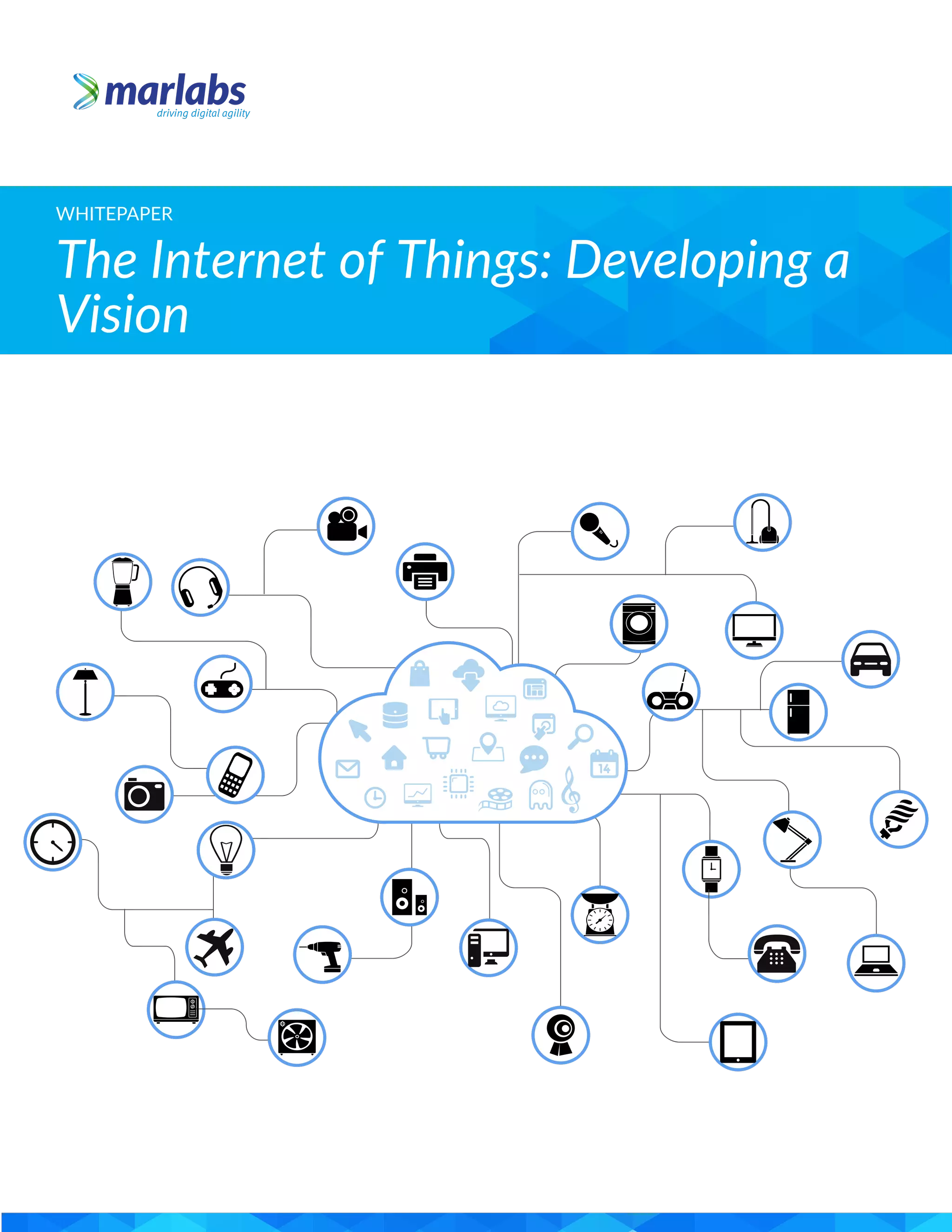
Massive in scale and sweeping in reach, there is
practically nothing that the IoT will not touch. Think of
any physical object—you can attach/embed sensors to it
at which point it starts generating data. That data can be
processed to garner intelligence that will drive business
and operational transformation.
Bringing together the physical and digital worlds in ways
that could barely be imagined a few years ago is what the
IoT is doing. Consumer applications of the IoT have the
most buzz. But B2B IoT is where organizations see the
maximum value. Sensors and actuators are getting
connected by networks to computers where data is
getting processed—lots of data!
Because of its sheer size and scope, different sectors of
the economy tend to look at the IoT from their own
individual perspectives. For consumers, it is all about
smart home devices that step up the quality of life. Smart
refrigerators that order items like milk when the levels
start to run low, for instance. Retailers look at it in terms
of using RFID tags to raise inventory accuracy, reduce
out-of-stock goods, cut down shrinkage, and lift sales.
Logistics providers would like to monitor the status of
assets, parcels, and people in real-time throughout the
value chain. Collecting data about processes through
sensors on the assembly line and finding out the status
of production is an example of what manufacturers are
seeking.
But the IoT is all of this and more. It is about the
end-to-end supply chain from manufacturing to logistics
to retail to consumers. All these parts of the economy
will have to come together in order to strengthen
processes at an aggregate level.
Four Categories of IoT
Essentially, there are four overlapping categories of IoT:
IoT of manufacturing, IoT of logistics, IoT of retail, and
IoT of the consumer.
Let us start with manufacturing. Only a small fraction of
manufacturers are connected along the lines of the IoT.
However, the levels of competition have been rising,
which is driving manufacturers to take out the
inefficiencies from their systems and uncover new
opportunities. Protocol choices are many. OPC, Modbus,
Profibus, BACnet, Foundation, and Fieldbus are
examples. Integration, therefore, has been a challenge.
Including the rest of the manufacturers in the IoT will
require integrating these disparate protocols in order to
realize the vision of a truly connected enterprise.
Logistics operators and their customers have a lot to gain
from the IoT. Be it warehousing operations, freight
transportation or last-mile delivery, benefits of the IoT
can be realized across the chain. Increased operational
efficiency, safety and security, and customer experience
are some of the outcomes. Assets, parcels, and people can
be tracked in real-time. Measuring asset performance
and automating business processes will result in higher
quality and predictability and lower costs. Analytics will
identify additional improvement opportunities and best
practices.
Retailers are looking to extract greater efficiencies and
profits from their physical stores. Locating inventory is
the crux of the matter. Arising from the massive number
and variability of SKUs in the retail supply chain is an
ever-increasing challenge of retailers being able to
properly manage their inventories. Knowing exactly how
much inventory is lying where has been the issue all
along. Increasing visibility can be accomplished through
solutions that leverage both existing
infrastructure—cameras within the store for example—as
well as new technologies like sensors, beacons, and RFID
chips. A number of technologies will need to come
together for retailers to be able to track and link basically
two sets of data: what is on the shelf and what is in back
room storage. These technologies include store shelf
sensors, smart displays, digital price tags, and high
resolution cameras.
In the consumer IoT, there are a massive number of
products—light bulbs to security alarms to air
conditioners—that can benefit from Internet connections.
Managed via apps and websites, these products will
transmit data to the cloud. Startups specialized in home
automation, established consumer electronics giants, and
large Silicon Valley-based tech companies are all poised
for a huge battle over this new consumer space.
To sum up, these four categories of IoT will need to talk to
each other for an end-to-end integration:
Made: IoT (Manufacturing) - has its origins in
SCADA, Modbus/Fieldbus, etc.
Moved: IoT (Logistics) - has its origins in
BACnet, WMS (warehouse management
systems), and shipping.
Sold: IoT (Retail) - has its origins in RFID, POS,
and SKUs.
Consumed: IoT (Consumer) - has its origins in
barcodes, phone numbers, part numbers, and
ISBNs.
> Whitepaper
1.
2.
3.
4.
> Whitepaper
Looking at the broader macro picture, goods are made,
moved, sold, and consumed. At each stage (phase) of
economic activity, distributed assets are leveraged in
order to bring about value. For example, in the ‘made
phase’, raw materials are acquired and processed and
final goods are produced. Goods are ordered from the
warehouse, displayed, and purchased by consumers in
the sold phase.
Depending on the level of automation of assets and
nature of processes involved, data is generated at each
stage that can be analyzed for raising transactional
efficiency and lowering costs. As a given phase scales up
in order to service a larger market, there are incentives
along the way to further reduce costs through closer
monitoring of asset performance and process efficiency.
Early on, separate data communication protocols and
information systems were in use in each phase. Then
came the evolution of industrial networks from LAN-scale
to WAN-scale aided by progress in sensors. This provided
an unprecedented opportunity for optimizing physical
assets at scale driven by WAN-scale access and analysis
of acquired data along with greater geographic
distribution/centralization of control.
The Internet with TCP/IP has been the game changer.
Breaking down silos between different stages, it is
lowering communication costs and operational costs
across phases. Enabling assets to communicate with each
other, the Internet is further deduping information
systems in different stages. Going beyond maximizing
efficiencies, industries are able to seek cost reductions
across phases. Just as the middleman was eliminated in
retail, thanks to the arrival of online order fulfillment,
duplicate processes across stages will get extinguished
with the IoT.
Also, communication will drive efficiencies in
maintenance, repair, and monitoring and in any activity
that requires ad hoc labor scheduling. Furthermore,
M2M communication will lead to more process
automation resulting in further cost savings.
Prior to the advent of the IoT, systems such as
just-in-time, zero inventory, and so on were what
achieved efficiencies in manufacturing. Logistics
efficiencies were realized via usage of GPS, scheduling,
and various forms of inventory tracking. Now the
Internet (TCP/IP) will hybridize those ideas across
phases.
The result will be a new economic paradigm. Total
transparency across the value chain will be the key tenet
of this IoT driven economy. Consequently, marginal cost
will be brought down to near-zero levels across all areas
of the economy. A new golden age of truly seamless, fluid,
and agile supply chains will be the outcome: the age of
‘IoT-Transactional ’.
IoT Architectural Lifecycle
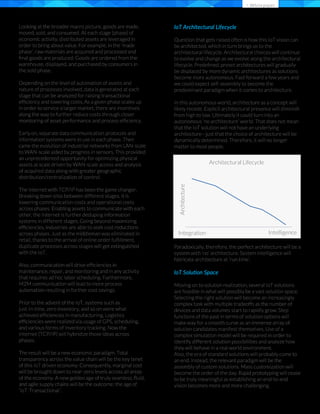
Question that gets raised often is how this IoT vision can
be architected, which in turn brings us to the
architectural lifecycle. Architectural choices will continue
to evolve and change as we evolve along the architectural
lifecycle. Predefined, preset architectures will gradually
be displaced by more dynamic architectures as solutions
become more autonomous. Fast forward a few years and
we could expect self-assembly to become the
predominant paradigm when it comes to architecture.
In this autonomous world, architecture as a concept will
likely recede. Explicit architectural presence will diminish
from high to low. Ultimately it could turn into an
autonomous ‘no architecture’ world. That does not mean
that the IoT solution will not have an underlying
architecture—just that the choice of architecture will be
dynamically determined. Therefore, it will no longer
matter to most people.
Paradoxically, therefore, the perfect architecture will be a
system with ‘no’ architecture. System intelligence will
fabricate architecture at ‘run time’.
IoT Solution Space
Moving on to solution realization, several IoT solutions
are feasible in what will possibly be a vast solution space.
Selecting the right solution will become an increasingly
complex task with multiple tradeoffs as the number of
devices and data volumes start to rapidly grow. Step
functions of the past in terms of solution options will
make way for a smooth curve as an immense array of
solution candidates manifest themselves. Use of a
complex simulation model will be required in order to
identify different solution possibilities and analyze how
they will behave in a real world environment.
Also, the era of standard solutions will probably come to
an end. Instead, the relevant paradigm will be the
assembly of custom solutions. Mass customization will
become the order of the day. Rapid prototyping will cease
to be truly meaningful as establishing an end-to-end
vision becomes more and more challenging.
Architectural Lifecycle
Architecture
IntelligenceIntegration
> Whitepaper
IoT Implementation
Implementation models too will likely increase in number.
Traditional models will gradually decline in relevance and
cease to deliver value. New solutions will call for new
approaches and new models. Essentially, we will no
longer be able to select implementation models on a
deterministic basis. Instead, they will fall along a
continuum. Plotting the continuum will again require use
of simulation techniques.
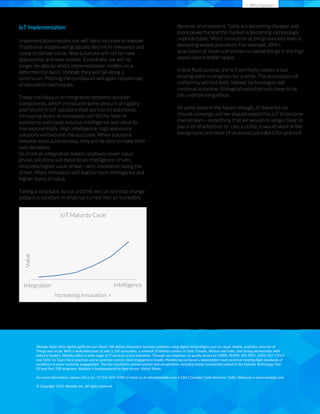
Today the focus is on integration between solution
components, which introduces some amount of rigidity
and results in IoT solutions that are low on autonomy.
Increasing levels of innovation will lift the level of
autonomy and cause solution intelligence and value to
rise exponentially. High intelligence, high autonomy
solutions will become the outcome. When solutions
become more autonomous, they will be able to make their
own decisions.
So, from an integration-based, relatively lower value
phase, solutions will move to an intelligence-driven,
relatively higher value phase—with innovation being the
driver. More innovation will lead to more intelligence and
higher levels of value.
Taking a step back, to use a cliché, we can see that change
today is a constant in what has turned into an incredibly
dynamic environment. Tools are becoming cheaper and
more powerful and the market is becoming increasingly
unpredictable. More innovation at the grassroots level is
becoming widely prevalent. For example, IBM’s
acquisition of Aspera promises to upend things in the high
speed data transfer space.
In this fluid context, the IoT will likely remain a fast
moving work in progress for a while. The assumption of
uniformity will not hold. Indeed, technologies will
continue to evolve. Biological evolution will come to be
the underpinning ethos.
At some point in the future though, all these forces
should converge and we should expect the IoT to become
mainstream—something that we would no longer have to
pay a lot of attention to. Like a utility, it would work in the
background and most of us would just take it for granted.
Things and social. With a dedicated team of over 2,100 associates, a network of delivery centers in USA, Canada, Mexico and India, and strong partnerships with
industry leaders, Marlabs offers a wide range of IT services across industries. Through our emphasis on quality driven by CMMi, PCMM, ISO 9001-2000, ISO 27001
50 and Fast 500 programs. Marlabs is headquartered in New Jersey, United States.
© Copyright 2015 Marlabs Inc. All rights reserved.
Value
Intelligence
Increasing innovation >
IoT Maturity Cycle
Integration

The Internet of Things : Developing a Vision

  • 1.
    The Internet ofThings: Developing a Vision WHITEPAPER
  • 2.
    The Internet ofThings (IoT) is a revolutionary evolution that is just getting started. An estimate has it that, of the roughly 1.5 trillion items on the planet that could have an IP address, only about 15 billion are connected to the Internet today. Come 2020, that number is expected to go up to more than 50 billion connected devices. By then, computers, including PCs, tablets, and smartphones, will represent just about 17 percent of all Internet connections. The balance 83 percent will result from the IoT, which will include wearables and smart home devices. Massive in scale and sweeping in reach, there is practically nothing that the IoT will not touch. Think of any physical object—you can attach/embed sensors to it at which point it starts generating data. That data can be processed to garner intelligence that will drive business and operational transformation. Bringing together the physical and digital worlds in ways that could barely be imagined a few years ago is what the IoT is doing. Consumer applications of the IoT have the most buzz. But B2B IoT is where organizations see the maximum value. Sensors and actuators are getting connected by networks to computers where data is getting processed—lots of data! Because of its sheer size and scope, different sectors of the economy tend to look at the IoT from their own individual perspectives. For consumers, it is all about smart home devices that step up the quality of life. Smart refrigerators that order items like milk when the levels start to run low, for instance. Retailers look at it in terms of using RFID tags to raise inventory accuracy, reduce out-of-stock goods, cut down shrinkage, and lift sales. Logistics providers would like to monitor the status of assets, parcels, and people in real-time throughout the value chain. Collecting data about processes through sensors on the assembly line and finding out the status of production is an example of what manufacturers are seeking. But the IoT is all of this and more. It is about the end-to-end supply chain from manufacturing to logistics to retail to consumers. All these parts of the economy will have to come together in order to strengthen processes at an aggregate level. Four Categories of IoT Essentially, there are four overlapping categories of IoT: IoT of manufacturing, IoT of logistics, IoT of retail, and IoT of the consumer. Let us start with manufacturing. Only a small fraction of manufacturers are connected along the lines of the IoT. However, the levels of competition have been rising, which is driving manufacturers to take out the inefficiencies from their systems and uncover new opportunities. Protocol choices are many. OPC, Modbus, Profibus, BACnet, Foundation, and Fieldbus are examples. Integration, therefore, has been a challenge. Including the rest of the manufacturers in the IoT will require integrating these disparate protocols in order to realize the vision of a truly connected enterprise. Logistics operators and their customers have a lot to gain from the IoT. Be it warehousing operations, freight transportation or last-mile delivery, benefits of the IoT can be realized across the chain. Increased operational efficiency, safety and security, and customer experience are some of the outcomes. Assets, parcels, and people can be tracked in real-time. Measuring asset performance and automating business processes will result in higher quality and predictability and lower costs. Analytics will identify additional improvement opportunities and best practices. Retailers are looking to extract greater efficiencies and profits from their physical stores. Locating inventory is the crux of the matter. Arising from the massive number and variability of SKUs in the retail supply chain is an ever-increasing challenge of retailers being able to properly manage their inventories. Knowing exactly how much inventory is lying where has been the issue all along. Increasing visibility can be accomplished through solutions that leverage both existing infrastructure—cameras within the store for example—as well as new technologies like sensors, beacons, and RFID chips. A number of technologies will need to come together for retailers to be able to track and link basically two sets of data: what is on the shelf and what is in back room storage. These technologies include store shelf sensors, smart displays, digital price tags, and high resolution cameras. In the consumer IoT, there are a massive number of products—light bulbs to security alarms to air conditioners—that can benefit from Internet connections. Managed via apps and websites, these products will transmit data to the cloud. Startups specialized in home automation, established consumer electronics giants, and large Silicon Valley-based tech companies are all poised for a huge battle over this new consumer space. To sum up, these four categories of IoT will need to talk to each other for an end-to-end integration: Made: IoT (Manufacturing) - has its origins in SCADA, Modbus/Fieldbus, etc. Moved: IoT (Logistics) - has its origins in BACnet, WMS (warehouse management systems), and shipping. Sold: IoT (Retail) - has its origins in RFID, POS, and SKUs. Consumed: IoT (Consumer) - has its origins in barcodes, phone numbers, part numbers, and ISBNs. > Whitepaper 1. 2. 3. 4.
  • 3.
    > Whitepaper Looking atthe broader macro picture, goods are made, moved, sold, and consumed. At each stage (phase) of economic activity, distributed assets are leveraged in order to bring about value. For example, in the ‘made phase’, raw materials are acquired and processed and final goods are produced. Goods are ordered from the warehouse, displayed, and purchased by consumers in the sold phase. Depending on the level of automation of assets and nature of processes involved, data is generated at each stage that can be analyzed for raising transactional efficiency and lowering costs. As a given phase scales up in order to service a larger market, there are incentives along the way to further reduce costs through closer monitoring of asset performance and process efficiency. Early on, separate data communication protocols and information systems were in use in each phase. Then came the evolution of industrial networks from LAN-scale to WAN-scale aided by progress in sensors. This provided an unprecedented opportunity for optimizing physical assets at scale driven by WAN-scale access and analysis of acquired data along with greater geographic distribution/centralization of control. The Internet with TCP/IP has been the game changer. Breaking down silos between different stages, it is lowering communication costs and operational costs across phases. Enabling assets to communicate with each other, the Internet is further deduping information systems in different stages. Going beyond maximizing efficiencies, industries are able to seek cost reductions across phases. Just as the middleman was eliminated in retail, thanks to the arrival of online order fulfillment, duplicate processes across stages will get extinguished with the IoT. Also, communication will drive efficiencies in maintenance, repair, and monitoring and in any activity that requires ad hoc labor scheduling. Furthermore, M2M communication will lead to more process automation resulting in further cost savings. Prior to the advent of the IoT, systems such as just-in-time, zero inventory, and so on were what achieved efficiencies in manufacturing. Logistics efficiencies were realized via usage of GPS, scheduling, and various forms of inventory tracking. Now the Internet (TCP/IP) will hybridize those ideas across phases. The result will be a new economic paradigm. Total transparency across the value chain will be the key tenet of this IoT driven economy. Consequently, marginal cost will be brought down to near-zero levels across all areas of the economy. A new golden age of truly seamless, fluid, and agile supply chains will be the outcome: the age of ‘IoT-Transactional ’. IoT Architectural Lifecycle Question that gets raised often is how this IoT vision can be architected, which in turn brings us to the architectural lifecycle. Architectural choices will continue to evolve and change as we evolve along the architectural lifecycle. Predefined, preset architectures will gradually be displaced by more dynamic architectures as solutions become more autonomous. Fast forward a few years and we could expect self-assembly to become the predominant paradigm when it comes to architecture. In this autonomous world, architecture as a concept will likely recede. Explicit architectural presence will diminish from high to low. Ultimately it could turn into an autonomous ‘no architecture’ world. That does not mean that the IoT solution will not have an underlying architecture—just that the choice of architecture will be dynamically determined. Therefore, it will no longer matter to most people. Paradoxically, therefore, the perfect architecture will be a system with ‘no’ architecture. System intelligence will fabricate architecture at ‘run time’. IoT Solution Space Moving on to solution realization, several IoT solutions are feasible in what will possibly be a vast solution space. Selecting the right solution will become an increasingly complex task with multiple tradeoffs as the number of devices and data volumes start to rapidly grow. Step functions of the past in terms of solution options will make way for a smooth curve as an immense array of solution candidates manifest themselves. Use of a complex simulation model will be required in order to identify different solution possibilities and analyze how they will behave in a real world environment. Also, the era of standard solutions will probably come to an end. Instead, the relevant paradigm will be the assembly of custom solutions. Mass customization will become the order of the day. Rapid prototyping will cease to be truly meaningful as establishing an end-to-end vision becomes more and more challenging. Architectural Lifecycle Architecture IntelligenceIntegration
  • 4.
    > Whitepaper IoT Implementation Implementationmodels too will likely increase in number. Traditional models will gradually decline in relevance and cease to deliver value. New solutions will call for new approaches and new models. Essentially, we will no longer be able to select implementation models on a deterministic basis. Instead, they will fall along a continuum. Plotting the continuum will again require use of simulation techniques. Today the focus is on integration between solution components, which introduces some amount of rigidity and results in IoT solutions that are low on autonomy. Increasing levels of innovation will lift the level of autonomy and cause solution intelligence and value to rise exponentially. High intelligence, high autonomy solutions will become the outcome. When solutions become more autonomous, they will be able to make their own decisions. So, from an integration-based, relatively lower value phase, solutions will move to an intelligence-driven, relatively higher value phase—with innovation being the driver. More innovation will lead to more intelligence and higher levels of value. Taking a step back, to use a cliché, we can see that change today is a constant in what has turned into an incredibly dynamic environment. Tools are becoming cheaper and more powerful and the market is becoming increasingly unpredictable. More innovation at the grassroots level is becoming widely prevalent. For example, IBM’s acquisition of Aspera promises to upend things in the high speed data transfer space. In this fluid context, the IoT will likely remain a fast moving work in progress for a while. The assumption of uniformity will not hold. Indeed, technologies will continue to evolve. Biological evolution will come to be the underpinning ethos. At some point in the future though, all these forces should converge and we should expect the IoT to become mainstream—something that we would no longer have to pay a lot of attention to. Like a utility, it would work in the background and most of us would just take it for granted. Things and social. With a dedicated team of over 2,100 associates, a network of delivery centers in USA, Canada, Mexico and India, and strong partnerships with industry leaders, Marlabs offers a wide range of IT services across industries. Through our emphasis on quality driven by CMMi, PCMM, ISO 9001-2000, ISO 27001 50 and Fast 500 programs. Marlabs is headquartered in New Jersey, United States. © Copyright 2015 Marlabs Inc. All rights reserved. Value Intelligence Increasing innovation > IoT Maturity Cycle Integration