ARI 202
INTERNET OF THINGS
"Anything that can be connected, will be connected"
2
CONTENT
1. Introduction
2. Benefits of IoT
3. Application and use of IoT
4. IoT challenges
5. What needs to be done?
6. Top IoT technologies and trends
7. Future of IoT
8. Q&A
3
INTRODUCTION – WHAT IS IOT?
• The Internet of things (IoT) is a system of interrelated computing devices,
mechanical and digital machines, objects, animals or people that are
provided with unique identifiers ( UIDs ) and the ability to transfer data over a
network without requiring human-to-human or human-to-computer
interaction - IoTAgenda
• A thing in the IoT can be a person with a heart monitor implant, a farm
animal with a biochip transponder, an automobile that has built-in sensors to
alert the driver when tire pressure is low or any other natural or man-made
object that can be assigned an IP address and is able to transfer data over
a network.
• IoT is a sensor network of billions of smart devices that connect people,
systems and other applications to collect and share data.
4
INTRODUCTION – CONT’D
• IoT is a concept of connecting any device with an on and off switch to the
Internet (and/or to each other). This includes everything from cellphones,
coffee makers, washing machines, headphones, lamps, wearable devices
and almost anything else you can think of. This also applies to components
of machines, for example a jet engine of an airplane or the drill of an oil rig –
Forbes.
• The IoT is a giant network of connected "things" (which also includes people).
The relationship will be between people-people, people-things, and things-
things.
• The dominant consumer IoT device, worldwide, is the smart TV. Between 25-
35% cent of consumers worldwide own a television that can connect to the
Internet, according to a Deloitte research. However, other areas of the IoT
market are growing rapidly.
5
WHY IOT?
• Organizations in a variety of industries are using IoT to operate more
efficiently, better understand customers to deliver enhanced customer
service, improve decision-making and increase the value of the business.
6
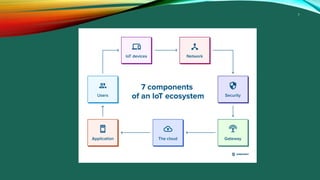
IOT ECOYSTEM
• An IoT ecosystem consists of web-enabled smart devices that use
embedded processors, sensors and communication hardware to collect,
send and act on data they acquire from their environments.
• IoT devices share the sensor data they collect by connecting to an IoT
gateway or other edge device where data is either sent to the cloud to be
analyzed or analyzed locally.
7
8
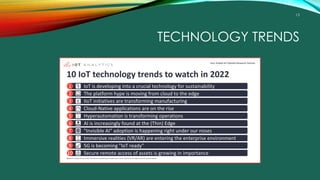
TOP 10 STRATEGIC IOT TECHNOLOGIES AND
TRENDS - GARTNER
1) Trend No. 1: Artificial Intelligence (AI): “Data is the fuel that powers the IoT
and the organization’s ability to derive meaning from it will define their long
term success.”
2) Trend No. 2: Social, Legal and Ethical IoT: These include ownership of data
and the deductions made from it, algorithmic bias, privacy and
compliance with regulations such as the General Data Protection
Regulation. “Successful deployment of an IoT solution demands that it’s not
just technically effective but also socially acceptable.”
3) Trend No. 3: Infonomics and Data Broking: The theory of infonomics takes
monetization of data further by seeing it as a strategic business asset to be
recorded in the company accounts. By 2023, the buying and selling of IoT
data will become an essential part of many IoT systems.
9
TOP 10 STRATEGIC IOT TECHNOLOGIES AND
TRENDS – GARTNER (CONT’D)
4) Trend No. 4: The Shift from Intelligent Edge to Intelligent Mesh: The shift from
centralized and cloud to edge architectures is well under way in the IoT
space. These mesh architectures will enable more flexible, intelligent and
responsive IoT systems — although often at the cost of additional
complexities.
5) Trend No. 5: IoT Governance: As the IoT continues to expand, the need for
a governance framework that ensures appropriate behaviour in the
creation, storage, use and deletion of information related to IoT projects
will become increasingly important.
6) Trend No. 6: Sensor Innovation: The sensor market will evolve continuously
through 2023. New sensors will enable a wider range of situations and
events to be detected.
10
TOP 10 STRATEGIC IOT TECHNOLOGIES
AND TRENDS – GARTNER (CONT’D)
7) Trend No. 7: Trusted Hardware and Operating System: ‘.. by 2023, we expect
to see the deployment of hardware and software combinations that together
create more trustworthy and secure IoT systems…’.
8) Trend 8: Novel IoT User Experiences: User experience driven by 4 factors: new
sensors, new algorithms, new experience architectures and context, and
socially aware experiences.
9) Trend No. 9: Silicon Chip Innovation: By 2023, it’s expected that new special-
purpose chips will reduce the power consumption required to run IoT devices.
10)Trend No. 10: New Wireless Networking Technologies for IoT: IoT networking
involves balancing a set of competing requirements. In particular they should
explore 5G, the forthcoming generation of low earth orbit satellites, and
backscatter networks.
11
BENEFITS OF IOT
IoT offers a number of benefits to organizations, enabling them to:
1. Monitor their overall business processes;
2. Improve the customer experience;
3. Save time and money;
4. Enhance employee productivity;
5. Integrate and adapt business models;
6. Make better business decisions; and
7. Generate more revenue.
12
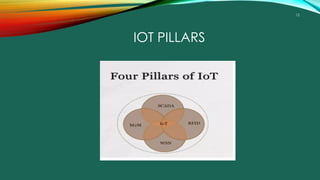
IOT PILLARS
13
TECHNOLOGY TRENDS
14
4 KEY TECHNOLOGIES THAT ARE DRIVING IOT
DEVELOPMENT
• Cloud Computing
• The Internet of Things focuses on sharing real-time information, therefore,
would be generating huge amounts of data which would require enough space
to store this database so that IoT apps and sensors continue to perform. This
space is needed for processing as well as storing the huge databases which
would require cloud computing. Therefore, cloud computing is one of the
driving technologies for IoT. Cloud computing has huge potential to store and
quickly process huge amounts of data. Cloud is highly efficient and is
becoming more scalable day by day and is being developed to leverage the
benefits of this platform.
15
• Blockchain
• One of the key technologies that are driving the development of IoT solutions is
blockchain. Putting together IoT solutions along with blockchain technology can be
highly beneficial for organizations and their customers as it ensures that data is
reliable, authentic, and genuine. For instance, IoT devices are used by supply chain
and logistics companies for tracking goods, each product/component may be
assigned a digital id which helps in smooth movement and transportation of goods. In
addition to this, with the help of the unique digital id, they can maintain tamper-proof
and secure blockchain repositories maintaining a proper history about the product.
Organizations and customers can be assured that the products are exactly as
described and the information is not tampered with. It is important for organizations
to integrate both the technologies to gain a competitive advantage in the industry and
an IoT development company could help your organization with this integration.
16
• Sensors
• There are a lot of factors like the interaction between different devices which
helps in reaping the full benefits of the IoT solutions. Sensors are one of the
key elements of IoT solutions. We use sensors to perform different day-to-day
activities like unlocking and locking your car from a distance. These sensors
transmit a message which leads to the desired actions. With advanced IoT
sensors, one can do much more than just locking and unlocking the care.
These sensors help in remote activities which is the reason why it is becoming
one of the key technologies to drive the development of IoT solutions. With
modern problems, IoT software development companies are offering modern
solutions to organizations.
17
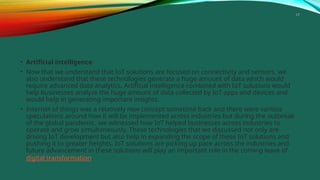
• Artificial intelligence
• Now that we understand that IoT solutions are focused on connectivity and sensors, we
also understand that these technologies generate a huge amount of data which would
require advanced data analytics. Artificial intelligence combined with IoT solutions would
help businesses analyze the huge amount of data collected by IoT apps and devices and
would help in generating important insights.
• Internet of things was a relatively new concept sometime back and there were various
speculations around how it will be implemented across industries but during the outbreak
of the global pandemic, we witnessed how IoT helped businesses across industries to
operate and grow simultaneously. These technologies that we discussed not only are
driving IoT development but also help in expanding the scope of these IoT solutions and
pushing it to greater heights. IoT solutions are picking up pace across the industries and
future advancement in these solutions will play an important role in the coming wave of
digital transformation.
18
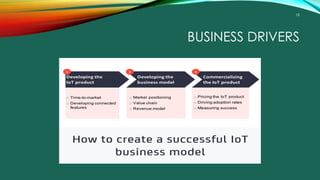
BUSINESS DRIVERS
19
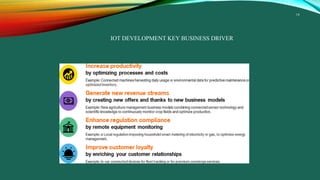
IOT DEVELOPMENT KEY BUSINESS DRIVER
20
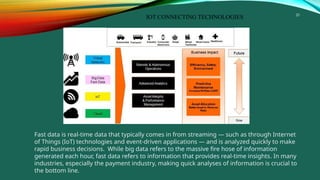
IOT CONNECTING TECHNOLOGIES
Fast data is real-time data that typically comes in from streaming — such as through Internet
of Things (IoT) technologies and event-driven applications — and is analyzed quickly to make
rapid business decisions. While big data refers to the massive fire hose of information
generated each hour, fast data refers to information that provides real-time insights. In many
industries, especially the payment industry, making quick analyses of information is crucial to
the bottom line.
21
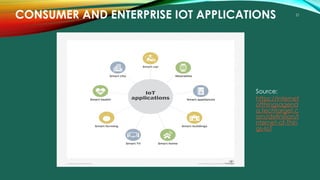
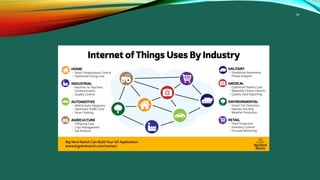
CONSUMER AND ENTERPRISE IOT APPLICATIONS
Source:
https://internet
ofthingsagend
a.techtarget.c
om/definition/I
nternet-of-Thin
gs-IoT
IoT things presentation - Davis M Onsakia
22
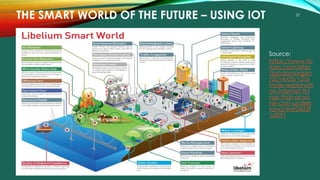
THE SMART WORLD OF THE FUTURE – USING IOT
Source:
https://www.fo
rbes.com/sites
/jacobmorgan
/2014/05/13/si
mple-explanati
on-internet-thi
ngs-that-anyo
ne-can-unders
tand/#ef2433f
1d091
23
SAMPLE: CONSUMER IOT PRODUCTS &
SERVICES
1. Helmet Concussion Sensor
2. Medical Alert Watch
3. Smart Fitness Clothing and Smart Running Shoes
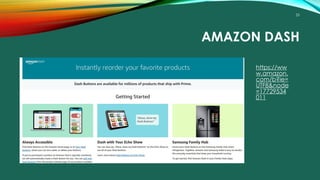
4. One-Button Product Purchases: “Order at the click of a button!” Amazon
has taken that phrase literally and produced physical branded buttons
called Amazon Dash that link to products in your home. Say you run out of
laundry powder. You can press your Dash button for Tide and Amazon will
reorder your Tide Powder product for you. No need to sign onto the Web,
fumble with payment methods, or retype credit card numbers.
5. Garden Sensors
6. Smart Televisions
24
HELMET CONCUSSION SENSOR
https://www.amazon.c
om/Shockbox-LM2004-
EXT-MultiSport-Helmet-S
ensor/dp/B00DVHA1LM
?imprToken=NXcTrCpp
NfgrAo2MA1K7ig&slotN
um=2&SubscriptionId=
AKIAIO22DD3AFUSKXUK
Q&tag=makeusw-20&li
nkCode=xm2&camp=2
025&creative=165953&
creativeASIN=B00DVHA
1LM
25
AMAZON DASH
https://ww
w.amazon.
com/b?ie=
UTF8&node
=17729534
011
26
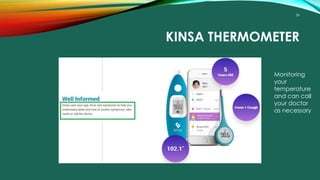
KINSA THERMOMETER
Monitoring
your
temperature
and can call
your doctor
as necessary
27
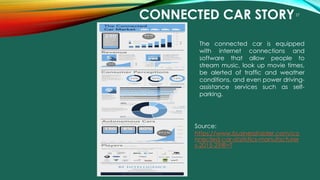
CONNECTED CAR STORY
Source:
https://www.businessinsider.com/co
nnected-car-statistics-manufacturer
s-2015-2?IR=T
The connected car is equipped
with internet connections and
software that allow people to
stream music, look up movie times,
be alerted of traffic and weather
conditions, and even power driving-
assistance services such as self-
parking.
28
SMART FARMING: USE OF IOT TO IMPROVE
AGRICULTURE
• In IoT-based smart farming, a system is built for monitoring the crop field with the
help of sensors (light, humidity, temperature, soil moisture, etc.) and automating
the irrigation system. The farmers can monitor the field conditions from anywhere.
This is highly efficient compared to the traditional/conventional approach.
• In terms of environmental issues, IoT-based smart farming provides great benefits
including: better and efficient water usage, and optimization of inputs and
treatments.
• Therefore, smart farming based on IoT technologies enables growers and farmers
to reduce waste and enhance productivity.
• Some of the IoT applications in this area are:
i. Precision farming
ii. Agricultural drones
iii. Livestock monitoring
iv. Smart greenhouses
29
INDUSTRIAL IOT (IIOT)
• Industrial IoT (IIoT) focusses on the use of cyber-physical systems to monitor
the physical factory processes and make data-based automated decisions.
• While the physical systems are made the intelligent using IoT, the real-time
communication, and cooperation both with each other and with humans is
established via the wireless web
• IIoT brings in the concept of ‘a connected factory leads to a smart factory’.
30
IIOT IN MANUFACTURING
1. Digital/connected factory: IoT enabled machinery can transmit
operational information to the partners like original equipment
manufacturers and to field engineers.
2. Facility management: The use of IoT sensors in manufacturing equipment
enables condition-based maintenance alerts.
3. Production flow monitoring: IoT in manufacturing can enable the
monitoring of production lines starting from the refining process down to
the packaging of final products.
4. Inventory management: IoT applications permit the monitoring of events
across a supply chain.
31
IIOT IN MANUFACTURING (CONT’D)
5. Plant Safety and Security: IoT combined big data analysis can improve the
overall workers’ safety and security in the plant. .
6. Quality control: IoT sensors collect aggregate product data and other
third-party syndicated data from various stages of a product cycle.
7. Packaging Optimization: By using IoT sensors in products and/or
packaging, manufacturers can gain insights into the usage patterns and
handling of product from multiple customers.
8. Logistics and Supply Chain Optimization: The Industrial IoT (IIoT) can provide
access to real-time supply chain information by tracking materials,
equipment, and products as they move through the supply chain.
32
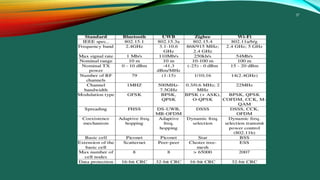
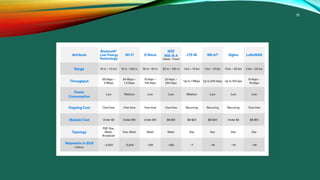
TECHNOLOGIES INVOLVED IN IOT
DEVELOPMENT
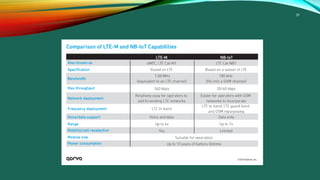
• IoT primarily exploits standard protocols and networking technologies.
However, the major enabling technologies and protocols of IoT are RFID, NFC,
low-energy Bluetooth, low-energy wireless, low-energy radio protocols, LTE-A,
and WiFi-Direct.
33
• NFC and RFID
• RFID (radio-frequency identification) and NFC (near-field communication)
provide simple, lowenergy, and versatile options for identity and access tokens,
connection bootstrapping, and payments.
• RFID technology employs 2-way radio transmitter-receivers to identify and
track tags associated with objects.
• NFC consists of communication protocols for electronic devices, typically a
mobile device and a standard device.
34
• Low-Energy Bluetooth
• This technology supports the low-power, long-use need of IoT function while
exploiting a standard technology with native support across systems.
• Low-Energy Wireless
• This technology replaces the most power hungry aspect of an IoT system.
Though sensors and other elements can power down over long periods,
communication links (i.e., wireless) must remain in listening mode. Low-energy
wireless not only reduces consumption, but also extends the life of the device
through less use.
35
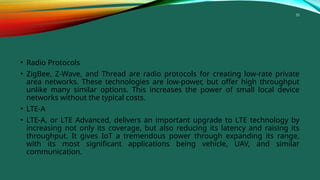
• Radio Protocols
• ZigBee, Z-Wave, and Thread are radio protocols for creating low-rate private
area networks. These technologies are low-power, but offer high throughput
unlike many similar options. This increases the power of small local device
networks without the typical costs.
• LTE-A
• LTE-A, or LTE Advanced, delivers an important upgrade to LTE technology by
increasing not only its coverage, but also reducing its latency and raising its
throughput. It gives IoT a tremendous power through expanding its range,
with its most significant applications being vehicle, UAV, and similar
communication.
36
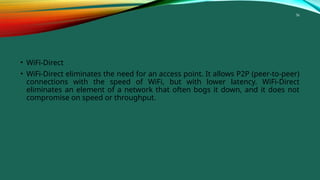
• WiFi-Direct
• WiFi-Direct eliminates the need for an access point. It allows P2P (peer-to-peer)
connections with the speed of WiFi, but with lower latency. WiFi-Direct
eliminates an element of a network that often bogs it down, and it does not
compromise on speed or throughput.
37
38
39
40
IOT CHALLENGES
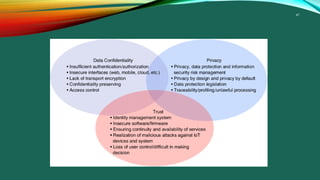
Security, privacy and data sharing issues
• Because IoT devices are closely connected, all a hacker has to do is exploit one
vulnerability to manipulate all the data, rendering it unusable. And manufacturers
that don't update their devices regularly -- or at all -- leave them vulnerable to
cybercriminals.
• However, hackers aren't the only threat to the internet of things; privacy is another
major concern for IoT users. For instance, companies that make and distribute
consumer IoT devices could use those devices to obtain and sell users' personal
data.
• Challenges with IIoT:
i. Security of data – same as above
ii. Reliability and stability – of IIoT sensors
iii. Connectivity of all the systems in IIoT setup – no maintenance envisioned?
iv. Blending legacy systems – IIoT is new in the market
41
• What is the edge technology?
• Enhanced Data rates for GSM Evolution (EDGE) also known as Enhanced GPRS
(EGPRS).
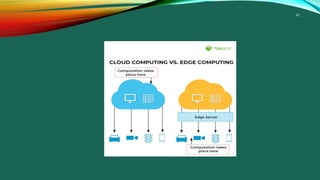
• Edge computing is an emerging computing paradigm which refers to a range of
networks and devices at or near the user. Edge is about processing data closer
to where it's being generated, enabling processing at greater speeds and volumes,
leading to greater action-led results in real time.
42
43
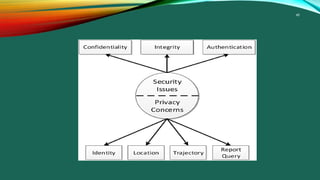
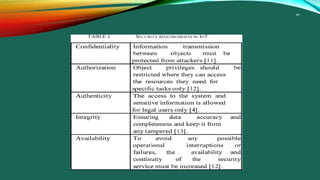
IOT SECURITY ISSUES
1.Public Perception: If the IoT is ever going to truly take off, this needs to be the
first problem that manufacturers address. In fact, Deloitte’s 2022 Connectivity
and Mobile Trends Survey found that 52% of users are worried about the
security vulnerabilities of smart home devices.
2. Vulnerability to Hacking: Researchers have been able to hack into real, on-
the-market devices with enough time and energy, which means hackers would
likely be able to replicate their efforts. For example, a team of researchers at
Microsoft and the University of Michigan found a plethora of holes in the security
of Samsung’s SmartThings smart home platform, and the methods were far from
complex.
44
3. Are Companies Ready?: AT&T’s Cybersecurity Insights Report surveyed more
than 5,000 enterprises around the world and found that 85% of enterprises are
in the process of or intend to deploy IoT devices. Yet a mere 10% of those
surveyed feel confident that they could secure those devices against hackers.
4. True Security: Jason Porter, AT&T’s VP of security solutions, told Insider
Intelligence that securing IoT devices means more than simply securing the
actual devices themselves. Companies also need to build security into software
applications and network connections that link to those devices.
45
IOT PRIVACY ISSUES
1.Too Much Data: The sheer amount of data that IoT devices can generate is
staggering. A Federal Trade Commission report entitled “Internet of Things:
Privacy & Security in a Connected World” found that fewer than 10,000
households can generate 150 million discrete data points every day. This
creates more entry points for hackers and leaves sensitive information
vulnerable.
2. Unwanted Public Profile: You’ve undoubtedly agreed to terms of service at
some point, but have you ever actually read through an entire document? The
aforementioned FTC report found that companies could use collected data that
consumers willingly offer to make employment decisions. For example, an
insurance company might gather information from you about your driving
habits through a connected car when calculating your insurance rate. The same
could occur for health or life insurance thanks to fitness trackers.
46
3. Eavesdropping: Manufacturers or hackers could actually use a connected
device to virtually invade a person’s home. German researchers accomplished
this by intercepting unencrypted data from a smart meter device to determine
what television show someone was watching at that moment.
4. Consumer Confidence: Each of these problems could put a dent in
consumers’ desire to purchase connected products, which would prevent the IoT
from fulfilling its true potential.
47
48
49
50
WHAT NEEDS TO BE DONE?
1. Consumer education
2. Product reviews and comparisons
3. Vulnerability disclosure and vulnerability markets
4. Self-certification and voluntary codes of practice
5. Trust marks and labels like Internet Society’s Online Trust Alliance (OTA) IoT Trust
Framework
6. Government initiatives
7. Mandated security requirements
8. Mandated certification
9. Liability reform
10. Etc.
11. No intervention!?
51
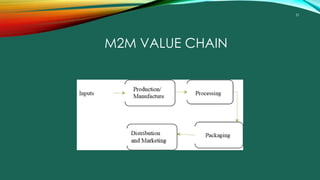
M2M VALUE CHAIN
52
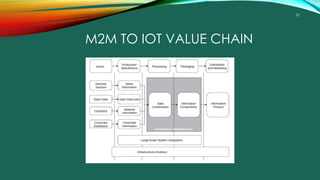
M2M TO IOT VALUE CHAIN
53
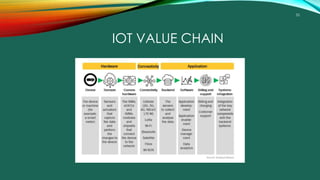
IOT VALUE CHAIN
54
OVERVIEW OF GOVERNANCE IN
IOT
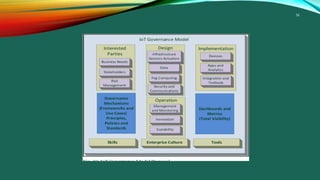
• An IoT governance framework should ensure data integrity and data security
for information shared by all IoT devices in the enterprise network. It should
also maintain the trusted source of information across the different layers of
the IoT architecture.
55
• As IoT usage becomes more widespread, the physical network of IoT devices grows larger
and more complicated to manage, with approximately 13.1 billion IoT devices in operation
today according to Statista. An IoT governance model is an effective way to address data
security and privacy concerns, as well as legal, ethical, and public relations matters. It
establishes the policies, procedures, and practices that define how a company will design,
build, deploy, and manage an IoT system.
• IoT governance models also outline how the system will comply with industry, local, and
global data security and privacy laws. These laws define how an IoT device should collect,
store, manage, use, and discard data. The type of data an IoT device collects is another
contributing factor. IoT devices that collect sensitive PII – i.e. full name, home address,
driver’s license, medical record – must manage this data in accordance with data protection
laws, such as the GDPR in EU member states. Failure to do so can result in significant fines.
56
57
THE FUTURE OF IOT
• Bain & Company expects annual IoT revenue of hardware and software to exceed $450
billion by 2020.
• McKinsey & Company estimates IoT will have an $11.1 trillion impact by 2025.
• IHS Markit believes the number of connected IoT devices will increase 12% annually to
reach 125 billion in 2030.
• Gartner assesses that 20.8 billion connected things will be in use by 2020, with total spend
on IoT devices and services to reach $3.7 trillion in 2021.
• By 2023, the average CIO will be responsible for more than three times as many endpoints
as this year – Gartner
• Garter forecasts that worldwide IoT Security Spending will be 3.11 billion by 2021 largely
driven by regulatory compliance.
• Great improvements in the security of IoT devices driven by manufacturers’ own initiatives
as well users’ demand for better secure devices.
• Global manufacturers will use analytics data recorded from connected devices to analyze
processes and identify optimization possibilities, according to IDC and SAP.
• Business Insider forecasts that by 2020, 75 percent of new cars will come with built-in IoT
connectivity.
58
IOT HARDWARE PLATFORMS AND PROTOTYPING
KITS
• Raspberry Pi
A single-board computer that runs Linux, the Raspberry Pi is one of the most popular and accessible IoT development platforms out there.
• Arduino
Well-known in the IoT development arena, Arduino makes many different kinds of microcontrollers, open-source development tools, kits, and software.
• Pycom
Pycom is known for their WiPy and LoPy boards, which pack a ton of functionality into a tiny package. The company offers modules with flexible connectivity
options, including Bluetooth Low Energy, Wi-Fi, and cellular LPWAN.
• Particle
With a variety of development kits and connectivity modules, Particle hardware is designed to work with the company’s software platform, Particle IoT Device
Management, which includes tools to help you build and connect your IoT device.
• SODAQ
SODAQ’s durable, solar-powered IoT tracking and sensing hardware is designed for B2B and large-scale deployment. They also offer engineering services if you
need help with your IoT designs and prototyping.
• Adafruit
An open-source hardware company, Adafruit offers a variety of IoT development boards and kits with varying features and capabilities.
• SparkFun
SparkFun’s microcontroller development and breakout boards allow you to create and test IoT device prototypes, and they sell additional hardware items such
as cables, LTE antennas, and more.
• Espressif
Espressif’s microcontrollers are popular among IoT developers. The company specializes in creating chips with a high level of integration, helping you design IoT
devices that are easily manufactured and deployed.
59
60
END
Thanks for listening

Iot2. Iotivity and other archs different.
  • 1.
    ARI 202 INTERNET OFTHINGS "Anything that can be connected, will be connected"
  • 2.
    2 CONTENT 1. Introduction 2. Benefitsof IoT 3. Application and use of IoT 4. IoT challenges 5. What needs to be done? 6. Top IoT technologies and trends 7. Future of IoT 8. Q&A
  • 3.
    3 INTRODUCTION – WHATIS IOT? • The Internet of things (IoT) is a system of interrelated computing devices, mechanical and digital machines, objects, animals or people that are provided with unique identifiers ( UIDs ) and the ability to transfer data over a network without requiring human-to-human or human-to-computer interaction - IoTAgenda • A thing in the IoT can be a person with a heart monitor implant, a farm animal with a biochip transponder, an automobile that has built-in sensors to alert the driver when tire pressure is low or any other natural or man-made object that can be assigned an IP address and is able to transfer data over a network. • IoT is a sensor network of billions of smart devices that connect people, systems and other applications to collect and share data.
  • 4.
    4 INTRODUCTION – CONT’D •IoT is a concept of connecting any device with an on and off switch to the Internet (and/or to each other). This includes everything from cellphones, coffee makers, washing machines, headphones, lamps, wearable devices and almost anything else you can think of. This also applies to components of machines, for example a jet engine of an airplane or the drill of an oil rig – Forbes. • The IoT is a giant network of connected "things" (which also includes people). The relationship will be between people-people, people-things, and things- things. • The dominant consumer IoT device, worldwide, is the smart TV. Between 25- 35% cent of consumers worldwide own a television that can connect to the Internet, according to a Deloitte research. However, other areas of the IoT market are growing rapidly.
  • 5.
    5 WHY IOT? • Organizationsin a variety of industries are using IoT to operate more efficiently, better understand customers to deliver enhanced customer service, improve decision-making and increase the value of the business.
  • 6.
    6 IOT ECOYSTEM • AnIoT ecosystem consists of web-enabled smart devices that use embedded processors, sensors and communication hardware to collect, send and act on data they acquire from their environments. • IoT devices share the sensor data they collect by connecting to an IoT gateway or other edge device where data is either sent to the cloud to be analyzed or analyzed locally.
  • 7.
  • 8.
    8 TOP 10 STRATEGICIOT TECHNOLOGIES AND TRENDS - GARTNER 1) Trend No. 1: Artificial Intelligence (AI): “Data is the fuel that powers the IoT and the organization’s ability to derive meaning from it will define their long term success.” 2) Trend No. 2: Social, Legal and Ethical IoT: These include ownership of data and the deductions made from it, algorithmic bias, privacy and compliance with regulations such as the General Data Protection Regulation. “Successful deployment of an IoT solution demands that it’s not just technically effective but also socially acceptable.” 3) Trend No. 3: Infonomics and Data Broking: The theory of infonomics takes monetization of data further by seeing it as a strategic business asset to be recorded in the company accounts. By 2023, the buying and selling of IoT data will become an essential part of many IoT systems.
  • 9.
    9 TOP 10 STRATEGICIOT TECHNOLOGIES AND TRENDS – GARTNER (CONT’D) 4) Trend No. 4: The Shift from Intelligent Edge to Intelligent Mesh: The shift from centralized and cloud to edge architectures is well under way in the IoT space. These mesh architectures will enable more flexible, intelligent and responsive IoT systems — although often at the cost of additional complexities. 5) Trend No. 5: IoT Governance: As the IoT continues to expand, the need for a governance framework that ensures appropriate behaviour in the creation, storage, use and deletion of information related to IoT projects will become increasingly important. 6) Trend No. 6: Sensor Innovation: The sensor market will evolve continuously through 2023. New sensors will enable a wider range of situations and events to be detected.
  • 10.
    10 TOP 10 STRATEGICIOT TECHNOLOGIES AND TRENDS – GARTNER (CONT’D) 7) Trend No. 7: Trusted Hardware and Operating System: ‘.. by 2023, we expect to see the deployment of hardware and software combinations that together create more trustworthy and secure IoT systems…’. 8) Trend 8: Novel IoT User Experiences: User experience driven by 4 factors: new sensors, new algorithms, new experience architectures and context, and socially aware experiences. 9) Trend No. 9: Silicon Chip Innovation: By 2023, it’s expected that new special- purpose chips will reduce the power consumption required to run IoT devices. 10)Trend No. 10: New Wireless Networking Technologies for IoT: IoT networking involves balancing a set of competing requirements. In particular they should explore 5G, the forthcoming generation of low earth orbit satellites, and backscatter networks.
  • 11.
    11 BENEFITS OF IOT IoToffers a number of benefits to organizations, enabling them to: 1. Monitor their overall business processes; 2. Improve the customer experience; 3. Save time and money; 4. Enhance employee productivity; 5. Integrate and adapt business models; 6. Make better business decisions; and 7. Generate more revenue.
  • 12.
  • 13.
  • 14.
    14 4 KEY TECHNOLOGIESTHAT ARE DRIVING IOT DEVELOPMENT • Cloud Computing • The Internet of Things focuses on sharing real-time information, therefore, would be generating huge amounts of data which would require enough space to store this database so that IoT apps and sensors continue to perform. This space is needed for processing as well as storing the huge databases which would require cloud computing. Therefore, cloud computing is one of the driving technologies for IoT. Cloud computing has huge potential to store and quickly process huge amounts of data. Cloud is highly efficient and is becoming more scalable day by day and is being developed to leverage the benefits of this platform.
  • 15.
    15 • Blockchain • Oneof the key technologies that are driving the development of IoT solutions is blockchain. Putting together IoT solutions along with blockchain technology can be highly beneficial for organizations and their customers as it ensures that data is reliable, authentic, and genuine. For instance, IoT devices are used by supply chain and logistics companies for tracking goods, each product/component may be assigned a digital id which helps in smooth movement and transportation of goods. In addition to this, with the help of the unique digital id, they can maintain tamper-proof and secure blockchain repositories maintaining a proper history about the product. Organizations and customers can be assured that the products are exactly as described and the information is not tampered with. It is important for organizations to integrate both the technologies to gain a competitive advantage in the industry and an IoT development company could help your organization with this integration.
  • 16.
    16 • Sensors • Thereare a lot of factors like the interaction between different devices which helps in reaping the full benefits of the IoT solutions. Sensors are one of the key elements of IoT solutions. We use sensors to perform different day-to-day activities like unlocking and locking your car from a distance. These sensors transmit a message which leads to the desired actions. With advanced IoT sensors, one can do much more than just locking and unlocking the care. These sensors help in remote activities which is the reason why it is becoming one of the key technologies to drive the development of IoT solutions. With modern problems, IoT software development companies are offering modern solutions to organizations.
  • 17.
    17 • Artificial intelligence •Now that we understand that IoT solutions are focused on connectivity and sensors, we also understand that these technologies generate a huge amount of data which would require advanced data analytics. Artificial intelligence combined with IoT solutions would help businesses analyze the huge amount of data collected by IoT apps and devices and would help in generating important insights. • Internet of things was a relatively new concept sometime back and there were various speculations around how it will be implemented across industries but during the outbreak of the global pandemic, we witnessed how IoT helped businesses across industries to operate and grow simultaneously. These technologies that we discussed not only are driving IoT development but also help in expanding the scope of these IoT solutions and pushing it to greater heights. IoT solutions are picking up pace across the industries and future advancement in these solutions will play an important role in the coming wave of digital transformation.
  • 18.
  • 19.
    19 IOT DEVELOPMENT KEYBUSINESS DRIVER
  • 20.
    20 IOT CONNECTING TECHNOLOGIES Fastdata is real-time data that typically comes in from streaming — such as through Internet of Things (IoT) technologies and event-driven applications — and is analyzed quickly to make rapid business decisions. While big data refers to the massive fire hose of information generated each hour, fast data refers to information that provides real-time insights. In many industries, especially the payment industry, making quick analyses of information is crucial to the bottom line.
  • 21.
    21 CONSUMER AND ENTERPRISEIOT APPLICATIONS Source: https://internet ofthingsagend a.techtarget.c om/definition/I nternet-of-Thin gs-IoT
  • 22.
    IoT things presentation- Davis M Onsakia 22 THE SMART WORLD OF THE FUTURE – USING IOT Source: https://www.fo rbes.com/sites /jacobmorgan /2014/05/13/si mple-explanati on-internet-thi ngs-that-anyo ne-can-unders tand/#ef2433f 1d091
  • 23.
    23 SAMPLE: CONSUMER IOTPRODUCTS & SERVICES 1. Helmet Concussion Sensor 2. Medical Alert Watch 3. Smart Fitness Clothing and Smart Running Shoes 4. One-Button Product Purchases: “Order at the click of a button!” Amazon has taken that phrase literally and produced physical branded buttons called Amazon Dash that link to products in your home. Say you run out of laundry powder. You can press your Dash button for Tide and Amazon will reorder your Tide Powder product for you. No need to sign onto the Web, fumble with payment methods, or retype credit card numbers. 5. Garden Sensors 6. Smart Televisions
  • 24.
  • 25.
  • 26.
  • 27.
    27 CONNECTED CAR STORY Source: https://www.businessinsider.com/co nnected-car-statistics-manufacturer s-2015-2?IR=T Theconnected car is equipped with internet connections and software that allow people to stream music, look up movie times, be alerted of traffic and weather conditions, and even power driving- assistance services such as self- parking.
  • 28.
    28 SMART FARMING: USEOF IOT TO IMPROVE AGRICULTURE • In IoT-based smart farming, a system is built for monitoring the crop field with the help of sensors (light, humidity, temperature, soil moisture, etc.) and automating the irrigation system. The farmers can monitor the field conditions from anywhere. This is highly efficient compared to the traditional/conventional approach. • In terms of environmental issues, IoT-based smart farming provides great benefits including: better and efficient water usage, and optimization of inputs and treatments. • Therefore, smart farming based on IoT technologies enables growers and farmers to reduce waste and enhance productivity. • Some of the IoT applications in this area are: i. Precision farming ii. Agricultural drones iii. Livestock monitoring iv. Smart greenhouses
  • 29.
    29 INDUSTRIAL IOT (IIOT) •Industrial IoT (IIoT) focusses on the use of cyber-physical systems to monitor the physical factory processes and make data-based automated decisions. • While the physical systems are made the intelligent using IoT, the real-time communication, and cooperation both with each other and with humans is established via the wireless web • IIoT brings in the concept of ‘a connected factory leads to a smart factory’.
  • 30.
    30 IIOT IN MANUFACTURING 1.Digital/connected factory: IoT enabled machinery can transmit operational information to the partners like original equipment manufacturers and to field engineers. 2. Facility management: The use of IoT sensors in manufacturing equipment enables condition-based maintenance alerts. 3. Production flow monitoring: IoT in manufacturing can enable the monitoring of production lines starting from the refining process down to the packaging of final products. 4. Inventory management: IoT applications permit the monitoring of events across a supply chain.
  • 31.
    31 IIOT IN MANUFACTURING(CONT’D) 5. Plant Safety and Security: IoT combined big data analysis can improve the overall workers’ safety and security in the plant. . 6. Quality control: IoT sensors collect aggregate product data and other third-party syndicated data from various stages of a product cycle. 7. Packaging Optimization: By using IoT sensors in products and/or packaging, manufacturers can gain insights into the usage patterns and handling of product from multiple customers. 8. Logistics and Supply Chain Optimization: The Industrial IoT (IIoT) can provide access to real-time supply chain information by tracking materials, equipment, and products as they move through the supply chain.
  • 32.
    32 TECHNOLOGIES INVOLVED INIOT DEVELOPMENT • IoT primarily exploits standard protocols and networking technologies. However, the major enabling technologies and protocols of IoT are RFID, NFC, low-energy Bluetooth, low-energy wireless, low-energy radio protocols, LTE-A, and WiFi-Direct.
  • 33.
    33 • NFC andRFID • RFID (radio-frequency identification) and NFC (near-field communication) provide simple, lowenergy, and versatile options for identity and access tokens, connection bootstrapping, and payments. • RFID technology employs 2-way radio transmitter-receivers to identify and track tags associated with objects. • NFC consists of communication protocols for electronic devices, typically a mobile device and a standard device.
  • 34.
    34 • Low-Energy Bluetooth •This technology supports the low-power, long-use need of IoT function while exploiting a standard technology with native support across systems. • Low-Energy Wireless • This technology replaces the most power hungry aspect of an IoT system. Though sensors and other elements can power down over long periods, communication links (i.e., wireless) must remain in listening mode. Low-energy wireless not only reduces consumption, but also extends the life of the device through less use.
  • 35.
    35 • Radio Protocols •ZigBee, Z-Wave, and Thread are radio protocols for creating low-rate private area networks. These technologies are low-power, but offer high throughput unlike many similar options. This increases the power of small local device networks without the typical costs. • LTE-A • LTE-A, or LTE Advanced, delivers an important upgrade to LTE technology by increasing not only its coverage, but also reducing its latency and raising its throughput. It gives IoT a tremendous power through expanding its range, with its most significant applications being vehicle, UAV, and similar communication.
  • 36.
    36 • WiFi-Direct • WiFi-Directeliminates the need for an access point. It allows P2P (peer-to-peer) connections with the speed of WiFi, but with lower latency. WiFi-Direct eliminates an element of a network that often bogs it down, and it does not compromise on speed or throughput.
  • 37.
  • 38.
  • 39.
  • 40.
    40 IOT CHALLENGES Security, privacyand data sharing issues • Because IoT devices are closely connected, all a hacker has to do is exploit one vulnerability to manipulate all the data, rendering it unusable. And manufacturers that don't update their devices regularly -- or at all -- leave them vulnerable to cybercriminals. • However, hackers aren't the only threat to the internet of things; privacy is another major concern for IoT users. For instance, companies that make and distribute consumer IoT devices could use those devices to obtain and sell users' personal data. • Challenges with IIoT: i. Security of data – same as above ii. Reliability and stability – of IIoT sensors iii. Connectivity of all the systems in IIoT setup – no maintenance envisioned? iv. Blending legacy systems – IIoT is new in the market
  • 41.
    41 • What isthe edge technology? • Enhanced Data rates for GSM Evolution (EDGE) also known as Enhanced GPRS (EGPRS). • Edge computing is an emerging computing paradigm which refers to a range of networks and devices at or near the user. Edge is about processing data closer to where it's being generated, enabling processing at greater speeds and volumes, leading to greater action-led results in real time.
  • 42.
  • 43.
    43 IOT SECURITY ISSUES 1.PublicPerception: If the IoT is ever going to truly take off, this needs to be the first problem that manufacturers address. In fact, Deloitte’s 2022 Connectivity and Mobile Trends Survey found that 52% of users are worried about the security vulnerabilities of smart home devices. 2. Vulnerability to Hacking: Researchers have been able to hack into real, on- the-market devices with enough time and energy, which means hackers would likely be able to replicate their efforts. For example, a team of researchers at Microsoft and the University of Michigan found a plethora of holes in the security of Samsung’s SmartThings smart home platform, and the methods were far from complex.
  • 44.
    44 3. Are CompaniesReady?: AT&T’s Cybersecurity Insights Report surveyed more than 5,000 enterprises around the world and found that 85% of enterprises are in the process of or intend to deploy IoT devices. Yet a mere 10% of those surveyed feel confident that they could secure those devices against hackers. 4. True Security: Jason Porter, AT&T’s VP of security solutions, told Insider Intelligence that securing IoT devices means more than simply securing the actual devices themselves. Companies also need to build security into software applications and network connections that link to those devices.
  • 45.
    45 IOT PRIVACY ISSUES 1.TooMuch Data: The sheer amount of data that IoT devices can generate is staggering. A Federal Trade Commission report entitled “Internet of Things: Privacy & Security in a Connected World” found that fewer than 10,000 households can generate 150 million discrete data points every day. This creates more entry points for hackers and leaves sensitive information vulnerable. 2. Unwanted Public Profile: You’ve undoubtedly agreed to terms of service at some point, but have you ever actually read through an entire document? The aforementioned FTC report found that companies could use collected data that consumers willingly offer to make employment decisions. For example, an insurance company might gather information from you about your driving habits through a connected car when calculating your insurance rate. The same could occur for health or life insurance thanks to fitness trackers.
  • 46.
    46 3. Eavesdropping: Manufacturersor hackers could actually use a connected device to virtually invade a person’s home. German researchers accomplished this by intercepting unencrypted data from a smart meter device to determine what television show someone was watching at that moment. 4. Consumer Confidence: Each of these problems could put a dent in consumers’ desire to purchase connected products, which would prevent the IoT from fulfilling its true potential.
  • 47.
  • 48.
  • 49.
  • 50.
    50 WHAT NEEDS TOBE DONE? 1. Consumer education 2. Product reviews and comparisons 3. Vulnerability disclosure and vulnerability markets 4. Self-certification and voluntary codes of practice 5. Trust marks and labels like Internet Society’s Online Trust Alliance (OTA) IoT Trust Framework 6. Government initiatives 7. Mandated security requirements 8. Mandated certification 9. Liability reform 10. Etc. 11. No intervention!?
  • 51.
  • 52.
    52 M2M TO IOTVALUE CHAIN
  • 53.
  • 54.
    54 OVERVIEW OF GOVERNANCEIN IOT • An IoT governance framework should ensure data integrity and data security for information shared by all IoT devices in the enterprise network. It should also maintain the trusted source of information across the different layers of the IoT architecture.
  • 55.
    55 • As IoTusage becomes more widespread, the physical network of IoT devices grows larger and more complicated to manage, with approximately 13.1 billion IoT devices in operation today according to Statista. An IoT governance model is an effective way to address data security and privacy concerns, as well as legal, ethical, and public relations matters. It establishes the policies, procedures, and practices that define how a company will design, build, deploy, and manage an IoT system. • IoT governance models also outline how the system will comply with industry, local, and global data security and privacy laws. These laws define how an IoT device should collect, store, manage, use, and discard data. The type of data an IoT device collects is another contributing factor. IoT devices that collect sensitive PII – i.e. full name, home address, driver’s license, medical record – must manage this data in accordance with data protection laws, such as the GDPR in EU member states. Failure to do so can result in significant fines.
  • 56.
  • 57.
    57 THE FUTURE OFIOT • Bain & Company expects annual IoT revenue of hardware and software to exceed $450 billion by 2020. • McKinsey & Company estimates IoT will have an $11.1 trillion impact by 2025. • IHS Markit believes the number of connected IoT devices will increase 12% annually to reach 125 billion in 2030. • Gartner assesses that 20.8 billion connected things will be in use by 2020, with total spend on IoT devices and services to reach $3.7 trillion in 2021. • By 2023, the average CIO will be responsible for more than three times as many endpoints as this year – Gartner • Garter forecasts that worldwide IoT Security Spending will be 3.11 billion by 2021 largely driven by regulatory compliance. • Great improvements in the security of IoT devices driven by manufacturers’ own initiatives as well users’ demand for better secure devices. • Global manufacturers will use analytics data recorded from connected devices to analyze processes and identify optimization possibilities, according to IDC and SAP. • Business Insider forecasts that by 2020, 75 percent of new cars will come with built-in IoT connectivity.
  • 58.
    58 IOT HARDWARE PLATFORMSAND PROTOTYPING KITS • Raspberry Pi A single-board computer that runs Linux, the Raspberry Pi is one of the most popular and accessible IoT development platforms out there. • Arduino Well-known in the IoT development arena, Arduino makes many different kinds of microcontrollers, open-source development tools, kits, and software. • Pycom Pycom is known for their WiPy and LoPy boards, which pack a ton of functionality into a tiny package. The company offers modules with flexible connectivity options, including Bluetooth Low Energy, Wi-Fi, and cellular LPWAN. • Particle With a variety of development kits and connectivity modules, Particle hardware is designed to work with the company’s software platform, Particle IoT Device Management, which includes tools to help you build and connect your IoT device. • SODAQ SODAQ’s durable, solar-powered IoT tracking and sensing hardware is designed for B2B and large-scale deployment. They also offer engineering services if you need help with your IoT designs and prototyping. • Adafruit An open-source hardware company, Adafruit offers a variety of IoT development boards and kits with varying features and capabilities. • SparkFun SparkFun’s microcontroller development and breakout boards allow you to create and test IoT device prototypes, and they sell additional hardware items such as cables, LTE antennas, and more. • Espressif Espressif’s microcontrollers are popular among IoT developers. The company specializes in creating chips with a high level of integration, helping you design IoT devices that are easily manufactured and deployed.
  • 59.
  • 60.