By Regan Montague
   Classroom Audio Podcasting
    ◦   Article review – highlight the top 5 reasons
    ◦   Example of a classroom podcast
    ◦   Article review
    ◦   My conclusions
   Classroom Instructional Blog
    ◦ Article review
    ◦ Article review
    ◦ My conclusions
   Interactive Whiteboards
    ◦ Article review
    ◦ Article review
    ◦ My conclusions
   Citations
 Classroom   Audio Podcasting
 Instead of asking students to write exclusively for
  an audience of one (the teacher) using technology
  from the 1500’s (a pencil), teachers can now
  challenge students to publish for a global listening
  audience via a classroom podcast. (Fryer, 2006)
 The author provides 10 compelling reasons why
  teachers should use and incorporate podcasting
  into their curriculum.
 The  best thing about podcasting is that it is a
  cheap technology to implement
 Podcasting invites a global audience into your
  classroom
 Its disruptive nature is key to both its potential
  motivational power and the mixed reception it can
  invite with different audiences.
 Audio podcasting is digital storytelling
 Podcasting can be interactive
 Podcaster can realize the benefits and excitement
  inherent in interactive web 2.0 dialog.
 Podcasting   can be creative
I  think that this is an incredible way to inspire
  children to be creative and learn at the same
  time.
 Having them create a storyboard first ensures
  that they have researched all the facts and are
  getting the educational value out of the
  exercise.
 It is also a great way to teach students about
  tone, intonation, speed of delivery, and
  expression.
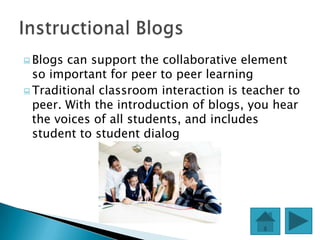
 Blogs can support the collaborative element
  so important for peer to peer learning
 Traditional classroom interaction is teacher to
  peer. With the introduction of blogs, you hear
  the voices of all students, and includes
  student to student dialog
 An  important part of having a classroom blog
  is providing posting guidelines and
  expectations.
 This is also a great way to teach students how
  to credit the work and ideas of others.
 Involve the students in all aspects of the
  blogging process.
 Here is a link to a great classroom blog:
 http://mswift.edublogs.org/
I think that creating a classroom blog gives
  your students an opportunity to have their
  voice heard.
 You have to have a plan in place before you
  start blogging or it will not be effective.
 Realize that creating a blog will require a ton
  of time to keep as a viable tool.
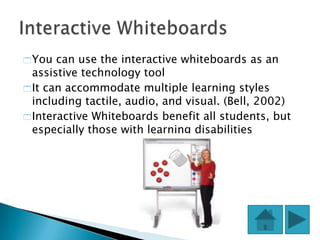
 You  can use the interactive whiteboards as an
  assistive technology tool
 It can accommodate multiple learning styles
  including tactile, audio, and visual. (Bell, 2002)
 Interactive Whiteboards benefit all students, but
  especially those with learning disabilities
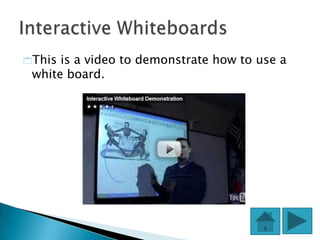
This is a video to demonstrate how to use a
 white board.
I would have never guessed that the
 whiteboards could be used as an assistive
 technology.
Also having the children come up to the
 board and use it, will help them stay focused
 on the subject at hand.
I like that you print class notes or email them.
This article made me think of other
 classroom technologies in different ways.
   As a teacher you have a whole new tool bag
    to draw from.
   You have to use the technology to get the
    most from your students without using it just
    for the sake of using it.
   Most of all you have to teach your students to
    be responsible with the technology.
   I’m excited to use all of the new tools that are
    now available.
 Fryer, Wesley A. Tools for the Teks: Integrating technology
  in the Classroom. Classroom Audio Podcasting, Speed of
  Creativity. Retrieved August 6, 2009.
  http://www.wtvi.com/teks/05_06_articles/classroom-audio-
  podcasting.html
 Deubel, Patricia (2007). Moderating and Ethics for the
  Classroom Instructional Blog. The Journal. Retrieved
  August 6, 2009.
  http://thejournal.com/Articles/2007/02/26/Moderating-and-
  Ethics-for-the-Classroom-Instructional-
  Blog_633573844495478025.aspx?Page=1
 Basilicato,Alfred N. Interactive Whiteboards: Assistive
  Technology for Every Classroom (2005). Today’s School.
  Retrieved August 6, 2009.
  http://www.interactivewhiteboards.com/www/files/articles/Article_200
  5todaysschool.pdf

The Interactive Classroom

  • 1.
  • 2.
    Classroom Audio Podcasting ◦ Article review – highlight the top 5 reasons ◦ Example of a classroom podcast ◦ Article review ◦ My conclusions  Classroom Instructional Blog ◦ Article review ◦ Article review ◦ My conclusions  Interactive Whiteboards ◦ Article review ◦ Article review ◦ My conclusions  Citations
  • 3.
     Classroom Audio Podcasting Instead of asking students to write exclusively for an audience of one (the teacher) using technology from the 1500’s (a pencil), teachers can now challenge students to publish for a global listening audience via a classroom podcast. (Fryer, 2006) The author provides 10 compelling reasons why teachers should use and incorporate podcasting into their curriculum.
  • 5.
     The best thing about podcasting is that it is a cheap technology to implement  Podcasting invites a global audience into your classroom Its disruptive nature is key to both its potential motivational power and the mixed reception it can invite with different audiences.  Audio podcasting is digital storytelling  Podcasting can be interactive Podcaster can realize the benefits and excitement inherent in interactive web 2.0 dialog.  Podcasting can be creative
  • 6.
    I thinkthat this is an incredible way to inspire children to be creative and learn at the same time.  Having them create a storyboard first ensures that they have researched all the facts and are getting the educational value out of the exercise.  It is also a great way to teach students about tone, intonation, speed of delivery, and expression.
  • 7.
     Blogs cansupport the collaborative element so important for peer to peer learning  Traditional classroom interaction is teacher to peer. With the introduction of blogs, you hear the voices of all students, and includes student to student dialog
  • 8.
     An important part of having a classroom blog is providing posting guidelines and expectations.  This is also a great way to teach students how to credit the work and ideas of others.  Involve the students in all aspects of the blogging process.  Here is a link to a great classroom blog: http://mswift.edublogs.org/
  • 9.
    I think thatcreating a classroom blog gives your students an opportunity to have their voice heard.  You have to have a plan in place before you start blogging or it will not be effective.  Realize that creating a blog will require a ton of time to keep as a viable tool.
  • 10.
     You can use the interactive whiteboards as an assistive technology tool  It can accommodate multiple learning styles including tactile, audio, and visual. (Bell, 2002)  Interactive Whiteboards benefit all students, but especially those with learning disabilities
  • 11.
    This is avideo to demonstrate how to use a white board.
  • 12.
    I would havenever guessed that the whiteboards could be used as an assistive technology. Also having the children come up to the board and use it, will help them stay focused on the subject at hand. I like that you print class notes or email them. This article made me think of other classroom technologies in different ways.
  • 13.
    As a teacher you have a whole new tool bag to draw from.  You have to use the technology to get the most from your students without using it just for the sake of using it.  Most of all you have to teach your students to be responsible with the technology.  I’m excited to use all of the new tools that are now available.
  • 14.
     Fryer, WesleyA. Tools for the Teks: Integrating technology in the Classroom. Classroom Audio Podcasting, Speed of Creativity. Retrieved August 6, 2009. http://www.wtvi.com/teks/05_06_articles/classroom-audio- podcasting.html  Deubel, Patricia (2007). Moderating and Ethics for the Classroom Instructional Blog. The Journal. Retrieved August 6, 2009. http://thejournal.com/Articles/2007/02/26/Moderating-and- Ethics-for-the-Classroom-Instructional- Blog_633573844495478025.aspx?Page=1  Basilicato,Alfred N. Interactive Whiteboards: Assistive Technology for Every Classroom (2005). Today’s School. Retrieved August 6, 2009. http://www.interactivewhiteboards.com/www/files/articles/Article_200 5todaysschool.pdf