Postgraduate and Mid- Career Development Unit
Faculty of Management and Finance
University of Colombo
Towards the foremost conglomerate in the
nation through effective communication
Case study: Expolanka PLC
PREPARED BY:
MBA (Weekday Program) 2017/2019
Group (II) Team 10
2017/MBA/WD/36 H.D.S.E.Kumarathunga
2017/MBA/WD/37 L.K.N.Lihinikumara
2017/MBA/WD/40 D.N.P.Munasinghe
2017/MBA/WD/14 T.H.D.C.M.DeSilva
2017/MBA/WD/17 R.M.N.S.Divulwewa
August 13, 2018
1
Contents
Overview of the Organization......................................................................................................... 2
1. Identification and Justification of the issue ............................................................................. 3
2. Sufficient evidence of analysis over the issue based on theoretical support ........................... 5
2.1. Herzberg’s Two Factor Theory........................................................................................ 6
2.2. Transmission Model of Communication.......................................................................... 7
2.3. Uncertainty Reduction Theory......................................................................................... 7
2.4. The 7 C’s of Communication........................................................................................... 8
2.5. Communication Channels ................................................................................................ 9
2.6. Information sharing.......................................................................................................... 9
3. Solutions and Justifications ................................................................................................... 10
References and Citation................................................................................................................ 11
2
Overview of the Organization
Expolanka Holdings is a global diversified conglomerate rooted in Sri Lanka. Expolanka begins
its journey in 1978 as family owned business which focused on exporting fresh products.
Expolanka Freight was established in 1982 and thereafter the company moved into multiple sectors
which includes airline services, travel and tea. Expolanka began expanding their business beyond
Sri Lanka borders in 1992. In 2003, Expolanka Holdings was established bringing all its
investments under one umbrella and with the rapid growth, the family business went public via an
IPO on the Colombo Stock Exchange.
In 2014, Expolanka Holdings entered a strategic partnership with SG Holdings Group from Japan,
and they currently owns 67% of the parent company. SG Holdings Group is a leading logistics
conglomerate headquartered in Tokyo, and the parent company of Sagawa Express is one of the
largest delivery companies in South Asia. This investment was one of the largest and most
significant foreign transactions in the Sri Lankan market. This investment made Expolanka a
corporate multi-national that had gone beyond the borders of Sri Lanka. Expolanka operates in 20
countries and in over 50 cities.
Expolanka companies specialize in end to end solutions in mainly three sectors.
1. Logistics
2. Leisure
3. Investments
Expolanka companies are known for challenging the status quo with a global vision and a strategic
growth plan that places the group at the forefront of driving innovation, growth and change in
every aspect of business – a successful formula that has earned Expo a place as a market leader
across all three sectors. As the South-Asian region’s powerhouse to provide simplified logistics
solutions via air,sea and land, Expolanka operates from 60 offices in 17 countries. With a growing
workforce of over 2000 employees, we ensure that our global network caters to specific needs
arising from US, Europe, Asia, Africa and the Middle-Eastern regions. In addition, Expolanka
PLC strategic positioning in global sourcing markets has enabled us to provide efficient services
from the point of origin to the end- destination with minimal lead times and helps us prove
ourselves to be one of the top global players in the logistics industry.
3
1. Identification and Justification of the issue
In today’s context organizations do not operate in isolation but instead operates by interacting with
the environment in which it functions. The environment is categorized into two main aspects:
• Internal environment
• External environment
The internal environment consists of employees, management, culture etc. while the external
environment consists of both task environment (customers, competitors, suppliers, labor market)
and general environment (technological, natural, sociocultural, economics, legal/political,
international). When taking the internal environment into consideration, the most important aspect
in the internal environment is the employees. The success and the failure of an organization
depends on the employees. Therefore, it is important to give the employees the attention that is
needed and to consider them as an asset to the organization. When considering the employees as
an asset there are many aspects that needs to be focused which enhances their attachment towards
the organizations. Some of the key factors are as follows:
• Work environment
• Fringe benefits
• Culture
• Leadership styles
• Communication
Therefore, fulfilling these aspects are important for the management. When looking into
Expolanka’s environment we could see a family oriented culture and an autocratic leadership style.
Various kinds of fringe benefits are given to employees and the work environment and atmosphere
in all workstations are designed in a very comfortable and employee friendly manner. After
looking to all these aspects, we found that the communication gap between the higher management
and its employees is an organizational issue which needs to be addressed in order to increase the
employees’ attachment towards the organization. Following scenarios clearly justify the existence
of afore mentioned organizational issue.
It is important that employees are well informed when an acquisition or a bought over is taken
place. But unfortunately, when Expolanka was bought over by the Japanese company Sagawa
Holdings in 2014 the employees were not informed and nothing in particular to the bought over
4
was communicated to the employees officially. At this point the employees heard the news through
media and other outside parties which confused and created a doubt within the mindsets of the
employees. Doubts with regard to job security, uncertainty and certain working conditions started
to exist. Even at present, when the business moves into certain diversifications, or moves into new
ventures the employees are unaware which creates a negative mindset within the employees.
Another reason to justify the communication gap between the parties is, annually at the beginning
of each financial year each sector (logistics, leisure and investments) is been given certain targets
that needs to be achieved during the said time period. The targets are not communicated effectively
to the subsidiaries and there on to the departments. Therefore, at the end of the financial year the
management is not satisfied with regard to the figures and the management complains that the
subsidiaries have not met the targets given to them while the heads of subsidiaries mention that
they have met the targets given which clearly exposes a communication gap. The same scenario is
seen when it comes to individual’s performance. The individual’s key performance indicators
should be in line with the department’s annual targets and these indicators should be
communicated at the beginning of the financial year to the individuals which cannot be seen in
Expolanka. Therefore the individuals are not assessed effectively at the end of the financial year
which demotivates the employees immensely.
The communication gap can be seen in the insurance as well. when employee handover
hospitalization bills for claiming certain claims are rejected due to the medical issue not being
covered, not submitting certain documents etc. When analyzed in depth the root cause for claims
to be rejected is that the employees are not well informed which again shows the communication
gap. Therefore, it is important to address the communication gap within Expolanka since this
organizational issue has caused the following and many more negative impacts within the
employees.
• Demotivation
• Loss of attachment to the organization
• Loss of trust with the management
• Ineffectiveness
5
2. Sufficient evidence of analysis over the issue based on theoretical support
A proper management of production processes involves greater collaboration and teamwork
among workers in different functional groups. Therefore, to manage the remaining performance
of the employees and to stimulate them for better performance, effective communication practices
have become more significant for an organization. In addition, organizational capabilities are
established and ratified through “intensely social and communicative processes”. With regard to
the Expolanka PLC, the communication channels are bit ineffective which creates barriers in the
activities of the organization in order to achieve goals, socialization, decision-making, problem-
solving and change-management processes.
As communication serves two essential functions in every organization including, that
disseminates the information needed by employees to get things done and builds relationships of
trust and commitment. Therefore, in Expolanka PLC, employees tend to end up working with no
clear direction, vague goals and little opportunity for improvement. As a result, the staff morale
plummets when communication is ambiguous, unfocused, lacking in important details and does
not allow for genuine two-way dialogue. Therefore, these communication gaps can be addressed
in relation to number of theories and concepts towards the Expolanka PLC success as follows.
If we consider the role of motivational practices followed in the other well reputed organizations, we
can easily find a solution to the ‘communication problem’ mentioned above in the Expolanka PLC as
motivating is the work which managers perform to inspire, encourage and impel people to take action.
To motivate the employees, the employee must be reached and to reach him there must be a completed
understanding of the complexity of his make-up. Motivation efforts must be directed towards
improving organization operations. In fact, motivation can best be accomplished when workers are
able to merge their personal ambitions with those of the organization. Theories of motivation can be
divided into two: the content theories; and the process theories. Content theories emphasize the factors
that motivate individuals. Examples of content theories are Maslow’s theory, Alfelder’s theory,
McClelland’s theory, and Herzberg’s theories. On the other hand, the emphasis on process theories is
on the actual process of motivation. Some examples of process theories are Expectancy theories, equity
theory, goal theory, and social learning theory.
With regard to the Expolanka PLC, those motivation theories and process theories can be discussed as
given below.
6
2.1. Herzberg’s Two Factor Theory
Herzberg's theory recommends that motivation is composed of two largely unrelated dimensions: job-
related factors which can prevent dissatisfaction, but do not promote employees' growth and development
(hygiene); and job-related factors that encourage growth (motivators).
This theory explains the importance of non-
monetary rewards in motivating employees
which includes variables such as achievement,
recognition, personal growth, personal
responsibility and the characteristics of the work.
These factors are called motivators. When people
are satisfied, they attribute their satisfaction to
the work itself and not on the environment in
which they work.
As explained in Expolanka PLC using this flow
chart, dissatisfying experiences result from the
extrinsic work environment. These factors
include company policies, salary, co-worker
relations, supervisor relationships, status, supervision, personal life and job security. These factors cause a
person who feels value less about the job to feel disappointments and less motivated. According to the
theory workers basically attribute their dissatisfaction to the environment in which they work, or conditions
that surround the doings of the job. These are the “Hygiene factors” of this theory.
The organization should continually maintain these factors as employees never completely satisfied. In this
theory, when the hygiene factors are very low, workers are dissatisfied. However, when hygiene factors are
met, workers are not dissatisfied but it does not necessarily mean that they are satisfied or motivated to
work. The same goes for the motivator factors. When motivators are met, workers are satisfied leading to
higher performance. However, when motivators are not met, workers are not satisfied but it does not
necessarily mean they are dissatisfied with their work.
Therefore, the two-factor theory of Herzberg states that there are certain factors in the workplace that cause
job satisfaction, while a separate set of factors cause dissatisfaction. In line with that concept, the Expolanka
PLC should narrate its internal and external environment by addressing these motivational and hygiene
factors.
Introducing
Hygene Factors
to Expolanka PLC
Enhancing
Motivational
Factors to
Expolanka PLC
Staff is
motivated and
satisfied
7
2.2. Transmission Model of Communication
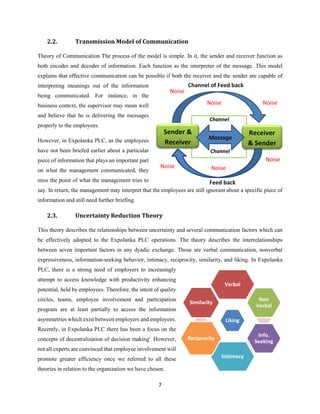
Theory of Communication The process of the model is simple. In it, the sender and receiver function as
both encoder and decoder of information. Each function as the interpreter of the message. This model
explains that effective communication can be possible if both the receiver and the sender are capable of
interpreting meanings out of the information
being communicated. For instance, in the
business context, the supervisor may mean well
and believe that he is delivering the messages
properly to the employees.
However, in Expolanka PLC, as the employees
have not been briefed earlier about a particular
piece of information that plays an important part
on what the management communicated, they
miss the point of what the management tries to
say. In return, the management may interpret that the employees are still ignorant about a specific piece of
information and still need further briefing.
2.3. Uncertainty Reduction Theory
This theory describes the relationships between uncertainty and several communication factors which can
be effectively adopted to the Expolanka PLC operations. The theory describes the interrelationships
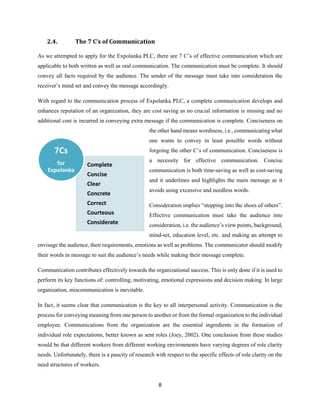
between seven important factors in any dyadic exchange. Those are verbal communication, nonverbal
expressiveness, information-seeking behavior, intimacy, reciprocity, similarity, and liking. In Expolanka
PLC, there is a strong need of employers to increasingly
attempt to access knowledge with productivity enhancing
potential, held by employees. Therefore, the intent of quality
circles, teams, employee involvement and participation
program are at least partially to access the information
asymmetries which exist between employers and employees.
Recently, in Expolanka PLC there has been a focus on the
concepts of decentralization of decision making'. However,
not all experts are convinced that employee involvement will
promote greater efficiency once we referred to all these
theories in relation to the organization we have chosen.
Liking
Verbal
Non
Verbal
Info.
Seeking
Initimacy
Reciprocity
Similarity
Channel of Feed back
Receiver
& Sender
Sender &
Receiver
Noise
Massage
Feed back
NoiseNoise
Noise
Noise
Noise
Channel
Channel
8
2.4. The 7 C’s of Communication
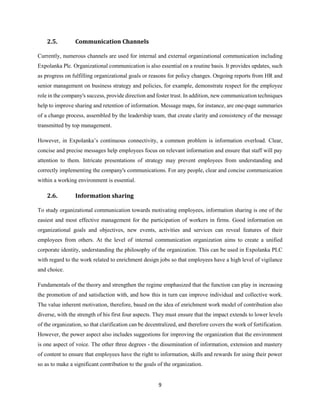
As we attempted to apply for the Expolanka PLC, there are 7 C’s of effective communication which are
applicable to both written as well as oral communication. The communication must be complete. It should
convey all facts required by the audience. The sender of the message must take into consideration the
receiver’s mind set and convey the message accordingly.
With regard to the communication process of Expolanka PLC, a complete communication develops and
enhances reputation of an organization, they are cost saving as no crucial information is missing and no
additional cost is incurred in conveying extra message if the communication is complete. Conciseness on
the other hand means wordiness, i.e., communicating what
one wants to convey in least possible words without
forgoing the other C’s of communication. Conciseness is
a necessity for effective communication. Concise
communication is both time-saving as well as cost-saving
and it underlines and highlights the main message as it
avoids using excessive and needless words.
Consideration implies “stepping into the shoes of others”.
Effective communication must take the audience into
consideration, i.e. the audience’s view points, background,
mind-set, education level, etc. and making an attempt to
envisage the audience, their requirements, emotions as well as problems. The communicator should modify
their words in message to suit the audience’s needs while making their message complete.
Communication contributes effectively towards the organizational success. This is only done if it is used to
perform its key functions of: controlling, motivating, emotional expressions and decision making. In large
organization, miscommunication is inevitable.
In fact, it seems clear that communication is the key to all interpersonal activity. Communication is the
process for conveying meaning from one person to another or from the formal organization to the individual
employee. Communications from the organization are the essential ingredients in the formation of
individual role expectations, better known as sent roles (Joey, 2002). One conclusion from these studies
would be that different workers from different working environments have varying degrees of role clarity
needs. Unfortunately, there is a paucity of research with respect to the specific effects of role clarity on the
need structures of workers.
Complete
Concise
Clear
Concrete
Correct
Courteous
Considerate
7Cs
for
Expolanka
9
2.5. Communication Channels
Currently, numerous channels are used for internal and external organizational communication including
Expolanka Plc. Organizational communication is also essential on a routine basis. It provides updates, such
as progress on fulfilling organizational goals or reasons for policy changes. Ongoing reports from HR and
senior management on business strategy and policies, for example, demonstrate respect for the employee
role in the company's success, provide direction and foster trust. In addition, new communication techniques
help to improve sharing and retention of information. Message maps, for instance, are one-page summaries
of a change process, assembled by the leadership team, that create clarity and consistency of the message
transmitted by top management.
However, in Expolanka’s continuous connectivity, a common problem is information overload. Clear,
concise and precise messages help employees focus on relevant information and ensure that staff will pay
attention to them. Intricate presentations of strategy may prevent employees from understanding and
correctly implementing the company's communications. For any people, clear and concise communication
within a working environment is essential.
2.6. Information sharing
To study organizational communication towards motivating employees, information sharing is one of the
easiest and most effective management for the participation of workers in firms. Good information on
organizational goals and objectives, new events, activities and services can reveal features of their
employees from others. At the level of internal communication organization aims to create a unified
corporate identity, understanding the philosophy of the organization. This can be used in Expolanka PLC
with regard to the work related to enrichment design jobs so that employees have a high level of vigilance
and choice.
Fundamentals of the theory and strengthen the regime emphasized that the function can play in increasing
the promotion of and satisfaction with, and how this in turn can improve individual and collective work.
The value inherent motivation, therefore, based on the idea of enrichment work model of contribution also
diverse, with the strength of his first four aspects. They must ensure that the impact extends to lower levels
of the organization, so that clarification can be decentralized, and therefore covers the work of fortification.
However, the power aspect also includes suggestions for improving the organization that the environment
is one aspect of voice. The other three degrees - the dissemination of information, extension and mastery
of content to ensure that employees have the right to information, skills and rewards for using their power
so as to make a significant contribution to the goals of the organization.
10
3. Solutions and Justifications
As we studied the organizational and employee relations of the Expolanka PLC, we understood
that since employee involvement in decision making affects the employee motivation, the
company managers should involve the employees of all cadres to enable them have experience on
the intricates of running the business.
"We have managed to significantly improve document collaboration and information exchange,
search information relating to a customer job or business context, enable version control, saving
considerable amount of real-estate and improve overall productivity enhancements."
Expolanka Head of IT, Asitha Kaggoda (Business Times)
For that purpose, we have identified that the 7 C’s of communication affects the employee
motivation to a great extent, therefore we recommend that;
3.1. The Expolanka PLC management should ensure there is clarity, courtesy, correctness and
completeness of any information shared.
3.2. The communication should always take into consideration timing and the organization’s
structure has a significant impact on the communication and strategy implementation
process.
3.3. The Expolanka PLC management should have a good verbal communication in the
company especially oral communication (face to face) which is considered richer than
written communication due to its ability to carry larger loads of information and for its
ability to allow instant clarification of any message ambiguity.
3.4. The organizational management should enhance information sharing as it makes
employees feel empowered and trusted, increases cohesion within a team and ensures easy
decision making.
3.5. Formation of groups enhance information sharing and thus motivation, information sharing
is one of the easiest and most effective management for the participation of workers in
firms and good information on organizational goals and objectives, new events, activities
and services reveal features of their employees from others.
11
“The Expolanka Group has always maintained a rich tradition of being an equal opportunity
employer. With deeper penetration as a foremost conglomerate in the nation, the Group is
increasingly moving towards diversity in terms of age, gender, ethnicity and religion and strives
to ensure that Company policies and processes enable all employees to work together by following
all the steps mentioned above, the Expolanka will be able to achieve its potential growth in near
future while making all the employees satisfied with their work life.”
Annual Report 2017 (ExpoLanka)
To achieve the aforesaid objective given in the annual report 2017, Expolanka PLC should increase
its effective communication process towards employee motivation in order to absorb the highest
potential of its labor force.
References and Citation
Mutuku, C.K. & Mathooko, P. (2014). Effects of Organizational Communication on Employee
Motivation: A Case Study of Nokia Siemens Networks Kenya, International Academic
Journal of Information Sciences and Project Management Volume 1, Issue 3, pp. 28-62
Cooper,D. R. & Schindler, P.S. (2006). Business Research Methods(9th Ed). New York:McGraw
Hill.
Denscombe, J. (2007). A longitudinal analysis of the antecedents of organizational commitments.
Academy of Management Journal, 27 (1), 95-112.
Elashmawi, D. & Harris, O. (1993). Developing Communicative Competencies for a
learningorganization. Journal of Management Development Vol. 25 No. 3.
Grunig, F. (1992). Internal communication during change management.
CorporateCommunications: An International Journal Vol. 7 No.1.
Harper, G. (2002). Using vision to improve organizational communication, Leadership
andOrganizational Journal Vol.21 No.2.

Assignment explolanka plc

  • 1.
    Postgraduate and Mid-Career Development Unit Faculty of Management and Finance University of Colombo Towards the foremost conglomerate in the nation through effective communication Case study: Expolanka PLC PREPARED BY: MBA (Weekday Program) 2017/2019 Group (II) Team 10 2017/MBA/WD/36 H.D.S.E.Kumarathunga 2017/MBA/WD/37 L.K.N.Lihinikumara 2017/MBA/WD/40 D.N.P.Munasinghe 2017/MBA/WD/14 T.H.D.C.M.DeSilva 2017/MBA/WD/17 R.M.N.S.Divulwewa August 13, 2018
  • 2.
    1 Contents Overview of theOrganization......................................................................................................... 2 1. Identification and Justification of the issue ............................................................................. 3 2. Sufficient evidence of analysis over the issue based on theoretical support ........................... 5 2.1. Herzberg’s Two Factor Theory........................................................................................ 6 2.2. Transmission Model of Communication.......................................................................... 7 2.3. Uncertainty Reduction Theory......................................................................................... 7 2.4. The 7 C’s of Communication........................................................................................... 8 2.5. Communication Channels ................................................................................................ 9 2.6. Information sharing.......................................................................................................... 9 3. Solutions and Justifications ................................................................................................... 10 References and Citation................................................................................................................ 11
  • 3.
    2 Overview of theOrganization Expolanka Holdings is a global diversified conglomerate rooted in Sri Lanka. Expolanka begins its journey in 1978 as family owned business which focused on exporting fresh products. Expolanka Freight was established in 1982 and thereafter the company moved into multiple sectors which includes airline services, travel and tea. Expolanka began expanding their business beyond Sri Lanka borders in 1992. In 2003, Expolanka Holdings was established bringing all its investments under one umbrella and with the rapid growth, the family business went public via an IPO on the Colombo Stock Exchange. In 2014, Expolanka Holdings entered a strategic partnership with SG Holdings Group from Japan, and they currently owns 67% of the parent company. SG Holdings Group is a leading logistics conglomerate headquartered in Tokyo, and the parent company of Sagawa Express is one of the largest delivery companies in South Asia. This investment was one of the largest and most significant foreign transactions in the Sri Lankan market. This investment made Expolanka a corporate multi-national that had gone beyond the borders of Sri Lanka. Expolanka operates in 20 countries and in over 50 cities. Expolanka companies specialize in end to end solutions in mainly three sectors. 1. Logistics 2. Leisure 3. Investments Expolanka companies are known for challenging the status quo with a global vision and a strategic growth plan that places the group at the forefront of driving innovation, growth and change in every aspect of business – a successful formula that has earned Expo a place as a market leader across all three sectors. As the South-Asian region’s powerhouse to provide simplified logistics solutions via air,sea and land, Expolanka operates from 60 offices in 17 countries. With a growing workforce of over 2000 employees, we ensure that our global network caters to specific needs arising from US, Europe, Asia, Africa and the Middle-Eastern regions. In addition, Expolanka PLC strategic positioning in global sourcing markets has enabled us to provide efficient services from the point of origin to the end- destination with minimal lead times and helps us prove ourselves to be one of the top global players in the logistics industry.
  • 4.
    3 1. Identification andJustification of the issue In today’s context organizations do not operate in isolation but instead operates by interacting with the environment in which it functions. The environment is categorized into two main aspects: • Internal environment • External environment The internal environment consists of employees, management, culture etc. while the external environment consists of both task environment (customers, competitors, suppliers, labor market) and general environment (technological, natural, sociocultural, economics, legal/political, international). When taking the internal environment into consideration, the most important aspect in the internal environment is the employees. The success and the failure of an organization depends on the employees. Therefore, it is important to give the employees the attention that is needed and to consider them as an asset to the organization. When considering the employees as an asset there are many aspects that needs to be focused which enhances their attachment towards the organizations. Some of the key factors are as follows: • Work environment • Fringe benefits • Culture • Leadership styles • Communication Therefore, fulfilling these aspects are important for the management. When looking into Expolanka’s environment we could see a family oriented culture and an autocratic leadership style. Various kinds of fringe benefits are given to employees and the work environment and atmosphere in all workstations are designed in a very comfortable and employee friendly manner. After looking to all these aspects, we found that the communication gap between the higher management and its employees is an organizational issue which needs to be addressed in order to increase the employees’ attachment towards the organization. Following scenarios clearly justify the existence of afore mentioned organizational issue. It is important that employees are well informed when an acquisition or a bought over is taken place. But unfortunately, when Expolanka was bought over by the Japanese company Sagawa Holdings in 2014 the employees were not informed and nothing in particular to the bought over
  • 5.
    4 was communicated tothe employees officially. At this point the employees heard the news through media and other outside parties which confused and created a doubt within the mindsets of the employees. Doubts with regard to job security, uncertainty and certain working conditions started to exist. Even at present, when the business moves into certain diversifications, or moves into new ventures the employees are unaware which creates a negative mindset within the employees. Another reason to justify the communication gap between the parties is, annually at the beginning of each financial year each sector (logistics, leisure and investments) is been given certain targets that needs to be achieved during the said time period. The targets are not communicated effectively to the subsidiaries and there on to the departments. Therefore, at the end of the financial year the management is not satisfied with regard to the figures and the management complains that the subsidiaries have not met the targets given to them while the heads of subsidiaries mention that they have met the targets given which clearly exposes a communication gap. The same scenario is seen when it comes to individual’s performance. The individual’s key performance indicators should be in line with the department’s annual targets and these indicators should be communicated at the beginning of the financial year to the individuals which cannot be seen in Expolanka. Therefore the individuals are not assessed effectively at the end of the financial year which demotivates the employees immensely. The communication gap can be seen in the insurance as well. when employee handover hospitalization bills for claiming certain claims are rejected due to the medical issue not being covered, not submitting certain documents etc. When analyzed in depth the root cause for claims to be rejected is that the employees are not well informed which again shows the communication gap. Therefore, it is important to address the communication gap within Expolanka since this organizational issue has caused the following and many more negative impacts within the employees. • Demotivation • Loss of attachment to the organization • Loss of trust with the management • Ineffectiveness
  • 6.
    5 2. Sufficient evidenceof analysis over the issue based on theoretical support A proper management of production processes involves greater collaboration and teamwork among workers in different functional groups. Therefore, to manage the remaining performance of the employees and to stimulate them for better performance, effective communication practices have become more significant for an organization. In addition, organizational capabilities are established and ratified through “intensely social and communicative processes”. With regard to the Expolanka PLC, the communication channels are bit ineffective which creates barriers in the activities of the organization in order to achieve goals, socialization, decision-making, problem- solving and change-management processes. As communication serves two essential functions in every organization including, that disseminates the information needed by employees to get things done and builds relationships of trust and commitment. Therefore, in Expolanka PLC, employees tend to end up working with no clear direction, vague goals and little opportunity for improvement. As a result, the staff morale plummets when communication is ambiguous, unfocused, lacking in important details and does not allow for genuine two-way dialogue. Therefore, these communication gaps can be addressed in relation to number of theories and concepts towards the Expolanka PLC success as follows. If we consider the role of motivational practices followed in the other well reputed organizations, we can easily find a solution to the ‘communication problem’ mentioned above in the Expolanka PLC as motivating is the work which managers perform to inspire, encourage and impel people to take action. To motivate the employees, the employee must be reached and to reach him there must be a completed understanding of the complexity of his make-up. Motivation efforts must be directed towards improving organization operations. In fact, motivation can best be accomplished when workers are able to merge their personal ambitions with those of the organization. Theories of motivation can be divided into two: the content theories; and the process theories. Content theories emphasize the factors that motivate individuals. Examples of content theories are Maslow’s theory, Alfelder’s theory, McClelland’s theory, and Herzberg’s theories. On the other hand, the emphasis on process theories is on the actual process of motivation. Some examples of process theories are Expectancy theories, equity theory, goal theory, and social learning theory. With regard to the Expolanka PLC, those motivation theories and process theories can be discussed as given below.
  • 7.
    6 2.1. Herzberg’s TwoFactor Theory Herzberg's theory recommends that motivation is composed of two largely unrelated dimensions: job- related factors which can prevent dissatisfaction, but do not promote employees' growth and development (hygiene); and job-related factors that encourage growth (motivators). This theory explains the importance of non- monetary rewards in motivating employees which includes variables such as achievement, recognition, personal growth, personal responsibility and the characteristics of the work. These factors are called motivators. When people are satisfied, they attribute their satisfaction to the work itself and not on the environment in which they work. As explained in Expolanka PLC using this flow chart, dissatisfying experiences result from the extrinsic work environment. These factors include company policies, salary, co-worker relations, supervisor relationships, status, supervision, personal life and job security. These factors cause a person who feels value less about the job to feel disappointments and less motivated. According to the theory workers basically attribute their dissatisfaction to the environment in which they work, or conditions that surround the doings of the job. These are the “Hygiene factors” of this theory. The organization should continually maintain these factors as employees never completely satisfied. In this theory, when the hygiene factors are very low, workers are dissatisfied. However, when hygiene factors are met, workers are not dissatisfied but it does not necessarily mean that they are satisfied or motivated to work. The same goes for the motivator factors. When motivators are met, workers are satisfied leading to higher performance. However, when motivators are not met, workers are not satisfied but it does not necessarily mean they are dissatisfied with their work. Therefore, the two-factor theory of Herzberg states that there are certain factors in the workplace that cause job satisfaction, while a separate set of factors cause dissatisfaction. In line with that concept, the Expolanka PLC should narrate its internal and external environment by addressing these motivational and hygiene factors. Introducing Hygene Factors to Expolanka PLC Enhancing Motivational Factors to Expolanka PLC Staff is motivated and satisfied
  • 8.
    7 2.2. Transmission Modelof Communication Theory of Communication The process of the model is simple. In it, the sender and receiver function as both encoder and decoder of information. Each function as the interpreter of the message. This model explains that effective communication can be possible if both the receiver and the sender are capable of interpreting meanings out of the information being communicated. For instance, in the business context, the supervisor may mean well and believe that he is delivering the messages properly to the employees. However, in Expolanka PLC, as the employees have not been briefed earlier about a particular piece of information that plays an important part on what the management communicated, they miss the point of what the management tries to say. In return, the management may interpret that the employees are still ignorant about a specific piece of information and still need further briefing. 2.3. Uncertainty Reduction Theory This theory describes the relationships between uncertainty and several communication factors which can be effectively adopted to the Expolanka PLC operations. The theory describes the interrelationships between seven important factors in any dyadic exchange. Those are verbal communication, nonverbal expressiveness, information-seeking behavior, intimacy, reciprocity, similarity, and liking. In Expolanka PLC, there is a strong need of employers to increasingly attempt to access knowledge with productivity enhancing potential, held by employees. Therefore, the intent of quality circles, teams, employee involvement and participation program are at least partially to access the information asymmetries which exist between employers and employees. Recently, in Expolanka PLC there has been a focus on the concepts of decentralization of decision making'. However, not all experts are convinced that employee involvement will promote greater efficiency once we referred to all these theories in relation to the organization we have chosen. Liking Verbal Non Verbal Info. Seeking Initimacy Reciprocity Similarity Channel of Feed back Receiver & Sender Sender & Receiver Noise Massage Feed back NoiseNoise Noise Noise Noise Channel Channel
  • 9.
    8 2.4. The 7C’s of Communication As we attempted to apply for the Expolanka PLC, there are 7 C’s of effective communication which are applicable to both written as well as oral communication. The communication must be complete. It should convey all facts required by the audience. The sender of the message must take into consideration the receiver’s mind set and convey the message accordingly. With regard to the communication process of Expolanka PLC, a complete communication develops and enhances reputation of an organization, they are cost saving as no crucial information is missing and no additional cost is incurred in conveying extra message if the communication is complete. Conciseness on the other hand means wordiness, i.e., communicating what one wants to convey in least possible words without forgoing the other C’s of communication. Conciseness is a necessity for effective communication. Concise communication is both time-saving as well as cost-saving and it underlines and highlights the main message as it avoids using excessive and needless words. Consideration implies “stepping into the shoes of others”. Effective communication must take the audience into consideration, i.e. the audience’s view points, background, mind-set, education level, etc. and making an attempt to envisage the audience, their requirements, emotions as well as problems. The communicator should modify their words in message to suit the audience’s needs while making their message complete. Communication contributes effectively towards the organizational success. This is only done if it is used to perform its key functions of: controlling, motivating, emotional expressions and decision making. In large organization, miscommunication is inevitable. In fact, it seems clear that communication is the key to all interpersonal activity. Communication is the process for conveying meaning from one person to another or from the formal organization to the individual employee. Communications from the organization are the essential ingredients in the formation of individual role expectations, better known as sent roles (Joey, 2002). One conclusion from these studies would be that different workers from different working environments have varying degrees of role clarity needs. Unfortunately, there is a paucity of research with respect to the specific effects of role clarity on the need structures of workers. Complete Concise Clear Concrete Correct Courteous Considerate 7Cs for Expolanka
  • 10.
    9 2.5. Communication Channels Currently,numerous channels are used for internal and external organizational communication including Expolanka Plc. Organizational communication is also essential on a routine basis. It provides updates, such as progress on fulfilling organizational goals or reasons for policy changes. Ongoing reports from HR and senior management on business strategy and policies, for example, demonstrate respect for the employee role in the company's success, provide direction and foster trust. In addition, new communication techniques help to improve sharing and retention of information. Message maps, for instance, are one-page summaries of a change process, assembled by the leadership team, that create clarity and consistency of the message transmitted by top management. However, in Expolanka’s continuous connectivity, a common problem is information overload. Clear, concise and precise messages help employees focus on relevant information and ensure that staff will pay attention to them. Intricate presentations of strategy may prevent employees from understanding and correctly implementing the company's communications. For any people, clear and concise communication within a working environment is essential. 2.6. Information sharing To study organizational communication towards motivating employees, information sharing is one of the easiest and most effective management for the participation of workers in firms. Good information on organizational goals and objectives, new events, activities and services can reveal features of their employees from others. At the level of internal communication organization aims to create a unified corporate identity, understanding the philosophy of the organization. This can be used in Expolanka PLC with regard to the work related to enrichment design jobs so that employees have a high level of vigilance and choice. Fundamentals of the theory and strengthen the regime emphasized that the function can play in increasing the promotion of and satisfaction with, and how this in turn can improve individual and collective work. The value inherent motivation, therefore, based on the idea of enrichment work model of contribution also diverse, with the strength of his first four aspects. They must ensure that the impact extends to lower levels of the organization, so that clarification can be decentralized, and therefore covers the work of fortification. However, the power aspect also includes suggestions for improving the organization that the environment is one aspect of voice. The other three degrees - the dissemination of information, extension and mastery of content to ensure that employees have the right to information, skills and rewards for using their power so as to make a significant contribution to the goals of the organization.
  • 11.
    10 3. Solutions andJustifications As we studied the organizational and employee relations of the Expolanka PLC, we understood that since employee involvement in decision making affects the employee motivation, the company managers should involve the employees of all cadres to enable them have experience on the intricates of running the business. "We have managed to significantly improve document collaboration and information exchange, search information relating to a customer job or business context, enable version control, saving considerable amount of real-estate and improve overall productivity enhancements." Expolanka Head of IT, Asitha Kaggoda (Business Times) For that purpose, we have identified that the 7 C’s of communication affects the employee motivation to a great extent, therefore we recommend that; 3.1. The Expolanka PLC management should ensure there is clarity, courtesy, correctness and completeness of any information shared. 3.2. The communication should always take into consideration timing and the organization’s structure has a significant impact on the communication and strategy implementation process. 3.3. The Expolanka PLC management should have a good verbal communication in the company especially oral communication (face to face) which is considered richer than written communication due to its ability to carry larger loads of information and for its ability to allow instant clarification of any message ambiguity. 3.4. The organizational management should enhance information sharing as it makes employees feel empowered and trusted, increases cohesion within a team and ensures easy decision making. 3.5. Formation of groups enhance information sharing and thus motivation, information sharing is one of the easiest and most effective management for the participation of workers in firms and good information on organizational goals and objectives, new events, activities and services reveal features of their employees from others.
  • 12.
    11 “The Expolanka Grouphas always maintained a rich tradition of being an equal opportunity employer. With deeper penetration as a foremost conglomerate in the nation, the Group is increasingly moving towards diversity in terms of age, gender, ethnicity and religion and strives to ensure that Company policies and processes enable all employees to work together by following all the steps mentioned above, the Expolanka will be able to achieve its potential growth in near future while making all the employees satisfied with their work life.” Annual Report 2017 (ExpoLanka) To achieve the aforesaid objective given in the annual report 2017, Expolanka PLC should increase its effective communication process towards employee motivation in order to absorb the highest potential of its labor force. References and Citation Mutuku, C.K. & Mathooko, P. (2014). Effects of Organizational Communication on Employee Motivation: A Case Study of Nokia Siemens Networks Kenya, International Academic Journal of Information Sciences and Project Management Volume 1, Issue 3, pp. 28-62 Cooper,D. R. & Schindler, P.S. (2006). Business Research Methods(9th Ed). New York:McGraw Hill. Denscombe, J. (2007). A longitudinal analysis of the antecedents of organizational commitments. Academy of Management Journal, 27 (1), 95-112. Elashmawi, D. & Harris, O. (1993). Developing Communicative Competencies for a learningorganization. Journal of Management Development Vol. 25 No. 3. Grunig, F. (1992). Internal communication during change management. CorporateCommunications: An International Journal Vol. 7 No.1. Harper, G. (2002). Using vision to improve organizational communication, Leadership andOrganizational Journal Vol.21 No.2.