The Humanistic Tradition in
Transformative Coaching
What we’ll cover
● Origins & essential assumptions of humanistic psychology
● Its role in transformative coaching
● Dangers of wholesale introjection
● Critiques of the tradition
● My hopes for the humanistic tradition in coaching
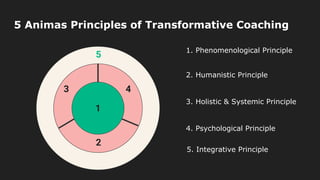
5
5. Integrative Principle
5 Animas Principles of Transformative Coaching
4
2
3
2. Humanistic Principle
3. Holistic & Systemic Principle
4. Psychological Principle
1
1. Phenomenological Principle
Origins and Assumptions of
Humanistic Psychology
Origins of Humanistic Psychology
● 2 schools of psychology plus divide of body and mind
● Post-war optimism
● Maslow (1908 - 1970)
● Rogers (1902 - 1987)
● Rejection of authority and professionalisation
● Human Potential Movement
● 1960s and 70s - counterculture
● Rollo May (1909 - 1994)
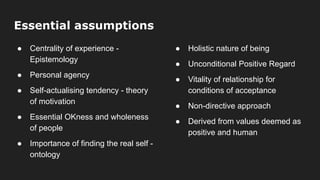
Essential assumptions
● Centrality of experience -
Epistemology
● Personal agency
● Self-actualising tendency - theory
of motivation
● Essential OKness and wholeness
of people
● Importance of finding the real self -
ontology
● Holistic nature of being
● Unconditional Positive Regard
● Vitality of relationship for
conditions of acceptance
● Non-directive approach
● Derived from values deemed as
positive and human
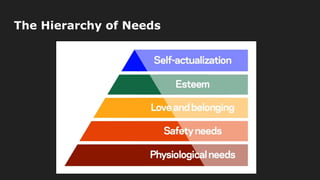
The Hierarchy of Needs
What is self-actualisation?
“to become more and more what one is, to become
everything that one is capable of becoming.
Abraham Maslow
Unconditional Positive Regard
“The individual has within him or her self vast resources
for self-understanding, for altering her or his self-concept,
attitudes, and self-directed behaviour—and that these
resources can be tapped if only a definable climate of
facilitative psychological attitudes can be provided.”
Carl Rogers
Rogers’ 6 Necessary & Sufficient
Conditions for Change
6 Necessary & Sufficient Conditions for Change
1. Two persons are in psychological contact.
2. The client desires change but experiences stuckness.
3. The coach is congruent and authentic in the relationship.
4. The coach experiences unconditional positive regard for the client.
5. The coach experiences and communicates empathic
understanding of the client's internal frame of reference.
6. The client receives and feels the coach’s empathic understanding
and unconditional positive regard is to a minimal degree achieved.
The function of the relationship
● Empathy creates trust and acceptance
● Client experiences themselves anew in the
relationship
● Dialogue facilitates change through awareness
and acceptance
● Coach and client are both essential to the
relational quality
The Humanistic Tradition in
Transformative Coaching
HP in Transformative Coaching
● Power of dialogue and personal inquiry
● Underlying unconditional positive regard
● Centrality of client’s experience
● Belief in growth and trust in client to move towards growth
● Holistic nature of the person
● What TC specifically introduces - a focus on mental
paradigms that derives more from constructivist theory and
practice
The danger of wholesale
introjection
The danger of wholesale introjection
● Rejection of the positivist, cognitive and logical dimensions
to coaching
● Overemphasis on the relationship in coaching
● Subtle imposition of humanistic values
Critiques of
the Humanistic Tradition
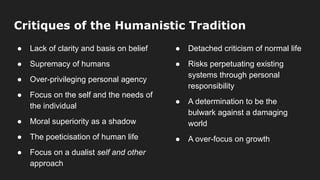
Critiques of the Humanistic Tradition
● Lack of clarity and basis on belief
● Supremacy of humans
● Over-privileging personal agency
● Focus on the self and the needs of
the individual
● Moral superiority as a shadow
● The poeticisation of human life
● Focus on a dualist self and other
approach
● Detached criticism of normal life
● Risks perpetuating existing
systems through personal
responsibility
● A determination to be the
bulwark against a damaging
world
● A over-focus on growth
My hopes for the humanistic
approach
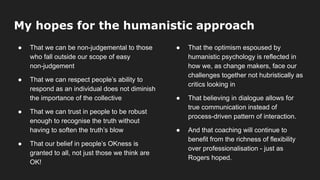
My hopes for the humanistic approach
● That we can be non-judgemental to those
who fall outside our scope of easy
non-judgement
● That we can respect people’s ability to
respond as an individual does not diminish
the importance of the collective
● That we can trust in people to be robust
enough to recognise the truth without
having to soften the truth’s blow
● That our belief in people’s OKness is
granted to all, not just those we think are
OK!
● That the optimism espoused by
humanistic psychology is reflected in
how we, as change makers, face our
challenges together not hubristically as
critics looking in
● That believing in dialogue allows for
true communication instead of
process-driven pattern of interaction.
● And that coaching will continue to
benefit from the richness of flexibility
over professionalisation - just as
Rogers hoped.
Finish by celebrating
● Belief in essential OKness
● Belief in the individual’s ability to make a difference
● Belief in our capacity to grow and change
● Belief in dialogue
● Desire to focus on happiness

The Humanistic Tradition in Transformative Coaching.pdf

  • 1.
    The Humanistic Traditionin Transformative Coaching
  • 2.
    What we’ll cover ●Origins & essential assumptions of humanistic psychology ● Its role in transformative coaching ● Dangers of wholesale introjection ● Critiques of the tradition ● My hopes for the humanistic tradition in coaching
  • 3.
    5 5. Integrative Principle 5Animas Principles of Transformative Coaching 4 2 3 2. Humanistic Principle 3. Holistic & Systemic Principle 4. Psychological Principle 1 1. Phenomenological Principle
  • 4.
    Origins and Assumptionsof Humanistic Psychology
  • 5.
    Origins of HumanisticPsychology ● 2 schools of psychology plus divide of body and mind ● Post-war optimism ● Maslow (1908 - 1970) ● Rogers (1902 - 1987) ● Rejection of authority and professionalisation ● Human Potential Movement ● 1960s and 70s - counterculture ● Rollo May (1909 - 1994)
  • 6.
    Essential assumptions ● Centralityof experience - Epistemology ● Personal agency ● Self-actualising tendency - theory of motivation ● Essential OKness and wholeness of people ● Importance of finding the real self - ontology ● Holistic nature of being ● Unconditional Positive Regard ● Vitality of relationship for conditions of acceptance ● Non-directive approach ● Derived from values deemed as positive and human
  • 7.
  • 8.
  • 9.
    What is self-actualisation? “tobecome more and more what one is, to become everything that one is capable of becoming. Abraham Maslow
  • 10.
  • 11.
    Unconditional Positive Regard “Theindividual has within him or her self vast resources for self-understanding, for altering her or his self-concept, attitudes, and self-directed behaviour—and that these resources can be tapped if only a definable climate of facilitative psychological attitudes can be provided.” Carl Rogers
  • 12.
    Rogers’ 6 Necessary& Sufficient Conditions for Change
  • 13.
    6 Necessary &Sufficient Conditions for Change 1. Two persons are in psychological contact. 2. The client desires change but experiences stuckness. 3. The coach is congruent and authentic in the relationship. 4. The coach experiences unconditional positive regard for the client. 5. The coach experiences and communicates empathic understanding of the client's internal frame of reference. 6. The client receives and feels the coach’s empathic understanding and unconditional positive regard is to a minimal degree achieved.
  • 14.
    The function ofthe relationship
  • 15.
    The function ofthe relationship ● Empathy creates trust and acceptance ● Client experiences themselves anew in the relationship ● Dialogue facilitates change through awareness and acceptance ● Coach and client are both essential to the relational quality
  • 16.
    The Humanistic Traditionin Transformative Coaching
  • 17.
    HP in TransformativeCoaching ● Power of dialogue and personal inquiry ● Underlying unconditional positive regard ● Centrality of client’s experience ● Belief in growth and trust in client to move towards growth ● Holistic nature of the person ● What TC specifically introduces - a focus on mental paradigms that derives more from constructivist theory and practice
  • 18.
    The danger ofwholesale introjection
  • 19.
    The danger ofwholesale introjection ● Rejection of the positivist, cognitive and logical dimensions to coaching ● Overemphasis on the relationship in coaching ● Subtle imposition of humanistic values
  • 20.
  • 21.
    Critiques of theHumanistic Tradition ● Lack of clarity and basis on belief ● Supremacy of humans ● Over-privileging personal agency ● Focus on the self and the needs of the individual ● Moral superiority as a shadow ● The poeticisation of human life ● Focus on a dualist self and other approach ● Detached criticism of normal life ● Risks perpetuating existing systems through personal responsibility ● A determination to be the bulwark against a damaging world ● A over-focus on growth
  • 22.
    My hopes forthe humanistic approach
  • 23.
    My hopes forthe humanistic approach ● That we can be non-judgemental to those who fall outside our scope of easy non-judgement ● That we can respect people’s ability to respond as an individual does not diminish the importance of the collective ● That we can trust in people to be robust enough to recognise the truth without having to soften the truth’s blow ● That our belief in people’s OKness is granted to all, not just those we think are OK! ● That the optimism espoused by humanistic psychology is reflected in how we, as change makers, face our challenges together not hubristically as critics looking in ● That believing in dialogue allows for true communication instead of process-driven pattern of interaction. ● And that coaching will continue to benefit from the richness of flexibility over professionalisation - just as Rogers hoped.
  • 24.
    Finish by celebrating ●Belief in essential OKness ● Belief in the individual’s ability to make a difference ● Belief in our capacity to grow and change ● Belief in dialogue ● Desire to focus on happiness