CHALLENGES &
OPPORTUNITIES IN
MANAGING CYBER RISKS
MAY 03, 2018
Ram Ramadoss, MBA, CISA, CISM, CISSP, CRISC, CIPP
Vice President – CRP Privacy and Information Security and EHR Oversight
Corporate Responsibility Program
Catholic Health Initiatives
Colorado, USA
AGENDA
• CHI Overview
• Small and Medium Sized Providers – an easy target
• Challenges
• Opportunities
• Board Members Engagement
• Highlights – Key recommendations from the Taskforce
• Q&A
2
CATHOLIC HEALTH INITIATIVES OVERVIEW
• An integrated Healthcare provider in the USA
• We operate in 17 states through 100 hospitals and 700 plus
clinics, including three academic health centers and major
teaching hospitals as well as 30 critical-access facilities,
community health-service organizations, and nursing colleges.
• Operating revenue - $15.5 Billion
• 90,000 plus employees
• Merger discussion in progress with Dignity Health (a major faith-
based healthcare provider in California, Nevada and Arizona)
3
Small and Medium Sized
Healthcare Providers
– an easy target for cyber
threats
4
CHALLENGES
• Ignorance is bliss
• Dwindling operating margins - low or no security budget
• Lack of IT resources and support
• No policies/training and lack of cyber hygiene practices
• Lack of awareness and education – employees/physicians
• Risk assessment – even large companies struggle in this area
• No sense of urgency from this sector
• Ransomware attacks |No incident management program
• Majority of providers moving towards cloud based
Electronic Health Record (EHR) solutions
5
CHALLENGES
• A major challenge for large healthcare systems – access to
EMRs from third party physician practices
• Challenges with EHR vendors – configuration best practices
• No leverage when these entities deal with third party
companies and partners
• No ability and resources to process security alerts from
Information Sharing and Analysis Centers (ISACs)
• No cost effective Managed Security Service Providers
(MSSPs) to support this sector
6
CHALLENGES
• Legacy applications and legacy medical devices
• Business Resilience (non-existent) – major confusion
regarding the ownership even for large providers
• Lack of knowledge of organization’s storage of data
location for cloud based solutions
• Lack of accountability in addressing remediation
• No robust logging capabilities
• Monitoring of activities is minimal | a significant challenge
when faced with security incidents
7
CHALLENGES
• No network segmentation
• No threat and vulnerability management program
• A small percentage of organizations with cyber insurance
coverage
A coordinated attack on multiple small entities could
pose a significant risk to national security
8
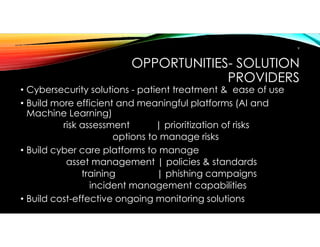
OPPORTUNITIES- SOLUTION
PROVIDERS
• Cybersecurity solutions - patient treatment & ease of use
• Build more efficient and meaningful platforms (AI and
Machine Learning)
risk assessment | prioritization of risks
options to manage risks
• Build cyber care platforms to manage
asset management | policies & standards
training | phishing campaigns
incident management capabilities
• Build cost-effective ongoing monitoring solutions
9
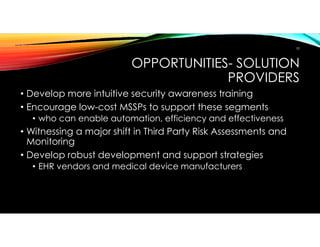
OPPORTUNITIES- SOLUTION
PROVIDERS
• Develop more intuitive security awareness training
• Encourage low-cost MSSPs to support these segments
• who can enable automation, efficiency and effectiveness
• Witnessing a major shift in Third Party Risk Assessments and
Monitoring
• Develop robust development and support strategies
• EHR vendors and medical device manufacturers
10
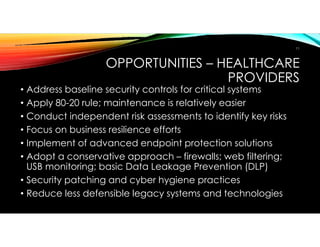
OPPORTUNITIES – HEALTHCARE
PROVIDERS
• Address baseline security controls for critical systems
• Apply 80-20 rule; maintenance is relatively easier
• Conduct independent risk assessments to identify key risks
• Focus on business resilience efforts
• Implement of advanced endpoint protection solutions
• Adopt a conservative approach – firewalls; web filtering;
USB monitoring; basic Data Leakage Prevention (DLP)
• Security patching and cyber hygiene practices
• Reduce less defensible legacy systems and technologies
11
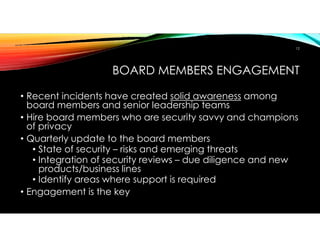
BOARD MEMBERS ENGAGEMENT
• Recent incidents have created solid awareness among
board members and senior leadership teams
• Hire board members who are security savvy and champions
of privacy
• Quarterly update to the board members
• State of security – risks and emerging threats
• Integration of security reviews – due diligence and new
products/business lines
• Identify areas where support is required
• Engagement is the key
12
Highlights – Key recommendations
from the Health and Human
Services National Cybersecurity
Taskforce
13
RECOMMENDATIONS FOR SMALL
AND MEDIUM SIZED PROVIDERS
• Tax incentives, grants to encourage low-cost MSSPs
• Crediting providers who have engaged MSSPs
• Explore opportunities for individuals to engage in ongoing
internship programs
• Evaluate incentive options to encourage health care
providers migrate to more secure environments
14
OTHER KEY RECOMMENDATIONS
• Establish a consistent, consensus based health care specific
Cybersecurity Framework
• Explore potential impacts to the Physician Self-Referral Law,
the Anti-Kickback Statute, and other fraud and abuse laws
to allow large health care organizations to share
cybersecurity resources and information with their partners.
• Improve manufacturing and development transparency
among developers and users.
• Establish a model for adequately resourcing the
cybersecurity workforce with qualified individuals.
15
OTHER KEY RECOMMENDATIONS
• Establish a cybersecurity hygiene posture within the health
care industry to ensure existing and new products/systems
risks are managed in a secure and sustainable fashion.
• Provide patients with information on how to manage their
health care data, including a cybersecurity and privacy
grading system for consumers to make educated decisions
when selecting services or products around non-regulated
health care services and products.
• Improve information sharing of industry threats, risks, and
mitigations.
16
Q & A
RamRamadoss@catholichealth.net
17

Challenges & Opportunities in Managing Cyber Risks

  • 1.
    CHALLENGES & OPPORTUNITIES IN MANAGINGCYBER RISKS MAY 03, 2018 Ram Ramadoss, MBA, CISA, CISM, CISSP, CRISC, CIPP Vice President – CRP Privacy and Information Security and EHR Oversight Corporate Responsibility Program Catholic Health Initiatives Colorado, USA
  • 2.
    AGENDA • CHI Overview •Small and Medium Sized Providers – an easy target • Challenges • Opportunities • Board Members Engagement • Highlights – Key recommendations from the Taskforce • Q&A 2
  • 3.
    CATHOLIC HEALTH INITIATIVESOVERVIEW • An integrated Healthcare provider in the USA • We operate in 17 states through 100 hospitals and 700 plus clinics, including three academic health centers and major teaching hospitals as well as 30 critical-access facilities, community health-service organizations, and nursing colleges. • Operating revenue - $15.5 Billion • 90,000 plus employees • Merger discussion in progress with Dignity Health (a major faith- based healthcare provider in California, Nevada and Arizona) 3
  • 4.
    Small and MediumSized Healthcare Providers – an easy target for cyber threats 4
  • 5.
    CHALLENGES • Ignorance isbliss • Dwindling operating margins - low or no security budget • Lack of IT resources and support • No policies/training and lack of cyber hygiene practices • Lack of awareness and education – employees/physicians • Risk assessment – even large companies struggle in this area • No sense of urgency from this sector • Ransomware attacks |No incident management program • Majority of providers moving towards cloud based Electronic Health Record (EHR) solutions 5
  • 6.
    CHALLENGES • A majorchallenge for large healthcare systems – access to EMRs from third party physician practices • Challenges with EHR vendors – configuration best practices • No leverage when these entities deal with third party companies and partners • No ability and resources to process security alerts from Information Sharing and Analysis Centers (ISACs) • No cost effective Managed Security Service Providers (MSSPs) to support this sector 6
  • 7.
    CHALLENGES • Legacy applicationsand legacy medical devices • Business Resilience (non-existent) – major confusion regarding the ownership even for large providers • Lack of knowledge of organization’s storage of data location for cloud based solutions • Lack of accountability in addressing remediation • No robust logging capabilities • Monitoring of activities is minimal | a significant challenge when faced with security incidents 7
  • 8.
    CHALLENGES • No networksegmentation • No threat and vulnerability management program • A small percentage of organizations with cyber insurance coverage A coordinated attack on multiple small entities could pose a significant risk to national security 8
  • 9.
    OPPORTUNITIES- SOLUTION PROVIDERS • Cybersecuritysolutions - patient treatment & ease of use • Build more efficient and meaningful platforms (AI and Machine Learning) risk assessment | prioritization of risks options to manage risks • Build cyber care platforms to manage asset management | policies & standards training | phishing campaigns incident management capabilities • Build cost-effective ongoing monitoring solutions 9
  • 10.
    OPPORTUNITIES- SOLUTION PROVIDERS • Developmore intuitive security awareness training • Encourage low-cost MSSPs to support these segments • who can enable automation, efficiency and effectiveness • Witnessing a major shift in Third Party Risk Assessments and Monitoring • Develop robust development and support strategies • EHR vendors and medical device manufacturers 10
  • 11.
    OPPORTUNITIES – HEALTHCARE PROVIDERS •Address baseline security controls for critical systems • Apply 80-20 rule; maintenance is relatively easier • Conduct independent risk assessments to identify key risks • Focus on business resilience efforts • Implement of advanced endpoint protection solutions • Adopt a conservative approach – firewalls; web filtering; USB monitoring; basic Data Leakage Prevention (DLP) • Security patching and cyber hygiene practices • Reduce less defensible legacy systems and technologies 11
  • 12.
    BOARD MEMBERS ENGAGEMENT •Recent incidents have created solid awareness among board members and senior leadership teams • Hire board members who are security savvy and champions of privacy • Quarterly update to the board members • State of security – risks and emerging threats • Integration of security reviews – due diligence and new products/business lines • Identify areas where support is required • Engagement is the key 12
  • 13.
    Highlights – Keyrecommendations from the Health and Human Services National Cybersecurity Taskforce 13
  • 14.
    RECOMMENDATIONS FOR SMALL ANDMEDIUM SIZED PROVIDERS • Tax incentives, grants to encourage low-cost MSSPs • Crediting providers who have engaged MSSPs • Explore opportunities for individuals to engage in ongoing internship programs • Evaluate incentive options to encourage health care providers migrate to more secure environments 14
  • 15.
    OTHER KEY RECOMMENDATIONS •Establish a consistent, consensus based health care specific Cybersecurity Framework • Explore potential impacts to the Physician Self-Referral Law, the Anti-Kickback Statute, and other fraud and abuse laws to allow large health care organizations to share cybersecurity resources and information with their partners. • Improve manufacturing and development transparency among developers and users. • Establish a model for adequately resourcing the cybersecurity workforce with qualified individuals. 15
  • 16.
    OTHER KEY RECOMMENDATIONS •Establish a cybersecurity hygiene posture within the health care industry to ensure existing and new products/systems risks are managed in a secure and sustainable fashion. • Provide patients with information on how to manage their health care data, including a cybersecurity and privacy grading system for consumers to make educated decisions when selecting services or products around non-regulated health care services and products. • Improve information sharing of industry threats, risks, and mitigations. 16
  • 17.