Improving Patient Safety:
Machine Learning Targets an Urgent Concern
© 2016 Health Catalyst
Proprietary. Feel free to share but we would appreciate a Health Catalyst citation.
Improving Patient Safety
Patient harm is a persistent and urgent
healthcare concern that directly impacts the
patient experience and overall outcomes.
According to recent estimates, one in three
hospitalized patients experiences
preventable harm, and over 400,000
individuals per year die from these injuries.
As the third-leading cause of death,
preventable harm costs health systems
more than $1 billion annually.
© 2016 Health Catalyst
Proprietary. Feel free to share but we would appreciate a Health Catalyst citation.
Improving Patient Safety
As health systems seek ways to improve
patient safety, many organizations are
looking to patient harm risk assessment
tools that leverage machine learning.
This article describes how machine
learning powers better risk prediction
tools, with the eventual goal of helping
clinicians identify safety concerns before
the patient harm occurs.
© 2016 Health Catalyst
Proprietary. Feel free to share but we would appreciate a Health Catalyst citation.
Better Risk Prediction Tools Consider
Whole-Patient Risk
Previous risk prediction models were
limited because they were developed using
populations different from the populations
for which the tools were being used.
Another downside to these out-of-the-box
models (such LACE, which predicts
readmissions) is that they were often
trained on data that was 15 to 20 years old.
These generalized tools were also siloed in
stand-alone prediction systems.
© 2016 Health Catalyst
Proprietary. Feel free to share but we would appreciate a Health Catalyst citation.
Better Risk Prediction Tools Consider
Whole-Patient Risk
Patients tend to be at risk for a variety of
negative outcomes, so with a siloed risk
assessment approach, clinicians miss
opportunities to manage or prevent harm.
The patient safety community has devised
a whole patient measure of safety to
address siloing in measuring patient harm.
The same concept needs to be applied to
risk prevention.
© 2016 Health Catalyst
Proprietary. Feel free to share but we would appreciate a Health Catalyst citation.
Better Risk Prediction Tools Consider
Whole-Patient Risk
A better, machine learning-powered
patient safety tool uses health
system data to assess whole-patient
risk, giving clinicians a compre-
hensive view of patients who are at
risk for a safety event, including
identifying the particular event(s), as
well as modifiable risk factors.
© 2016 Health Catalyst
Proprietary. Feel free to share but we would appreciate a Health Catalyst citation.
Machine Learning Enables Timely Risk Identification
This new generation of machine learning-based
patient safety tools will close the loop between
information and action, as the software not only
forecasts the likelihood of harm, but also the
most important clinical actions to lower that
patient’s risk, helping the clinician make an
informed intervention decision.
Clinicians will be able to predict harm before it
occurs, know who in their patient population is
at risk, understand which of the patient’s
modifiable risk factors need to change, and be
able to make timely interventions.
© 2016 Health Catalyst
Proprietary. Feel free to share but we would appreciate a Health Catalyst citation.
Improving Patient Safety with Five Must-Have
Machine Learning Capabilities
To successfully reduce rates of patient harm,
today’s patient safety risk assessment tools
must have five core capabilities:
1. Identifies risk
2. Stratifies patients at risk
3. Shows modifiable risk factors
4. Shows impactability
5. Makes risk prediction accessible
© 2016 Health Catalyst
Proprietary. Feel free to share but we would appreciate a Health Catalyst citation.
Improving Patient Safety with Five Must-Have
Machine Learning Capabilities
1: Identifies Risk
• Provides concurrent daily surveillance for
all-cause harm events using literature-based
triggers to show how many patients in a
health system population are at risk for
safety events (e.g., CLABSI).
© 2016 Health Catalyst
Proprietary. Feel free to share but we would appreciate a Health Catalyst citation.
Improving Patient Safety with Five Must-Have
Machine Learning Capabilities
2: Stratifies patients at risk
• Places at-risk patients into risk categories
(e.g., high, medium, and low risk).
© 2016 Health Catalyst
Proprietary. Feel free to share but we would appreciate a Health Catalyst citation.
Improving Patient Safety with Five Must-Have
Machine Learning Capabilities
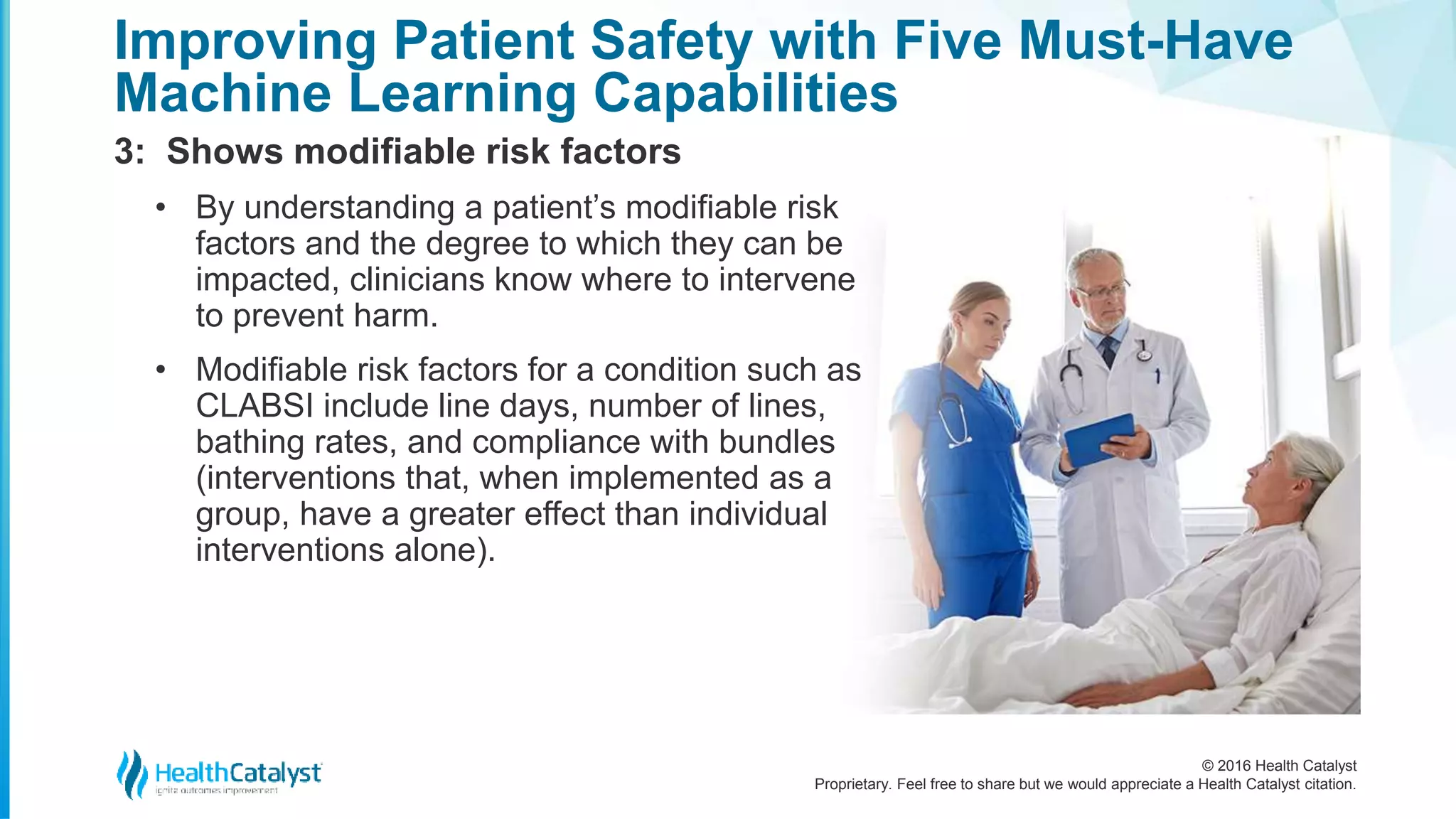
3: Shows modifiable risk factors
• By understanding a patient’s modifiable risk
factors and the degree to which they can be
impacted, clinicians know where to intervene
to prevent harm.
• Modifiable risk factors for a condition such as
CLABSI include line days, number of lines,
bathing rates, and compliance with bundles
(interventions that, when implemented as a
group, have a greater effect than individual
interventions alone).
© 2016 Health Catalyst
Proprietary. Feel free to share but we would appreciate a Health Catalyst citation.
Improving Patient Safety with Five Must-Have
Machine Learning Capabilities
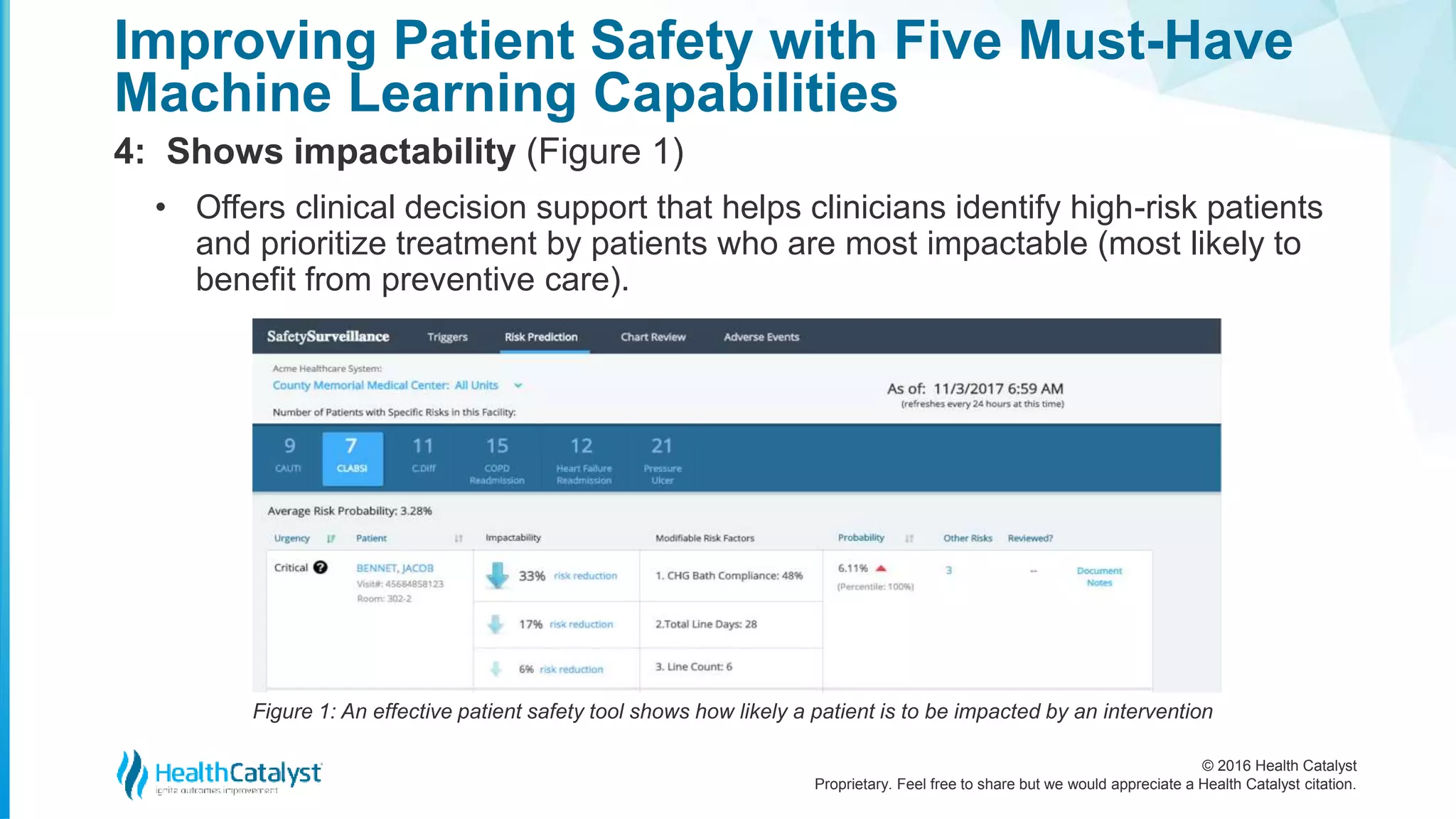
4: Shows impactability (Figure 1)
• Offers clinical decision support that helps clinicians identify high-risk patients
and prioritize treatment by patients who are most impactable (most likely to
benefit from preventive care).
Figure 1: An effective patient safety tool shows how likely a patient is to be impacted by an intervention
© 2016 Health Catalyst
Proprietary. Feel free to share but we would appreciate a Health Catalyst citation.
Improving Patient Safety with Five Must-Have
Machine Learning Capabilities
5: Makes risk prediction accessible
• Integrates risk prediction into workflow
tools for immediate access.
© 2016 Health Catalyst
Proprietary. Feel free to share but we would appreciate a Health Catalyst citation.
Improving Patient Safety with Five Must-Have
Machine Learning Capabilities
Machine learning capabilities help
organizations get upstream of the risk before
a patient is harmed or at risk of harm.
Eventually, predictive patient safety tools will
advance the way organizations mitigate
patient harm by recommending interventions
for modifiable risk factors and documenting
those interventions.
The next goal is to integrate with cost
management tools to attribute cost and
recommend data-driven, cost effective
interventions.
© 2016 Health Catalyst
Proprietary. Feel free to share but we would appreciate a Health Catalyst citation.
Machine Learning for Patient Safety:
A Much-Needed Solution
With the current, unacceptably high rates of
preventable patient harm occurring in health
systems, improving patient safety is a critical
healthcare mission.
Machine learning will drive the solution by
enabling safety surveillance tools that use health
system data to identify patients at risk, identify
patients’ modifiable risk factors and impactability,
and, eventually, recommend the most cost-
effective interventions.
Healthcare’s best chance of improving patient
safety and outcomes lies in predicting harm and
taking action to prevent it.
© 2016 Health Catalyst
Proprietary. Feel free to share but we would appreciate a Health Catalyst citation.
Machine Learning for Patient Safety:
A Much-Needed Solution
As Don Berwick, MD, MPP, president
emeritus and senior fellow at the IHI,
explained in his keynote address at the
2017 National Patient Safety Foundation
Patient Safety Congress, healthcare has a
lot of work to do to improve patient safety.
“There’s an illusion that we’ve worked on
safety,” Berwick said, and added that
healthcare hasn’t developed real insight
into patient harm and ways to prevent it.
With a comprehensive, concurrent data-
driven approach to patient harm, machine
learning promises to transform patient
safety from illusion to reality.
© 2016 Health Catalyst
Proprietary. Feel free to share but we would appreciate a Health Catalyst citation.
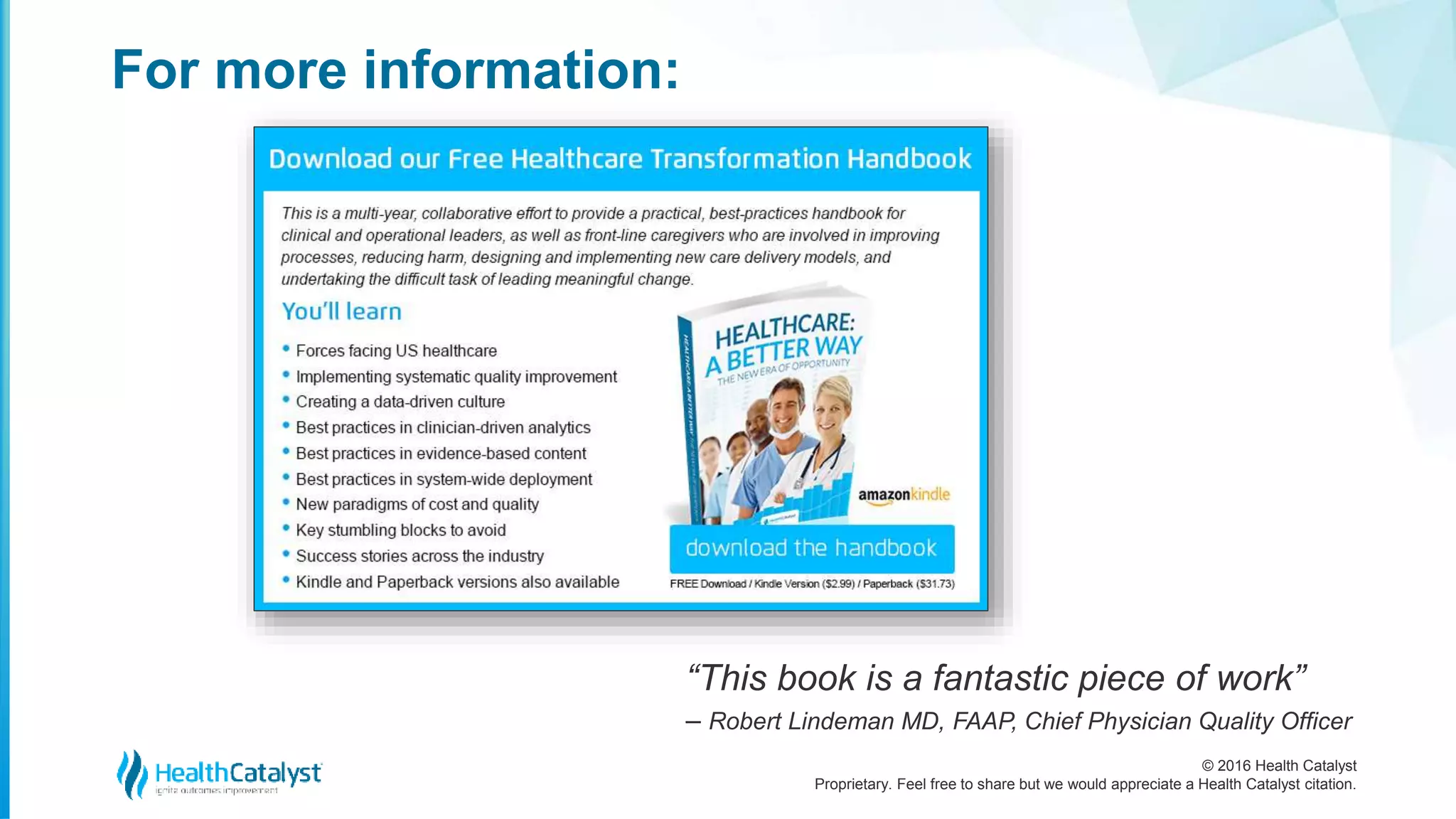
For more information:
“This book is a fantastic piece of work”
– Robert Lindeman MD, FAAP, Chief Physician Quality Officer
© 2016 Health Catalyst
Proprietary. Feel free to share but we would appreciate a Health Catalyst citation.
More about this topic
Link to original article for a more in-depth discussion.
Improving Patient Safety: Machine Learning Targets an Urgent Concern
How to Use Data to Improve Patient Safety
Stan Pestotnik, MS, RPh,VP, Patient Safety Products; Valere Lemon, MBA, RN, Sr. Subject Matter Expert
Patient Flight Path Analytics: From Airline Operations to Healthcare Outcomes
Dale Sanders, President of Technology; David Crockett; Justin Gressel
The Top Seven Analytics-Driven Approaches for Reducing Diagnostic Error and Improving
Patient Safety – Kirstin Scott; Tracy Vayo
Prescriptive Analytics Beats Simple Prediction for Improving Healthcare
David Crockett
Lowering Sepsis Mortality and Length of Stay: One Hospital System’s Story
Health Catalyst Success Story
© 2016 Health Catalyst
Proprietary. Feel free to share but we would appreciate a Health Catalyst citation.
Prior to Health Catalyst Stan has held several executive, clinical and research roles. Most
recently he was the Chief Strategy Officer for Pascal Metrics a federally-certified Patient
Safety Organization. Prior to that Stan was the founding CEO of TheraDoc, which he led for
10+years until its acquisition. For 2+ decades Stan was a clinician, researcher and
educator at the University of Utah School of Medicine, College of Pharmacy and at IHC-
LDS Hospital. Stan is clinically trained as a pharmacist specializing in infectious diseases as well and
has an advanced degree in medical informatics specializing in clinical surveillance and expert system
decision support technologies.
Other Clinical Quality Improvement Resources
Click to read additional information at www.healthcatalyst.com
Stan Pestotnik, MS, RPh

Improving Patient Safety: Machine Learning Targets an Urgent Concern

  • 1.
    Improving Patient Safety: MachineLearning Targets an Urgent Concern
  • 2.
    © 2016 HealthCatalyst Proprietary. Feel free to share but we would appreciate a Health Catalyst citation. Improving Patient Safety Patient harm is a persistent and urgent healthcare concern that directly impacts the patient experience and overall outcomes. According to recent estimates, one in three hospitalized patients experiences preventable harm, and over 400,000 individuals per year die from these injuries. As the third-leading cause of death, preventable harm costs health systems more than $1 billion annually.
  • 3.
    © 2016 HealthCatalyst Proprietary. Feel free to share but we would appreciate a Health Catalyst citation. Improving Patient Safety As health systems seek ways to improve patient safety, many organizations are looking to patient harm risk assessment tools that leverage machine learning. This article describes how machine learning powers better risk prediction tools, with the eventual goal of helping clinicians identify safety concerns before the patient harm occurs.
  • 4.
    © 2016 HealthCatalyst Proprietary. Feel free to share but we would appreciate a Health Catalyst citation. Better Risk Prediction Tools Consider Whole-Patient Risk Previous risk prediction models were limited because they were developed using populations different from the populations for which the tools were being used. Another downside to these out-of-the-box models (such LACE, which predicts readmissions) is that they were often trained on data that was 15 to 20 years old. These generalized tools were also siloed in stand-alone prediction systems.
  • 5.
    © 2016 HealthCatalyst Proprietary. Feel free to share but we would appreciate a Health Catalyst citation. Better Risk Prediction Tools Consider Whole-Patient Risk Patients tend to be at risk for a variety of negative outcomes, so with a siloed risk assessment approach, clinicians miss opportunities to manage or prevent harm. The patient safety community has devised a whole patient measure of safety to address siloing in measuring patient harm. The same concept needs to be applied to risk prevention.
  • 6.
    © 2016 HealthCatalyst Proprietary. Feel free to share but we would appreciate a Health Catalyst citation. Better Risk Prediction Tools Consider Whole-Patient Risk A better, machine learning-powered patient safety tool uses health system data to assess whole-patient risk, giving clinicians a compre- hensive view of patients who are at risk for a safety event, including identifying the particular event(s), as well as modifiable risk factors.
  • 7.
    © 2016 HealthCatalyst Proprietary. Feel free to share but we would appreciate a Health Catalyst citation. Machine Learning Enables Timely Risk Identification This new generation of machine learning-based patient safety tools will close the loop between information and action, as the software not only forecasts the likelihood of harm, but also the most important clinical actions to lower that patient’s risk, helping the clinician make an informed intervention decision. Clinicians will be able to predict harm before it occurs, know who in their patient population is at risk, understand which of the patient’s modifiable risk factors need to change, and be able to make timely interventions.
  • 8.
    © 2016 HealthCatalyst Proprietary. Feel free to share but we would appreciate a Health Catalyst citation. Improving Patient Safety with Five Must-Have Machine Learning Capabilities To successfully reduce rates of patient harm, today’s patient safety risk assessment tools must have five core capabilities: 1. Identifies risk 2. Stratifies patients at risk 3. Shows modifiable risk factors 4. Shows impactability 5. Makes risk prediction accessible
  • 9.
    © 2016 HealthCatalyst Proprietary. Feel free to share but we would appreciate a Health Catalyst citation. Improving Patient Safety with Five Must-Have Machine Learning Capabilities 1: Identifies Risk • Provides concurrent daily surveillance for all-cause harm events using literature-based triggers to show how many patients in a health system population are at risk for safety events (e.g., CLABSI).
  • 10.
    © 2016 HealthCatalyst Proprietary. Feel free to share but we would appreciate a Health Catalyst citation. Improving Patient Safety with Five Must-Have Machine Learning Capabilities 2: Stratifies patients at risk • Places at-risk patients into risk categories (e.g., high, medium, and low risk).
  • 11.
    © 2016 HealthCatalyst Proprietary. Feel free to share but we would appreciate a Health Catalyst citation. Improving Patient Safety with Five Must-Have Machine Learning Capabilities 3: Shows modifiable risk factors • By understanding a patient’s modifiable risk factors and the degree to which they can be impacted, clinicians know where to intervene to prevent harm. • Modifiable risk factors for a condition such as CLABSI include line days, number of lines, bathing rates, and compliance with bundles (interventions that, when implemented as a group, have a greater effect than individual interventions alone).
  • 12.
    © 2016 HealthCatalyst Proprietary. Feel free to share but we would appreciate a Health Catalyst citation. Improving Patient Safety with Five Must-Have Machine Learning Capabilities 4: Shows impactability (Figure 1) • Offers clinical decision support that helps clinicians identify high-risk patients and prioritize treatment by patients who are most impactable (most likely to benefit from preventive care). Figure 1: An effective patient safety tool shows how likely a patient is to be impacted by an intervention
  • 13.
    © 2016 HealthCatalyst Proprietary. Feel free to share but we would appreciate a Health Catalyst citation. Improving Patient Safety with Five Must-Have Machine Learning Capabilities 5: Makes risk prediction accessible • Integrates risk prediction into workflow tools for immediate access.
  • 14.
    © 2016 HealthCatalyst Proprietary. Feel free to share but we would appreciate a Health Catalyst citation. Improving Patient Safety with Five Must-Have Machine Learning Capabilities Machine learning capabilities help organizations get upstream of the risk before a patient is harmed or at risk of harm. Eventually, predictive patient safety tools will advance the way organizations mitigate patient harm by recommending interventions for modifiable risk factors and documenting those interventions. The next goal is to integrate with cost management tools to attribute cost and recommend data-driven, cost effective interventions.
  • 15.
    © 2016 HealthCatalyst Proprietary. Feel free to share but we would appreciate a Health Catalyst citation. Machine Learning for Patient Safety: A Much-Needed Solution With the current, unacceptably high rates of preventable patient harm occurring in health systems, improving patient safety is a critical healthcare mission. Machine learning will drive the solution by enabling safety surveillance tools that use health system data to identify patients at risk, identify patients’ modifiable risk factors and impactability, and, eventually, recommend the most cost- effective interventions. Healthcare’s best chance of improving patient safety and outcomes lies in predicting harm and taking action to prevent it.
  • 16.
    © 2016 HealthCatalyst Proprietary. Feel free to share but we would appreciate a Health Catalyst citation. Machine Learning for Patient Safety: A Much-Needed Solution As Don Berwick, MD, MPP, president emeritus and senior fellow at the IHI, explained in his keynote address at the 2017 National Patient Safety Foundation Patient Safety Congress, healthcare has a lot of work to do to improve patient safety. “There’s an illusion that we’ve worked on safety,” Berwick said, and added that healthcare hasn’t developed real insight into patient harm and ways to prevent it. With a comprehensive, concurrent data- driven approach to patient harm, machine learning promises to transform patient safety from illusion to reality.
  • 17.
    © 2016 HealthCatalyst Proprietary. Feel free to share but we would appreciate a Health Catalyst citation. For more information: “This book is a fantastic piece of work” – Robert Lindeman MD, FAAP, Chief Physician Quality Officer
  • 18.
    © 2016 HealthCatalyst Proprietary. Feel free to share but we would appreciate a Health Catalyst citation. More about this topic Link to original article for a more in-depth discussion. Improving Patient Safety: Machine Learning Targets an Urgent Concern How to Use Data to Improve Patient Safety Stan Pestotnik, MS, RPh,VP, Patient Safety Products; Valere Lemon, MBA, RN, Sr. Subject Matter Expert Patient Flight Path Analytics: From Airline Operations to Healthcare Outcomes Dale Sanders, President of Technology; David Crockett; Justin Gressel The Top Seven Analytics-Driven Approaches for Reducing Diagnostic Error and Improving Patient Safety – Kirstin Scott; Tracy Vayo Prescriptive Analytics Beats Simple Prediction for Improving Healthcare David Crockett Lowering Sepsis Mortality and Length of Stay: One Hospital System’s Story Health Catalyst Success Story
  • 19.
    © 2016 HealthCatalyst Proprietary. Feel free to share but we would appreciate a Health Catalyst citation. Prior to Health Catalyst Stan has held several executive, clinical and research roles. Most recently he was the Chief Strategy Officer for Pascal Metrics a federally-certified Patient Safety Organization. Prior to that Stan was the founding CEO of TheraDoc, which he led for 10+years until its acquisition. For 2+ decades Stan was a clinician, researcher and educator at the University of Utah School of Medicine, College of Pharmacy and at IHC- LDS Hospital. Stan is clinically trained as a pharmacist specializing in infectious diseases as well and has an advanced degree in medical informatics specializing in clinical surveillance and expert system decision support technologies. Other Clinical Quality Improvement Resources Click to read additional information at www.healthcatalyst.com Stan Pestotnik, MS, RPh