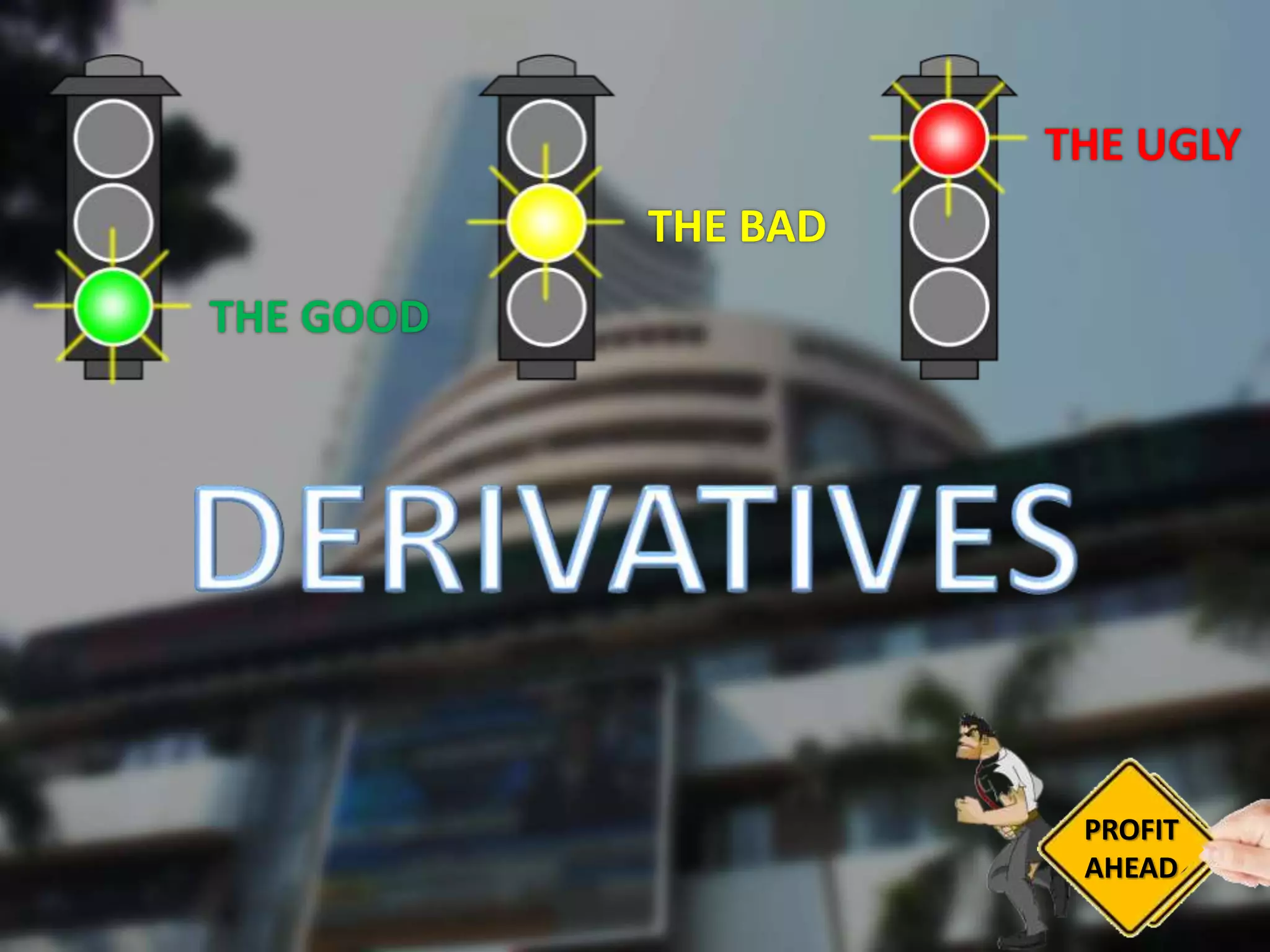
THE GOOD
THE BAD
THE UGLY
PROFIT
AHEAD
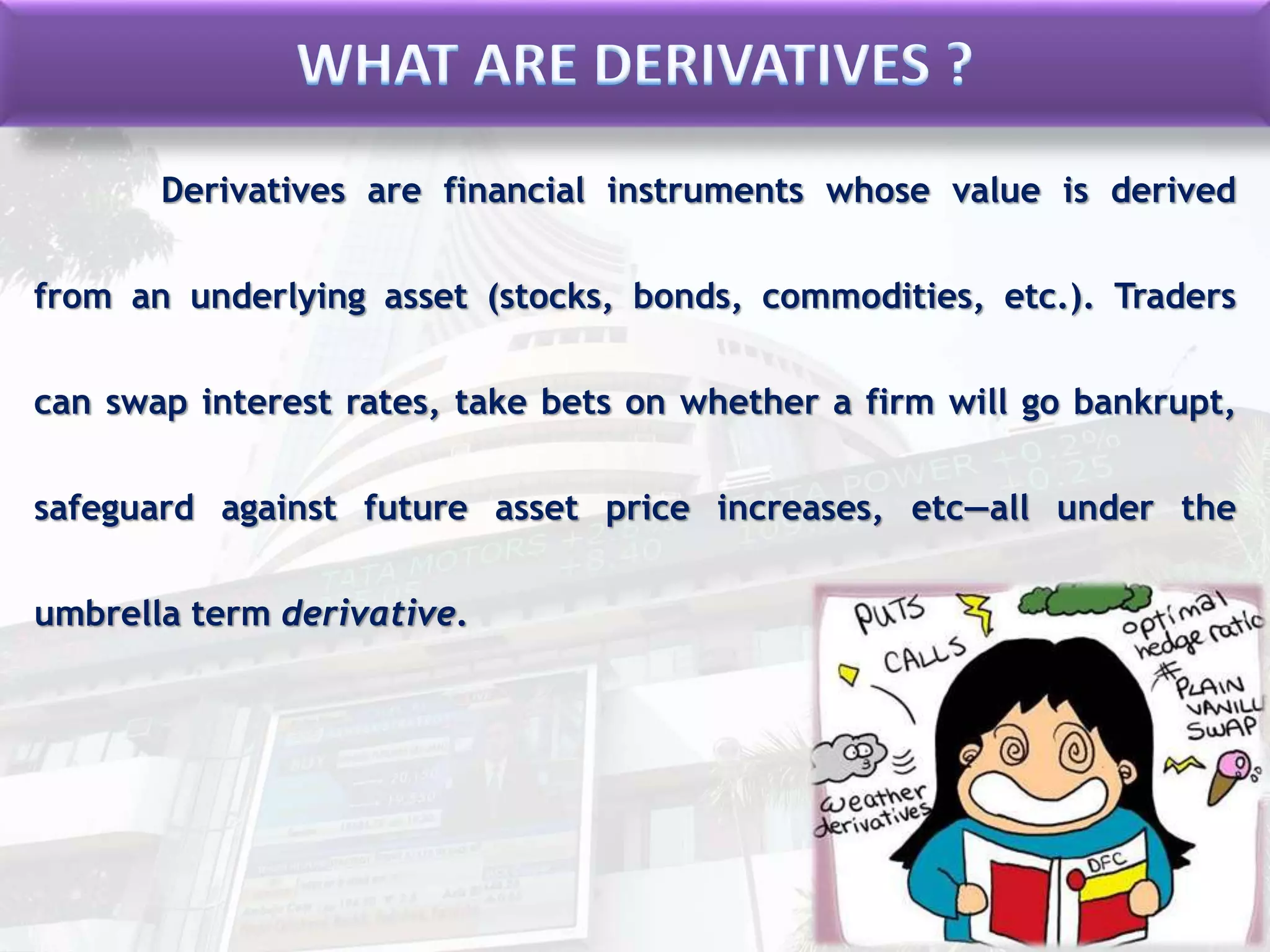
Derivatives are financial instruments whose value is derived
from an underlying asset (stocks, bonds, commodities, etc.). Traders
can swap interest rates, take bets on whether a firm will go bankrupt,
safeguard against future asset price increases, etc—all under the
umbrella term derivative.
 It’s not the concept of derivatives themselves that is the problem – it’s the
sloppy way they’ve been used.
 Derivatives are generally used to transform one kind of risk into another, so
for example a farmer might sell a futures contract obligating him to deliver
a certain amount of wheat of a certain quality in future time.
 Derivatives can be used to swap interest rate risk for equity (stock market)
risk, or to reduce or increase exposure to the price of a share or index rising
or falling.
Example-
 LTCM hedge fund generated 43% and 41% returns in first two years of it’s
operation.
 Derivative are traded over the counter, as an individual contract between t
wo parties. This means that there is no central pricing authority that sets a
valuation for these things.
 In OTC derivatives, counterparties rely on individual agreements about
margining, and firm make their own assessments about the creditworthiness
of their trading partners. In practice this means that large derivatives
positions can be built up without putting up large amounts of money (lever
age, anyone?), and counterparty risk can be very significant over time.
 Example- Allied Irish Bank incurred $691 million losses due to inefficient
management and its currency arbitrage trading strategy.
 Can be very hard to value, because they may be based on underlying
securities that are themselves hard to price, or hardly ever trade.
 Banks and brokerages may not have a full understanding of the market
risk in their derivative positions, let alone the counterparty risk.
Example-
 Mortgage-backed securities, another type of derivative, were blamed for
creating the housing bubble and subsequent recession.
 Barings Bank, one of the world’s oldest merchant banks went bankrupt by
incurring losses approximately $1.25 billion.
And THAT’s why
derivatives might one day come to
your door in the middle of the night
and suck your soul out through your
eyeballs. Don’t say I didn’t warn
you.
The Good The Bad and The Ugly about Derivatives

The Good The Bad and The Ugly about Derivatives

  • 1.
    THE GOOD THE BAD THEUGLY PROFIT AHEAD
  • 5.
    Derivatives are financialinstruments whose value is derived from an underlying asset (stocks, bonds, commodities, etc.). Traders can swap interest rates, take bets on whether a firm will go bankrupt, safeguard against future asset price increases, etc—all under the umbrella term derivative.
  • 6.
     It’s notthe concept of derivatives themselves that is the problem – it’s the sloppy way they’ve been used.  Derivatives are generally used to transform one kind of risk into another, so for example a farmer might sell a futures contract obligating him to deliver a certain amount of wheat of a certain quality in future time.  Derivatives can be used to swap interest rate risk for equity (stock market) risk, or to reduce or increase exposure to the price of a share or index rising or falling. Example-  LTCM hedge fund generated 43% and 41% returns in first two years of it’s operation.
  • 7.
     Derivative aretraded over the counter, as an individual contract between t wo parties. This means that there is no central pricing authority that sets a valuation for these things.  In OTC derivatives, counterparties rely on individual agreements about margining, and firm make their own assessments about the creditworthiness of their trading partners. In practice this means that large derivatives positions can be built up without putting up large amounts of money (lever age, anyone?), and counterparty risk can be very significant over time.  Example- Allied Irish Bank incurred $691 million losses due to inefficient management and its currency arbitrage trading strategy.
  • 8.
     Can bevery hard to value, because they may be based on underlying securities that are themselves hard to price, or hardly ever trade.  Banks and brokerages may not have a full understanding of the market risk in their derivative positions, let alone the counterparty risk. Example-  Mortgage-backed securities, another type of derivative, were blamed for creating the housing bubble and subsequent recession.  Barings Bank, one of the world’s oldest merchant banks went bankrupt by incurring losses approximately $1.25 billion.
  • 9.
    And THAT’s why derivativesmight one day come to your door in the middle of the night and suck your soul out through your eyeballs. Don’t say I didn’t warn you.